REVIEW 4 major objections 5 minor 25 references
This paper claims that the bending of a single flow-matching denoising trajectory, measured as denoising acceleration (accel), is a faithful, cost-free proxy for the model's uncertainty, and that this signal can be used for online failure d
Reviewed by Pith at T0; open to challenge. T0 means a machine referee read the full paper against a public rubric. the ladder, T0–T4 →
A single-pass measure of how much a flow-matching action trajectory bends correlates with the model's uncertainty and can flag impending robot failures for free.
T0 review reviewed 2026-08-05 challenge →
load-bearing objection A genuinely useful single-trajectory uncertainty proxy for FM policies, with an honest local proof and solid empirical coverage, but the universal faithfulness claim outruns the evidence. the 4 major comments →
The Geometric Nature and a Free Proxy for Flow-Matching Uncertainty
The pith
A machine-rendered reading of the paper's core claim, the machinery that carries it, and where it could break.
The reading
Core claim
The paper's central claim is that uncertainty in a flow-matching policy is visible as a bend in the denoising path, and this bend can be measured for free. Formally: if the target posterior is a point mass, the FM field is an affine-isotropic contraction toward the target with Jacobian −I/(1−s), and every denoising trajectory is a straight line at constant velocity; any local deviation of the field Jacobian from that template implies nonzero target covariance, and the mean-square deviation lower-bounds the covariance. Along a single trajectory, the velocity change equals the motion of the posterior mean being chased, which the second-order Tweedie identity ties to the conditional endpoint co
What carries the argument
Denoising acceleration (accel): for a denoising path produced by Euler steps of the FM ODE, accel is the normalized total variation of velocity over a prefix, accel_p = p Σ∥v_t−v_{t−1}∥ / Σ∥v_t∥. The load-bearing identity is v′(s)=m′_path(s)/(1−s): motion toward a fixed target contributes no acceleration, so the path bends if and only if the posterior mean the denoiser is chasing moves; via the second-order Tweedie identity, that motion is proportional to Cov(x1|x_s=x), connecting a single trajectory's curvature to the posterior covariance.
Load-bearing premise
The learned network must approximate the true conditional-expectation field closely enough that measured bending is dominated by posterior covariance, not by approximation or discretization error; the paper's own results show accel degrades on an undertrained model.
What would settle it
Run a flow-matching model whose target posterior is an exactly known Gaussian with covariance σ²Σ0 and measure expected accel over many noise draws as σ²→0; if the growth is not linear in σ², or if accel stays nonzero at σ=0, the faithfulness theorem fails.
If this is right
- accel gives an architecture-agnostic, zero-cost uncertainty read for any flow-matching action head: no extra training, ensembling, resampling, or Jacobian estimation.
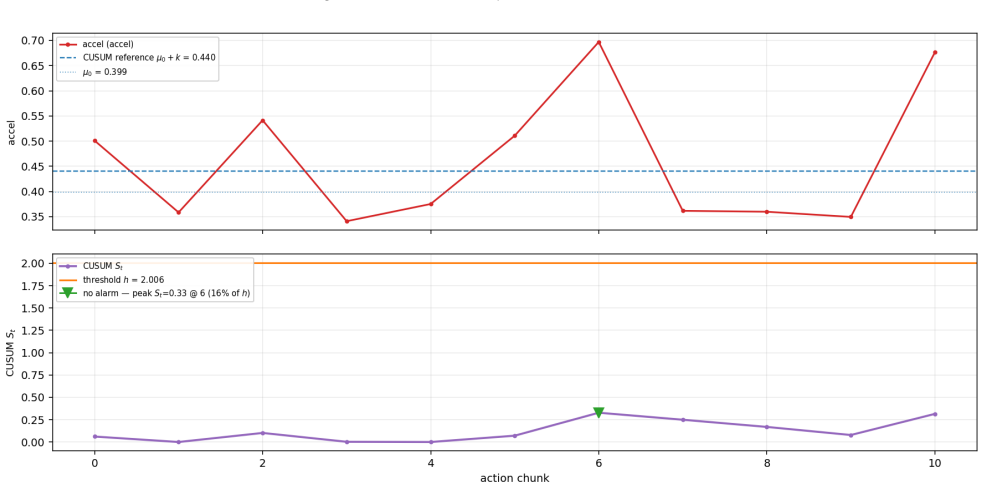
- Used as an online failure score with a time-invariant CUSUM threshold, it raises alarms 17–34 action chunks before failure timeout, with true-positive rates 0.40–0.87 at a 0.1 false-alarm rate across eight model/benchmark cells.
- The best correlation with resampled endpoint divergence comes from a middle prefix of the denoising path, not the full path, because the field has a terminal singularity near the clean endpoint.
- accel distinguishes aleatoric uncertainty (multimodal action distributions near contact events) from epistemic uncertainty (out-of-distribution inputs producing chaotic fields), matching the geometric theory.
- Because the score is free, it can be mounted on every replanning step, enabling dense, real-time monitoring rather than sparse offline checks.
Where Pith is reading between the lines
- The paper leaves implicit that accel is blind to failures caused by confident misinterpretation of the instruction, since that is a VLM reasoning error rather than FM-head uncertainty; a practical monitor would pair accel with a separate semantic-confidence signal.
- The prefix-peak pattern—earlier peaks on harder benchmarks—suggests an adaptive or task-aware prefix could improve on a fixed prefix; the paper only reports this as a hypothesis.
- The geometric argument should transfer to any conditional flow-matching generative model beyond robotics (video, audio, molecular generation), because the theorem relies only on the CFM field structure, not on the action domain.
- accel's detection of 'non-lethal failures'—temporary stalls and self-corrections that the simulator's success label ignores—could serve as a dense reward signal or data-cleaning filter for imitation learning.
Editorial analysis
A structured set of objections, weighed in public.
Referee Report
Summary. The paper proposes a geometric interpretation of uncertainty in flow-matching (FM) policies: an ideal certain FM field is an affine-isotropic contraction, and deviations from this template encode posterior covariance (Theorems 1–2, Eq. 7). It introduces "denoising acceleration" (accel), the normalized total variation of velocity along a single denoising trajectory, as a cost-free proxy for that covariance, with a local monotonicity guarantee (Eq. 14, Prop. A.4). The proxy is then evaluated as an online failure detector for four FM-based vision-language-action models on LIBERO and RoboCasa, compared against resampling- and training-based baselines. The paper is honest about limitations: the guarantee is local and assumes an exact CFM field; the terminal singularity is avoided only by prefix truncation; and geometry-based methods degrade for undertrained models and on harder benchmarks.
Significance. If the claims hold, accel is a nearly free uncertainty signal and failure alarm for FM-based embodied policies, requiring no training or resampling. The geometric derivation from Tweedie's identity (Eqs. 6–7) is elegant and connects to recent work on denoiser covariance estimation. The empirical evaluation is broad (four models, three benchmarks, 12 correlation cells and eight detection cells), and the authors provide code. However, the theoretical guarantee is local and conditional on an exact field, and the empirical support is weakened by post hoc prefix selection in the correlation table and by strong degradation in exactly the cells where the learned field is less reliable. The contribution is a valuable practical heuristic with a partial theoretical explanation, not a universally faithful guarantee.
major comments (4)
- [Table 1 / §3.3] Table 1 reports ρ_best, defined as the highest Spearman correlation over prefix lengths p*, selected post hoc for each model×benchmark cell. This selection bias inflates the empirical faithfulness claim: with T up to 10 and 12 cells, one expects a nontrivial upward bias in the reported maximum correlation. Please report the correlation for a fixed rule (e.g., full path or the accel_{-2} prefix used in §4.2), and either show a validation split for choosing p* or correct for multiple comparisons. As it stands, the statement in §3.3 that "accel rank-tracks the resample divergence" is not supported at the reported magnitudes.
- [Eq. (14) / Appendix C.3] The local monotonicity result is stated for the full path τ=1, but the proof only controls ∥v'(s)∥ for s bounded away from 1. In the small-spread expansion, m'_path = O(σ²), so ∥v'∥ = O(σ²)/(1-s); the integral in Eq. (10) therefore grows logarithmically as τ→1, and the O(σ^4) remainder is not uniform. Appendix B concedes that the terminal singularity is "avoided, not addressed." This means Eq. (14) is not established for the actual full-path accel used in the abstract; it holds only for prefixes with τ<1. Please state the theorem with the prefix restriction, and justify the specific prefix choice in §4.2 (accel_{-2}) either theoretically or by a held-out selection procedure.
- [Abstract / Table 2 / §4.3] The headline "matching or even outperforming costly resampling- and training-based baselines" is not supported by the aggregate results. In Table 2, accel's average TPR (0.66) is below SAFE's (0.68), and in two of eight cells accel is substantially worse (π0.5×RoboCasa 0.49 vs 0.83; GR00T-N1.7×LIBERO 0.53 vs 0.70). The Limitations section correctly identifies these failure modes, but the abstract and conclusion should be tempered, or a matched-pair significance analysis (e.g., over seeds) should be provided to justify "matching" despite the per-cell variance.
- [§3.2 / §4.3] The theoretical faithfulness result assumes an exact CFM field. The paper does not quantify how approximation error in learned fields contaminates accel, and its own results show degradation for the undertrained GR00T-N1.7 and on RoboCasa. Please add an analysis separating the field-error component from the posterior-covariance component—for example, on the toy model of §2.4, compute accel using the true analytic field and the learned field, or measure the Jacobian error ∥J_θ - J_true∥ along sampled trajectories. At minimum, the claimed empirical domain should be restricted to models whose field is sufficiently accurate, with a practical diagnostic for that accuracy.
minor comments (5)
- [§3.3] The number of resamples K used for the divergence reference is not specified here; it is only defined as K=32 in §4.3. Please state K in §3.3 or point forward to the later definition.
- [Algorithm 1 / §4.2] With default p=n, the returned accel_p is the full-path value, but §4.2 uses "the second-to-last prefix accel_{-2}". Clarify how accel_{-2} maps to the prefix length p in Eq. (11) (e.g., p=T-2).
- [Appendix E, Table 3] Episode counts are shown with one decimal place (e.g., 1936.0, 506.6). State explicitly that these are averages over the five evaluation seeds.
- [Editorial] Typos: §4.2 "additioanlly", Conclusions "an denoising path", Figure 4 caption "time serties". Also, the reference list contains 2026-dated entries; please check final publication status and remove duplicated author lists (e.g., Nasiriany et al. 2024/2026).
- [§2.4 / Figure 2] For the π0.5 field, clarify that the streamlines are projected onto the first two principal components; the geometric template in Eq. (4) refers to the original action space, so the visual departure is qualitative.
Circularity Check
No significant circularity: accel is derived from an exact CFM identity, not fitted, and the paper's stated limitations are explicit assumptions rather than hidden self-referential inputs.
full rationale
The central derivation chain is self-contained. accel (Eq. 10/11) is defined as normalized total variation of denoising velocity; using the CFM conditional-expectation form v = (E[x1|xs] - x)/(1 - s) and the Tweedie identity, the paper derives the exact trajectory identity (Eq. 18/21) v'(s) = ... Cov(x1|xs) v(s), then obtains the leading-order local monotonicity E[accel] = κσ² + O(σ⁴) (Proposition A.4). No parameter is fitted to the validation target: κ is not estimated from data, and the empirical validation compares accel to an independent MC-resampling estimator of posterior spread, which is a separate measurement of the same underlying quantity rather than a renamed input. Failure detection uses a standard CUSUM threshold calibrated on held-out successful rollouts and is evaluated on failure labels, so there is no fitted-input-called-prediction structure. There are no load-bearing self-citations and no imported uniqueness theorems: the cited related work (FreeHunch, Xing et al.) is contextual, not used to justify accel. The paper is explicit about the scope of its guarantee: Appendix C.3 states the result 'holds in expectation, under an exact CFM field and a small-spread family with a fixed covariance shape' and concedes it 'does not establish pointwise or global monotonicity'; Appendix B concedes the terminal singularity is 'not addressed but only avoided'; Section 4.3 reports degradation for undertrained GR00T-N1.7 and on RoboCasa. These are honest limitations and correctness risks (unverified approximation/discretization error bounds, in-sample selection of the best prefix p* in Table 1), not circularity: none of these passages makes the claimed prediction equal to its input by construction. The derivation is therefore not circular.
Axiom & Free-Parameter Ledger
free parameters (4)
- prefix length p =
T-2 in failure detection; p*/T values in Table 1 vary per cell (e.g., 9/10, 5/10, 3/10)
- CUSUM slack coefficient c =
0.25
- Conformal level alpha =
0.1
- Calibration set size M =
50
axioms (5)
- domain assumption Network v_theta approximates exact conditional-expectation field E[x1 | x_s = x]
- domain assumption Small-spread posterior family with fixed covariance shape, Sigma = sigma^2 Sigma0
- standard math Gaussian channel with linear interpolant x_s = s x1 + (1-s) x0, x0 ~ N(0,I)
- standard math Point-mass bridge: if Sigma=0, posterior mean m(x,s)=a* for all (x,s)
- domain assumption CUSUM statistic with time-invariant reference level models failure onset
Cite this review
Pith. "Pith review of The Geometric Nature and a Free Proxy for Flow-Matching Uncertainty." pith.science (2026). https://pith.science/paper/DEUP5KJ2
@misc{pith2026260727933,
  author       = {Pith},
  title        = {Pith review of: The Geometric Nature and a Free Proxy for Flow-Matching Uncertainty},
  year         = {2026},
  howpublished = {\url{https://pith.science/paper/DEUP5KJ2}},
  note         = {Machine review of arXiv:2607.27933}
}
abstract
Flow matching (FM) has become a popular action head paradigm for modern embodied models. However, as a conditional generative model, it does not explicitly expose its inherent uncertainty, producing faulty action chunks even when it misinterprets the scene or encounters out-of-distribution (OOD) inputs. Therefore, determining when an FM-generated action can be trusted is essential for safe deployment, yet existing uncertainty estimation methods on real-time control suffer from several issues: extra training budget, high computational overhead, and low generalization ability. In this work, we provide a geometric interpretation of FM uncertainty in the velocity field, showing that uncertainty manifests as deviation from an ideal affine-isotropic contraction field. Building on this observation, we introduce denoising acceleration ($\mathrm{accel}$), a highly-generalizable and cost-free uncertainty proxy that measures the bending of the denoising trajectory from a single forward pass, without additional model evaluations, training, or resampling. We theoretically and empirically demonstrate that $\mathrm{accel}$ is a faithful proxy for FM uncertainty and further test its utility in online failure detection. Results show that $\mathrm{accel}$ identifies failing rollouts well before termination, matching or even outperforming costly resampling- and training-based baselines across settings under realistic deployment budget. Code and demos available at: https://github.com/rrrrrrzy/fm-geometry.
Figures


Reference graph
Works this paper leans on
-
[3]
GR00T N1: An Open Foundation Model for Generalist Humanoid Robots.CoRR, abs/2503.14734. Black,K.;Brown,N.;Driess,D.;Esmail,A.;Equi,M.;Finn, C.;Fusai,N.;Groom,L.;Hausman,K.;Ichter,B.;Jakubczak, S.; Jones, T.; Ke, L.; Levine, S.; Li-Bell, A.; Mothukuri, M.; Nair, S.; Pertsch, K.; Shi, L. X.; Tanner, J.; Vuong, Q.; Walling,A.;Wang,H.;andZhilinsky,U.2024.π 0:...
Pith/arXiv arXiv 2024
-
[4]
Rie- mannian Flow Matching Policy for Robot Motion Learning. InIEEE/RSJ International Conference on Intelligent Robots andSystems,IROS2024,AbuDhabi,UnitedArabEmirates, October 14-18, 2024, 5144–5151. IEEE. Chi, C.; Feng, S.; Du, Y.; Xu, Z.; Cousineau, E.; Burchfiel, B.; and Song, S
work page 2024
-
[5]
Farquhar,S.;Kossen,J.;Kuhn,L.;andGal,Y.2024
OpenReview.net. Farquhar,S.;Kossen,J.;Kuhn,L.;andGal,Y.2024. Detect- ing hallucinations in large language models using semantic entropy.Nat., 630(8017): 625–630. Fei, S.; Wang, S.; Shi, J.; Dai, Z.; Cai, J.; Qian, P.; Ji, L.; He, X.; Zhang, S.; Fei, Z.; Fu, J.; Gong, J.; and Qiu, X
work page 2024
-
[6]
Gu, Q.; Ju, Y.; Sun, S.; Gilitschenski, I.; Nishimura, H.; Itkina, M.; and Shkurti, F
LIBERO-Plus: In-depth Robustness Analysis of Vision-Language-Action Models.CoRR, abs/2510.13626. Gu, Q.; Ju, Y.; Sun, S.; Gilitschenski, I.; Nishimura, H.; Itkina, M.; and Shkurti, F
-
[7]
Accepted at the Conference on Neural In- formation Processing Systems (NeurIPS)
SAFE: Multitask Fail- ure Detection for Vision-Language-Action Models.CoRR, abs/2506.09937. Accepted at the Conference on Neural In- formation Processing Systems (NeurIPS)
-
[9]
Jia, X.; Blessing, D.; Jiang, X.; Reuss, M.; Donat, A.; Li- outikov, R.; and Neumann, G
Generative Uncertainty in Diffu- sion Models.CoRR, abs/2502.20946. Jia, X.; Blessing, D.; Jiang, X.; Reuss, M.; Donat, A.; Li- outikov, R.; and Neumann, G
-
[10]
Ac- cepted at the Conference on Robot Learning (CoRL)
Streaming Flow Policy: Sim- plifying diffusion/flow-matching policies by treating action trajectoriesasflowtrajectories.CoRR,abs/2505.21851. Ac- cepted at the Conference on Robot Learning (CoRL)
-
[11]
Khatib,O.1986. Real-timeobstacleavoidanceformanipula- torsandmobilerobots.Theinternationaljournalofrobotics research, 5(1): 90–98. Kossen, J.; Han, J.; Razzak, M.; Schut, L.; Malik, S. A.; and Gal, Y
work page 1986
-
[12]
Kou, S.; Gan, L.; Wang, D.; Li, C.; and Deng, Z
Semantic Entropy Probes: Robust and Cheap Hallucination Detection in LLMs.CoRR, abs/2406.15927. Kou, S.; Gan, L.; Wang, D.; Li, C.; and Deng, Z
-
[13]
BayesDiff: Estimating Pixel-wise Uncertainty in Diffusion via Bayesian Inference. InThe Twelfth International Con- ference on Learning Representations, ICLR 2024, Vienna, Austria, May 7-11,
work page 2024
-
[14]
Diff-Dagger: Un- certainty Estimation With Diffusion Policy for Robotic Ma- nipulation. InIEEE International Conference on Robotics andAutomation,ICRA2025,Atlanta,GA,USA,May19-23, 2025, 4845–4852. IEEE. Lipman, Y.; Chen, R. T. Q.; Ben-Hamu, H.; Nickel, M.; and Le, M
work page 2025
-
[16]
LIBERO: Benchmarking Knowledge Trans- fer for Lifelong Robot Learning. In Oh, A.; Naumann, T.; Globerson, A.; Saenko, K.; Hardt, M.; and Levine, S., eds., AdvancesinNeuralInformationProcessingSystems36:An- nual Conference on Neural Information Processing Systems 2023, NeurIPS 2023, New Orleans, LA, USA, December 10 - 16,
work page 2023
-
[17]
FlowStraightandFast: LearningtoGenerateandTransferDatawithRectifiedFlow
Liu,X.;Gong,C.;andLiu,Q.2023. FlowStraightandFast: LearningtoGenerateandTransferDatawithRectifiedFlow. InThe Eleventh International Conference on Learning Rep- resentations, ICLR 2023, Kigali, Rwanda, May 1-5,
work page 2023
-
[18]
Accepted at the International Conference on Learning Representations (ICLR)
RoboCasa365: A Large-Scale Simulation Framework for Training and Benchmarking Generalist Robots.CoRR, abs/2603.04356. Accepted at the International Conference on Learning Representations (ICLR)
-
[19]
Rissanen,S.;Heinonen,M.;andSolin,A.2025
Hide-and-Seek in Trajectories: Discover- ing Failure Signals for VLA Runtime Monitoring.CoRR, abs/2605.30834. Rissanen,S.;Heinonen,M.;andSolin,A.2025. FreeHunch: DenoiserCovarianceEstimationforDiffusionModelsWith- outExtraCosts. InTheThirteenthInternationalConference on Learning Representations, ICLR 2025, Singapore, April 24-28,
Pith/arXiv arXiv 2025
-
[20]
Römer,R.;Kobras,A.;Worbis,L.;andSchoellig,A.P.2025
OpenReview.net. Römer,R.;Kobras,A.;Worbis,L.;andSchoellig,A.P.2025. FailurePredictionatRuntimeforGenerativeRobotPolicies. CoRR,abs/2510.09459. AcceptedattheConferenceonNeu- ral Information Processing Systems (NeurIPS)
arXiv 2025
-
[21]
Uncertainty Quantification for Flow-Based Vision-Language-Action Models
Un- certainty Quantification for Flow-Based Vision-Language- Action Models.CoRR, abs/2606.18043. Schulman,J.;Duan,Y.;Ho,J.;Lee,A.;Awwal,I.;Bradlow, H.;Pan,J.;Patil,S.;Goldberg,K.;andAbbeel,P.2014. Mo- tion planning with sequential convex optimization and con- vexcollisionchecking.TheInternationalJournalofRobotics Research, 33(9): 1251–1270. Shukor, M.; Au...
work page internal anchor Pith review Pith/arXiv arXiv 2014
-
[22]
Sun,J.;Zhang,W.;Qi,Z.;Ren,S.;Liu,Z.;Zhu,H.;Sun,G.; Jin, X.; and Chen, Z
SmolVLA: A Vision-Language-Action Model for Affordable and Efficient Robotics.CoRR, abs/2506.01844. Sun,J.;Zhang,W.;Qi,Z.;Ren,S.;Liu,Z.;Zhu,H.;Sun,G.; Jin, X.; and Chen, Z
-
[23]
Xing,J.;Wang,S.;andWang,J.2026
VLA-JEPA: Enhancing Vision- Language-Action Model with Latent World Model.CoRR, abs/2602.10098. Xing,J.;Wang,S.;andWang,J.2026. DivergenceisUncer- tainty:AClosed-FormPosteriorCovarianceforFlowMatch- ing.CoRR, abs/2605.00941. Xu, C.; Nguyen, T. K.; Dixon, E.; Rodriguez, C.; Miller, P. T.; Lee, R.; Shah, P.; Ambrus, R.; Nishimura, H.; and Itkina, M
arXiv 2026
-
[24]
Accepted at Robotics: Science and Systems (RSS)
Can We Detect Failures Without Failure Data?Uncertainty-AwareRuntimeFailureDetectionforIm- itationLearningPolicies.CoRR,abs/2503.08558. Accepted at Robotics: Science and Systems (RSS)
-
[25]
2026.τ 0-WM: A Unified Video-Action World Model for Robotic Manipulation.CoRR, abs/2606.01027
Zhou,P.;Chen,S.;Chen,D.;Wang,J.;Jin,R.;Zhu,B.;Pan, Y.; Gu, S.; Wang, K.; Nan, S.; Qiu, X.; Qiu, C.; Yang, P.; Cai, Y.; Gao, J.; Li, Y.; Fu, Y.; Yue, X.; Chen, Z.; and Luo, J. 2026.τ 0-WM: A Unified Video-Action World Model for Robotic Manipulation.CoRR, abs/2606.01027. Zhu,C.;Yu,R.;Feng,S.;Burchfiel,B.;Shah,P.;andGupta, A.2025. UnifiedWorldModels:Coupling...
Pith/arXiv arXiv 2026
-
[2023]
Flow Matching for Generative Modeling. In The Eleventh International Conference on Learning Rep- resentations, ICLR 2023, Kigali, Rwanda, May 1-5,
work page 2023
-
[2024]
Unpacking Failure Modes of Gen- erative Policies: Runtime Monitoring of Consistency and Progress. In Agrawal, P.; Kroemer, O.; and Burgard, W., eds.,Conference on Robot Learning, 6-9 November 2024, Munich, Germany, volume 270 ofProceedings of Machine Learning Research, 689–723. PMLR. Assran, M.; Bardes, A.; Fan, D.; Garrido, Q.; Howes, R.; Komeili, M.; Mu...
work page 2024
-
[2025]
V-JEPA 2: Self-Supervised Video Mod- els Enable Understanding, Prediction and Planning.CoRR, abs/2506.09985. Bjorck, J.; Castañeda, F.; Cherniadev, N.; Da, X.; Ding, R.; Fan, L.; Fang, Y.; Fox, D.; Hu, F.; Huang, S.; Jang, J.; Jiang, Z.; Kautz, J.; Kundalia, K.; Lao, L.; Li, Z.; Lin, Z.; Lin, K.; Liu, G.; LLontop, E.; Magne, L.; Mandlekar, A.; Narayan, A....
-
[2026]
Flow Match- ing with Uncertainty Quantification and Guidance.CoRR, abs/2602.10326. Intelligence, P.; Black, K.; Brown, N.; Darpinian, J.; Dha- balia, K.; Driess, D.; Esmail, A.; Equi, M.; Finn, C.; Fusai, N.; Galliker, M. Y.; Ghosh, D.; Groom, L.; Hausman, K.; Ichter, B.; Jakubczak, S.; Jones, T.; Ke, L.; LeBlanc, D.; Levine,S.;Li-Bell,A.;Mothukuri,M.;Nai...
Pith/arXiv arXiv 2025
This paper was first reviewed by deepseek-v4-flash on August 5, 2026.
discussion (0)
Sign in with ORCID, Apple, or X to comment. Anyone can read and Pith papers without signing in.