REVIEW 4 major objections 6 minor 57 references
MADE: Graph Backdoor Defense with Masked Unlearning
T0 review · 4 major / 6 minor · reviewed 2026-08-12 · deepseek-v4-flash
Pith's one-line read MADE is a training-time graph backdoor defense that drives average attack success rates to near zero—below 3% on four graph classification datasets—while keeping accuracy within a few points of vanilla training.
desk verdict A solid training-time graph backdoor defense with a genuine mechanism, worth refereeing — but the authors overclaim generality and need to tighten reporting. read the letter →
The pith
A machine-rendered reading of the paper's core claim, the machinery that carries it, and where it could break.
The reading
What carries the argument
The load-bearing mechanism is masked aggregation driven by a homophily-based natural score. A learnable projection head maps node features into a subspace associated with small singular values, and each node's natural score is the average cosine similarity between its projection and its neighbors' projections (Eq. 6); trigger nodes score low because they are dissimilar to their neighbors. Edge masks are then set to the original adjacency weight for edges between the top-$\beta$ clean nodes and to the projected cosine similarity otherwise, so message passing (Eq. 8) down-weights edges that touch trigger nodes. Homophily outlier detection (Eq. 4) supplies the initial separation of poisoned graphs from clean graphs, and the adversarial loss on the poisoned subset (Eq. 10) together with cross-entropy and smoothing losses on the clean subset (Eq. 13) performs the unlearning and preserves utility.
What would settle it
Train MADE against a backdoor attack whose trigger subgraph is engineered to be homophilous with its host graph—for example, trigger nodes connect only to feature-similar neighbors—at a 10% injection rate on AIDS. If the attack success rate stays near 100% while accuracy remains high, the homophily assumption is the load-bearing premise that fails.
Extended reading notes
Core claim
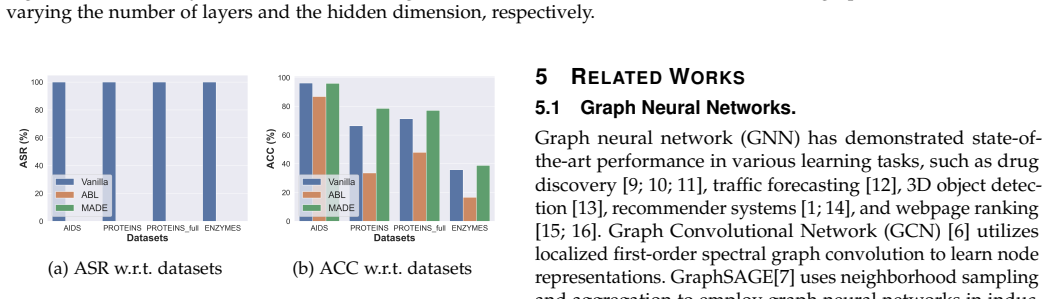
On its own terms, the paper claims that backdoor triggers on graphs have a measurable structural signature—they lower a graph's homophily score—and that this signature can be exploited for precise defense. MADE first marks as suspicious any graph whose homophily falls more than one standard deviation from the training-set mean, then adds low-loss samples to form an enriched poisoned subset and high-loss samples as a clean subset. During training, a learnable projection head maps node features into a subspace associated with small singular values, a natural score measures how similar each node is to its neighbors, and edge weights are masked so that trigger-like nodes and edges are suppressed while the top-scoring clean nodes keep their original connections. Adversarial loss on the poisoned subset unlearns the trigger while cross-entropy plus a smoothing loss on the clean subset preserves accuracy. Across AIDS, PROTEINS, PROTEINS_full, and ENZYMES under the GTA attack with a 10% injection rate, the reported average attack success rate is 0.00–2.73% with accuracy within roughly 2–5 points of vanilla training, and the method extends to node classification against UGBA.
Load-bearing premise
The method assumes that injected trigger subgraphs reliably lower graph homophily, so a threshold at one standard deviation from the training-set mean (Eq. 4) marks poisoned graphs, and that trigger nodes are dissimilar to their neighbors so the natural score (Eq. 6) finds them.
Editorial extensions
If this is right
- On the four graph classification datasets under GTA at a 10% injection rate, the reported average attack success rate drops to between 0.00% and 2.73% while average accuracy stays within roughly 2–5 points of vanilla training.
- The defense is not architecture-specific: near-zero attack success rates are reported for GCN, GAT, and GraphSAGE on both graph and node classification tasks.
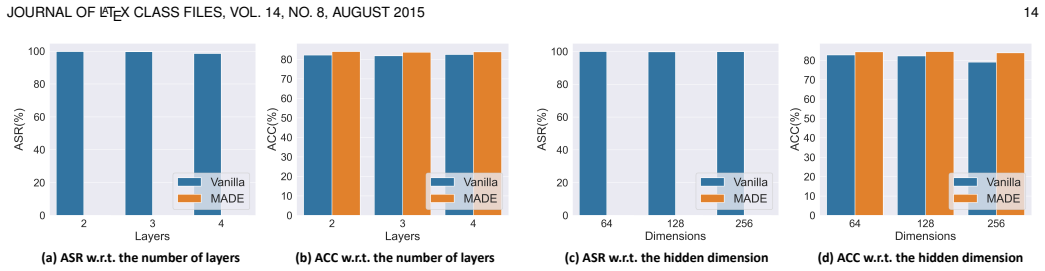
- At injection rates from 5% to 20% on AIDS, attack success rate stays below 8% and mostly below 2%, with accuracy degrading by less than 3% even at the highest rate.
- On node classification with UGBA, average attack success rate falls below 3.5% on Cora, PubMed, OGBN-Arxiv, and Flickr, showing the same design covers node-level attacks.
- Masked unlearning keeps the clean part of poisoned graphs intact, which is why accuracy does not collapse the way it does when whole poisoned graphs are unlearned.
Reading between the lines
- An attacker who engineers trigger subgraphs to be homophilous with their host graphs—for instance by connecting trigger nodes only to feature-similar neighbors—would likely evade the homophily outlier test; whether the low-loss selection step could still catch such triggers is a testable open question.
- The paper's spectral analysis suggests the mask mechanism could generalize to other localized structural anomalies beyond backdoors, such as adversarial edge flips or poisoned subgraphs, but that application is not tested here.
- Because mask values are produced at inference time, MADE doubles as a per-node trigger detector; exposing these scores as an audit signal is a natural extension the paper does not pursue.
- The comparison with ABL indicates that localized masking rather than whole-sample unlearning is what preserves utility, a principle that could inform defenses for other structured data with sparse malicious perturbations.
Editorial analysis
A structured set of objections, weighed in public.
Referee Report
Summary. The paper proposes MADE, a training-time backdoor defense for GNNs that does not require additional clean data. MADE first isolates a poisoned subset using a homophily-based criterion (Eq. 4) plus low-loss selection, then generates edge masks via a learned projection head and natural scores (Eqs. 5-7), and trains with an adversarial loss on the isolated backdoor subset to unlearn triggers while a clean-subset loss preserves utility. The authors evaluate on four graph-classification datasets under the GTA attack and four node-classification datasets under the UGBA attack, reporting near-zero ASR with small accuracy drops, and include ablations on injection rates and hyperparameters.
Significance. If the results are reproducible, MADE addresses a practical gap: existing image-based defenses such as ABL and ANP degrade on graphs, and graph-specific defenses are scarce. The method is training-set-only, end-to-end for graph classification, and the ablation in Section 4.2.4 supports the claim that masked unlearning preserves utility better than whole-graph unlearning. The main risk is the strong assumption that graph backdoor triggers reduce homophily, which is only demonstrated for two attack families; the paper should either broaden the attack coverage or temper the general claim.
major comments (4)
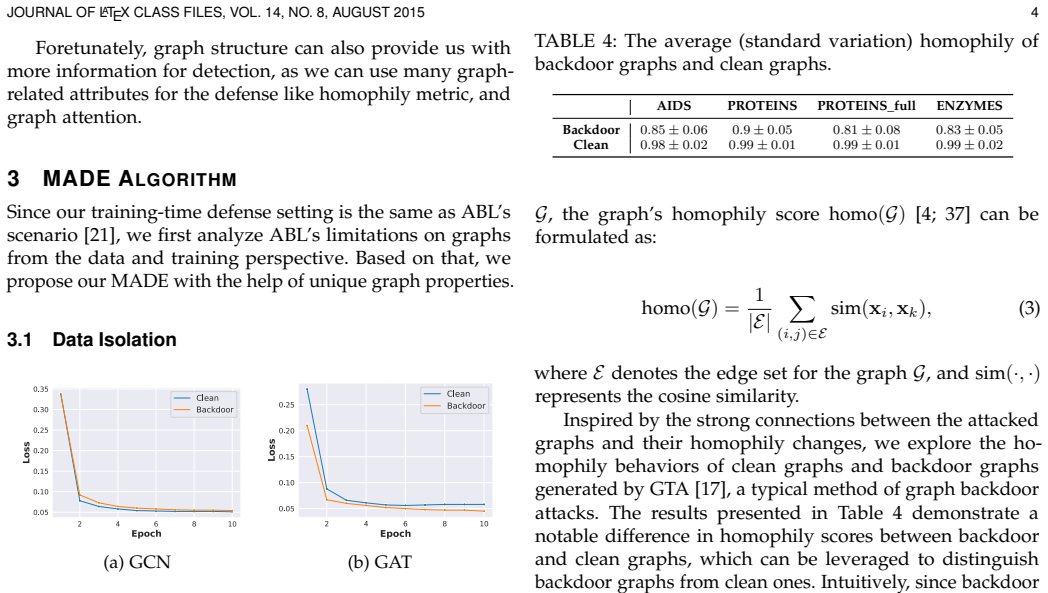
- [§3.1, §3.2.1, Eq. (4), Eq. (6)] The defense's isolation and masking mechanisms both assume that backdoor triggers lower graph homophily; this is demonstrated concretely only for GTA (graph classification) and UGBA (node classification) in Table 4. If a trigger subgraph is engineered to be homophilous with the host graph, Eq. (4) will not flag the poisoned graph, and Eq. (6) will assign high natural scores to trigger nodes, so the masks will not remove the trigger. The manuscript's abstract and conclusion claim general effectiveness ('significantly reducing the attack success rate'), which overstates the evidence. Either evaluate against additional attack families that include homophilous triggers, or scope the claim explicitly to low-homophily triggers.
- [§4.1, Tables 5 and 6] Section 4.1 states that each experiment is repeated five times and the mean results are recorded, yet Tables 5 and 6 report no standard deviations or other dispersion measures. Because the headline result is near-zero average ASR (e.g., MADE average ASR of 0.00 on PROTEINS in Table 5), the variance across seeds is critical to assessing whether the attack success rate is reliably near zero. Please report standard deviations (or confidence intervals) for both ASR and accuracy.
- [Table 5, Appendix F, References [46] and [52]] The baseline labeled 'GCNJaccard' in Table 5 is not described in Appendix F, which instead presents 'GCN-SVD' with citation [52]. Moreover, reference [46] is titled 'Graph Information Bottleneck,' which is not GCNJaccard. This inconsistency prevents the reader from knowing which baseline was actually compared and makes the experimental comparison unreproducible. Please align the table label, the appendix description, and the references so that the baseline is unambiguously defined and cited.
- [§4.2.2, Figure 6] The robustness study in Section 4.2.2 varies injection rates only for the GTA attack on the AIDS dataset. Combined with the single-attack-per-task main evaluation (GTA for graph classification, UGBA for node classification), the paper does not establish that MADE's performance generalizes across attacks with different trigger designs or different homophily behavior. At a minimum, add a discussion of this limitation; ideally, evaluate one additional attack per task to support the broader claim.
minor comments (6)
- [§3.1] In the text after Eq. (4), 'µhomo and σhomo represents the mean and standard variance' should be 'represent the mean and standard deviation'; 'standard variance' is used inaccurately.
- [§2.2] The sentence 'To sum up, the problem of backdoor attacks on graphs can be defined as follows:' is duplicated immediately before Problem 1; remove the duplicate.
- [Figure 1 caption] The caption reads 'PROETINS' but should be 'PROTEINS'.
- [§4.1] The text says 'Graph Convoluation Network' which should be 'Graph Convolutional Network'.
- [Algorithm 2] Line 8 selects the top α1 samples with lowest loss as Dl, and line 9 forms Dbad = Dl ∪ Dh; the relationship between the size of Dh and the isolation rate α1 is unclear, since Dh is determined by the homophily threshold. Clarify how the two sets are combined to satisfy the stated isolation rate.
- [Figure 5 caption] The caption uses 'Lossadv', 'Lossclean', and 'Losssmh' while the text uses Ladv, Lnat, and Lsmh; standardize the notation.
Circularity Check
No significant circularity: MADE's detection is validated against ground-truth labels, the mask contribution is isolated by a controlled ablation, and the reported ASR is measured on held-out triggers from external attacks rather than being the training objective itself.
full rationale
Walking the derivation chain: Eq. (4) isolates graphs whose homophily deviates from the training-set mean, but the paper validates this selection against ground-truth injected samples in Table 3 and Appendix C, so backdoor detection is empirically checked rather than defined as 'low homophily'. The mask generation in Eqs. (5)-(7) uses a learnable projection head and cosine-similarity natural scores; its contribution is tested by holding data isolation fixed and comparing ABL versus MADE in Figure 8, which isolates the mask mechanism. The adversarial loss in Eq. (10) directly suppresses the target-class probability on the detected backdoor subset, but the reported ASR is the attack success rate on triggers generated by external attacks (GTA for graph classification, UGBA for node classification) at evaluation time, so it is not merely a restatement of the fitted training objective. The only self-citation is the ANP baseline [20], co-authored by the corresponding author; ANP is a comparison baseline, not a premise used to construct MADE, so it is not load-bearing. The homophily assumption underlying Eq. (4) and Eq. (6) is demonstrated only for the evaluated attack families, which is a scope limitation for potential homophilous triggers, but that is a robustness/generality concern, not a circular reduction. No equation or citation in the paper assumes the near-zero ASR conclusion by construction.
Assumptions & free parameters
free parameters (5)
- homophily deviation threshold (1 std) =
mu_homo +/- sigma_homo
- isolation rate alpha1 =
not explicitly reported for main experiments
- clean subset rate alpha2 =
not explicitly reported
- clean-node fraction beta =
0.9
- smoothing loss weight lambda =
5
assumptions (5)
- domain assumption Backdoor graphs have measurably lower homophily than clean graphs.
- domain assumption Trigger nodes are dissimilar to their neighbors, so cosine similarity between projected neighbor features identifies them.
- domain assumption Triggers occupy only a minor fraction of each poisoned graph.
- domain assumption The projection head's output onto low singular-value subspace separates trigger from clean nodes.
- domain assumption The highest-loss samples after warm-up form an enriched clean subset D_clean.
Cite this review
Pith. "Pith review of MADE: Graph Backdoor Defense with Masked Unlearning." pith.science (2026). https://pith.science/paper/DEZ5H373
@misc{pith2026241118648,
  author       = {Pith},
  title        = {Pith review of: MADE: Graph Backdoor Defense with Masked Unlearning},
  year         = {2026},
  howpublished = {\url{https://pith.science/paper/DEZ5H373}},
  note         = {Machine review of arXiv:2411.18648}
}
read the original abstract
Graph Neural Networks (GNNs) have garnered significant attention from researchers due to their outstanding performance in handling graph-related tasks, such as social network analysis, protein design, and so on. Despite their widespread application, recent research has demonstrated that GNNs are vulnerable to backdoor attacks, implemented by injecting triggers into the training datasets. Trained on the poisoned data, GNNs will predict target labels when attaching trigger patterns to inputs. This vulnerability poses significant security risks for applications of GNNs in sensitive domains, such as drug discovery. While there has been extensive research into backdoor defenses for images, strategies to safeguard GNNs against such attacks remain underdeveloped. Furthermore, we point out that conventional backdoor defense methods designed for images cannot work well when directly implemented on graph data. In this paper, we first analyze the key difference between image backdoor and graph backdoor attacks. Then we tackle the graph defense problem by presenting a novel approach called MADE, which devises an adversarial mask generation mechanism that selectively preserves clean sub-graphs and further leverages masks on edge weights to eliminate the influence of triggers effectively. Extensive experiments across various graph classification tasks demonstrate the effectiveness of MADE in significantly reducing the attack success rate (ASR) while maintaining a high classification accuracy.
Figures


Figures from the paper (7 more)



Reference graph
Works this paper leans on
-
[52]
Svd-gcn: A simpli- fied graph convolution paradigm for recommendation,
S. Peng, K. Sugiyama, and T. Mine, “Svd-gcn: A simpli- fied graph convolution paradigm for recommendation,” in CIKM, 2022. Xiao Lin received the B.E. degree from Peking University in 2019. He is currently a Ph.D. stu- dent in IdeaLab, University of Illinois Urbana- Champaign. His research interests include graph learning, trustworthy machine learning, and...
work page 2022
-
[46]
Graph informa- tion bottleneck,
T. Wu, H. Ren, P . Li, and J. Leskovec, “Graph informa- tion bottleneck,” in NeurIPS, 2020
work page 2020
-
[1]
Graph neural networks for social recommendation,
W. Fan, Y. Ma, Q. Li, Y. He, E. Zhao, J. Tang, and D. Yin, “Graph neural networks for social recommendation,” in WWW, 2019
work page 2019
-
[2]
Random graph models of social networks,
M. E. Newman, D. J. Watts, and S. H. Strogatz, “Random graph models of social networks,” Proceedings of the national academy of sciences, 2002
work page 2002
-
[3]
Trinajstic, Chemical graph theory
N. Trinajstic, Chemical graph theory. Routledge, 2018
work page 2018
-
[4]
Beyond homophily in graph neural networks: Current limitations and effective designs,
J. Zhu, Y. Yan, L. Zhao, M. Heimann, L. Akoglu, and D. Koutra, “Beyond homophily in graph neural networks: Current limitations and effective designs,” Advances in neural information processing systems, vol. 33, pp. 7793–7804, 2020
work page 2020
-
[5]
T. Wang, D. Jin, R. Wang, D. He, and Y. Huang, “Powerful graph convolutional networks with adaptive propagation mechanism for homophily and heterophily,” in Proceedings of the AAAI conference on artificial intelligence, vol. 36, no. 4, 2022, pp. 4210–4218
work page 2022
-
[6]
Semi-supervised classi- fication with graph convolutional networks,
T. N. Kipf and M. Welling, “Semi-supervised classi- fication with graph convolutional networks,” arXiv preprint arXiv:1609.02907, 2016
arXiv 2016
Show all 57 references
-
[7]
Inductive representation learning on large graphs,
W. Hamilton, Z. Ying, and J. Leskovec, “Inductive representation learning on large graphs,” in NeurIPS, 2017
2017
-
[8]
Gated graph sequence neural networks,
Y. Li, R. Zemel, M. Brockschmidt, and D. Tarlow, “Gated graph sequence neural networks,” in ICLR, 2016
2016
-
[9]
Predicting drug–target interaction using a novel graph neural network with 3d structure-embedded graph representation,
J. Lim, S. Ryu, K. Park, Y. J. Choe, J. Ham, and W. Y. Kim, “Predicting drug–target interaction using a novel graph neural network with 3d structure-embedded graph representation,” Journal of chemical information and modeling, 2019
2019
-
[10]
Kgnn: Knowledge graph neural network for drug-drug interaction prediction
X. Lin, Z. Quan, Z.-J. Wang, T. Ma, and X. Zeng, “Kgnn: Knowledge graph neural network for drug-drug interaction prediction.” in IJCAI, 2020
2020
-
[11]
Could graph neural networks learn better molecular representation for drug discovery? a comparison study of descriptor-based and graph-based models,
D. Jiang, Z. Wu, C.-Y. Hsieh, G. Chen, B. Liao, Z. Wang, C. Shen, D. Cao, J. Wu, and T. Hou, “Could graph neural networks learn better molecular representation for drug discovery? a comparison study of descriptor-based and graph-based models,” Journal of cheminformatics, 2021
2021
-
[12]
Graph neural network for traffic forecasting: A survey,
W. Jiang and J. Luo, “Graph neural network for traffic forecasting: A survey,” Expert Systems with Applications, 2022
2022
-
[13]
Point-gnn: Graph neural network for 3d object detection in a point cloud,
W. Shi and R. Rajkumar, “Point-gnn: Graph neural network for 3d object detection in a point cloud,” in CVPR, 2020
2020
-
[14]
Neural graph collaborative filtering,
X. Wang, X. He, M. Wang, F. Feng, and T.-S. Chua, “Neural graph collaborative filtering,” in SIGIR, 2019
2019
-
[15]
Scaling graph neural networks with approxi- mate pagerank,
A. Bojchevski, J. Klicpera, B. Perozzi, A. Kapoor, M. Blais, B. Rózemberczki, M. Lukasik, and S. Gün- nemann, “Scaling graph neural networks with approxi- mate pagerank,” in SIGKDD, 2020
2020
-
[16]
Predict then propagate: Graph neural networks meet personal- ized pagerank,
J. Klicpera, A. Bojchevski, and S. Günnemann, “Predict then propagate: Graph neural networks meet personal- ized pagerank,” arXiv preprint arXiv:1810.05997, 2018
2018 arXiv
-
[17]
Graph backdoor,
Z. Xi, R. Pang, S. Ji, and T. Wang, “Graph backdoor,” in USENIX Security, 2021
2021
-
[18]
Backdoor attacks to graph neural networks,
Z. Zhang, J. Jia, B. Wang, and N. Z. Gong, “Backdoor attacks to graph neural networks,” in ACM Symposium on Access Control Models and Technologies, 2021
2021
-
[19]
Transferable graph backdoor attack,
S. Yang, B. G. Doan, P . Montague, O. De Vel, T. Abraham, S. Camtepe, D. C. Ranasinghe, and S. S. Kanhere, “Transferable graph backdoor attack,” in International Symposium on Research in Attacks, Intrusions and Defenses, 2022
2022
-
[20]
Adversarial neuron pruning purifies backdoored deep models,
D. Wu and Y. Wang, “Adversarial neuron pruning purifies backdoored deep models,” in NeurIPS, 2021
2021
-
[21]
Anti- backdoor learning: Training clean models on poisoned data,
Y. Li, X. Lyu, N. Koren, L. Lyu, B. Li, and X. Ma, “Anti- backdoor learning: Training clean models on poisoned data,” 2021
2021
-
[22]
Fine-tuning is all you need to mitigate backdoor at- tacks,
Z. Sha, X. He, P . Berrang, M. Humbert, and Y. Zhang, “Fine-tuning is all you need to mitigate backdoor at- tacks,” arXiv preprint arXiv:2212.09067, 2022
2022 arXiv
-
[23]
Very deep convolu- tional networks for large-scale image recognition,
K. Simonyan and A. Zisserman, “Very deep convolu- tional networks for large-scale image recognition,”arXiv preprint arXiv:1409.1556, 2014
2014 arXiv
-
[24]
Deep residual learning for image recognition,
K. He, X. Zhang, S. Ren, and J. Sun, “Deep residual learning for image recognition,” in CVPR, 2016
2016
-
[25]
Attention is all you need,
A. Vaswani, N. Shazeer, N. Parmar, J. Uszkoreit, L. Jones, A. N. Gomez, Ł. Kaiser, and I. Polosukhin, “Attention is all you need,” in NeurIPS, 2017
2017
-
[26]
Spectral signatures in backdoor attacks,
B. Tran, J. Li, and A. Madry, “Spectral signatures in backdoor attacks,” in NeurIPS, 2018
2018
-
[27]
Targeted backdoor attacks on deep learning systems using data poisoning,
X. Chen, C. Liu, B. Li, K. Lu, and D. Song, “Targeted backdoor attacks on deep learning systems using data poisoning,” arXiv preprint arXiv:1712.05526, 2017
2017 arXiv
-
[28]
Badnets: Iden- tifying vulnerabilities in the machine learning model supply chain,
T. Gu, B. Dolan-Gavitt, and S. Garg, “Badnets: Iden- tifying vulnerabilities in the machine learning model supply chain,” arXiv preprint arXiv:1708.06733, 2017
2017 arXiv
-
[29]
Reflection backdoor: A natural backdoor attack on deep neural networks,
Y. Liu, X. Ma, J. Bailey, and F. Lu, “Reflection backdoor: A natural backdoor attack on deep neural networks,” in ECCV, 2020
2020
-
[30]
Re- thinking the reverse-engineering of trojan triggers,
Z. Wang, K. Mei, H. Ding, J. Zhai, and S. Ma, “Re- thinking the reverse-engineering of trojan triggers,” in NeurIPS, 2022
2022
-
[31]
Few-shot backdoor defense using shapley estimation,
J. Guan, Z. Tu, R. He, and D. Tao, “Few-shot backdoor defense using shapley estimation,” in CVPR, 2022
2022
-
[32]
Unnotice- able backdoor attacks on graph neural networks,
E. Dai, M. Lin, X. Zhang, and S. Wang, “Unnotice- able backdoor attacks on graph neural networks,” in Proceedings of the ACM Web Conference 2023, 2023, pp. 2263–2273. JOURNAL OF LATEX CLASS FILES, VOL. 14, NO. 8, AUGUST 2015 12
2023
-
[33]
Textual backdoor attack for the text classification system,
H. Kwon and S. Lee, “Textual backdoor attack for the text classification system,” Security and Communication Networks, vol. 2021, pp. 1–11, 2021
2021
-
[34]
Mind the style of text! adversarial and backdoor attacks based on text style transfer,
F. Qi, Y. Chen, X. Zhang, M. Li, Z. Liu, and M. Sun, “Mind the style of text! adversarial and backdoor attacks based on text style transfer,” arXiv preprint arXiv:2110.07139, 2021
2021 arXiv
-
[35]
A backdoor attack against lstm-based text classification systems,
J. Dai, C. Chen, and Y. Li, “A backdoor attack against lstm-based text classification systems,” IEEE Access, vol. 7, pp. 138 872–138 878, 2019
2019
-
[36]
How does heterophily impact the robustness of graph neural networks? theoretical connections and practical implications,
J. Zhu, J. Jin, D. Loveland, M. T. Schaub, and D. Koutra, “How does heterophily impact the robustness of graph neural networks? theoretical connections and practical implications,” in SIGKDD, 2022
2022
-
[37]
Finding global homophily in graph neural networks when meeting heterophily,
X. Li, R. Zhu, Y. Cheng, C. Shan, S. Luo, D. Li, and W. Qian, “Finding global homophily in graph neural networks when meeting heterophily,” in ICML. PMLR, 2022, pp. 13 242–13 256
2022
-
[38]
Grad-cam: Visual explanations from deep networks via gradient-based localization,
R. R. Selvaraju, M. Cogswell, A. Das, R. Vedantam, D. Parikh, and D. Batra, “Grad-cam: Visual explanations from deep networks via gradient-based localization,” in CVPR, 2017
2017
-
[39]
Debiasing back- door attack: A benign application of backdoor attack in eliminating data bias,
S. Wu, Q. He, Y. Zhang, and J. Sang, “Debiasing back- door attack: A benign application of backdoor attack in eliminating data bias,” arXiv preprint arXiv:2202.10582, 2022
2022 arXiv
-
[40]
Iam graph database reposi- tory for graph based pattern recognition and machine learning,
K. Riesen and H. Bunke, “Iam graph database reposi- tory for graph based pattern recognition and machine learning,” in IAPR workshop, 2008
2008
-
[41]
Protein function prediction via graph kernels,
K. M. Borgwardt, C. S. Ong, S. Schönauer, S. Vish- wanathan, A. J. Smola, and H.-P . Kriegel, “Protein function prediction via graph kernels,” Bioinformatics, 2005
2005
-
[42]
Automating the construction of internet portals with machine learning,
A. K. McCallum, K. Nigam, J. Rennie, and K. Seymore, “Automating the construction of internet portals with machine learning,” Information Retrieval, vol. 3, pp. 127–163, 2000
2000
-
[43]
Collective classification in network data,
P . Sen, G. Namata, M. Bilgic, L. Getoor, B. Galligher, and T. Eliassi-Rad, “Collective classification in network data,” AI magazine, vol. 29, no. 3, pp. 93–93, 2008
2008
-
[44]
Open graph benchmark: Datasets for machine learning on graphs,
W. Hu, M. Fey, M. Zitnik, Y. Dong, H. Ren, B. Liu, M. Catasta, and J. Leskovec, “Open graph benchmark: Datasets for machine learning on graphs,” Advances in neural information processing systems, vol. 33, pp. 22 118–22 133, 2020
2020
-
[45]
Graphsaint: Graph sampling based induc- tive learning method,
H. Zeng, H. Zhou, A. Srivastava, R. Kannan, and V . Prasanna, “Graphsaint: Graph sampling based induc- tive learning method,” arXiv preprint arXiv:1907.04931, 2019
1907 arXiv
-
[47]
Graph attention networks,
P . Veliˇ ckovi´ c, G. Cucurull, A. Casanova, A. Romero, P . Lio, and Y. Bengio, “Graph attention networks,”arXiv preprint arXiv:1710.10903, 2017
2017 arXiv
-
[48]
Backdoor embedding in convolutional neural net- work models via invisible perturbation,
C. Liao, H. Zhong, A. Squicciarini, S. Zhu, and D. Miller, “Backdoor embedding in convolutional neural net- work models via invisible perturbation,” arXiv preprint arXiv:1808.10307, 2018
2018 arXiv
-
[49]
Clean-label backdoor attacks on video recognition models,
S. Zhao, X. Ma, X. Zheng, J. Bailey, J. Chen, and Y.-G. Jiang, “Clean-label backdoor attacks on video recognition models,” in CVPR, 2020
2020
-
[50]
Backdoor defense via decoupling the training process,
K. Huang, Y. Li, B. Wu, Z. Qin, and K. Ren, “Backdoor defense via decoupling the training process,” arXiv preprint arXiv:2202.03423, 2022
2022 arXiv
-
[51]
Defending against backdoor attack on graph nerual network by explainability,
B. Jiang and Z. Li, “Defending against backdoor attack on graph nerual network by explainability,” arXiv preprint arXiv:2209.02902, 2022
2022 arXiv
-
[53]
In this paper, the experiment JOURNAL OF LATEX CLASS FILES, VOL
fine-tune [ 22], a widely used method in transfer learning, can effectively remove backdoors from ma- chine learning models. In this paper, the experiment JOURNAL OF LATEX CLASS FILES, VOL. 14, NO. 8, AUGUST 2015 15 of fine-tuning runs on the clean subset isolated by data isolation
2015
-
[54]
ABL [ 21] isolate backdoor examples at an early training stage, and then break the correlation be- tween backdoor examples and the target class by unlearning mechanism
-
[55]
For typical graph defense methods,
ANP [20] prunes sensitive neurons to remove the injected backdoor by identifying the increased sen- sitivity of backdoored DNNs to adversarial neuron perturbations. For typical graph defense methods,
-
[56]
Edge dropout randomly remove the connections between nodes, thus decreasing the influence of poi- soned nodes during message passing and defending backdoor attacks
-
[57]
This modification aims to concentrate solely on the features associated with the K-largest singular vectors, thereby enhancing the model’s robustness to perturbations
GCN-SVD [ 52] replaces the core design of GCN- based methods with a low-rank truncated SVD. This modification aims to concentrate solely on the features associated with the K-largest singular vectors, thereby enhancing the model’s robustness to perturbations. APPENDIX G MADE T...
Reviewed August 12, 2026 · model on record in the stance chip above.
Discussion (0). Continue with ORCID to comment.