REVIEW 4 major objections 8 minor 57 references
Boosting Classification with Quantum-Inspired Augmentations
T0 review · 4 major / 8 minor · reviewed 2026-08-06 · deepseek-v4-flash
Pith's one-line read The paper claims that applying small random Bloch-sphere rotations to amplitude-encoded images, then discarding the imaginary part, improves ImageNet classification beyond classical augmentation alone, and that the benefit comes from the…
desk verdict Quantum-inspired augmentation idea is interesting, but the accuracy claim is undercut by per-method hyperparameter tuning and a mismatch with the reported table. read the letter →
The pith
A machine-rendered reading of the paper's core claim, the machinery that carries it, and where it could break.
The reading
What carries the argument
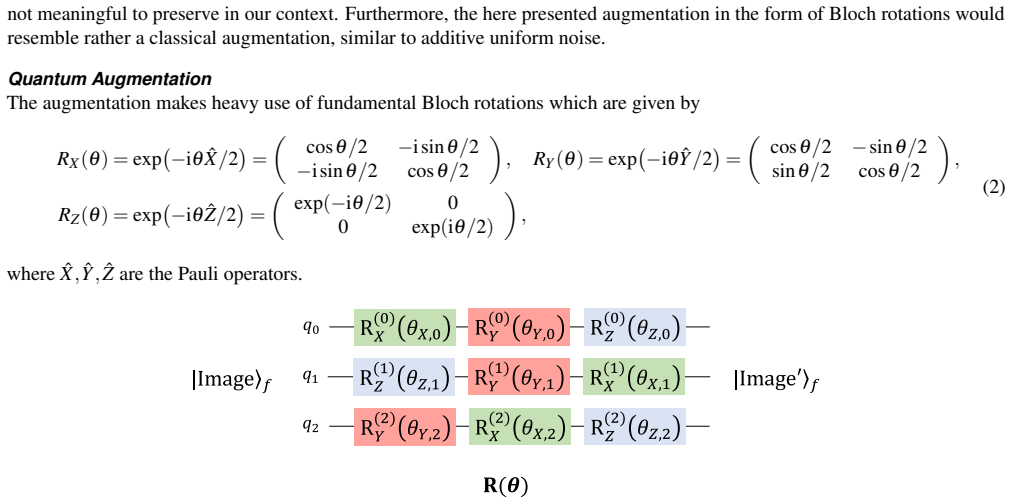
The central object is the amplitude-encoded image state |Image>_f, flattened into a 2^n-dimensional vector, acted on by tensor products of single-qubit Bloch rotations RX, RY, RZ with angles drawn from [0, Θ]. Because the rotations are separable SU(2) operations, they leave the singular values of the state invariant; the augmentation's effect is created by the subsequent element-wise real() or abs() projection, which breaks that invariance and reshapes the singular value spectrum. Computationally this is a sequence of n reshape-and-multiply steps, giving O(N log N) complexity, and for QRZ the action reduces to an element-wise multiplication by cosines of Gaussian-distributed phase sums.
What would settle it
Train the best classical method F(PR(x)) and the best combined method real(QRZ(F(PR(x)))) with identical hyperparameters across several random seeds; if the Top-1 gap shrinks to within the run-to-run variance, the central claim that the quantum-inspired step boosts classification would collapse.
Extended reading notes
Core claim
On the paper's own terms, the discovery is that a quantum-inspired augmentation built from single-qubit Bloch rotations on an amplitude-encoded image can outperform standard classical augmentations on ImageNet when the rotation is followed by a non-unitary projection. The best method, real(QRZ(F(PR(x)))), combines the classical perfect-rotation-plus-flip augmentation with a random Z-axis rotation whose real part is kept; it reaches 63.40% Top-1, 85.35% Top-5, and 12.51% F1. The authors isolate the mechanism by comparing with singular-value-preserving rotations such as real(QRY(x)) and QRXYZ(x), which stay near baseline, concluding that the benefit comes from the projection disturbing the singular value spectrum—an effect they describe as a positional, dropout-like masking—rather than from the unitary rotation itself.
Load-bearing premise
The reported accuracy gaps are assumed to reflect the augmentation itself, even though each method was tuned with its own hyperparameter search and no repeated runs or error bars are reported.
Editorial extensions
If this is right
- If the result holds, quantum-inspired augmentation can be deployed on classical hardware at low overhead, since the full pipeline is O(N log N) and needs no actual quantum device.
- The mechanism implies that non-unitary projections that disturb the singular value spectrum are the active ingredient; future augmentation design can focus on such projections rather than on the choice of unitary rotation.
- real(QRZ(F(PR(x)))) nearly doubles F1 relative to baseline (6.41% to 12.51%), suggesting the method helps most in the long tail of classes where F1 is low.
- The negative privacy result means strong unitary augmentations should not be used as a substitute for differential privacy mechanisms, despite their visually unrecognizable output.
- Combining quantum-inspired rotations with classical augmentations works in nested order, so the method is a plug-in addition to existing classical augmentation pipelines.
Reading between the lines
- A testable extension: because real(QRZ) acts as a register-position-dependent cosine mask, a purely classical mask built from the same Gaussian-distributed phase sums should reproduce the accuracy gain, which would show the quantum framing is not the operative part.
- The paper's single-run comparisons leave open whether the 2-3 point Top-1 gap survives seed averaging; an immediate experiment is to fix one hyperparameter set and run both F(PR(x)) and real(QRZ(F(PR(x)))) across several seeds.
- If the spectral distortion mechanism is the true cause, similar gains should appear on other large-scale datasets and architectures, and the augmentation could be transferred to contrastive learning pipelines where composite transformations are the standard tool.
- The privacy proof applies to the augmentation as a standalone map; it does not rule out combining the augmentation with differentially private training, which is a separate and untested direction.
Editorial analysis
A structured set of objections, weighed in public.
Referee Report
Summary. The paper proposes quantum-inspired data augmentations based on random Bloch-sphere rotations applied to amplitude-encoded image vectors, optionally combined with classical augmentations, and evaluates them on ImageNet with ResNet-34. The best reported method, real(QRZ(F(PR(x)))), is claimed to improve Top-1, Top-5, and F1 over the best classical augmentation F(PR(x)). The authors attribute the gain to non-unitary projections (real() or abs()) rather than to the unitary rotation itself, support this with singular-value spectrum analyses, give an O(N log N) implementation argument, and include a differential-privacy negative result in the supplementary material.
Significance. If the empirical claim survives a controlled comparison, the paper offers a simple, cheap augmentation with a concrete mechanistic story (singular-value distortion via non-unitary projection) and a useful negative result on differential privacy. The O(N log N) implementation and the singular-value invariance analysis are genuine strengths. However, the central evidence is a single table without error bars, repeated seeds, or statistical tests, and the per-method hyperparameter search confounds the augmentation effect; the current support for the headline claim is therefore weak.
major comments (4)
- [Methods/Implementation and Results/Table 1] The genetic-algorithm hyperparameter search is performed separately for each augmentation method over batch size, learning rate, Adam betas, weight decay, and learning-rate decay schedule. Because the training configuration is not held constant across methods, the accuracy differences in Table 1 can be explained by tuning artifacts rather than by the augmentation itself. The paper needs a controlled comparison in which hyperparameters are fixed across methods (or at least matched by search budget and seeds), with repeated runs and error bars, before the headline claim is supported.
- [Augmentation Methods and Methods/Implementation] The rotation strength Theta is only described as being 'in the order of 10^-2', and the paper does not report the exact Theta values, the random seeds, or the final hyperparameter configurations used for each method. This makes the experiments unreproducible and leaves open the possibility that the reported gains depend critically on a particular untested choice of Theta. Please report the exact augmentation parameters and the hyperparameter configuration for every row of Table 1.
- [Results/Table 1 and Discussion] No seeds, repeated runs, or statistical tests are reported, and the phrase 'within the margin of error' in the Results section refers to a margin that is never defined. The differences among the top combined methods (63.40%, 63.36%, 63.52% Top-1) are small relative to the uncontrolled setup, so the ranking is not statistically grounded. At minimum, the authors should report mean and standard deviation over multiple seeds and a paired significance test for the main comparisons.
- [Abstract, Introduction, Discussion, and Table 1] The reported improvements are numerically inconsistent. Table 1 shows real(QRZ(F(PR(x)))) at 63.40% Top-1 versus 61.47% for F(PR(x)), a 1.93 percentage-point difference; Top-5 is 85.35% versus 84.12%, a 1.23 percentage-point difference; and F1 is 12.51% versus 7.93%, a 4.58 percentage-point difference. The abstract's '3%, 2.5%, and from 8% to 12%' are not percentage-point changes, and if they are intended as relative changes, the Top-5 value is about 1.5%, not 2.5%. The Introduction states '2%, 1%' instead. The comparison baseline and the metric convention must be stated precisely and used consistently.
minor comments (8)
- [Introduction] The sentence 'and its unclear if the same procedures adapt to significantly harder datasets' contains a typo; it should read 'it is unclear'.
- [Quantum Augmentation] The term 'Trait-Bryan angles' should be 'Tait-Bryan angles'.
- [Quantum Augmentation] In Eq. (3), the notation with the primed product over the ordered tuple (X,Y,Z) is confusing; please clarify explicitly that the order of the non-commuting rotation gates is the randomly drawn order.
- [Algorithm Description and Complexity] The sentence 'Transpose Image f and flatten the image back to the state |Image>_f' is not a complete algorithmic specification; please state the reshape/transpose operation precisely, including the roles of the two index sets.
- [Singular Value Spectrum Analysis] There is a missing closing parenthesis in 'F(PR(x), in both figures' and a doubled word 'of of' in the Discussion; these should be corrected.
- [Supplementary A] The differential-privacy proof uses the symbol R both for the rotation operation and for the output state, and the sentence about the singular-value decomposition of R(Theta)|Psi> is unnecessary for the argument; please rephrase the proof to state directly that a deterministic map cannot satisfy epsilon-DP for finite epsilon.
- [Supplementary B] The term 'unit8' appears throughout; it should be 'uint8'.
- [Data availability] The statement 'Data and Code will be made available on reasonable request' is too vague for reproducibility; please provide a repository or at least a detailed description of the experimental configuration, including exact Theta values and hyperparameter settings.
Circularity Check
No significant circularity; the augmentation claims are empirical comparisons against ImageNet and are not reduced by construction to their inputs.
full rationale
No circularity found. The paper's central claim is an empirical comparison of augmentation methods on ImageNet validation data; the classification accuracies are measured outcomes, not quantities assumed in the definitions of the augmentations. The singular-value invariance argument around Eq. (5) follows directly from the Schmidt decomposition and the fact that single-qubit rotations act locally on the two partitions; it does not presuppose any classification result. The real(QRZ) derivation in Eq. (9) is a straightforward consequence of RZ being diagonal and the Hadamard product structure; it explains the visual artifacts but is not used to force the reported accuracy gains. The non-differential-privacy theorem in Supplementary A is proven constructively for any rotation angle and is therefore not an imported uniqueness claim. The only self-citations that appear (refs. 17, 23, 48) are used for background, optical-implementation motivation, and the genetic-algorithm hyperparameter search, respectively; none of them supplies the load-bearing claim that real(QRZ(F(PR(x)))) improves classification. The methodological concern about per-method hyperparameter search and the absence of seeds or error bars is a statistical-validity issue, not a circularity issue: the numbers in Table 1 are not fitted parameters renamed as predictions, and the comparison is made against an external benchmark. Accordingly, the paper is self-contained with respect to the circularity patterns considered here.
Assumptions & free parameters
free parameters (2)
- Rotation strength Theta =
on the order of 10^-2 (exact value not reported)
- Per-method training hyperparameters =
not reported
assumptions (4)
- domain assumption Amplitude encoding with min-max normalization preserves class-discriminative information after Bloch rotations.
- standard math Single-qubit rotations cannot change the singular values of the amplitude-encoded image because no entangling gates are used.
- domain assumption The Irwin-Hall distribution of summed rotation angles is well approximated by a Gaussian for n > 10.
- ad hoc to paper Per-method genetic-algorithm hyperparameter optimization yields comparable training conditions across augmentation methods.
Cite this review
Pith. "Pith review of Boosting Classification with Quantum-Inspired Augmentations." pith.science (2026). https://pith.science/paper/DFV4UZEO
@misc{pith2026250622241,
  author       = {Pith},
  title        = {Pith review of: Boosting Classification with Quantum-Inspired Augmentations},
  year         = {2026},
  howpublished = {\url{https://pith.science/paper/DFV4UZEO}},
  note         = {Machine review of arXiv:2506.22241}
}
abstract
Understanding the impact of small quantum gate perturbations, which are common in quantum digital devices but absent in classical computers, is crucial for identifying potential advantages in quantum machine learning. While these perturbations are typically seen as detrimental to quantum computation, they can actually enhance performance by serving as a natural source of data augmentation. Additionally, they can often be efficiently simulated on classical hardware, enabling quantum-inspired approaches to improve classical machine learning methods. In this paper, we investigate random Bloch sphere rotations, which are fundamental SU(2) transformations, as a simple yet effective quantum-inspired data augmentation technique. Unlike conventional augmentations such as flipping, rotating, or cropping, quantum transformations lack intuitive spatial interpretations, making their application to tasks like image classification less straightforward. While common quantum augmentation methods rely on applying quantum models or trainable quanvolutional layers to classical datasets, we focus on the direct application of small-angle Bloch rotations and their effect on classical data. Using the large-scale ImageNet dataset, we demonstrate that our quantum-inspired augmentation method improves image classification performance, increasing Top-1 accuracy by 3%, Top-5 accuracy by 2.5%, and the F$_1$ score from 8% to 12% compared to standard classical augmentation methods. Finally, we examine the use of stronger unitary augmentations. Although these transformations preserve information in principle, they result in visually unrecognizable images with potential applications for privacy computations. However, we show that our augmentation approach and simple SU(2) transformations do not enhance differential privacy and discuss the implications of this limitation.
Figures


Figures from the paper (5 more)


Reference graph
Works this paper leans on
-
[1]
Khalifa, N. E., Loey, M. & Mirjalili, S. A comprehensive survey of recent trends in deep learning for digital images augmentation. Artif. Intell. Rev. 55, 2351–2377, DOI: 10.1007/s10462-021-10066-4 (2022)
-
[2]
Ba¸ stanlar, Y . & Özuysal, M. Introduction to machine learning.miRNomics: MicroRNA biology computational analysis 105–128 (2014)
work page 2014
-
[3]
Van Dyk, D. A. & Meng, X.-L. The art of data augmentation. J. Comput. Graph. Stat. 10, 1–50 (2001)
work page 2001
-
[4]
Shorten, C. & Khoshgoftaar, T. M. A survey on image data augmentation for deep learning. J. big data 6, 1–48 (2019)
work page 2019
- [5]
-
[6]
Mikołajczyk, A. & Grochowski, M. Data augmentation for improving deep learning in image classification problem. In 2018 international interdisciplinary PhD workshop (IIPhDW) , 117–122 (IEEE, 2018)
work page 2018
-
[7]
Biamonte, J. et al. Quantum machine learning. Nature 549, 195–202 (2017)
2017
-
[8]
Perrier, E., Youssry, A. & Ferrie, C. Qdataset, quantum datasets for machine learning. Sci. Data 9, 582, DOI: 10.1038/ s41597-022-01639-1 (2022)
work page 2022
Show all 57 references
-
[9]
& Manoj, B
Chalumuri, A., Kune, R., Kannan, S. & Manoj, B. S. Quantum–classical image processing for scene classification. IEEE Sensors Lett. 6, 1–4, DOI: 10.1109/LSENS.2022.3173253 (2022). 11/18
2022
-
[10]
& Feld, S
Apak, B., Bandic, M., Sarkar, A. & Feld, S. Ketgpt – dataset augmentation of nbsp;quantum circuits using transformers. In Computational Science – ICCS 2024: 24th International Conference, Malaga, Spain, July 2–4, 2024, Proceedings, Part VI , 235–251, DOI: 10.1007/978-3-031-637...
2024 doi
-
[11]
& Chen, Y
Gao, H., Lin, K., Cui, Y . & Chen, Y . Quantum assimilation-based data augmentation for state of health prediction of lithium-ion batteries with peculiar degradation paths. Appl. Soft Comput. 129, 109515, DOI: https://doi.org/10.1016/j.asoc. 2022.109515 (2022)
2022
-
[12]
Data augmentation experiments with style-based quantum generative adversarial networks on trapped-ion and superconducting-qubit technologies (2024)
Baglio, J. Data augmentation experiments with style-based quantum generative adversarial networks on trapped-ion and superconducting-qubit technologies (2024). 2405.04401
2024 arXiv
-
[13]
& Khalil, I
Kottahachchi Kankanamge Don, A. & Khalil, I. Q-supcon: Quantum-enhanced supervised contrastive learning architecture within the representation learning framework. ACM Transactions on Quantum Comput. 6, DOI: 10.1145/3660647 (2025)
2025 doi
- [14]
-
[15]
R., Izaac, J., Schuld, M
Mari, A., Bromley, T. R., Izaac, J., Schuld, M. & Killoran, N. Transfer learning in hybrid classical-quantum neural networks. Quantum 4, 340, DOI: 10.22331/q-2020-10-09-340 (2020)
2020 doi
-
[16]
& Stirenko, S
Gordienko, Y ., Trochun, Y ., Taran, V ., Khmelnytskyi, A. & Stirenko, S. Hnn-qc n: Hybrid neural network with multiple backbones and quantum transformation as data augmentation technique. AI 6, 36 (2025)
2025
-
[17]
Palaiodimopoulos, N. et al. Quantum inspired image augmentation applicable to waveguides and optical image transfer via anderson localization. In ICASSP 2024-2024 IEEE International Conference on Acoustics, Speech and Signal Processing (ICASSP), 116–120 (IEEE, 2024)
2024
-
[18]
Disqu: investigating the impact of disorder in quantum generative models.arXiv preprint arXiv:2409.16180 (2024)
Werner, Y .et al. Disqu: investigating the impact of disorder in quantum generative models.arXiv preprint arXiv:2409.16180 (2024)
2024
-
[19]
Quantum Computing in the NISQ era and beyond
Preskill, J. Quantum Computing in the NISQ era and beyond. Quantum 2, 79, DOI: 10.22331/q-2018-08-06-79 (2018)
2018 doi
- [20]
-
[21]
M., Delgado, A., Bardhan, B
Arrazola, J. M., Delgado, A., Bardhan, B. R. & Lloyd, S. Quantum-inspired algorithms in practice. Quantum 4, 307, DOI: 10.22331/q-2020-08-13-307 (2020)
2020 doi
-
[22]
& Macaluso, A
Srinivasan, A., Geng, A. & Macaluso, A. e. a. Benefiting from quantum? a comparative study of q-seg, quantum-inspired techniques, and u-net for crack segmentation. arXiv (2024). 2410.10713
2024 arXiv
-
[23]
& Moghiseh, A
Srinivasan, A., Geng, A., Macaluso, A., Kiefer-Emmanouilidis, M. & Moghiseh, A. A comparative study of q-seg, quantum-inspired techniques, and u-net for crack image segmentation. tm-Technisches Messen (2025)
2025
-
[24]
& Andronikos, T
Papalitsas, C., Kastampolidou, K. & Andronikos, T. Nature and quantum-inspired procedures – a short literature review. In Vlamos, P. (ed.) GeNeDis 2020, 129–133 (Springer International Publishing, Cham, 2021)
2020
-
[25]
Huynh, L. et al. Quantum-inspired machine learning: a survey. arXiv preprint arXiv:2308.11269 (2023)
2023 arXiv
-
[26]
& Hinton, G
Chen, T., Kornblith, S., Norouzi, M. & Hinton, G. A simple framework for contrastive learning of visual representations. In International conference on machine learning , 1597–1607 (PmLR, 2020)
2020
-
[27]
Chen, C.-S., Tsai, A. H.-W. & Huang, S.-C. Quantum multimodal contrastive learning framework (2025). 2408.13919
2025 arXiv
-
[28]
& Wang, X
Ren, Y ., Wang, D., An, L., Mao, S. & Wang, X. Multi-positive sample quantum contrastive learning for human activity recognition. In GLOBECOM 2024 - 2024 IEEE Global Communications Conference , 3992–3997, DOI: 10.1109/ GLOBECOM52923.2024.10901296 (2024)
2024
-
[29]
& Wang, X
Ren, Y ., Wang, D., An, L., Mao, S. & Wang, X. Quantum contrastive learning for human activity recognition.Smart Heal. 36, 100574, DOI: https://doi.org/10.1016/j.smhl.2025.100574 (2025)
2025
-
[30]
Jaderberg, B. et al. Quantum self-supervised learning. Quantum Sci. Technol. 7, 035005, DOI: 10.1088/2058-9565/ac6825 (2022)
2022 doi
-
[31]
Kankeu, I. et al. Quantum-inspired embeddings projection and similarity metrics for representation learning (2025). 2501.04591
2025 arXiv
-
[32]
& Yan, R
Yu, Y ., Qiu, D. & Yan, R. A quantum-like tensor compression sentence representation based on constraint functions for semantics analysis. Int. J. Comput. Intell. Syst. 17, 1, DOI: 10.1007/s44196-023-00380-w (2024). 12/18
2024 doi
-
[33]
& Schuld, M
Bowles, J., Ahmed, S. & Schuld, M. Better than classical? the subtle art of benchmarking quantum machine learning models. arXiv preprint arXiv:2403.07059 (2024)
2024 arXiv
-
[34]
& Sun, J
He, K., Zhang, X., Ren, S. & Sun, J. Deep residual learning for image recognition. In Proceedings of the IEEE conference on computer vision and pattern recognition , 770–778 (2016)
2016
-
[35]
& Capmany, J
Macho-Ortiz, A., Pérez-López, D. & Capmany, J. Optical implementation of 2 × 2 universal unitary matrix transformations. Laser & Photonics Rev. 15, 2000473, DOI: https://doi.org/10.1002/lpor.202000473 (2021). https://onlinelibrary.wiley.com/ doi/pdf/10.1002/lpor.202000473
2021 doi
-
[36]
J., Bergholm, V
Möttönen, M., Vartiainen, J. J., Bergholm, V . & Salomaa, M. M. Transformation of quantum states using uniformly controlled rotations. Quantum Info. Comput. 5, 467–473 (2005)
2005
-
[37]
Quantum computing in the nisq era and beyond
Preskill, J. Quantum computing in the nisq era and beyond. Quantum 2, 79 (2018)
2018
-
[38]
F., Blank, C., Araújo, I
Araujo, I. F., Blank, C., Araújo, I. C. & da Silva, A. J. Low-rank quantum state preparation. IEEE Transactions on Comput. Des. Integr. Circuits Syst. 43, 161–170 (2023)
2023
-
[39]
& Protasov, S
Lisnichenko, M. & Protasov, S. Quantum image representation: a review. Quantum Mach. Intell. 5, 2, DOI: 10.1007/ s42484-022-00089-7 (2022)
2022
-
[40]
O., Endo, S
Kubo, K., Nakagawa, Y . O., Endo, S. & Nagayama, S. Variational quantum simulations of stochastic differential equations. Phys. Rev. A 103, 052425 (2021)
2021
-
[41]
& Sánchez-Soto, L
de Guise, H., Di Matteo, O. & Sánchez-Soto, L. L. Simple factorization of unitary transformations. Phys. Rev. A 97, 022328 (2018)
2018
-
[42]
Moll, N. et al. Quantum optimization using variational algorithms on near-term quantum devices. Quantum Sci. Technol. 3, 030503 (2018)
2018
-
[43]
& Lukin, M
Zhou, L., Wang, S.-T., Choi, S., Pichler, H. & Lukin, M. D. Quantum approximate optimization algorithm: Performance, mechanism, and implementation on near-term devices. Phys. Rev. X 10, 021067 (2020)
2020
-
[44]
Bley, J. et al. Visualizing entanglement in multiqubit systems. Phys. Rev. Res. 6, 023077, DOI: 10.1103/PhysRevResearch. 6.023077 (2024)
2024 doi
-
[45]
Https://people.math.sc.edu/Burkardt/data/tif/cameraman.tif [Online; accessed June 17, 2025]
A man taking a picture (grayscale). Https://people.math.sc.edu/Burkardt/data/tif/cameraman.tif [Online; accessed June 17, 2025]
2025
-
[46]
Fast r-cnn
Girshick, R. Fast r-cnn. In Proceedings of the IEEE international conference on computer vision , 1440–1448 (2015)
2015
-
[47]
& Adam, H
Chen, L.-C., Zhu, Y ., Papandreou, G., Schroff, F. & Adam, H. Encoder-decoder with atrous separable convolution for semantic image segmentation. In Proceedings of the European conference on computer vision (ECCV) , 801–818 (2018)
2018
-
[48]
& Lukowicz, P
Tschöpe, M., Schneider, D., Suh, S. & Lukowicz, P. A novel guidance framework for nasal rapid antigen tests with improved swab keypoint detection. Smart Heal. 35, 100534 (2025)
2025
-
[49]
The distribution of means for samples of size n drawn from a population in which the variate takes values between 0 and 1, all such values being equally probable
Hall, P. The distribution of means for samples of size n drawn from a population in which the variate takes values between 0 and 1, all such values being equally probable. Biometrika 240–245 (1927)
1927
-
[50]
Dwork, C., Roth, A. et al. The algorithmic foundations of differential privacy. F oundations Trends Theor. Comput. Sci.9, 211–407 (2014)
2014
-
[51]
& Smith, A
Dwork, C., McSherry, F., Nissim, K. & Smith, A. Calibrating noise to sensitivity in private data analysis. In Halevi, S. & Rabin, T. (eds.) Theory of Cryptography, 265–284 (Springer Berlin Heidelberg, Berlin, Heidelberg, 2006)
2006
-
[52]
Seo, J., Choi, S., Ha, E., Kim, B. & Na, D. New benchmarks for asian facial recognition tasks: Face classification with large foundation models. arXiv preprint arXiv:2310.09756 (2023)
2023 arXiv
-
[53]
Differential privacy
Dwork, C. Differential privacy. In International colloquium on automata, languages, and programming , 1–12 (Springer, 2006)
2006
-
[54]
& Naor, M
Dwork, C., Kenthapadi, K., McSherry, F., Mironov, I. & Naor, M. Our data, ourselves: Privacy via distributed noise generation. In Advances in Cryptology-EUROCRYPT 2006: 24th Annual International Conference on the Theory and Applications of Cryptographic Techniques, St. Petersb...
2006
-
[55]
Renyi differential privacy
Mironov, I. Renyi differential privacy. In 2017 IEEE 30th computer security foundations symposium (CSF) , 263–275 (IEEE, 2017)
2017
-
[56]
Dong, J., Roth, A. & Su, W. J. Gaussian differential privacy. J. Royal Stat. Soc. Ser. B: Stat. Methodol. 84, 3–37 (2022). 13/18
2022
-
[57]
Ji, J. et al. Privacy-preserving face recognition with learnable privacy budgets in frequency domain. In European Conference on Computer Vision, 475–491 (Springer, 2022). Acknowledgements We gratefully acknowledge financial support from the Quantum Initiative Rhineland-Palatin...
2022
Reviewed August 6, 2026 · model on record in the stance chip above.
Discussion (0). Continue with ORCID to comment.