REVIEW 4 major objections 5 minor 97 references
Parallel Decoding Distillation predicts multiple denoising steps in one network evaluation, reproducing teacher trajectories with 4-8 function evaluations for large-scale image, video, and audio generation.
Reviewed by Pith at T0; open to challenge. T0 means a machine referee read the full paper against a public rubric. the ladder, T0–T4 →
T0 review · deepseek-v4-flash
2026-08-01 00:52 UTC pith:DGC3BQOB
load-bearing objection A genuinely simpler parallel-decoding distillation idea with real results, but the theory is proved for the ideal objective while the headline experiments use data-free rollouts and approximate targets, and the 'SOTA' claim is stronger than the tables. the 4 major comments →
Parallel Decoding Distillation for Fast Image and Video Generation
The pith
A machine-rendered reading of the paper's core claim, the machinery that carries it, and where it could break.
Core claim
The central claim is that a student model sharing the teacher's backbone, with the final linear layer repeated once per grid interval, can learn to output all mean velocities in a block from a single forward pass. The parallel-decoding loss regresses each sampled interval's output against a Runge-Kutta approximation of the teacher's mean velocity at the student's on-policy state. Proposition 1 states that a minimizer of this loss satisfies the parallel-decoder condition and, up to the Runge-Kutta approximation error, produces exactly the teacher's trajectory. On this basis, PDD reports state-of-the-art few-step quality on text-to-video, text-to-audio, and text-to-image models at 4-8 function
What carries the argument
The load-bearing object is the interval's mean velocity: the time-averaged teacher velocity over a discretization interval, which integrates the flow ODE exactly in one step. The parallel decoder is the same backbone as the teacher but with N final linear heads, one per grid interval, so one forward pass yields L velocities. The PD loss is a mean-squared regression of a randomly sampled head's output against a teacher mean-velocity target computed by an Euler or Midpoint step on the student's own parallelized trajectory. At generation, the block-step rule sums the heads, and layer fusion combines them into a single weighted-average linear layer, so advancing L intervals costs one evaluation
Load-bearing premise
The PD loss is assumed to be realizable with zero global minimum: the shared backbone, conditioned only on the block-start time, can represent all per-interval teacher mean velocities, and training on one randomly sampled interval per block transfers to all intervals at inference.
What would settle it
Train PDD on a simple curved flow with known closed-form trajectories and a fixed block of, say, four intervals; then compare the student's predicted mean velocity against the teacher's on the same states for each intra-block position, and compare a block-step rollout against the exact trajectory. If errors grow with the number of intervals skipped from the block start, or if a zero-loss fit on the training objective still fails on the last interval, the realizability and transfer assumption is false.
If this is right
- High-resolution image, video, and audio generation becomes practical at 4-8 network evaluations instead of hundreds, while matching or beating teacher quality on standard benchmarks.
- A single trained parallel decoder supports multiple inference budgets: varying the block size at generation time yields 2, 4, or 8 NFE from one checkpoint without retraining.
- Trajectory regression is sufficient at scale: no variational-score, adversarial, or derivative-based losses are needed, removing a known source of mode collapse and training instability.
- Because generation uses only the fused weighted-average head, the enlarged prediction head is essentially free at inference time.
- PDD's loss needs only one or two teacher evaluations per training step, making distillation tractable on large models without expensive Jacobian-vector products or finite differences.
Where Pith is reading between the lines
- If the block-parallel idea transfers to autoregressive models, a block of tokens could be predicted per forward pass, using a discrete analogue of the mean velocity as the target; the paper notes this as future work but does not develop it.
- The data-free training variant suggests that a teacher checkpoint plus a prompt set is enough to distill a model even when the original training data is unavailable, widening the practical use of distillation.
- An adaptive verifier choosing block size per sample would let compute track local trajectory difficulty; the paper flags this possibility but does not implement it, leaving a testable extension.
- Because guidance is folded into the teacher's mean-velocity target, PDD may serve as a general acceleration wrapper for guided ODE sampling, not only for generative-model distillation.
Editorial analysis
A structured set of objections, weighed in public.
Referee Report
Summary. The paper introduces Parallel Decoding Distillation (PDD), a trajectory-based distillation method for diffusion and flow models. PDD augments a pretrained teacher's backbone with N parallel linear heads so that, for a block of L time intervals, a single forward pass predicts all per-interval mean velocities. Training is a simple regression objective (the PD loss, Eq. (11)) against one-step Euler or Midpoint approximations of the teacher's mean velocity, computed on student rollouts. Inference advances the state by a fused linear layer (Eqs. (14)-(15)), so L steps are taken per network evaluation, giving variable NFE by varying L. Experiments cover ImageNet-256 (SiT-XL+REPA), Qwen-Image 20B, Wan2.1 1.3B/14B, and LTX-2.3 22B text-to-video/audio. The central claims are that PDD achieves state-of-the-art few-step generation at 4-8 NFE on Qwen-Image and Wan2.1, matches or outperforms the official distilled LTX-2.3 model, preserves diversity better than distribution-based baselines, and that its PD-loss minimizer reproduces teacher trajectories (Proposition 1).
Significance. If the empirical claims hold, PDD is a genuinely useful contribution: it shows that a pure trajectory-regression objective, without VSD, GAN losses, JVPs, or finite differences, can be scaled to 14B-22B video/audio models and produce competitive few-step generation with variable NFE. The architecture is simple—N repeated final linear layers on a frozen-pretrained backbone—and the fused-layer identity in Eqs. (14)-(15) is a clean and practical trick for avoiding extra inference cost. The paper also provides reproducible pseudocode for training and inference, and it makes a concrete falsifiable prediction: the PD-loss minimizer matches teacher trajectories. The diversity-focused evaluation (pairwise V-JEPA 2 / VideoMAE V2 distances) is a useful counterpoint to the known mode-collapse of distribution-based methods. However, the central theoretical guarantee, as stated, applies only to an idealized objective and does not cover the actual training algorithm used for the headline results; the empirical SOTA claim is also somewhat stronger than the tables support. With those gaps addressed, the contribution would be solid and significant for the fast-generation community.
major comments (4)
- [Section 3, Eq. (11), Appendix D] Proposition 1's proof assumes (i) the PD objective is realizable with global minimum zero, (ii) X_n is distributed as p_tn via the interpolant, and (iii) the teacher mean velocity u_k is exact. None of these hold for the algorithm that produced the main results. In Algorithms 2 and 3 the target is a one-step Euler or Midpoint approximation of u_k, so a zero-loss student would reproduce the numerical solver's trajectory, not the teacher ODE; the phrase 'up to a controllable Runge-Kutta approximation error' is not quantified. The proposition needs to be stated for the approximate objective, and an error-accumulation bound over N/L block steps should be provided, or the paper should clearly separate the idealized theoretical statement from a separate, empirically justified claim for the RK-approximated loss.
- [Section 3, 'Data-free training', Algorithm 3] All large-scale T2I/T2V experiments use data-free training (Algorithm 3), where the block starting state X_n is not sampled from p_tn but is generated by the student's own block-step rule from previous iterations. Proposition 1's induction starts from X_n ~ p_tn; for student-rollout states the induction breaks, and the paper gives no fixed-point or convergence analysis for the data-free loop. The conclusion even states that data-free settings beyond ImageNet-256 remain future work, but the abstract's SOTA results rely entirely on this unanalyzed data-free regime. This is a load-bearing gap: it should be either formally addressed or the theoretical claims should be explicitly restricted to the data-dependent setting, with empirical evidence carrying the data-free results.
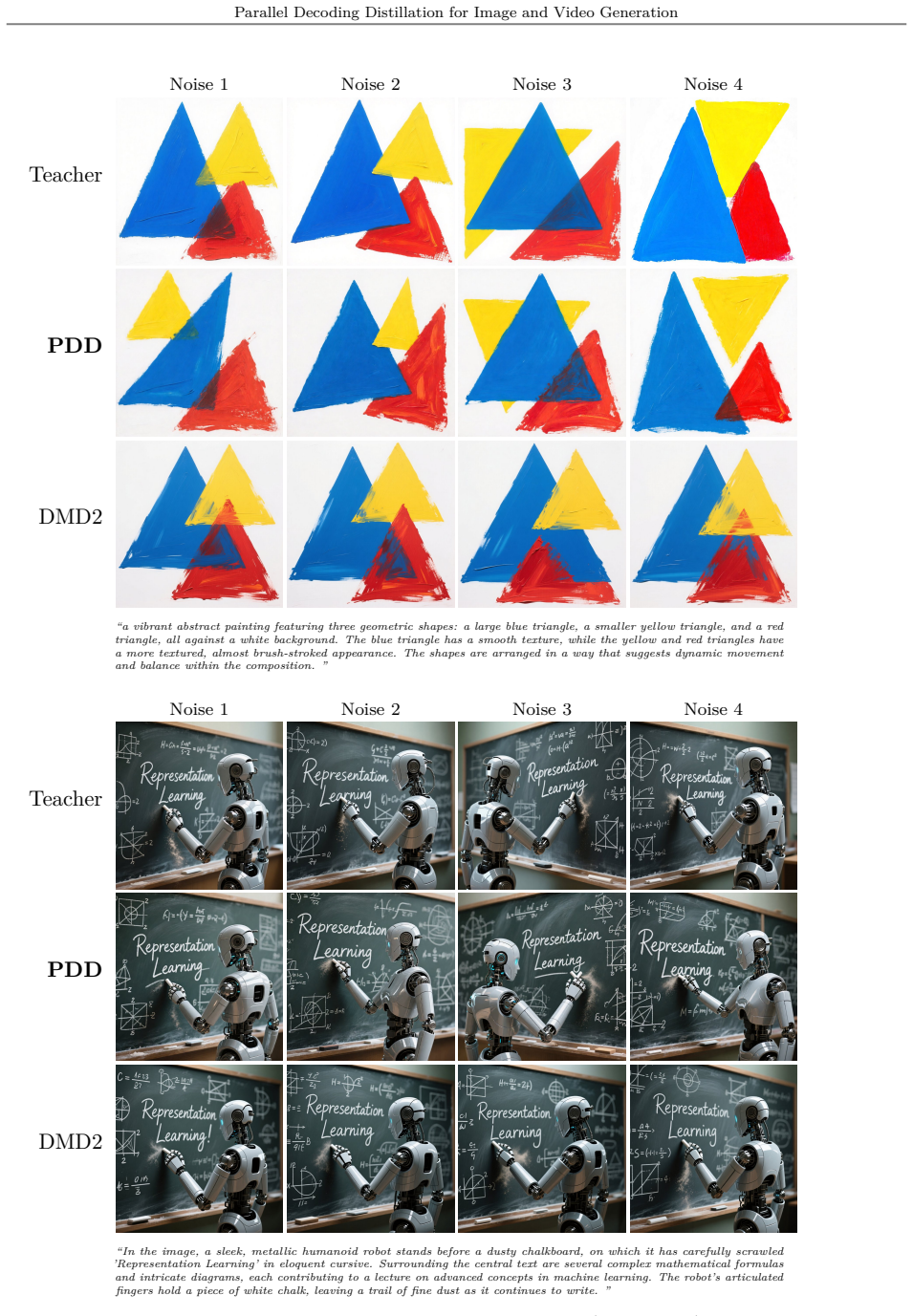
- [Tables 4 and 5 vs. Abstract] The abstract and introduction state 'SOTA performance' and 'significant improvement in generated video diversity.' The tables are more nuanced: on Wan2.1 14B, AnyFlow has higher VBench Overall than PDD-short at both 4 NFE (84.95 vs. 84.92) and 8 NFE (85.08 vs. 84.96); on HPSv2 and PickScore, DMD2 remains ahead at 4 and 8 NFE (e.g., HPSv2 32.34 vs. 31.33 at 4 NFE). The diversity comparisons are also reported on pairwise feature distances without confidence intervals or seed variability, and the 'significant improvement' is primarily qualitative. Please temper the claims to match the evidence, e.g., 'competitive or state-of-the-art on specific benchmarks' and 'improved diversity relative to distribution-based baselines in our measurements.'
- [Section 3, Eq. (13), Appendix B.3, Figure 17] The architecture assumes that a single shared backbone feature H_tn(X_n), linearly decoded by N heads, can represent the teacher per-interval mean velocities u_k(X_k) for k > n. This is a capacity/realizability assumption that is never demonstrated. Figure 17 reports average intra-block curvature over 10 trajectories, which is a weak proxy: it does not compare the student's per-interval predictions against the teacher's u_k at the corresponding states, nor does it measure representational error. Some statement about capacity (e.g., an ablation of the number of heads or a per-interval prediction-error plot) is needed to support the architecture choice, particularly for long blocks.
minor comments (5)
- [Appendix B.2, checkpoint selection] The Qwen-Image models are evaluated at the iteration that achieves the best average on the three benchmarks (1250 for Euler, 2250 for Midpoint). This is effectively checkpoint selection on the test set; it should be disclosed more prominently, and ideally the variance across nearby checkpoints should be reported.
- [Table 5 and Figure 22] The LTX-2.3 comparison in Figure 22 is based on a Gemini 3.1 Pro Preview judge on 100 prompts, with PDD winning 142, tying 35, and losing 123 of 300 paired comparisons (mean score 2.62 vs. 2.59). This is a very small aggregate margin; the text should not describe this as clearly 'on par or better' without also reporting the per-axis margins and the judge's reliability.
- [Throughout] Several tables have formatting artifacts ('T able 3', 'T able 5'), and the author line contains a stray space in 'Arash V ahdat'. Please proofread.
- [Section 5, Tables 2-5] All benchmark numbers are reported without confidence intervals or repeated-run variability. Given that differences between top methods are often small (e.g., 84.92 vs. 84.95 on VBench), error bars or at least a statement of evaluation budget would help assess whether the differences are meaningful.
- [Figure 17] The figure measures 'average curvature' but the definition of curvature is not given. Please specify how curvature is computed, over what time interval, and why intra-block curvature is the relevant quantity for validating the representational capacity of the parallel decoder.
Circularity Check
No circularity: the PD loss is a standard student-teacher regression onto frozen teacher targets; Proposition 1 is a zero-loss characterization, not a tautology.
full rationale
The core derivation chain is a conventional student-teacher distillation. The student map in Eq. (13) learns N linear heads over a shared backbone, and the PD loss (11) regresses those predictions onto the frozen pretrained teacher's Runge-Kutta approximation of the mean velocity. The target u_k(sg(\bar X_k)) depends on student states only through a stop-gradient on-policy rollout, and the teacher itself is never trained or fit to the student. Proposition 1 (Appendix D) is not circular: it assumes a global minimizer with zero loss and proves by induction on the block that the student state \bar X_k equals the teacher state X_k, converting the zero-loss equality (22) into the parallel-decoder condition (8). This is a mathematical characterization of a zero-loss fixed point, not an identity imposed by definition. The fused-layer identity (14)-(15) is an algebraic reparameterization of the block update and introduces no circularity. Self-citations in the paper (FastGen [38] as a baseline implementation, Bespoke non-stationary solvers [48] for the shift time transformation) are background or evaluation tools and are not used to define the PDD objective or to prove the central claim. The principal weakness is a correctness gap rather than circularity: the large-scale text-to-image and video experiments use the data-free Algorithm 3, which advances states by the student's own block-step rule instead of sampling X_n ~ p_{t_n} as assumed in Proposition 1, and the practical targets are Euler/Midpoint approximations rather than exact mean velocities. These are unproven assumptions about distribution shift and error accumulation, but they do not amount to the derivation reducing to its own inputs. Because the method is a regression onto externally computed, frozen-teacher targets and is benchmarked against independent checkpoints and metrics, the paper is self-contained with respect to circularity and receives score 0.
Axiom & Free-Parameter Ledger
free parameters (6)
- Grid size N =
64/128 for ImageNet; 128/256 for text-to-image/video; 256 for LTX Euler
- Block-size range L_min..L_max =
Chosen so inference NFE is 1/2/4/8 for ImageNet and 2/4/8 or 4/8 for others
- Shift scale s in time reparameterization (16) =
5 for Qwen, 6 for Wan, 10 for LTX
- CFG guidance scale w =
2.7/2.9/3.2 for ImageNet, 4 for Qwen, 5 for Wan
- CFG unconditional layer skip =
layer 10 for Wan 1.3B, layer 12 for Wan 14B
- Checkpoint selection iteration =
Qwen: 1250 (Euler), 2250 (Midpoint); Wan 1.3B: 25/225; Wan 14B: 200/3000; LTX: 250
axioms (5)
- domain assumption The generator is a deterministic flow with well-defined velocity field v_t and source distribution p_0 (Eq. 1), and pretrained models use the linear interpolant (Eq. 2).
- domain assumption The pretrained teacher flow model is frozen and treated as the ground-truth generator to match.
- ad hoc to paper The PD objective is realizable and its global minimum is zero; the teacher mean velocity is approximated with one Euler or Midpoint step.
- ad hoc to paper The student backbone, with block-start time conditioning and N linear heads, has enough capacity to represent all per-interval mean velocities u_k(X_k) from X_n alone.
- domain assumption Data-free on-policy training (Algorithm 3), with stop-gradient state advancement, provides a training distribution that covers the generation-time distribution.
read the original abstract
Generation in video diffusion or flow models is computationally expensive due to the slow and iterative sampling process. Current state-of-the-art (SOTA) acceleration methods heavily rely on variational score distillation (VSD) and adversarial losses to distill diffusion models into few-step generators. Albeit achieving high-quality video generation, these training losses are notoriously hard to optimize and suffer from mode collapse, leading to loss of video diversity and lack of motion. In this paper, we introduce Parallel Decoding Distillation (PDD), a simplified and scalable trajectory-based distillation method for fast inference of diffusion and flow matching models. Our architecture and training procedure are compatible with any pre-trained model and support sampling with a varying number of function evaluations (NFE). PDD accelerates generation by predicting multiple denoising steps per network evaluation. Conceptually, it learns a representation of the mean velocity without regressing its derivative using JVPs or finite-difference approximations. Our method achieves SOTA performance with 4-8 NFE on LTX-2.3 Text-to-Video/Audio, Wan 14B Text-to-Video, and Qwen-Image Text-to-Image. Moreover, PDD presents a significant improvement in generated video diversity.
Figures




Reference graph
Works this paper leans on
-
[1]
Albergo, Nicholas M
Michael S. Albergo, Nicholas M. Boffi, and Eric Vanden-Eijnden. Stochastic interpolants: A unifying framework for flows and diffusions,
-
[2]
V-jepa 2: Self-supervised video models enable un- derstanding, prediction and planning, 2025
MidoAssran, AdrienBardes, DavidFan, Quentin Garrido, Russell Howes, Mojtaba, Komeili, Matthew Muckley, Ammar Rizvi, Claire Roberts, Koustuv Sinha, Artem Zholus, Sergio Arnaud, Abha Gejji, Ada Martin, Francois Robert Hogan, Daniel Dugas, Piotr Bojanowski, Vasil Khali- dov, Patrick Labatut, Francisco Massa, Marc Szafraniec, Kapil Krishnakumar, Yong Li, Xi- ...
Pith/arXiv arXiv 2025
-
[3]
Nicholas M. Boffi, Michael S. Albergo, and Eric Vanden-Eijnden. Flow map matching with stochastic interpolants: A mathematical frame- work for consistency models, 2025. URLhttps: //arxiv.org/abs/2406.07507
Pith/arXiv arXiv 2025
-
[4]
Boffi, Michael S
Nicholas M. Boffi, Michael S. Albergo, and Eric Vanden-Eijnden. How to build a consistency model: Learning flow maps via self-distillation,
-
[5]
Shortcutting pre-trained flow matching diffusion models is almost free lunch, 2025
Xu Cai, Yang Wu, Qianli Chen, Haoran Wu, Lichuan Xiang, and Hongkai Wen. Shortcutting pre-trained flow matching diffusion models is almost free lunch, 2025. URLhttps://arxiv. org/abs/2510.17858
arXiv 2025
-
[6]
URL https://arxiv.org/abs/2505. 18825
-
[7]
pi-flow: Policy-based few-step generation via imitation distillation, 2025
Hansheng Chen, Kai Zhang, Hao Tan, Leonidas Guibas, Gordon Wetzstein, and Sai Bi. pi-flow: Policy-based few-step generation via imitation distillation, 2025. URLhttps://arxiv.org/ abs/2510.14974
arXiv 2025
-
[8]
Oneig-bench: Omni- dimensional nuanced evaluation for image gener- ation, 2025
Jingjing Chang, Yixiao Fang, Peng Xing, Shuhan Wu, Wei Cheng, Rui Wang, Xianfang Zeng, Gang Yu, and Hai-Bao Chen. Oneig-bench: Omni- dimensional nuanced evaluation for image gener- ation, 2025. URLhttps://arxiv.org/abs/ 2506.07977
Pith/arXiv arXiv 2025
-
[9]
Lightx2v: Light video generation inference framework
LightX2V Contributors. Lightx2v: Light video generation inference framework. https:// github.com/ModelTC/lightx2v, 2025
2025
-
[10]
Twinflow: Realizing one-step gener- ation on large models with self-adversarial flows,
Zhenglin Cheng, Peng Sun, Jianguo Li, and Tao Lin. Twinflow: Realizing one-step gener- ation on large models with self-adversarial flows,
-
[11]
Phased dmd: Few-step distribution matching distil- lation via score matching within subintervals,
Xiangyu Fan, Zesong Qiu, Zhuguanyu Wu, Fanzhou Wang, Zhiqian Lin, Tianxiang Ren, Dahua Lin, Ruihao Gong, and Lei Yang. Phased dmd: Few-step distribution matching distil- lation via score matching within subintervals,
-
[12]
One step diffusion via short- cut models, 2025
Kevin Frans, Danijar Hafner, Sergey Levine, and Pieter Abbeel. One step diffusion via short- cut models, 2025. URLhttps://arxiv.org/ abs/2410.12557
Pith/arXiv arXiv 2025
-
[13]
Scaling rectified flow transformers for high-resolution image synthe- sis, 2024
Patrick Esser, SumithKulal, AndreasBlattmann, Rahim Entezari, Jonas Müller, Harry Saini, Yam Levi, Dominik Lorenz, Axel Sauer, Frederic Boe- sel, Dustin Podell, Tim Dockhorn, Zion En- glish, Kyle Lacey, Alex Goodwin, Yannik Marek, and Robin Rombach. Scaling rectified flow transformers for high-resolution image synthe- sis, 2024. URL https://arxiv.org/abs/...
Pith/arXiv arXiv 2024
-
[14]
Zhengyang Geng, Mingyang Deng, Xingjian Bai, J. Zico Kolter, and Kaiming He. Mean flows for one-step generative modeling, 2025. URL https://arxiv.org/abs/2505.13447
Pith/arXiv arXiv 2025
-
[15]
URL https://arxiv.org/abs/2510. 27684
-
[16]
Geneval: An object-focused frame- work for evaluating text-to-image alignment,
Dhruba Ghosh, Hanna Hajishirzi, and Ludwig Schmidt. Geneval: An object-focused frame- work for evaluating text-to-image alignment,
-
[17]
Zhengyang Geng, Ashwini Pokle, William Luo, Justin Lin, and J. Zico Kolter. Consistency mod- els made easy, 2024. URL https://arxiv. org/abs/2406.14548
Pith/arXiv arXiv 2024
-
[18]
Splitmeanflow: Interval split- ting consistency in few-step generative modeling, 11 Parallel Decoding Distillation for Image and Video Generation
Yi Guo, Wei Wang, Zhihang Yuan, Rong Cao, Kuan Chen, Zhengyang Chen, Yuanyuan Huo, Yang Zhang, Yuping Wang, Shouda Liu, and Yuxuan Wang. Splitmeanflow: Interval split- ting consistency in few-step generative modeling, 11 Parallel Decoding Distillation for Image and Video Generation
-
[19]
Zhengyang Geng, Yiyang Lu, Zongze Wu, Eli Shechtman, J. Zico Kolter, and Kaiming He. Im- proved mean flows: On the challenges of fast- forward generative models, 2025. URLhttps: //arxiv.org/abs/2512.02012
Pith/arXiv arXiv 2025
-
[20]
Classifier- free diffusion guidance, 2022
Jonathan Ho and Tim Salimans. Classifier- free diffusion guidance, 2022. URL https: //arxiv.org/abs/2207.12598
Pith/arXiv arXiv 2022
-
[21]
De- noising diffusion probabilistic models, 2020
Jonathan Ho, Ajay Jain, and Pieter Abbeel. De- noising diffusion probabilistic models, 2020. URL https://arxiv.org/abs/2006.11239
Pith/arXiv arXiv 2020
-
[22]
Anyflow: Any-step video diffusion model with on- policy flow map distillation, 2026
Yuchao Gu, Guian Fang, Yuxin Jiang, Weijia Mao, Song Han, Han Cai, and Mike Zheng Shou. Anyflow: Any-step video diffusion model with on- policy flow map distillation, 2026. URLhttps: //arxiv.org/abs/2605.13724
Pith/arXiv arXiv 2026
-
[23]
Cmt: Mid-training for ef- ficient learning of consistency, mean flow, and flow map models, 2026
Zheyuan Hu, Chieh-Hsin Lai, Yuki Mitsufuji, and Stefano Ermon. Cmt: Mid-training for ef- ficient learning of consistency, mean flow, and flow map models, 2026. URLhttps://arxiv. org/abs/2509.24526
arXiv 2026
-
[24]
URL https://arxiv.org/abs/2507. 16884
-
[25]
Ltx-2: Efficient joint audio-visual foundation model,
YoavHaCohen, BennyBrazowski, NisanChiprut, Yaki Bitterman, Andrew Kvochko, Avishai Berkowitz, Daniel Shalem, Daphna Lifschitz, Dudu Moshe, Eitan Porat, Eitan Richardson, Guy Shiran, Itay Chachy, Jonathan Chetboun, Michael Finkelson, Michael Kupchick, Nir Zabari, Nitzan Guetta, Noa Kotler, Ofir Bibi, Ori Gor- don, Poriya Panet, Roi Benita, Shahar Armon, Vi...
-
[26]
URL https://arxiv.org/abs/2601. 03233
-
[27]
Decoupled meanflow: Turning flow models into flow maps for accelerated sampling, 2025
Kyungmin Lee, Sihyun Yu, and Jinwoo Shin. Decoupled meanflow: Turning flow models into flow maps for accelerated sampling, 2025. URL https://arxiv.org/abs/2510.24474
arXiv 2025
-
[28]
Diffusion adversar- ial post-training for one-step video generation,
ShanchuanLin, XinXia, YuxiRen, CeyuanYang, Xuefeng Xiao, and Lu Jiang. Diffusion adversar- ial post-training for one-step video generation,
-
[29]
Ella: Equip diffusion modelswithllmforenhancedsemanticalignment,
Xiwei Hu, Rui Wang, Yixiao Fang, Bin Fu, Pei Cheng, and Gang Yu. Ella: Equip diffusion modelswithllmforenhancedsemanticalignment,
-
[30]
Flow straight and fast: Learning to generate and transfer data with rectified flow, 2022
Xingchao Liu, Chengyue Gong, and Qiang Liu. Flow straight and fast: Learning to generate and transfer data with rectified flow, 2022. URL https://arxiv.org/abs/2209.03003
Pith/arXiv arXiv 2022
-
[31]
Decoupled weight decay regularization, 2019
Ilya Loshchilov and Frank Hutter. Decoupled weight decay regularization, 2019. URLhttps: //arxiv.org/abs/1711.05101
Pith/arXiv arXiv 2019
-
[32]
Vbench: Comprehensive benchmark suite for video generative models, 2023
Ziqi Huang, Yinan He, Jiashuo Yu, Fan Zhang, Chenyang Si, Yuming Jiang, Yuanhan Zhang, Tianxing Wu, Qingyang Jin, Nattapol Chan- paisit, Yaohui Wang, Xinyuan Chen, Limin Wang, Dahua Lin, Yu Qiao, and Ziwei Liu. Vbench: Comprehensive benchmark suite for video generative models, 2023. URL https: //arxiv.org/abs/2311.17982
Pith/arXiv arXiv 2023
-
[33]
Hunyuanvideo: A systematic framework for large video generative models, 2025
Weijie Kong, Qi Tian, Zijian Zhang, Rox Min, Zuozhuo Dai, Jin Zhou, Jiangfeng Xiong, Xin Li, Bo Wu, Jianwei Zhang, Kathrina Wu, Qin Lin, Junkun Yuan, Yanxin Long, Aladdin Wang, An- dong Wang, Changlin Li, Duojun Huang, Fang Yang, Hao Tan, Hongmei Wang, Jacob Song, Ji- awangBai, JianbingWu, JinbaoXue, JoeyWang, Kai Wang, Mengyang Liu, Pengyu Li, Shuai Li, ...
Pith/arXiv arXiv 2025
-
[34]
FLUX.2: Frontier Visual In- telligence
Black Forest Labs. FLUX.2: Frontier Visual In- telligence. https://bfl.ai/blog/flux-2, 2025
2025
-
[35]
Soflow: Solution flow models for one-step gen- erative modeling, 2026
Tianze Luo, Haotian Yuan, and Zhuang Liu. Soflow: Solution flow models for one-step gen- erative modeling, 2026. URLhttps://arxiv. org/abs/2512.15657
arXiv 2026
-
[36]
Zico Kolter, and Guo jun Qi
Weijian Luo, Zemin Huang, Zhengyang Geng, J. Zico Kolter, and Guo jun Qi. One-step diffu- sion distillation through score implicit matching, 12 Parallel Decoding Distillation for Image and Video Generation
-
[37]
URL https://arxiv.org/abs/2501. 08316
-
[38]
Yaron Lipman, Ricky T. Q. Chen, Heli Ben- Hamu, Maximilian Nickel, and Matt Le. Flow matching for generative modeling, 2023. URL https://arxiv.org/abs/2210.02747
Pith/arXiv arXiv 2023
-
[39]
Transition matching distillation for fast video generation,
Weili Nie, Julius Berner, Nanye Ma, Chao Liu, Saining Xie, and Arash Vahdat. Transition matching distillation for fast video generation,
-
[40]
Cosmos 3: Omnimodal world models for physical ai, 2026
NVIDIA. Cosmos 3: Omnimodal world models for physical ai, 2026. URL https://arxiv. org/abs/2606.02800
Pith/arXiv arXiv 2026
-
[41]
Simplifying, stabiliz- ing and scaling continuous-time consistency mod- els, 2025
Cheng Lu and Yang Song. Simplifying, stabiliz- ing and scaling continuous-time consistency mod- els, 2025. URL https://arxiv.org/abs/ 2410.11081
Pith/arXiv arXiv 2025
-
[42]
One-step latent-free image generation with pixel mean flows, 2026
Yiyang Lu, Susie Lu, Qiao Sun, Hanhong Zhao, Zhicheng Jiang, Xianbang Wang, Tianhong Li, Zhengyang Geng, and Kaiming He. One-step latent-free image generation with pixel mean flows, 2026. URLhttps://arxiv.org/abs/ 2601.22158
Pith/arXiv arXiv 2026
-
[43]
Latent consistency models: Synthesizing high-resolution images with few- step inference, 2023
Simian Luo, Yiqin Tan, Longbo Huang, Jian Li, and Hang Zhao. Latent consistency models: Synthesizing high-resolution images with few- step inference, 2023. URL https://arxiv. org/abs/2310.04378
Pith/arXiv arXiv 2023
-
[44]
Align your flow: Scaling continuous-time flow map distillation, 2025
Amirmojtaba Sabour, Sanja Fidler, and Karsten Kreis. Align your flow: Scaling continuous-time flow map distillation, 2025. URL https:// arxiv.org/abs/2506.14603
Pith/arXiv arXiv 2025
-
[45]
Progressive distillation for fast sampling of diffusion models,
Tim Salimans and Jonathan Ho. Progressive distillation for fast sampling of diffusion models,
-
[46]
URL https://arxiv.org/abs/2410. 16794
-
[47]
Im- proved training technique for shortcut models,
Anh Nguyen, Viet Nguyen, Duc Vu, Trung Dao, Chi Tran, Toan Tran, and Anh Tran. Im- proved training technique for shortcut models,
-
[48]
URL https://arxiv.org/abs/2510. 21250
-
[49]
Nvidia fastgen: Fast generation from diffusion models, 2026
Weili Nie, Julius Berner, Chao Liu, and Arash Vahdat. Nvidia fastgen: Fast generation from diffusion models, 2026. URLhttps://github. com/NVlabs/FastGen
2026
-
[50]
Improved techniques for training consistency models,
Yang Song and Prafulla Dhariwal. Improved techniques for training consistency models,
-
[51]
URL https://arxiv.org/abs/2601. 09881
-
[52]
Yang Song, Prafulla Dhariwal, Mark Chen, and Ilya Sutskever. Consistency models, 2023. URL https://arxiv.org/abs/2303.01469
Pith/arXiv arXiv 2023
-
[53]
Eflow: Fast few-step video generator training from scratch via efficient solution flow,
Dogyun Park, Yanyu Li, Sergey Tulyakov, and Anil Kag. Eflow: Fast few-step video generator training from scratch via efficient solution flow,
-
[54]
URL https://arxiv.org/abs/2603. 27086
-
[55]
High- resolution image synthesis with latent diffusion models, 2022
Robin Rombach, Andreas Blattmann, Dominik Lorenz, Patrick Esser, and Björn Ommer. High- resolution image synthesis with latent diffusion models, 2022. URL https://arxiv.org/ abs/2112.10752
Pith/arXiv arXiv 2022
-
[56]
Olga Russakovsky, Jia Deng, Hao Su, Jonathan Krause, Sanjeev Satheesh, Sean Ma, Zhi- heng Huang, Andrej Karpathy, Aditya Khosla, MichaelBernstein, AlexanderC.Berg, andLiFei- Fei. ImageNet Large Scale Visual Recogni- tion Challenge.International Journal of Com- puter Vision (IJCV), 115(3):211–252, 2015. doi: 10.1007/s11263-015-0816-y
-
[57]
Videomae v2: Scaling video masked autoencoders with dual masking, 2023
Limin Wang, Bingkun Huang, Zhiyu Zhao, Zhan Tong, Yinan He, Yi Wang, Yali Wang, and Yu Qiao. Videomae v2: Scaling video masked autoencoders with dual masking, 2023. URL https://arxiv.org/abs/2303.16727
Pith/arXiv arXiv 2023
-
[58]
VidProM: A million- scale real prompt-gallery dataset for text-to- video diffusion models, 2024
Wenhao Wang and Yi Yang. VidProM: A million- scale real prompt-gallery dataset for text-to- video diffusion models, 2024. URL https: //arxiv.org/abs/2403.06098
Pith/arXiv arXiv 2024
-
[59]
Pro- lificdreamer: High-fidelity and diverse text-to- 3d generation with variational score distillation,
Zhengyi Wang, Cheng Lu, Yikai Wang, Fan Bao, Chongxuan Li, Hang Su, and Jun Zhu. Pro- lificdreamer: High-fidelity and diverse text-to- 3d generation with variational score distillation,
-
[60]
Adver- sarial diffusion distillation, 2023
Axel Sauer, Dominik Lorenz, Andreas Blattmann, and Robin Rombach. Adver- sarial diffusion distillation, 2023. URL https://arxiv.org/abs/2311.17042
Pith/arXiv arXiv 2023
-
[61]
Fast high-resolution image synthe- sis with latent adversarial diffusion distillation,
Axel Sauer, Frederic Boesel, Tim Dockhorn, Andreas Blattmann, Patrick Esser, and Robin Rombach. Fast high-resolution image synthe- sis with latent adversarial diffusion distillation,
-
[62]
URL https://arxiv.org/abs/2403. 12015
-
[63]
Neta Shaul, Uriel Singer, Ricky T. Q. Chen, Matthew Le, Ali Thabet, Albert Pumarola, and Yaron Lipman. Bespoke non-stationary solvers for fast sampling of diffusion and flow models,
-
[64]
URL https://arxiv.org/abs/2403. 01329
-
[65]
Weiss, Niru Mah- eswaranathan, and Surya Ganguli
Jascha Sohl-Dickstein, Eric A. Weiss, Niru Mah- eswaranathan, and Surya Ganguli. Deep unsu- pervised learning using nonequilibrium thermo- dynamics, 2015. URL https://arxiv.org/ abs/1503.03585
Pith/arXiv arXiv 2015
-
[66]
Tianwei Yin, Michaël Gharbi, Taesung Park, Richard Zhang, Eli Shechtman, Fredo Durand, and William T. Freeman. Improved distribution matching distillation for fast image synthesis,
-
[67]
URL https://arxiv.org/abs/2310. 14189
-
[68]
Kingma, Abhishek Kumar, Stefano Ermon, and Ben Poole
Yang Song, Jascha Sohl-Dickstein, Diederik P. Kingma, Abhishek Kumar, Stefano Ermon, and Ben Poole. Score-based generative mod- eling through stochastic differential equations,
-
[69]
Alphaflow: Understanding and improving meanflow models,
Huijie Zhang, Aliaksandr Siarohin, Willi Mena- pace, Michael Vasilkovsky, Sergey Tulyakov, Qing Qu, and Ivan Skorokhodov. Alphaflow: Understanding and improving meanflow models,
-
[70]
Large scale diffusion distillation via score-regularized continuous-time consistency,
Kaiwen Zheng, Yuji Wang, Qianli Ma, Huayu Chen, Jintao Zhang, Yogesh Balaji, Jianfei Chen, Ming-Yu Liu, Jun Zhu, and Qinsheng Zhang. Large scale diffusion distillation via score-regularized continuous-time consistency,
-
[71]
Any-step genera- tion via n-th order recursive consistent veloc- ity field estimation
Peng Sun and Tao Lin. Any-step genera- tion via n-th order recursive consistent veloc- ity field estimation. InThe Fourteenth In- ternational Conference on Learning Represen- tations, 2026. URL https://openreview. net/forum?id=GnawtLKGkP
2026
-
[72]
Joshua Tian Jin Tee, Kang Zhang, Hee Suk Yoon, Dhananjaya Nagaraja Gowda, Chanwoo Kim, and Chang D. Yoo. Physics informed distillation for diffusion models, 2024. URL https://arxiv.org/abs/2411.08378
Pith/arXiv arXiv 2024
-
[73]
Flow map distillation without data, 2025
Shangyuan Tong, Nanye Ma, Saining Xie, and Tommi Jaakkola. Flow map distillation without data, 2025. URL https://arxiv.org/abs/ 2511.19428
arXiv 2025
-
[74]
Wan: Open and advanced large-scale video generative models, 2025
Team Wan, Ang Wang, Baole Ai, Bin Wen, Chaojie Mao, Chen-Wei Xie, Di Chen, Feiwu Yu, Haiming Zhao, Jianxiao Yang, Jianyuan Zeng, JiayuWang, JingfengZhang, JingrenZhou, Jinkai Wang, Jixuan Chen, Kai Zhu, Kang Zhao, 13 Parallel Decoding Distillation for Image and Video Generation Keyu Yan, Lianghua Huang, Mengyang Feng, Ningyi Zhang, Pandeng Li, Pingyu Wu, ...
Pith/arXiv arXiv 2025
-
[78]
URL https://arxiv.org/abs/2305. 16213
-
[79]
Transition models: Rethinking the gen- erative learning objective, 2025
Zidong Wang, Yiyuan Zhang, Xiaoyu Yue, Xi- angyu Yue, Yangguang Li, Wanli Ouyang, and Lei Bai. Transition models: Rethinking the gen- erative learning objective, 2025. URL https: //arxiv.org/abs/2509.04394
Pith/arXiv arXiv 2025
-
[80]
Qwen- image technical report, 2025
Chenfei Wu, Jiahao Li, Jingren Zhou, Junyang Lin, Kaiyuan Gao, Kun Yan, Sheng ming Yin, Shuai Bai, Xiao Xu, Yilei Chen, Yuxiang Chen, Zecheng Tang, Zekai Zhang, Zhengyi Wang, An Yang, Bowen Yu, Chen Cheng, Dayiheng Liu, Deqing Li, Hang Zhang, Hao Meng, Hu Wei, Jingyuan Ni, Kai Chen, Kuan Cao, Liang Peng, Lin Qu, Minggang Wu, Peng Wang, Shuting Yu, Tingkun...
Pith/arXiv arXiv 2025
-
[81]
Xiaoshi Wu, Yiming Hao, Keqiang Sun, Yix- iong Chen, Feng Zhu, Rui Zhao, and Hong- sheng Li. Human preference score v2: A solid benchmark for evaluating human preferences of text-to-image synthesis, 2023. URLhttps: //arxiv.org/abs/2306.09341
Pith/arXiv arXiv 2023
-
[82]
Spectral progressive diffusion for efficient image and video generation, 2026
Howard Xiao, Brian Chao, Lior Yariv, and Gor- don Wetzstein. Spectral progressive diffusion for efficient image and video generation, 2026. URL https://arxiv.org/abs/2605.18736
Pith/arXiv arXiv 2026
-
[83]
One-step diffusion models with𝑓-divergence distribution matching, 2025
YilunXu, WeiliNie, andArashVahdat. One-step diffusion models with𝑓-divergence distribution matching, 2025. URL https://arxiv.org/ abs/2502.15681
Pith/arXiv arXiv 2025
discussion (0)
Sign in with ORCID, Apple, or X to comment. Anyone can read and Pith papers without signing in.