REVIEW 5 major objections 5 minor 5 cited by
This paper argues that accretion onto a magnetized, rapidly spinning Kerr–Bertotti–Robinson black hole cyclically switches between a violently oscillating shock cone and a near-stationary torus, and that this alternation naturally produces
Reviewed by Pith at T0; open to challenge. T0 means a machine referee read the full paper against a public rubric. the ladder, T0–T4 →
T0 review · deepseek-v4-flash
2026-08-03 03:07 UTC pith:DGZ4WJUI
load-bearing objection The accretion simulations are new and worth a look, but the QPO peaks are not yet robust enough to support the unified framework. the 5 major comments →
Dynamics, Ringdown, and Accretion-Driven Multiple Quasi-Periodic Oscillations of Kerr-Bertotti-Robinson Black Holes
The pith
A machine-rendered reading of the paper's core claim, the machinery that carries it, and where it could break.
Core claim
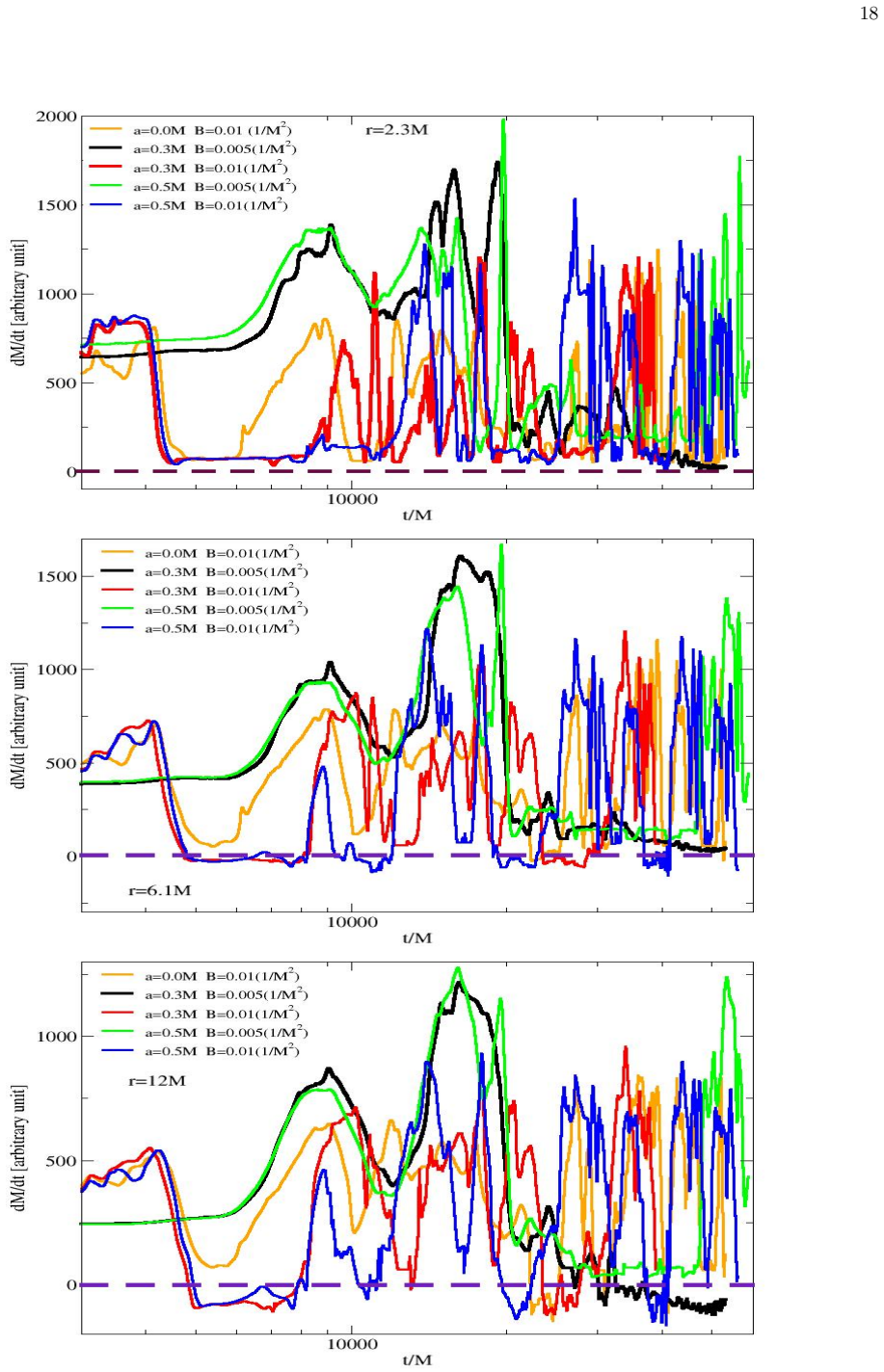
The central claim is that the KBR spacetime—a rotating black hole threaded by a uniform external magnetic field—naturally produces two dynamically distinct accretion states under Bondi–Hoyle–Lyttleton wind accretion. For rapid spin (a=0.9M) and moderate magnetic parameter (B=0.005 or 0.01), the classical Kerr shock cone is destroyed; the flow either develops a wide-angle, strongly oscillating flip-flop shock cone or reorganizes into a dense, quasi-stationary torus near the ISCO. These two morphologies alternate in time, and the transition is controlled by the magnetic parameter and by angular-momentum redistribution. The power spectra of the mass accretion rate in the two states show charact
What carries the argument
The central object is the Kerr–Bertotti–Robinson (KBR) metric, an exact Einstein–Maxwell solution describing a rotating black hole immersed in a uniform magnetic field, with parameters mass M, spin a, and magnetic curvature parameter B. The metric reduces to Kerr when B=0. The argument is carried by three complementary analyses: (1) geodesic and epicyclic-frequency calculations for test particles, which show how B shifts the energy, angular momentum, and oscillation frequencies; (2) a WKB computation of scalar quasinormal modes showing that B increases damping while spin and angular momentum set the oscillation frequency; and (3) fully general-relativistic hydrodynamic simulations of Bondi–H
Load-bearing premise
The unifying QPO interpretation rests on the premise that the power-spectral peaks extracted from the simulations are robust, spacetime-determined modes rather than artifacts of the numerical setup, since the paper provides no resolution convergence test, no variation of the wind parameters, and no Kerr (B=0) control run.
What would settle it
A single high-resolution run of the same BHL accretion setup at, say, double the grid resolution, or with a different wind speed/density profile, should reproduce the same QPO peak frequencies in the torus phase. If the peaks shift, broaden, or disappear under resolution change or window choice, the claim that these are spacetime-driven modes fails. Similarly, a direct comparison with a Kerr (B=0) simulation under identical conditions should show no such alternating two-state morphology; if Kerr also produces the two states, the magnetic field is not the cause.
If this is right
- If the KBR accretion framework is correct, the co-occurrence of low- and high-frequency QPOs in a single X-ray binary does not require separate emission regions; a single magnetized, rapidly spinning black hole can alternate between shock-dominated and torus-dominated states.
- The recurring QPO frequencies at different epochs and radii follow from the spacetime parameters (M, a, B) rather than from transient flow conditions, matching observations in which QPO peaks persist across spectral states.
- The magnetic field parameter B acts as a control parameter: increasing B makes the transition to the torus occur earlier (t≈7000M vs t≈18000M) and changes the frequency content, so magnetized black holes should show a correlation between accretion-state switching times and QPO frequencies.
- Quasinormal-mode ringdowns of KBR black holes carry a magnetic imprint: B lowers the real frequency and increases damping, offering a possible gravitational-wave signature of external magnetic fields.
- Test-particle epicyclic frequencies in KBR differ from Kerr, so fitting observed high-frequency QPO pairs to these frequencies could provide a way to estimate both a and B for a given source.
Where Pith is reading between the lines
- A testable extension: the model predicts that the transition time from flip-flop shock to torus should scale with the magnetic parameter B; comparing this timescale with observed state-transition timescales in sources like GRS 1915+105 would provide an independent check.
- The paper treats the magnetic field as a fixed spacetime parameter; in a real accretion flow the field is dynamical. A natural follow-up would be to include magnetic field evolution (MHD) to see whether the alternating shock/torus states survive when the field is allowed to react to the flow.
- The QPO frequencies are computed for a 10 solar-mass black hole; scaling the same dimensionless frequencies to other masses predicts that the same sources should show QPO frequencies inversely proportional to mass, which can be compared with the observed mass–QPO scaling in stellar-mass and intermediate-mass black holes.
- The numerical identification of QPOs relies on PSD peaks selected after the fact; the paper's own interpretation would be strengthened if future work computes PSDs over a fixed, pre-registered time window and varies numerical resolution.
Editorial analysis
A structured set of objections, weighed in public.
Referee Report
Summary. The manuscript is a three-part study of the Kerr–Bertotti–Robinson (KBR) black hole: (i) bound test-particle dynamics (energy, angular momentum, effective potential, epicyclic frequencies); (ii) scalar quasinormal modes via a WKB/eikonal treatment; and (iii) general-relativistic hydrodynamic Bondi–Hoyle–Lyttleton (BHL) accretion simulations, whose power spectra are interpreted as low- and high-frequency quasi-periodic oscillations (QPOs) and compared with X-ray binary observations. The headline claim is that KBR accretion alternates between a flip-flop shock cone and a toroidal structure, and that these states produce recurrent multi-frequency QPOs, providing a unified explanation for observed LFQPO/HFQPO phenomenology.
Significance. If the hydrodynamical result were quantitatively robust, it would be a valuable contribution: it would connect a specific non-Kerr spacetime parameter to accretion-state transitions and to the simultaneous presence of LF and HF QPOs in one source, and it would motivate further study of KBR spacetimes. The paper also usefully collects a broad scan of particle-orbit and QNM parameter dependencies, and the B→0 and a→0 limits appear consistent with known Kerr/Schwarzschild behaviors. However, the central QPO claim is presently supported only by a post-hoc, window-selected PSD analysis without numerical convergence tests or a Kerr control; the observational comparison depends on a free choice M=10 M⊙. The significance is therefore conditional on the additional robustness tests requested below.
major comments (5)
- [Section VII, Fig. 16] The central QPO claim rests on PSD peaks that appear only after selecting the time window t=30000M–55000M, while the full-window PSD is described as broad. The paper reports no significance threshold, no comparison against red-noise/continuum models, and no test of peak stability under different window choices. Since ν∝1/M, the choice M=10 M⊙ is a free scaling that places the numerical frequencies into the observed ranges. Please provide full-window PSDs, a systematic window scan, and significance estimates; otherwise the claim that the peaks are persistent spacetime modes is unsupported.
- [Section V and Section VII] No numerical convergence or resolution study is reported, and the GRHD setup (grid size, boundary conditions, wind speed/density, equation of state) is not specified in this paper. There is also no Kerr (B=0) PSD control: Fig. 11 shows Kerr morphologies but no Kerr power spectra. Since flip-flop and shock-cone variability are known features of BHL accretion in Kerr-like flows, the low-frequency peaks could be generic. The authors should show that the QPO peaks survive resolution changes and that they are absent or substantially different for B=0 before attributing them to KBR geometry.
- [Section VIII vs. Section IX] The mechanism-to-frequency assignment is internally contradictory. Section VIII states that "in the toroidal configuration we numerically obtain LFQPOs together with moderate amplitude HFQPOs ... whereas in the purely strong flip-flop phase only HFQPOs are present." Section IX concludes that "LFQPOs are caused by large-scale shock oscillations and repetitive spiral shock generation. While the toroidal flow mainly stimulates HFQPOs..." This is a direct conflict in the mapping that supports the unified QPO interpretation and must be resolved.
- [Section II.A and Abstract] The abstract and Introduction promise "analytical expressions for the energy and angular momentum of stable equatorial circular orbits" and for the oscillation frequencies, but no closed-form expressions are written out. The results are presented only as numerical plots (Figs. 1–2) and as derivatives of the effective potential (Eqs. (9)–(11)). The paper should either provide the promised expressions or revise the claim.
- [Section IV, Eqs. (16)–(23) and Figs. 6–8] The WKB treatment assumes B^2≪1, but Figs. 6 and 8 vary B up to 0.5 (B^2=0.25) and 0.3, where the reduction to the standard spheroidal equation and the leading-order potential (21) is not justified. In addition, the eikonal formula (23) is used for l=2, m=1 in Figs. 5–10. The validity of the large-l approximation at low multipoles should be demonstrated (e.g., by comparison with direct numerical integration or higher-order WKB), otherwise the reported B- and a-dependences of ωI may be artifacts.
minor comments (5)
- [Section VI] The paragraph beginning "To study the effects of black-hole spin a and magnetic curvature B on accretion, Fig. 14 shows..." appears verbatim twice; remove the duplicate.
- [Throughout] Typos and OCR artifacts: "TThrough", "sufficient", "aamong", "e accretion", and "KKB BH" in the Fig. 13 caption.
- [Section V] "The middle row of Figure 12 shows the mildly rotating BH" appears to be a cross-reference error; the row with a=0.5M is in Fig. 11, while Fig. 12 is a time sequence for a=0.9M.
- [Section IV] The text says the angular equation "reduces to the standard scalar spheroidal harmonic equation" but then calls Eq. (16) "which generalizes the spheroidal harmonic equation"; the wording should be clarified.
- [Eq. (14) and Fig. 4] The label "10 M/M" in the frequency axes is unclear; specify the mass scaling (e.g., ν for M=10 M⊙ with ν∝1/M) in the caption or axis label.
Circularity Check
No circular derivation: simulated QPOs are outputs, not fitted inputs; self-citations are methodological, not load-bearing.
full rationale
The paper's derivation chain is not circular. The particle-dynamics and epicyclic-frequency results (Secs. II–III) are direct analytic consequences of the KBR metric and standard effective-potential/Hamiltonian methods; the KBR metric is quoted as an external solution (Ref. [37]), not fitted to the paper's QPO claims. The WKB scalar QNM computation (Sec. IV) uses standard WKB/effective-potential formulas and reduces to Kerr QNMs at B=0; no QPO target enters that calculation. The GRHD BHL simulations (Secs. V–VII) evolve the same metric with standard numerical methods and produce mass-accretion-rate time series; the PSD peaks (30, 45, 57, 68 Hz for M=10 M_sun) are outputs of the simulations, not parameters fitted to observed QPOs. The comparison to GRS 1915+105, XTE J1550-564, etc. (Sec. VIII) is an observational postdiction with a physically motivated mass scaling, not a fit to the target frequencies. The paper's weaknesses—sharp peaks from a hand-selected torus window (t=30000–55000M), no stated convergence test, no Kerr (B=0) PSD control, and an internal inconsistency about whether LFQPOs come from shock or torus phases—are robustness/correctness concerns, not cases where a prediction is equivalent to its input by construction. Self-citations (Refs. [53, 63–70]) are methodological precedents rather than load-bearing theorems. Therefore the circularity score is 0.
Axiom & Free-Parameter Ledger
free parameters (4)
- Stellar mass M for QPO comparison =
10 M_sun
- Magnetic parameter B samples =
0.005/M^2 and 0.01/M^2
- Spin parameter a samples =
0, 0.3M, 0.5M, 0.9M
- GRHD simulation setup (grid, wind speed/density, EOS, boundary conditions) =
not stated in paper
axioms (5)
- domain assumption Eq. (1) is an exact Einstein-Maxwell solution (the rotating KBR metric taken from refs [37,62]).
- ad hoc to paper In the weak-field regime (B^2 << 1), the angular equation reduces to the standard spheroidal harmonic equation and Eq. (21) gives the leading-order radial potential.
- domain assumption The eikonal/QNM relation ω_QNM ≈ m_l Ω_c - i(n+1/2)|λ_c| is applied at l=2, m=1 even though it is derived in the large-l limit.
- domain assumption The BHL accretion flow is a perfect fluid on the fixed KBR background with standard wind boundary conditions; the external electromagnetic field is not evolved and backreaction is neglected.
- ad hoc to paper The QPO peaks extracted from PSDs are stationary global modes of the spacetime, not numerical artifacts or windowing effects.
read the original abstract
We study the motion of test particles around the Kerr--Bertotti--Robinson (KBR) black hole (BH) and explore how the three defining parameters, the mass $M$, rotation parameter $a$, and magnetic parameter $B$ influence their dynamics. We derive analytical expressions for the energy and angular momentum of stable equatorial circular orbits, along with the corresponding radial and latitudinal oscillation frequencies, as functions of $M$, $a$, and $B$. We also examine the key features of the quasi-periodic oscillations (QPOs) of test particles near stable circular orbits, including the precession effects such as periastron precession and the Lense-Thirring effect. We compare our results with those corresponding to the Kerr BH. We find that the particle motion is strongly shaped by the BH parameters. Using a WKB approach, we also study scalar quasinormal modes of rotating KBR BH in an external magnetic field and show that the magnetic field increases damping, while rotation and angular momentum mainly set the oscillation frequencies. Alternatively, general relativistic modeling of Bondi-Hoyle-Lyttleton (BHL) accretion onto rapidly rotating KBR BH shows that two distinct physical structures emerge and cyclically transform into one another over time. These processes produce either a strongly oscillating flip-flop shock cone or a nearly stationary toroidal structure, with their formation governed by the BH spin and magnetic curvature. Power spectral analysis shows that these configurations give rise to low- and high-frequency QPO, providing a unified theoretical framework to understand how multiple QPO-like features can arise in rapidly spinning accreting systems.
Figures




Forward citations
Cited by 5 Pith papers
-
Massless scalar scattering by Kerr-Bertotti-Robinson black holes:transparent-end channels and superradiance
In the transparent-end model, scalar superradiance on Kerr–BR black holes operates only when both the horizon frequency gate and the outer propagation gate are open, and the propagation gate closes the window at BM≈0....
-
Astrophysical signatures of Kerr-Bertotti-Robinson black holes in a cloud of strings: ISCO, microquasar QPOs, and Bondi-Hoyle-Lyttleton accretion
The string-cloud parameter α in Kerr-Bertotti-Robinson spacetimes pushes the ISCO outward, raises accretion efficiency above 0.25, fits microquasar QPO data for α < 0.13, and sustains shock instabilities in GR hydrody...
-
Thermodynamics of Kerr-Bertotti-Robinson black hole
A consistent thermodynamics of the Kerr-Bertotti-Robinson black hole is constructed by adopting the Christodoulou-Ruffini mass relation, yielding a first law and Smarr formula without an explicit magnetic-field work term.
-
Thin Accretion Disks around Rotating Charged Black Holes in an Effective Higher-Curvature Spacetime
An effective Gauss-Bonnet-like deformation of the Kerr-Newman metric moves the ISCO inward, raises radiative efficiency, flux, and temperature, while charge suppresses these quantities.
-
Optical Appearance of the Kerr-Bertotti-Robinson Black Hole with a Magnetically Driven Synchrotron Emissivity Model
Kerr-BR black hole images with magnetically coupled synchrotron emissivity show spin- and B-dependent shifts in the inner disk edge, altered lensing rings, and Doppler asymmetries, with retrograde cases displaying wid...
Reference graph
Works this paper leans on
-
[1]
R. V. Pound and G. A. Rebka Jr., Physical Review Let- ters 4, 337 (1960)
1960
-
[2]
Krawczynski, Astrophysical Journal 754, 133 (2012)
H. Krawczynski, Astrophysical Journal 754, 133 (2012)
2012
-
[3]
B. P. Abbott et al., Physical Review Letters 116, 061102 (2016)
2016
-
[4]
Akiyama et al., Astrophysical Journal Letters 930, L12 (2022)
K. Akiyama et al., Astrophysical Journal Letters 930, L12 (2022)
2022
-
[5]
Akiyama et al., Astrophysical Journal Letters 875, L1 (2019)
K. Akiyama et al., Astrophysical Journal Letters 875, L1 (2019)
2019
-
[6]
Padmanabhan, Physical Review D 66, 021301 (2002)
T. Padmanabhan, Physical Review D 66, 021301 (2002)
2002
-
[7]
Schwinger, Physical Review 130, 1253 (1963)
J. Schwinger, Physical Review 130, 1253 (1963)
1963
-
[8]
W. E. Thirring, Annals of Physics 16, 96 (1961)
1961
-
[9]
Casanellas et al., Astrophysical Journal 745, 15 (2012)
J. Casanellas et al., Astrophysical Journal 745, 15 (2012)
2012
-
[10]
Shankaranarayanan and J
S. Shankaranarayanan and J. P. Johnson, General Rela- tivity and Gravitation 54, 44 (2022)
2022
-
[11]
S. W. Hawking, Communications in Mathematical Physics 25, 152 (1972)
1972
-
[12]
Yagi and L
K. Yagi and L. C. Stein, Classical and Quantum Gravity 33, 054001 (2016)
2016
-
[13]
Müller and J
T. Müller and J. Frauendiener, European Journal of Physics 32, 747 (2011)
2011
-
[14]
Batool and I
M. Batool and I. Hussain, International Journal of Mod- ern Physics D 26, 1741005 (2017)
2017
-
[15]
Bacchini, B
F. Bacchini, B. Ripperda, A. Y. Chen, and L. Sironi, Astrophysical Journal Supplement Series 237 (2018)
2018
-
[16]
Mustafa and I
G. Mustafa and I. Hussain, European Physical Journal C 81, 419 (2021)
2021
-
[17]
Takahashi, Astrophysical Journal 611, 996 (2004)
R. Takahashi, Astrophysical Journal 611, 996 (2004)
2004
-
[18]
A. A. Abdujabbarov, L. Rezzolla, and B. J. Ahmedov, Monthly Notices of the Royal Astronomical Society 454 (2015)
2015
-
[20]
Atamurotov et al., Chinese Physics C 47, 025102 (2023)
F. Atamurotov et al., Chinese Physics C 47, 025102 (2023)
2023
-
[21]
Ovchinnikov et al., Physical Review D 104, 063027 (2021)
D. Ovchinnikov et al., Physical Review D 104, 063027 (2021)
2021
-
[22]
K. K. Nandi, T. B. Nayak, A. Bhadra, and P. M. Alsing, International Journal of Modern Physics D 10 (2001)
2001
-
[23]
Capozziello and M
S. Capozziello and M. Francaviglia, General Relativity and Gravitation 40, 357 (2008)
2008
-
[24]
E. V. Linder, Physical Review D 95, 023518 (2017)
2017
-
[25]
Afrin and S
M. Afrin and S. G. Ghosh, Astrophysical Journal 932, 51 (2022)
2022
-
[26]
Fienga and O
A. Fienga and O. Minazzoli, Living Reviews in Relativity 27, 1 (2024)
2024
-
[27]
Ul Islam et al., Journal of Cosmology and Astroparticle Physics 12, 047 (2024)
S. Ul Islam et al., Journal of Cosmology and Astroparticle Physics 12, 047 (2024)
2024
-
[28]
V. I. Dokuchaev, Astronomy 2, 141 (2023)
2023
-
[29]
Ricarte et al., Astrophysical Journal 980, 136 (2025)
A. Ricarte et al., Astrophysical Journal 980, 136 (2025)
2025
-
[30]
R. P. Kerr, Physical Review Letters 11, 237 (1963)
1963
-
[31]
Lukes-Gerakopoulos et al., Physical Review D 81, 124005 (2010)
G. Lukes-Gerakopoulos et al., Physical Review D 81, 124005 (2010)
2010
-
[32]
Brink et al., Physical Review D 91, 083001 (2015)
J. Brink et al., Physical Review D 91, 083001 (2015)
2015
-
[33]
S. A. Teukolsky, Classical and Quantum Gravity 32, 124006 (2015)
2015
-
[34]
Grenzebach, Physical Review D 89, 124004 (2014)
A. Grenzebach, Physical Review D 89, 124004 (2014)
2014
-
[35]
Atamurotov, I
F. Atamurotov, I. Hussain, G. Mustafa, et al., European Physical Journal C 82, 831 (2022)
2022
-
[36]
Narzilloev et al., Physical Review D 108, 103013 (2023)
B. Narzilloev et al., Physical Review D 108, 103013 (2023)
2023
-
[37]
Podolský and H
J. Podolský and H. Ovcharenko, Physical Review Letters 135, 181401 (2025). 27
2025
-
[38]
M. F. A. R. Sakti et al., Journal of Physics: Conference Series 1127, 012002 (2019)
2019
-
[39]
Guica et al., Physical Review D 80, 124008 (2009)
M. Guica et al., Physical Review D 80, 124008 (2009)
2009
-
[40]
C. V. Vishveshwara, Physical Review D 1, 2870 (1970)
1970
-
[41]
Chandrasekhar and S
S. Chandrasekhar and S. Detweiler, Proceedings of the Royal Society of London A 344, 441 (1975)
1975
-
[42]
Regge and J
T. Regge and J. A. Wheeler, Physical Review 108, 1063 (1957)
1957
-
[43]
F. J. Zerilli, Physical Review Letters 24, 737 (1970)
1970
-
[44]
F. J. Zerilli, Physical Review D 2, 2141 (1970)
1970
-
[45]
F. J. Zerilli, Physical Review D 9, 860 (1974)
1974
-
[46]
Moncrief, Physical Review D 12, 1526 (1975)
V. Moncrief, Physical Review D 12, 1526 (1975)
1975
-
[47]
S. A. Teukolsky, Physical Review Letters 29, 1114 (1972)
1972
-
[48]
Bondi, Mon
H. Bondi, Mon. Not. Roy. Astron. Soc. 112, 195 (1952)
1952
-
[49]
J. A. Font, J. M. Ibanez, and P. Papadopoulos, Mon. Not. Roy. Astron. Soc. 305, 920 (1999), astro-ph/9810344
Pith/arXiv arXiv 1999
-
[50]
P. J. Armitage, Astron. Geophys. 61, 2.40 (2020), 2004.00203
Pith/arXiv arXiv 2020
-
[51]
T. Foglizzo, P. Galletti, and M. Ruffert, Astron. Astro- phys. 435, 397 (2005), astro-ph/0502168
Pith/arXiv arXiv 2005
-
[52]
J. M. Blondin and T. C. Pope, Astrophys. J. 700, 95 (2009), 0905.2769
Pith/arXiv arXiv 2009
-
[53]
O. Donmez, O. Zanotti, and L. Rezzolla, Mon. Not. Roy. Astron. Soc. 412, 1659 (2011), 1010.1739
Pith/arXiv arXiv 2011
-
[54]
O. Zanotti, L. Rezzolla, and J. A. Font, Mon. Not. Roy. Astron. Soc. 341, 832 (2003), gr-qc/0210018
Pith/arXiv arXiv 2003
-
[55]
J. D. Schnittman and L. Rezzolla, Astrophys. J. Lett. 637, L113 (2006), astro-ph/0506702
Pith/arXiv arXiv 2006
-
[56]
R. A. Remillard and J. E. McClintock, Ann. Rev. Astron. Astrophys. 44, 49 (2006), astro-ph/0606352
Pith/arXiv arXiv 2006
-
[57]
T. M. Belloni, A. Sanna, and M. Mendez, Mon. Not. Roy. Astron. Soc. 426, 1701 (2012), 1207.2311
Pith/arXiv arXiv 2012
-
[58]
A. Ingram and S. Motta, New Astron. Rev. 85, 101524 (2019), 2001.08758
Pith/arXiv arXiv 2019
-
[59]
Zeng and K
X. Zeng and K. Wang, Phys. Rev. D 112, 064032 (2025)
2025
-
[60]
A. K. Amnish Vachher and S. G. Ghosh, JCAP 2025, 021 (2025)
2025
-
[61]
Ali and S
H. Ali and S. G. Ghosh, JCAP 2026, 018 (2026)
2026
-
[62]
Ovcharenko and J
H. Ovcharenko and J. Podolský, Phys. Rev. D 112, 064076 (2025)
2025
- [63]
-
[64]
Koyuncu and O
F. Koyuncu and O. Dönmez, Mod. Phys. Lett. A 29, 1450115 (2014)
2014
-
[65]
Donmez and F
O. Donmez and F. Dogan, Universe 10, 152 (2024)
2024
-
[66]
Donmez, JCAP 09, 006 (2024), 2402.16707
O. Donmez, JCAP 09, 006 (2024), 2402.16707
Pith/arXiv arXiv 2024
- [67]
-
[68]
Donmez, JHEAp 45, 1 (2025), 2408.10102
O. Donmez, JHEAp 45, 1 (2025), 2408.10102
Pith/arXiv arXiv 2025
-
[69]
Donmez, Eur
O. Donmez, Eur. Phys. J. C 85, 1019 (2025)
2025
-
[70]
G. Mustafa, S. G. Ghosh, O. Donmez, S. K. Maurya, S. Orzuev, and F. Atamurotov, JCAP 10, 068 (2025), 2506.16405
Pith/arXiv arXiv 2025
- [71]
-
[72]
O. Donmez and R. Kayali, Appl. Math. Comput. 182, 1286 (2006), gr-qc/0602053
Pith/arXiv arXiv 2006
- [73]
- [74]
-
[75]
C. Done, M. Gierlinski, and A. Kubota, Astron. Astro- phys. Rev. 15, 1 (2007), 0708.0148
Pith/arXiv arXiv 2007
-
[76]
Donmez, S
O. Donmez, S. Murodov, and J. Rayimbaev, Annals of Physics 486, 170350 (2026), ISSN 0003-4916
2026
-
[77]
D. D. Pawar, S. Motta, K. Shanthi, D. Bhattacharya, and T. Belloni, Mon. Not. Roy. Astron. Soc. 448, 1298 (2015), 1501.01823
Pith/arXiv arXiv 2015
-
[78]
T. E. Strohmayer, Adv. Space Res. 28, 511 (2001), astro- ph/0012516
arXiv 2001
-
[79]
S. E. Motta and T. M. Belloni, Astron. Astrophys. 684, A209 (2024), 2307.00867
Pith/arXiv arXiv 2024
-
[80]
R. A. Remillard, J. E. McClintock, J. A. Orosz, and A. M. Levine, Astrophys. J. 637, 1002 (2006), astro- ph/0407025
arXiv 2006
-
[81]
R. A. Remillard, M. P. Muno, J. E. McClintock, and J. A. Orosz (2002), astro-ph/0208402
Pith/arXiv arXiv 2002
discussion (0)
Sign in with ORCID, Apple, or X to comment. Anyone can read and Pith papers without signing in.