REVIEW 4 major objections 5 minor 17 references
MetaGen Blended RAG: Unlocking Zero-Shot Precision for Specialized Domain Question-Answering
T0 review · 4 major / 5 minor · reviewed 2026-08-07 · deepseek-v4-flash
Pith's one-line read MetaGen Blended RAG claims that generating metadata and boosting hybrid queries lifts zero-shot RAG to 77.9% accuracy on PubMedQA, beating fine-tuned systems without retraining a model.
desk verdict A pragmatic metadata-enrichment recipe for zero-shot RAG that deserves a referee, but the headline PubMedQA numbers rest on an unstated answer to whether the question and answer fields were in the index and prompt. read the letter →
The pith
A machine-rendered reading of the paper's core claim, the machinery that carries it, and where it could break.
The reading
What carries the argument
The load-bearing mechanism is the MetaGen Pool, a deduplicated repository of metadata extracted from each document by lightweight NLP tools (KeyBERT keyphrases, YAKE phrases, spaCy named entities) and, for smaller corpora, an instruction-tuned LLM that produces topics, phrases, synonyms, and acronyms in JSON. A stepwise forward-selection loop tests which metadata streams improve recall@k on a ground-truth retrieval benchmark and discards the rest. The final retriever fuses BM25 and dense k-NN scores with field-level boosts that emphasize the selected metadata fields during query formulation.
What would settle it
Rerun the PubMedQA retrieval experiment after removing the question field from every indexed record, keeping abstracts and metadata. If top-1 accuracy falls to roughly the 74.9% no-metadata baseline, the reported 82.1% gain comes from self-matching rather than from the enriched metadata.
Extended reading notes
Core claim
The central claim is that metadata enrichment plus boosted hybrid queries, not model adaptation, account for the accuracy gains. Combining existing metadata (MeSH terms, titles) with generated metadata (KeyBERT, YAKE, NER, LLM tags) and boosting those fields in a BM25 and dense-vector hybrid query yields 82.1% top-1 retrieval on PubMedQA, up from 74.9% for plain semantic search and 77.3% for unboosted hybrid search. The same pipeline raises RAG accuracy to 77.9%, surpassing AlzheimerRAG (74.0%), RAFT (73.3%), and GPT-3.5 plus RAG (71.6%) and trailing only RankRAG (79.8%) among the reported baselines.
Load-bearing premise
The indexed PubMedQA records each contain the question text, so a query can match its own record through exact lexical overlap; the paper never states that questions were removed before indexing.
Editorial extensions
If this is right
- On PubMedQA, the reported 82.1% top-1 retrieval accuracy and 77.9% RAG accuracy are achieved without fine-tuning any model.
- The 10.5-point absolute gain on NQ (49.99% to 60.48% top-5) suggests the enrichment generalizes beyond biomedicine to open-domain QA.
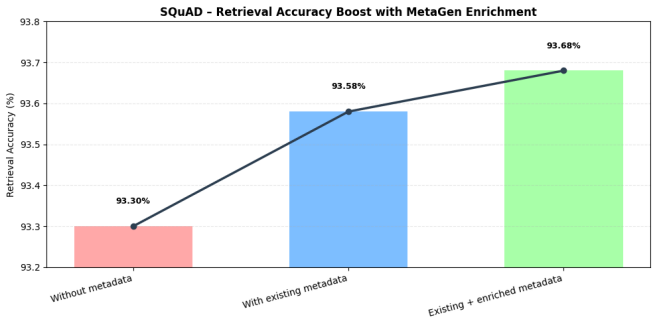
- The SQuAD gain of 0.38 points at a 93.3% baseline indicates the method still adds correct retrievals in saturated regimes.
- Because the pipeline leaves the generator untouched, it can be stacked on top of any fine-tuned model for additional gains.
- The stepwise metadata selection provides an automated, data-driven way to choose which metadata streams matter for a given corpus.
Reading between the lines
- The PubMedQA numbers are vulnerable to query self-matching because Section 6.1.2 shows each indexed record contains the question itself; deleting the question field from the index would likely shrink the reported gap.
- The stepwise selection is supervised by the benchmark's own retrieval ground truth, so the method is zero-shot with respect to model fine-tuning but not with respect to feature selection on the target benchmark.
- If the self-match concern is confirmed but the NQ and SQuAD results hold, the core idea of generated metadata plus field-boosted hybrid retrieval still plausibly helps in corpora whose records do not embed the query.
- A testable extension is to apply the pipeline to another domain, such as legal or networking corpora, and measure whether the metadata streams selected on a small labeled dev set transfer to a held-out set.
Editorial analysis
A structured set of objections, weighed in public.
Referee Report
Summary. The paper proposes MetaGen Blended RAG, a zero-shot retrieval-augmented generation system that enriches documents with NLP- and LLM-generated metadata (keyphrases, named entities, topics, synonyms, acronyms), builds hybrid BM25+dense indexes, and uses field-boosted blended queries. The method is evaluated on PubMedQA, Natural Questions, and SQuAD. The headline claims are 82.1% top-1 retrieval accuracy and 77.9% RAG accuracy on PubMedQA without fine-tuning, which the authors state surpasses prior zero-shot RAG benchmarks and rivals fine-tuned systems.
Significance. If the reported results were established, the work would be practically valuable: it addresses metadata-sparse domain corpora without model fine-tuning, it is complementary to fine-tuned systems, and it includes a reproducible pipeline and public dataset releases. The paper is clearly written and the proposed metadata-enrichment idea is a natural and potentially useful extension of the authors' earlier Blended RAG work. However, the current evaluation does not support the central claim because of a likely query-in-document confound, an evaluation procedure that selects metadata on the same dataset used for reporting, and several internally inconsistent results. The paper's significance therefore depends on a corrected and rerun evaluation before the claims can be credited.
major comments (4)
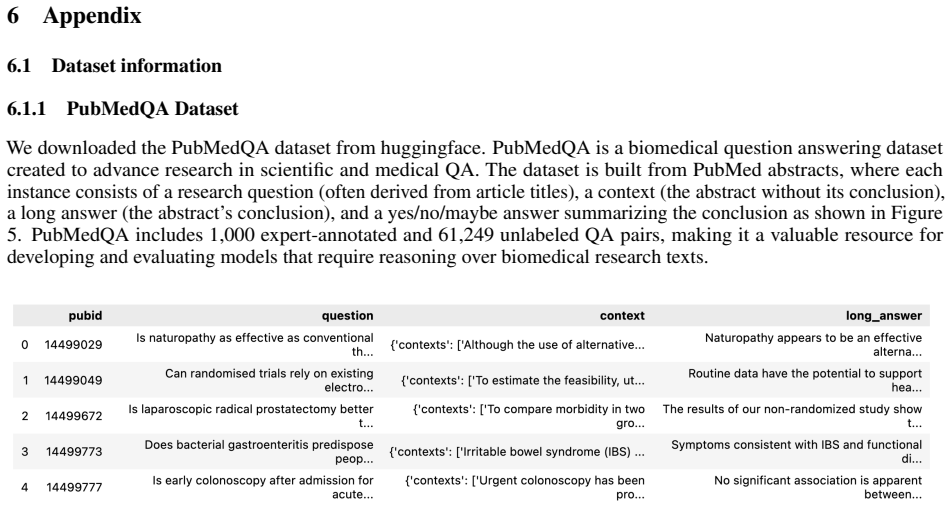
- [§6.1.2, §4.1] Section 6.1.2 describes the combined PubMedQA corpus as records that 'contain a biomedical question, a context passage (abstract), and the corresponding answer,' and it is constructed 'to test the efficacy of the retriever in finding the right document.' The paper does not state that the question field was removed before indexing. Since the retrieval queries are exactly the biomedical questions in that dataset, a BM25 component can rank the document containing the query verbatim as the top hit through exact lexical overlap, and the hybrid retriever inherits this. This would inflate the reported 82.1% top-1 retrieval accuracy independently of metadata enrichment, and would also inflate the 77.9% RAG accuracy because the LLM is then fed the abstract that is already paired with the query. To support the causal attribution to MetaGen enrichment, the authors must either state explicitly that the question field was stripped before indexing or, better, run an ablation that indexes the same corpus with and without the question field and reports retrieval and RAG accuracy for both conditions.
- [§3.2.2, §4.1] The stepwise metadata selection in Section 3.2.2 chooses metadata streams by evaluating recall@k on a 'ground-truth retrieval benchmark,' which the paper then reports as the PubMedQA result. This is a circular evaluation: the metadata streams, and likely the field-boost weights and significant-gain thresholds, are tuned on the same PubMedQA data that is later used as evidence for the method's accuracy. The authors should perform selection on a development split (or on a different dataset) and report final results on a held-out test split, and they should describe all selection thresholds and weights so readers can judge the degree of overfitting.
- [Table 5, §4.1.1] The reported numerical results contain internal contradictions that undermine the generalizability claim. On NQ, RAG accuracy with existing metadata is 27.42%, but adding enriched metadata lowers it to 26.71%, directly contradicting the claim that enrichment improves RAG accuracy. On PubMedQA, boosting enriched metadata alone lowers accuracy from 73.73% (unboosted) to 73.54% (boosted), while boosting existing+enriched metadata jumps to 77.9% with no explanation; no confidence intervals or significance tests are given. Additionally, Section 4.1.1 claims an absolute improvement of 20.98 percentage points on NQ retrieval, but Table 1 shows 60.48% - 49.99% = 10.49 percentage points and the conclusion says 10.5. These inconsistencies must be resolved and the experiments rerun under a single, clearly specified protocol before the performance claims can be accepted.
- [§4.2, Tables 3–4] The comparison against prior systems is not apples-to-apples. The baselines GPT-3.5 + RAG and LLaMA2-7B + RAG, as cited from RAFT [10], appear to receive the context passage directly or to use a different retrieval setup, whereas the proposed method retrieves over a combined corpus of 62,249 records in which, per Section 6.1.2, each record already contains the query question. Differences in task setup can easily account for reported gaps, independent of metadata quality. The authors should specify the exact retrieval protocol for every baseline and report results under identical conditions, including a shared corpus and identical query set.
minor comments (5)
- [§3.2.1] The phrase 'metadata metadata-deficient corpus' repeats 'metadata'; please rephrase.
- [§4.1, §4.2] Figure 4 is referenced both in the retriever evaluation (Section 4.1) and in the RAG evaluation (Section 4.2), but the captions and body text refer to different content; renumber the figures consistently.
- [§6.3] The GitHub repository is mentioned but no URL or repository name is given; please include the full link and, if possible, a version identifier.
- [§6.1.3] The sentence 'We downloaded this data from GitHub Bier' appears to contain a typo; the reference is likely to the BEIR benchmark repository. Please correct the name and provide the URL.
- [Table 5] The SQuAD rows in Table 5 list RAG accuracy for existing metadata and for existing+enriched metadata, but no 'without metadata' row is shown, despite the text in Section 6.2.2 referring to a baseline 'without metadata.' Please complete the table and align the description.
Circularity Check
PubMedQA headline results are determined by construction: queries are stored inside the indexed records, and metadata selection is tuned on the same PubMedQA retrieval metric.
-
self definitional
[Appendix §6.1.2 (PubMedQA Corpus Details)]
"PubMedQA_original_corpus_combined.json: This file is constructed directly from the official PubMedQA dataset, preserving its original structure. Each record contains a biomedical question, a context passage (abstract), and the corresponding answer, providing a strong baseline for QA and retrieval tasks in the biomedical domain. We have constructed this file to test the efficacy of the retriever in finding the right document and passage across using the method."
The correct document for a PubMedQA query is a record that contains the query verbatim in its own 'biomedical question' field. If these records are indexed as-is, a BM25/hybrid retriever can rank the correct document first by exact lexical overlap with the query, independent of any metadata enrichment. The paper never states that the question field is stripped or excluded before indexing, and no ablation removes it. Therefore the reported 82.1% top-1 retrieval accuracy (and the downstream 77.9% RAG accuracy, where the LLM receives the abstract already paired with the query) is determined by construction rather than by MetaGen metadata. This is not merely a baseline-selection issue: the evaluation target itself contains the query.
-
fitted input called prediction
[§3.2.2 Stepwise Metadata Selection; results in §4.1 Table 1]
"The process initiates with an empty metadata set evaluated against a predefined ground-truth retrieval benchmark. In each iteration, candidate metadata streams (KeyBERT, YAKE, NER, LLM-derived tags) are individually considered. The specific candidate stream under evaluation is provisionally integrated into hybrid queries used for retrieval, and the resulting improvement in retrieval accuracy (measured by recall@k) is rigorously evaluated against the baseline."
The stepwise selection optimizes recall@k on the PubMedQA ground-truth retrieval benchmark, and the paper then reports top-1 retrieval accuracy on PubMedQA as evidence that metadata enrichment works. No held-out split is described. The selected metadata streams and boosted field weights are thus fit to the same benchmark used for the headline numbers, so the 82.1% result is not an independent zero-shot evaluation of the method; it is the optimized value of the selection objective. This is fitted-input-called-prediction: the 'prediction' is the same quantity used for model selection.
full rationale
Two concrete circular/confounded steps reduce the central PubMedQA claim. First, the combined corpus stores the query inside each indexed record, so top-1 retrieval of the correct document can be achieved by verbatim question matching; the paper never excludes that field, making the 82.1% accuracy partly an artifact of the evaluation definition. Second, the metadata stream selection and field-boost tuning in §3.2.2 are performed by optimizing recall@k on PubMedQA, and the same PubMedQA top-1 accuracy is then presented as the outcome; this is selection on the test metric, not a zero-shot generalization result. The downstream 77.9% RAG figure inherits both problems. The paper is not circular in the fine-tuning sense—it does not adapt the LLM—and the NQ/SQuAD experiments provide external benchmarks that are not confounded in the same way. The self-citation [8] (Blended RAG by the same authors) supplies the hybrid-query mechanism but is not used to forbid alternatives or to import an unverified uniqueness theorem, so it does not add circularity. Overall, because the headline PubMedQA retrieval and RAG numbers are substantially determined by construction and by fitting the selection objective to the evaluation benchmark, the central claim is materially compromised.
Assumptions & free parameters
free parameters (4)
- field boost weights =
not reported
- corpus size threshold for LLM enrichment =
not reported (typically millions)
- significant-gain threshold in stepwise selection =
not reported
- extraction counts (keyphrases, entities) =
one keyphrase and three entities per document
assumptions (5)
- domain assumption PubMedQA document labels are correct retrieval ground truth
- domain assumption Fusing BM25 and cosine similarity with per-field boosts produces a valid and comparable retrieval ranking
- ad hoc to paper Adding NLP and LLM-generated metadata to indexes improves precision without systematically hurting recall
- ad hoc to paper Selecting metadata streams on PubMedQA and then reporting PubMedQA accuracy does not overfit the reported result
- domain assumption Non-fine-tuned RAG baselines that receive gold context are comparable to a system that retrieves from 62k documents
Cite this review
Pith. "Pith review of MetaGen Blended RAG: Unlocking Zero-Shot Precision for Specialized Domain Question-Answering." pith.science (2026). https://pith.science/paper/DHA2AAND
@misc{pith2026250518247,
  author       = {Pith},
  title        = {Pith review of: MetaGen Blended RAG: Unlocking Zero-Shot Precision for Specialized Domain Question-Answering},
  year         = {2026},
  howpublished = {\url{https://pith.science/paper/DHA2AAND}},
  note         = {Machine review of arXiv:2505.18247}
}
read the original abstract
Retrieval-Augmented Generation (RAG) struggles with domain-specific enterprise datasets, often isolated behind firewalls and rich in complex, specialized terminology unseen by LLMs during pre-training. Semantic variability across domains like medicine, networking, or law hampers RAG's context precision, while fine-tuning solutions are costly, slow, and lack generalization as new data emerges. Achieving zero-shot precision with retrievers without fine-tuning still remains a key challenge. We introduce 'MetaGen Blended RAG', a novel enterprise search approach that enhances semantic retrievers through a metadata generation pipeline and hybrid query indexes using dense and sparse vectors. By leveraging key concepts, topics, and acronyms, our method creates metadata-enriched semantic indexes and boosted hybrid queries, delivering robust, scalable performance without fine-tuning. On the biomedical PubMedQA dataset, MetaGen Blended RAG achieves 82% retrieval accuracy and 77% RAG accuracy, surpassing all prior zero-shot RAG benchmarks and even rivaling fine-tuned models on that dataset, while also excelling on datasets like SQuAD and NQ. This approach redefines enterprise search using a new approach to building semantic retrievers with unmatched generalization across specialized domains.
Figures


Figures from the paper (8 more)



Reference graph
Works this paper leans on
-
[10]
Raft: Adapting language model to domain specific rag
Tianjun Zhang, Shishir G Patil, Naman Jain, Sheng Shen, Matei Zaharia, Ion Stoica, and Joseph E Gonzalez. Raft: Adapting language model to domain specific rag. InFirst Conference on Language Modeling, 2024
work page 2024
-
[1]
Retrieval-augmented generation for knowledge- intensive nlp tasks.Advances in neural information processing systems, 33:9459–9474, 2020
Patrick Lewis, Ethan Perez, Aleksandra Piktus, Fabio Petroni, Vladimir Karpukhin, Naman Goyal, Heinrich Küttler, Mike Lewis, Wen-tau Yih, Tim Rocktäschel, et al. Retrieval-augmented generation for knowledge- intensive nlp tasks.Advances in neural information processing systems, 33:9459–9474, 2020
2020
-
[2]
Yunfan Gao, Yun Xiong, Xinyu Gao, Kangxiang Jia, Jinliu Pan, Yuxi Bi, Yi Dai, Jiawei Sun, Qianyu Guo, Meng Wang, and Haofen Wang. Retrieval-augmented generation for large language models: A survey.arXiv preprint arXiv:2312.10997, 2023
arXiv 2023
-
[3]
Stephen Robertson and Hugo Zaragoza. The probabilistic relevance framework: Bm25 and beyond.F oundations and Trends in Information Retrieval, 3(4):333–389, 2009
work page 2009
-
[4]
Sentence-bert: Sentence embeddings using siamese bert-networks
Nils Reimers and Iryna Gurevych. Sentence-bert: Sentence embeddings using siamese bert-networks. InProceed- ings of the 2019 Conference on Empirical Methods in Natural Language Processing and the 9th International Joint Conference on Natural Language Processing (EMNLP-IJCNLP), pages 3982–3992. Association for Computational Linguistics, 2019
work page 2019
-
[5]
Yu A Malkov and Dmitry A Yashunin. Efficient and robust approximate nearest neighbor search using hierarchical navigable small world graphs.IEEE transactions on pattern analysis and machine intelligence, 42(4):824–836, 2018
2018
-
[6]
Dense passage retrieval for open-domain question answering
Vladimir Karpukhin, Barlas Oguz, Sewon Min, Patrick Lewis, Ledell Wu, Sergey Edunov, Danqi Chen, and Wen- tau Yih. Dense passage retrieval for open-domain question answering. InProceedings of the 2020 Conference on Empirical Methods in Natural Language Processing (EMNLP), pages 6769–6781. Association for Computational Linguistics, 2020
work page 2020
-
[7]
Simple and effective unsupervised redundancy elimination to compress dense representations
Jimmy Lin, Xueguang Ma, Rodrigo Nogueira, Zhuyun Dai, and Yiluan Guo. Simple and effective unsupervised redundancy elimination to compress dense representations. InProceedings of the 2021 Conference on Empirical Methods in Natural Language Processing (EMNLP), pages 2870–2881, 2021
work page 2021
Show all 17 references
-
[8]
Blended rag: Improving retriever-augmented generation accuracy with semantic search and hybrid query-based retrievers
Kunal Sawarkar, Abhilasha Mangal, and Shivam Raj Solanki. Blended rag: Improving retriever-augmented generation accuracy with semantic search and hybrid query-based retrievers. In2024 IEEE 7th International Conference on Multimedia Information Processing and Retrieval (MIPR), ...
2024
-
[9]
Alzheimerrag: Multimodal retrieval augmented generation for pubmed articles.arXiv preprint arXiv:2412.16701, 2024
Aritra Kumar Lahiri and Qinmin Vivian Hu. Alzheimerrag: Multimodal retrieval augmented generation for pubmed articles.arXiv preprint arXiv:2412.16701, 2024
2024 arXiv
-
[11]
A comparative study on embedding models for keyword extraction using keybert method
Bayan Issa, Muhammed Basheer Jasser, Hui Na Chua, and Muzaffar Hamzah. A comparative study on embedding models for keyword extraction using keybert method. In2023 IEEE 13th International Conference on System Engineering and Technology (ICSET), pages 40–45. IEEE, 2023. 9
2023
-
[12]
A natural language processing model on bert and yake technique for keyword extraction on sustainability reports.IEEE Access, 12:7942–7951, 2024
Akriti Gupta, Aman Chadha, and Vijaishri Tewari. A natural language processing model on bert and yake technique for keyword extraction on sustainability reports.IEEE Access, 12:7942–7951, 2024
2024
-
[13]
An algorithm for automatic text annotation for named entity recognition using spacy framework
Murari Kumar, Krishna Kumar Chaturvedi, Anu Sharma, Alka Arora, Mohammad Samir Farooqi, Shashi Bhushan Lal, Achal Lama, and Rajeev Ranjan. An algorithm for automatic text annotation for named entity recognition using spacy framework. 2023
2023
-
[14]
Squad: 100,000+ questions for machine comprehension of text.arXiv preprint arXiv:1606.05250, 2016
Pranav Rajpurkar, Jian Zhang, Konstantin Lopyrev, and Percy Liang. Squad: 100,000+ questions for machine comprehension of text.arXiv preprint arXiv:1606.05250, 2016
2016 arXiv
-
[15]
The llama 3 herd of models.arXiv preprint arXiv:2407.21783, 2024
Aaron Grattafiori, Abhimanyu Dubey, Abhinav Jauhri, Abhinav Pandey, Abhishek Kadian, Ahmad Al-Dahle, Aiesha Letman, Akhil Mathur, Alan Schelten, Alex Vaughan, et al. The llama 3 herd of models.arXiv preprint arXiv:2407.21783, 2024
2024 arXiv
-
[16]
Rankrag: Unifying context ranking with retrieval-augmented generation in llms.Advances in Neural Information Processing Systems, 37:121156–121184, 2024
Yue Yu, Wei Ping, Zihan Liu, Boxin Wang, Jiaxuan You, Chao Zhang, Mohammad Shoeybi, and Bryan Catanzaro. Rankrag: Unifying context ranking with retrieval-augmented generation in llms.Advances in Neural Information Processing Systems, 37:121156–121184, 2024. 10 6 Appendix 6.1 D...
2024
-
[17]
PubMedQA includes 1,000 expert-annotated and 61,249 unlabeled QA pairs, making it a valuable resource for developing and evaluating models that require reasoning over biomedical research texts. Figure 5: PubMedQA sample data 6.1.2 PubMedQA Corpus Details To support robust benc...
Reviewed August 7, 2026 · model on record in the stance chip above.
Discussion (0). Continue with ORCID to comment.