REVIEW 4 minor 59 references
For autonomous quantum energy pumps whose terminals are ideal translation clocks, every ordered moment of the terminal-work observables is exactly represented by pump-only operators, making the phase-derivative current a genuine observable
Reviewed by Pith at T0; open to challenge. T0 means a machine referee read the full paper against a public rubric. the ladder, T0–T4 →
T0 review · deepseek-v4-flash
2026-08-04 01:30 UTC pith:DIPAV4YB
load-bearing objection A carefully scoped, mathematically explicit framework for terminal-resolved work statistics in quantum pumps; the ideal-clock limitation is real but honestly quantified, and the paper deserves serious peer review.
Work Statistics of Autonomous Quantum Energy Pumps
The pith
A machine-rendered reading of the paper's core claim, the machinery that carries it, and where it could break.
Core claim
The central claim is Theorem 2: for ideal translation-clock terminals with the pump–clock coupling diagonal in clock coordinates, the full terminal-work observable Ŵ_i(t) is diagonal in the initial clock-coordinate basis, and its pump-space block is i ω_i Û_s†(t) ∂_{s_i} Û_s(t). Equation (16) then states that, for any initial pump–clock state and any ordered index string, the expectation of the product of terminal works equals the trace over the pump of the coordinate-diagonal density with the product of pump-space blocks. This makes the phase-derivative current the exact continuity current of an explicitly modeled terminal, and it extends to repeated cycles, where the mean work in a Floquet
What carries the argument
The carrying mechanism is the coordinate-block decomposability of the autonomous propagator: with free clocks Ĥ_i = -iω_i ∂_{s_i} and a coupling diagonal in |s⟩⟨s|, the propagator becomes Û(t)=∫d^D s Û_s(t)⊗|s+ωt⟩⟨s|, so every terminal-work observable is block diagonal in the initial clock coordinates. The block Ŵ_i^{(s)}(t)=iω_i Û_s†(t)∂_{s_i}Û_s(t) is the central object; it simultaneously acts as the exact work operator, the generator of ordered mixed moments, and the integrand of the phase-derivative current.
Load-bearing premise
The exact reduction rests on each terminal being an ideal translation clock whose Hamiltonian is -iω_i ∂_{s_i} and whose coupling to the pump is diagonal in the clock-coordinate basis; the paper's own Section VII shows that physical terminals only approximate this, producing the work-variance gap.
What would settle it
Measure the full terminal-work distribution for a physical terminal that is not an ideal clock (for instance, a finite-ladder battery or a coherent cavity at low occupation) and compare the exact second moment of Ŵ_q(t) with the pump-only prediction; if the positive work-variance gap Ĝ_q(t) develops negative eigenvalues, or if the variance decomposition Eq. (101) fails to reproduce the exactly computed variance, the construction is falsified. A clean numerical check at finite occupation would settle whether the gap closes exactly in the large-occupation limit.
If this is right
- The phase-derivative current used throughout driven-pump theory is not a convention: it is the expectation of an exact, Hermitian terminal-work observable on the pump space for ideal-clock terminals.
- For commensurate drives, a Floquet eigenstate transports energy with a mean that grows linearly in the number of cycles while each directional variance remains bounded by four times the Floquet quantum metric; fluctuations do not accumulate.
- At long times the rescaled terminal-work operators converge in operator norm to a commuting family of asymptotic currents, so the pump becomes increasingly catalytic and the terminal currents acquire a common spectral description.
- In the exactly solvable two-clock qubit, balanced couplings make transport work perfectly sharp at every cycle even though individual terminal energies and receiver gain remain noisy — a noise-matching regime distinct from deterministic delivery.
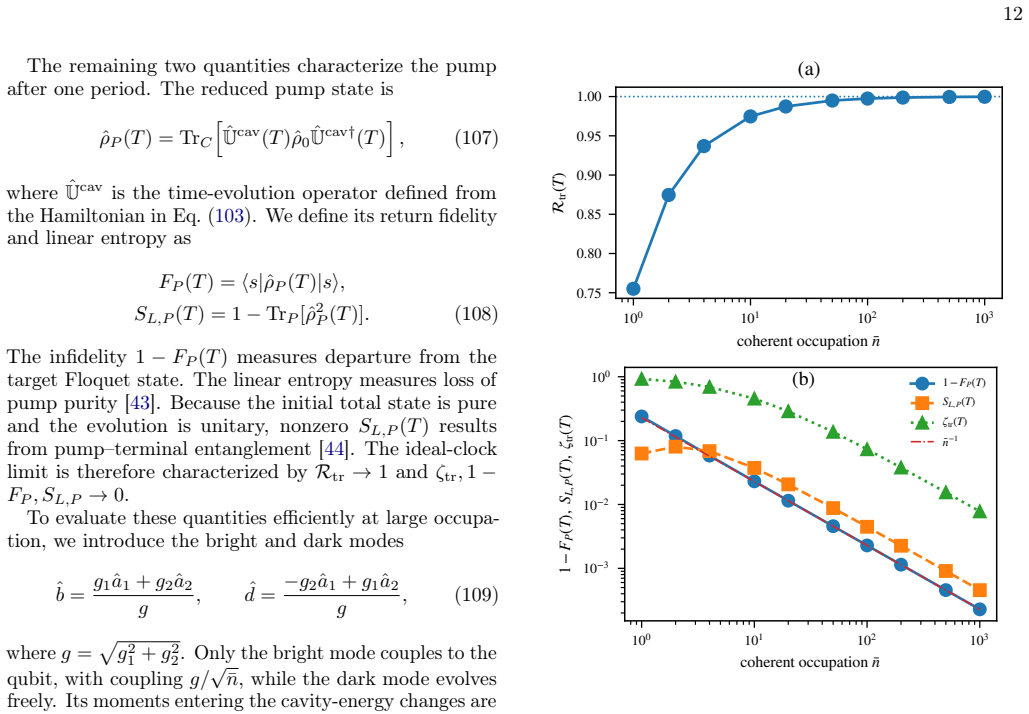
- For physical terminals, the work-variance gap Ĝ_q(t) is positive and measures what a pump-only description misses; the coherent-cavity benchmark shows the mean transport current can be within 0.25% of the ideal-clock value while 7.3% of the transport variance is still missing.
Where Pith is reading between the lines
- The same operator-inequality argument that produces the variance gap should yield higher-moment gaps, so the framework suggests a practical hierarchy test: a pump-only model that reproduces the variance also reproduces all polynomial moments only when the gap vanishes.
- The correlation-assisted gain, which is already classical, invites a resource viewpoint: for a fixed phase distribution, the gap between product and correlated optima measures how much directional energy transfer is unlocked by classical pump–clock correlations, and one could ask whether a mutual-information-like bound governs this gain.
- The noise-matching condition suggests a design rule for transducers: if the source and receiver couplings are symmetric, common-mode terminal fluctuations decouple from the transport channel, potentially sharpening transferred energy without requiring quiet terminals — a testable engineering target in superconducting or photonic implementations.
Editorial analysis
A structured set of objections, weighed in public.
Referee Report
Summary. The paper develops a terminal-resolved theory of work statistics for autonomous quantum energy pumps, in which the energy source and sink are modeled as explicit quantum terminals and the work supplied by each terminal is defined as the decrease of that terminal's own Hamiltonian. For ideal translation clocks with coordinate-diagonal coupling to the pump, the central Theorem 2 gives an exact pump-space representation of all ordered moments of the terminal-work observables, recovering the conventional phase-derivative currents of driven pumping. The framework handles arbitrary initial pump-terminal correlations and shows that classical correlations suffice for the identified correlation-assisted pumping advantage. For commensurate periodic drives, the paper derives exact finite-cycle Floquet work statistics: the mean grows linearly with the number of cycles, the variance is bounded by the Floquet quantum metric, and the long-time cycle-averaged currents become mutually commuting. An exactly solvable two-clock qubit model illustrates a noise-matching effect in which balanced couplings make transport sharp through cancellation of common-mode terminal fluctuations. For physical terminals beyond the ideal-clock limit, the paper introduces a positive work-variance gap and, in a coherent-cavity benchmark, demonstrates convergence toward the ideal-clock regime with increasing occupation, while emphasizing that agreement of the mean current alone does not guarantee accurate work stati
Significance. If the results hold, this is a significant contribution to the theory of autonomous quantum energy conversion. The exact moment representation in Eq. (16) provides a microscopic, observable-level foundation for the phase-derivative currents used throughout driven quantum pumping, including their fluctuations and cross-correlations. The Floquet variance bound in Eq. (64) connects finite-cycle work fluctuations to quantum geometry in a falsifiable way, and the noise-matching effect in Sec. VI is a clean example of fluctuations being controlled independently of the mean current. The paper is also strong methodologically: the central derivations are explicit, with proofs in Appendices A-D; the exactly solvable two-clock qubit provides a nontrivial check of the general formulas; and the coherent-cavity benchmark uses a specified truncation with reported convergence, including omitted Poisson weight and fitted power-law decays. No parameters are fitted to data; the main formulas are derived analytically from the autonomous Hamiltonian. The ideal-clock limitation is not a hidden assumption: it is stated in Eq. (2), and Sec. VII quantifies its breakdown for physical terminals through a pos
minor comments (4)
- [Sec. IV and Sec. VII] The symbol \hat W_i(t) denotes the full-space observable in Secs. II-III and again in Sec. VII, but in Secs. IV-VI it denotes the pump-space block after localization. The switch is explicit when it happens, but a one-sentence reminder at the start of each section would help the reader avoid confusion.
- [Ref. [26]] The DOI for Ref. [26], '10.1103/fnv6-yqmk', appears malformed or placeholder-like. Please verify and replace it with the correct DOI, or use the arXiv identifier if the DOI is not yet assigned.
- [Eq. (110)] The truncation expression is written as ⌈n̄_b + 10√n̄_b+1 + 30⌉; adding parentheses, √(n̄_b+1), would remove ambiguity about which term is under the square root.
- [Sec. VII / Eq. (106)] The quantity ζ_q is introduced with the caveat that it is understood only when the exact variance is nonzero. This caveat is stated once near Eq. (102), but it would be helpful to repeat it where ζ_tr is defined in Eq. (106), since the denominator there could in principle vanish.
Circularity Check
No load-bearing circularity: the pump-space work reduction is derived from the autonomous Hamiltonian; self-citations are contextual and not inputs to the main theorems.
full rationale
The central result, Theorem 2 / Eqs. (13)-(16), is derived rather than assumed: the terminal-work observable is defined in Eq. (9) as the negative change of the terminal Hamiltonian, and Appendix B obtains the pump-space block W_i^(s)(t)=iω_i U_s^†(t)∂_{s_i}U_s(t) from the propagator identity Eq. (4) and the coordinate-diagonal coupling Eq. (2). The phase-derivative current is therefore a consequence of the autonomous model, not an input to it. Eq. (18) is derived before the citation to [22], so that self-citation is a pointer and is not load-bearing. The Floquet variance bounds, asymptotic commutativity, and noise-matching effect are analytic consequences of the exactly solvable model, with no fitted parameters renamed as predictions. The coherent-cavity benchmark uses a distinct physical Hamiltonian (Eq. (103)) and exact numerical evolution; the scaling λ_i=g_i/√n̄ is a controlled classical limit, and Sec. VII explicitly introduces a positive work-variance gap via Kadison's inequality as a derived diagnostic rather than a circular rescue. Self-citations [11,16,21,22] appear only in contextual sentences. No specific circular step can be exhibited, and the paper's own limitation statements appropriately scope the exactness to ideal translation clocks.
Axiom & Free-Parameter Ledger
axioms (3)
- domain assumption Terminals are ideal translation clocks with \hat H_i = -i\omega_i \partial_{s_i} on L^2(R).
- domain assumption Pump-clock coupling is diagonal in the clock-coordinate basis.
- standard math Standard quantum mechanics results (Trotter product formula, Kadison's inequality, Choi's multiplicative-domain theorem).
read the original abstract
We develop a terminal-resolved theory of work statistics for autonomous quantum energy pumps. By modeling the systems that supply and receive energy as explicit quantum terminals, the energy exchanged with each terminal is defined directly from its Hamiltonian change. When the terminals are modeled by ideal clocks, these full-space observables admit exact representations on the pump Hilbert space and recover the conventional phase-derivative currents of periodically and quasiperiodically driven systems. The framework resolves transported work from energy accumulated in the pump. It also incorporates arbitrary initial pump--terminal correlations and identifies when correlations can enhance directional energy transfer under uncertain driving phases. For periodic pumps, we derive finite-cycle work statistics in Floquet eigenstates, relate their fluctuations to Floquet quantum geometry, and show that the long-time terminal currents become mutually compatible. An exactly solvable two-terminal qubit exhibits noise matching, in which transport becomes sharp through cancellation of common-mode terminal fluctuations even though the individual terminal energies remain noisy. Finally, for physical terminals beyond the ideal-clock limit, we introduce a positive work-variance gap that quantifies the fluctuations missed by a pump-only description. A coherent-cavity benchmark shows systematic convergence toward the ideal-clock regime with increasing occupation while demonstrating that agreement of the mean current alone does not guarantee accurate work statistics.
Figures


Reference graph
Works this paper leans on
-
[1]
Equation (4) acts as ˆU(t)Ψ (s) = ˆUs−ωt(t)|Ψ(s−ωt)⟩.(B1) Using ˆHi =−iω i∂si, ˆHi ˆU(t)Ψ (s) =−iω i h ∂si ˆUs−ωt(t) i |Ψ(s−ωt)⟩ + ˆUs−ωt(t) ˆHi|Ψ(s−ωt)⟩
Terminal-work block identity In the clock-coordinate representation, a joint state is a pump-valued wave function|Ψ(s)⟩. Equation (4) acts as ˆU(t)Ψ (s) = ˆUs−ωt(t)|Ψ(s−ωt)⟩.(B1) Using ˆHi =−iω i∂si, ˆHi ˆU(t)Ψ (s) =−iω i h ∂si ˆUs−ωt(t) i |Ψ(s−ωt)⟩ + ˆUs−ωt(t) ˆHi|Ψ(s−ωt)⟩. Applying ˆU†(t)and returning to the initial clock coordi- nate gives ˆU†(t) ˆHi ˆ...
-
[2]
Its moments entering the cavity-energy changes are evaluated analytically
Only the bright mode couples to the qubit, with couplingg/√¯n, while the dark mode evolves freely. Its moments entering the cavity-energy changes are evaluated analytically. The remaining qubit–bright-mode evolution is obtained from numerically converged sparse evolution of the truncated Hamiltonian. The bright-mode Fock space is truncated at Nb = ¯nb + 1...
-
[3]
15 Adding and subtracting R dDsp (s)m2 q(s, t)in D ˆW 2 q (t) E − D ˆWq(t) E2 gives the law of total variance in Eq
Pump–clock correlations Using ˆσP (s) = p(s)˜σP (s), the first two moments of the directional work are D ˆWq(t) E = Z dDsp(s)m q(s, t), D ˆW 2 q (t) E = Z dDsp(s) TrP h ˜σP (s) ˆW (s) q (t) 2i . 15 Adding and subtracting R dDsp (s)m2 q(s, t)in D ˆW 2 q (t) E − D ˆWq(t) E2 gives the law of total variance in Eq. (23). For a product preparation,˜σP (s) = ˆρP...
-
[4]
Commutativity of the coordinate derivatives, together withˆU † ˆU=I, gives ∂si ˆBj −∂ sj ˆBi + h ˆBi, ˆBj i = 0
Maurer–Cartan identity At fixed t, suppress the coordinate and time labels and define ˆBi = ˆU †∂si ˆU = −i ˆAi. Commutativity of the coordinate derivatives, together withˆU † ˆU=I, gives ∂si ˆBj −∂ sj ˆBi + h ˆBi, ˆBj i = 0. Substituting ˆBi =−i ˆAi yields ∂si ˆAj −∂ sj ˆAi = i h ˆAi, ˆAj i , which is Eq. (32)
-
[5]
Expanding aroundδ= 0gives ˆU † − ˆU+ =I+ 1 2 h ˆU †∂δ ˆU− ∂δ ˆU † ˆU i + 1 8 h ˆU †∂2 δ ˆU+ ∂2 δ ˆU † ˆU i − 1 4 ∂δ ˆU † ∂δ ˆU +O(∥δ∥ 3)
Expansion of the PRFT counting amplitude Define ∂δ = P i δi∂ϕi and ˆU± = ˆUϕ±δ/2(t). Expanding aroundδ= 0gives ˆU † − ˆU+ =I+ 1 2 h ˆU †∂δ ˆU− ∂δ ˆU † ˆU i + 1 8 h ˆU †∂2 δ ˆU+ ∂2 δ ˆU † ˆU i − 1 4 ∂δ ˆU † ∂δ ˆU +O(∥δ∥ 3). Using the first and second derivatives ofˆU † ˆU = I reduces this expression to ˆU † − ˆU+ =I−i ˆAδ − 1 2 ˆA2 δ +O(∥δ∥ 3), ˆAδ = i ˆU ...
-
[6]
Let ˆUϕ(t2, t1)denote the corresponding propagator from t1 to t2
Time-origin covariance For a localized initial clock configurationϕ, the driven pump Hamiltonian satisfies ˆH (ϕ+ωτ) P (t) = ˆH (ϕ) P (t + τ ). Let ˆUϕ(t2, t1)denote the corresponding propagator from t1 to t2. The Floquet operator for the shifted initial phases is ˆF (ϕ + ωτ ) = ˆUϕ(T + τ, τ). Periodicity and the composition law give ˆF(ϕ+ωτ) = ˆUϕ(T+τ, τ...
-
[7]
Repeated-cycle work statistics Recall ∂q = PD i=1 qiωi∂ϕi. The corresponding one-cycle directional work is ˆAq = i ˆF †∂q ˆF= ˆWq(T).(C1) Differentiating ˆF n gives ˆWq(nT) = i( ˆF n)†∂q ˆF n = n−1X r=0 ˆF −r ˆAq ˆF r.(C2) 16 Let ˆF|α⟩ = e −iθα |α⟩. Differentiating this eigenvalue equation and projecting onto|α⟩gives ⟨α| ˆAq|α⟩=∂ qθα =T wq,α.(C3) Forβ̸=α,...
-
[8]
The mean ergodic theorem gives lim n→∞ 1 n n−1X r=0 ˆF −r ˆA ˆF r − PF ( ˆA) = 0(C6) for every pump operator ˆA
Asymptotic current operators For a finite-dimensional Floquet operator with non- degenerate eigenvalues, define its ergodic projection by PF ( ˆA) = P α |α⟩⟨α| ˆA|α⟩⟨α|. The mean ergodic theorem gives lim n→∞ 1 n n−1X r=0 ˆF −r ˆA ˆF r − PF ( ˆA) = 0(C6) for every pump operator ˆA. Applying this result to ωi ˆAi/Tand using(ω i/T)⟨α| ˆAi|α⟩= wi,α gives lim...
-
[9]
H. J. Kimble, The quantum internet, Nature453, 1023 (2008)
2008
-
[10]
N. Lauk, N. Sinclair, S. Barzanjeh, J. P. Covey, M. Saffman, M. Spiropulu, and C. Simon, Perspectives on quantum transduction, Quantum Sci. Technol.5, 020501 (2020)
2020
-
[11]
Niedenzu, M
W. Niedenzu, M. Huber, and E. Boukobza, Concepts of work in autonomous quantum heat engines, Quantum3, 195 (2019)
2019
-
[12]
Elouard and C
C. Elouard and C. L. Latune, Extending the laws of ther- modynamics for arbitrary autonomous quantum systems, PRX Quantum4, 020309 (2023)
2023
-
[13]
Kurman, K
Y. Kurman, K. Hymas, A. Fedorov, W. J. Munro, and J. Quach, Powering quantum computation with quantum batteries, Phys. Rev. X16, 011016 (2026)
2026
-
[14]
Auffèves, Quantum technologies need a quantum en- ergy initiative, PRX Quantum3, 020101 (2022)
A. Auffèves, Quantum technologies need a quantum en- ergy initiative, PRX Quantum3, 020101 (2022)
2022
-
[15]
Campaioli, S
F. Campaioli, S. Gherardini, J. Q. Quach, M. Polini, and G. M. Andolina, Colloquium: Quantum batteries, Rev. Mod. Phys.96, 031001 (2024)
2024
-
[16]
D. J. Thouless, Quantization of particle transport, Phys. Rev. B27, 6083 (1983)
1983
-
[17]
P. W. Brouwer, Scattering approach to parametric pump- ing, Phys. Rev. B58, R10135 (1998)
1998
-
[18]
Martin, G
I. Martin, G. Refael, and B. Halperin, Topological fre- quency conversion in strongly driven quantum systems, Phys. Rev. X7, 041008 (2017)
2017
-
[19]
Peng and G
Y. Peng and G. Refael, Topological energy conversion through the bulk or the boundary of driven systems, Phys. Rev. B97, 134303 (2018)
2018
-
[20]
M. H. Kolodrubetz, F. Nathan, S. Gazit, T. Morimoto, and J. E. Moore, Topological floquet-thouless energy pump, Phys. Rev. Lett.120, 150601 (2018)
2018
-
[21]
F.Nathan, I.Martin,andG.Refael,Topologicalfrequency conversion in a driven dissipative quantum cavity, Phys. Rev. B99, 094311 (2019)
2019
-
[22]
P. J. D. Crowley, I. Martin, and A. Chandran, Half-integer quantized topological response in quasiperiodically driven quantum systems, Phys. Rev. Lett.125, 100601 (2020)
2020
-
[23]
D. M. Long, P. J. D. Crowley, and A. Chandran, Nonadia- batic topological energy pumps with quasiperiodic driving, Phys. Rev. Lett.126, 106805 (2021)
2021
-
[24]
Z. Qi, G. Refael, and Y. Peng, Universal nonadiabatic energy pumping in a quasiperiodically driven extended system, Phys. Rev. B104, 224301 (2021)
2021
-
[25]
D. M. Long, P. J. D. Crowley, A. J. Kollár, and A. Chan- dran, Boosting the quantum state of a cavity with floquet driving, Phys. Rev. Lett.128, 183602 (2022)
2022
-
[26]
F.Nathan, I.Martin,andG.Refael,Topologicalfrequency conversion in weyl semimetals, Phys. Rev. Research4, 043060 (2022)
2022
-
[27]
Malz and A
D. Malz and A. Smith, Topological two-dimensional flo- quet lattice on a single superconducting qubit, Phys. Rev. Lett.126, 163602 (2021)
2021
-
[28]
Psaroudaki and G
C. Psaroudaki and G. Refael, Energy transfer in random- matrix ensembles of floquet hamiltonians, Phys. Rev. B 108, 064301 (2023)
2023
-
[29]
Peng, Non-abelian geometric quantum energy pump, Phys
Y. Peng, Non-abelian geometric quantum energy pump, Phys. Rev. B114, L020304 (2026)
2026
-
[30]
Schmid, F
H. Schmid, F. von Oppen, G. Refael, and Y. Peng, Su- perextensive charging speeds in a correlated quantum charger, Phys. Rev. B114, 014313 (2026)
2026
-
[31]
Friis and M
N. Friis and M. Huber, Precision and work fluctuations in gaussian battery charging, Quantum2, 61 (2018)
2018
-
[32]
L. P. García-Pintos, A. Hamma, and A. del Campo, Fluc- tuations in extractable work bound the charging power of quantum batteries, Phys. Rev. Lett.125, 040601 (2020)
2020
-
[33]
Bakhshinezhad, B
P. Bakhshinezhad, B. R. Jablonski, F. C. Binder, and N. Friis, Trade-offs between precision and fluctuations in charging finite-dimensional quantum batteries, Phys. Rev. E109, 014131 (2024)
2024
- [34]
-
[35]
L.S.Levitov, H.Lee,andG.B.Lesovik,Electroncounting statistics and coherent states of electric current, J. Math. Phys.37, 4845 (1996)
1996
-
[36]
G. T. Landi, M. J. Kewming, M. T. Mitchison, and P. P. Potts, Current fluctuations in open quantum sys- tems: Bridging the gap between quantum continuous measurements and full counting statistics, PRX Quantum 5, 020201 (2024)
2024
-
[37]
A. E. Allahverdyan, R. Balian, and T. M. Nieuwenhuizen, Maximal work extraction from finite quantum systems, Europhys. Lett.67, 565 (2004)
2004
-
[38]
G. M. Andolina, D. Farina, A. Mari, V. Pellegrini, V. Gio- vannetti, and M. Polini, Charger-mediated energy transfer in exactly solvable models for quantum batteries, Phys. Rev. B98, 205423 (2018)
2018
-
[39]
G. M. Andolina, M. Keck, A. Mari, M. Campisi, V. Gio- vannetti, and M. Polini, Extractable work, the role of correlations, and asymptotic freedom in quantum batter- ies, Phys. Rev. Lett.122, 047702 (2019)
2019
-
[40]
C. Cepollaro, D. Chughtai, A. Spalvieri, M. Huber, and A. Rolandi, Autonomization of quantum systems and the emergence of the work operator, arXiv:2607.20602 (2026), arXiv:2607.20602 [quant-ph]
Pith/arXiv arXiv 2026
-
[41]
C. Han, N. Katz, and E. Sela, Measuring work in quan- tum many-body systems using a dynamical work agent, Phys. Rev. B112, 035416 (2025), arXiv:2503.20729 [cond- mat.mes-hall]
Pith/arXiv arXiv 2025
-
[42]
X.-H. Zhao and H. T. Quan, Fluctuation theorems for au- tonomous work in the quantum regime, arXiv:2607.24690 (2026), arXiv:2607.24690 [cond-mat.stat-mech]
Pith/arXiv arXiv 2026
-
[43]
Engelhardt, S
G. Engelhardt, S. Choudhury, and W. V. Liu, Unified light-matter floquet theory and its application to quantum communication, Phys. Rev. Research6, 013116 (2024)
2024
-
[44]
Engelhardt, J
G. Engelhardt, J. Luo, V. M. Bastidas, and G. Platero, Photon-resolved floquet theory. i. full counting statistics of the driving field in floquet systems, Phys. Rev. A110, 063707 (2024)
2024
-
[45]
Engelhardt, J
G. Engelhardt, J. Luo, V. M. Bastidas, and G. Platero, Photon-resolved floquet theory. ii. open quantum systems, Phys. Rev. A110, 063708 (2024)
2024
-
[46]
Seibold, O
K. Seibold, O. Ameye, and O. Zilberberg, Floquet expan- sion by counting pump photons, Phys. Rev. Lett.134, 060401 (2025)
2025
-
[47]
H. P. Robertson, The uncertainty principle, Phys. Rev. 34, 163 (1929)
1929
-
[48]
Schrödinger, Zum heisenbergschen unschärfeprinzip, Sitzungsberichte der Preußischen Akademie der Wis- 18 senschaften, Physikalisch-Mathematische Klasse , 296 (1930)
E. Schrödinger, Zum heisenbergschen unschärfeprinzip, Sitzungsberichte der Preußischen Akademie der Wis- 18 senschaften, Physikalisch-Mathematische Klasse , 296 (1930)
1930
-
[49]
Kolodrubetz, D
M. Kolodrubetz, D. Sels, P. Mehta, and A. Polkovnikov, Geometry and non-adiabatic response in quantum and classical systems, Phys. Rep.697, 1 (2017)
2017
-
[50]
R. V. Kadison, A generalized schwarz inequality and algebraic invariants for operator algebras, Ann. Math.56, 494 (1952)
1952
-
[51]
Manfredi and M
G. Manfredi and M. R. Feix, Entropy and wigner func- tions, Phys. Rev. E62, 4665 (2000)
2000
-
[52]
Rungta, V
P. Rungta, V. Bužek, C. M. Caves, M. Hillery, and G. J. Milburn, Universal state inversion and concurrence in arbitrary dimensions, Phys. Rev. A64, 042315 (2001)
2001
-
[53]
R. J. Glauber, Coherent and incoherent states of the radiation field, Phys. Rev.131, 2766 (1963)
1963
-
[54]
M. P. Woods, R. Silva, and J. Oppenheim, Autonomous quantum machines and finite-sized clocks, Ann. Henri Poincaré20, 125 (2019)
2019
-
[55]
Roulet, S
A. Roulet, S. Nimmrichter, J. M. Arrazola, S. Seah, and V. Scarani, Autonomous rotor heat engine, Phys. Rev. E 95, 062131 (2017)
2017
-
[56]
S. Seah, S. Nimmrichter, and V. Scarani, Work production of quantum rotor engines, New J. Phys.20, 043045 (2018)
2018
-
[57]
von Lindenfels, O
D. von Lindenfels, O. Gräb, C. T. Schmiegelow, V. Kaushal, J. Schulz, M. T. Mitchison, J. Goold, F. Schmidt-Kaler, and U. G. Poschinger, Spin heat engine coupled to a harmonic-oscillator flywheel, Phys. Rev. Lett. 123, 080602 (2019)
2019
-
[58]
Alicki and M
R. Alicki and M. Fannes, Entanglement boost for ex- tractable work from ensembles of quantum batteries, Phys. Rev. E87, 042123 (2013)
2013
-
[59]
Choi, A schwarz inequality for positive linear maps onc ∗-algebras, Illinois J
M.-D. Choi, A schwarz inequality for positive linear maps onc ∗-algebras, Illinois J. Math.18, 565 (1974)
1974
discussion (0)
Sign in with ORCID, Apple, or X to comment. Anyone can read and Pith papers without signing in.