REVIEW 3 major objections 4 minor 51 references
This paper uses geometric cosmological data to show that a generalized mass-to-horizon entropy leaves the expansion history indistinguishable from ΛCDM: the entropy exponent is bounded to |m−1| ≲ 10⁻⁴, and every extension is disfavored by B
Reviewed by Pith at T0; open to challenge. T0 means a machine referee read the full paper against a public rubric. the ladder, T0–T4 →
T0 review · deepseek-v4-flash
2026-08-01 15:10 UTC pith:DJY5NYCP
load-bearing objection Good constraint paper, but the Bayesian evidence numbers don't match the stated priors. the 3 major comments →
Modified Cosmology from Mass-to-Horizon Relation: Observational Bounds
The pith
A machine-rendered reading of the paper's core claim, the machinery that carries it, and where it could break.
Core claim
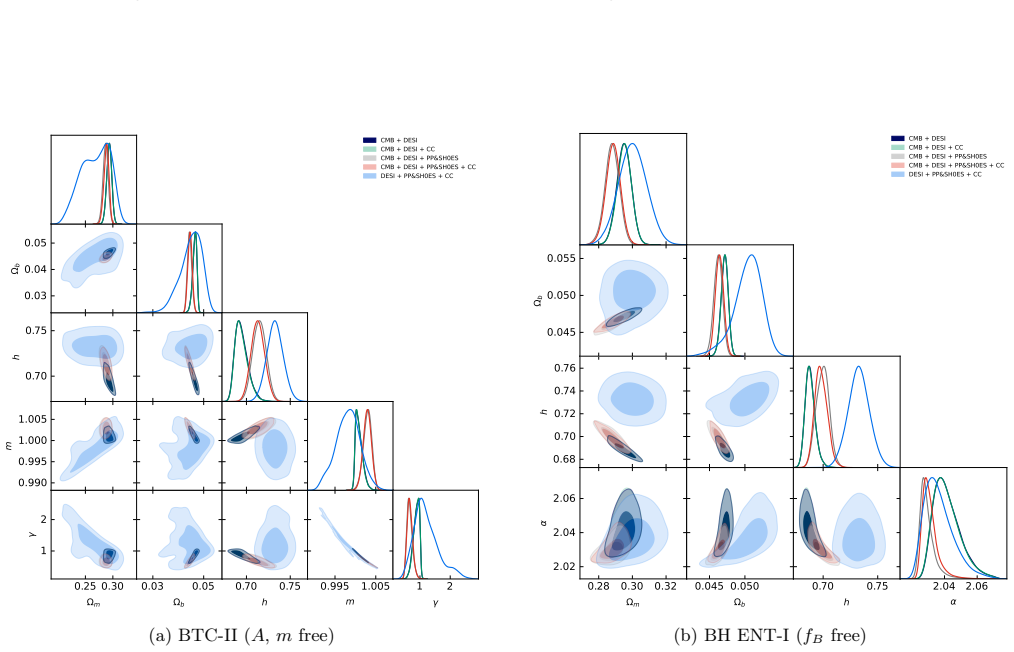
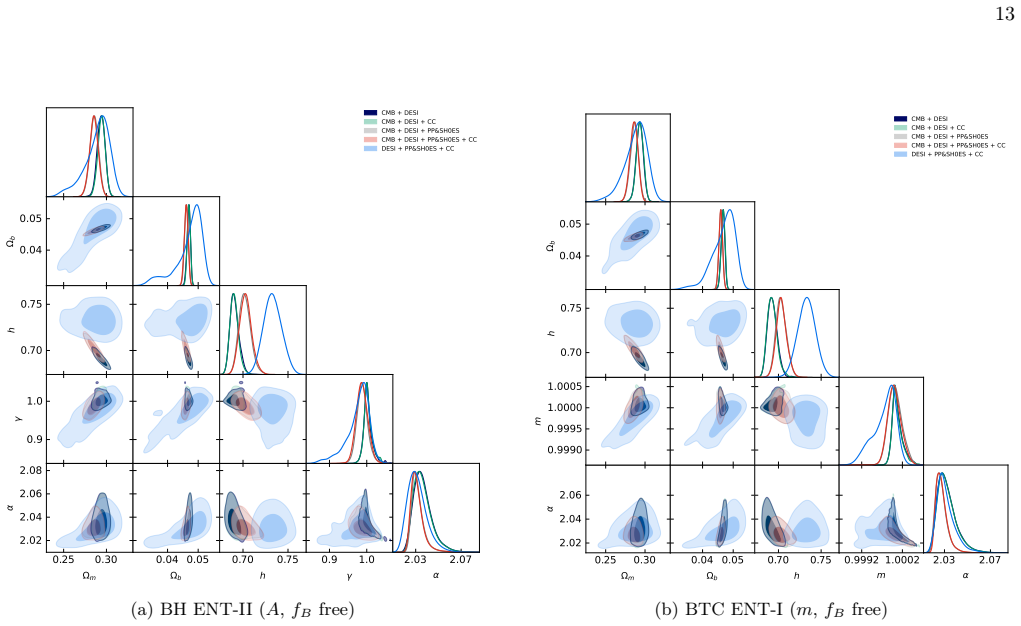
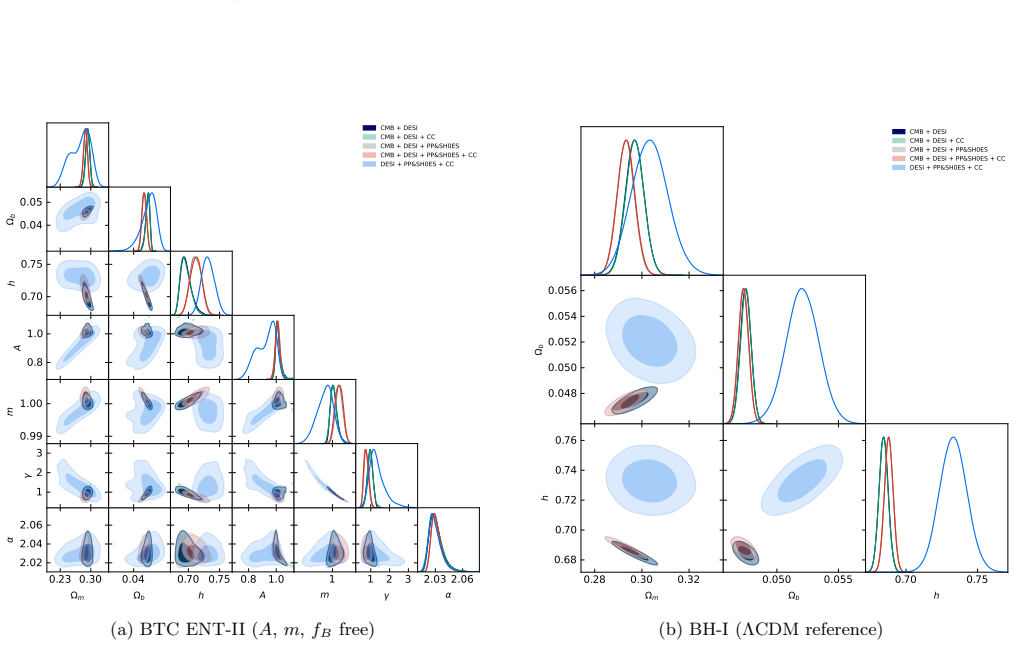
The paper's central claim is that the generalized mass-to-horizon entropy class, despite its additional parameters, is observationally forced back to standard Bekenstein–Hawking thermodynamics: the entropy exponent satisfies |m−1| ≲ 10⁻⁴ when the MHR coupling is fixed and ≲10⁻³ when the coupling is free, and the derived coupling and entanglement amplitude deviate from their ΛCDM values only along degeneracy directions. It further claims that the apparent resolution of the Hubble tension is an artifact: adding parameters absorbs the CMB–SH0ES discrepancy, pushing h to 0.70–0.71, but the Bayesian log-evidence is negative for every extension in every dataset combination (−16 ≲ Δ ln Z ≲ −1). The
What carries the argument
The central object is the generalized mass-to-horizon relation M = γ(c²/G)ℓ_Pl [(L/ℓ_Pl) ∓ β(L/ℓ_Pl)^{3−α}]^m, combined with the Cai–Kim horizon temperature and the Clausius relation dE = T dS to produce implicit modified Friedmann equations with an effective dark-energy density that depends explicitly on H. The quantity that carries the argument is the Planck-to-Hubble hierarchy X = ℓ_Pl H0/c ≈ 10⁻⁶¹ h: because the coupling A ∝ X^{1−m}, a fractional deviation of m from 1 is amplified roughly 140-fold in the dark-energy density, which is why the data bound m at the 10⁻⁴ level even though the observations never directly probe horizon microstructure. Two reparametrizations—sampling A instead o
Load-bearing premise
The load-bearing premise is that the compressed Planck 2018 shift-parameter likelihood, validated mainly for wCDM-type dark energy, remains accurate for these models whose effective dark-energy density depends explicitly on H—the paper itself flags this as not independently established, so a bias in the compression would systematically shift the tight bound on m and the inferred Hubble constants.
What would settle it
Repeat the MCMC analysis with a full Planck 2018 CMB power-spectrum likelihood instead of the shift-parameter compression. If the marginalized posterior for m moves outside 1 ± few×10⁻⁴, or if the inferred h in CMB-inclusive chains shifts by more than the quoted uncertainties, the headline constraint is an artifact of the compressed likelihood. A second check: run the CMB-free combination with a SH0ES-independent absolute magnitude calibration; if the preference for A≠1 or f_B≠0 persists, the 'tension absorption' interpretation would need revision.
If this is right
- Standard Bekenstein–Hawking horizon entropy is sufficient for the background expansion history; no macroscopically significant modification of horizon thermodynamics survives the data.
- The Hubble tension is not resolved by this class of flat-universe entropy modifications: the highest inferred value, h = 0.7148 ± 0.0076, still sits about 1.2σ below the SH0ES determination.
- Because the Bayesian evidence favors ΛCDM in every dataset combination, any apparent preference for modified entropy in SH0ES-anchored fits should be attributed to parameter-driven absorption of the tension.
- The scale-hierarchy amplification means that any Planck-normalized MHR-type entropy modification is testable at the 10⁻⁴ level with CMB plus BAO data, independent of direct sensitivity to horizon structure.
- The ∼2σ hint of a nonzero entanglement amplitude appears only when the SH0ES calibration is included, reinforcing the conclusion that it is tension absorption rather than a physical detection.
Where Pith is reading between the lines
- If the compressed-CMB caveat is resolved with a full power-spectrum likelihood, the tight bound on m could either be confirmed or shift; the paper's own stated limitation makes this the first external check to perform.
- The near-degenerate m–γ direction (slope ≈ −140) implies that background data alone cannot separate the entropy exponent from the coupling; only perturbation-level observables such as growth-rate measurements or CMB lensing are likely to break it.
- The negative BTC-I interval (m < 1 at 68% for some datasets) suggests that if one imposes the physically motivated Barrow prior m ≥ 1, the posterior would pile up at m = 1, further reinforcing the standard-entropy conclusion.
- The caution about shift-parameter compression for H-dependent dark energy likely applies to any dark-energy model whose equation of state depends explicitly on H; future H-dependent models should revalidate compressed CMB likelihoods before quoting background constraints.
Editorial analysis
A structured set of objections, weighed in public.
Referee Report
Summary. The paper constrains a family of modified Friedmann cosmologies obtained in a companion paper from a generalized mass-to-horizon relation, using Pantheon+/SH0ES SNe, cosmic chronometers, DESI DR2 BAO, and Planck 2018 shift parameters. Eight sub-cases (area-law and entanglement families, with m, γ/A, and f_B free in various combinations) are sampled with emcee, using reparametrizations to handle the m–γ and α–f_B degeneracies. The reported results are: a tight bound |m−1|≲O(10^-4) when γ=1, relaxing to O(10^-3) along the m–γ ridge; a partial alleviation of the CMB–SH0ES Hubble tension (to ~1.2–2.6σ) when γ or f_B is freed; and Bayesian log-evidence differences −16≲ΔlnZ≲−1 disfavoring all extensions relative to ΛCDM. The paper attributes the tight m bound to a Planck-to-Hubble hierarchy amplification rather than direct sensitivity to horizon structure, and it emphasizes that the improved fits with SH0ES reflect absorption of the tension rather than evidence for modified entropy.
Significance. If the constraints are correct, the paper would provide a comprehensive phenomenological exclusion of observable MHR-type entropy modifications and show that this framework does not resolve the Hubble tension. The treatment of the m–γ degeneracy via the A parametrization with an explicit Jacobian is careful, and the comparison with Barrow/Tsallis–Cirto mappings and with previous MHR constraints is useful. A notable strength is the authors' transparency: they explicitly identify the hierarchy-amplification origin of the m bound and state the CMB shift-parameter caveat. However, the quantitative Bayesian evidence is compromised by an internal prior/evidence inconsistency, and the CMB-inclusive constraints rest on an unvalidated compressed likelihood. These issues affect the headline numerical claims, although the qualitative conclusion that the extensions are not favored is likely to survive.
major comments (3)
- [Sec. IIIB(d), Table II, Table V] The Bayesian evidence values in Table V are incompatible with the stated prior on f_B. For BH ENT-I with CMB+DESI+PP&SH0ES, Table IV gives f_B = 0.0092^{+0.0041}_{-0.0051}. The prior, defined in Sec. IIIB(d) and Table II, is uniform on [0, f_B,max(m,h)], with f_B,max ≈ X^{-1/2} ≈ 3×10^30 for m≈1, h≈0.7. The Occam penalty is ln(f_B,max/σ) ≈ ln(6×10^32) ≈ 75. With the reported χ² improvement Δχ²≈5–16 (Sec. IVE), the expected ΔlnZ is ≈ Δχ²/2 − 75 ≈ −70, not −2.710. This factor-of-25 discrepancy in log-evidence indicates that the evidence calculation did not use the stated prior. The Jeffreys-scale interpretation in Sec. IVE and the abstract's range −16≲ΔlnZ≲−1 are therefore not supported. The qualitative disfavoring of extensions is probably preserved, but all evidence values in Table V must be recomputed with the actual prior, or the prior specification must be corrected.
- [Sec. III (CMB compressed likelihood)] The Planck shift-parameter likelihood is used for every CMB-inclusive combination, but its validity for models whose effective dark-energy density depends explicitly on H (Eq. 2.3) has not been established; the authors note this caveat. Since the headline constraints on m, h, and f_B in CMB-inclusive chains are derived from this compressed likelihood, a systematic bias in R, l_a, or z* would shift the central values and uncertainties directly. This affects the claimed O(10^-4) bound on |m−1| and the Hubble-tension residuals in Table VI. Please validate the compression against the full Planck likelihood on representative MHR fiducial models (or an H-dependent dark-energy proxy), or present the CMB-inclusive numbers as provisional pending that check.
- [Sec. IVB, Eq. (4.1), abstract] The tight bound on m is a reparametrization of the constraint on ΩΛ0 through the Planck-to-Hubble hierarchy, not a direct measurement of horizon entropy. The authors state this transparently in Sec. IVB, but the abstract's phrase 'excluding any macroscopically significant departure from standard horizon thermodynamics' overstates what is excluded: in the Hubble-normalized MHR convention of Refs. [39,40], the same physical extension allows m≈1.1 without conflicting with late-time data. The result should be framed as a bound on the Planck-normalized amplitude A (equivalently the combination in Eq. 2.6), with the convention dependence made explicit in the abstract and conclusions.
minor comments (4)
- [Table II] The f_B prior upper limit f_B,max(m,h) depends on the sampled m and h, making the prior volume parameter-dependent. If this conditional prior is used in the evidence integral, its normalization must be included explicitly; please specify how MCEvidence handles this dependence.
- [Sec. IVE] The sentence estimating the Occam factor 'ln(50) or more per additional parameter' seems intended for A, but for f_B the factor is ~75. The text should use the actual prior widths when explaining the evidence results.
- [Table III, BTC-I row] The CMB-free constraint m = 0.99957^{+0.00043}_{-0.000042} has a strongly asymmetric error bar. Please clarify whether this asymmetry is physical, a Jacobian effect, or a boundary/prior artifact.
- [Sec. IVB] Several passages repeat the scale-hierarchy amplification argument (e.g., '∼140-fold') almost verbatim. Tightening this repetition would improve readability without changing the content.
Circularity Check
No significant circularity: the tight |m−1| bound is a transparent algebraic amplification of the measured ΩΛ0 constraint, not a fitted quantity renamed as a prediction.
full rationale
The paper's central numerical claim, |m−1| ≲ O(10⁻⁴) at γ=1, follows directly from its own equations (2.6)–(2.7) and (4.1): A = (2mγ/(3−m))X^{1−m} with X ∼ 10⁻⁶¹, and ΩΛ0 = A − (Ωm0+Ωr0) fixed by flatness. The data constrain ΩΛ0, and m is recovered by inverting this definitional mapping. This is a standard parameter inference, not a circular step: the paper does not claim an independent measurement of horizon geometry, and it explicitly states that the precision 'reflects the amplification of the Planck-to-Hubble hierarchy onto ΩΛ0, not a direct observational sensitivity to the fractal geometry.' No fitted parameter is relabeled as an independent prediction. The companion Paper I is self-cited for the thermodynamic derivation, but the Friedmann equations used here are restated in Sec. II, and the observational test against Pantheon+/SH0ES, CC, DESI, and Planck data is external and self-contained. No uniqueness theorem is imported from the authors' prior work, and no ansatz is smuggled in via citation in a way that forces the conclusions. The serious internal inconsistency in the Bayesian evidence values (the reported ΔlnZ between −1 and −16 is hard to reconcile with the stated f_B prior width and the Occam penalty, which naively gives ΔlnZ ≈ −70) is a statistical/correctness concern and would invalidate the quantitative model comparison, but it is not circular reasoning. Similarly, the acknowledged caveat about the CMB shift-parameter compression for H-dependent dark energy affects accuracy, not logical circularity. Therefore the derivation chain is not circular; the score is 0.
Axiom & Free-Parameter Ledger
free parameters (7)
- Ω_m0 =
~0.29 (dataset dependent)
- Ω_b0 =
~0.047 (dataset dependent)
- h =
0.6844–0.7330 depending on dataset combination
- m =
0.99957–1.0030 across scenarios
- A (or derived γ) =
A≈0.827–1.017; derived γ≈0.66–1.34
- f_B (or derived α) =
f_B≈0.009 with SH0ES; upper limits otherwise; derived α≈2.03
- M =
not reported
axioms (4)
- domain assumption The generalized MHR entropy S_G and modified Friedmann equation (2.1) from Paper I [1] are the correct thermodynamic extension of horizon gravity.
- domain assumption The compressed Planck 2018 shift-parameter likelihood is valid for models with H-dependent effective dark energy.
- domain assumption Spatial flatness (k=0) and the present-day flatness condition Eq. (2.7).
- ad hoc to paper The prior on f_B is uniform on [0, f_B,max(m,h)] with no Jacobian correction, as stated in Sec. IIIB(d).
read the original abstract
We constrain the class of modified cosmologies derived in Paper I [1] from a generalized mass-to-horizon relation (MHR) that enforces thermodynamic consistency between the Cai-Kim horizon temperature and generalized horizon entropies. The modified Friedmann equations depend on an entropy exponent $m$, an MHR coupling parameter $\gamma$, and an entanglement-correction amplitude $f_B$, with standard $\Lambda$CDM recovered in the appropriate limit. Using Pantheon$+$/SH0ES Type~Ia supernovae, cosmic chronometers, DESI DR2 baryon acoustic oscillations, and Planck 2018 CMB distance priors, we constrain eight physically motivated sub-cases via Markov chain Monte Carlo and compare models through the Bayesian log-evidence. The entropy exponent is tightly bounded, $|m-1|\lesssim O(10^{-4})$ when the MHR coupling is fixed ($\gamma=1$), relaxing to $O(10^{-3})$ along the $m$-$\gamma$ degeneracy, excluding any macroscopically significant departure from standard horizon thermodynamics. Freeing the MHR coupling parameter or the entanglement amplitude raises the inferred Hubble constant to $h\simeq0.70$-$0.71$, reducing the CMB-SH0ES tension from ${\sim}4\sigma$ to ${\sim}1.2$-$2.6\sigma$, but no scenario fully resolves it within a flat universe. The Bayesian log-evidence nevertheless disfavors every extension relative to $\Lambda$CDM in all dataset combinations ($-16\lesssim\Delta\ln Z \lesssim-1$): the improved fits obtained when the SH0ES calibration is included reflect an absorption of the Hubble tension by the additional parameters rather than genuine evidence for modified horizon entropy.
Figures

Reference graph
Works this paper leans on
-
[1]
occur only when the CMB and the SH0ES calibra- tion are combined, reaching∼2–3σfor BH-II, BTC- II, and BH ENT-I; the CMB-only chains show no sig- nificant departures, and in the CMB-free combination DESI+PP&SH0ES+CChlocks onto the SH0ES value whileallextensionparametersareconsistentwithΛCDM within∼1σ. Thepreferenceformodifiedentropyisthere- fore driven by...
2018
-
[2]
P. Prasanthan, H. Gohar, and V. Salzano, Phys. Lett. B (2026), accepted for publication, arXiv:2607.00133 [gr- qc]
Pith/arXiv arXiv 2026
-
[3]
J. D. Bekenstein, Phys. Rev. D7, 2333 (1973)
1973
-
[4]
S. W. Hawking, Nature248, 30 (1974)
1974
- [5]
- [6]
-
[7]
T. Padmanabhan, Class. Quant. Grav.21, 4485 (2004), arXiv:gr-qc/0308070
Pith/arXiv arXiv 2004
-
[8]
E. P. Verlinde, JHEP04, 029 (2011), arXiv:1001.0785 [hep-th]
Pith/arXiv arXiv 2011
-
[9]
Y. Gong and A. Wang, Phys. Rev. Lett.99, 211301 (2007), arXiv:0704.0793 [hep-th]
Pith/arXiv arXiv 2007
-
[10]
H. Gohar and V. Salzano, Phys. Lett. B855, 138781 (2024), arXiv:2307.01768 [gr-qc]
Pith/arXiv arXiv 2024
-
[11]
H. Gohar and V. Salzano, Phys. Rev. D109, 084075 (2024), arXiv:2307.06239 [gr-qc]
Pith/arXiv arXiv 2024
- [12]
-
[13]
Gohar, (2026), arXiv:2605.18551 [gr-qc]
H. Gohar, (2026), arXiv:2605.18551 [gr-qc]
Pith/arXiv arXiv 2026
-
[14]
T. Denkiewicz and H. Gohar, Phys. Rev. D113, 063564 (2026), arXiv:2512.22103 [gr-qc]
arXiv 2026
-
[15]
Tsallis, J
C. Tsallis, J. Statist. Phys.52, 479 (1988)
1988
-
[16]
C. Tsallis and L. J. L. Cirto, Eur. Phys. J. C73, 2487 (2013), arXiv:1202.2154 [cond-mat.stat-mech]
Pith/arXiv arXiv 2013
-
[17]
Renyi, Acta Mathematica Academiae Scientiarum Hungarica10, 193 (1959)
A. Renyi, Acta Mathematica Academiae Scientiarum Hungarica10, 193 (1959)
1959
- [18]
-
[19]
K. A. Meissner, Class. Quant. Grav.21, 5245 (2004), arXiv:gr-qc/0407052
Pith/arXiv arXiv 2004
-
[20]
A. J. M. Medved and E. C. Vagenas, Phys. Rev. D70, 124021 (2004), arXiv:hep-th/0411022
Pith/arXiv arXiv 2004
-
[21]
J. D. Barrow, Phys. Lett. B808, 135643 (2020), arXiv:2004.09444 [gr-qc]
Pith/arXiv arXiv 2020
-
[22]
S. Das, S. Shankaranarayanan, and S. Sur, Phys. Rev. D77, 064013 (2008), arXiv:0705.2070 [gr-qc]
Pith/arXiv arXiv 2008
-
[23]
I. Çimdiker, M. P. Dabrowski, and H. Gohar, Eur. Phys. J. C83, 169 (2023), arXiv:2208.04473 [gr-qc]
Pith/arXiv arXiv 2023
-
[24]
D. Broutet al., Astrophys. J.938, 110 (2022), arXiv:2202.04077 [astro-ph.CO]
Pith/arXiv arXiv 2022
-
[25]
K. Jiao, N. Borghi, M. Moresco, and T.-J. Zhang, Astro- phys. J. Suppl.265, 48 (2023), arXiv:2205.05701 [astro- ph.CO]
Pith/arXiv arXiv 2023
-
[26]
M. Abdul Karimet al.(DESI), Phys. Rev. D112, 083515 (2025), arXiv:2503.14738 [astro-ph.CO]
Pith/arXiv arXiv 2025
-
[27]
N. Aghanimet al.(Planck), Astron. Astrophys.641, A6 (2020), [Erratum: Astron.Astrophys. 652, C4 (2021)], arXiv:1807.06209 [astro-ph.CO]
Pith/arXiv arXiv 2020
-
[28]
D. Foreman-Mackey, D. W. Hogg, D. Lang, and J. Goodman, Publ. Astron. Soc. Pac.125, 306 (2013), arXiv:1202.3665 [astro-ph.IM]
Pith/arXiv arXiv 2013
-
[29]
A. Carr, T. M. Davis, D. Scolnic, D. Scolnic, K. Said, D. Brout, E. R. Peterson, and R. Kessler, Publ. Astron. Soc. Austral.39, e046 (2022), arXiv:2112.01471 [astro- ph.CO]
Pith/arXiv arXiv 2022
-
[30]
R. Jimenez and A. Loeb, Astrophys. J.573, 37 (2002), arXiv:astro-ph/0106145
Pith/arXiv arXiv 2002
-
[31]
M. Moresco, R. Jimenez, A. Cimatti, and L. Pozzetti, JCAP03, 045 (2011), arXiv:1010.0831 [astro-ph.CO]
Pith/arXiv arXiv 2011
-
[32]
M. Moresco, R. Jimenez, L. Verde, L. Pozzetti, A. Cimatti, and A. Citro, Astrophys. J.868, 84 (2018), arXiv:1804.05864 [astro-ph.CO]
Pith/arXiv arXiv 2018
-
[33]
M. Moresco, R. Jimenez, L. Verde, A. Cimatti, and L. Pozzetti, Astrophys. J.898, 82 (2020), arXiv:2003.07362 [astro-ph.GA]
Pith/arXiv arXiv 2020
-
[34]
M. Morescoet al., Living Rev. Rel.25, 6 (2022), arXiv:2201.07241 [astro-ph.CO]
Pith/arXiv arXiv 2022
-
[35]
Y. Wang and P. Mukherjee, Phys. Rev. D76, 103533 (2007), arXiv:astro-ph/0703780
Pith/arXiv arXiv 2007
-
[36]
Z. Zhai, C.-G. Park, Y. Wang, and B. Ratra, JCAP07, 009 (2020), arXiv:1912.04921 [astro-ph.CO]
Pith/arXiv arXiv 2020
-
[37]
A. Aizpuru, R. Arjona, and S. Nesseris, Phys. Rev. D 104, 043521 (2021), arXiv:2106.00428 [astro-ph.CO]
Pith/arXiv arXiv 2021
-
[38]
D. W. Hogg, (1999), arXiv:astro-ph/9905116
Pith/arXiv arXiv 1999
-
[39]
A. Heavens, Y. Fantaye, A. Mootoovaloo, H. Eggers, Z. Hosenie, S. Kroon, and E. Sellentin, (2017), arXiv:1704.03472 [stat.CO]
Pith/arXiv arXiv 2017
-
[40]
S. Basilakos, A. Lymperis, M. Petronikolou, and E. N. Saridakis, arXiv (2025), arXiv:2503.24355 [gr-qc]
Pith/arXiv arXiv 2025
-
[41]
G. G. Luciano and A. Paliathanasis, Phys. Lett. B870, 139954 (2025), arXiv:2508.13260 [gr-qc]
arXiv 2025
-
[42]
G. G. Luciano, JHEAp50, 100487 (2026), arXiv:2510.00673 [gr-qc]
arXiv 2026
-
[43]
G. G. Luciano and E. N. Saridakis, arXiv (2025), arXiv:2511.01693 [gr-qc]
arXiv 2025
-
[44]
İ. Çimdiker, M. P. Dąbrowski, and V. Salzano, arXiv (2025), arXiv:2503.18230 [astro-ph.CO]
Pith/arXiv arXiv 2025
-
[45]
A. Ghoshal and G. Lambiase, arXiv (2021), arXiv:2104.11296 [astro-ph.CO]
Pith/arXiv arXiv 2021
-
[46]
G. G. Luciano and J. Giné, Phys. Lett. B833, 137352 (2022), arXiv:2204.02723 [gr-qc]
Pith/arXiv arXiv 2022
-
[47]
G. G. Luciano, Eur. Phys. J. C83, 329 (2023), arXiv:2301.12509 [gr-qc]
Pith/arXiv arXiv 2023
-
[48]
M. Asghari and A. Sheykhi, Mon. Not. Roy. Astron. Soc. 508, 2855 (2021), arXiv:2106.15551 [gr-qc]
Pith/arXiv arXiv 2021
-
[49]
R. D’Agostino, Phys. Rev. D99, 103524 (2019), arXiv:1903.03836 [gr-qc]
Pith/arXiv arXiv 2019
-
[50]
M. P. Dąbrowski and V. Salzano, Phys. Rev. D102, 064047 (2020), arXiv:2009.08306 [astro-ph.CO]
Pith/arXiv arXiv 2020
-
[51]
T. Denkiewicz, V. Salzano, and M. P. Dąbrowski, Phys. Rev. D108, 103533 (2023), arXiv:2303.11680 [astro- ph.CO]
Pith/arXiv arXiv 2023
discussion (0)
Sign in with ORCID, Apple, or X to comment. Anyone can read and Pith papers without signing in.