REVIEW 5 major objections 5 minor 53 references
BanglaDialecto: An End-to-End AI-Powered Regional Speech Standardization
T0 review · 5 major / 5 minor · reviewed 2026-08-12 · deepseek-v4-flash
Pith's one-line read Fine-tuned Whisper and BanglaT5 can standardize Noakhali dialect speech into formal Bangla, with near-perfect transcription on the authors' new dataset.
desk verdict A new Noakhali dialect speech corpus and a plausible end-to-end ASR/MT/TTS pipeline, but the headline numbers likely rest on a non-speaker-disjoint split and the state-of-the-art claim contradicts the paper's own table. read the letter →
The pith
A machine-rendered reading of the paper's core claim, the machinery that carries it, and where it could break.
The reading
What carries the argument
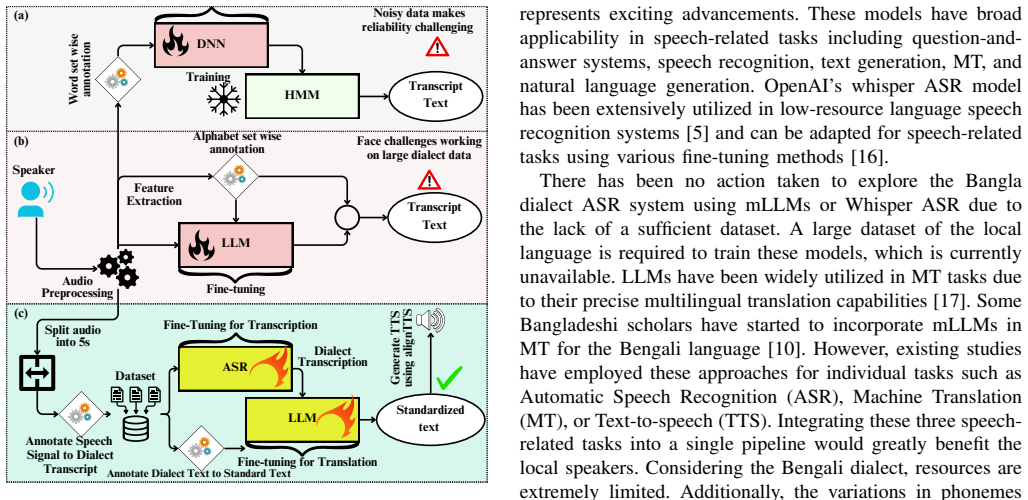
The load-bearing object is the NDD (Noakhali Dialect Dataset): 10 hours of dialect speech from 24 native speakers, segmented into 7,200 five-second chunks, each aligned with a manual dialect transcription and a standard Bangla translation. The argument runs on two fine-tuning stages over this triply-aligned data: Whisper (speech-to-text) is trained on (audio chunk, dialect text) pairs, and BanglaT5 (text-to-text) is trained on (dialect text, standard text) pairs; AlignTTS then synthesizes standard speech from the translated text. The 5-second segmentation is what makes the alignment tractable for transformer models.
What would settle it
Recompute CER, WER, and BLEU using a split that holds out entire speakers or entire source recordings, then compare with the paper's numbers; large degradation would show the reported metrics came from overlap, not generalization.
Extended reading notes
Core claim
The central claim is that fine-tuning a large multilingual ASR and a multilingual text-to-text model on a modest but carefully aligned dialect corpus is enough to nearly close the gap between a regional Bangla accent and the standard language. Specifically, the paper reports that fine-tuned Whisper-large V2 drops from a CER of 135.2% (pretrained, essentially useless on this dialect) to 0.8%, and from WER 167.5% to 1.5%, on Noakhali dialect speech; fine-tuned BanglaT5 reaches a BLEU score of 41.6 for dialect-to-standard translation, up from 22.7 without fine-tuning. The authors also demonstrate the complete chain by feeding ASR output through BanglaT5 and then AlignTTS to produce standard Bangla voice. The discovery is framed as evidence that large multilingual models, adapted on dialect-specific data, can perform dialect standardization without hand-built pronunciation or grammar rules.
Load-bearing premise
The results assume the data split is clean, meaning no audio from the same speaker or same recording appears in both training and test sets; the paper describes chunking recordings into 5-second pieces and then splitting the chunks, which risks inflating the scores.
Editorial extensions
If this is right
- A speaker of the Noakhali dialect can, in principle, dictate in their native accent and receive formal Bangla text or speech without human transcription.
- Fine-tuning is the decisive step: pretrained Whisper and BanglaT5 perform badly on this dialect, while fine-tuned versions reach the reported accuracy.
- Larger Whisper variants scale monotonically on this task, from base (CER 20.6%) to large V2 (CER 0.8%).
- The same three-stage recipe can be applied to other Bangla dialects once an equivalent aligned speech-text dataset exists.
Reading between the lines
- The reported test metrics are likely optimistic because the 7,200 segment split into train/validation/test was done without a speaker-disjoint or recording-disjoint partition, so adjacent 5-second chunks of the same utterance can appear on both sides of the split.
- The BLEU 41.6 for Noakhali is below the 47.43 previously reported by Vashantor on a Noakhali text benchmark; a fair comparison to that benchmark would require the same evaluation protocol.
- A quick test of the pipeline's true generalization would be to record a new Noakhali speaker, run the system, and measure whether CER and WER remain in single digits; the paper does not report such an out-of-corpus evaluation.
Editorial analysis
A structured set of objections, weighed in public.
Referee Report
Summary. This paper describes an end-to-end pipeline that converts Noakhali-dialect Bangla speech into standard Bangla speech. The authors collect a 10-hour corpus (NDD) from 24 speakers, segment it into 7200 five-second chunks, and fine-tune Whisper variants for dialect speech-to-text and several sequence-to-sequence models (including BanglaT5) for dialect-to-standard text translation, then use AlignTTS for text-to-speech. The headline results are 0.8% CER and 1.5% WER for Whisper-large V2 and a BLEU of 41.6 for BanglaT5. The paper claims this is the first integrated ASR+MT+TTS system for a Bangla dialect and that it outperforms existing techniques.
Significance. If the reported performance survives a properly disjoint evaluation, the paper would be a useful contribution to low-resource Bangla dialect processing: it provides a new annotated dialect corpus, compares multiple Whisper and MT model sizes under fine-tuning, and makes code and data available through a linked repository. The main value is the integrated pipeline and the new corpus, not any single methodological innovation. However, the current manuscript does not establish that the metrics are independent of the training data, and it does not evaluate the TTS output at all, so the headline claims are not yet supported.
major comments (5)
- [§III-B and §IV-A] The train/validation/test partition is described only as a split of the 7200 five-second segments into 6270/810/120 samples, with no statement that the split is disjoint by speaker or by original recording. Since Section III-A reports that the audio comes from 24 speakers and Section III-B chunks each recording into contiguous five-second segments, a segment-level random split will in all likelihood place chunks from the same recording, often from the same read paragraph, in both training and test. Such leakage can artificially lower the reported CER, WER, and BLEU. Please re-run the evaluation with a speaker- or recording-disjoint split, or otherwise provide evidence that segment-level independence is satisfied; please also report the test-set size and confidence intervals for the headline numbers.
- [§IV-B, Table II, Table III] The text in Section IV-B states that 'our models performed better than any of the current techniques,' but Table II itself reports a BLEU of 47.43 for Faria et al. [10] on the Noakhali dialect, which is higher than the 41.6 BLEU attributed to BanglaT5 in the same table. In addition, the Ours row in Table II reports CER 20.2 and WER 38.2 for the MT task, while Table III reports 21.3 and 38.2 for the fine-tuned BanglaT5 model. These internal inconsistencies must be corrected before the state-of-the-art claim can be assessed.
- [§III-A and §II] The claim in Section III-A that 'no speech signal dataset for the Noakhali dialect has been available to date' is contradicted by the paper's own related-work discussion: Faria et al. [10] (Vashantor) is cited as containing a Noakhali dialect benchmark and an associated BLEU score. The authors should clarify the relation between NDD and Vashantor, state what NDD adds (e.g., speech recordings vs. text-only data, different annotation protocol, larger size), and soften the dataset-novelty claim accordingly.
- [§I and §IV-B] The paper's title and abstract promise an end-to-end conversion of dialect speech to standard Bangla speech, but the TTS stage is not evaluated at all. Section IV-B states only that AlignTTS was used to generate standard speech; no MOS, intelligibility, similarity, or even qualitative listening-test results are reported, and Table IV (which should contain example outputs) appears empty in the manuscript. Without any evaluation of the synthesized speech, the end-to-end claim is not substantiated. Please add an evaluation of the TTS output or explicitly restrict the paper's claims to the ASR+MT stages.
- [§IV-A and §IV-C] The test set consists of only 120 five-second segments, and the parameter-scaling conclusion in Figure 4(a) is based on small performance differences (e.g., CER 2.0 vs. 1.5 vs. 0.8 across Whisper-small, medium, and large V2) reported without error bars or significance tests. On such a small test set these differences may reflect sampling noise; the authors should report confidence intervals or a significance test before drawing conclusions about model scale.
minor comments (5)
- [Table III] The column header 'BLUE Score' should be 'BLEU Score', and BLEU should not be reported with a percent sign in the abstract and text (41.6% should be 41.6).
- [§III-B] In the segmentation formula, the index 'j' in 's_i^k = s_i[(k-1)*5 : j*5]' should be 'k'; the surrounding text also mixes t_{i}^{d,j} and t_{i}^{d,k} notation.
- [Table I] The 'Max Text' row in Table I has no value; please complete the table entry or remove the row.
- [§IV-C] The statement that 'mBART showing the lowest WER' in the ablation study contradicts Table III, where fine-tuned mBART50 has WER 416.8, the highest among the four MT models; please correct this discussion.
- [§IV-A] The phrase 'which is a standard and thereby enables rigorous evaluation of model performance' is an incomplete sentence and should be rewritten.
Circularity Check
No circularity: results come from a conventional supervised fine-tuning evaluation, with only a non-circular data-split provenance concern.
full rationale
The paper's claimed derivation chain is a standard supervised fine-tuning pipeline: NDD provides paired speech, dialect-text, and standard-text examples; Whisper variants are fine-tuned on (s_i^k, t_i^d,k) for speech-to-text, BanglaT5 and other models are fine-tuned on (t_i^d,k, t_i^s,k) for text standardization, and the reported CER, WER, and BLEU scores are computed on a held-out partition of 120 samples and compared against pretrained checkpoints. None of the model outputs is defined in terms of the training targets, no fitted parameter is renamed as a prediction, and no uniqueness theorem or load-bearing self-citation is invoked. The citations to Whisper, BanglaT5, and AlignTTS are external model references, not justifications for the paper's own conclusions. The only substantive concern is that the paper does not state whether the 6270/810/120 split is speaker- or recording-disjoint; if segments from the same original recording appear in both training and test, the absolute metrics could be inflated. That is a data-provenance and independence risk, not a definitional circularity, and it cannot be established from the manuscript text alone. Accordingly, no circular step is exhibited and the circularity score is 0.
Assumptions & free parameters
free parameters (5)
- 5-second segment length =
5 s
- ASR training epochs =
10
- MT training epochs =
25
- Batch sizes =
16 for ASR, 6 for MT
- Train/validation/test split =
6270/810/120
assumptions (5)
- domain assumption NDD human annotations are accurate and consistent
- domain assumption 5-second chunks align with the corresponding text chunks
- domain assumption Train/test segments are independent
- domain assumption Fine-tuning generalizes beyond the 24 recorded speakers
- standard math CER/WER/BLEU are adequate measures of pipeline quality
Cite this review
Pith. "Pith review of BanglaDialecto: An End-to-End AI-Powered Regional Speech Standardization." pith.science (2026). https://pith.science/paper/DKV6FPV5
@misc{pith2026241110879,
  author       = {Pith},
  title        = {Pith review of: BanglaDialecto: An End-to-End AI-Powered Regional Speech Standardization},
  year         = {2026},
  howpublished = {\url{https://pith.science/paper/DKV6FPV5}},
  note         = {Machine review of arXiv:2411.10879}
}
read the original abstract
This study focuses on recognizing Bangladeshi dialects and converting diverse Bengali accents into standardized formal Bengali speech. Dialects, often referred to as regional languages, are distinctive variations of a language spoken in a particular location and are identified by their phonetics, pronunciations, and lexicon. Subtle changes in pronunciation and intonation are also influenced by geographic location, educational attainment, and socioeconomic status. Dialect standardization is needed to ensure effective communication, educational consistency, access to technology, economic opportunities, and the preservation of linguistic resources while respecting cultural diversity. Being the fifth most spoken language with around 55 distinct dialects spoken by 160 million people, addressing Bangla dialects is crucial for developing inclusive communication tools. However, limited research exists due to a lack of comprehensive datasets and the challenges of handling diverse dialects. With the advancement in multilingual Large Language Models (mLLMs), emerging possibilities have been created to address the challenges of dialectal Automated Speech Recognition (ASR) and Machine Translation (MT). This study presents an end-to-end pipeline for converting dialectal Noakhali speech to standard Bangla speech. This investigation includes constructing a large-scale diverse dataset with dialectal speech signals that tailored the fine-tuning process in ASR and LLM for transcribing the dialect speech to dialect text and translating the dialect text to standard Bangla text. Our experiments demonstrated that fine-tuning the Whisper ASR model achieved a CER of 0.8% and WER of 1.5%, while the BanglaT5 model attained a BLEU score of 41.6% for dialect-to-standard text translation.
Figures


Figures from the paper (1 more)

Reference graph
Works this paper leans on
-
[10]
F. T. J. Faria, M. B. Moin, A. A. Wase, M. Ahmmed, M. R. Sani, and T. Muhammad, “Vashantor: a large-scale multilingual benchmark dataset for automated translation of bangla regional dialects to bangla language,” arXiv preprint arXiv:2311.11142 , 2023
arXiv 2023
-
[1]
Continuous bengali speech recognition based on deep neural network,
M. A. Al Amin, M. T. Islam, S. Kibria, and M. S. Rahman, “Continuous bengali speech recognition based on deep neural network,” in 2019 international conference on electrical, computer and communication engineering (ECCE). IEEE, 2019, pp. 1–6
work page 2019
-
[2]
S. Khan, M. Pal, J. Basu, M. S. Bepari, and R. Roy, “Assessing performance of bengali speech recognizers under real world conditions using gmm-hmm and dnn based methods.” in SLTU, 2018, pp. 192–196
work page 2018
-
[3]
A. M. Samin, M. H. Kobir, S. Kibria, and M. S. Rahman, “Deep learning based large vocabulary continuous speech recognition of an under-resourced language bangladeshi bangla,” Acoustical Science and Technology, vol. 42, no. 5, pp. 252–260, 2021
work page 2021
-
[4]
Whisper augmented end-to- end/hybrid speech recognition system-cyclegan approach
P. R. Gudepu, G. P. Vadisetti, A. Niranjan, K. Saranu, R. Sarma, M. A. B. Shaik, and P. Paramasivam, “Whisper augmented end-to- end/hybrid speech recognition system-cyclegan approach.” in INTER- SPEECH, 2020, pp. 2302–2306
work page 2020
-
[5]
Analysis of whisper automatic speech recognition performance on low resource language,
R. S. A. Pratama and A. Amrullah, “Analysis of whisper automatic speech recognition performance on low resource language,” Jurnal Pilar Nusa Mandiri, vol. 20, no. 1, pp. 1–8, 2024
work page 2024
-
[6]
Enhancing whisper model for vietnamese specific domain with data blending and lora fine-tuning,
N. H. Phung, D. T. Dang, K. D. Ta, K. T. A. Nguyen, T. K. Tran, and C. T. Nguyen, “Enhancing whisper model for vietnamese specific domain with data blending and lora fine-tuning,” in The International Conference on Intelligent Systems & Networks . Springer, 2024, pp. 145–155
work page 2024
-
[7]
M. M. Rahman, B. Barman, L. Sharmin, M. R. Uddin, S. B. Yusuf, and U. Rasool, “Phonological variation and linguistic diversity in bangladeshi dialects: An exploration of sound patterns and sociolinguis- tic significance,” in Forum for Linguistic Studies , vol. 6, no. 2, 2024
work page 2024
Show all 53 references
-
[8]
Social factors and dialect variation: An analysis of age, gender, and social class in linguistic practice
S. H. Hamed and S. Mohamed, “Social factors and dialect variation: An analysis of age, gender, and social class in linguistic practice.” Refereed Journal of Northern Europe Academy for Studies & Research (Denmark), no. 21, 2023
2023
-
[9]
English to bangla machine translation using recurrent neural network,
S. Siddique, T. Ahmed, M. R. A. Talukder, and M. M. Uddin, “English to bangla machine translation using recurrent neural network,” arXiv preprint arXiv:2106.07225, 2021
2021 arXiv
-
[11]
Yu and L
D. Yu and L. Deng, Automatic speech recognition . Springer, 2016, vol. 1
2016
-
[12]
Deep learning based bangla speech-to-text conver- sion,
M. T. Tausif, S. Chowdhury, M. S. Hawlader, M. Hasanuzzaman, and H. Heickal, “Deep learning based bangla speech-to-text conver- sion,” in 2018 5th International Conference on Computational Sci- ence/Intelligence and Applied Informatics (CSII) . IEEE, 2018, pp. 49–54
2018
-
[13]
Deep neural networks in machine translation: An overview
J. Zhang, C. Zong et al., “Deep neural networks in machine translation: An overview.” IEEE Intell. Syst. , vol. 30, no. 5, pp. 16–25, 2015
2015
-
[14]
Bert: Pre-training of deep bidirectional transformers for language understanding,
J. Devlin, “Bert: Pre-training of deep bidirectional transformers for language understanding,” arXiv preprint arXiv:1810.04805 , 2018
2018 arXiv
-
[15]
Robust speech recognition via large-scale weak supervi- sion,
A. Radford, J. W. Kim, T. Xu, G. Brockman, C. McLeavey, and I. Sutskever, “Robust speech recognition via large-scale weak supervi- sion,” in International conference on machine learning . PMLR, 2023, pp. 28 492–28 518
2023
-
[16]
Exploration of whisper fine-tuning strategies for low-resource asr,
Y . Liu, X. Yang, and D. Qu, “Exploration of whisper fine-tuning strategies for low-resource asr,” EURASIP Journal on Audio, Speech, and Music Processing , vol. 2024, no. 1, p. 29, 2024
2024
-
[17]
Multilingual machine translation with large language models: Empirical results and analysis,
W. Zhu, H. Liu, Q. Dong, J. Xu, S. Huang, L. Kong, J. Chen, and L. Li, “Multilingual machine translation with large language models: Empirical results and analysis,” arXiv preprint arXiv:2304.04675, 2023
2023 arXiv
-
[18]
Bangla natural language processing: A comprehensive analysis of classical, machine learning, and deep learning-based methods,
O. Sen, M. Fuad, M. N. Islam, J. Rabbi, M. Masud, M. K. Hasan, M. A. Awal, A. A. Fime, M. T. H. Fuad, D. Sikder et al. , “Bangla natural language processing: A comprehensive analysis of classical, machine learning, and deep learning-based methods,” IEEE Access, vol. 10, pp. 38...
2022
-
[19]
Chinese dialect speech recog- nition: a comprehensive survey,
Q. Li, Q. Mai, M. Wang, and M. Ma, “Chinese dialect speech recog- nition: a comprehensive survey,” Artificial Intelligence Review , vol. 57, no. 2, p. 25, 2024
2024
-
[20]
Deep investigation of the recent advances in dialectal arabic speech recognition,
H. A. Alsayadi, A. A. Abdelhamid, I. Hegazy, B. Alotaibi, and Z. T. Fayed, “Deep investigation of the recent advances in dialectal arabic speech recognition,” IEEE Access, vol. 10, pp. 57 063–57 079, 2022
2022
-
[21]
End-to-end automatic speech recogni- tion model for the sudanese dialect,
A. Mansour and W. F. Mukhtar, “End-to-end automatic speech recogni- tion model for the sudanese dialect,” arXiv preprint arXiv:2212.10826 , 2022
2022 arXiv
-
[22]
Deep speech: Scaling up end-to-end speech recognition,
A. Hannun, “Deep speech: Scaling up end-to-end speech recognition,” arXiv preprint arXiv:1412.5567 , 2014
2014 arXiv
-
[23]
Tunisian dialectal end-to-end speech recognition based on deepspeech,
A. Messaoudi, H. Haddad, C. Fourati, M. B. Hmida, A. B. E. Mabrouk, and M. Graiet, “Tunisian dialectal end-to-end speech recognition based on deepspeech,” Procedia Computer Science , vol. 189, pp. 183–190, 2021
2021
-
[24]
Effective training end-to-end asr systems for low-resource lhasa dialect of tibetan language,
L. Pan, S. Li, L. Wang, and J. Dang, “Effective training end-to-end asr systems for low-resource lhasa dialect of tibetan language,” in 2019 Asia-Pacific Signal and Information Processing Association Annual Summit and Conference (APSIPA ASC) . IEEE, 2019, pp. 1152–1156
2019
-
[25]
A real- time bangla local language recognition from voice,
M. J. K. Noor, F. T. Johora, M. Mahin, and M. A. Rahaman, “A real- time bangla local language recognition from voice,” in Proceedings of the Fourth International Conference on Trends in Computational and Cognitive Engineering: TCCE 2022 . Springer, 2023, pp. 489–501
2022
-
[26]
Classification of bangla regional languages and recogni- tion of artificial bangla speech using deep learning,
P. S. Hossain, “Classification of bangla regional languages and recogni- tion of artificial bangla speech using deep learning,” Ph.D. dissertation, Brac University, 2022
2022
-
[27]
A neural attention-based encoder-decoder approach for english to bangla transla- tion,
A. A. Shiam, S. M. Redwan, M. H. Kabir, and J. Shin, “A neural attention-based encoder-decoder approach for english to bangla transla- tion,” Computer Science Journal of Moldova , vol. 91, no. 1, pp. 70–85, 2023
2023
-
[28]
Banglanlg and banglat5: Benchmarks and resources for evaluating low-resource natural language generation in bangla,
A. Bhattacharjee, T. Hasan, W. U. Ahmad, and R. Shahriyar, “Banglanlg and banglat5: Benchmarks and resources for evaluating low-resource natural language generation in bangla,” 2023
2023
-
[29]
mt5: A massively multilingual pre-trained text-to-text transformer,
L. Xue, N. Constant, A. Roberts, M. Kale, R. Al-Rfou, A. Siddhant, A. Barua, and C. Raffel, “mt5: A massively multilingual pre-trained text-to-text transformer,” arXiv preprint arXiv:2010.11934 , 2020
2010 arXiv
-
[30]
A comprehensive dialect conversion approach from chittagonian to standard bangla,
H. R. Milon, S. N. U. Sabbir, A. Inan, and N. Hossain, “A comprehensive dialect conversion approach from chittagonian to standard bangla,” in 2020 IEEE Region 10 Symposium (TENSYMP) . IEEE, 2020, pp. 214– 217
2020
-
[31]
F. Alam, M. Habib, and M. Khan, Bangla Text to Speech using Festival, May 2011
2011
-
[32]
A bangla text-to-speech system using deep neural networks,
R. S. Raju, P. Bhattacharjee, A. Ahmad, and M. S. Rahman, “A bangla text-to-speech system using deep neural networks,” in2019 International Conference on Bangla Speech and Language Processing (ICBSLP) , 2019, pp. 1–5
2019
-
[33]
End to end bangla speech synthesis,
P. Bhattacharjee, R. S. Raju, A. Ahmad, and M. S. Rahman, “End to end bangla speech synthesis,” 2021. [Online]. Available: https://arxiv.org/abs/2108.00500
2021 arXiv
-
[34]
Text-to-speech synthesis system for mymensinghiya dialect of bangla language,
A. Begum, S. M. S. Askari, and U. Sharma, “Text-to-speech synthesis system for mymensinghiya dialect of bangla language,” in Progress in Advanced Computing and Intelligent Engineering: Proceedings of ICACIE 2017, Volume 2 . Springer, 2019, pp. 291–303
2017
-
[35]
A comprehensive overview of large language models,
H. Naveed, A. U. Khan, S. Qiu, M. Saqib, S. Anwar, M. Usman, N. Akhtar, N. Barnes, and A. Mian, “A comprehensive overview of large language models,” arXiv preprint arXiv:2307.06435 , 2023
2023 arXiv
-
[36]
Sichuan dialect speech recognition with deep lstm network,
W. Ying, L. Zhang, and H. Deng, “Sichuan dialect speech recognition with deep lstm network,” Frontiers of Computer Science, vol. 14, no. 2, pp. 378–387, 2020
2020
-
[37]
Bengali common voice speech dataset for automatic speech recognition,
S. Alam, A. Sushmit, Z. Abdullah, S. Nakkhatra, M. Ansary, S. M. Hossen, S. M. Mehnaz, T. Reasat, and A. I. Humayun, “Bengali common voice speech dataset for automatic speech recognition,” arXiv preprint arXiv:2206.14053, 2022
2022 arXiv
-
[38]
Hybrid pipeline for building arabic tunisian dialect-standard arabic neural machine translation model from scratch,
S. Kchaou, R. Boujelbane, and L. Hadrich, “Hybrid pipeline for building arabic tunisian dialect-standard arabic neural machine translation model from scratch,” ACM Transactions on Asian and Low-Resource Language Information Processing, vol. 22, no. 3, pp. 1–21, 2023
2023
-
[39]
Automatic speech recognition for biomedical data in bengali language,
S. Kabir, N. Nahar, S. Saha, and M. Rashid, “Automatic speech recognition for biomedical data in bengali language,” arXiv preprint arXiv:2406.12931, 2024
2024 arXiv
-
[40]
Deep learning approach for translating arabic holy quran into italian language,
H. Hamed, A. M. Helmy, and A. Mohammed, “Deep learning approach for translating arabic holy quran into italian language,” in 2021 In- ternational Mobile, Intelligent, and Ubiquitous Computing Conference (MIUCC). IEEE, 2021, pp. 193–199
2021
-
[41]
End-to-end speech recognition for arabic dialects,
S. Nasr, R. Duwairi, and M. Quwaider, “End-to-end speech recognition for arabic dialects,” Arabian Journal for Science and Engineering , vol. 48, no. 8, pp. 10 617–10 633, 2023
2023
-
[42]
Low resource neural ma- chine translation: Assamese to/from other indo-aryan (indic) languages,
R. Baruah, R. K. Mundotiya, and A. K. Singh, “Low resource neural ma- chine translation: Assamese to/from other indo-aryan (indic) languages,” Transactions on Asian and Low-Resource Language Information Pro- cessing, vol. 21, no. 1, pp. 1–32, 2021
2021
-
[43]
Development of indonesian- japanese statistical machine translation using lemma translation and additional post-process,
M. A. Sulaeman and A. Purwarianti, “Development of indonesian- japanese statistical machine translation using lemma translation and additional post-process,” in 2015 International conference on electrical engineering and informatics (ICEEI) . IEEE, 2015, pp. 54–58
2015
-
[44]
End-to-end jordanian dialect speech-to-text self-supervised learning framework,
A. A. Safieh, I. A. Alhaol, and R. Ghnemat, “End-to-end jordanian dialect speech-to-text self-supervised learning framework,” Frontiers in Robotics and AI , vol. 9, p. 1090012, 2022
2022
-
[45]
Sylheti to standard bangla neural ma- chine translation: A deep learning-based dialect conversion approach
T. T. Prama and M. M. Anwar, “Sylheti to standard bangla neural ma- chine translation: A deep learning-based dialect conversion approach.”
-
[46]
Robust speech recognition via large-scale weak super- vision,
A. Radford, J. W. Kim, T. Xu, G. Brockman, C. McLeavey, and I. Sutskever, “Robust speech recognition via large-scale weak super- vision,” 2022
2022
-
[47]
Gaussian error linear units (gelus),
D. Hendrycks and K. Gimpel, “Gaussian error linear units (gelus),” arXiv preprint arXiv:1606.08415, 2016
2016 arXiv
-
[48]
Glu variants improve transformer,
N. Shazeer, “Glu variants improve transformer,” arXiv preprint arXiv:2002.05202, 2020
2002 arXiv
-
[49]
Aligntts: Effi- cient feed-forward text-to-speech system without explicit alignment,
Z. Zeng, J. Wang, N. Cheng, T. Xia, and J. Xiao, “Aligntts: Effi- cient feed-forward text-to-speech system without explicit alignment,” in ICASSP 2020-2020 IEEE international conference on acoustics, speech and signal processing (ICASSP) . IEEE, 2020, pp. 6714–6718
2020
-
[50]
Analyzing the input stream for character-level errors in unconstrained text entry evaluations,
J. O. Wobbrock and B. A. Myers, “Analyzing the input stream for character-level errors in unconstrained text entry evaluations,” ACM Transactions on Computer-Human Interaction (TOCHI) , vol. 13, no. 4, pp. 458–489, 2006
2006
-
[51]
Minimizing word error rate in textual summaries of spoken language,
K. Zechner and A. Waibel, “Minimizing word error rate in textual summaries of spoken language,” in 1st Meeting of the North American Chapter of the Association for Computational Linguistics , 2000
2000
-
[52]
Bleu: a method for automatic evaluation of machine translation,
K. Papineni, S. Roukos, T. Ward, and W.-J. Zhu, “Bleu: a method for automatic evaluation of machine translation,” in Proceedings of the 40th annual meeting of the Association for Computational Linguistics , 2002, pp. 311–318
2002
-
[53]
Sparks of large audio models: A survey and outlook,
S. Latif, M. Shoukat, F. Shamshad, M. Usama, Y . Ren, H. Cuay ´ahuitl, W. Wang, X. Zhang, R. Togneri, E. Cambria et al. , “Sparks of large audio models: A survey and outlook,” arXiv preprint arXiv:2308.12792, 2023
2023 arXiv
Reviewed August 12, 2026 · model on record in the stance chip above.
Discussion (0). Continue with ORCID to comment.