REVIEW 3 major objections 4 minor 1 cited by
Aggregating Votes with Local Differential Privacy: Usefulness, Soundness vs. Indistinguishability
T0 review · 3 major / 4 minor · reviewed 2026-08-14 · deepseek-v4-flash
Pith's one-line read Local differential privacy can make vote aggregation both more accurate and harder to manipulate than Laplace noise does.
desk verdict Real mechanism-design contribution with a mostly sound theory, but the additive sampler is buggy as printed; referee it and demand a fix. read the letter →
The pith
A machine-rendered reading of the paper's core claim, the machinery that carries it, and where it could break.
The reading
What carries the argument
The machinery is the conversion of a numerical scored vote into a bounded random object before aggregation. In the weighted sampling mechanism, a rank $j^*$ is sampled with mass $m_j$, the selected candidate's indicator undergoes binary randomised response, and the result is rescaled by $\frac{\sqrt{e^\epsilon}+1}{\sqrt{e^\epsilon}-1}\cdot\frac{w_{j^*}-c}{m_{j^*}}+c$ to stay unbiased; the intercept $c$ and masses $m_j$ are chosen to minimise $\sum_j (w_j-c)^2/m_j$, giving the median-based bound. In the additive mechanism, a subset $S$ of size $k$ is output with probability proportional to the sum of scores in $S$ minus the minimum subset score, and the private view is $a_k[C_j\in S]-b_k$ with coefficients chosen for unbiasedness. The soundness metrics are the maximum and expected $\ell^1$ magnitude of a single private view divided by $n$, and the $\ell^1$ diameter of the output domain; the finite supports of the two new mechanisms are what make these quantities finite and small.
What would settle it
Submit an out-of-support vector, say a single private view with one entry equal to $10^6$, into the proposed mechanisms' aggregation without any filter; if the estimated average scores shift by more than the proved $O(d^3/(n\epsilon))$ or $O(d^2/(n\epsilon))$ maximum-magnitude bound, the guarantee as stated fails. A concrete experiment would measure realised $\mathrm{risk}_{\mathrm{MM}}$ under such submissions and compare it with the proved bound.
Extended reading notes
Core claim
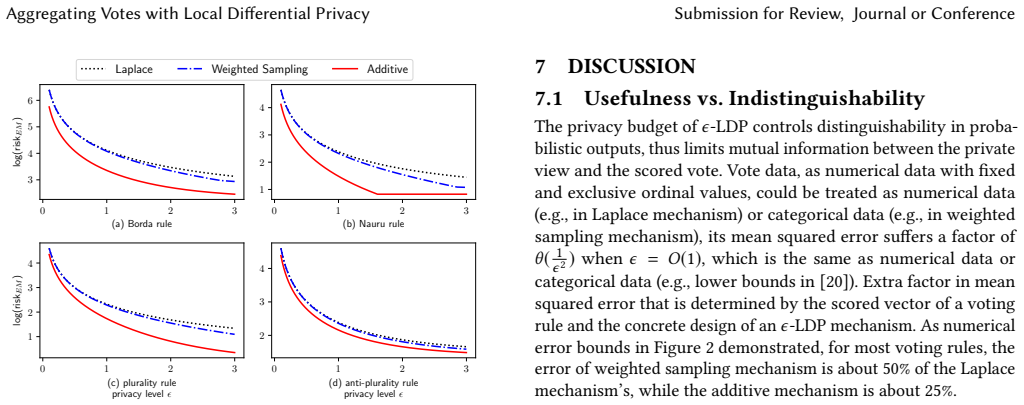
The paper's central claim is that usefulness and soundness are not opposed in local private vote aggregation: replacing unbounded additive noise with bounded sampling-based output improves both at once. The Laplace mechanism has infinite maximum magnitude risk and infinite output-domain diameter; the proposed mechanisms replace the continuous unbounded output with a finite support, and the paper proves that the worst-case effect of one manipulated view becomes finite and explicit. The weighted sampling mechanism interprets the scored vote as probabilistic data, samples a rank with probability proportional to its shifted weight, and applies binary randomised response to that rank. The additive mechanism samples a subset of candidates with probability linear in the subset's total score, which is a specialised weighted random sampling problem solved by a recursive $O(d\cdot k)$ algorithm. For Borda counts, the proven mean squared error bounds are $O(d^5/(n\epsilon^2))$ for weighted sampling and $O(d^4/(n\epsilon^2))$ for additive, with maximum magnitude risks $O(d^3/(n\epsilon))$ and $O(d^2/(n\epsilon))$, respectively, instead of the Laplace mechanism's infinity.
Load-bearing premise
The soundness theorems assume the adversary can only submit private views inside the mechanism's output domain $D_{\tilde v}$; the paper does not specify how an aggregator verifies that a submitted vector belongs to that finite support.
Editorial extensions
If this is right
- For Borda voting, the mean squared error of the estimated average score drops from $O(d^5/(n\epsilon^2))$ under Laplace to $O(d^4/(n\epsilon^2))$ under the additive mechanism, a factor of $d$ improvement in candidate-count scaling.
- Maximum manipulation risk under data amplification becomes finite: $O(d^3/(n\epsilon))$ for weighted sampling and $O(d^2/(n\epsilon))$ for additive, instead of infinity for Laplace, so a single fraudulent vote has a bounded worst-case effect on averaged scores.
- The additive mechanism's maximum and expected magnitude risks coincide, meaning its worst-case and average manipulation power are the same; the paper notes Laplace and weighted sampling do not share this property.
- The relation $\mathrm{risk}_{\mathrm{EM}} \le (\sqrt{d\cdot n\cdot \mathrm{err}_{\mathrm{MSE}}}+\sum_j |w_j|)/n$ implies that a mechanism with good usefulness usually also has good soundness, so the two goals are complementary rather than opposed.
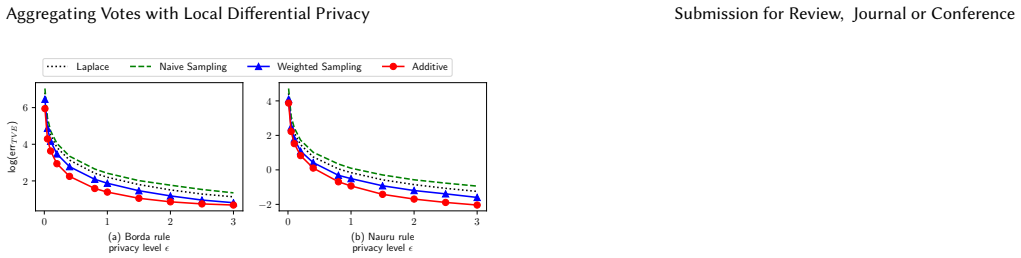
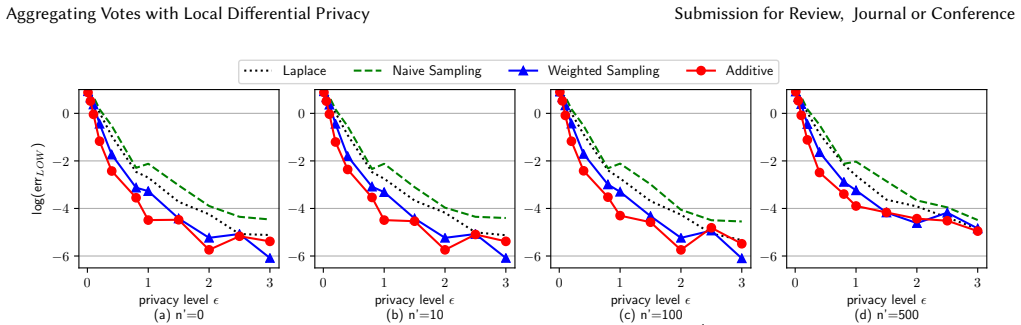
- Experiments on Borda and Nauru rules with $d$ from 4 to 32 and $n$ up to 1,000,000 report about 50% average estimation-error reduction and improved robustness to adversarial votes or views at fractions from 0.1% to 5%.
- The negative result that hard $\mathrm{risk}_{\mathrm{DD}}$ constraints can make unbiased $\epsilon$-LDP mechanisms nonexistent suggests a follow-up: relax unbiasedness slightly and quantify the resulting usefulness-soundness Pareto frontier.
Reading between the lines
- The paper leaves open how an aggregator verifies that a submitted vector lies in the mechanism's finite output support; a natural extension is to design cheap, non-interactive support proofs or signed outputs and to measure their cost and false-rejection rate.
- The same sampling-plus-randomised-response template should transfer to other aggregation tasks with bounded score vectors, such as quality scoring or recommendation aggregation, where the finite-support property would give bounded manipulation risk by the same argument.
- One could test the additive mechanism against an optimal adversary who knows the aggregator's filter threshold; the paper's experiments use a confidence-interval filter for Laplace, so an explicit comparison of best-response attacks across mechanisms would sharpen the soundness claims.
Signed reviews
Editorial analysis
A structured set of objections, weighed in public.
Referee Report
Summary. The manuscript studies local differential privacy for aggregate vote reporting under positional voting rules. It introduces two attack notions (data amplification and view disguise), defines usefulness and soundness metrics, analyzes the Laplace mechanism, and proposes two mechanisms: a weighted sampling mechanism and an additive subset-sampling mechanism. The central claims are that, for Borda voting with d candidates, the weighted sampling mechanism halves the mean squared error bound relative to Laplace and reduces the maximum-magnitude risk from +∞ to O(d^3/(nε)), while the additive mechanism improves the MSE bound from O(d^5/(nε^2)) to O(d^4/(nε^2)) and gives finite O(d^2/(nε)) manipulation risk bounds. Theoretical proofs are given for LDP and unbiasedness of both mechanisms, and synthetic experiments are reported for Borda and Nauru rules.
Significance. If the claims hold, the paper makes a useful contribution to local private data aggregation: it identifies a soundness dimension that is usually ignored, proposes concrete mechanisms with closed-form, parameter-derived MSE and risk bounds, and demonstrates that finite-support mechanisms can dominate the Laplace baseline on both usefulness and soundness. Strengths include the explicit attack definitions, the exact sensitivity bound in Lemma 4.1, the closed-form parameter optimization in Theorem 5.4, and the fact that the theoretical comparisons are not fitted to experimental data. However, the additive mechanism's usefulness claim rests on the unproved near-optimality of k=1, and, more importantly, the printed recursive sampler does not sample from the distribution in Definition 6.1 for k>1, so the implementation and experimental validation of the additive mechanism are currently unsupported. The theoretical k=1 analysis remains defensible and the conceptual contribution is significant, but the practical claims need substantial repair.
major comments (3)
- [§6.1 / Appendix 10.6, Algorithm 4] The recursive sampler does not implement Definition 6.1 for k>1. Definition 6.1 requires sampling each size-k subset T with probability proportional to z(T)=Σ_{j∈T} z_j, so Pr[min(T)=j] should be C(d-j,k-1) z_j + C(d-j-1,k-2) Σ_{j'>j} z_{j'} up to normalization. Algorithm 4 line 3 instead computes p_j = C(d-j,k-1)(z_j + (Σ_{j'>j} z_{j'} − z_j)(k−1)/(d−j)), which subtracts z_j inside the parenthesized term. For d=3, k=2, e^ε=2.718, and Borda weights w=[2,1,0], Definition 6.1 gives subset probabilities (0.487, 0.333, 0.179) for subsets {1,2}, {1,3}, {2,3}, whereas Algorithm 4 produces (0.579, 0.396, 0.025). Thus the O(d·k) implementation claimed in §6.1 and the experimental results in §8 for the additive mechanism do not correspond to the mechanism whose bounds are proved in Theorems 6.2–6.5. The authors need to correct Algorithm 4, provide a correctness proof that it samples from Definition 6.1, and re-run the affected experiments.
- [§6.2, Theorem 6.4] The theorem is stated as a general bound for the additive mechanism, but the proof analyzes only the case k=1, and the claim that 'k=1 is near to optimal for many voting rules except extremal cases' is asserted without proof. Since the headline O(d^4/(nε^2)) MSE improvement for the additive mechanism depends on k=1 being near-optimal, the authors should either prove this claim under explicit conditions on the score vector w, or restrict the usefulness theorem to k=1 and state clearly that the general parameter-k bound is not established.
- [§3.4 / §6.3, Theorem 6.5] The finite riskMM and riskDD guarantees for the proposed mechanisms are defined with respect to the output domain D_{\tilde v}, but the paper does not specify how the aggregator verifies that a submitted vector belongs to the finite support of the mechanism. For the additive mechanism the support is the set of vectors with exactly k entries equal to a_k−b_k and d−k entries equal to −b_k; for the weighted sampling mechanism the support is also finite. If an adversary may submit an arbitrary real vector and the aggregator does not check support membership, then both the maximum magnitude and the domain diameter for these mechanisms are unbounded, and the claimed finite O(d^3/(nε)) and O(d^2/(nε)) improvements over the Laplace mechanism are not realized. The paper should specify the validation procedure, analyze its cost and false-rejection rate, or explicitly state a threat model in which the aggregator can authenticate genuine mechanism outputs.
minor comments (4)
- [§5.2, Lemma 5.3 and Theorem 5.4] The text says 'the Laplace mechanism in Algorithm 2' but these statements concern the weighted sampling mechanism; please correct the naming for clarity.
- [§6.3, Theorem 6.5 proof] The proof writes riskMM = |ak−bk|+(d−1)|bk|, while the theorem statement correctly has k|ak−bk|+(d−k)|bk|; the displayed proof should match the statement.
- [Definition 6.1] The normalizer Φ is garbled as typeset and appears to contain an extraneous factor n and ambiguous parentheses; please rewrite the definition in a form that can be checked directly against the normalization used in the proof of Theorem 6.2.
- [§8, Experiments] The 'Naive Sampling' baseline is compared in several figures but has no pseudo-code and no formal statement of its privacy or unbiasedness properties, and no code or data are provided for the synthetic experiments; this makes the experimental comparison difficult to reproduce.
Circularity Check
No significant circularity: the central error and risk bounds follow from mechanism definitions and closed-form parameter choice; the only self-citations are not load-bearing.
full rationale
The paper's central claims are derived from mechanism definitions rather than from fitted data or from self-cited premises. Theorem 4.3 computes the Laplace mechanism's mean squared error directly from the variance of Laplace noise; Theorem 5.4 solves a closed-form optimization over sampling masses and the intercept; Theorem 6.4 derives the additive mechanism's error bound from the variance of the Bernoulli indicators that define the private view; and Theorems 4.4, 5.5, and 6.5 compute risk bounds from the output domains of the respective mechanisms. No fitted parameter is renamed as a prediction, and the experimental section is presented as validation rather than as an input to the theorems. The Laplace baseline is a standard, externally established mechanism and is not supplied by the authors. The paper cites the authors' earlier work (e.g., Wang et al. 2018) only in related-work comparisons and as an example of set-valued local differential privacy; it is not used as the premise of the uniqueness, error, or soundness results. The soundness analysis does assume that an adversary submits private views in the mechanism's output domain D_{\tilde v}, but this is an explicit modeling assumption rather than an equivalence between a prediction and an input. The possible implementation error in Algorithm 4 raised by the skeptical analysis is a correctness concern, not a circularity: if the sampler is wrong, the experimental and complexity claims would be unsupported, but the theoretical bounds for Definition 6.1 would still stand or fall on their own derivations. No equation in the paper reduces to another equation by construction, and no load-bearing argument depends on a self-citation chain.
Assumptions & free parameters
free parameters (3)
- intercept c =
median(w) (or w_{ceil(d/2)} / w_{floor(d/2)+1})
- sampling masses m =
|w_j - c| / sum_j |w_j - c|
- subset size k =
1 for Borda (claimed near-optimal)
assumptions (3)
- domain assumption The score vector w is non-increasing and every vote is a permutation of w.
- domain assumption The adversary in the view disguise attack is constrained to the mechanism's output domain D_{\tilde v}.
- standard math Standard properties of Laplace noise, randomized response, and Popoviciu's inequality.
Cite this review
Pith. "Pith review of Aggregating Votes with Local Differential Privacy: Usefulness, Soundness vs. Indistinguishability." pith.science (2026). https://pith.science/paper/DM2ELY34
@misc{pith2026190804920,
  author       = {Pith},
  title        = {Pith review of: Aggregating Votes with Local Differential Privacy: Usefulness, Soundness vs. Indistinguishability},
  year         = {2026},
  howpublished = {\url{https://pith.science/paper/DM2ELY34}},
  note         = {Machine review of arXiv:1908.04920}
}
abstract
Voting plays a central role in bringing crowd wisdom to collective decision making, meanwhile data privacy has been a common ethical/legal issue in eliciting preferences from individuals. This work studies the problem of aggregating individual's voting data under the local differential privacy setting, where usefulness and soundness of the aggregated scores are of major concern. One naive approach to the problem is adding Laplace random noises, however, it makes aggregated scores extremely fragile to new types of strategic behaviors tailored to the local privacy setting: data amplification attack and view disguise attack. The data amplification attack means an attacker's manipulation power is amplified by the privacy-preserving procedure when contributing a fraud vote. The view disguise attack happens when an attacker could disguise malicious data as valid private views to manipulate the voting result. In this work, after theoretically quantifying the estimation error bound and the manipulating risk bound of the Laplace mechanism, we propose two mechanisms improving the usefulness and soundness simultaneously: the weighted sampling mechanism and the additive mechanism. The former one interprets the score vector as probabilistic data. Compared to the Laplace mechanism for Borda voting rule with $d$ candidates, it reduces the mean squared error bound by half and lowers the maximum magnitude risk bound from $+\infty$ to $O(\frac{d^3}{n\epsilon})$. The latter one randomly outputs a subset of candidates according to their total scores. Its mean squared error bound is optimized from $O(\frac{d^5}{n\epsilon^2})$ to $O(\frac{d^4}{n\epsilon^2})$, and its maximum magnitude risk bound is reduced to $O(\frac{d^2}{n\epsilon})$. Experimental results validate that our proposed approaches averagely reduce estimation error by $50\%$ and are more robust to adversarial attacks.
Figures


Figures from the paper (32 more)






Forward citations
Cited by 1 Pith paper
-
Private Rank Aggregation under Local Differential Privacy
LDP-KwikSort:RR provides locally differentially private rank aggregation, with an error bound under Mallows data and the best empirical utility when each agent answers about half the privacy budget in pairwise queries.
Reference graph
Works this paper leans on
-
[1]
Masayuki Abe. 1998. Universally verifiable mix-net with verification work inde- pendent of the number of mix-servers. In International Conference on the Theory and Applications of Cryptographic Techniques. Springer, 437–447
work page 1998
-
[2]
John J Bartholdi, Craig A Tovey, and Michael A Trick. 1989. The computational difficulty of manipulating an election. Social Choice and Welfare 6, 3 (1989), 227–241
work page 1989
-
[3]
John J Bartholdi III, Craig A Tovey, and Michael A Trick. 1992. How hard is it to control an election? Mathematical and Computer Modelling 16, 8-9 (1992), 27–40
work page 1992
-
[4]
Raef Bassily and Adam Smith. 2015. Local, private, efficient protocols for succinct histograms. In Proceedings of the forty-seventh annual ACM symposium on Theory of computing. ACM, 127–135
work page 2015
-
[5]
Josh C Benaloh and Moti Yung. 1986. Distributing the power of a government to enhance the privacy of voters. In PODC, Vol. 86. 52–62
work page 1986
-
[6]
Raghav Bhaskar, Srivatsan Laxman, Adam Smith, and Abhradeep Thakurta. 2010. Discovering frequent patterns in sensitive data. In Proceedings of the 16th ACM SIGKDD international conference on Knowledge discovery and data mining . ACM, 503–512
work page 2010
-
[7]
Duncan Black, Robert Albert Newing, Iain McLean, Alistair McMillan, and Burt L Monroe. 1958. The theory of committees and elections. (1958)
work page 1958
-
[8]
Philippe Bulens, Damien Giry, Olivier Pereira, et al. 2011. Running Mixnet-Based Elections with Helios. EVT/WOTE 11 (2011)
work page 2011
Show all 78 references
-
[9]
Mark Bun, Jelani Nelson, and Uri Stemmer. 2018. Heavy hitters and the struc- ture of local privacy. In Proceedings of the 35th ACM SIGMOD-SIGACT-SIGAI Symposium on Principles of Database Systems . ACM, 435–447
2018
-
[10]
Konstantinos Chatzikokolakis, Catuscia Palamidessi, and Prakash Panangaden
-
[11]
David Chaum, Claude Crépeau, and Ivan Damgard. 1988. Multiparty uncondi- tionally secure protocols. In Proceedings of the twentieth annual ACM symposium on Theory of computing . ACM, 11–19
1988
-
[12]
David L Chaum. 1981. Untraceable electronic mail, return addresses, and digital pseudonyms. Commun. ACM 24, 2 (1981), 84–90
1981
-
[13]
Rui Chen, Noman Mohammed, Benjamin CM Fung, Bipin C Desai, and Li Xiong
-
[14]
1985.A robust and verifiable cryptographically secure election scheme
Josh D Cohen and Michael J Fischer. 1985.A robust and verifiable cryptographically secure election scheme. Yale University. Department of Computer Science
1985
-
[15]
Vincent Conitzer, Tuomas Sandholm, and Jérôme Lang. 2007. When are elections with few candidates hard to manipulate? Journal of the ACM (JACM) 54, 3 (2007), 14
2007
-
[16]
Graham Cormode, Tejas Kulkarni, and Divesh Srivastava. 2018. Marginal release under local differential privacy. InProceedings of the 2018 International Conference on Management of Data . ACM, 131–146
2018
-
[17]
Ronald Cramer, Matthew Franklin, Berry Schoenmakers, and Moti Yung. 1996. Multi-authority secret-ballot elections with linear work. In International Con- ference on the Theory and Applications of Cryptographic Techniques . Springer, 72–83
1996
-
[18]
Ronald Cramer, Rosario Gennaro, and Berry Schoenmakers. 1997. A secure and optimally efficient multi-authority election scheme. European transactions on Telecommunications 8, 5 (1997), 481–490
1997
-
[19]
Bolin Ding, Janardhan Kulkarni, and Sergey Yekhanin. 2017. Collecting telemetry data privately. In Advances in Neural Information Processing Systems . 3571–3580
2017
-
[20]
John C Duchi, Michael I Jordan, and Martin J Wainwright. 2013. Local privacy and statistical minimax rates. In2013 IEEE 54th Annual Symposium on Foundations of Computer Science. IEEE, 429–438
2013
-
[21]
Michael Dummett and Robin Farquharson. 1961. Stability in voting.Econometrica: Journal of The Econometric Society (1961), 33–43
1961
-
[22]
Cynthia Dwork. 2011. Differential privacy. Encyclopedia of Cryptography and Security (2011), 338–340
2011
-
[23]
Cynthia Dwork, Krishnaram Kenthapadi, Frank McSherry, Ilya Mironov, and Moni Naor. 2006. Our data, ourselves: Privacy via distributed noise generation. In Annual International Conference on the Theory and Applications of Cryptographic Techniques. Springer, 486–503
2006
-
[24]
Cynthia Dwork, Frank McSherry, Kobbi Nissim, and Adam Smith. 2006. Cali- brating noise to sensitivity in private data analysis. In Theory of cryptography conference. Springer, 265–284
2006
-
[25]
Cynthia Dwork, Aaron Roth, et al. 2014. The algorithmic foundations of differ- ential privacy. Foundations and Trends® in Theoretical Computer Science 9, 3–4 (2014), 211–407
2014
-
[26]
Cynthia Dwork, Weijie Su, and Li Zhang. 2015. Private false discovery rate control. arXiv preprint arXiv:1511.03803 (2015)
2015 arXiv
-
[27]
Cynthia Dwork, Weijie J Su, and Li Zhang. 2018. Differentially Private False Discovery Rate Control. arXiv preprint arXiv:1807.04209 (2018)
2018 arXiv
-
[28]
Pavlos S Efraimidis and Paul G Spirakis. 2006. Weighted random sampling with a reservoir. Inform. Process. Lett. 97, 5 (2006), 181–185
2006
-
[29]
Eithan Ephrati and Jeffrey S Rosenschein. 1991. The Clarke Tax as a Consensus Mechanism Among Automated Agents.. In AAAI, Vol. 91. 173–178
1991
-
[30]
Eithan Ephrati, Jeffrey S Rosenschein, et al . 1993. Multi-agent planning as a dynamic search for social consensus. In IJCAI, Vol. 93. 423–429
1993
-
[31]
Úlfar Erlingsson, Vasyl Pihur, and Aleksandra Korolova. 2014. Rappor: Ran- domized aggregatable privacy-preserving ordinal response. In Proceedings of the 2014 ACM SIGSAC conference on computer and communications security . ACM, 1054–1067
2014
-
[32]
Piotr Faliszewski, Edith Hemaspaandra, and Lane A Hemaspaandra. 2009. How hard is bribery in elections? Journal of Artificial Intelligence Research 35 (2009), 485–532
2009
-
[33]
Giulia Fanti, Vasyl Pihur, and Úlfar Erlingsson. 2016. Building a rappor with the unknown: Privacy-preserving learning of associations and data dictionaries. Proceedings on Privacy Enhancing Technologies 2016, 3 (2016), 41–61
2016
-
[34]
Atsushi Fujioka, Tatsuaki Okamoto, and Kazuo Ohta. 1992. A practical secret voting scheme for large scale elections. In International Workshop on the Theory and Application of Cryptographic Techniques. Springer, 244–251
1992
-
[35]
Allan Gibbard et al. 1977. Manipulation of schemes that mix voting with chance. Econometrica 45, 3 (1977), 665–681
1977
-
[36]
Moritz Hardt and Jonathan Ullman. 2014. Preventing false discovery in interactive data analysis is hard. In 2014 IEEE 55th Annual Symposium on Foundations of Computer Science. IEEE, 454–463
2014
-
[37]
Michael Hay, Vibhor Rastogi, Gerome Miklau, and Dan Suciu. 2010. Boosting the accuracy of differentially private histograms through consistency. Proceedings of the VLDB Endowment 3, 1-2 (2010), 1021–1032
2010
-
[38]
Martin Hirt. 2010. Receipt-free K-out-of-L voting based on ElGamal encryption. In Towards Trustworthy Elections. Springer, 64–82
2010
-
[39]
Martin Hirt and Kazue Sako. 2000. Efficient receipt-free voting based on homo- morphic encryption. In International Conference on the Theory and Applications of Cryptographic Techniques. Springer, 539–556
2000
-
[40]
Prateek Jain, Vivek Kulkarni, Abhradeep Thakurta, and Oliver Williams. 2015. To drop or not to drop: Robustness, consistency and differential privacy properties of dropout. arXiv preprint arXiv:1503.02031 (2015)
2015 arXiv
-
[41]
Peter Kairouz, Keith Bonawitz, and Daniel Ramage. 2016. Discrete Distribution Estimation under Local Privacy. In International Conference on Machine Learning . 2436–2444
2016
-
[42]
Peter Kairouz, Sewoong Oh, and Pramod Viswanath. 2014. Extremal mechanisms for local differential privacy. InAdvances in neural information processing systems. 2879–2887
2014
-
[43]
Hillol Kargupta, Souptik Datta, Qi Wang, and Krishnamoorthy Sivakumar. 2003. On the Privacy Preserving Properties of Random Data Perturbation Techniques.. In ICDM, Vol. 3. Citeseer, 99–106
2003
-
[44]
Yusuke Kawamoto and Takao Murakami. 2018. Differentially Private Obfuscation Mechanisms for Hiding Probability Distributions. arXiv preprint arXiv:1812.00939 (2018)
2018 arXiv
-
[45]
Daniel Kifer and Ashwin Machanavajjhala. 2011. No free lunch in data privacy. In Proceedings of the 2011 ACM SIGMOD International Conference on Management of data. ACM, 193–204
2011
-
[46]
Byoungcheon Lee, Colin Boyd, Ed Dawson, Kwangjo Kim, Jeongmo Yang, and Seungjae Yoo. 2003. Providing receipt-freeness in mixnet-based voting protocols. In International Conference on Information Security and Cryptology . Springer, 245–258
2003
-
[47]
Chao Li, Michael Hay, Vibhor Rastogi, Gerome Miklau, and Andrew McGregor
-
[48]
Ninghui Li, Tiancheng Li, and Suresh Venkatasubramanian. 2007. t-closeness: Privacy beyond k-anonymity and l-diversity. In 2007 IEEE 23rd International Conference on Data Engineering . IEEE, 106–115
2007
-
[49]
Ninghui Li, Wahbeh Qardaji, Dong Su, and Jianneng Cao. 2012. Privbasis: Fre- quent itemset mining with differential privacy. Proceedings of the VLDB Endow- ment 5, 11 (2012), 1340–1351
2012
-
[50]
Ashwin Machanavajjhala, Johannes Gehrke, Daniel Kifer, and Muthuramakrish- nan Venkitasubramaniam. 2006. l-diversity: Privacy beyond k-anonymity. In 22nd International Conference on Data Engineering (ICDE’06) . IEEE, 24–24
2006
-
[51]
Frank McSherry and Kunal Talwar. 2007. Mechanism Design via Differential Privacy.. In FOCS, Vol. 7. 94–103
2007
-
[52]
Hervé Moulin. 1980. On strategy-proofness and single peakedness. Public Choice 35, 4 (1980), 437–455
1980
-
[53]
Yi Mu and Vijay Varadharajan. 1998. Anonymous secure e-voting over a network. In Proceedings 14th Annual Computer Security Applications Conference (Cat. No. 98EX217). IEEE, 293–299
1998
-
[54]
Thông T Nguyên, Xiaokui Xiao, Yin Yang, Siu Cheung Hui, Hyejin Shin, and Junbum Shin. 2016. Collecting and analyzing data from smart device users with local differential privacy. arXiv preprint arXiv:1606.05053 (2016)
2016 arXiv
-
[55]
Choonsik Park, Kazutomo Itoh, and Kaoru Kurosawa. 1993. Efficient anony- mous channel and all/nothing election scheme. In Workshop on the Theory and Aggregating Votes with Local Differential Privacy Submission for Review, Journal or Conference Application of of Cryptographic T...
1993
-
[56]
Kun Peng, Riza Aditya, Colin Boyd, Ed Dawson, and Byoungcheon Lee. 2004. Multiplicative homomorphic e-voting. In International Conference on Cryptology in India. Springer, 61–72
2004
-
[57]
Ariel D Procaccia and Jeffrey S Rosenschein. 2007. Junta distributions and the average-case complexity of manipulating elections. Journal of Artificial Intelligence Research 28 (2007), 157–181
2007
-
[58]
Zhan Qin, Yin Yang, Ting Yu, Issa Khalil, Xiaokui Xiao, and Kui Ren. 2016. Heavy hitter estimation over set-valued data with local differential privacy. In Proceedings of the 2016 ACM SIGSAC Conference on Computer and Communications Security. ACM, 192–203
2016
-
[59]
Benjamin Reilly. 2002. Social choice in the south seas: Electoral innovation and the borda count in the pacific island countries. International Political Science Review 23, 4 (2002), 355–372
2002
-
[60]
Peter YA Ryan. 2008. Prêt à Voter with Paillier encryption. Mathematical and Computer Modelling 48, 9-10 (2008), 1646–1662
2008
-
[61]
Thomas Steinke and Jonathan Ullman. 2017. Tight lower bounds for differentially private selection. In2017 IEEE 58th Annual Symposium on Foundations of Computer Science (FOCS). IEEE, 552–563
2017
-
[62]
Latanya Sweeney. 2002. k-anonymity: A model for protecting privacy. Inter- national Journal of Uncertainty, Fuzziness and Knowledge-Based Systems 10, 05 (2002), 557–570
2002
-
[63]
Jun Tang, Aleksandra Korolova, Xiaolong Bai, Xueqiang Wang, and Xiaofeng Wang. 2017. Privacy loss in Apple’s implementation of differential privacy on MacOS 10.12. arXiv preprint arXiv:1709.02753 (2017)
2017 arXiv
-
[64]
Abhradeep Guha Thakurta, Andrew H Vyrros, Umesh S Vaishampayan, Gaurav Kapoor, Julien Freudiger, Vivek Rangarajan Sridhar, and Doug Davidson. 2019. Learning new words. US Patent App. 16/159,473
2019
-
[65]
Abhradeep Guha Thakurta, Andrew H Vyrros, Umesh S Vaishampayan, Gaurav Kapoor, Julien Freudinger, Vipul Ved Prakash, Arnaud Legendre, and Steven Duplinsky. 2017. Emoji frequency detection and deep link frequency. US Patent 9,705,908
2017
-
[66]
Jonathan Ullman. 2018. Tight lower bounds for locally differentially private selection. arXiv preprint arXiv:1802.02638 (2018)
2018 arXiv
-
[67]
Paul Voigt and Axel Von dem Bussche. 2017. The EU General Data Protection Regulation (GDPR). A Practical Guide, 1st Ed., Cham: Springer International Publishing (2017)
2017
-
[68]
Ning Wang, Xiaokui Xiao, Yin Yang, Jun Zhao, Siu Cheung Hui, Hyejin Shin, Junbum Shin, and Ge Yu. 2019. Collecting and Analyzing Multidimensional Data with Local Differential Privacy. In Proceedings of IEEE ICDE
2019
-
[69]
Shaowei Wang, Liusheng Huang, Yiwen Nie, Pengzhan Wang, Hongli Xu, and Wei Yang. 2018. PrivSet: Set-Valued Data Analyses with Locale Differential Privacy. In IEEE INFOCOM 2018-IEEE Conference on Computer Communications . IEEE, 1088–1096
2018
-
[70]
Stanley L Warner. 1965. Randomized response: A survey technique for eliminating evasive answer bias. J. Amer. Statist. Assoc. 60, 309 (1965), 63–69
1965
-
[71]
Zhe Xia, Steve A Schneider, James Heather, and Jacques Traoré. 2008. Analysis, Improvement, and Simplification of Prêt à Voter with Paillier Encryption.. In EVT’08 Proceedings of the Conference on Electronic Voting Technology
2008
-
[72]
Jia Xu, Zhenjie Zhang, Xiaokui Xiao, Yin Yang, Ge Yu, and Marianne Winslett
-
[73]
Zhikun Zhang, Tianhao Wang, Ninghui Li, Shibo He, and Jiming Chen. 2018. Calm: Consistent adaptive local marginal for marginal release under local differ- ential privacy. In Proceedings of the 2018 ACM SIGSAC Conference on Computer and Communications Security. ACM, 212–229
2018
-
[74]
Quanyu Zhao and Yining Liu. 2016. E-Voting scheme using secret sharing and k-anonymity. In International Conference on Broadband and Wireless Computing, Communication and Applications. Springer, 893–900. Submission for Review, Journal or Conference 10 APPENDICES 10.1 Proof of ...
2016
-
[2008]
Information and Computation 206, 2-4 (2008), 378–401
Anonymity protocols as noisy channels. Information and Computation 206, 2-4 (2008), 378–401
2008
-
[2010]
InProceedings of the twenty-ninth ACM SIGMOD-SIGACT-SIGART symposium on Principles of database systems
Optimizing linear counting queries under differential privacy. InProceedings of the twenty-ninth ACM SIGMOD-SIGACT-SIGART symposium on Principles of database systems. ACM, 123–134
-
[2011]
Proceedings of the VLDB Endowment 4, 11 (2011), 1087–1098
Publishing set-valued data via differential privacy. Proceedings of the VLDB Endowment 4, 11 (2011), 1087–1098
2011
-
[2013]
The VLDB JournalâĂŤThe International Journal on Very Large Data Bases 22, 6 (2013), 797–822
Differentially private histogram publication. The VLDB JournalâĂŤThe International Journal on Very Large Data Bases 22, 6 (2013), 797–822
2013
Reviewed August 14, 2026 · model on record in the stance chip above.
Discussion (0). Continue with ORCID to comment.