REVIEW 4 major objections 4 minor 37 references
Influence of correlations between yields on the chemical freeze-out temperature
T0 review · 4 major / 4 minor · reviewed 2026-08-14 · deepseek-v4-flash
Pith's one-line read Yield correlations barely move the chemical freeze-out temperature extracted from thermal fits
desk verdict Honest toy-model sensitivity study: within its assumed two-parameter correlation family the freeze-out temperature barely moves, but the family itself is unmeasured, so the claim is conditional. read the letter →
The pith
A machine-rendered reading of the paper's core claim, the machinery that carries it, and where it could break.
The reading
What carries the argument
The machinery is the least-squares statistic generalized to a multivariate Gaussian with a known covariance matrix, $\chi^2_{\mathrm{LS}} = \sum_{i,j}(Y_i - Y_i^{\mathrm{th}})[C^{-1}]_{ij}(Y_j - Y_j^{\mathrm{th}})$, replacing the diagonal-only form that ignores correlations. Since the true covariance is unknown, the paper builds a toy model in which the only non-zero off-diagonal elements couple resonances to their final daughter pions, kaons or (anti-)protons, and resonances to later resonances in cascade decays, compressed into just two free coefficients $\rho_1$ and $\rho_2$. Positive definiteness of $C$ bounds these coefficients, and they are scanned up to their maximal values rather than fitted. The thermal densities include resonance-decay feed-down, and light nuclei enter through the entropy-per-baryon argument, so the fit parameters are the volume $V$, the chemical freeze-out temperature $T_{\mathrm{ch}}$ and the baryochemical potential $\mu_B$.
What would settle it
Measure the actual covariance matrix of the measured yields (for instance by Monte-Carlo simulation of the resonance reconstruction or by event-mixing techniques), insert it into the generalized chi-squared statistic, and refit; if the freeze-out temperature shifts by more than about 2% relative to the diagonal-only fit, or if the covariance matrix fails to be positive definite, the paper's central claim is wrong.
Extended reading notes
Core claim
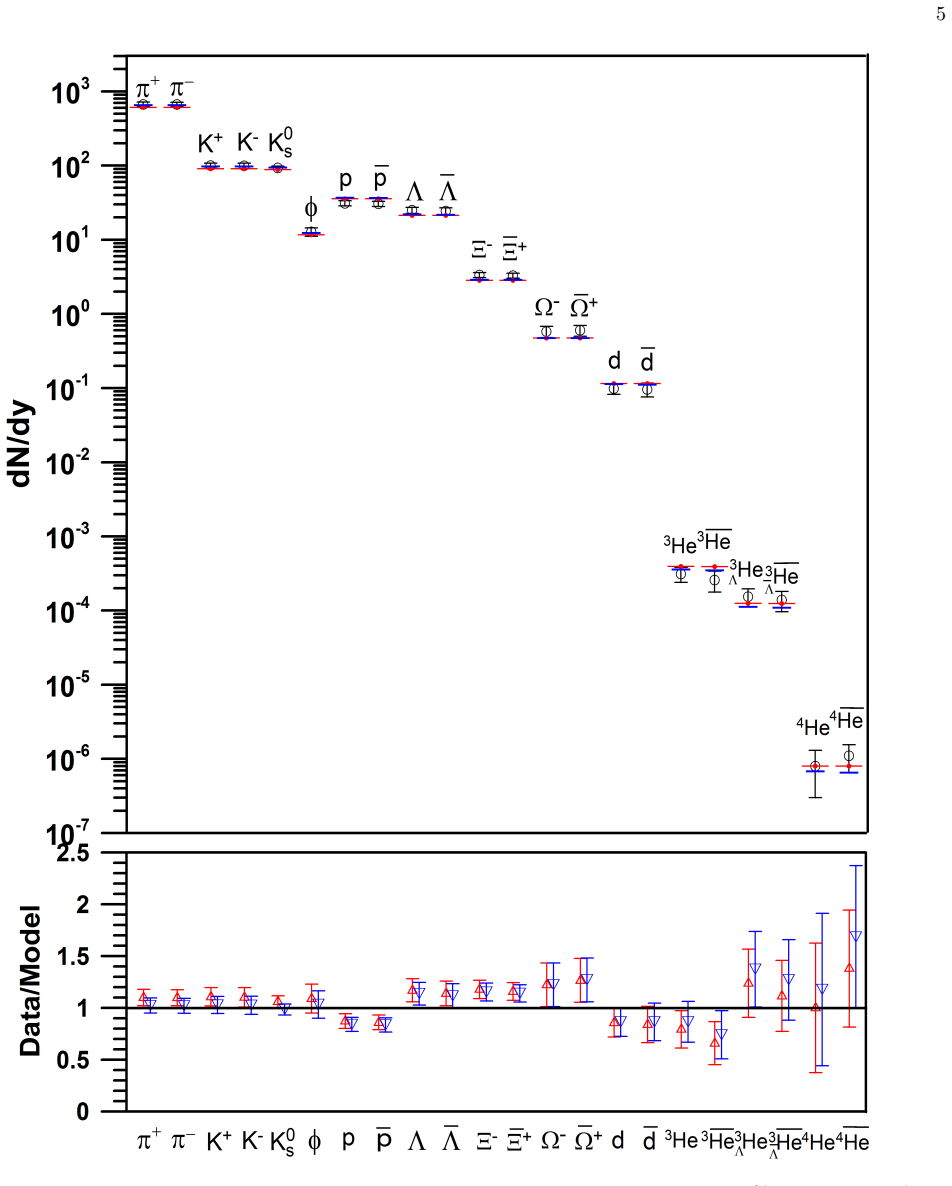
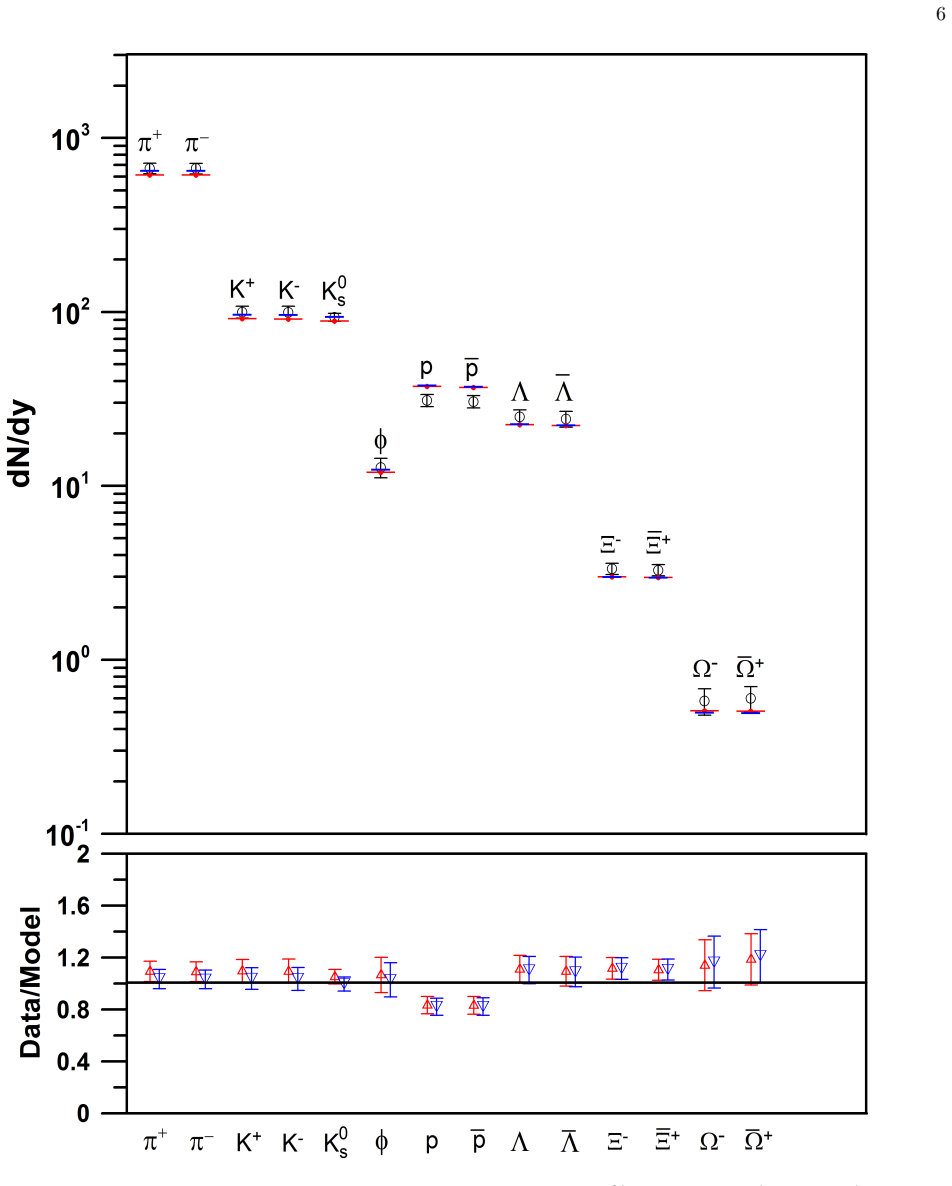
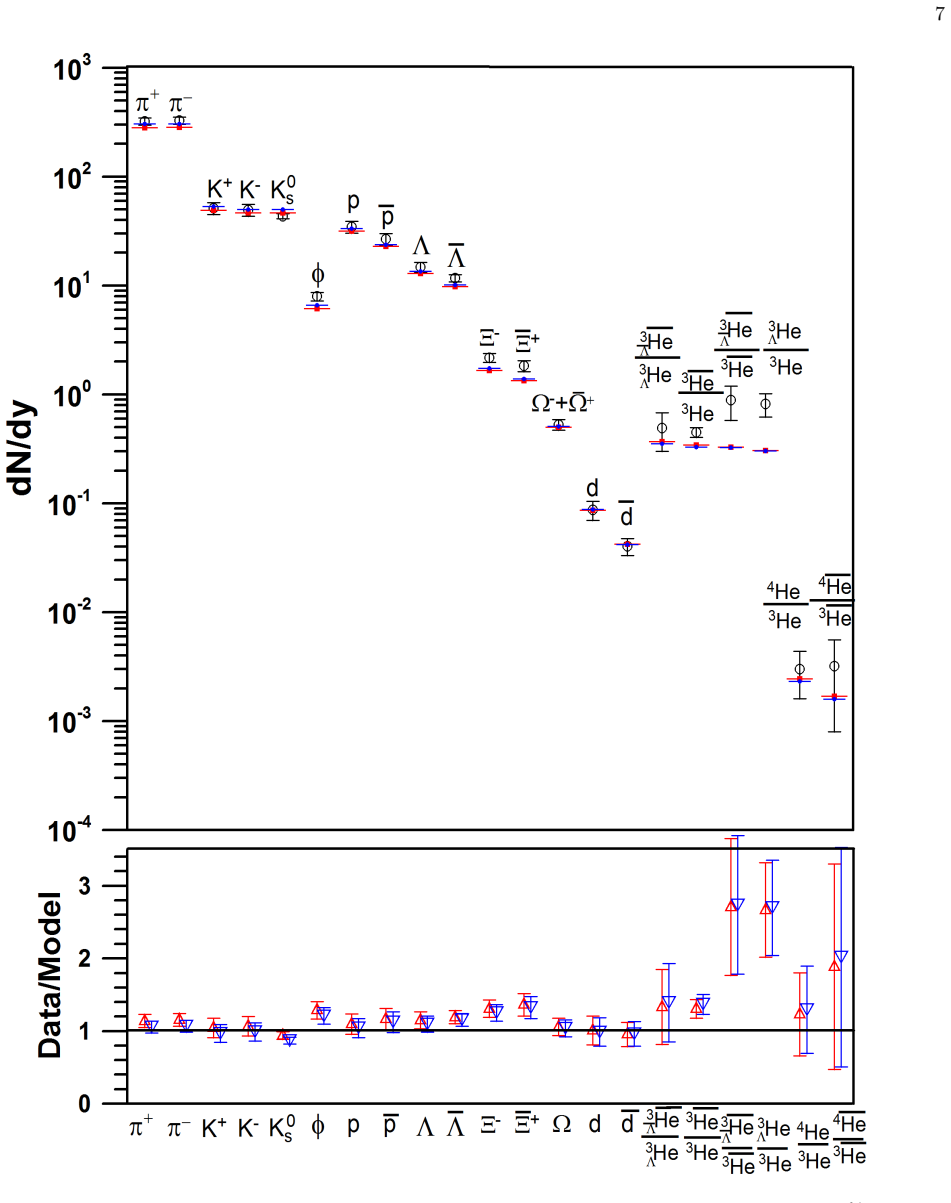
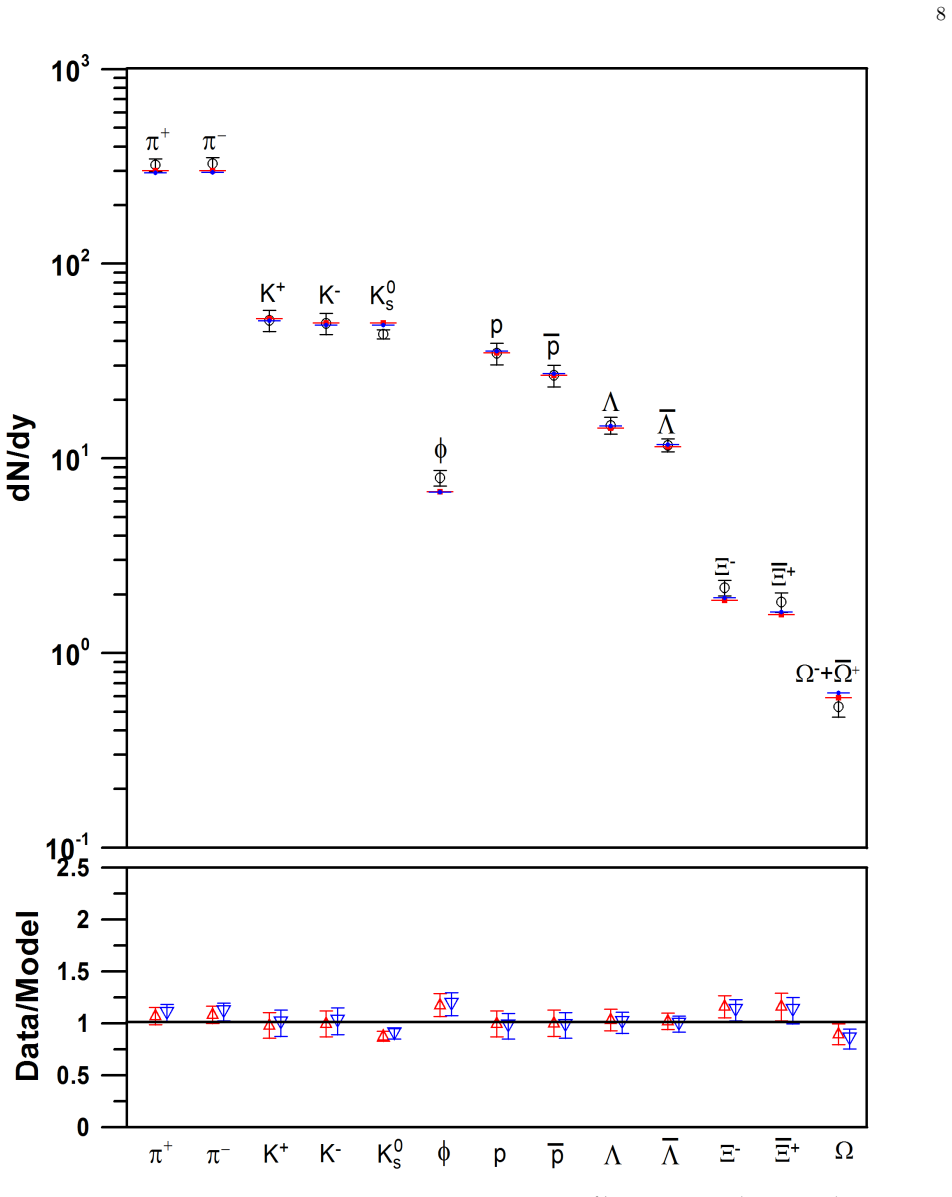
The paper's central claim is that the chemical freeze-out temperature extracted from statistical hadronization fits is insensitive to the correlations between measured yields, as long as those correlations are modeled as in this toy construction. For central Au-Au collisions at $\sqrt{s_{NN}}=200$ GeV and Pb-Pb collisions at 2.76 TeV, varying the two correlation coefficients over their full positive-definite range changes $T_{\mathrm{ch}}$ by no more than 2%. Once light nuclei are included in the fits, the correlated values for the two collision systems converge to about 158 MeV (and about 160 MeV without light nuclei), whereas the uncorrelated fits give 156 MeV for LHC and 163 MeV for RHIC without nuclei, reproducing the known discrepancy. The baryochemical potential stays essentially unchanged, while the fitted volume decreases as correlations increase and is strongly anti-correlated with temperature.
Load-bearing premise
The result rests on the toy covariance structure: the only non-zero off-diagonal correlations are between resonances and their final daughter particles, collapsed into just two coefficients; if the real yield covariance is structured differently, the fitted temperatures and the claimed weak dependence could change.
Editorial extensions
If this is right
- If the central claim is right, published thermal fits that treated yields as independent did not bias the freeze-out temperature by more than about 2%, so the parameter is robust to the missing correlation information.
- With light nuclei and correlations, the RHIC and LHC freeze-out temperatures agree at about 158 MeV, suggesting a single common chemical freeze-out temperature at these two energies and a possible resolution of the earlier discrepancy.
- The baryochemical potential is essentially unaffected by correlations, so conclusions about the chemical freeze-out line drawn from $\mu_B$ remain stable.
- The quality of the fits degrades as correlations increase, so experiments that measure the actual covariance matrix would be needed to decide whether the correlated or uncorrelated fit is the better description.
Reading between the lines
- The 2% insensitivity may be a generic feature of ratio-driven fits, because the freeze-out temperature is constrained mainly by yield ratios such as K/pi and p/pi, and correlated shifts in numerator and denominator tend to cancel; a future test would compute $T_{\mathrm{ch}}$ with a measurement-based covariance matrix from event-mixing or Monte Carlo studies.
- The strong temperature-volume anti-correlation reported here suggests that the total measured yield fixes a compensating relation between $T_{\mathrm{ch}}$ and $V$, so any future covariance model that shifts the volume will likely shift the temperature in the opposite direction, which could explain why the temperature remains so stable.
- The toy model confines correlations to two coefficients; extending it to include non-resonant species, such as pion-kaon correlations from the same centrality class, would provide a direct check of whether the weak dependence survives a more realistic covariance structure.
Signed reviews
Editorial analysis
A structured set of objections, weighed in public.
Referee Report
Summary. The paper extends the standard least-squares fit of hadron yields in the statistical thermal model by including off-diagonal elements in the covariance matrix of measured yields, representing correlations between resonances and their decay daughters. Because the experimental covariance is not available, the author constructs a toy model with only two correlation coefficients, rho1 and rho2, applied to resonance-daughter pairs, and fits the chemical freeze-out temperature, baryochemical potential, and volume to central RHIC and LHC data, both with and without light nuclei. The reported results are that the freeze-out temperature depends only weakly on the adopted correlations, that including correlations moves the RHIC and LHC temperatures to a common value of about 158 MeV with light nuclei included, and that all conclusions are explicitly speculative because the correlation structure is not measured.
Significance. If the central claim holds, the paper provides a useful methodological illustration that thermal-model freeze-out temperatures are not strongly sensitive to a plausible class of yield correlations. The statistical formulation is clearly presented, and the author reports chi-square per degree of freedom, p-values, and parameter correlation matrices for each fit, which is a strength. The conclusion, however, rests entirely on an ad hoc two-parameter covariance ansatz, and the quantitative claim of weak dependence is not documented over the full explored range. The paper is honest about its speculative nature, which is commendable, but the displayed results are not sufficient to establish the weak-dependence conclusion as a robust statement beyond the specific toy model.
major comments (4)
- [Section II, Eq. (4) and Footnote 1] The covariance model is the load-bearing assumption of the paper: only resonance-daughter and cascade pairs are assumed correlated, all correlations are positive, and they are described by just two coefficients rho1 and rho2. The maximal admissible values of these coefficients are then selected by requiring positive definiteness and, for the ALICE case, a p-value no smaller than 1%. This means the explored correlation space is constrained by the fit quality, and larger correlations that would produce stronger temperature shifts may simply lie outside the tested family. The manuscript should either provide a sensitivity scan over a wider class of covariance matrices (including different signs and off-diagonal patterns) or explicitly restrict all conclusions to the one-parameter-family illustration and explain why the p-value cutoff does not bias the weak-dependence claim.
- [Section III, first paragraph] The paper states that 'the dependence of the freeze-out temperature on the correlation coefficients has turned out to be weak (differences in temperature in the considered ranges of correlation coefficients are 2% at most)', but Tables I and II report only the uncorrelated case and the case at maximal rho1/rho2. No figure or table shows Tch as a function of rho1 and rho2 between these endpoints, so the 2% bound cannot be checked from the manuscript. The author should provide a scan or table of Tch over the considered rho grid, even if only for one representative dataset.
- [Section IV and Section II] The comparison between the RHIC and LHC cases is weakened by the fact that rho1 has different meanings in the two fits: for the ALICE case it is the correlation coefficient for cases where a proton is a daughter particle, while for the STAR case it is the coefficient for cases where a pion is a daughter particle. The agreement of both freeze-out temperatures at about 158 MeV therefore does not demonstrate that the same physical correlation structure produces the same temperature; it may be coincidental. The manuscript should discuss this asymmetry, or better, adopt a common covariance parameterization when drawing the 158 MeV conclusion.
- [General (data and code availability)] The numerical results are not reproducible from the manuscript because the input yield data, experimental errors, the thermal-model implementation, and the constructed covariance matrices are not provided. A reader cannot verify the reported chi-square values, p-values, parameter correlations, or the maximal rho values obtained from positive-definiteness and p-value cuts. The author should provide a supplementary data file and the fitting code, or at minimum a table with all measured yields, errors, and the full covariance matrix at the maximal rho values used in the fits.
minor comments (4)
- [Conclusions, paragraph 2] The phrase 'no definite conclusions can be drawn/fomulated' contains a typo: 'fomulated' should be 'formulated'.
- [Conclusions, paragraph 2] The text 'slight increase of the the chemical freeze-out temperature' contains a duplicated 'the'.
- [References] Reference [14] lists 'Phys. Rev. Lett. 1111 (2013) 22230'; the volume number appears to be a typo and should likely be 111.
- [Tables I and II] The tables would be clearer with a caption note stating that the reported nonzero rho values are the maximal values allowed by positive definiteness and the p-value cutoff, rather than leaving this information only in a footnote.
Circularity Check
No significant circularity: the correlation coefficients are free inputs, and the weak T dependence is a computed output.
full rationale
The paper's central exercise is to fit Tch, muB, and V for fixed assumed values of two correlation coefficients rho1 and rho2 using the generalized least-squares statistic (Eq. 2), and then to compare the fitted temperatures across rho. The rho parameters are explicitly declared free parameters and are not fitted to the data: 'The ρ1 and ρ2 are free parameters and are not fitted here' (Section II). The maximal rho values are fixed by positive definiteness and a p-value acceptance threshold, which is a model-selection constraint rather than a parameter fit that determines Tch. The reported weak dependence of Tch on rho is a computed output over the scanned rho values, not an input or a renamed fit quantity. The paper repeatedly disclaims definitiveness, states that the considerations are speculative, and notes that the 1-sigma intervals for correlated and uncorrelated cases overlap. No load-bearing self-citation, uniqueness import, or renaming of a known result occurs; the zero-correlation comparison with Ref. [25] is an external benchmark. The p-value cut could limit the explored covariance range, but that is a limitation of scope, not a circular derivation.
Assumptions & free parameters
free parameters (5)
- Tch (chemical freeze-out temperature) =
155.8 to 163.4 MeV depending on data set and correlations
- muB (baryochemical potential) =
0.08 to 29.1 MeV depending on data set and correlations
- V (system volume) =
1545.8 to 4198.3 fm^3 depending on data set and correlations
- rho1 (correlation coefficient for weak-decay-corrected daughter species) =
0.14 to 0.18 at maximal allowed values
- rho2 (correlation coefficient for other resonance-daughter pairs) =
0.34 to 0.38 at maximal allowed values
assumptions (5)
- domain assumption Measured yields follow a multivariate Gaussian with known, constant covariance matrix.
- ad hoc to paper Only listed resonance-daughter pairs have non-zero yield correlations, with only two distinct coefficients rho1 and rho2.
- domain assumption The grand-canonical statistical model with point-like hadron gas and resonance decays up to about 2 GeV describes the yields.
- domain assumption A centrality class can be treated as an ensemble for comparing yields with grand-canonical predictions.
- standard math The minimized least-squares statistic is approximately chi-squared distributed with N-m degrees of freedom.
Cite this review
Pith. "Pith review of Influence of correlations between yields on the chemical freeze-out temperature." pith.science (2026). https://pith.science/paper/DMCFZMLB
@misc{pith2026190804201,
  author       = {Pith},
  title        = {Pith review of: Influence of correlations between yields on the chemical freeze-out temperature},
  year         = {2026},
  howpublished = {\url{https://pith.science/paper/DMCFZMLB}},
  note         = {Machine review of arXiv:1908.04201}
}
abstract
A statistical (thermal) model is applied to the description of hadron yields measured at central nucleus-nucleus collisions at the top RHIC energy $\sqrt{s_{NN}} = 200$ GeV and the LHC energy $\sqrt{s_{NN}} = 2.76$ TeV. In contrast to the previous analyzes a more general form of the least squares test statistic is used, which takes into account also possible correlations between different species of yields. In addition to hadrons also light nuclei are included in the fits. Because of the lack of data, a toy model is constructed where the correlation coefficients are just free parameters. Because of this the presented considerations are speculative and should be treated as an imperfect illustration of the problem. Within these limitations it is impossible to formulate any definite conclusion, it might be only mentioned that for the considered examples the dependence of the freeze-out temperature and baryon chemical potential on correlations turned out to be weak.
Figures
Figures from the paper (1 more)
Reference graph
Works this paper leans on
-
[1]
( Y1, Y2, ..., YN ) is an N -dimensional Gaussian random variable with known covariance matrix C or (Y1, Y2, ..., YN ) are independent Gaussian random variables with known variances σ2 i
-
[2]
76 TeV. In contrast to the previous analyzes a more general fo rm of the least squares test statistic is used, which takes into account also possible correlation s between different species of yields. In addition to hadrons also light nuclei are included in the fits . Because of the lack of data, a toy model is constructed where the correlation coefficients a...
-
[3]
the hypothesis Y th i (θ1, ..., θm) is linear in the parameters θi; and
-
[4]
the hypothesis is correct, then the test statistic χ2 LS,min is distributed according to a χ2 distribution with nd = N − m degrees of freedom. If the hypothesis Y th i (θ1, ..., θm) is nonlinear in the parameters, the exact distribution of χ2 LS,min is not known. However, asymptotically (when N − → ∞ ) the distribution of χ2 LS,min approaches a χ2 distrib...
work page 2010
-
[5]
Leupold, et al., Bulk properties of strongly interact ing matter, Lect
S. Leupold, et al., Bulk properties of strongly interact ing matter, Lect. Notes Phys. 814 (2011) 39
work page 2011
-
[6]
Huovinen, Hydrodynamics at RHIC and LHC: What have we l earned?, Int
P. Huovinen, Hydrodynamics at RHIC and LHC: What have we l earned?, Int. J. Mod. Phys. E 22 (2013) 1330029
work page 2013
-
[7]
P. Braun-Munzinger, K. Redlich and J. Stachel, Particle production in heavy ion collisions, in: R. C. Hwa, X.-N. Wang (Eds.), Quark-Gluon Plasma 3, World Scientific, Singapore, 2004, pp. 491-599
work page 2004
-
[8]
Floris, Hadron yields and the phase diagram of strongl y interacting matter, Nucl
M. Floris, Hadron yields and the phase diagram of strongl y interacting matter, Nucl. Phys. A 931 (2014) 103
work page 2014
Show all 37 references
-
[9]
P. J. Siemens and J. I. Kapusta, Evidence For A Soft Nuclea r Matter Equation Of State, Phys. Rev. Lett. 43 (1979) 1486, doi:10.1103/PhysRevLett.43.1486. 10 TABLE II: Fit results for Au-Au collisions at √ sN N = 200 GeV and the measurement at central rapidity, |y |< 0. 35. wit...
1979 doi
-
[10]
Braun-Munzinger and J
P. Braun-Munzinger and J. Stachel, Production of strang e clusters and strange matter in nucleus-nucleus collision s at the AGS, J. Phys.G 21 (1995) L17, doi:10.1088/0954-3899/21/3/ 002
1995 doi
-
[11]
Braun-Munzinger and J
P. Braun-Munzinger and J. Stachel, Particle ratios, equ ilibration, and the QCD phase boundary, J. Phys.G 28 (2002) 1 971, doi:10.1088/0954-3899/28/7/355
2002 doi
-
[12]
K. A. Olive, et al., [Particle Data Group Collaboration] , Review of Particle Physics, Chin. Phys. C 38 (2014) 090001
2014
-
[13]
Cowan, Statistical data analysis, Oxford University Press, Oxford, 1998
G. Cowan, Statistical data analysis, Oxford University Press, Oxford, 1998
1998
-
[14]
R. J. Barlow, Statistics: a guide to the use of statistic al methods in the physical sciences, John Wiley & Sons, Chich ester, 1989
1989
-
[15]
A. G. Frodesen, O. Skjeggestad and H. Tofte, Probabilit y And Statistics In Particle Physics, Universitetsforlage t, Bergen, Norway, 1979
1979
-
[16]
B. P. Roe, Probability and Statistics in Experimental P hysics, 2nd ed., Springer-Verlag, New York, 1992
1992
-
[17]
Abelev, et al., [ALICE Collaboration], Centrality d ependence of π , K, p production in Pb-Pb collisions at √ sN N = 2.76 TeV, Phys
B. Abelev, et al., [ALICE Collaboration], Centrality d ependence of π , K, p production in Pb-Pb collisions at √ sN N = 2.76 TeV, Phys. Rev. C 88 (2013) 044910
2013
-
[18]
B. B. Abelev, et al., [ALICE Collaboration], K 0 S and Λ production in Pb-Pb collisions at √ sN N = 2.76 TeV, Phys. Rev. Lett. 1111 (2013) 22230
2013
-
[19]
B. B. Abelev, et al., [ALICE Collaboration], Multi-str ange baryon production at mid-rapidity in Pb-Pb collisions at √ sN N = 2.76 TeV, Phys. Lett. B 728 (2014) 216, Erratum: Phys. Lett. B 734 (2014) 409
2014
-
[20]
B. B. Abelev, et al., [ALICE Collaboration], K ∗ (892)0 and ?(1020) production in Pb-Pb collisions at √ sN N = 2.76 TeV, Phys. Rev. C 91 (2015) 024609
2015
-
[21]
B. I. Abelev, et al., [STAR Collaboration], Systematic Measurements of Identified Particle Spectra in pp, d + Au and Au+Au Collisions from STAR, Phys. Rev. C 79 (2009) 034909
2009
-
[22]
Adams, et al., [STAR Collaboration], Scaling Proper ties of Hyperon Production in Au+Au Collisions at s**(1/2) = 200-GeV, Phys
J. Adams, et al., [STAR Collaboration], Scaling Proper ties of Hyperon Production in Au+Au Collisions at s**(1/2) = 200-GeV, Phys. Rev. Lett. 98 (2007) 062301
2007
-
[23]
B. I. Abelev, et al., [STAR Collaboration], Measuremen ts of phi meson production in relativistic heavy-ion collis ions at RHIC, Phys. Rev. C 79 (2009) 064903
2009
-
[24]
Agakishiev, et al., [STAR Collaboration], Strangen ess Enhancement in Cu+Cu and Au+Au Collisions at √ sN N = 200 GeV, Phys
G. Agakishiev, et al., [STAR Collaboration], Strangen ess Enhancement in Cu+Cu and Au+Au Collisions at √ sN N = 200 GeV, Phys. Rev. Lett. 108 (2012) 072301
2012
-
[25]
Torrieri, S
G. Torrieri, S. Jeon and J. Rafelski, Particle yield fluc tuations and chemical non-equilibrium at RHIC, Phys. Rev. C 74 11 (2006) 024901, doi:10.1103/PhysRevC.74.024901
2006 doi
-
[26]
Torrieri, S
G. Torrieri, S. Jeon, J. Letessier and J. Rafelski, SHAR Ev2: Fluctuations and a comprehensive treatment of decay fe ed- down, Comput. Phys. Commun. 175 (2006) 635, doi:10.1016/j. cpc.2006.07.010
2006 doi
-
[27]
Torrieri, What can we learn from fluctuations of parti cle ratios?, arXiv:0709.0587 [nucl-th]
G. Torrieri, What can we learn from fluctuations of parti cle ratios?, arXiv:0709.0587 [nucl-th]
-
[28]
Milano, Identified charged hadron production in Pb-P b collisions at √ sN N = 2.76 TeV with the ALICE experiment at the LHC, CERN-THESIS-2012-251, unpublished
L. Milano, Identified charged hadron production in Pb-P b collisions at √ sN N = 2.76 TeV with the ALICE experiment at the LHC, CERN-THESIS-2012-251, unpublished
2012
-
[29]
Andronic, P
A. Andronic, P. Braun-Munzinger, K. Redlich and J. Stac hel, Decoding the phase structure of QCD via particle produc tion at high energy, Nature 561 (7723) (2018) 321, doi:10.1038/s 41586-018-0491-6
2018 doi
-
[30]
Stachel, A
J. Stachel, A. Andronic, P. Braun-Munzinger and K. Redl ich, Confronting LHC data with the statistical hadronizati on model, J. Phys. Conf. Ser. 509 (2014) 012019
2014
-
[31]
Andronic, P
A. Andronic, P. Braun-Munzinger and J. Stachel, Hadron production in central nucleus-nucleus collisions at chemi cal freeze-out, Nucl. Phys. A 772 (2006) 167
2006
-
[32]
Adam, et al., [ALICE Collaboration], 3 Λ H and 3 ¯Λ H production in Pb-Pb collisions at √ sNN = 2.76 TeV, Phys
J. Adam, et al., [ALICE Collaboration], 3 Λ H and 3 ¯Λ H production in Pb-Pb collisions at √ sNN = 2.76 TeV, Phys. Lett. B 754 (2016) 360
2016
-
[33]
Adam, et al., [ALICE Collaboration], Production of l ight nuclei and anti-nuclei in pp and Pb-Pb collisions at ene rgies available at the CERN Large Hadron Collider, Phys
J. Adam, et al., [ALICE Collaboration], Production of l ight nuclei and anti-nuclei in pp and Pb-Pb collisions at ene rgies available at the CERN Large Hadron Collider, Phys. Rev. C 93 ( 2016) 024917
2016
-
[34]
Acharya, et al., [ALICE Collaboration], Production of 4He and 4He in Pb-Pb collisions at √ sNN = 2.76 TeV at the LHC, Nucl
S. Acharya, et al., [ALICE Collaboration], Production of 4He and 4He in Pb-Pb collisions at √ sNN = 2.76 TeV at the LHC, Nucl. Phys. A 971 (2018) 1
2018
-
[35]
Agakishiev, et al., [STAR Collaboration], Observat ion of the antimatter helium-4 nucleus, Nature 473 (2011) 35 3, Erratum: Nature 475 (2011) 412
H. Agakishiev, et al., [STAR Collaboration], Observat ion of the antimatter helium-4 nucleus, Nature 473 (2011) 35 3, Erratum: Nature 475 (2011) 412
2011
-
[36]
B. I. Abelev, et al., [STAR Collaboration], Observatio n of an Antimatter Hypernucleus, Science 328 (2010) 58
2010
-
[37]
Adam, et al., [STAR Collaboration], Beam energy depe ndence of (anti-)deuteron production in Au + Au collisions a t the BNL Relativistic Heavy Ion Collider, Phys
J. Adam, et al., [STAR Collaboration], Beam energy depe ndence of (anti-)deuteron production in Au + Au collisions a t the BNL Relativistic Heavy Ion Collider, Phys. Rev. C 99 (6) ( 2019) 064905. doi:10.1103/PhysRevC.99.064905
2019 doi
Reviewed August 14, 2026 · model on record in the stance chip above.
Discussion (0). Continue with ORCID to comment.