REVIEW 3 major objections 6 minor 3 cited by
AI Flow: Perspectives, Scenarios, and Approaches
T0 review · 3 major / 6 minor · reviewed 2026-08-07 · deepseek-v4-flash
Pith's one-line read AI Flow claims that a three-tier device-edge-cloud architecture running feature-aligned familial models and multi-model collaboration can deliver lower latency, lower bandwidth, and collective intelligence that exceeds any single model.
desk verdict A credible framework paper whose headline claims outrun the evidence; the familial-model implementations are worth a look, but the key split-inference premise is never directly tested. read the letter →
The pith
A machine-rendered reading of the paper's core claim, the machinery that carries it, and where it could break.
The reading
What carries the argument
The load-bearing object is the familial model: a series of differently sized models with aligned hidden features, obtained by weight decomposition that splits each transformer linear layer into two low-rank layers, with SVD plus data whitening used for initialization and the squared discarded singular values $\sigma_i^2$ quantifying per-layer compression loss, and by early exiting with scalable branches, where decomposed transformer blocks placed after exit points allow almost arbitrary parameter counts while sharing one LM head. This feature alignment is what makes split inference work without middleware, and it is also what makes speculative decoding and cross-tier collaboration cheap. The identity $h(n+m)/nm$, which ties the parameter ratio of a decomposed layer to its multiply-accumulate ratio, is what lets the framework translate architecture choices directly into hardware cost.
What would settle it
Run a controlled split-inference experiment across a familial pair at several scale gaps: let a small model process the first $k$ layers, transmit its activations, and let a larger familial model resume; if the end-to-end accuracy falls materially below the monolithic larger model as the scale ratio grows, or if the alignment between intermediate features, measured for instance by CKA or cosine similarity, degrades sharply as more singular values are discarded, the overhead-free sharing claim fails.
Extended reading notes
Core claim
The paper's central discovery is that the bottleneck blocking ubiquitous AI, the need to send high-dimensional activations between devices and servers, can be eliminated by constructing models that are feature-aligned across scales. Familial models are built by decomposing transformer linear layers with SVD after data whitening, so the parameter count can be tuned almost arbitrarily, and by adding early-exit branches whose decomposed transformer blocks refine intermediate features; because every variant operates on the same feature space, a small model's activations can be handed to a larger model which resumes computation directly. The paper further claims that with this alignment, collaborative decoding, split inference, and multi-agent aggregation become overhead-free or nearly so, and that the resulting connectivity between heterogeneous models is itself a source of intelligence that exceeds any isolated model. Evidence includes 25 to 60 percent transmission savings for VQA at equal accuracy, roughly 1.25x faster decoding at equal accuracy in device-edge collaboration, familial models that keep 98.2 percent of a 7B backbone's VQA capability at 3.17B parameters, and consistent gains when several LLMs or VLMs pool answers.
Load-bearing premise
The framework assumes that SVD-based weight decomposition and early-exit branches can produce model families whose hidden features stay aligned across large size gaps, so a small model's intermediate results can be handed to a larger model with no conversion and no meaningful loss of accuracy.
Editorial extensions
If this is right
- Task-oriented feature compression for device-edge VLM inference reduces transmitted data by 25 to 60 percent at equal task accuracy compared with JPEG and WebP, and cuts end-to-end latency to about a third of server-only inference on the MME benchmark.
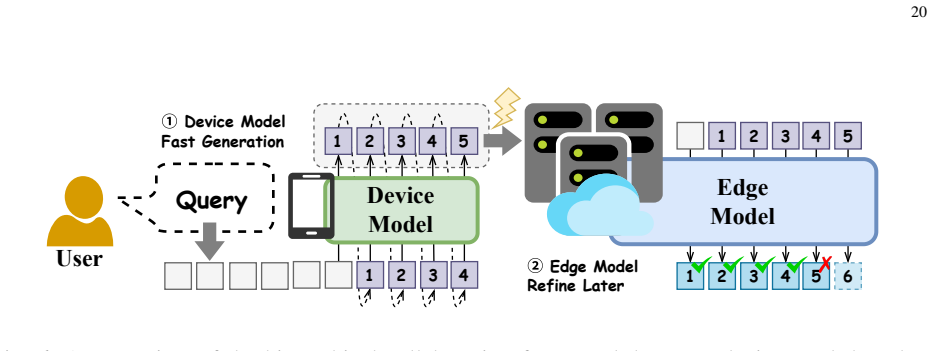
- Hierarchical speculative decoding lets a 1.5B device model plus a 7B edge verifier match 7B-only accuracy while decoding at roughly 1.25x the edge-only speed, and adding a 14B cloud model matches 14B accuracy at higher speed.
- Familial models built by early exiting with scalable branches deliver 98.2 percent of a 7B backbone's average performance on six VQA benchmarks with 3.17B parameters, and outperform direct LM-head early exits at every parameter count.
- HPCD model families with 2.38B to 6.30B parameters reach performance comparable to LLaMA2-7B, Baichuan2-7B, and ChatGLM2-6B on standard benchmarks despite far smaller parameter counts.
- Connecting multiple LLMs and VLMs through a server aggregator improves every participating model, with the weakest models gaining the most, and performance on Arena-Hard rises nearly linearly with the number of agents.
Reading between the lines
- If feature alignment holds across scale gaps, the framework implies a new cost model for distributed inference: bandwidth should scale with the number of correction tokens or compressed features, not with full activation dimensions, and the same aligned features could serve speculative decoding, split inference, and fault-tolerant resumption after disconnection.
- The per-layer SVD loss identity suggests a natural next step the paper does not take: formulating rank allocation across all layers as a constrained optimization under a total parameter budget, which could make familial family construction optimal rather than heuristic.
- The near-linear scaling of multi-agent performance with agent count is a specific, testable prediction: aggregate capability should continue to rise with the number and diversity of agents, which could be checked against larger agent pools and against collaboration among models of very different sizes.
- One limitation the paper itself records in its declarations is that part of the HPCD training data is proprietary and cannot be shared, making the familial-model benchmark numbers not fully reproducible from the paper alone even though the code is public.
Editorial analysis
A structured set of objections, weighed in public.
Referee Report
Summary. The paper introduces AI Flow, a framework that combines device-edge-cloud collaboration, familial models with aligned hidden features, and connectivity- and interaction-based intelligence emergence, and it claims that collaborative inference across heterogeneous nodes achieves emergent intelligence surpassing any single model. The manuscript supports this framework with experiments on task-oriented feature compression, hierarchical collaborative decoding, two familial-model implementations (HPCD and EESB), multi-agent LLM/VLM collaboration, and three diffusion-model collaboration paradigms. The central claims are that familial models enable overhead-free split inference and that collaborative interaction yields emergent intelligence beyond the capability of any individual model.
Significance. If validated, AI Flow would provide a useful organizing perspective for distributed AI and 6G edge intelligence, and the paper contains several substantive pieces: Eq. (3) correctly quantifies single-layer SVD truncation loss under input whitening; the TOFC and collaborative-decoding evaluations are concrete; the EESB experiments show that branch networks can recover most backbone performance at reduced parameter counts; and the authors make code publicly available. However, the headline claims about feature-aligned familial models and about surpassing the best single model are supported only partially by the reported evidence, so the significance of the paper as it stands depends on additional validation or on a substantial narrowing of the claims.
major comments (3)
- [Section III and Section III-D] The load-bearing claim that familial models are feature-aligned and 'directly reuse intermediate results ... without further processing' is not empirically established. The evaluations in Section III-C (Table II and Fig. 9) measure standalone accuracy versus parameter count only; there is no experiment in which a smaller familial model's intermediate features are consumed by a larger familial model, no split-inference latency or bandwidth measurement, no speculative-decoding acceptance-rate comparison using familial draft/target pairs, and no alignment metric (e.g., CKA or downstream transfer accuracy) across rank or scale gaps. Eq. (3) bounds the output distortion of a single decomposed linear layer when its input is whitened on a calibration set, but it does not account for error accumulation over layers, and the EESB branches are trained toward the LM head rather than toward matching the main model's internal feature distribution. The statements in Section III-D that shared computation 'is not repeated' and that split inference is 'overhead-free' are therefore assertions rather than results supported by the reported experiments.
- [Section IV-A and Abstract] The abstract states that collaboration among AI models 'achieves emergent intelligence that surpasses the capability of any single model,' but Tables III and IV do not consistently support that claim. In Table IV, Ours (Qwen2.5-VL-7B) remains below GPT-4o on MME-R (614.64 vs 672.86) and MMMU-Val (0.532 vs 0.569), and Ours (Janus-Pro-7B) remains below GPT-4o on most metrics. In Table III, the MT-Bench column for Ours (Qwen-Math) appears to show an average (7.612) below the standalone Qwen-Math average (8.465), and the header and row alignment are difficult to parse. If the intended claim is that collaboration improves each participating model or that the aggregated system outperforms each specialized baseline, that weaker claim is supported by some of the tables, but 'surpasses the capability of any single model' should either be evaluated against the best single model under identical settings or removed.
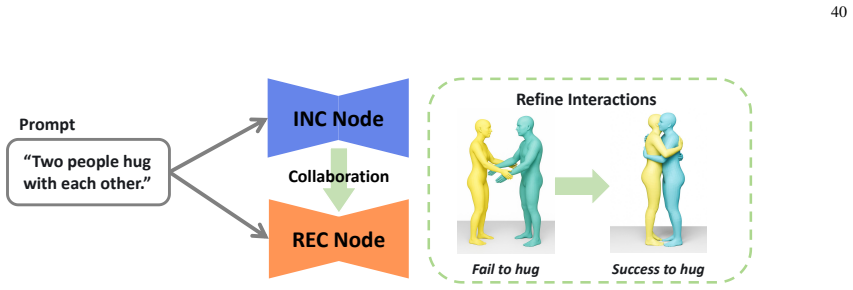
- [Section II-B2 and Section IV-B] The 'emergent' gains reported for collaborative decoding and diffusion-model collaboration are not compared against a single model with a matched total parameter or compute budget. Table I shows that device-edge-cloud (1.5B, 7B, 14B) reaches cloud-only accuracy at higher speed, but the comparison is against standalone smaller models, not against a single model with comparable aggregate capacity or against a sequential speculative-decoding baseline. Similarly, Table VII compares the serial INS+REC system against single-module baselines without reporting the combined parameter count of the two modules, and Table IX compares OmniVDiff against baselines without a matched-budget single-model control. Without such controls, the improvement cannot be attributed to the collaboration mechanism itself rather than to additional parameters or compute.
minor comments (6)
- [Section II-B2, Details] The sentence 'Given the user instruction of length and a prefixed output sequence of length' contains undefined placeholders; the lengths should be specified or the sentence should be rephrased.
- [Section I-D3] The phrase 'Al Flow provides paradigms' should read 'AI Flow provides paradigms.'
- [Table III caption and Table X] The phrase 'GPT-Conv donates the abbreviation' should be 'denotes the abbreviation,' and 'Internet of Thing' in Table X should be 'Internet of Things.'
- [Section III-C1] The sentence 'with the total training token counts (in billions) ranging from 400 to 100' reads as a decreasing range; if the intended range is 100 to 400 billion tokens, the order should be reversed.
- [Table II] The teacher model TeleChat2-7.68B is not included in Table II; since the HPCD family is distilled from it, reporting the teacher's scores on the same benchmarks would help calibrate the absolute numbers.
- [Section II-B2, Evaluations] The claim that communication delay is negligible would benefit from reporting the size of the transmitted token indices and clarifying whether the draft and target models share the same tokenizer and vocabulary.
Circularity Check
The familial-model 'overhead-free split inference' benefit is a restatement of the paper's own definition of familial models; the rest of the framework is benchmarked externally and is not circular.
-
self definitional
[Section I (Key Points bullet) and Section III-D (Discussions)]
"Notably, the familial models are feature-aligned, which allows efficient information sharing without the need for additional middleware. ... familial models of varying sizes all have shared intermediate features, which can be transferred between devices and directly reused without further processing, thus enabling overhead-free split inference."
The claimed conclusion 'overhead-free split inference' is the same relation as the defining property 'feature-aligned ... without the need for additional middleware,' restated as a derived benefit. 'Aligned hidden features' and 'shared intermediate features ... directly reused without further processing' are semantically equivalent in the paper's usage, so the efficiency advantage over non-aligned model families is true by stipulation of what a familial model is. Section III's experiments (HPCD and EESB) evaluate only standalone accuracy versus parameter count; no measurement of cross-model feature transfer, acceptance rate, or communication savings is reported. The familial-model collaboration benefit is therefore imported from the definition rather than demonstrated by the evaluations.
full rationale
Most of the paper is self-contained and benchmarked externally: TOFC is tested on RealWorldQA and MME against JPEG/WebP; hierarchical collaborative decoding is tested on Math-500, AIME, and LiveCodeBench; HPCD and EESB families are evaluated on MMLU, CMMLU, C-Eval, GSM8K, MATH, BBH, and nine VQA benchmarks; and the multi-agent and diffusion results use MT-Bench, AlpacaEval, Arena-Hard, InterHuman, NYU-V2, KITTI, and video-generation metrics. These comparisons do not define success in terms of the framework's own outputs, so there is no fitted-constant or circular benchmark loop. The one definitional circularity is the framing of familial-model collaboration: the central payoff 'overhead-free split inference' is a restatement of the defining property 'feature-aligned ... without the need for additional middleware,' and Section III contains no measurement of cross-model feature transfer or bandwidth savings. Self-citations to companion papers (e.g., [6], [29], [49]) are used as pointers to related work, code, and benchmarks rather than as an unverified uniqueness theorem, so they do not add circularity. The score reflects the localized, definitional nature of the familial-model efficiency claim, while the rest of the framework stands on independent evidence.
Assumptions & free parameters
free parameters (2)
- knowledge distillation weighting coefficient λ =
0.4
- EESB branch compression ratio =
0.75
assumptions (5)
- standard math Truncated SVD minimizes the Frobenius-norm reconstruction error (Eckart-Young theorem).
- domain assumption Three-tier device-edge-cloud architecture is the correct abstraction of modern communication networks and workload distribution.
- domain assumption Public benchmark scores (MMLU, VQA, MT-Bench, Arena-Hard, etc.) are valid measures of model capability and collaboration quality.
- domain assumption SVD truncation of linear-layer weights followed by training preserves enough task information for intermediate features to remain aligned across model scales.
- ad hoc to paper The teacher model (TeleChat2-7.68B) provides supervision strong enough for knowledge distillation to produce aligned familial models.
invented entities (2)
-
AI Flow framework
independent evidence
-
Familial models
independent evidence
Cite this review
Pith. "Pith review of AI Flow: Perspectives, Scenarios, and Approaches." pith.science (2026). https://pith.science/paper/DNY5M76T
@misc{pith2026250612479,
  author       = {Pith},
  title        = {Pith review of: AI Flow: Perspectives, Scenarios, and Approaches},
  year         = {2026},
  howpublished = {\url{https://pith.science/paper/DNY5M76T}},
  note         = {Machine review of arXiv:2506.12479}
}
read the original abstract
Pioneered by the foundational information theory by Claude Shannon and the visionary framework of machine intelligence by Alan Turing, the convergent evolution of information and communication technologies (IT/CT) has created an unbroken wave of connectivity and computation. This synergy has sparked a technological revolution, now reaching its peak with large artificial intelligence (AI) models that are reshaping industries and redefining human-machine collaboration. However, the realization of ubiquitous intelligence faces considerable challenges due to substantial resource consumption in large models and high communication bandwidth demands. To address these challenges, AI Flow has been introduced as a multidisciplinary framework that integrates cutting-edge IT and CT advancements, with a particular emphasis on the following three key points. First, device-edge-cloud framework serves as the foundation, which integrates end devices, edge servers, and cloud clusters to optimize scalability and efficiency for low-latency model inference. Second, we introduce the concept of familial models, which refers to a series of different-sized models with aligned hidden features, enabling effective collaboration and the flexibility to adapt to varying resource constraints and dynamic scenarios. Third, connectivity- and interaction-based intelligence emergence is a novel paradigm of AI Flow. By leveraging communication networks to enhance connectivity, the collaboration among AI models across heterogeneous nodes achieves emergent intelligence that surpasses the capability of any single model. The innovations of AI Flow provide enhanced intelligence, timely responsiveness, and ubiquitous accessibility to AI services, paving the way for the tighter fusion of AI techniques and communication systems.
Figures


Figures from the paper (10 more)






Forward citations
Cited by 3 Pith papers
-
OmniMate: Open-Ended Real-Time Streaming Audio-Visual Generation for Interactive Avatars
OmniMate generates real-time streaming video, speech, and sound effects for interactive avatars while preserving the same face and voice across long multi-turn conversations.
-
Skill-Nav: Enhanced Navigation with Versatile Quadrupedal Locomotion via Waypoint Interface
A waypoint-based interface between planners and a trained quadrupedal locomotion policy enables navigation over diverse obstacles in simulation and on a real robot.
-
Technical Report of TeleChat2, TeleChat2.5 and T1
The released T1-115B open-weight model outperforms OpenAI's o1-mini and GPT-4o on MATH500, AlignBench, and IFEval, despite using a standard dense transformer architecture.
Reference graph
Works this paper leans on
-
[1]
A. M. Turing, Computing machinery and intelligence . Springer, 2009
2009
-
[2]
A mathematical theory of communication,
C. E. Shannon, “A mathematical theory of communication,” The Bell system technical journal , 1948
1948
-
[3]
A survey on information and communication technologies for industry 4.0: State- of-the-art, taxonomies, perspectives, and challenges,
G. Aceto, V . Persico, and A. Pescap ´e, “A survey on information and communication technologies for industry 4.0: State- of-the-art, taxonomies, perspectives, and challenges,” IEEE Communications Surveys & Tutorials , vol. 21, no. 4, pp. 3467–3501, 2019
2019
-
[4]
Language models are few-shot learners,
T. B. Brown et al., “Language models are few-shot learners,” in Advances in the Neural Information Processing Systems (NeurIPS), 2020
2020
-
[5]
Latva-aho and K
M. Latva-aho and K. Lepp ¨anen, Key Drivers and Research Challenges for 6G Ubiquitous Wireless Intelligence. University of Oulu, 2019
2019
-
[6]
AI flow at the network edge,
J. Shao and X. Li, “AI flow at the network edge,” IEEE Network, Early Access
-
[7]
A survey on mobile edge computing: The communication perspective,
Y . Mao, C. You, J. Zhang, K. Huang, and K. B. Letaief, “A survey on mobile edge computing: The communication perspective,” IEEE Communications Surveys & Tutorials , vol. 19, no. 4, pp. 2322–2358, 2017
2017
-
[8]
Communication-computation trade-off in resource-constrained edge inference,
J. Shao and J. Zhang, “Communication-computation trade-off in resource-constrained edge inference,” IEEE Communi- cations Magazine, 2021
2021
Show all 102 references
-
[9]
The roadmap to 6G: AI empowered wireless networks,
K. B. Letaief, W. Chen, Y . Shi, J. Zhang, and Y .-J. A. Zhang, “The roadmap to 6G: AI empowered wireless networks,” IEEE Communications Magazine , vol. 57, no. 8, pp. 84–90, 2019
2019
-
[10]
Edge artificial intelligence for 6G: Vision, enabling technologies, and applications,
K. B. Letaief, Y . Shi, J. Lu, and J. Lu, “Edge artificial intelligence for 6G: Vision, enabling technologies, and applications,” IEEE Journal on Selected Areas in Communications , vol. 40, no. 1, pp. 5–36, 2021
2021
-
[11]
Reconstructive sequence-graph network for video summarization,
B. Zhao, H. Li, X. Lu, and X. Li, “Reconstructive sequence-graph network for video summarization,” IEEE Transactions on Pattern Analysis and Machine Intelligence , vol. 44, no. 5, pp. 2793–2801, 2022
2022
-
[12]
Two-stage learning to predict human eye fixations via sdaes,
J. Han, D. Zhang, S. Wen, L. Guo, T. Liu, and X. Li, “Two-stage learning to predict human eye fixations via sdaes,” IEEE Transactions on Cybernetics , vol. 46, no. 2, pp. 487–498, 2016
2016
-
[13]
A review of co-saliency detection algorithms: Fundamentals, applications, and challenges,
D. Zhang, H. Fu, J. Han, A. Borji, and X. Li, “A review of co-saliency detection algorithms: Fundamentals, applications, and challenges,” ACM Trans. Intell. Syst. Technol. , vol. 9, no. 4, Jan 2018
2018
-
[14]
Deep neural networks with elastic rectified linear units for object recognition,
X. Jiang, Y . Pang, X. Li, J. Pan, and Y . Xie, “Deep neural networks with elastic rectified linear units for object recognition,” Neurocomputing, vol. 275, pp. 1132–1139, 2018
2018
-
[15]
Bayesian tensor approach for 3-d face modeling,
D. Tao, M. Song, X. Li, J. Shen, J. Sun, X. Wu, C. Faloutsos, and S. J. Maybank, “Bayesian tensor approach for 3-d face modeling,” IEEE Transactions on Circuits and Systems for Video Technology , vol. 18, no. 10, pp. 1397–1410, 2008
2008
-
[16]
Attention is all you need,
A. Vaswani et al., “Attention is all you need,” in Advances in Neural Information Processing Systems (NeurIPS) , 2017
2017
-
[17]
GPT-4 technical report,
OpenAI et al., “GPT-4 technical report,” 2024. [Online]. Available: https://arxiv.org/abs/2303.08774
2024 arXiv
-
[18]
DeepSeek-V3 technical report,
DeepSeek-AI et al., “DeepSeek-V3 technical report,” 2025. [Online]. Available: https://arxiv.org/abs/2412.19437
2025 arXiv
-
[19]
Qwen2.5 technical report,
Qwen et al., “Qwen2.5 technical report,” 2025. [Online]. Available: https://arxiv.org/abs/2412.15115
2025 arXiv
-
[20]
Visual instruction tuning,
H. Liu, C. Li, Q. Wu, and Y . J. Lee, “Visual instruction tuning,” in Advances in Neural Information Processing Systems (NeurIPS), 2023
2023
-
[21]
Positive-incentive noise,
X. Li, “Positive-incentive noise,” IEEE Transactions on Neural Networks and Learning Systems , vol. 35, no. 6, pp. 8708–8714, 2024
2024
-
[22]
Chain-of-thought prompting elicits reasoning in large language models,
J. Wei et al. , “Chain-of-thought prompting elicits reasoning in large language models,” 2023. [Online]. Available: https://arxiv.org/abs/2201.11903
2023 arXiv
-
[23]
A survey on large language model based autonomous agents,
L. Wang et al., “A survey on large language model based autonomous agents,” Frontiers of Computer Science , vol. 18, no. 6, Mar. 2024. 57
2024
-
[24]
WirelessLLM: Empowering large language models towards wireless intelligence,
J. Shao et al., “WirelessLLM: Empowering large language models towards wireless intelligence,” Journal of Communi- cations and Information Networks , vol. 9, no. 2, pp. 99–112, 2024
2024
-
[25]
Task-oriented communication for edge video analytics,
J. Shao, X. Zhang, and J. Zhang, “Task-oriented communication for edge video analytics,” IEEE Transactions on Wireless Communications, vol. 23, no. 5, pp. 4141–4154, 2023
2023
-
[26]
Deep residual learning for image recognition,
K. He, X. Zhang, S. Ren, and J. Sun, “Deep residual learning for image recognition,” 2015. [Online]. Available: https://arxiv.org/abs/1512.03385
2015 arXiv
-
[27]
Large language models empowered autonomous edge AI for connected intelligence,
Y . Shen et al., “Large language models empowered autonomous edge AI for connected intelligence,” IEEE Communica- tions Magazine, vol. 62, no. 10, pp. 140–146, 2024
2024
-
[28]
Learning transferable visual models from natural language supervision,
A. Radford et al. , “Learning transferable visual models from natural language supervision,” 2021. [Online]. Available: https://arxiv.org/abs/2103.00020
2021 arXiv
-
[29]
Task-oriented feature compression for multimodal understanding via device-edge co-inference,
C. Yuan et al. , “Task-oriented feature compression for multimodal understanding via device-edge co-inference,” 2025. [Online]. Available: https://arxiv.org/abs/2503.12926
2025
-
[30]
Task-oriented communication for multidevice cooperative edge inference,
J. Shao, Y . Mao, and J. Zhang, “Task-oriented communication for multidevice cooperative edge inference,” IEEE Transactions on Wireless Communications , vol. 22, no. 1, pp. 73–87, 2022
2022
-
[31]
Study on density peaks clustering based on k-nearest neighbors and principal component analysis,
M. Du, S. Ding, and H. Jia, “Study on density peaks clustering based on k-nearest neighbors and principal component analysis,” Knowledge-Based Systems, vol. 99, pp. 135–145, May 2016
2016
-
[32]
Variational image compression with a scale hyperprior,
J. Ball ´e, D. Minnen, S. Singh, S. J. Hwang, and N. Johnston, “Variational image compression with a scale hyperprior,” in Proceedings of the International Conference on Learning Representations (ICLR) , 2018
2018
-
[33]
Channel-wise autoregressive entropy models for learned image compression,
D. Minnen and S. Singh, “Channel-wise autoregressive entropy models for learned image compression,” in IEEE International Conference on Image Processing (ICIP) , 2020
2020
-
[34]
LLaV A-OneVision: Easy visual task transfer,
B. Li et al., “LLaV A-OneVision: Easy visual task transfer,” 2024. [Online]. Available: https://arxiv.org/abs/2408.03326
2024 arXiv
-
[35]
LoRA: Low-rank adaptation of large language models,
E. J. Hu et al., “LoRA: Low-rank adaptation of large language models,” in Proceedings of the International Conference on Learning Representations (ICLR) , 2022
2022
-
[36]
Improved baselines with visual instruction tuning,
H. Liu, C. Li, Y . Li, and Y . J. Lee, “Improved baselines with visual instruction tuning,” in Proceedings of the IEEE/CVF Conference on Computer Vision and Pattern Recognition (CVPR) , 2024
2024
-
[37]
MME: A comprehensive evaluation benchmark for multimodal large language models,
C. Fu et al. , “MME: A comprehensive evaluation benchmark for multimodal large language models,” 2023, arXiv:2306.13394. [Online]. Available: https://arxiv.org/abs/2306.13394
2023 arXiv
-
[38]
The JPEG 2000 still image compression standard,
A. Skodras, C. Christopoulos, and T. Ebrahimi, “The JPEG 2000 still image compression standard,” IEEE Signal Processing Magazine, vol. 18, no. 5, pp. 36–58, 2001
2000
-
[39]
Research on the WebP image format,
Z. Si and K. Shen, “Research on the WebP image format,” in Advanced Graphic Communications, Packaging Technology and Materials, Singapore, 2016
2016
-
[40]
Let’s verify step by step,
H. Lightman et al., “Let’s verify step by step,” 2023. [Online]. Available: https://arxiv.org/abs/2305.20050
2023 arXiv
-
[41]
Livecodebench: Holistic and contamination free evaluation of large language models for code,
N. Jain et al. , “Livecodebench: Holistic and contamination free evaluation of large language models for code,” 2024. [Online]. Available: https://arxiv.org/abs/2403.07974
2024 arXiv
-
[42]
Low-rank matrix factorization for deep neural network training with high-dimensional output targets,
T. N. Sainath, B. Kingsbury, V . Sindhwani, E. Arisoy, and B. Ramabhadran, “Low-rank matrix factorization for deep neural network training with high-dimensional output targets,” in Proceedings of the IEEE International Conference on Acoustics, Speech and Signal Processing (ICA...
2013
-
[43]
Learning low-rank deep neural networks via singular vector orthogonality regularization and singular value sparsification,
H. Yang et al. , “Learning low-rank deep neural networks via singular vector orthogonality regularization and singular value sparsification,” in Proceedings of the IEEE/CVF Conference on Computer Vision and Pattern Recognition (CVPR) Workshops, 2020
2020
-
[44]
LoRA+: Efficient low rank adaptation of large models,
S. Hayou, N. Ghosh, and B. Yu, “LoRA+: Efficient low rank adaptation of large models,” 2024. [Online]. Available: https://arxiv.org/abs/2402.12354 58
2024 arXiv
-
[45]
Early-exit deep neural network-a comprehensive survey,
H. Rahmath P, V . Srivastava, K. Chaurasia, R. G. Pacheco, and R. S. Couto, “Early-exit deep neural network-a comprehensive survey,” ACM Computing Surveys , vol. 57, no. 3, pp. 1–37, 2024
2024
-
[46]
EE-LLM: large-scale training and inference of early-exit large language models with 3d parallelism,
Y . Chen, X. Pan, Y . Li, B. Ding, and J. Zhou, “EE-LLM: large-scale training and inference of early-exit large language models with 3d parallelism,” in Proceedings of the International Conference on Machine Learning (ICML) , 2024
2024
-
[47]
HELIOS: Adaptive model and early-exit selection for efficient llm inference serving,
A. Kumar, S. Nag, J. Clemons, L. John, and P. Das, “HELIOS: Adaptive model and early-exit selection for efficient llm inference serving,” 2025. [Online]. Available: https://arxiv.org/abs/2504.10724
2025
-
[48]
Branchynet: Fast inference via early exiting from deep neural networks,
S. Teerapittayanon, B. McDanel, and H. Kung, “Branchynet: Fast inference via early exiting from deep neural networks,” in International Conference on Pattern Recognition (ICPR) , 2016
2016
-
[49]
Branchy-gnn: A device-edge co-inference framework for efficient point cloud processing,
J. Shao, H. Zhang, Y . Mao, and J. Zhang, “Branchy-gnn: A device-edge co-inference framework for efficient point cloud processing,” in Proceedings of the IEEE International Conference on Acoustics, Speech and Signal Processing (ICASSP) , 2021
2021
-
[50]
Anytime dense prediction with confidence adaptivity,
Z. Liu, Z. Xu, H.-J. Wang, T. Darrell, and E. Shelhamer, “Anytime dense prediction with confidence adaptivity,” 2021. [Online]. Available: https://arxiv.org/abs/2104.00749
2021 arXiv
-
[51]
DeeBERT: Dynamic early exiting for accelerating BERT inference,
J. Xin, R. Tang, J. Lee, Y . Yu, and J. Lin, “DeeBERT: Dynamic early exiting for accelerating BERT inference,” in Proceedings of the 58th Annual Meeting of the Association for Computational Linguistics, D. Jurafsky, J. Chai, N. Schluter, and J. Tetreault, Eds. Association for ...
2020
-
[52]
SkipBERT: Efficient inference with shallow layer skipping,
J. Wang, K. Chen, G. Chen, L. Shou, and J. McAuley, “SkipBERT: Efficient inference with shallow layer skipping,” in Proceedings of the 60th Annual Meeting of the Association for Computational Linguistics (Volume 1: Long Papers) , S. Muresan, P. Nakov, and A. Villavicencio, Eds...
2022
-
[53]
Confident adaptive language modeling,
T. Schuster et al. , “Confident adaptive language modeling,” in Advances in Neural Information Processing Systems (NeurIPS), 2022
2022
-
[54]
EE-Tuning: An economical yet scalable solution for tuning early-exit large language models,
X. Pan, Y . Chen, Y . Li, B. Ding, and J. Zhou, “EE-Tuning: An economical yet scalable solution for tuning early-exit large language models,” 2024. [Online]. Available: https://arxiv.org/abs/2402.00518
2024 arXiv
-
[55]
SVD-LLM: Truncation-aware singular value decomposition for large language model compression,
X. Wang, Y . Zheng, Z. Wan, and M. Zhang, “SVD-LLM: Truncation-aware singular value decomposition for large language model compression,” in Proceedings of the International Conference on Learning Representations (ICLR) , 2025
2025
-
[56]
LayerSkip: Enabling early exit inference and self-speculative decoding,
M. Elhoushi et al. , “LayerSkip: Enabling early exit inference and self-speculative decoding,” in Proceedings of the Association for Computational Linguistic (ACL) , 2024
2024
-
[57]
Telechat technical report,
Z. He et al., “Telechat technical report,” 2024. [Online]. Available: https://arxiv.org/abs/2401.03804
2024 arXiv
-
[58]
Measuring massive multitask language understanding,
D. Hendrycks et al. , “Measuring massive multitask language understanding,” 2021. [Online]. Available: https: //arxiv.org/abs/2009.03300
2021 arXiv
-
[59]
CMMLU: Measuring massive multitask language understanding in chinese,
H. Li et al. , “CMMLU: Measuring massive multitask language understanding in chinese,” 2024. [Online]. Available: https://arxiv.org/abs/2306.09212
2024 arXiv
-
[60]
C-Eval: A Multi-Level Multi-Discipline chinese evaluation suite for foundation models,
Y . Huang et al. , “C-Eval: A Multi-Level Multi-Discipline chinese evaluation suite for foundation models,” 2023. [Online]. Available: https://arxiv.org/abs/2305.08322
2023 arXiv
-
[61]
Training verifiers to solve math word problems,
K. Cobbe et al. , “Training verifiers to solve math word problems,” 2021. [Online]. Available: https: //arxiv.org/abs/2110.14168
2021 arXiv
-
[62]
Measuring mathematical problem solving with the math dataset,
D. Hendrycks et al. , “Measuring mathematical problem solving with the math dataset,” 2021. [Online]. Available: https://arxiv.org/abs/2103.03874
2021 arXiv
-
[63]
Challenging BIG-Bench tasks and whether chain-of-thought can solve them,
M. Suzgun et al. , “Challenging BIG-Bench tasks and whether chain-of-thought can solve them,” 2022. [Online]. Available: https://arxiv.org/abs/2210.09261 59
2022 arXiv
-
[64]
A diagram is worth a dozen images,
A. Kembhavi, M. Salvato, E. Kolve, M. Seo, H. Hajishirzi, and A. Farhadi, “A diagram is worth a dozen images,” in Proceedings of the European Conference on Computer Vision (ECCV) , 2016
2016
-
[65]
MMBench: Is your multi-modal model an all-around player?
Y . Liu et al., “MMBench: Is your multi-modal model an all-around player?” in Proceedings of the European Conference on Computer Vision (ECCV) , 2024
2024
-
[66]
Are we on the right way for evaluating large vision-language models?
L. Chen et al., “Are we on the right way for evaluating large vision-language models?” in Advances in Neural Information Processing Systems (NeurIPS) , 2024
2024
-
[67]
Learn to explain: Multimodal reasoning via thought chains for science question answering,
P. Lu et al. , “Learn to explain: Multimodal reasoning via thought chains for science question answering,” in Advances in Neural Information Processing Systems (NeurIPS) , 2022
2022
-
[68]
SEED-Bench: Benchmarking multimodal large language models,
B. Li et al. , “SEED-Bench: Benchmarking multimodal large language models,” in Proceedings of the IEEE/CVF Conference on Computer Vision and Pattern Recognition (CVPR) , 2024
2024
-
[69]
ChartQA: A benchmark for question answering about charts with visual and logical reasoning,
A. Masry, D. Long, J. Q. Tan, S. Joty, and E. Hoque, “ChartQA: A benchmark for question answering about charts with visual and logical reasoning,” in Proceedings of the Association for Computational Linguistic (ACL) , 2022
2022
-
[70]
DocVQA: A dataset for VQA on document images,
M. Mathew, D. Karatzas, and C.V . Jawahar, “DocVQA: A dataset for VQA on document images,” in Proceedings of the IEEE/CVF Winter Conference on Applications of Computer Vision (WACV) , 2021
2021
-
[71]
InfographicVQA,
M. Mathew, V . Bagal, R. Tito, D. Karatzas, E. Valveny, and C.V . Jawahar, “InfographicVQA,” in Proceedings of the IEEE/CVF Winter Conference on Applications of Computer Vision (WACV) , 2022
2022
-
[72]
Judging LLM-as-a-judge with MT-Bench and chatbot arena,
L. Zheng et al. , “Judging LLM-as-a-judge with MT-Bench and chatbot arena,” 2023. [Online]. Available: https://arxiv.org/abs/2306.05685
2023 arXiv
-
[73]
Length-controlled alpacaeval: A simple way to debias automatic evaluators,
Y . Dubois, B. Galambosi, P. Liang, and T. B. Hashimoto, “Length-controlled alpacaeval: A simple way to debias automatic evaluators,” 2024. [Online]. Available: https://arxiv.org/abs/2404.04475
2024 arXiv
-
[74]
From crowdsourced data to high-quality benchmarks: Arena-hard and benchbuilder pipeline,
T. Li et al. , “From crowdsourced data to high-quality benchmarks: Arena-hard and benchbuilder pipeline,” 2024. [Online]. Available: https://arxiv.org/abs/2406.11939
2024 arXiv
-
[75]
Qwen2.5-VL technical report,
S. Bai et al., “Qwen2.5-VL technical report,” 2025. [Online]. Available: https://arxiv.org/abs/2502.13923
2025 arXiv
-
[76]
Janus-Pro: Unified multimodal understanding and generation with data and model scaling,
X. Chen et al. , “Janus-Pro: Unified multimodal understanding and generation with data and model scaling,” 2025. [Online]. Available: https://arxiv.org/abs/2501.17811
2025 arXiv
-
[77]
Temos: Generating diverse human motions from textual descriptions,
M. Petrovich, M. J. Black, and G. Varol, “Temos: Generating diverse human motions from textual descriptions,” in Proceedings of the European conference on computer vision (ECCV) , 2022
2022
-
[78]
Generating diverse and natural 3D human motions from text,
C. Guo et al., “Generating diverse and natural 3D human motions from text,” in Proceedings of the IEEE/CVF Conference on Computer Vision and Pattern Recognition (CVPR) , 2022
2022
-
[79]
Human motion diffusion model,
G. Tevet, S. Raab, B. Gordon, Y . Shafir, D. Cohen-or, and A. H. Bermano, “Human motion diffusion model,” in Proceedings of the International Conference on Learning Representations (ICLR) , 2023
2023
-
[80]
Human motion diffusion as a generative prior,
Y . Shafir, G. Tevet, R. Kapon, and A. H. Bermano, “Human motion diffusion as a generative prior,” 2023. [Online]. Available: https://arxiv.org/abs/2303.01418
2023 arXiv
-
[81]
Intergen: Diffusion-based multi-human motion generation under complex interactions,
H. Liang, W. Zhang, W. Li, J. Yu, and L. Xu, “Intergen: Diffusion-based multi-human motion generation under complex interactions,” International Journal of Computer Vision , vol. 132, no. 9, pp. 3463–3483, 2024
2024
-
[82]
Freemotion: A unified framework for number-free text-to-motion synthesis,
K. Fan et al., “Freemotion: A unified framework for number-free text-to-motion synthesis,” inProceedings of the European Conference on Computer Vision (ECCV) , 2024
2024
-
[83]
Metric-Solver: Sliding anchored metric depth estimation from a single image,
T. Wen, J. Wang, Y . Chen, S. Xu, C. Zhang, and X. Li, “Metric-Solver: Sliding anchored metric depth estimation from a single image,” 2025. [Online]. Available: https://arxiv.org/abs/2504.12103
2025 arXiv
-
[84]
Adabins: Depth estimation using adaptive bins,
S. F. Bhat, I. Alhashim, and P. Wonka, “Adabins: Depth estimation using adaptive bins,” in Proceedings of the IEEE/CVF Conference on Computer Vision and Pattern Recognition (CVPR) , 2021. 60
2021
-
[85]
New crfs: Neural window fully-connected crfs for monocular depth estimation,
W. Yuan, X. Gu, Z. Dai, S. Zhu, and P. Tan, “New crfs: Neural window fully-connected crfs for monocular depth estimation,” 2022. [Online]. Available: https://arxiv.org/abs/2203.01502
2022 arXiv
-
[86]
Vision transformers for dense prediction,
R. Ranftl, A. Bochkovskiy, and V . Koltun, “Vision transformers for dense prediction,” in Proceedings of the IEEE/CVF International Conference on Computer Vision (ICCV) , 2021
2021
-
[87]
P3depth: Monocular depth estimation with a piecewise planarity prior,
V . Patil, C. Sakaridis, A. Liniger, and L. Van Gool, “P3depth: Monocular depth estimation with a piecewise planarity prior,” in Proceedings of the IEEE/CVF Conference on Computer Vision and Pattern Recognition (CVPR) , 2022
2022
-
[88]
Swin transformer v2: Scaling up capacity and resolution,
Z. Liu et al. , “Swin transformer v2: Scaling up capacity and resolution,” in Proceedings of the IEEE/CVF Conference on Computer Vision and Pattern Recognition (CVPR) , 2022
2022
-
[89]
All in tokens: Unifying output space of visual tasks via soft token,
J. Ning et al. , “All in tokens: Unifying output space of visual tasks via soft token,” in Proceedings of the IEEE/CVF International Conference on Computer Vision (ICCV) , 2023
2023
-
[90]
Unleashing text-to-image diffusion models for visual perception,
W. Zhao, Y . Rao, Z. Liu, B. Liu, J. Zhou, and J. Lu, “Unleashing text-to-image diffusion models for visual perception,” in Proceedings of the IEEE/CVF International Conference on Computer Vision (ICCV) , 2023
2023
-
[91]
Iebins: Iterative elastic bins for monocular depth estimation,
S. Shao, Z. Pei, X. Wu, Z. Liu, W. Chen, and Z. Li, “Iebins: Iterative elastic bins for monocular depth estimation,” in Advances in Neural Information Processing Systems (NeurIPS) , 2023
2023
-
[92]
Zoedepth: Zero-shot transfer by combining relative and metric depth,
S. F. Bhat, R. Birkl, D. Wofk, P. Wonka, and M. M ¨uller, “Zoedepth: Zero-shot transfer by combining relative and metric depth,” 2023. [Online]. Available: https://arxiv.org/abs/2302.12288
2023 arXiv
-
[93]
Depth anything: Unleashing the power of large-scale unlabeled data,
L. Yang, B. Kang, Z. Huang, X. Xu, J. Feng, and H. Zhao, “Depth anything: Unleashing the power of large-scale unlabeled data,” in Proceedings of the IEEE/CVF Conference on Computer Vision and Pattern Recognition (CVPR) , 2024
2024
-
[94]
OmniVDiff: Omni controllable video diffusion for generation and understanding,
D. Xi et al. , “OmniVDiff: Omni controllable video diffusion for generation and understanding,” 2025. [Online]. Available: https://arxiv.org/abs/2504.10825
2025
-
[95]
Aligning cyber space with physical world: A comprehensive survey on embodied AI,
Y . Liu et al. , “Aligning cyber space with physical world: A comprehensive survey on embodied AI,” 2024. [Online]. Available: https://arxiv.org/abs/2407.06886
2024 arXiv
-
[96]
Embodied-AI with large models: research and challenges,
C. Bai, H. Xu, and X. Li, “Embodied-AI with large models: research and challenges,” SCIENTIA SINICA Informationis , 2024
2024
-
[97]
Learning task-oriented communication for edge inference: An information bottleneck approach,
J. Shao, Y . Mao, and J. Zhang, “Learning task-oriented communication for edge inference: An information bottleneck approach,” IEEE Journal on Selected Areas in Communications , vol. 40, no. 1, pp. 197–211, 2022
2022
-
[98]
Empowering smart glasses with large language models: Towards ubiquitous AGI,
D. Zhang, Y . Li, Z. He, and X. Li, “Empowering smart glasses with large language models: Towards ubiquitous AGI,” in Proceedings of ACM International Joint Conference of Pervasive Ubiquitous Computing (UbiComp) , 2024
2024
-
[99]
Dres-FL: Dropout-resilient secure federated learning for non-IID clients via secret data sharing,
J. Shao, Y . Sun, S. Li, and J. Zhang, “Dres-FL: Dropout-resilient secure federated learning for non-IID clients via secret data sharing,” in Advances in Neural Information Processing Systems (NeurIPS) , 2022
2022
-
[100]
Federated machine learning: Concept and applications,
Q. Yang, Y . Liu, T. Chen, and Y . Tong, “Federated machine learning: Concept and applications,” ACM Transactions on Intelligent Systems and Technology , vol. 10, no. 2, pp. 1–19, 2019
2019
-
[101]
Keeping yourself is important in downstream tuning multimodal large language model,
W. Huang et al. , “Keeping yourself is important in downstream tuning multimodal large language model,” 2025. [Online]. Available: https://arxiv.org/abs/2503.04543
2025 arXiv
-
[102]
Selective knowledge sharing for privacy-preserving federated distillation without a good teacher,
J. Shao, F. Wu, and J. Zhang, “Selective knowledge sharing for privacy-preserving federated distillation without a good teacher,” Nature Communications, vol. 15, no. 1, p. 349, Jan. 2024
2024
Reviewed August 7, 2026 · model on record in the stance chip above.
Discussion (0). Sign in to comment.