REVIEW 2 major objections 1 minor 1 cited by
Mellin Moments of the Unpolarized Gluon PDF in the Proton from Nonlocal Operators in Lattice QCD
T0 review · 2 major / 1 minor · reviewed 2026-06-28 · grok-4.3
Pith's one-line read Lattice QCD determines the ratio of the third to first Mellin moment for the gluon PDF at 2 GeV.
desk verdict This paper extracts a new lattice ratio for the third-to-first gluon Mellin moment on one ensemble using nonlocal operators, with internal checks on OPE truncation and mixing. read the letter →
The pith
A machine-rendered reading of the paper's core claim, the machinery that carries it, and where it could break.
The reading
What carries the argument
The short-distance operator product expansion (OPE) of the reduced gluon Ioffe-time distribution, which converts the lattice nonlocal matrix elements into ratios of Mellin moments.
What would settle it
If extending the OPE to higher orders or altering the Wilson-line separation window shifts the central value of ⟨x³⟩_g/⟨x⟩_g outside the reported uncertainties, the truncation assumption is falsified.
Extended reading notes
Core claim
Using matrix elements of nonlocal gluon operators coupled to boosted proton states on an Nf=2+1+1 ensemble, the short-distance OPE of the reduced gluon Ioffe-time distribution yields the ratio ⟨x³⟩_g/⟨x⟩_g at a scale of 2 GeV, with uncertainties that account for both statistical and the dominant theoretical systematic uncertainties.
Load-bearing premise
The short-distance operator product expansion of the reduced gluon Ioffe-time distribution remains accurate after truncation at the order used, for the chosen minimum and maximum Wilson-line separations.
Editorial extensions
If this is right
- The ratio supplies an additional constraint on the x-dependence of the gluon PDF beyond the total momentum fraction.
- DGLAP evolution of the moments permits a direct check of perturbative truncation effects by varying the renormalization scale.
- The same OPE framework can be applied to extract further moments n>3 once more terms are retained.
- Quantified dependence on the minimum and maximum Wilson-line separations sets a benchmark for controlling finite-separation systematics in future runs.
Reading between the lines
- The lattice ratio can be inserted into global PDF analyses to test whether current parametrizations of the gluon at moderate x are consistent with first-principles input.
- Repeating the calculation at the physical pion mass would isolate the size of the chiral extrapolation uncertainty present at 260 MeV.
- A side-by-side comparison with moments inferred from jet or heavy-flavor production data would expose any tension between lattice and phenomenological determinations.
Signed reviews
Editorial analysis
A structured set of objections, weighed in public.
Referee Report
Summary. The manuscript presents a lattice QCD determination of ratios of Mellin moments of the unpolarized gluon PDF, specifically ⟨x³⟩_g/⟨x⟩_g at 2 GeV, extracted from matrix elements of nonlocal gluon operators on an N_f=2+1+1 twisted-mass clover ensemble at m_π≈260 MeV. The extraction uses the short-distance OPE applied to the reduced gluon Ioffe-time distribution, with reported investigations of OPE truncation order, Wilson-line separation cuts, quark-singlet mixing under perturbative matching, and stability under DGLAP scale evolution to assess perturbative truncation effects.
Significance. If robust, the result supplies a non-perturbative lattice anchor for a higher gluon moment ratio that can be compared directly to global PDF analyses and used to constrain the gluon contribution to the proton's momentum. The explicit checks on multiple sources of systematic uncertainty and the use of scale variation to probe perturbative truncation represent concrete strengths in an area where such controls are essential.
major comments (2)
- [Abstract] Abstract: the statement that the quoted uncertainties 'account for both statistical and the dominant theoretical systematic uncertainties' cannot be verified from the provided text, as no numerical tables, extracted central values, or detailed error budgets are shown; this directly affects the load-bearing claim that the ratio is determined with controlled systematics.
- [OPE analysis] OPE analysis (described in the abstract and method): the truncation error on the short-distance OPE of the reduced gluon Ioffe-time distribution at the accessed Wilson-line separations is assessed only via internal consistency checks (order variation, min/max cuts, scale evolution); because the OPE is asymptotic, these checks do not independently constrain the size of omitted higher-order coefficients, leaving open the possibility that the reported systematic band underestimates the true truncation uncertainty at z∼0.2–0.6 fm.
minor comments (1)
- [Abstract] The abstract refers to 'the choice of minimum and maximum Wilson-line separations entering the analysis' without quoting the numerical range or the criterion used to select them; adding these values would improve reproducibility.
Simulated Author's Rebuttal
We thank the referee for their careful review and constructive comments on our manuscript. We address each major comment below. Where the comments identify areas for improved clarity or documentation, we have revised the manuscript accordingly.
read point-by-point responses
-
Referee: [Abstract] Abstract: the statement that the quoted uncertainties 'account for both statistical and the dominant theoretical systematic uncertainties' cannot be verified from the provided text, as no numerical tables, extracted central values, or detailed error budgets are shown; this directly affects the load-bearing claim that the ratio is determined with controlled systematics.
Authors: We agree that the abstract's claim regarding the uncertainties cannot be directly verified without the supporting numerical results and error budget. The full manuscript presents the extracted ratio ⟨x³⟩_g/⟨x⟩_g together with statistical and systematic variations in Section 4 and the associated figures, but a consolidated error-budget table was not included. We will add a new table that lists the central value, statistical uncertainty, and individual contributions from OPE truncation, Wilson-line cuts, quark-singlet matching, and DGLAP scale variation. This revision will make the error accounting explicit and allow readers to assess the claim. revision: yes
-
Referee: [OPE analysis] OPE analysis (described in the abstract and method): the truncation error on the short-distance OPE of the reduced gluon Ioffe-time distribution at the accessed Wilson-line separations is assessed only via internal consistency checks (order variation, min/max cuts, scale evolution); because the OPE is asymptotic, these checks do not independently constrain the size of omitted higher-order coefficients, leaving open the possibility that the reported systematic band underestimates the true truncation uncertainty at z∼0.2–0.6 fm.
Authors: We acknowledge that the OPE is asymptotic and that consistency checks based on order variation, z-cuts, and scale evolution provide an estimate rather than a rigorous upper bound on omitted higher-order coefficients. These checks follow the standard methodology used in other lattice PDF studies. To strengthen the presentation, we will expand the relevant section to explicitly discuss the asymptotic nature of the series, report the observed convergence pattern, and add a conservative estimate of the possible size of the next term based on the last included coefficient. We will also state that the quoted band should be viewed as an indicative rather than exhaustive uncertainty. This addresses the concern without altering the central result. revision: partial
Circularity Check
No significant circularity detected
full rationale
The derivation extracts ratios of gluon Mellin moments from lattice matrix elements of nonlocal operators via the short-distance OPE applied to the reduced Ioffe-time distribution on an external N_f=2+1+1 ensemble. The OPE truncation, separation cuts, perturbative matching, and DGLAP evolution are treated as systematic variations on independent lattice inputs rather than self-definitions or fitted parameters renamed as predictions. No load-bearing step reduces by construction to the target ratio itself, and the central result remains a direct computation from external gauge configurations with standard external benchmarks.
Assumptions & free parameters
free parameters (1)
- Pion mass
assumptions (2)
- domain assumption Short-distance OPE of the reduced gluon Ioffe-time distribution is valid and truncatable at the order employed for the Wilson-line separations chosen
- domain assumption Perturbative matching to the quark-singlet sector introduces controllable errors
Cite this review
Pith. "Pith review of Mellin Moments of the Unpolarized Gluon PDF in the Proton from Nonlocal Operators in Lattice QCD." pith.science (2026). https://pith.science/paper/DPKP5JGJ
@misc{pith2026260530193,
  author       = {Pith},
  title        = {Pith review of: Mellin Moments of the Unpolarized Gluon PDF in the Proton from Nonlocal Operators in Lattice QCD},
  year         = {2026},
  howpublished = {\url{https://pith.science/paper/DPKP5JGJ}},
  note         = {Machine review of arXiv:2605.30193}
}
abstract
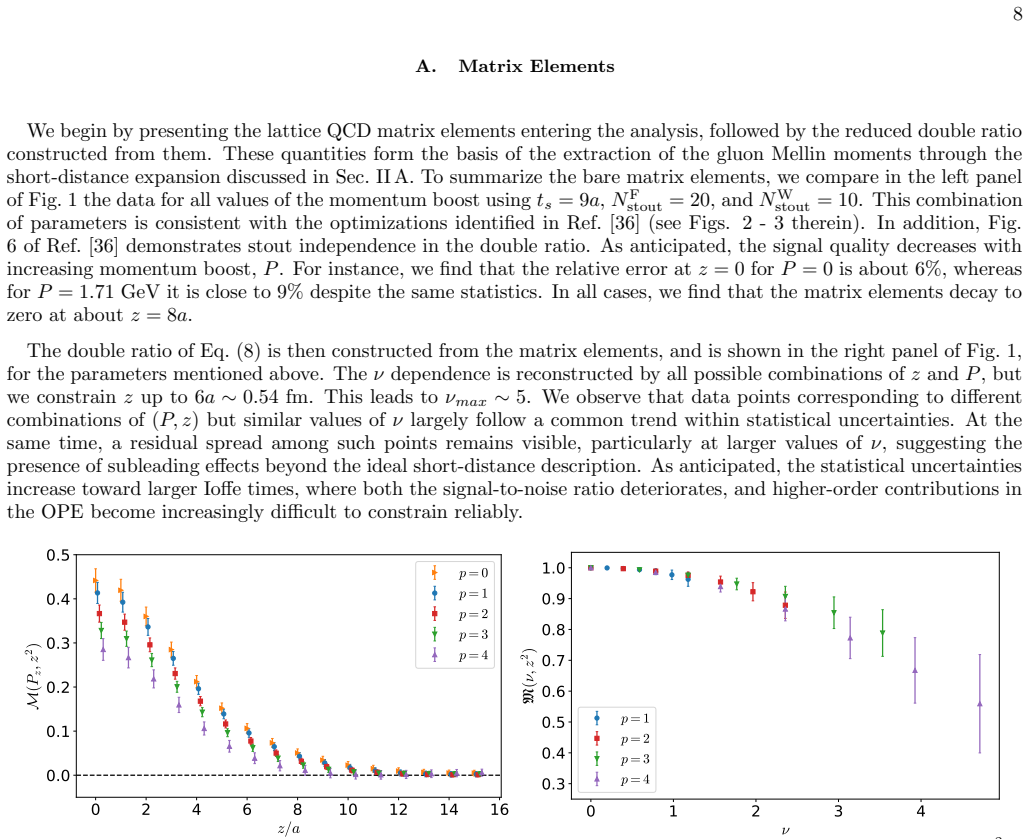
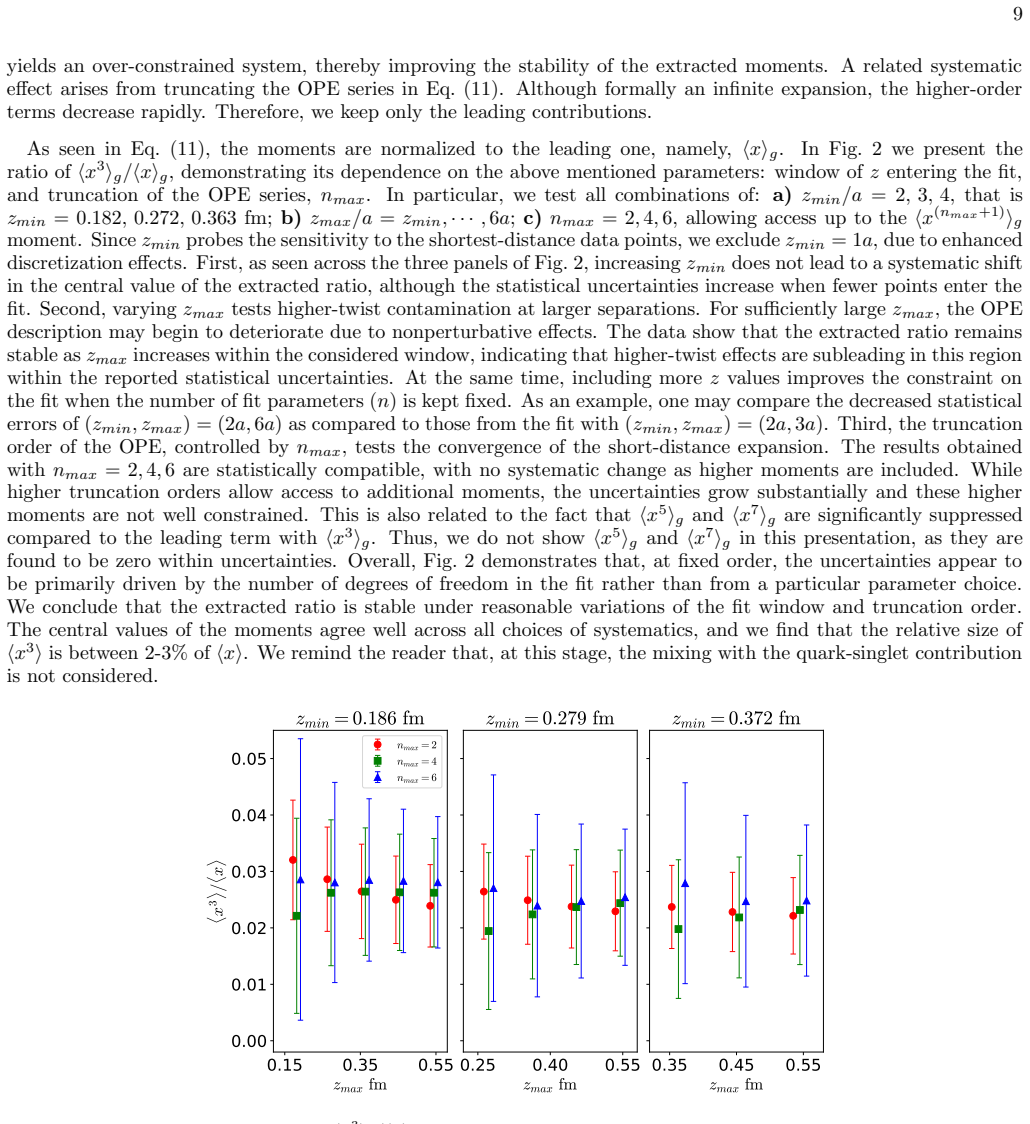
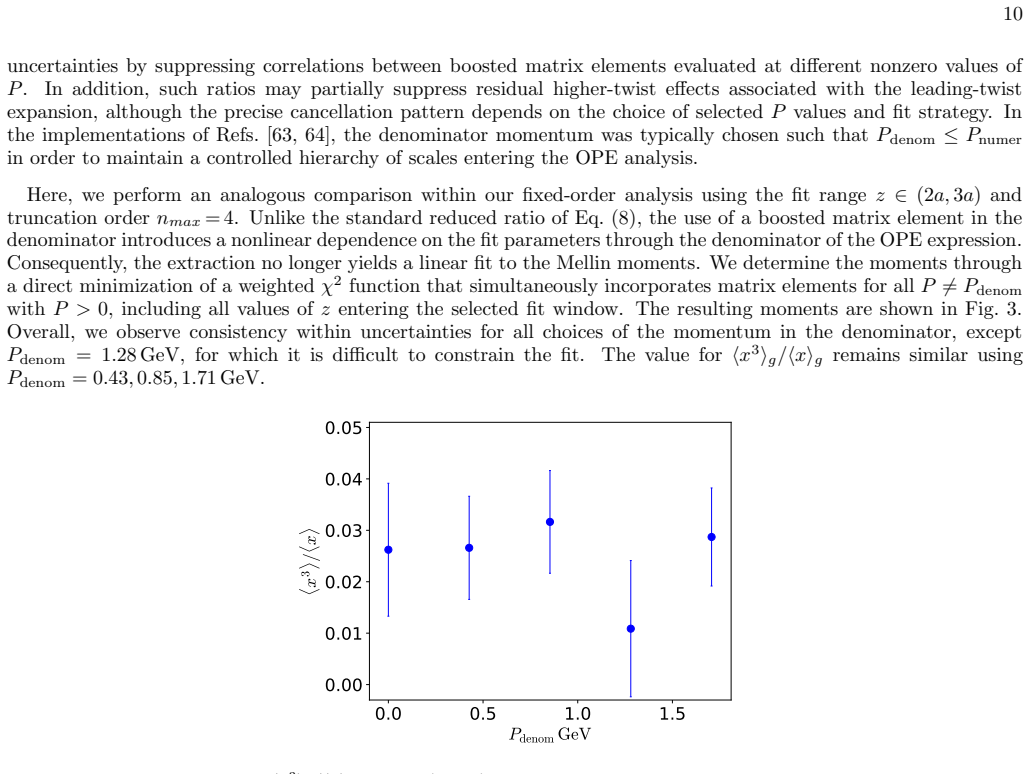
We present a lattice QCD determination of the Mellin moments of the unpolarized gluon parton distribution function in the proton. The analysis is based on matrix elements of nonlocal gluon operators coupled to momentum-boosted proton states. The calculation relies on an $N_f=2+1+1$ ensemble of maximally twisted mass fermions with clover improvement and the Iwasaki-improved gauge action, at a pion mass of approximately 260 MeV. Working within the short-distance operator product expansion (OPE) of the reduced gluon Ioffe-time distribution, we extract ratios of higher-order gluon moments, $\langle x^n\rangle$ with $n>1$, to the gluon momentum fraction, $\langle x\rangle$. We investigate systematic effects associated with the truncation of the order of moment in the OPE, the choice of minimum and maximum Wilson-line separations entering the analysis, and the treatment of mixing with the quark-singlet under perturbative matching. The stability of the extracted moments is further studied under scale evolution using DGLAP equations, allowing us to assess uncertainties related to perturbative truncation by varying the scale. Our work provides a determination of the ratio $\langle x^3\rangle_g/\langle x\rangle_g$ at a scale of 2 GeV, with uncertainties that account for both statistical and the dominant theoretical systematic uncertainties.
Figures
Figures from the paper (4 more)
Forward citations
Cited by 1 Pith paper
-
Parton distribution functions from lattice QCD
A review of lattice-QCD approaches to parton distribution functions concludes that the field is moving from feasibility studies to quantitatively controlled calculations.
Reference graph
Works this paper leans on
-
[1]
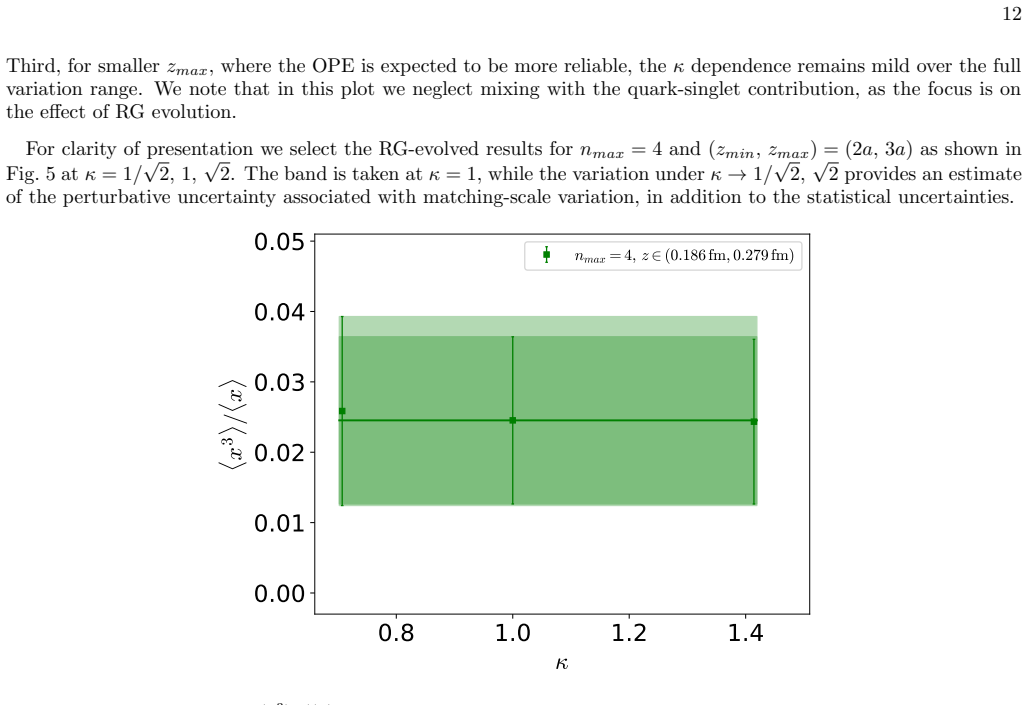
0.8 1.0 1.2 1.4 0.00 0.01 0.02 0.03 0.04 0.05 ⟨ x3⟩ / ⟨ x ⟩ nmax = 4, z ∈ (0.186fm, 0.279fm) FIG
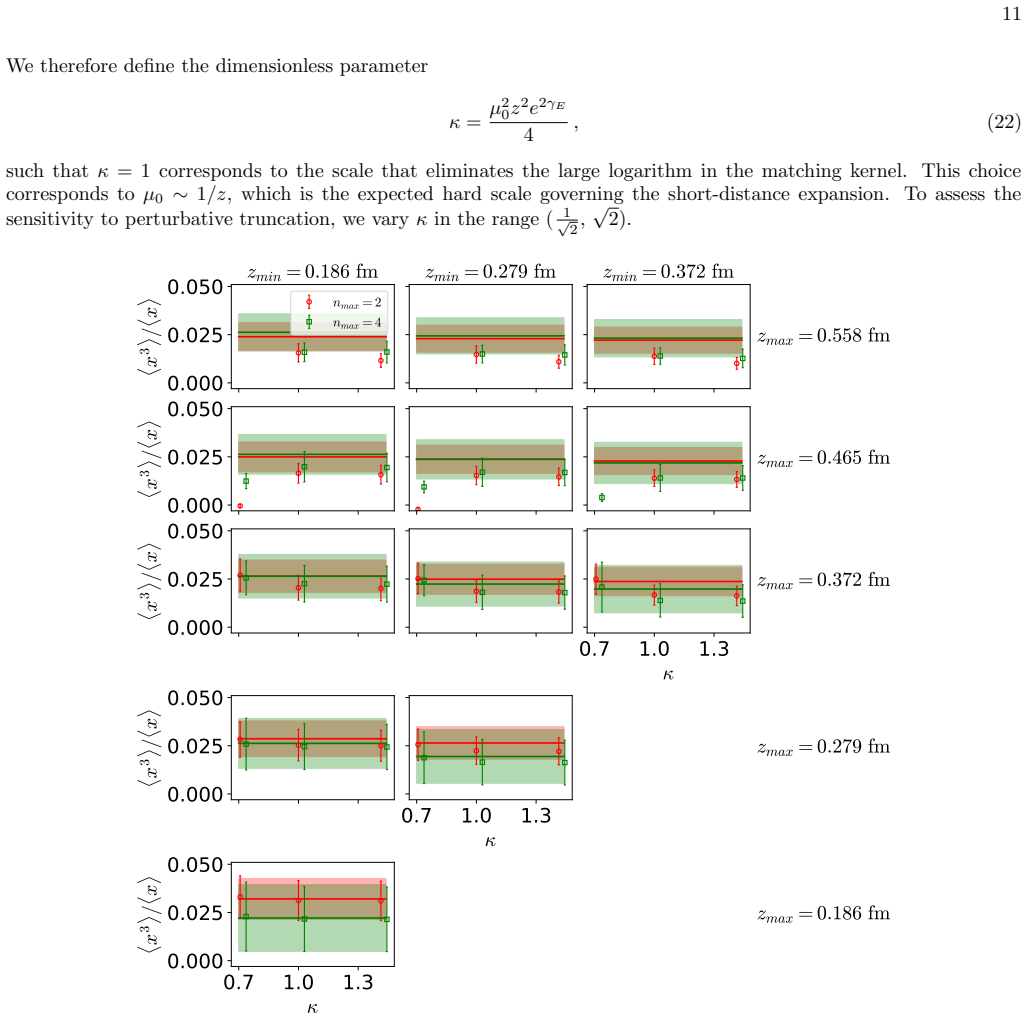
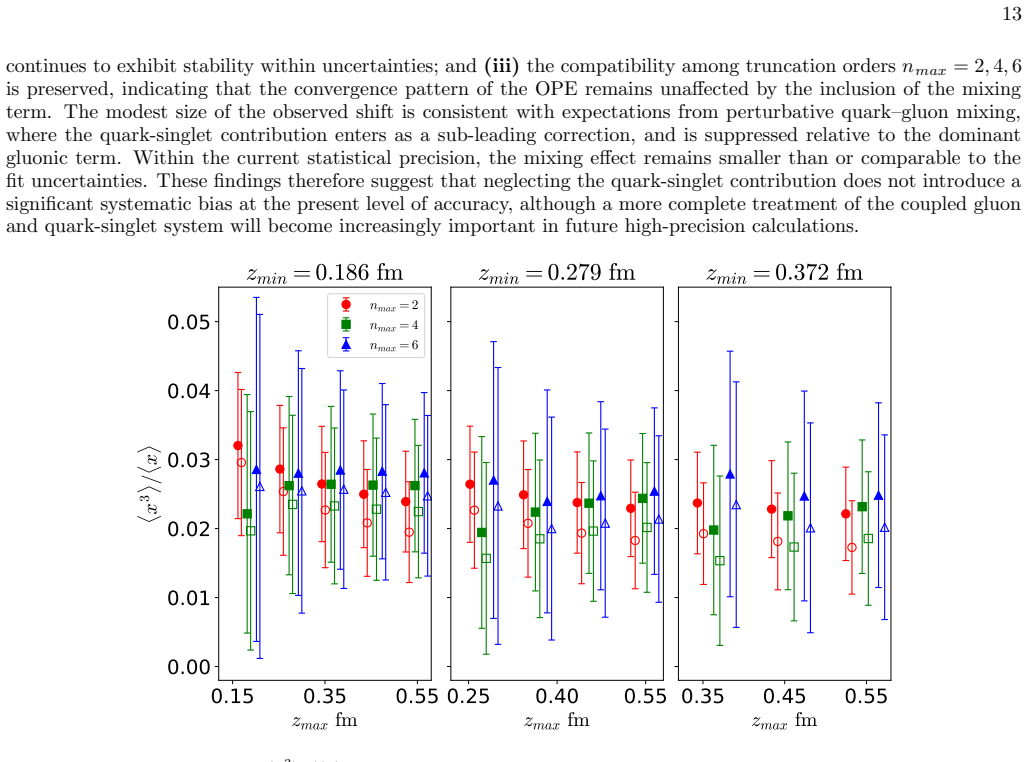
The band is taken atκ= 1, while the variation underκ→1/ √ 2, √ 2 provides an estimate of the perturbative uncertainty associated with matching-scale variation, in addition to the statistical uncertainties. 0.8 1.0 1.2 1.4 0.00 0.01 0.02 0.03 0.04 0.05 ⟨ x3⟩ / ⟨ x ⟩ nmax = 4, z ∈ (0.186fm, 0.279fm) FIG. 5. Comparison of ratios⟨x 3⟩g/⟨x⟩g for gluon only at ...
-
[2]
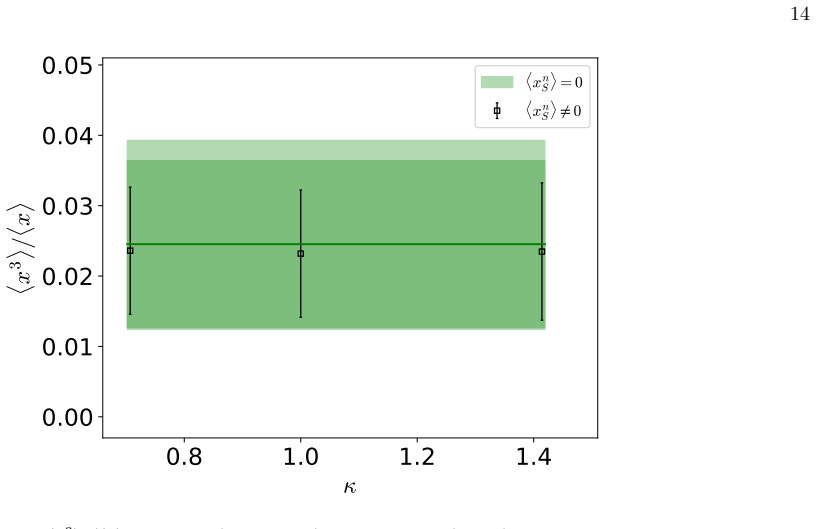
We include a band covering the uncertainties associated with extracted value atκ= 1 and a lighter band including additional theoretical error determined from varyingκ. E. Impact of Mixing with Quark-Singlet Contribution In the extraction of gluon Mellin moments, the perturbative matching receives contributions from mixing with the quark-singlet operator. ...
-
[3]
Pion and Kaon Form Factors using Lattice QCD
The shaded band corresponds to the final lattice-only determination obtained from the analysis without quark-singlet mixing of Eq. (23). The central value is taken from theκ= 1 analysis, corresponding to the natural choiceµ 0 ∼1/z, while the variation underκ→1/ √ 2 andκ→ √ 2 is used to estimate the associated perturbative systematic uncertainty. Our final...
2021
-
[4]
New CTEQ global analysis of quantum chromodynamics with high-precision data from the LHC
T.-J. Houet al., Phys. Rev. D103, 014013 (2021), 1912.10053
work page Pith review arXiv 2021
-
[5]
Simultaneous Monte Carlo analysis of parton densities and fragmentation functions
Jefferson Lab Angular Momentum (JAM), E. Moffatet al., Phys. Rev. D104, 016015 (2021), 2101.04664. 16
work page Pith review arXiv 2021
-
[6]
R. D. Ballet al., The European Physical Journal C82(2022)
2022
-
[7]
Electron Ion Collider: The Next QCD Frontier - Understanding the glue that binds us all
A. Accardiet al., Electron ion collider: The next QCD frontier - understanding the glue that binds us all, 2014, 1212.1701
work page Pith review arXiv 2014
-
[8]
Abdul Khaleket al., Nuclear Physics A1026, 122447 (2022)
R. Abdul Khaleket al., Nuclear Physics A1026, 122447 (2022)
2022
Show all 71 references
- [9]
-
[10]
X. Ji, Sci. China Phys. Mech. Astron.57, 1407 (2014), 1404.6680
2014 arXiv
-
[11]
Jiet al., Rev
X. Jiet al., Rev. Mod. Phys.93, 035005 (2021), 2004.03543
2021
-
[12]
A. V. Radyushkin, Phys. Rev. D96, 034025 (2017), 1705.01488
2017 arXiv
- [13]
- [14]
- [15]
- [16]
- [17]
- [18]
-
[19]
A. J. Chamberset al., Phys. Rev. Lett.118, 242001 (2017), 1703.01153
2017 arXiv
-
[20]
Detmoldet al., Phys
HOPE, W. Detmoldet al., Phys. Rev. D105, 034506 (2022), 2109.15241
2022
- [21]
-
[22]
Shindler, Phys
A. Shindler, Phys. Rev. D110, L051503 (2024), 2311.18704
2024
-
[23]
Cichy and M
K. Cichy and M. Constantinou, Adv. High Energy Phys.2019, 3036904 (2019), 1811.07248
2019 arXiv
-
[24]
Constantinouet al., Prog
M. Constantinouet al., Prog. Part. Nucl. Phys.121, 103908 (2021), 2006.08636
2021
-
[25]
Lin, Prog
H.-W. Lin, Prog. Part. Nucl. Phys.144, 104177 (2025), 2506.05025. [23]Precision QCD with the Electron-Ion Collider, 2026, 2604.04765
2025
- [26]
- [27]
-
[28]
Z. Fan, R. Zhang, and H.-W. Lin, Int. J. Mod. Phys. A36, 2150080 (2021), 2007.16113
2021
-
[29]
Fan and H.-W
Z. Fan and H.-W. Lin, Phys. Lett. B823, 136778 (2021), 2104.06372
2021
-
[30]
Salas-Chavira, Z
A. Salas-Chavira, Z. Fan, and H.-W. Lin, Phys. Rev. D106, 094510 (2022), 2112.03124
2022
-
[31]
Khanet al., Phys
HadStruc, T. Khanet al., Phys. Rev. D104, 094516 (2021), 2107.08960
2021
-
[32]
Egereret al., Phys
HadStruc, C. Egereret al., Phys. Rev. D106, 094511 (2022), 2207.08733
2022
-
[33]
T. Khan, T. Liu, and R. S. Sufian, Phys. Rev. D108, 074502 (2023), 2211.15587
2023
-
[34]
Z. Fan, W. Good, and H.-W. Lin, Phys. Rev. D108, 014508 (2023), 2210.09985
2023
-
[35]
T. A. Chowdhuryet al., Phys. Rev. D111, 074509 (2025), 2409.17234
2025
-
[36]
W. Good, F. Yao, and H.-W. Lin, Physics Letters B872, 140067 (2026)
2026
-
[37]
Chenet al., Unpolarized gluon pdf of the nucleon from lattice qcd in the continuum limit, 2025, 2510.26425
C. Chenet al., Unpolarized gluon pdf of the nucleon from lattice qcd in the continuum limit, 2025, 2510.26425
2025
-
[38]
Delmaret al., Phys
J. Delmaret al., Phys. Rev. D108, 094515 (2023), 2310.01389
2023
-
[39]
K. G. Wilson, Phys. Rev.179, 1499 (1969)
1969
- [40]
-
[41]
Balitsky, W
I. Balitsky, W. Morris, and A. Radyushkin, Phys. Lett. B808, 135621 (2020), 1910.13963
2020
-
[42]
Balitsky, W
I. Balitsky, W. Morris, and A. Radyushkin, SciPost Phys. Proc.8, 161 (2022), 2106.01916
2022
- [43]
- [44]
-
[45]
Green, K
J. Green, K. Jansen, and F. Steffens, Phys. Rev. Lett.121, 022004 (2018), 1707.07152
2018 arXiv
- [46]
-
[47]
Alexandrouet al., Phys
C. Alexandrouet al., Phys. Rev. Lett.119, 142002 (2017), 1706.02973
2017 arXiv
-
[48]
Alexandrouet al., Phys
C. Alexandrouet al., Phys. Rev. D101, 094513 (2020), 2003.08486
2020
-
[49]
Gaoet al., Phys
X. Gaoet al., Phys. Rev. D103, 094504 (2021), 2102.01101
2021
-
[50]
Suet al., Nucl
Y. Suet al., Nucl. Phys. B991, 116201 (2023), 2209.01236. 17
2023
-
[51]
S. Moch, J. Vermaseren, and A. Vogt, Nuclear Physics B688, 101–134 (2004)
2004
-
[52]
A. Vogt, S. Moch, and J. Vermaseren, Nuclear Physics B691, 129–181 (2004)
2004
-
[53]
Ledoit and M
O. Ledoit and M. Wolf, Journal of Multivariate Analysis88, 365 (2004)
2004
-
[54]
Li, Y.-Q
Z.-Y. Li, Y.-Q. Ma, and J.-W. Qiu, Phys. Rev. Lett.122, 062002 (2019), 1809.01836
2019 arXiv
- [55]
-
[56]
Alexandrouet al., Phys
Extended Twisted Mass, C. Alexandrouet al., Phys. Rev. D104, 074515 (2021), 2104.13408
2021
-
[57]
QUDA, M. A. Clarket al., (2016), 1612.07873
2016 arXiv
- [58]
-
[59]
Bacchio, C
S. Bacchio, C. Alexandrou, and J. Finkerath, EPJ Web Conf.175, 02002 (2018), 1710.06198
2018 arXiv
-
[60]
Alexandrou, S
C. Alexandrou, S. Bacchio, and J. Finkenrath, Comput. Phys. Commun.236, 51 (2019), 1805.09584
2019 arXiv
-
[61]
Morningstar and M
C. Morningstar and M. J. Peardon, Phys. Rev. D69, 054501 (2004), hep-lat/0311018
2004 arXiv
- [62]
-
[63]
G. S. Baliet al., Phys. Rev. D93, 094515 (2016), 1602.05525
2016 arXiv
- [64]
-
[65]
Gaoet al., Phys
X. Gaoet al., Phys. Rev. D106, 074505 (2022), 2206.04084
2022
-
[66]
Gaoet al., Phys
X. Gaoet al., Phys. Rev. D107, 074509 (2023), 2212.12569
2023
-
[67]
I. W. Stewart, F. J. Tackmann, and W. J. Waalewijn, Journal of High Energy Physics2010(2010)
2010
-
[68]
Buckleyet al., The European Physical Journal C75(2015)
A. Buckleyet al., The European Physical Journal C75(2015)
2015
-
[69]
Cocuzzaet al., Phys
JAM Collaboration (Spin PDF Analysis Group), C. Cocuzzaet al., Phys. Rev. D112, 114017 (2025), 2506.13616
2025
-
[70]
Cocuzzaet al., Stability of parton distributions at highx: impact of nuclear and power corrections, 2026, 2605.00666
C. Cocuzzaet al., Stability of parton distributions at highx: impact of nuclear and power corrections, 2026, 2605.00666
2026 arXiv
- [71]
Reviewed June 28, 2026 · model on record in the stance chip above.
Discussion (0). Continue with ORCID to comment.