REVIEW 3 major objections 5 minor 1 cited by
DynaMind: Reconstructing Dynamic Visual Scenes from EEG by Aligning Temporal Dynamics and Multimodal Semantics to Guided Diffusion
T0 review · 3 major / 5 minor · reviewed 2026-08-05 · deepseek-v4-flash
Pith's one-line read DynaMind claims that EEG-to-video reconstruction works best when a region-aware multimodal semantic prior and a temporal blueprint jointly guide a pretrained latent diffusion model, reporting a 12.5-point jump in 40-way video semantic accur
desk verdict A legitimate incremental step over EEG2Video with solid gains, but Equation 8's target is either a typo or a fatal flaw, and the paper overclaims 'all settings'. read the letter →
The pith
A machine-rendered reading of the paper's core claim, the machinery that carries it, and where it could break.
The reading
What carries the argument
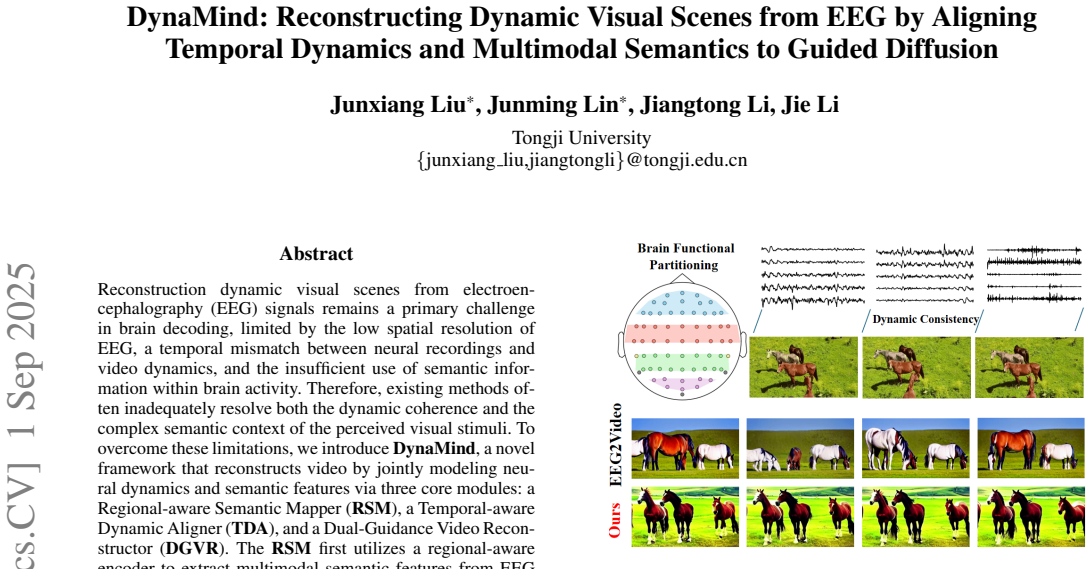
The load-bearing mechanism is dual-guidance latent diffusion: a DALLE-2-style diffusion prior maps EEG-derived embeddings into the CLIP text latent space, while the temporal blueprint is upsampled and added to the initial noise latent as x_T = E + alpha*U(z_B), so the reverse diffusion process is conditioned both semantically (cross-attention) and dynamically (initial latent). The structural consistency loss on frame-pair cosine-similarity matrices enforces relational temporal coherence, and the symmetric InfoNCE losses align predicted embeddings with true CLIP image and text embeddings.
What would settle it
Rerun the Regional-aware Semantic Mapper training with Eq. (8)'s target replaced by the independently computed CLIP text embedding of the ground-truth video and compare 40-way video semantic accuracy; if accuracy drops or changes materially, the published losses and gains depend on a self-referential target rather than true semantic alignment.
Extended reading notes
Core claim
The paper's central claim is that dual guidance is the key to EEG-to-video reconstruction: one branch, the Regional-aware Semantic Mapper, partitions EEG channels into four functional brain regions, independently encodes each, aligns the fused representation with image, text, and category CLIP embeddings, and translates it into a diffusion prior in CLIP text space; a second branch, the Temporal-aware Dynamic Aligner, segments the EEG sequence and generates a temporal blueprint of latent vectors aligned with ground-truth video latents through content and structural consistency losses. The Dual-Guidance Video Reconstructor then fine-tunes a pretrained video diffusion model, injecting the seman
Load-bearing premise
The load-bearing premise is that Eq. (8) supervises the diffusion prior against the true CLIP text embedding of the watched video, not the model's own predicted embedding; if the target is literally the prediction that also conditions the prior, the reported semantic gains are not measuring what they appear to measure.
Editorial extensions
If this is right
- If correct, EEG carries enough distributed semantic and temporal structure to drive coherent video reconstruction, not just static object or image decoding.
- The reported 40-way video semantic accuracy gain (0.159 to 0.284) and frame-level gain (0.138 to 0.241) establish a new quantitative benchmark on SEED-DV that future EEG-to-video systems will be compared against.
- Ablations indicate every brain region contributes, with the occipital lobe most important, so region-aware decoding is a measurable factor in semantic reconstruction quality.
- The temporal blueprint plus structural consistency loss cuts FVMD by 19.7% relative, showing that motion statistics of reconstructed videos can be made closer to real video dynamics.
- The improvement grows with task difficulty (10 to 40 classes), suggesting the added semantic guidance matters most when discriminations are fine-grained.
Reading between the lines
- The paper's Eq. (8) is ambiguous: if the diffusion prior target is literally the model's own predicted text embedding rather than the true CLIP text embedding, the reported semantic gains could be partly self-referential; this is an editorial concern, not a claim the paper makes explicitly.
- Because the method fine-tunes a pretrained video diffusion model, the same dual-guidance skeleton could transfer to other neural modalities (MEG, fMRI) or other clip-level labeled video datasets with relatively little modification.
- The structural self-similarity loss is a generic temporal-coherence regularizer that could be tested independently in other brain-to-video or video-denoising pipelines.
- Given the listed failure cases (motion direction inconsistency and semantic misclassification on ambiguous frames), the next bottleneck appears to be object kinematics rather than appearance, suggesting a testable extension would add optical-flow or motion-conditioned supervision.
Editorial analysis
A structured set of objections, weighed in public.
Referee Report
Summary. The paper proposes DynaMind, a three-module framework for reconstructing video from EEG on the SEED-DV dataset. The Regional-aware Semantic Mapper (RSM) partitions EEG channels by brain region, extracts a fused representation, aligns it to CLIP image/text/category embeddings via InfoNCE and cross-entropy losses, and produces a semantic diffusion prior. The Temporal-aware Dynamic Aligner (TDA) generates a temporal blueprint by processing EEG windows with a TCN and aligning the resulting latent sequence to ground-truth video latents with content and structural losses. The Dual-Guidance Video Reconstructor (DGVR) fine-tunes Stable Diffusion (Tune-A-Video) using the semantic prior as cross-attention conditioning and the temporal blueprint as the initial latent. Experiments on SEED-DV report state-of-the-art results in EEG classification and reconstruction metrics, including a 40-class video semantic accuracy of 0.284 versus 0.159 for EEG2Video, and improved SSIM/FVMD.
Significance. If the reported results are correct, DynaMind represents a meaningful advance in EEG-based dynamic visual decoding. The combination of regional semantic mapping with a temporal blueprint is a reasonable and well-motivated architectural direction, and the reported gains on the 40-class task are non-trivial. The paper includes ablations, detailed experimental setup, and qualitative comparisons, providing a useful benchmark for the field. However, the scientific value hinges on whether the semantic diffusion prior is actually a cross-modal translator rather than a degenerate copy of its own conditioning. The evaluation protocol also shares the same embedding space and label set as the training objective, so the semantic accuracy claims are less compelling than they initially appear. These issues require clarification and additional evidence before the central claims can be fully credited.
major comments (3)
- [Eq. (8) in §3.1] The diffusion prior loss is written as Lprior = E_t ||Pθ(Ĉ_T(t), t, Ĉ_diff) − Ĉ_T||^2, where Ĉ_diff in Eq. (7) is Concat(Ĉ_I, Ĉ_T, Ĉ_Y). Thus the target Ĉ_T is also a component of the conditioning input. A model can minimize this loss by copying that conditioning component, reducing the prior to an identity/no-op rather than a DALL-E-2-style cross-modal translator. This is not a presentation nuance: the paper's novelty and its attribution of the semantic accuracy gains to the diffusion prior (Eq. 8) become unsupported. Please either correct the target to the ground-truth CLIP text embedding c_T, or clarify the notation if Ĉ_T in Eq. (8) is meant to be c_T. If the literal equation is what was implemented, the effective semantic alignment is entirely due to the InfoNCE loss in Eq. (9), and the prior's role must be re-assessed.
- [§4.2, Table 2] The text states that 'Our method significantly outperforms the EEG2Video baseline in all evaluated settings.' This is contradicted by Table 2: for the 10-class video-based 2-way semantic accuracy, Ours is 0.847 ± 0.01 whereas EEG2Video is 0.852 ± 0.02, i.e., the baseline is higher. The claim should be qualified to 'most settings' or the discrepancy should be explained. In addition, no statistical significance tests are reported for Table 2; 'significantly outperforms' is not supported by p-values or confidence intervals. This is a load-bearing summary claim that needs correction.
- [Appendix B and §4.1] The semantic evaluation uses a CLIP classifier fine-tuned on ground-truth frames and a VideoMAE classifier fine-tuned on ground-truth video clips for the same 40 categories that define the training labels. The RSM is explicitly trained to align EEG embeddings to CLIP image/text embeddings of those categories and applies a category-level cross-entropy loss. Consequently, the semantic accuracy metric and the training objective share the same embedding space and label set. This protocol can inflate the reported semantic accuracy for a method that directly optimizes CLIP-space alignment, relative to methods that do not. Please provide an additional, more independent semantic evaluation (e.g., zero-shot CLIP retrieval against held-out text labels, a classifier trained on an unrelated label set, or human judgment) and discuss the potential bias. This is not a fatal flaw, but it is necessary to
minor comments (5)
- [§3.1 vs Appendix A.2] The methodology text lists five brain regions (frontal, central, temporal, parietal, occipital), but Appendix A.2 says K=4 and the ablation table removes only Frontal, Parietal, Occipital, and Temporal. Clarify whether the central lobe is included and how the K regions are defined.
- [Abstract] Typo: 'Reconstruction dynamic visual scenes' should be 'Reconstructing dynamic visual scenes'.
- [§2.1] The phrase 'high signal-to-noise and low spatial resolution ratio' is contradictory; the intended meaning is likely 'low signal-to-noise ratio and low spatial resolution'.
- [Eq. (8)] The diffusion prior loss is written as an MSE between the model output and a target, but the noise schedule, the noise variable, and the predictor type (noise vs. embedding) are not defined. Please align the notation with a standard diffusion loss or specify the training objective precisely.
- [Table 1 caption] The caption says 'different EEG classifiers' but the rows are different methods/models, not classifiers applied to the same features. Rephrase to avoid ambiguity.
Circularity Check
Eq. 8's diffusion prior is self-referential: its target ĉ_T is also part of the conditioning ĉ_diff, so the claimed cross-modal semantic translation reduces to copying its own input unless the equation is a typo for c_T.
-
self definitional
[Section 3.1, 'Generation of Semantic Diffusion Prior', Eqs. (7)-(8)]
"ĉ_diff = Concat(ĉ_I , ĉ_T , ĉ_Y ), (7) L_prior = E_{t∼[1,T]} [ || P_θ(ĉ_T^(t), t, ĉ_diff) − ĉ_T ||^2 ]. (8)"
The loss target in Eq. 8 is ĉ_T, the model's own predicted text embedding from Eq. 2. Eq. 7 defines the conditioning ĉ_diff as the concatenation containing that same ĉ_T. Thus the diffusion prior can minimize L_prior to zero by copying the clean ĉ_T out of the conditioning, regardless of the noised input. It is not trained against a ground-truth CLIP text embedding c_T, so the claimed 'translation' to CLIP text space is, by construction, a denoising autoencoder of its own input. Since this prior is the semantic guidance used in the DGVR (Eq. 18) and is credited for the semantic accuracy gains, the central semantic-guidance mechanism reduces to a self-referential fit unless Eq. 8 is intended to use c_T as the target.
full rationale
The paper's overall framework is not uniformly circular: the RSM uses InfoNCE losses against true CLIP image/text embeddings and a cross-entropy loss against class labels, the TDA aligns to VAE features of ground-truth video via DDIM inversion, and the DGVR fine-tunes a pre-trained video diffusion model. These components give the method substantial independent content. However, the diffusion prior described in Eqs. (7)-(8), a core novelty highlighted in the abstract and Section 3.1, is written with the target equal to the model's own predicted embedding ĉ_T, which is also a component of the conditioning ĉ_diff. As written, the prior can satisfy its loss by copying the conditioning, rather than by learning a cross-modal map from EEG-derived features to actual CLIP text embeddings. This is a specific, equation-level circularity in a load-bearing component: the paper attributes semantic accuracy improvements to this 'semantic diffusion prior' (e.g., Table 2 and the ablation 'w/o Text'), but the prior's objective is degenerate unless the intended target is c_T. The FVMD metric is self-cited (Liu et al. 2024b), but using one's own metric is not by itself circular; the metric is applied to both methods and is not load-bearing for the derivation. Overall, the central semantic-guidance claim partially reduces to a self-referential construction, while the rest of the pipeline retains independent evidence. Score 6.
Assumptions & free parameters
free parameters (3)
- alpha (temporal guidance strength in Eq. 17) =
not reported
- tau (InfoNCE temperature) =
not reported
- K (number of brain regions) =
4 (Appendix) vs 5 (main text)
assumptions (5)
- domain assumption CLIP ViT-L/14 image and text embeddings are valid semantic targets for EEG alignment
- domain assumption EEG channels can be partitioned into anatomically meaningful brain regions with distinct visual information
- domain assumption A DALLE-2 style diffusion prior can translate EEG-derived embeddings to CLIP text embeddings
- domain assumption Fine-tuning Stable Diffusion v1.4 on about 1400 short clips yields novel, non-memorized videos
- domain assumption FVMD (Liu et al. 2024b) is a valid measure of temporal coherence
Cite this review
Pith. "Pith review of DynaMind: Reconstructing Dynamic Visual Scenes from EEG by Aligning Temporal Dynamics and Multimodal Semantics to Guided Diffusion." pith.science (2026). https://pith.science/paper/DSPNM543
@misc{pith2026250901177,
  author       = {Pith},
  title        = {Pith review of: DynaMind: Reconstructing Dynamic Visual Scenes from EEG by Aligning Temporal Dynamics and Multimodal Semantics to Guided Diffusion},
  year         = {2026},
  howpublished = {\url{https://pith.science/paper/DSPNM543}},
  note         = {Machine review of arXiv:2509.01177}
}
read the original abstract
Reconstruction dynamic visual scenes from electroencephalography (EEG) signals remains a primary challenge in brain decoding, limited by the low spatial resolution of EEG, a temporal mismatch between neural recordings and video dynamics, and the insufficient use of semantic information within brain activity. Therefore, existing methods often inadequately resolve both the dynamic coherence and the complex semantic context of the perceived visual stimuli. To overcome these limitations, we introduce DynaMind, a novel framework that reconstructs video by jointly modeling neural dynamics and semantic features via three core modules: a Regional-aware Semantic Mapper (RSM), a Temporal-aware Dynamic Aligner (TDA), and a Dual-Guidance Video Reconstructor (DGVR). The RSM first utilizes a regional-aware encoder to extract multimodal semantic features from EEG signals across distinct brain regions, aggregating them into a unified diffusion prior. In the mean time, the TDA generates a dynamic latent sequence, or blueprint, to enforce temporal consistency between the feature representations and the original neural recordings. Together, guided by the semantic diffusion prior, the DGVR translates the temporal-aware blueprint into a high-fidelity video reconstruction. On the SEED-DV dataset, DynaMind sets a new state-of-the-art (SOTA), boosting reconstructed video accuracies (video- and frame-based) by 12.5 and 10.3 percentage points, respectively. It also achieves a leap in pixel-level quality, showing exceptional visual fidelity and temporal coherence with a 9.4% SSIM improvement and a 19.7% FVMD reduction. This marks a critical advancement, bridging the gap between neural dynamics and high-fidelity visual semantics.
Figures


Figures from the paper (3 more)


Forward citations
Cited by 1 Pith paper
-
Let EEG Models Learn EEG
JET is a conditional flow matching framework that generates EEG as continuous raw sequences with added constraints for spectral and temporal properties, achieving over 40% lower TS-FID than prior discrete denoising me...
Reference graph
Works this paper leans on
-
[1]
, " * write output.state after.block = add.period write newline
ENTRY address archivePrefix author booktitle chapter edition editor eid eprint howpublished institution isbn journal key month note number organization pages publisher school series title type volume year label extra.label sort.label short.list INTEGERS output.state before.all mid.sentence after.sentence after.block FUNCTION init.state.consts #0 'before.a...
-
[2]
write newline
" write newline "" before.all 'output.state := FUNCTION n.dashify 't := "" t empty not t #1 #1 substring "-" = t #1 #2 substring "--" = not "--" * t #2 global.max substring 't := t #1 #1 substring "-" = "-" * t #2 global.max substring 't := while if t #1 #1 substring * t #2 global.max substring 't := if while FUNCTION word.in bbl.in capitalize " " * FUNCT...
-
[3]
R.; Hillebrand, A.; and Holliday, I
Adjamian, P.; Hadjipapas, A.; Barnes, G. R.; Hillebrand, A.; and Holliday, I. E. 2008. Induced Gamma activity in primary visual cortex is related to luminance and not color contrast: An MEG study. Journal of Vision, 8(7): 4--4
work page 2008
-
[4]
Al-Saegh, A.; Dawwd, S. A.; and Abdul-Jabbar, J. M. 2021. Deep learning for motor imagery EEG-based classification: A review. Biomedical Signal Processing and Control, 63: 102172
work page 2021
-
[5]
Bain, M.; Nagrani, A.; Varol, G.; and Zisserman, A. 2021. Frozen in time: A joint video and image encoder for end-to-end retrieval. In Proceedings of the IEEE/CVF international conference on computer vision, 1728--1738
work page 2021
-
[6]
Dahal, N.; Nandagopal, N.; Nafalski, A.; and Nedic, Z. 2011. Modeling of cognition using EEG: a review and a new approach. In TENCON 2011-2011 IEEE Region 10 Conference, 1045--1049. IEEE
work page 2011
-
[7]
Du, C.; Du, C.; Huang, L.; and He, H. 2018. Reconstructing perceived images from human brain activities with Bayesian deep multiview learning. IEEE transactions on neural networks and learning systems, 30(8): 2310--2323
work page 2018
-
[8]
Goodale, M. A.; and Milner, A. D. 1992. Separate visual pathways for perception and action. Trends in neurosciences, 15(1): 20--25
work page 1992
Show all 36 references
-
[9]
Kavasidis, I.; Palazzo, S.; Spampinato, C.; Giordano, D.; and Shah, M. 2017. Brain2image: Converting brain signals into images. In Proceedings of the 25th ACM international conference on Multimedia, 1809--1817
2017
-
[10]
Kay, W.; Carreira, J.; Simonyan, K.; Zhang, B.; Hillier, C.; Vijayanarasimhan, S.; Viola, F.; Green, T.; Back, T.; Natsev, P.; et al. 2017. The kinetics human action video dataset. arXiv preprint arXiv:1705.06950
2017 arXiv
-
[11]
J.; Solon, A
Lawhern, V. J.; Solon, A. J.; Waytowich, N. R.; Gordon, S. M.; Hung, C. P.; and Lance, B. J. 2018. EEGNet: a compact convolutional neural network for EEG-based brain--computer interfaces. Journal of neural engineering, 15(5): 056013
2018
-
[12]
Li, D.; Wei, C.; Li, S.; Zou, J.; Qin, H.; and Liu, Q. 2024. Visual decoding and reconstruction via eeg embeddings with guided diffusion. arXiv preprint arXiv:2403.07721
2024 arXiv
-
[13]
Liu, H.; Hajialigol, D.; Antony, B.; Han, A.; and Wang, X. 2024 a . Eeg2text: Open vocabulary eeg-to-text decoding with eeg pre-training and multi-view transformer. arXiv preprint arXiv:2405.02165
2024 arXiv
-
[14]
Liu, J.; Qu, Y.; Yan, Q.; Zeng, X.; Wang, L.; and Liao, R. 2024 b . Fr 'echet Video Motion Distance: A Metric for Evaluating Motion Consistency in Videos. arXiv preprint arXiv:2407.16124
2024 arXiv
-
[15]
Liu, S.; Wang, X.; Zhao, L.; Zhao, J.; Xin, Q.; and Wang, S.-H. 2020. Subject-independent emotion recognition of EEG signals based on dynamic empirical convolutional neural network. IEEE/ACM transactions on computational biology and bioinformatics, 18(5): 1710--1721
2020
-
[16]
Liu, X.-H.; Liu, Y.-K.; Wang, Y.; Ren, K.; Shi, H.; Wang, Z.; Li, D.; Lu, B.-L.; and Zheng, W.-L. 2024 c . EEG2video: Towards decoding dynamic visual perception from EEG signals. Advances in Neural Information Processing Systems, 37: 72245--72273
2024
-
[17]
Mesulam, M.-M. 1998. From sensation to cognition. Brain: a journal of neurology, 121(6): 1013--1052
1998
-
[18]
Nichol, A.; Dhariwal, P.; Ramesh, A.; Shyam, P.; Mishkin, P.; McGrew, B.; Sutskever, I.; and Chen, M. 2021. Glide: Towards photorealistic image generation and editing with text-guided diffusion models. arXiv preprint arXiv:2112.10741
2021 arXiv
-
[19]
Oord, A. v. d.; Li, Y.; and Vinyals, O. 2018. Representation learning with contrastive predictive coding. arXiv preprint arXiv:1807.03748
2018 arXiv
-
[20]
W.; Hallacy, C.; Ramesh, A.; Goh, G.; Agarwal, S.; Sastry, G.; Askell, A.; Mishkin, P.; Clark, J.; et al
Radford, A.; Kim, J. W.; Hallacy, C.; Ramesh, A.; Goh, G.; Agarwal, S.; Sastry, G.; Askell, A.; Mishkin, P.; Clark, J.; et al. 2021. Learning transferable visual models from natural language supervision. In International conference on machine learning, 8748--8763. PmLR
2021
-
[21]
Ramesh, A.; Dhariwal, P.; Nichol, A.; Chu, C.; and Chen, M. 2022. Hierarchical text-conditional image generation with clip latents. arXiv preprint arXiv:2204.06125, 1(2): 3
2022 arXiv
-
[22]
Rombach, R.; Blattmann, A.; Lorenz, D.; Esser, P.; and Ommer, B. 2022. High-resolution image synthesis with latent diffusion models. In Proceedings of the IEEE/CVF conference on computer vision and pattern recognition, 10684--10695
2022
-
[23]
L.; Ghasemipour, K.; Gontijo Lopes, R.; Karagol Ayan, B.; Salimans, T.; et al
Saharia, C.; Chan, W.; Saxena, S.; Li, L.; Whang, J.; Denton, E. L.; Ghasemipour, K.; Gontijo Lopes, R.; Karagol Ayan, B.; Salimans, T.; et al. 2022. Photorealistic text-to-image diffusion models with deep language understanding. Advances in neural information processing syste...
2022
-
[24]
T.; Springenberg, J
Schirrmeister, R. T.; Springenberg, J. T.; Fiederer, L. D. J.; Glasstetter, M.; Eggensperger, K.; Tangermann, M.; Hutter, F.; Burgard, W.; and Ball, T. 2017. Deep learning with convolutional neural networks for EEG decoding and visualization. Human brain mapping, 38(11): 5391--5420
2017
-
[25]
S.; Blankertz, B.; Curio, G.; Muller, K.-R.; and Wiegand, T
Scholler, S.; Bosse, S.; Treder, M. S.; Blankertz, B.; Curio, G.; Muller, K.-R.; and Wiegand, T. 2012. Toward a direct measure of video quality perception using EEG. IEEE transactions on Image Processing, 21(5): 2619--2629
2012
-
[26]
Singer, U.; Polyak, A.; Hayes, T.; Yin, X.; An, J.; Zhang, S.; Hu, Q.; Yang, H.; Ashual, O.; Gafni, O.; et al. 2022. Make-a-video: Text-to-video generation without text-video data. arXiv preprint arXiv:2209.14792
2022 arXiv
-
[27]
Singh, P.; Pandey, P.; Miyapuram, K.; and Raman, S. 2023. EEG2IMAGE: image reconstruction from EEG brain signals. In ICASSP 2023-2023 IEEE International Conference on Acoustics, Speech and Signal Processing (ICASSP), 1--5. IEEE
2023
-
[28]
Song, Y.; Liu, B.; Li, X.; Shi, N.; Wang, Y.; and Gao, X. 2023. Decoding natural images from eeg for object recognition. arXiv preprint arXiv:2308.13234
2023 arXiv
-
[29]
Song, Y.; Zheng, Q.; Liu, B.; and Gao, X. 2022. EEG conformer: Convolutional transformer for EEG decoding and visualization. IEEE Transactions on Neural Systems and Rehabilitation Engineering, 31: 710--719
2022
-
[30]
Sun, J.; Li, M.; Chen, Z.; Zhang, Y.; Wang, S.; and Moens, M.-F. 2023. Contrast, attend and diffuse to decode high-resolution images from brain activities. Advances in Neural Information Processing Systems, 36: 12332--12348
2023
-
[31]
Tong, Z.; Song, Y.; Wang, J.; and Wang, L. 2022. Videomae: Masked autoencoders are data-efficient learners for self-supervised video pre-training. Advances in neural information processing systems, 35: 10078--10093
2022
-
[32]
T.; Castro, S.; Kunze, J.; and Erhan, D
Villegas, R.; Babaeizadeh, M.; Kindermans, P.-J.; Moraldo, H.; Zhang, H.; Saffar, M. T.; Castro, S.; Kunze, J.; and Erhan, D. 2022. Phenaki: Variable length video generation from open domain textual description. arXiv preprint arXiv:2210.02399
2022 arXiv
-
[33]
C.; Sheikh, H
Wang, Z.; Bovik, A. C.; Sheikh, H. R.; and Simoncelli, E. P. 2004. Image quality assessment: from error visibility to structural similarity. IEEE transactions on image processing, 13(4): 600--612
2004
-
[34]
Wei, Y.; Cao, L.; Li, H.; and Dong, Y. 2024. Mb2c: Multimodal bidirectional cycle consistency for learning robust visual neural representations. In Proceedings of the 32nd ACM International Conference on Multimedia, 8992--9000
2024
-
[35]
Z.; Ge, Y.; Wang, X.; Lei, S
Wu, J. Z.; Ge, Y.; Wang, X.; Lei, S. W.; Gu, Y.; Shi, Y.; Hsu, W.; Shan, Y.; Qie, X.; and Shou, M. Z. 2023. Tune-a-video: One-shot tuning of image diffusion models for text-to-video generation. In Proceedings of the IEEE/CVF international conference on computer vision, 7623--7633
2023
-
[36]
Zhang, K.; He, L.; Jiang, X.; Lu, W.; Wang, D.; and Gao, X. 2025. CognitionCapturer: Decoding Visual Stimuli From Human EEG Signal With Multimodal Information. In Proceedings of the AAAI Conference on Artificial Intelligence, 14486--14493
2025
Reviewed August 5, 2026 · model on record in the stance chip above.
Discussion (0). Sign in to comment.