REVIEW 3 major objections 4 minor 33 references
Continuous Relaxation of Symbolic Planner for One-Shot Imitation Learning
T0 review · 3 major / 4 minor · reviewed 2026-08-14 · deepseek-v4-flash
Pith's one-line read This paper argues that one-shot imitation learning can be recast as symbolic planning over probabilistic symbol groundings, so a learned network's uncertain outputs feed a continuous planner directly instead of being forced into discrete…
desk verdict The empirical claim about planning on probabilistic symbols is plausible and worth testing, but the planner derivation hides an independence approximation that makes multi-step planning inexact; the paper should acknowledge this and define its goal-matching objective. read the letter →
The pith
A machine-rendered reading of the paper's core claim, the machinery that carries it, and where it could break.
The reading
What carries the argument
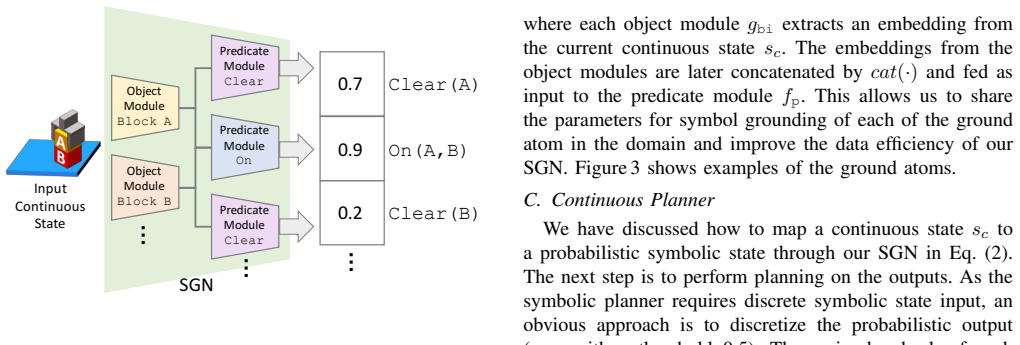
The load-bearing object is the probabilistic symbol representation from [10], which replaces a set of true ground atoms with a distribution over symbolic states, compactly encoded by the marginal probability per ground atom. On top of it, the Continuous Planner derives iterative formulas for state update, action applicability, and goal matching that operate only on those marginals, using the assumption that ground atoms are conditionally independent. The modular Symbol Grounding Network, with object modules and predicate modules that share parameters, supplies those marginals and is the only learned component.
What would settle it
Run the Continuous Planner in a domain where one action succeeds with probability 0.8 and otherwise leaves the state unchanged, and compare the planner's predicted distribution after one action (Eqs. 10-15) with the empirical distribution over states. If they diverge, the deterministic-transition update is invalid. Likewise, a domain with two strongly anti-correlated ground atoms (e.g., an object cannot be in two containers at once) should expose the conditional-independence assumption as the source of planning error.
Extended reading notes
Core claim
The central claim is that the compound mapping from demonstration to policy, which prior one-shot methods learn as a single black box, can be decomposed as $\phi(\cdot)=CP(SGN(\cdot))$: a Symbol Grounding Network maps continuous states to distributions over ground atoms, and a Continuous Planner searches for an action sequence that takes the current state distribution to the goal distribution. Because the planner assumes a known deterministic transition model, the effect of attempting an action on each ground atom's probability can be written in closed form (Eqs. 10-15) under a conditional-independence assumption, so no large state-space marginalization is needed. This makes it possible to plan on uncertain symbolic input directly, and the planner reduces to the classical symbolic planner when the distribution concentrates on one state. The paper reports that this formulation beats the symbolic-planner baseline that discretizes the same network outputs, and matches a manually-heuristic baseline without needing domain-specific rules.
Load-bearing premise
The state-update formulas assume the task domain's transition rules are known and deterministic, and that the network's fact probabilities are independent of one another; if actions can fail or facts are correlated, the planner's predicted states may be wrong.
Editorial extensions
If this is right
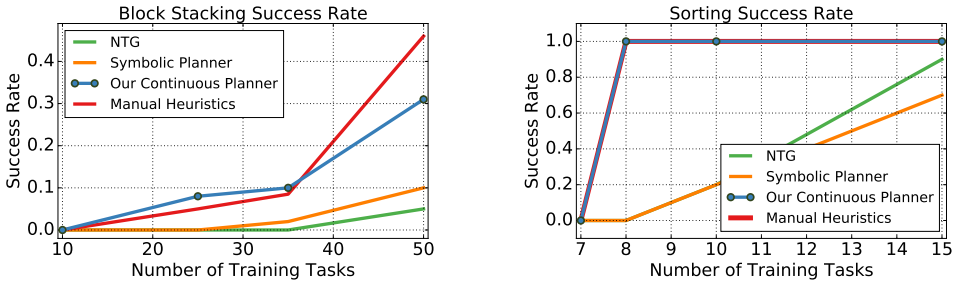
- On Block Stacking, planning-based methods all outperform the policy-network baseline (NTG) at every training-set size, and the Continuous Planner is the strongest, even matching a manually engineered heuristic without hand-defined rules.
- On Object Sorting, the Continuous Planner reaches 100% success with only 8 training tasks, a regime where neither NTG nor the symbolic planner converges within 15 tasks.
- Because the Continuous Planner is a generalization of the symbolic planner, it inherits the ability to find alternative solutions to the same goal, which the paper shows is essential for the Object Sorting task.
- Only the Symbol Grounding Network needs training; the planner itself is derived, so the approach's data requirement is set by how well the SGN can learn to ground symbols, not by how well a policy network can imitate.
Reading between the lines
- The same continuous relaxation should transfer to any classical planner with a known deterministic transition model, so task-and-motion-planning systems that currently threshold learned classifier outputs could adopt it directly; the expected benefit is the same robustness to grounding errors.
- The conditional-independence assumption on ground atoms is the main simplification; a domain with strong correlations between facts (e.g., spatial exclusivity) might need a richer state distribution than per-atom marginals. Modeling those correlations would be a natural next step.
- A strong test of the paper's decoupling thesis is to replace the modular SGN with a non-modular network of the same capacity; if performance degrades, that would confirm that parameter sharing among symbols, not just the planner relaxation, drives the data efficiency.
- The planner in Eq. (1) only sees the final demonstration state unless the goal recognizer is conditioned on the full demonstration; the closed-loop formulation is likely to be more robust when the final frame is ambiguous. This is an extension the paper mentions but does not evaluate.
Signed reviews
Editorial analysis
A structured set of objections, weighed in public.
Referee Report
Summary. The paper proposes a framework for one-shot imitation learning that decomposes the problem into symbol grounding and planning. A modular Symbol Grounding Network (SGN) maps continuous states to probabilistic symbolic states, and a Continuous Planner (CP) performs planning directly on these probabilistic states instead of discretizing them into a single symbolic state. The authors derive iterative update formulas for action applicability, action effects, and goal satisfaction under the assumption of deterministic symbolic transitions. They evaluate the approach on Block Stacking and Object Sorting domains, reporting that the planning-based methods, especially the Continuous Planner, outperform the Neural Task Graph Networks baseline with fewer meta-training tasks, and that the continuous relaxation offers gains over a symbolic planner that operates on discretized SGN outputs.
Significance. If the central claims hold, the paper makes a useful contribution by demonstrating that explicit symbolic planning, when combined with a learned probabilistic grounding, can reduce the meta-training burden in one-shot imitation learning. The proposed modular SGN and the idea of planning on continuous symbol probabilities are reasonable and interesting extensions of prior work, and the empirical results on two domains suggest that the approach is promising. The formulation disentangles policy execution from inter-task generalization, and the method does not rely on handcrafted rules for invalid states. However, the derivation of the continuous planner rests on an unstated independence assumption that is not preserved by the updates, and the goal-matching objective is left unspecified; these issues affect the paper's main technical contribution and must be addressed before the claims are fully supported.
major comments (3)
- [Section IV-C, Eqs. (7)-(15)] The derivation of the iterative update formulas assumes that the distribution over symbolic states remains factorized after each action update, but this is not stated and generally is false. For example, consider an operator o1 with precondition {A} and effect {B}; after applying the update in Eq. (11), the marginal P(B') becomes P(A) + (1-P(A))P(B), but the joint distribution has P(B'|A)=1, so B' is positively correlated with A. Consequently, for a subsequent operator o2 with precondition {A,B}, the true applicability probability is P(A), while Eq. (6) would return P(A)P(B'), which can be arbitrarily smaller. The paper's claim that the formulas are exact and avoid marginalizing a large state space (Section IV-C, after Eq. (15)) therefore only holds under a mean-field approximation that is not acknowledged. Please state this assumption explicitly, justify it empirically or theoretically, or restrict the claims to cases where the domain structure preserves conditional independence.
- [Section IV-C, "Goal Satisfaction"] The goal-satisfaction step is described only as "the objective of our search is thus to match the two distributions," but no concrete objective or algorithm is given. Without a definition of the distance or divergence between the current state distribution and the goal distribution, it is impossible to reproduce the planner's search procedure or to verify that the planner is actually optimizing the stated criterion. Please provide a formal definition (e.g., cross-entropy, KL divergence, or a weighted sum of atom probabilities) and explain how it is used in the forward search.
- [Section V, Figures 5 and 6] The success-rate curves are reported without error bars, the number of random seeds, or any statistical significance testing. The central claim that the Continuous Planner "significantly outperforms" the symbolic planner (Section V-B) may be sensitive to random initialization of the SGN and the variability of the evaluation tasks. Please report means and variances over multiple seeds and state the number of seeds used, or otherwise provide a statistical basis for the comparison.
minor comments (4)
- [Figure 1 caption] There is a typo in the caption: "Symbol Gnding Networks" should be "Symbol Grounding Networks."
- [Algorithm 2] In the line "sc←ExecActions(E, Π)", the variable sc is reused for the current continuous state after execution, which is also the name of the initial continuous state s0; using a distinct name such as s_{next} would improve clarity.
- [Section IV-A, Eq. (1)] The notation Π = CP(SGN(sc), SGN(dτ_T), O) is introduced but the closed-loop nature is only described in words; it would be clearer to specify how the plan is executed and re-planning is triggered, since Algorithm 2 leaves the exact interaction with the environment implicit.
- [Section IV-D, Learning] The sentence "SymbolicState(·) computes the aligned symbolic state Sτ for each dτ based on the action annotation aτ used in previous works" relies on references [4,6] for the action annotations; please clarify whether these annotations are available at meta-training time for all tasks and how they are obtained for novel tasks at test time.
Circularity Check
No significant circularity: the continuous planner is a hand-derived relaxation of deterministic operators, SGN outputs are independent inputs, and evaluation is on unseen tasks.
full rationale
The paper's central derivation is self-contained. The Continuous Planner (Eqs. 6-15) is derived directly from the stated deterministic STRIPS/symbolic transition model; no parameter of CP is fitted to the success metric, and the update formulas are not defined in terms of the final evaluation. The Symbol Grounding Network (Eq. 2) is trained with ground-truth symbolic states (Algorithm 1), and its probabilistic outputs are inputs to the planner, not fitted constants that are then renamed as predictions. The self-citations [4,6] are used only as a source of action annotations for generating training labels, not as an unverified load-bearing theorem. The empirical claims compare against baselines on unseen meta-test tasks, so the improvement of the continuous planner over the discrete planner is an independent outcome. The hidden conditional-independence assumption in the iterative action-application update is a potential correctness limitation, not a circularity, because the derivation does not assume the conclusion it tests.
Assumptions & free parameters
assumptions (4)
- domain assumption The symbolic transition model O is known and deterministic.
- domain assumption Ground-truth symbolic states for meta-training tasks are available from domain definitions and action annotations.
- domain assumption Ground atoms in the probabilistic state representation are conditionally independent.
- domain assumption Meta-training and meta-testing tasks share the same domain file, available at training time.
Cite this review
Pith. "Pith review of Continuous Relaxation of Symbolic Planner for One-Shot Imitation Learning." pith.science (2026). https://pith.science/paper/DT5NPPCA
@misc{pith2026190806769,
  author       = {Pith},
  title        = {Pith review of: Continuous Relaxation of Symbolic Planner for One-Shot Imitation Learning},
  year         = {2026},
  howpublished = {\url{https://pith.science/paper/DT5NPPCA}},
  note         = {Machine review of arXiv:1908.06769}
}
read the original abstract
We address one-shot imitation learning, where the goal is to execute a previously unseen task based on a single demonstration. While there has been exciting progress in this direction, most of the approaches still require a few hundred tasks for meta-training, which limits the scalability of the approaches. Our main contribution is to formulate one-shot imitation learning as a symbolic planning problem along with the symbol grounding problem. This formulation disentangles the policy execution from the inter-task generalization and leads to better data efficiency. The key technical challenge is that the symbol grounding is prone to error with limited training data and leads to subsequent symbolic planning failures. We address this challenge by proposing a continuous relaxation of the discrete symbolic planner that directly plans on the probabilistic outputs of the symbol grounding model. Our continuous relaxation of the planner can still leverage the information contained in the probabilistic symbol grounding and significantly improve over the baseline planner for the one-shot imitation learning tasks without using large training data.
Figures


Figures from the paper (2 more)

Reference graph
Works this paper leans on
-
[1]
Learning tasks from a single demonstration,
C. G. Atkeson and S. Schaal, “Learning tasks from a single demonstration,” in ICRA, 1997
work page 1997
-
[2]
Y . Duan, M. Andrychowicz, B. C. Stadie, J. Ho, J. Schneider, I. Sutskever, P. Abbeel, and W. Zaremba, “One-Shot Imitation Learning,” in NeurIPS, 2017
work page 2017
-
[3]
One-shot visual imitation learning via meta-learning,
C. inn, T. Yu, T. Zhang, P. Abbeel, and S. Levine, “One-shot visual imitation learning via meta-learning,” in CoRL, 2017
work page 2017
-
[4]
Neural task graphs: Generalizing to unseen tasks from a single video demonstration,
D.-A. Huang, S. Nair, D. Xu, Y . Zhu, A. Garg, L. Fei-Fei, S. Savarese, and J. C. Niebles, “Neural task graphs: Generalizing to unseen tasks from a single video demonstration,” in CVPR, 2019
work page 2019
-
[5]
D. Pathak, P. Mahmoudieh, G. Luo, P. Agrawal, D. Chen, Y . Shentu, E. Shelhamer, J. Malik, A. A. Efros, and T. Darrell, “Zero-shot visual imitation,” in ICLR, 2018
work page 2018
-
[6]
Neural task programming: Learning to generalize across hierarchical tasks,
D. Xu, S. Nair, Y . Zhu, J. Gao, A. Garg, L. Fei-Fei, and S. Savarese, “Neural task programming: Learning to generalize across hierarchical tasks,” in ICRA, 2018
work page 2018
-
[7]
One-shot imitation from observing humans via domain-adaptive meta-learning,
T. Yu, C. Finn, A. Xie, S. Dasari, T. Zhang, P. Abbeel, and S. Levine, “One-shot imitation from observing humans via domain-adaptive meta-learning,” in RSS, 2018
work page 2018
-
[8]
Matching networks for one shot learning,
O. Vinyals, C. Blundell, T. Lillicrap, D. Wierstra, et al., “Matching networks for one shot learning,” in NIPS, 2016, pp. 3630–3638
work page 2016
Show all 33 references
-
[9]
Ghallab, D
M. Ghallab, D. Nau, and P. Traverso, Automated planning: Theory and practice. Elsevier, 2004
2004
-
[10]
Symbol acquisi- tion for probabilistic high-level planning,
G. Konidaris, L. Kaelbling, and T. Lozano-Perez, “Symbol acquisi- tion for probabilistic high-level planning,” in IJCAI, 2015
2015
-
[11]
One-shot learning of multi-step tasks from observation via activity localization in auxiliary video,
W. Goo and S. Niekum, “One-shot learning of multi-step tasks from observation via activity localization in auxiliary video,” ArXiv preprint arXiv:1806.11244, 2018
2018 arXiv
-
[12]
Learning grounded finite-state representations from unstructured demonstrations,
S. Niekum, S. Osentoski, G. Konidaris, S. Chitta, B. Marthi, and A. G. Barto, “Learning grounded finite-state representations from unstructured demonstrations,” IJRR, 2015
2015
-
[13]
Taco: Learning task decomposition via temporal alignment for control,
K. Shiarlis, M. Wulfmeier, S. Salter, S. Whiteson, and I. Posner, “Taco: Learning task decomposition via temporal alignment for control,” ArXiv preprint arXiv:1803.01840 , 2018
2018 arXiv
-
[14]
Algorithms for sequential decision making,
M. L. Littman, “Algorithms for sequential decision making,” 1996
1996
-
[15]
Planning and acting in partially observable stochastic domains,
L. P. Kaelbling, M. L. Littman, and A. R. Cassandra, “Planning and acting in partially observable stochastic domains,” Artificial intelligence, vol. 101, no. 1-2, pp. 99–134, 1998
1998
-
[16]
Online planning algorithms for pomdps,
S. Ross, J. Pineau, S. Paquet, and B. Chaib-Draa, “Online planning algorithms for pomdps,” JAIR, vol. 32, pp. 663–704, 2008
2008
-
[17]
Ff-replan: A baseline for probabilistic planning.,
S. W. Yoon, A. Fern, and R. Givan, “Ff-replan: A baseline for probabilistic planning.,” in ICAPS, 2007
2007
-
[18]
Probabilistic planning via determinization in hindsight.,
S. W. Yoon, A. Fern, R. Givan, and S. Kambhampati, “Probabilistic planning via determinization in hindsight.,” in AAAI, 2008
2008
-
[19]
Probabilistic planning vs. replanning,
I. Little, S. Thiebaux, et al., “Probabilistic planning vs. replanning,” in ICAPS Workshop on IPC: Past, Present and Future , 2007
2007
-
[20]
Learning grounded rela- tional symbols from continuous data for abstract reasoning,
N. Jetchev, T. Lang, and M. Toussaint, “Learning grounded rela- tional symbols from continuous data for abstract reasoning,” 2013
2013
-
[21]
A hybrid architecture for hierarchical reinforcement learning,
M. Huber, “A hybrid architecture for hierarchical reinforcement learning,” in ICRA, IEEE, vol. 4, 2000, pp. 3290–3295
2000
-
[22]
Learning quickly to plan quickly using modular meta-learning,
R. Chitnis, L. P. Kaelbling, and T. Lozano-P ´erez, “Learning quickly to plan quickly using modular meta-learning,” in ICRA, 2019
2019
-
[23]
Learning heuristic search via imitation,
M. Bhardwaj, S. Choudhury, and S. Scherer, “Learning heuristic search via imitation,” in CoRL, 2017
2017
-
[24]
Model-Agnostic Meta- Learning for Fast Adaptation of Deep Networks,
C. Finn, P. Abbeel, and S. Levine, “Model-Agnostic Meta- Learning for Fast Adaptation of Deep Networks,” ArXiv preprint arXiv:1703.03400, 2017
2017 arXiv
-
[25]
Geometric backtracking for combined task and motion planning in robotic systems,
J. Bidot, L. Karlsson, F. Lagriffoul, and A. Saffiotti, “Geometric backtracking for combined task and motion planning in robotic systems,” Artificial Intelligence, 2017
2017
-
[26]
Asymov: A planner that deals with intricate symbolic and geometric problems,
F. Gravot, S. Cambon, and R. Alami, “Asymov: A planner that deals with intricate symbolic and geometric problems,” in ISRR, 2005
2005
-
[27]
Hierarchical planning in the now,
L. P. Kaelbling and T. Lozano-P ´erez, “Hierarchical planning in the now,” in AAAI Workshops, 2010
2010
-
[28]
From low-level tra- jectory demonstrations to symbolic actions for planning,
N. Abdo, H. Kretzschmar, and C. Stachniss, “From low-level tra- jectory demonstrations to symbolic actions for planning,” in ICAPS Workshops, 2012
2012
-
[29]
Manipulation planning using learned symbolic state abstractions,
R. Dearden and C. Burbridge, “Manipulation planning using learned symbolic state abstractions,” Robotics and Autonomous Systems, vol. 62, no. 3, pp. 355–365, 2014
2014
-
[30]
Learning spatial relations from functional simulation,
K. Sj ¨o¨o and P. Jensfelt, “Learning spatial relations from functional simulation,” in IROS, 2011
2011
-
[31]
Neural module networks,
J. Andreas, M. Rohrbach, T. Darrell, and D. Klein, “Neural module networks,” in CVPR, 2016
2016
-
[32]
Nervenet: Learning structured policy with graph neural networks,
T. Wang, R. Liao, J. Ba, and S. Fidler, “Nervenet: Learning structured policy with graph neural networks,” in ICLR, 2018
2018
-
[33]
Markov logic networks,
M. Richardson and P. Domingos, “Markov logic networks,” Machine learning, 2006
2006
Reviewed August 14, 2026 · model on record in the stance chip above.
Discussion (0). Continue with ORCID to comment.