REVIEW 3 major objections 4 minor 41 references
Predicting physical properties of alkanes with neural networks
T0 review · 3 major / 4 minor · reviewed 2026-08-14 · deepseek-v4-flash
Pith's one-line read A five-integer molecular code plus a fragmented-data neural network predicts six alkane physical properties at or above the accuracy of semi-empirical models.
desk verdict A competent application of fragmented-data NNs to alkane property prediction with a useful flash-point error correction, but the molecular descriptor needs a canonicalization proof and some headline numbers rest on very small comparison sets. read the letter →
The pith
A machine-rendered reading of the paper's core claim, the machinery that carries it, and where it could break.
The reading
What carries the argument
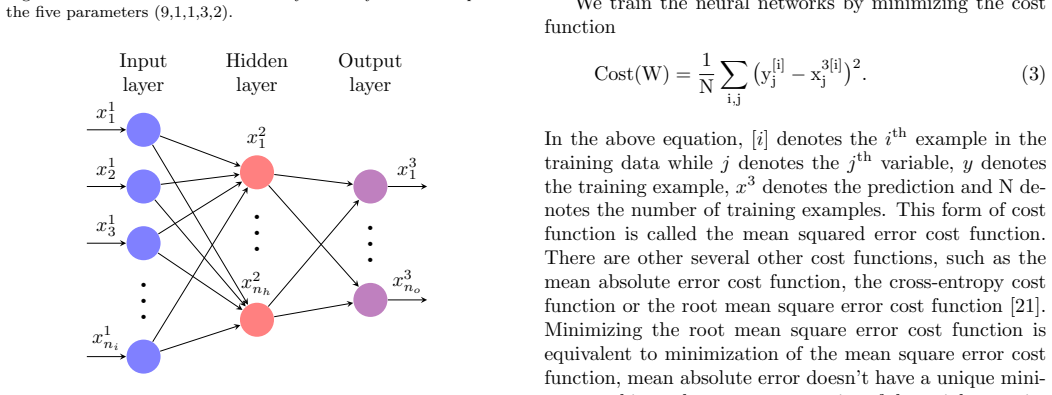
The load-bearing object is the five-integer molecular basis: carbon count, distance from one end of the longest chain to its nearest branch, length of that branch, distance from the other end to its nearest branch, and length of the second branch, with zeros for shorter molecules. This converts each alkane into a fixed-length vector while allowing straight chains to pass smoothly into singly and then doubly branched isomers. The second mechanism is the fragmented-data neural network: physical properties appear as both inputs and outputs, the diagonal output weights are pinned to zero during training, and missing values are filled by iterating $x^{[n+1]} = \gamma x^{[n]} + (1-\gamma) f(x^{[n]})$ with $\gamma=\frac{1}{2}$ until convergence. Six networks trained with different random data weights supply a mean and an uncertainty; leave-one-out cross-validation selects the hidden-node count and reports generalization accuracy. For melting point, two extra inputs — an odd/even carbon parity flag and the total number of molecular symmetries — carry the argument that symmetry, not just topology, controls melting.
What would settle it
Enumerate every alkane with up to twelve carbons that has two or more ways to pick the longest carbon chain or branches at equal distances from the chain ends, write each in the five-integer basis, and check whether any two distinct isomers produce the same tuple; a single collision disproves the uniqueness claim on which all the property predictions rest.
Extended reading notes
Core claim
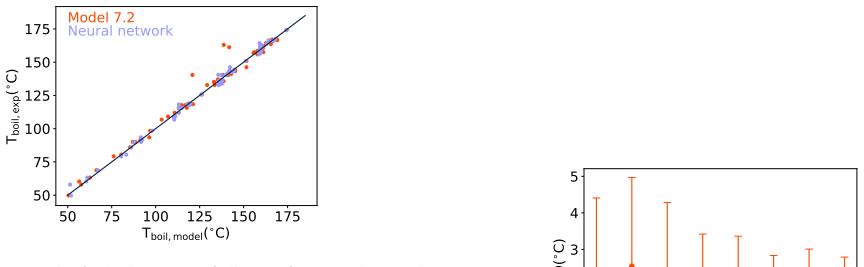
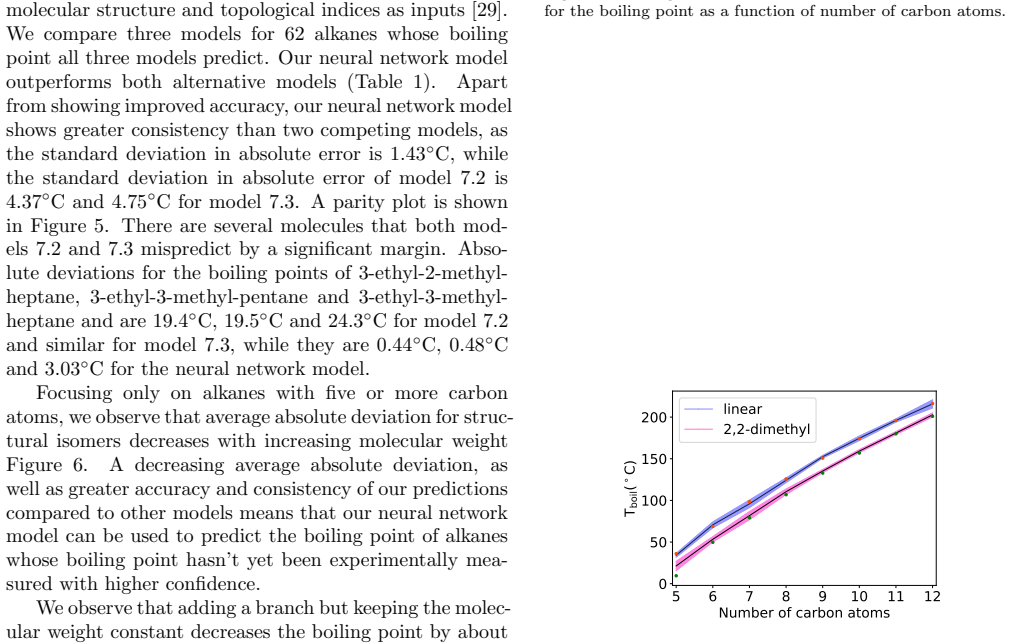
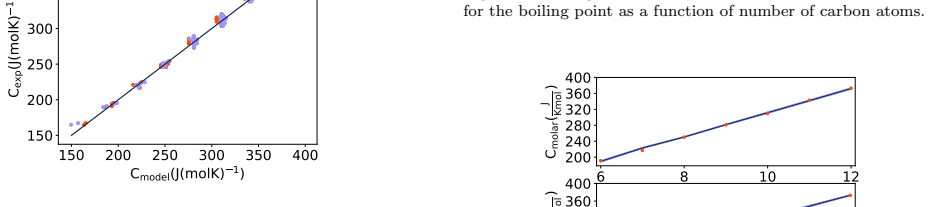
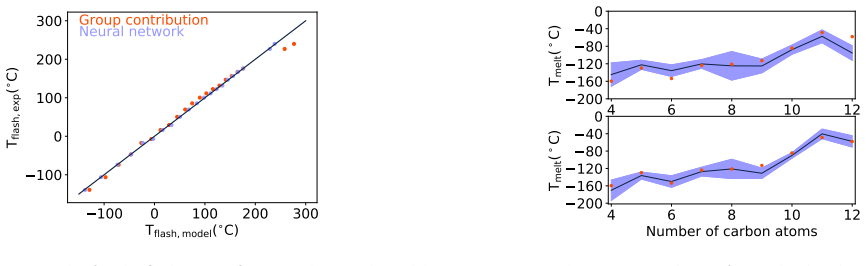
On its own terms, the paper's discovery is that a neural network with a five-integer molecular basis and a self-consistent imputation scheme reproduces experimental alkane properties at or above the accuracy of established semi-empirical methods. Cross-validated results include $R^2=0.992$ with an average absolute deviation of $1.74^{\circ}\mathrm{C}$ for the boiling point of 188 branched alkanes, $R^2=0.997$ for liquid heat capacity, $R^2=0.999$ for flash point after removing flagged erroneous entries, $R^2=0.998$ for melting point once molecular-symmetry and odd/even descriptors are added, $R^2=0.917$ for vapor pressure integrated over the Antoine-equation range, and $R^2=0.998$ for kinematic viscosity at $20^{\circ}\mathrm{C}$ on nine linear alkanes. The paper also claims two physical insights: adding a branch at constant molecular weight lowers the boiling point by about $7^{\circ}\mathrm{C}$ and raises vapor pressure, and molecular symmetry strongly raises the melting point. The flash-point result doubles as a data-quality finding: entries for eicosane through hexacosane are identified as incorrect in the source literature and removed.
Load-bearing premise
The paper assumes the five-integer molecular basis is a unique fingerprint for every linear, single-branched, and double-branched alkane it encodes, but it never tests molecules where the longest chain is not unique or where branches sit at equal distances from both ends; if two isomers share a tuple, the network cannot distinguish them and every structure-property prediction for that pair collapses.
Editorial extensions
If this is right
- If the central claim is right, boiling point is predictable for unmeasured branched alkanes with fewer than 13 carbons to within about $1.7^{\circ}\mathrm{C}$, and the errors shrink as molecular weight grows.
- The model's flash-point screening procedure — flagging entries more than two standard errors from the mean prediction and confirming against the flash-boiling correlation — can be used to audit other property databases.
- Because heat capacity is roughly linear in carbon number while branching effects are negligible, the model gives a simple engineering rule for choosing heat-transfer capacity in a base oil.
- Molecular symmetry, quantified as a simple integer count, is a first-order driver of melting point; including it lifts the network's cross-validated $R^2$ from $0.650$ to $0.998$.
- Kinematic viscosity at $40^{\circ}\mathrm{C}$ and $100^{\circ}\mathrm{C}$ can be obtained from predicted dynamic viscosity and density, and the resulting viscosity index identifies eicosane as the only linear alkane studied for which a viscosity index can be defined, implying linear alkanes play a small role in real base oils.
Reading between the lines
- A natural test this paper leaves open is whether the five-integer descriptor is injective on all alkanes in its scope; molecules in which two equivalent longest chains or branch positions at equal distances from both ends exist could collide, and an enumeration over isomers up to $\mathrm{C}_{12}$ would settle it.
- The same imputation architecture could be pointed at the temperature-pressure surface of longer alkanes by seeding it with molecular-dynamics data, which the paper names as a possible next step.
- The symmetry descriptor for melting point could be refined to include crystal-structure details, which the paper itself notes would be the next improvement.
- The flash-point error screening suggests a general template for database validation: train on all but one property, flag outliers in cross-validation residuals, and confirm with a physical correlation.
Signed reviews
Editorial analysis
A structured set of objections, weighed in public.
Referee Report
Summary. The paper trains artificial neural networks that can exploit fragmented data and property-property correlations to predict six physical properties of linear, single-branched, and double-branched alkanes up to roughly tridecane, with comparisons to semi-empirical methods. A five-integer molecular basis encodes molecular structure, a leave-one-out cross-validation scheme selects network architectures and reports accuracy, and the method is applied to boiling point, heat capacity, vapor pressure (via Antoine coefficients), flash point, melting point, and kinematic viscosity. The central claims are that the five-integer basis uniquely characterizes each alkane and that the neural network predictions are more accurate and more consistent than existing group-contribution, topological-index, and free-volume models.
Significance. If the descriptor uniqueness and validation issues are resolved, the paper would make a useful contribution to data-driven thermophysical property prediction: it demonstrates a practical way to train on fragmented experimental data, exploits property-property correlations for imputation, and uses leave-one-out cross-validation for each property model. The flash-point analysis also attempts an external check against original sources, and the kinematic viscosity model combines separate density and viscosity models in a physically sensible way. These strengths are tempered by the unresolved question of whether the molecular basis is truly injective and by the self-referential outlier removal in the flash-point analysis.
major comments (3)
- [Section 2.1] The five-integer descriptor is claimed to uniquely encode every linear, single-branched, and double-branched alkane, but the definition is incomplete because 'the longest carbon chain' is not unique in general and no tie-breaking or canonicalization rule is given. The paper gives no proof that the tuple is invariant under the choice of a longest chain, and it does not prove that distinct molecules always yield distinct tuples. Since this descriptor is the only structural input to every network, the uniqueness claim is load-bearing; the authors should either provide a canonical definition with a proof of injectivity for the intended class or demonstrate injectivity computationally for all alkanes in the considered range and state the result.
- [Section 3.3] The reported flash-point R2=0.999 is obtained after removing data entries that the same neural network flagged as lying more than two standard errors from the prediction. This is a self-referential cleaning rule: leave-one-out cross-validation on the cleaned subset does not estimate predictive accuracy on the original dataset, and the improvement from R2=0.910 to 0.999 may substantially reflect removing hard cases rather than correcting errors. The authors should report how many entries were removed and their identities, evaluate performance on an independent holdout set selected without using model residuals, and show the sensitivity of R2 to the removal threshold before claiming that the model predictions can replace experimental measurements.
- [Sections 3.4 and 3.5 (Tables 4 and 5)] The comparative claims against topological-index melting-point models and free-volume viscosity models rest on only 4 and 9 molecules, respectively. These sample sizes are too small to establish that the neural network is 'more accurate and consistent' than the competing methods; for instance, the standard deviations quoted for the free-volume comparison are computed on nine points and any single point heavily influences them. The authors should either expand the comparison sets or soften the comparative conclusions to a demonstration of feasibility on the limited common data.
minor comments (4)
- [Section 3.1 and Table 6] The number of alkanes used for heat capacity is given as 176 in Section 3.1 but 181 in Table 6; the heat-capacity AAD is given as 2.10 J(mol K)-1 in Section 3.1 and 2.33 J(mol K)-1 in Table 6. Please reconcile these numbers.
- [Section 3.3 and Table 6] The flash-point AAD is reported as 1.65 C in Section 3.3 and 1.61 C in Table 6, and the table lists 21 molecules while the text describes additional removed entries; please clarify which set these numbers refer to and how the leave-one-out procedure is run after the removal.
- [Equation (8)] Equation (8) is ambiguous: the intended expression should be written as T = B/(A - log10 p) + C with the two log10 p values substituted, and the current notation '(Tmin,Tmax) = Bexp/(Aexp - (-1.875, 0.294)) + Cexp' is not a standard tuple equation.
- [Throughout] There are several grammatical errors that should be corrected, including 'an dataset' in Section 2.4 and 'Our dataset consists comprises 51 molecules' in Section 3.4. Also, please add a data availability statement listing the exact experimental data sources and the trained network definitions, as the paper does not currently provide the data or code needed to reproduce the models.
Circularity Check
No significant circularity: all six property predictions are leave-one-out cross-validated against independent experimental data and external benchmark models, with self-citations limited to the network formalism.
full rationale
The claimed derivation chain is not circular. The molecular basis (Section 2.1) is a structural input representation defined from the alkane graph, not from any target property, so the five-integer descriptors are inputs to the network rather than outputs derived from the predicted quantities. The fragmented-data neural-network formalism is restated in the paper's own equations (Eqs. 1-5) rather than imported as an unexamined black box; the only self-citations (Refs. 6, 26, 27, 40, 41) point to earlier uses of the same formalism, and the present predictions are validated by leave-one-out cross-validation and by comparisons to independent group-contribution, topological-index, free-volume, and Antoine-equation models. The property-property correlation mechanism explicitly sets w2_ii=0 so that a property's prediction is not a function of its own input value, and the iterative imputation (Eq. 4) is a standard fixed-point procedure rather than a self-definitional shortcut. The flash-point outlier removal is the closest self-referential step, but the paper independently confirms the flagged eicosane-through-hexacosane entries against original sources and against the boiling-point correlation, so the final R2=0.999 is not a fitted parameter disguised as a prediction. Potential non-injectivity of the five-integer descriptor when the longest carbon chain is not unique is a correctness risk for the representation, but it is not a circularity of the derivation. Overall, the central results are self-contained empirical fits evaluated on held-out data.
Assumptions & free parameters
free parameters (3)
- gamma (imputation mixing parameter) =
1/2
- number of hidden nodes per property model =
6 (boiling point, heat capacity, vapor pressure); 2 (flash point); 5 (melting point)
- flash point outlier threshold =
2 standard errors
assumptions (4)
- domain assumption The five-integer molecular basis uniquely encodes every linear, single branched, and double branched alkane.
- domain assumption The Antoine equation describes vapor pressure over the studied temperature range.
- domain assumption Experimental data from cited sources (TRC, DIPPR 801, online databases) are accurate except where the paper flags errors.
- standard math Universal approximation theorem for tanh neural networks.
Cite this review
Pith. "Pith review of Predicting physical properties of alkanes with neural networks." pith.science (2026). https://pith.science/paper/DUWV77ST
@misc{pith2026190802067,
  author       = {Pith},
  title        = {Pith review of: Predicting physical properties of alkanes with neural networks},
  year         = {2026},
  howpublished = {\url{https://pith.science/paper/DUWV77ST}},
  note         = {Machine review of arXiv:1908.02067}
}
read the original abstract
We train artificial neural networks to predict the physical properties of linear, single branched, and double branched alkanes. These neural networks can be trained from fragmented data, which enables us to use physical property information as inputs and exploit property-property correlations to improve the quality of our predictions. We characterize every alkane uniquely using a set of five chemical descriptors. We establish correlations between branching and the boiling point, heat capacity, and vapor pressure as a function of temperature. We establish how the symmetry affects the melting point and identify erroneous data entries in the flash point of linear alkanes. Finally, we exploit the temperature and pressure dependence of shear viscosity and density in order to model the kinematic viscosity of linear alkanes. The accuracy of the neural network models compares favorably to the accuracy of several physico-chemical/thermodynamic methods.
Figures


Figures from the paper (9 more)





Reference graph
Works this paper leans on
-
[1]
Research Project 44 and Texas Engineering Experiment Station
American Petroleum Institute. Research Project 44 and Texas Engineering Experiment Station. Thermodynamics Research Center. TRC Thermodynamic Tables: Hydrocarbons . Ther- modynamics Research Center, Texas Engineering Experiment Station, Texas A & M University System, 1986
work page 1986
-
[2]
Sara S. Alqaheem and M. R. Riazi. Flash points of hydrocarbons and petroleum products: Prediction and evaluation of methods. Energy & Fuels , 31(4):3578–3584, 2017
work page 2017
-
[3]
M. J. Assael and M. Papadaki. Measurements of the viscosity of n-heptane, n-nonane, and n-undecane at pressures up to 70 MPa. International Journal of Thermophysics , 12(5):801–810, Sep 1991
work page 1991
-
[4]
Baled, Dazun Xing, Harrison Katz, Deepak Tapriyal, Isaac K
Hseen O. Baled, Dazun Xing, Harrison Katz, Deepak Tapriyal, Isaac K. Gamwo, Yee Soong, Babatunde A. Bamgbade, Yue Wu, Kun Liu, Mark A. McHugh, and Robert M. Enick. Viscos- ity of n-hexadecane, n-octadecane and n-eicosane at pressures up to 243MPa and temperatures up to 534K. The Journal of Chemical Thermodynamics, 72:108 – 116, 2014
work page 2014
-
[5]
Christopher M. Bishop. Pattern Recognition and Machine Learning (Information Science and Statistics) . Springer-Verlag, Berlin, Heidelberg, 2006
2006
-
[6]
Verpoort, P MacDonald, and G Conduit
P C. Verpoort, P MacDonald, and G Conduit. Materials data validation and imputation with an artificial neural network. 147, 02 2018
work page 2018
-
[7]
D. R. Caudwell, J. P. M. Trusler, V. Vesovic, and W. A. Wake- ham. The viscosity and density of n-dodecane and n-octadecane at pressures up to 200MPa and temperatures up to 473 K.Inter- national Journal of Thermophysics , 25(5):1339–1352, Sep 2004
work page 2004
-
[8]
Derek R. Caudwell, J. P. Martin Trusler, Velisa Vesovic, and William A. Wakeham. Viscosity and density of five hydrocarbon liquids at pressures up to 200 MPa and temperatures up to 473 K. Journal of Chemical & Engineering Data , 54(2):359–366, 2009
work page 2009
Show all 41 references
-
[9]
https: //www.chemeo.com/
Chemeo - chemical & physical properties by chemeo. https: //www.chemeo.com/
-
[10]
http://www.chemicaldictionary
Chemical dictionary online. http://www.chemicaldictionary. org/
-
[11]
Approximation by superpositions of a sigmoidal function
Cybenko G. Approximation by superpositions of a sigmoidal function. Math. Control Signals Systems , (2):303–314, 1989
1989
-
[12]
Hernndez-Galvn, Fernando Garca-Snchez, and Ricardo Macas-Salinas
Miguel A. Hernndez-Galvn, Fernando Garca-Snchez, and Ricardo Macas-Salinas. Liquid viscosities of benzene, n- tetradecane, and benzene+n-tetradecane from 313 to 393K and pressures up to 60MPa: Experiment and modeling. Fluid Phase Equilibria, 262(1):51 – 60, 2007
2007
-
[13]
Marano and Gerald D
John J. Marano and Gerald D. Holder. General equation for cor- relating the thermophysical properties of n-paraffins, n-olefins, and other homologous series. 1. formalism for developing asymp- 11 Physical Property Nmolecules R2 AAD Tboil 188 0.992 1.74 ◦C Cmolar 181 0.997 2.33 J(...
1997
-
[14]
Marano and Gerald D
John J. Marano and Gerald D. Holder. General equation for cor- relating the thermophysical properties of n-paraffins, n-olefins, and other homologous series. 2. asymptotic behavior correla- tions for pvt properties. Industrial & Engineering Chemistry Research, 36(5):1895–1907, 1997
1907
-
[15]
Marano and Gerald D
John J. Marano and Gerald D. Holder. A general equation for correlating the thermophysical properties of n-paraffins, n- olefins, and other homologous series. 3. asymptotic behavior correlations for thermal and transport properties. Industrial & Engineering Chemistry Research , 3...
1997
-
[16]
Matthews, John B
Michael A. Matthews, John B. Rodden, and Aydin Akger- man. High-temperature diffusion, viscosity, and density mea- surements in n-hexadecane. Journal of Chemical & Engineering Data, 32(3):317–319, 1987
1987
-
[17]
Messerly, Thomas A
Richard A. Messerly, Thomas A. Knotts, Neil F. Giles, and W. Vincent Wilding. Developing an internally consistent set of theoretically based prediction models for the critical constants and normal boiling point of large n-alkanes. Fluid Phase Equi- libria, 449:104 – 116, 2017
2017
-
[18]
https://pubchem.ncbi.nlm.nih.gov/
The pubchem project. https://pubchem.ncbi.nlm.nih.gov/
-
[19]
Needham, I Chien
Diane E. Needham, I Chien. Wei, and Paul G. Seybold. Molec- ular modeling of the physical properties of alkanes. Journal of the American Chemical Society , 110(13):4186–4194, 1988
1988
-
[20]
Santos, Marta F.V
Tania V.M. Santos, Marta F.V. Pereira, Helena M.N.T. Avelino, Fernando J.P. Caetano, and Joo M.N.A. Fareleira. Viscosity and density measurements on liquid n-tetradecane at moderately high pressures. Fluid Phase Equilibria , 453:46 – 57, 2017
2017
-
[21]
The Ele- ments of Statistical Learning
Jerome Friedman Trevor Hastie, Robert Tibshirani. The Ele- ments of Statistical Learning . 2009
2009
-
[22]
Molecular symmetry, rotational entropy, and ele- vated melting points
James Wei. Molecular symmetry, rotational entropy, and ele- vated melting points. Industrial & Engineering Chemistry Re- search, 38(12):5019–5027, 1999
1999
-
[23]
Wohlfarth
C. Wohlfarth. Viscosity of the mixture (1) tridecane; (2) 2,2,4,4,6,8,8-heptamethylnonane. 25, 01 2009
2009
-
[24]
Ian T.Jolliffe, Jorge Cadima Principal component analysis: a review and recent developments Phil. Trans. R. Soc. A 374: 20150202
-
[25]
and Williams, C.K.I
Rasmussen, C.E. and Williams, C.K.I. Gaussian Processes for Machine Learning University Press Group Limited
-
[26]
Conduit and N.G
B.D. Conduit and N.G. Jones and H.J. Stone and G.J. Conduit Probabilistic design of a molybdenum-base alloy using a neural network Scripta Materialia, 146, 82-86, 2018
2018
-
[27]
Conduit and N.G
B.D. Conduit and N.G. Jones and H.J. Stone and G.J. Con- duit Design of a nickel-base superalloy using a neural network Materials & Design, 131, 358-365, 2017
2017
-
[28]
cgi?D2270+10(2016)
Viscosity index https://compass.astm.org/EDIT/html_annot. cgi?D2270+10(2016)
2016
-
[29]
and Wakefield, D.K
Burch, K.J. and Wakefield, D.K. and Whitehead Jr, E.G. Boil- ing point models of alkanes MATCH Communications in Math- ematical and in Computer Chemistry, 01, 25-52, 2003
2003
-
[30]
Constantinou, Leonidas and Gani, Rafiqul New group con- tribution method for estimating properties of pure compounds AIChE Journal,40,10, 1697-1710,1994
1994
-
[31]
D.Mathieu Inductive modeling of physico-chemical properties: Flash point of alkanes Journal of Hazardous Materials, 179 , 1, 1161-1164, 2010
2010
-
[32]
Estimation of the Heat Capacities of Organic Liquids as a Function of Temper- ature using Group Additivity
Ruzicka,Vlastimil and Domalski,Eugene S. Estimation of the Heat Capacities of Organic Liquids as a Function of Temper- ature using Group Additivity. II. Compounds of Carbon, Hy- drogen, Halogens, Nitrogen, Oxygen, and Sulfur Journal of Physical and Chemical Reference Data, 22,...
1993
-
[33]
Burch, Kimberly Jordan and Whitehead, Earl Glen Melting- Point Models of Alkanes Journal of Chemical & Engineering Data, 49, 4, 858-863, 2004
2004
-
[34]
De la Porte and C.A
J.J. De la Porte and C.A. Kossack A liquid phase viscositytem- perature model for long-chain n-alkanes up to C64H130 based on the Free Volume Theory Fuel, 135, 156-164, 2014
2014
-
[35]
Nicolas Riesco and Velisa Vesovic Extended hard-sphere model for predicting the viscosity of long-chain n-alkanes Fluid Phase Equilibria, 425, 385-392, 2016
2016
-
[36]
Predictive Corresponding-States Viscosity Model for the Entire Fluid Region: n-Alkanes Industrial & Engineering Chemistry Research, 52, 20, 6841-6847, 2013
Novak, Lawrence T. Predictive Corresponding-States Viscosity Model for the Entire Fluid Region: n-Alkanes Industrial & Engineering Chemistry Research, 52, 20, 6841-6847, 2013
2013
-
[37]
Suzuki, Takahiro and Ebert, Ralf-Uwe and Schrmann, Ger- rit Application of Neural Networks to Modeling and Estimat- ing Temperature-Dependent Liquid Viscosity of Organic Com- pounds Journal of Chemical Information and Computer Sci- ences, 41, 3, 776-790, 2001
2001
-
[38]
Tarjomannejad, Ali Prediction of the Liquid Vapor Pres- sure Using the Artificial Neural Network-Group Contribution Method Iranian Journal of Chemistry and Chemical Engineer- ing (IJCCE),34, 4, 97-111, 2015
2015
-
[39]
Hosseini, Sayed Mostafa, Pierantozzi Mariano and Moghadasi Jalil Viscosities of some fatty acid esters and biodiesel fuels from a rough hard-sphere-chain model and artificial neural network Fuel, 235, 1083 - 1091, 2019
2019
-
[40]
Whitehead, T. M. and Irwin, B. W. J. and Hunt, P. and Segall, M. D. and Conduit, G. J. Imputation of Assay Bioactivity Data Using Deep Learning Journal of Chemical Information and Modeling, 59, 3, 1197-1204, 2019
2019
-
[41]
and Conduit G.J
Conduit B.D, Illston T., Baker S., Vadegadde Duggappa D., Harding S., Stone H.J. and Conduit G.J. Probabilistic neu- ral network identification of an alloy for direct laser deposition Materials & Design, 168, 107644, 2019 12
2019
Reviewed August 14, 2026 · model on record in the stance chip above.
Discussion (0). Continue with ORCID to comment.