REVIEW 3 major objections 3 minor 113 references
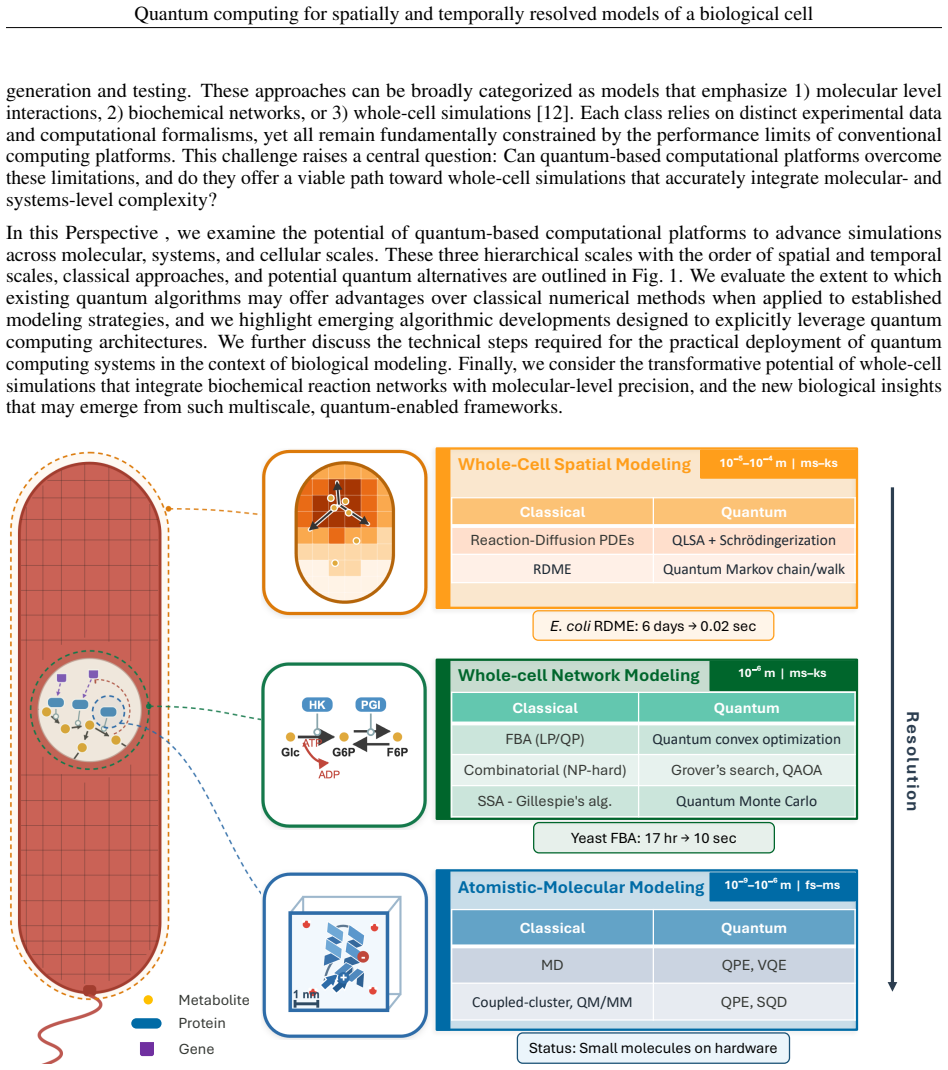
Under idealized assumptions about data access, quantum algorithms could cut the time for representative whole-cell simulation problems from days to seconds.
Reviewed by Pith at T0; open to challenge. T0 means a machine referee read the full paper against a public rubric. the ladder, T0–T4 →
T0 review · deepseek-v4-flash
2026-08-01 05:25 UTC pith:DWO5VWSH
load-bearing objection Useful roadmap with honest caveats, but the RDME speedup is built on a misidentified operator dimension and the headline numbers need revision. the 3 major comments →
Exploring the use of quantum computing for facilitating spatially and temporally resolved models of a biological cell
The pith
A machine-rendered reading of the paper's core claim, the machinery that carries it, and where it could break.
Core claim
The paper's central technical contribution is a systematic complexity comparison across the three scales. For constraint-based metabolic models, classical FBA runs in O(N^2.3)–O(N^3), while quantum convex optimization scales as O(√N·poly(s,κ,1/ε)). For stochastic simulation, classical SSA costs O(N) per trajectory and O(1/ε²) samples for convergence, while quantum linear solvers and quantum Monte Carlo/amplitude estimation offer O(log N · s²κ log(1/ε)) solves and O(1/ε) samples. For Markov-chain mixing and rare events, the gap is O(1/δ) to O(1/√δ). Plugging in representative system sizes—10^10 reactions for yeast FBA, 10^6 voxels and 4,000 species for the E. coli RDME—yields estimates such a
What carries the argument
The central objects are the algorithmic kernels and their complexity pairings: QLSA/HHL for linear systems, quantum convex optimization for LP/QP, Grover/QAOA search for combinatorial problems, quantum amplitude estimation for sampling, and quantum walks/Markov chains for mixing. The comparison is carried by asymptotic formulas—O(N^2.3)–O(N^3) vs O(√N) for FBA, O(N) vs O(log N s²κ log(1/ε)) for SSA solves, O(1/ε²) vs O(1/ε) for convergence, and O(1/δ) vs O(1/√δ) for mixing. The logarithmic scalings depend on the oracle-access assumption: that state vectors and sparse system matrices can be loaded into a quantum computer efficiently. Plugging representative sizes into these formulas produces
Load-bearing premise
The load-bearing premise is that a cell's state and the matrices describing its chemistry can be loaded into a quantum computer at a cost that does not grow with system size—that is, that efficient quantum oracles exist and data-encoding and readout overhead can be neglected.
What would settle it
Build the actual quantum circuit (block encoding plus state preparation) for a realistic genome-scale stoichiometric matrix or a cell-scale diffusion operator and count its qubits and gate depth. If that overhead grows roughly linearly with the number of reactions or voxels, or if the condition number grows with system size faster than the O(log N) solve time offsets, the claimed day-to-second wall-clock reductions do not occur at practical problem sizes.
If this is right
- If the speedups survive practical data-encoding costs, the natural deployment route is a hybrid quantum–HPC framework in which a quantum processor offloads selected kernels—ground-state energetics, FBA optimization, stochastic sampling, stiff linear solves—only above a complexity threshold.
- A credible endpoint emerges: fully atomistic, chemically accurate cellular simulation in which forces and rate parameters come from first-principles electronic structure, progressively replacing empirically fitted parameters in network and spatial models.
- Quantum-accelerated SSA and quantum-walk-based mixing would relieve the two classical bottlenecks of statistical convergence and rare-event sampling in stochastic cellular models.
- Whole-cell spatial stochastic models, currently intractable even on exascale supercomputers, could become feasible for single-cell-scale simulations if data-encoding overhead is controlled.
Where Pith is reading between the lines
- The paper's wall-clock estimates are better read as upper bounds on the claimed speedup than as predictions: data-loading and readout costs are omitted, so the true crossover problem size is likely larger than the representative cases quoted.
- A testable extension suggested by the comparison: construct a full end-to-end QLSA circuit for a stiffness-dominated biological operator and measure state-preparation depth; this would show whether the O(log N) solve time survives at practical N.
- If efficient block encodings exist for structured biological operators (stoichiometric matrices, diffusion operators), the paper's roadmap converts into an engineering checklist: which kernels to offload, when, and with how many logical qubits.
- The complexity map also implies a selection rule the paper does not state explicitly: only problems whose classical-to-quantum gap is exponential in system dimension or quadratic in error/mixing are candidates; problems with only polynomial gaps (like the non-spatial ODE case at yeast sizes) show no practical advantage.
Editorial analysis
A structured set of objections, weighed in public.
Referee Report
Summary. This Perspective surveys the potential of quantum computing for three hierarchical levels of whole-cell modeling: atomistic/molecular simulation, metabolic and regulatory network modeling, and spatial whole-cell modeling. For each level it reviews classical methods, proposes candidate quantum algorithms, and presents complexity analyses in the main text and SI that compare classical wall-clock estimates (on a workstation and on Frontier) with idealized quantum estimates. Headline numbers include a yeast FBA reduction from 17 hours to ~10 seconds and an E. coli RDME reduction from ~6 days to ~0.02 seconds. The paper also discusses hybrid quantum-HPC integration and practical challenges including data encoding, conditioning, and readout.
Significance. If the complexity analyses were correct, the paper would provide a valuable roadmap and identify concrete regimes where quantum algorithms could accelerate biological modeling. The survey is broad and up-to-date, with useful tables of algorithms and hardware demonstrations, and the authors are transparent about many idealizations (oracle access, omitted data-loading costs, s=1, κ=1). However, the two headline quantitative claims rest on internal dimension errors in the SI. The qualitative perspective and the general survey of algorithms remain useful, but the specific speedup numbers need substantial revision before they can support the paper's central claim.
major comments (3)
- [SI C.4, Eq. (S-9); Table S-2] The RDME estimate uses N = R_total × N_voxels = 2.4×10^10 and log N ≈ 11, leading to the 0.02 s headline. The RDME generator acts on probability distributions over chemical configurations, whose dimension is at least (K+1)^(M V) (with K+1 copy-number states per species per voxel). For M=4000, V=10^6, even K=1 gives log2 N ≈ 4×10^9, not 11. Thus the 'single operator application' claim does not justify O(log N) with that N. The same conflation of classical event count with QLSA dimension appears in SI B.3 (N = R × N_r) and in the SSA rows of Tables 3–4. This is an internal misapplication of QLSA complexity, not merely an omitted data-loading cost.
- [SI B.1 / Table S-1] The FBA 'system sizes' are inflated. The text lists the actual models as [95, 2712, 4058] reactions but then states totals O(10^5), O(10^9), O(10^10) 'reactions'; these values correspond to the product reactions×metabolites×genes, not to an LP variable dimension. For a flux-balance LP, N is the number of reaction fluxes (plus auxiliary variables), i.e., 2.7×10^3 for iML1515 and 4.1×10^3 for Yeast8. Using product dimensions therefore overstates the classical cost and the quantum advantage. The '17 hr→10 s' yeast FBA claim in Fig. 1 is not based on a representative biological problem as stated.
- [Section 3.2.3 / Table S-2] The headline wall-clock estimates set s=1, κ=1. The paper itself notes in §3.2.3 that 'large condition numbers (κ) expected for stiff biological PDEs will further amplify qubit and gate requirements.' Since the QLSA/quantum-walk complexities scale at least quadratically in κ, the speedup numbers in Fig. 1 and Tables S-1/S-2 are in tension with the authors' own characterization of the target systems. A sensitivity analysis (e.g., κ=10, 10^3, 10^6) is needed before these numbers can support the claimed regimes of advantage.
minor comments (3)
- [Fig. 1] The figure presents '6 days → 0.02 sec' and '17 hr→ 10 sec' without the caveats stated in Table S-2. Add a footnote indicating s=κ=1, oracle access, and no data-loading cost so the headline graphic is not misleading.
- [Section 2.3] Typo: 'Careleman linearization' should be 'Carleman linearization'.
- [Tables 3–4] The 'Advantage' column labels O(log N) as 'Exponential in N' in several rows. This phrasing is meaningful only if N is the actual matrix dimension, which is the issue raised in the first major comment; once the dimension error is fixed, these annotations need to be revisited.
Circularity Check
No circularity: quantum speedup estimates derive from external algorithm complexities and stated biological inputs; the paper explicitly disclaims data-encoding costs.
full rationale
The central claim is a complexity comparison, not a fitted prediction. For each representative problem (FBA, SSA/glycolysis, deterministic PDE, RDME), the paper takes biological inputs (reaction counts, voxel counts, propensities, cell volumes) from independent sources such as BioNumbers, iML1515, Yeast8, and StochKit2, and inserts them into quantum-algorithm complexity formulas taken from the external literature (HHL/QLSA [29,30], quantum walks [46,48,70], amplitude estimation [44], quantum convex optimization [64,65]). No parameter is fitted to a subset of data and then called a prediction; all quantum runtime numbers are explicitly labeled as idealized (oracle access, s=1, kappa=1, no data-loading costs). The paper's own limitations sections acknowledge that 'Encoding such datasets onto quantum devices can be extremely challenging, potentially limiting the attainable quantum advantage' (Sec. 3.2.1) and that concrete resource estimates remain an open direction (Sec. 3.2.3). These admissions reduce the strength of the claims but are not circularity. The authors' self-citations (e.g., Refs. [36,37,83,85,89,90,109]) are used as pointers to prior hardware demonstrations and algorithmic frameworks, not as the load-bearing justification for the three headline speedups, which rest on externally established complexity results. No uniqueness theorem or ansatz is imported from the authors' own prior work. The most significant quantitative concern is in SI C.4, where N is taken as R_total x N_voxels and then used as the dimension in 'log N ≈ 11' for QLSA; the RDME generator's state-space dimension is the number of chemical configurations, so this estimate may be internally misapplied. However, that is a correctness/validity risk, not a circular reduction of the prediction to its own inputs by construction, and therefore does not raise the circularity score.
Axiom & Free-Parameter Ledger
free parameters (6)
- Quantum hardware throughput (10.5 kop/s at 16-bit fp) =
10.5 kop/s
- Ideal sparsity and condition number =
s=1, κ=1
- E. coli glycolysis propensity =
a0 = 1e9 events/s
- Single-core SSA throughput =
1e7 events/s
- Voxel size and cell volumes =
10 nm voxels; E. coli 1 µm^3; yeast 42 µm^3
- Quantum sample count for 5% error =
20
axioms (5)
- domain assumption Efficient oracles/block encodings exist for biological system matrices at the costs quoted
- domain assumption Nonlinear biological PDEs can be linearized (Carleman/Koopman) with manageable truncation error
- domain assumption Quantum measurement can extract needed observables with O(1/ε) samples and no destructive state-preparation overhead
- standard math Classical solver complexity baselines O(N^1.5)–O(N^3) apply to whole-cell systems
- domain assumption The biological input data (kinetic parameters, initial conditions, molecular copy numbers) are sufficiently complete
read the original abstract
Whole-cell simulation, modeling all of a cell's functional systems over its life cycle, is an outstanding challenge in computational biology. Even the simplest living cell contains thousands of interacting proteins and metabolites (on the order of trillions of atoms) whose full functional dynamics spans roughly five orders of magnitude in space (nm to $\mu$m) and nearly nineteen in time (fs to hours). Further, many of the governing physical and chemical properties remain incompletely characterized. Simulating such complex systems at fully atomistic resolution over a full cell cycle is computationally intractable on classical architectures, raising a central question: Can quantum computing offer a viable path to whole-cell simulations that integrate molecular- and systems-level complexity? This Perspective examines the potential of quantum computing across three hierarchical scales: atomistic-molecular modeling, metabolic and regulatory networks, and whole-cell spatial modeling. We present a complexity analysis comparing classical and quantum algorithms for representative biological problems, identifying regimes of substantial theoretical speedup under specified algorithmic assumptions. We highlight algorithmic developments designed to leverage both near-term exploratory and fault-tolerant quantum architectures, and discuss practical bottlenecks: data encoding overhead, system conditioning, measurement constraints, and hybrid quantum-HPC integration. Together, these results outline a roadmap for quantum-accelerated whole-cell modeling and the biological insights such multiscale frameworks may eventually enable.
Figures

Reference graph
Works this paper leans on
-
[1]
Quantum computing at the frontiers of biological sciences,
P. S. Emani, J. Warrell, A. Anticevic, S. Bekiranov, M. Gandal, M. J. McConnell, G. Sapiro, A. Aspuru-Guzik, J. T. Baker, M. Bastiani, et al., “Quantum computing at the frontiers of biological sciences,” Nature Methods, vol. 18, no. 7, pp. 701–709, 2021
2021
-
[2]
Biology begins to tangle with quantum computing,
V . Marx, “Biology begins to tangle with quantum computing,”Nature Methods, vol. 18, no. 7, pp. 715–719, 2021
2021
-
[3]
Quantum computing algorithms: getting closer to critical problems in computational biology,
L. Marchetti, R. Nifosì, P. L. Martelli, E. Da Pozzo, V . Cappello, F. Banterle, M. L. Trincavelli, C. Martini, and M. D’Elia, “Quantum computing algorithms: getting closer to critical problems in computational biology,” Briefings in Bioinformatics, vol. 23, no. 6, p. bbac437, 2022
2022
-
[4]
Perspective on the current state-of-the-art of quantum computing for drug discovery applications,
N. S. Blunt, J. Camps, O. Crawford, R. Izsák, S. Leontica, A. Mirani, A. E. Moylett, S. A. Scivier, C. Sunder- hauf, P. Schopf, et al., “Perspective on the current state-of-the-art of quantum computing for drug discovery applications,” Journal of Chemical Theory and Computation, vol. 18, no. 12, pp. 7001–7023, 2022
2022
-
[5]
Biology and medicine in the landscape of quantum advantages,
B. A. Cordier, N. P. Sawaya, G. G. Guerreschi, and S. K. McWeeney, “Biology and medicine in the landscape of quantum advantages,” Journal of the Royal Society Interface, vol. 19, no. 196, p. 20220541, 2022
2022
-
[6]
Quantum computing for biomedical computational and data sciences: A joint doe-nih roundtable,
S. McWeeney, T. Perciano, C. Susut, L. Chatterjee, M. Fornari, L. Biven, and C. Siwy, “Quantum computing for biomedical computational and data sciences: A joint doe-nih roundtable,” tech. rep., USDOE Office of Science (SC), Advanced Scientific Computing Research (ASCR . . . , 2023
2023
-
[7]
Quantum computing in the next-generation computa- tional biology landscape: from protein folding to molecular dynamics,
S. Pal, M. Bhattacharya, S.-S. Lee, and C. Chakraborty, “Quantum computing in the next-generation computa- tional biology landscape: from protein folding to molecular dynamics,” Molecular biotechnology, vol. 66, no. 2, pp. 163–178, 2024
2024
-
[8]
Complexity of life sciences in quantum and ai era,
A. Pyrkov, A. Aliper, D. Bezrukov, D. Podolskiy, F. Ren, and A. Zhavoronkov, “Complexity of life sciences in quantum and ai era,” Wiley Interdisciplinary Reviews: Computational Molecular Science, vol. 14, no. 1, p. e1701, 2024
2024
-
[9]
A community approach to whole-cell modeling,
J. Singla and K. L. White, “A community approach to whole-cell modeling,” Current Opinion in Systems Biology, vol. 26, pp. 33–38, 2021
2021
-
[10]
Statistical and computational challenges for whole cell modelling,
M. P. Stumpf, “Statistical and computational challenges for whole cell modelling,”Current Opinion in Systems Biology, vol. 26, pp. 58–63, 2021. 13 Quantum computing for spatially and temporally resolved models of a biological cell
2021
-
[11]
Estimating computational limits on theoretical descriptions of biological cells,
R. R. Netz and W. A. Eaton, “Estimating computational limits on theoretical descriptions of biological cells,” Proceedings of the National Academy of Sciences, vol. 118, no. 6, p. e2022753118, 2021
2021
-
[12]
Multi-scale models of whole cells: progress and challenges,
K. Georgouli, J.-S. Yeom, R. C. Blake, and A. Navid, “Multi-scale models of whole cells: progress and challenges,” Frontiers in Cell and Developmental Biology, vol. 11, p. 1260507, 2023
2023
-
[13]
Molecular dynamics simulation of an entire cell,
J. A. Stevens, F. Grünewald, P. van Tilburg, M. König, B. R. Gilbert, T. A. Brier, Z. R. Thornburg, Z. Luthey- Schulten, and S. J. Marrink, “Molecular dynamics simulation of an entire cell,” Frontiers in Chemistry, vol. 11, p. 1106495, 2023
2023
-
[14]
The variational quantum eigensolver: a review of methods and best practices,
J. Tilly, H. Chen, S. Cao, D. Picozzi, K. Setia, Y . Li, E. Grant, L. Wossnig, I. Rungger, G. H. Booth,et al., “The variational quantum eigensolver: a review of methods and best practices,” Physics Reports, vol. 986, pp. 1–128, 2022
2022
-
[15]
Resource-efficient quantum algorithm for protein folding,
A. Robert, P. K. Barkoutsos, S. Woerner, and I. Tavernelli, “Resource-efficient quantum algorithm for protein folding,” npj Quantum Information, vol. 7, no. 1, p. 38, 2021
2021
-
[16]
Hardware-Efficient Variational Quantum Eigensolver for Small Molecules and Quantum Magnets,
A. Kandala et al., “Hardware-Efficient Variational Quantum Eigensolver for Small Molecules and Quantum Magnets,” Nature, vol. 549, no. 7671, pp. 242–246, 2017
2017
-
[17]
A quantum approximate optimization algorithm,
E. Farhi, J. Goldstone, and S. Gutmann, “A quantum approximate optimization algorithm,” arXiv preprint arXiv:1411.4028, 2014
Pith/arXiv arXiv 2014
-
[18]
Molecular quantum computations on a protein,
A. Shajan, D. Kaliakin, F. Liang, T. Pellegrini, H. Doga, S. Bhowmik, S. Das, A. Mezzacapo, M. Motta, and K. M. Merz Jr, “Molecular quantum computations on a protein,” Journal of Chemical Theory and Computation, 2026
2026
-
[19]
Optimal hamiltonian simulation by quantum signal processing,
G. H. Low and I. L. Chuang, “Optimal hamiltonian simulation by quantum signal processing,” Physical review letters, vol. 118, no. 1, p. 010501, 2017
2017
-
[20]
Hamiltonian simulation by qubitization,
G. H. Low and I. L. Chuang, “Hamiltonian simulation by qubitization,” Quantum, vol. 3, p. 163, 2019
2019
-
[21]
Boyd and L
S. Boyd and L. Vandenberghe, Convex optimization. Cambridge university press, 2004
2004
-
[22]
Numerical optimization,
J. Nocedal, “Numerical optimization,” Springer Ser. Oper. Res. Financ. Eng./Springer, 2006
2006
-
[23]
Quantum gene regulatory networks,
C. Roman-Vicharra and J. J. Cai, “Quantum gene regulatory networks,”npj Quantum Information, vol. 9, no. 1, p. 67, 2023
2023
-
[24]
What is flux balance analysis?,
J. D. Orth, I. Thiele, and B. Ø. Palsson, “What is flux balance analysis?,” Nature biotechnology, vol. 28, no. 3, pp. 245–248, 2010
2010
-
[25]
Palsson, Systems biology
B. Palsson, Systems biology. Cambridge university press, 2015
2015
-
[26]
A fast quantum mechanical algorithm for database search,
L. K. Grover, “A fast quantum mechanical algorithm for database search,” inProceedings of the twenty-eighth annual ACM symposium on Theory of computing, pp. 212–219, 1996
1996
-
[27]
Identifying protein co-regulatory network logic by solving b-sat problems through gate-based quantum computing,
A. E. Brisebois, J. Broderick, Z. Khatooni, H. L. Wilson, S. Rayan, and G. Broderick, “Identifying protein co-regulatory network logic by solving b-sat problems through gate-based quantum computing,” in 2025 IEEE International Conference on Quantum Computing and Engineering (QCE), vol. 01, pp. 2270–2278, 2025
2025
-
[28]
L. N. Trefethen and D. Bau, Numerical linear algebra. SIAM, 2022
2022
-
[29]
Quantum algorithm for linear systems of equations,
A. W. Harrow, A. Hassidim, and S. Lloyd, “Quantum algorithm for linear systems of equations,”Physical review letters, vol. 103, no. 15, p. 150502, 2009
2009
-
[30]
Quantum linear system solvers: A survey of algorithms and applications,
M. E. Morales, L. Pira, P. Schleich, K. Koor, P. Costa, D. An, A. Aspuru-Guzik, L. Lin, P. Rebentrost, and D. W. Berry, “Quantum linear system solvers: A survey of algorithms and applications,” arXiv preprint arXiv:2411.02522, 2024
Pith/arXiv arXiv 2024
-
[31]
Solving linear systems on quantum hardware with hybrid hhl++,
R. Yalovetzky, P. Minssen, D. Herman, and M. Pistoia, “Solving linear systems on quantum hardware with hybrid hhl++,” Scientific Reports, vol. 14, no. 1, p. 20610, 2024
2024
-
[32]
An Early Investigation of the HHL Quantum Linear Solver for Scientific Applications,
M. Zheng, C. Liu, S. Stein, X. Li, J. Mülmenstädt, Y . Chen, and A. Li, “An Early Investigation of the HHL Quantum Linear Solver for Scientific Applications,” arXiv preprint arXiv:2404.19067, 2024
Pith/arXiv arXiv 2024
-
[33]
Efficient quantum algorithm for dissipative nonlinear differential equations,
J.-P. Liu, H. Ø. Kolden, H. K. Krovi, N. F. Loureiro, K. Trivisa, and A. M. Childs, “Efficient quantum algorithm for dissipative nonlinear differential equations,” Proceedings of the National Academy of Sciences, vol. 118, no. 35, p. e2026805118, 2021
2021
-
[34]
Quantum algorithm for subcellular multiscale reaction-diffusion systems,
M. Lockwood, N. Wiebe, C. Johnson, J. Mülmenstädt, J. Chun, G. Schenter, M. S. Cheung, and X. Li, “Quantum algorithm for subcellular multiscale reaction-diffusion systems,” arXiv preprint arXiv:2509.20668, 2025
arXiv 2025
-
[35]
Finding flows of a navier–stokes fluid through quantum computing,
F. Gaitan, “Finding flows of a navier–stokes fluid through quantum computing,”npj Quantum Information, vol. 6, no. 1, p. 61, 2020. 14 Quantum computing for spatially and temporally resolved models of a biological cell
2020
-
[36]
Towards a quantum algorithm for the incompressible nonlinear navier-stokes equations,
M. Gopalakrishnan Meena, Y . Zhang, W. Jiang, Y . Lin, S. Günther, and X. Gao, “Towards a quantum algorithm for the incompressible nonlinear navier-stokes equations,” in 2024 IEEE International Conference on Quantum Computing and Engineering (QCE), vol. 1, pp. 662–668, IEEE, 2024
2024
-
[37]
Solving the Hele–Shaw flow using the Harrow–Hassidim–Lloyd algorithm on superconducting devices: A study of efficiency and challenges,
M. Gopalakrishnan Meena, K. C. Gottiparthi, J. G. Lietz, A. Georgiadou, and E. A. Coello Pérez, “Solving the Hele–Shaw flow using the Harrow–Hassidim–Lloyd algorithm on superconducting devices: A study of efficiency and challenges,” Physics of Fluids, vol. 36, no. 10, 2024
2024
-
[38]
Incompressible navier–stokes solve on noisy quantum hardware via a hybrid quantum–classical scheme,
Z. Song, R. Deaton, B. Gard, and S. H. Bryngelson, “Incompressible navier–stokes solve on noisy quantum hardware via a hybrid quantum–classical scheme,” Computers & Fluids, vol. 288, p. 106507, 2025
2025
-
[39]
Exact stochastic simulation of coupled chemical reactions,
D. T. Gillespie, “Exact stochastic simulation of coupled chemical reactions,” The journal of physical chemistry, vol. 81, no. 25, pp. 2340–2361, 1977
1977
-
[40]
Stochastic simulation of chemical kinetics,
D. T. Gillespie, “Stochastic simulation of chemical kinetics,” Annu. Rev. Phys. Chem., vol. 58, no. 1, pp. 35–55, 2007
2007
-
[41]
Direct solution of the chemical master equation using quantized tensor trains,
V . Kazeev, M. Khammash, M. Nip, and C. Schwab, “Direct solution of the chemical master equation using quantized tensor trains,” PLoS computational biology, vol. 10, no. 3, p. e1003359, 2014
2014
-
[42]
An in-silico human cell model reveals the influence of spatial organization on rna splicing,
Z. Ghaemi, J. R. Peterson, M. Gruebele, and Z. Luthey-Schulten, “An in-silico human cell model reveals the influence of spatial organization on rna splicing,” PLoS computational biology, vol. 16, no. 3, p. e1007717, 2020
2020
-
[43]
Quantifying the roles of space and stochasticity in computer simulations for cell biology and cellular biochemistry,
M. E. Johnson, A. Chen, J. R. Faeder, P. Henning, I. I. Moraru, M. Meier-Schellersheim, R. F. Murphy, T. Prüstel, J. A. Theriot, and A. M. Uhrmacher, “Quantifying the roles of space and stochasticity in computer simulations for cell biology and cellular biochemistry,”Molecular Biology of the Cell, vol. 32, no. 2, pp. 186–210, 2021
2021
-
[44]
Quantum-accelerated multilevel monte carlo methods for stochastic differential equations in mathematical finance,
D. An, N. Linden, J.-P. Liu, A. Montanaro, C. Shao, and J. Wang, “Quantum-accelerated multilevel monte carlo methods for stochastic differential equations in mathematical finance,” Quantum, vol. 5, p. 481, 2021
2021
-
[45]
Quantum algorithms for stochastic differential equations: A schrödingerisation approach,
S. Jin, N. Liu, and W. Wei, “Quantum algorithms for stochastic differential equations: A schrödingerisation approach,” Journal of Scientific Computing, vol. 104, no. 2, pp. 1–32, 2025
2025
-
[46]
Quantum speed-up of markov chain based algorithms,
M. Szegedy, “Quantum speed-up of markov chain based algorithms,” in 45th Annual IEEE symposium on foundations of computer science, pp. 32–41, IEEE, 2004
2004
-
[47]
Quantum walks: a comprehensive review,
S. E. Venegas-Andraca, “Quantum walks: a comprehensive review,”Quantum Information Processing, vol. 11, no. 5, pp. 1015–1106, 2012
2012
-
[48]
Quantum-enhanced markov chain monte carlo,
D. Layden, G. Mazzola, R. V . Mishmash, M. Motta, P. Wocjan, J.-S. Kim, and S. Sheldon, “Quantum-enhanced markov chain monte carlo,” Nature, vol. 619, no. 7969, pp. 282–287, 2023
2023
-
[49]
Bringing the genetically minimal cell to life on a computer in 4d,
Z. R. Thornburg, A. Maytin, J. Kwon, T. A. Brier, B. R. Gilbert, E. Fu, Y .-L. Gao, J. Quenneville, T. Wu, H. Li, T. Long, W. Pezeshkian, L. Sun, J. I. Glass, A. P. Mehta, T. Ha, and Z. Luthey-Schulten, “Bringing the genetically minimal cell to life on a computer in 4d,” Cell, vol. 189, pp. 1–16, 2026
2026
-
[50]
Qm/mm methods for biomolecular systems,
H. M. Senn and W. Thiel, “Qm/mm methods for biomolecular systems,” Angewandte Chemie International Edition, vol. 48, no. 7, pp. 1198–1229, 2009
2009
-
[51]
The protein data bank,
H. M. Berman, T. Battistuz, T. N. Bhat, W. F. Bluhm, P. E. Bourne, K. Burkhardt, Z. Feng, G. L. Gilliland, L. Iype, S. Jain, et al., “The protein data bank,” Biological Crystallography, vol. 58, no. 6, pp. 899–907, 2002
2002
-
[52]
Announcing the worldwide protein data bank,
H. Berman, K. Henrick, and H. Nakamura, “Announcing the worldwide protein data bank,”Nature structural & molecular biology, vol. 10, no. 12, pp. 980–980, 2003
2003
-
[53]
Highly accurate protein structure prediction with alphafold,
J. Jumper, R. Evans, A. Pritzel, T. Green, M. Figurnov, O. Ronneberger, K. Tunyasuvunakool, R. Bates, A. Žídek, A. Potapenko, et al., “Highly accurate protein structure prediction with alphafold,” nature, vol. 596, no. 7873, pp. 583–589, 2021
2021
-
[54]
Accurate structure prediction of biomolecular interactions with alphafold 3,
J. Abramson, J. Adler, J. Dunger, R. Evans, T. Green, A. Pritzel, O. Ronneberger, L. Willmore, A. J. Ballard, J. Bambrick, et al., “Accurate structure prediction of biomolecular interactions with alphafold 3,”Nature, vol. 630, no. 8016, pp. 493–500, 2024
2024
-
[55]
Elucidating reaction mechanisms on quantum computers,
M. Reiher, N. Wiebe, K. M. Svore, D. Wecker, and M. Troyer, “Elucidating reaction mechanisms on quantum computers,” Proceedings of the national academy of sciences, vol. 114, no. 29, pp. 7555–7560, 2017
2017
-
[56]
Macromolecular crowding: obvious but underappreciated,
R. J. Ellis, “Macromolecular crowding: obvious but underappreciated,” Trends in biochemical sciences, vol. 26, no. 10, pp. 597–604, 2001
2001
-
[57]
Quantum measurements and the abelian stabilizer problem,
A. Y . Kitaev, “Quantum measurements and the abelian stabilizer problem,”arXiv preprint quant-ph/9511026, 1995. 15 Quantum computing for spatially and temporally resolved models of a biological cell
Pith/arXiv arXiv 1995
-
[58]
K. M. Merz Jr, A. Shajan, D. Kaliakin, F. Liang, Y . Otsuka, T. Shirakawa, L. Broers, H. Xu, M. Tsuji, M. Sato, et al., “Crossing the 12,000-atom barrier with heterogeneous quantum-classical supercomputing: quantum chemistry of protein-ligand complexes,” arXiv preprint arXiv:2605.01138, 2026
Pith/arXiv arXiv 2026
-
[59]
A perspective on quantum computing applications in quantum chemistry using 25–100 logical qubits,
Y . Alexeev, V . S. Batista, N. Bauman, L. Bertels, D. Claudino, R. Dutta, L. Gagliardi, S. Godwin, N. Govind, M. Head-Gordon, et al., “A perspective on quantum computing applications in quantum chemistry using 25–100 logical qubits,” Journal of Chemical Theory and Computation, vol. 21, no. 22, pp. 11335–11357, 2025
2025
-
[60]
A general method for numerically simulating the stochastic time evolution of coupled chemical reactions,
D. T. Gillespie, “A general method for numerically simulating the stochastic time evolution of coupled chemical reactions,” Journal of computational physics, vol. 22, no. 4, pp. 403–434, 1976
1976
-
[61]
Biochemical network stochastic simulator (bionets): software for stochastic modeling of biochemical networks,
D. Adalsteinsson, D. McMillen, and T. C. Elston, “Biochemical network stochastic simulator (bionets): software for stochastic modeling of biochemical networks,” BMC bioinformatics, vol. 5, no. 1, p. 24, 2004
2004
-
[62]
A stochastic model for the evolution of metabolic networks with neighbor dependence,
A. Mithani, G. M. Preston, and J. Hein, “A stochastic model for the evolution of metabolic networks with neighbor dependence,” Bioinformatics, vol. 25, no. 12, pp. 1528–1535, 2009
2009
-
[63]
Stochastic simulation of cellular metabolism,
E. J. Clement, T. T. Schulze, G. A. Soliman, B. J. Wysocki, P. H. Davis, and T. A. Wysocki, “Stochastic simulation of cellular metabolism,” IEEE Access, vol. 8, pp. 79734–79744, 2020
2020
-
[64]
Convex optimization using quantum oracles,
J. van Apeldoorn, A. Gilyén, S. Gribling, and R. de Wolf, “Convex optimization using quantum oracles,” Quantum, vol. 4, p. 220, 2020
2020
-
[65]
Fast quantum subroutines for the simplex method,
G. Nannicini, “Fast quantum subroutines for the simplex method,” Operations Research, vol. 72, no. 2, pp. 763– 780, 2024
2024
-
[66]
Quantum speed-ups for solving semidefinite programs,
F. G. Brandao and K. M. Svore, “Quantum speed-ups for solving semidefinite programs,” in 2017 IEEE 58th Annual Symposium on Foundations of Computer Science (FOCS), pp. 415–426, IEEE, 2017
2017
-
[67]
Simulation of chemical reactions on a quantum computer,
S. S. Kale and S. Kais, “Simulation of chemical reactions on a quantum computer,” The Journal of Physical Chemistry Letters, vol. 15, no. 21, pp. 5633–5642, 2024
2024
-
[68]
mrna secondary structure prediction using utility-scale quantum computers,
D. Alevras, M. Metkar, T. Yamamoto, V . Kumar, T. Friedhoff, J.-E. Park, M. Takeori, M. LaDue, W. Davis, and A. Galda, “mrna secondary structure prediction using utility-scale quantum computers,” in 2024 IEEE International Conference on Quantum Computing and Engineering (QCE), vol. 1, pp. 488–499, IEEE, 2024
2024
-
[69]
A review on quantum approximate optimization algorithm and its variants,
K. Blekos, D. Brand, A. Ceschini, C.-H. Chou, R.-H. Li, K. Pandya, and A. Summer, “A review on quantum approximate optimization algorithm and its variants,” Physics Reports, vol. 1068, pp. 1–66, 2024
2024
-
[70]
Quantum walk based search algorithms,
M. Santha, “Quantum walk based search algorithms,” in International Conference on Theory and Applications of Models of Computation, pp. 31–46, Springer, 2008
2008
-
[71]
Modeling stochastic chemical kinetics on quantum computers,
T. Kabengele, Y . M. Lokare, J. Marston, and B. M. Rubenstein, “Modeling stochastic chemical kinetics on quantum computers,” arXiv preprint arXiv:2404.08770, 2024
Pith/arXiv arXiv 2024
-
[72]
On the asymptotic complexity of matrix multiplication,
D. Coppersmith and S. Winograd, “On the asymptotic complexity of matrix multiplication,”SIAM Journal on Computing, vol. 11, no. 3, pp. 472–492, 1982
1982
-
[73]
High-performance whole-cell simulation exploiting modular cell biology principles,
B. Das and P. Mitra, “High-performance whole-cell simulation exploiting modular cell biology principles,” Journal of Chemical Information and Modeling, vol. 61, no. 3, pp. 1481–1492, 2021
2021
-
[74]
Fundamental behaviors emerge from simulations of a living minimal cell,
Z. R. Thornburg, D. M. Bianchi, T. A. Brier, B. R. Gilbert, E. E. Earnest, M. C. Melo, N. Safronova, J. P. Sáenz, A. T. Cook, K. S. Wise, et al., “Fundamental behaviors emerge from simulations of a living minimal cell,”Cell, vol. 185, no. 2, pp. 345–360, 2022
2022
-
[75]
Quantum algorithms for multiscale partial differential equations,
J. Hu, S. Jin, and L. Zhang, “Quantum algorithms for multiscale partial differential equations,” Multiscale Modeling & Simulation, vol. 22, no. 3, pp. 1030–1067, 2024
2024
-
[76]
A quantum algorithm to solve nonlinear differential equations,
S. K. Leyton and T. J. Osborne, “A quantum algorithm to solve nonlinear differential equations,”arXiv preprint arXiv:0812.4423, 2008
Pith/arXiv arXiv 2008
-
[77]
Quantum algorithm for nonlinear differential equations,
S. Lloyd, G. De Palma, C. Gokler, B. Kiani, Z.-W. Liu, M. Marvian, F. Tennie, and T. Palmer, “Quantum algorithm for nonlinear differential equations,” arXiv preprint arXiv:2011.06571, 2020
Pith/arXiv arXiv 2011
-
[78]
Koopman–von neumann approach to quantum simulation of nonlinear classical dynamics,
I. Joseph, “Koopman–von neumann approach to quantum simulation of nonlinear classical dynamics,” Physical Review Research, vol. 2, no. 4, p. 043102, 2020
2020
-
[79]
Quantum algorithms for nonlinear partial differential equations,
S. Jin and N. Liu, “Quantum algorithms for nonlinear partial differential equations,” Bulletin des Sciences Mathématiques, vol. 194, p. 103457, 2024
2024
-
[80]
Quantum simulation of a noisy classical nonlinear dynamics,
S. Bravyi, R. Manson-Sawko, M. Zayats, and S. Zhuk, “Quantum simulation of a noisy classical nonlinear dynamics,” arXiv preprint arXiv:2507.06198, 2025. 16 Quantum computing for spatially and temporally resolved models of a biological cell
arXiv 2025
discussion (0)
Sign in with ORCID, Apple, or X to comment. Anyone can read and Pith papers without signing in.