REVIEW 4 major objections 6 minor 3 cited by
All Seeds Are Not Equal: Enhancing Compositional Text-to-Image Generation with Reliable Random Seeds
T0 review · 4 major / 6 minor · reviewed 2026-08-12 · deepseek-v4-flash
Pith's one-line read This paper argues that a large share of compositional failures in text-to-image diffusion models is caused by the initial random seed, since different seeds bias objects into different image layouts and some layouts are consistently more…
desk verdict A practical and well-evaluated paper showing that some random seeds reliably improve compositional T2I generation, with the honest caveat that the headline seed-sampling gains are likely inflated by best-of-100 selection. read the letter →
The pith
A machine-rendered reading of the paper's core claim, the machinery that carries it, and where it could break.
The reading
What carries the argument
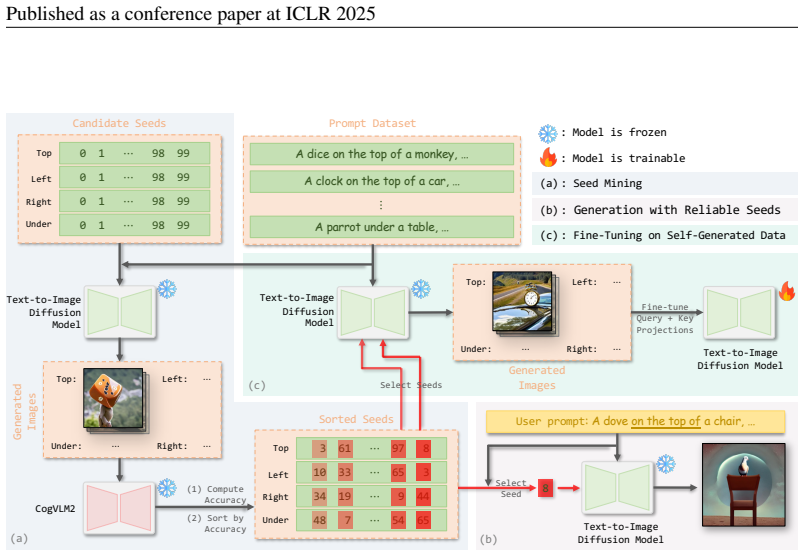
The load-bearing mechanism is the seed-conditioned layout prior carried in cross-attention maps: what a random seed dictates is not the object content but where the model's object tokens attend, producing distinct average image arrangements per seed. Because some arrangements (separated, evenly spread, vertically stacked) are far more likely to render counts and spatial relations correctly than clustered ones, compositional accuracy becomes a measurable property of the seed. The paper operationalizes this with (1) Comp90, a 90-category prompt set split into disjoint train/test categories and backgrounds, (2) a mining protocol that scores 100 candidate seeds with CogVLM2 on a small prompt subset and sorts them per quantity/relation, and (3) a parameter-restricted fine-tuning recipe that updates only query/key projections in attention, leaving the rest of the model frozen. The same machinery supplies both the training-free sampling gain and the self-generated training data.
What would settle it
Re-run the seed-mining protocol exactly as described, then evaluate the top-3 seeds against the full Comp90 test set (30 unseen categories, 4 unseen backgrounds) using human raters instead of GPT-4o; if the top seeds' accuracy is within noise of a random seed baseline — or if swapping the mining subset to a disjoint set of categories changes which seeds are top-ranked — the transferability claim is falsified. A second decisive check is to measure whether the same seeds remain reliable when the object categories are paraphrased in the prompt (e.g., 'a pair of dogs' vs 'two dogs'), since the paper's explanation predicts layout, not lexical, control.
Extended reading notes
Core claim
The central discovery is that compositional correctness in text-to-image diffusion models is strongly conditioned on the initial seed, because each seed biases the cross-attention maps toward a particular object arrangement. Averaged binarized attention maps show that correct images share consistent layouts (separated regions, grids, vertical stacking for 'on top of') while incorrect images cluster objects in small areas, and this association is visible in both Stable Diffusion 2.1 and PixArt-α. Consequently, with a small batch of candidate seeds scored by CogVLM2 on a subset of the paper's Comp90 prompts, a stable reliability ranking emerges: the top seeds outperform the bottom seeds by large margins on held-out categories (38.3% vs 17.5%), and using the top seeds either at sampling time or as a source of self-generated fine-tuning data transfers the gain to unseen test prompts. The fine-tuning step achieves seed-independent improvement by updating only the query and key projections of attention layers, so that random seeds inherit the reliable-layout behavior.
Load-bearing premise
The whole pipeline assumes that the reliability ranking of seeds, measured by CogVLM2 on a small subset of Comp90 (15 categories and 4 backgrounds for numerical, 20 scenes and 4 settings for spatial), is stable enough to transfer to unseen test categories, unseen backgrounds, quantities beyond 6, and to GPT-4o/human evaluation; the paper itself acknowledges that CogVLM2 can miscount underrepresented objects and large numbers, so a ranking error on the mining subset would propagate into both the sampling gains and the fine-tuning data.
Editorial extensions
If this is right
- Using the top-3 reliable seeds at sampling time gives a 3–6 point absolute accuracy improvement over random seeds on numerical and spatial composition with no retraining and no added inference cost, and the effect persists up to top-50 seeds.
- Fine-tuning only attention Q/K projections on self-generated images produced with reliable seeds yields relative gains of 29.3% (numerical, Stable Diffusion), 19.5% (numerical, PixArt-α), 60.7% (spatial, Stable Diffusion), and 21.1% (spatial, PixArt-α) while keeping aesthetic score and recall losses small.
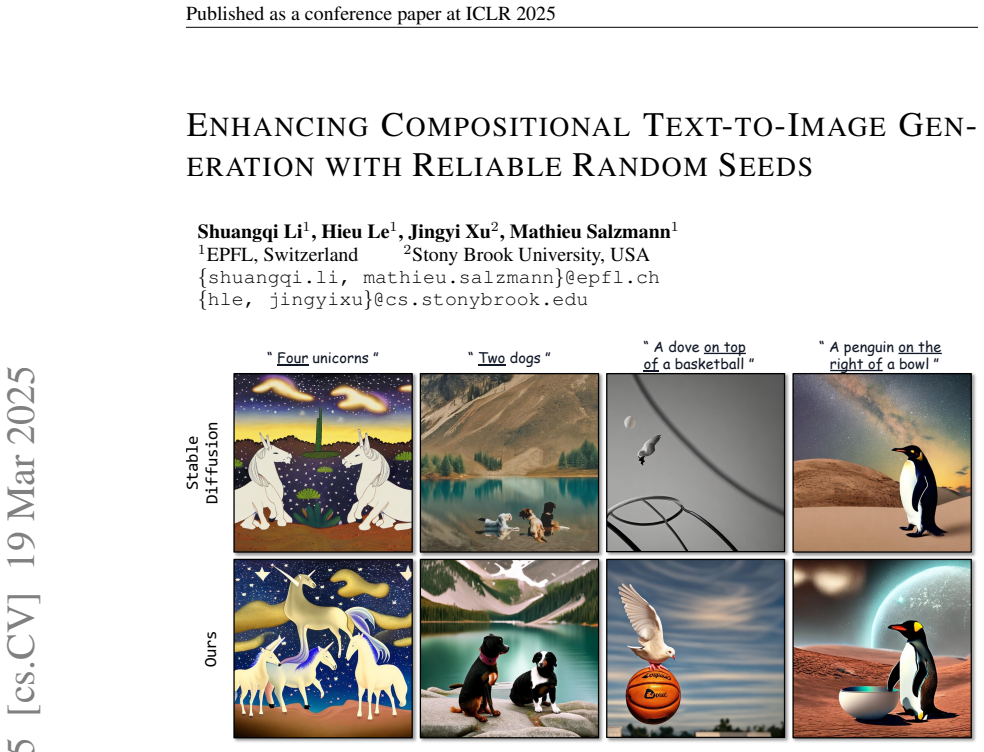
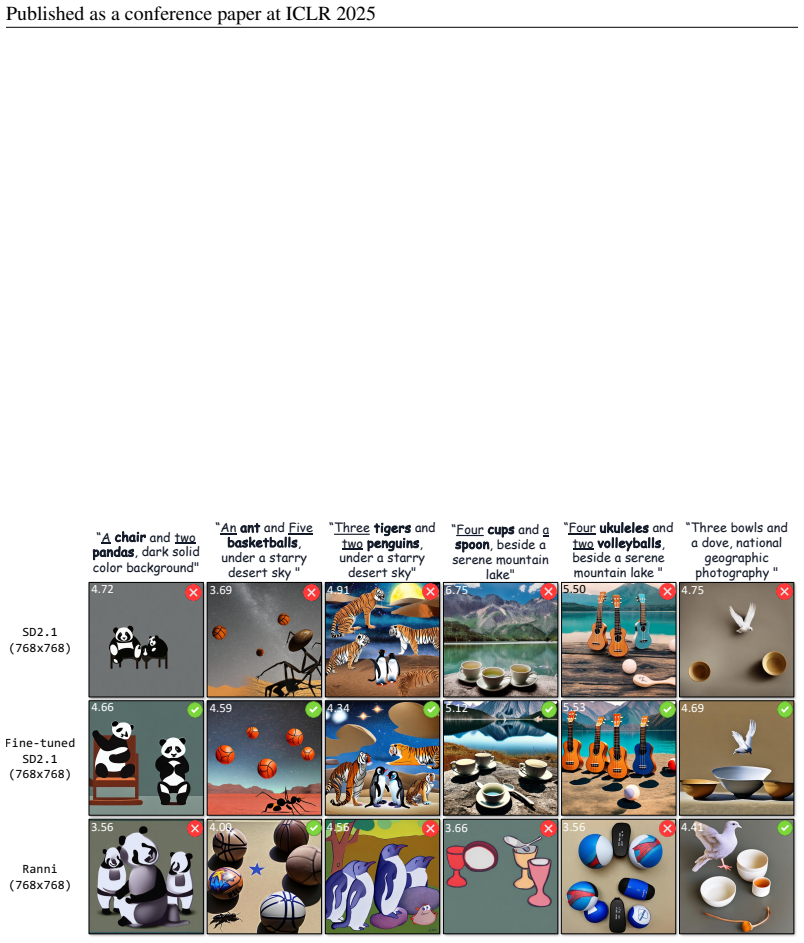
- The gains transfer to multiple-category prompts such as 'three tigers and two penguins' and to out-of-scope quantities like seven or eight objects, without re-mining seeds for those cases.
- Rectifying the self-generated captions with CogVLM2 (re-captioning) stacks with reliable-seed fine-tuning, and sampling a fine-tuned model with reliable seeds yields the best numbers reported (56.2% numerical accuracy on Stable Diffusion).
- The authors position reliable-seed mining as a general, model-agnostic inference-time scaling technique that needs no manual annotation and no layout inputs, unlike LLM-based layout methods that sacrifice diversity and aesthetic quality.
Reading between the lines
- Editorial inference: if seed-layout association is baked into diffusion training, the same mining protocol should transfer to other denoising-based generators — e.g., layout-free video or 3D generation — where structured composition also fails, making seed reliability a general property of generative samplers rather than a text-to-image curiosity.
- Editorial inference: a direct test of the paper's mechanism would be to measure whether reliability ranking is monotone under prompt paraphrase and under small weight perturbations; monotonicity would support a geometric interpretation ('good seeds sit in a favorable basin of the sampling trajectory'), whereas fragility would suggest the ranking is partly an artifact of the Comp90 prompt distribut
- Editorial inference: the large spatial gains suggest reliable-seed sampling may be a cheaper substitute for explicit layout conditioning in production pipelines; a natural comparison is whether combining top seeds with an LLM-generated bounding-box layout produces additive gains or saturates, which the paper does not test.
- Editorial inference: because only Q/K projections are updated, the fine-tuned model likely encodes a 'reliable layout prior' that could be distilled into a seed-independent adapter, letting users keep full seed diversity while inheriting reliable arrangements.
Signed reviews
Editorial analysis
A structured set of objections, weighed in public.
Referee Report
Summary. The paper studies the effect of the initial noise seed on compositional text-to-image generation. Using Stable Diffusion 2.1 and PixArt-α, the authors show that different seeds produce characteristic object layouts, that these layouts correlate with compositional correctness, and that per-seed accuracy varies substantially. They construct a new benchmark, Comp90, with disjoint train/test categories and backgrounds, mine 100 candidate seeds with CogVLM2 on a small subset, and then either sample with the top-3 seeds or fine-tune only the Q/K attention projections on images generated with those seeds, with optional CogVLM2-based recaptioning. On held-out test prompts, sampling with reliable seeds improves numerical and spatial accuracy by roughly 3 to 6 points, and fine-tuning on reliable, rectified self-generated data yields larger gains (e.g., 37.5 to 51.3 numerical and 17.8 to 36.6 spatial for Stable Diffusion 2.1). The authors include ablations over top-k, comparisons with random-seed and rectified baselines, a human evaluation of GPT-4o scoring, and diversity/image-quality metrics.
Significance. The paper identifies a genuinely useful and simple phenomenon: seed choice is not neutral for compositional correctness, and a small curated set of reliable seeds can improve both inference-time sampling and fine-tuning. The main empirical claims are supported by held-out category evaluation, human validation of the GPT-4o metrics, top-k ablations, and comparisons against random-seed fine-tuning and recaptioning baselines. The release of code and the Comp90 benchmark are valuable assets. The main weaknesses are statistical: the top-3 seed selection is made from 100 candidates without a multiple-comparison control, the transfer of the seed ranking across categories is not directly quantified, and the main tables lack error bars. These issues are fixable with additional analyses and do not, in my reading, invalidate the central phenomenon.
major comments (4)
- [Sec. 4.2, Fig. 6, Tables 1-2] The top-3 seeds are selected from 100 candidate seeds using per-seed accuracies estimated on only 60 images per quantity (numerical) and 80 images per relation (spatial). For a binomial proportion with p≈0.3 and n=60, the standard error is about 5.9 percentage points, so the maximum of 100 independent estimates is expected to exceed the mean by roughly 10-12 points even under the null of equal seed reliability. The chi-squared test in Sec. 3.3 covers five hand-picked seeds and does not control this multiple-comparison. Although evaluating the selected seeds on the held-out test set reduces the risk of selection inflation, the magnitude of the sampling gains in Tables 1-2 and the spread in Fig. 6 remain unquantified. The top-50 result in Table 10 (40.8 vs 37.5) suggests a genuine but weaker effect, so the specific top-3 ranking is load-bearing. Please add a permutation or bootstrap test under seed exchangeability (e.g., the null distribution of the best-of-100 accuracy on the mining subset) and report confidence intervals for the sampling gains.
- [Sec. 4.2 / Sec. 5.1, Tables 1-2, Table 10] The central generalization claim is that seed reliability transfers from the 15 mining categories and 4 settings to unseen categories, backgrounds, and tasks. The only quantitative evidence is the aggregate test-set improvement of the top-3 seeds. The paper does not report the correlation of per-seed accuracies between disjoint category splits, nor any split-half reliability of the mined ranking. Given that the top-50 gain (40.8 vs 37.5) is much smaller than the top-3 gain (43.0 vs 37.5), the observed top-3 improvement could be dominated by a small number of unstable seeds. Please provide a per-seed correlation between two disjoint category splits or a split-half analysis of the mining ranking, and report per-seed test accuracies on held-out categories.
- [Tables 1, 2, 4, and Appendix A.4] All main quantitative comparisons are reported as point estimates without standard deviations, confidence intervals, or the number of evaluation seeds. Several differences that are used to support design choices are small, for example PixArt-α spatial accuracy: fine-tuning (reliable) 27.5 vs fine-tuning (reliable + rectified) 27.2 vs fine-tuning (random + rectified) 26.6 in Table 2. Please report means and standard deviations over at least three evaluation runs or seeds, or otherwise justify that the reported differences exceed evaluation noise.
- [Sec. 3.3] The five candidate seeds used for the chi-squared test are not described as randomly selected or pre-registered; if they were chosen after inspecting their accuracies, the reported p=1.2e-4 is not a valid test of the null. Please state how these five seeds were selected, and consider reporting a significance test on the full 100-seed ranking instead of only on a hand-picked subset.
minor comments (6)
- [Abstract and Introduction] The claim of a '6% accuracy improvement' is imprecise; Tables 1-2 show gains ranging from about 2.9 to 6.0 points. Please report the exact numbers.
- [Figure 2] The visual claim that seeds produce distinct object arrangements would be strengthened by a quantitative measure, such as the centroid or entropy of the binarized attention maps, rather than relying only on visual inspection.
- [Sec. 4.3] The description of the data curation step is ambiguous: 'For each generated image, we use CogVLM2 to check its correctness' does not state whether incorrect images are removed, kept, or recaptioned. Please clarify the exact curation pipeline and report the fraction of generated images that were rectified or discarded, since this affects interpretation of the 'reliable' vs 'reliable + rectified' variants.
- [Figure 7] The labels 'Fine-tuned' and 'Fine-tuned (Ours)' are easy to confuse; consider renaming them to 'Fine-tuned (random seeds)' and 'Fine-tuned (reliable seeds + rectified)'.
- [Appendix A.3.1] The 'Potential Biases' paragraph is a useful limitation statement but appears only in the appendix; consider moving a condensed version to the main text, since the CogVLM2-in-the-loop design is central to the method.
- [Table 11 caption] The caption says 'Our method significantly improves the accuracy' but no significance test is reported; please qualify the language or add the corresponding statistical test.
Circularity Check
No circularity: the seed-reliability claim is selected on a training subset and validated on held-out categories with independent GPT-4o and human evaluation.
full rationale
The paper's central derivation—mining reliable seeds with CogVLM2 on a small portion of the Comp90 training set (Sec. 4.2) and then measuring compositional accuracy on held-out test prompts (Sec. 5.1, Tables 1–2)—does not reduce to its inputs by construction. The seed ranking is estimated only on 15 training categories and 4 training backgrounds, while the reported gains are evaluated with GPT-4o on disjoint test categories and backgrounds, with a human-evaluation cross-check in Table 3. The fine-tuning data in Sec. 4.3 is generated from the selected seeds and checked/rectified by CogVLM2, but the fine-tuned models are measured against original test prompts using an independent evaluator; a training-time dependence on CogVLM2 does not make the test accuracy tautological. The random+rectified baseline also uses CogVLM2 rectification, so the comparison isolates the effect of reliable seeds rather than the effect of using CogVLM2 at all. The self-citations (Xu et al. 2023; Xu et al. 2024) appear only as background support for noise-sensitivity and layout terminology, and they are not load-bearing for the paper's main claim. The best-of-100 seed-selection concern is a statistical robustness issue, not circularity, because the selected top seeds are then evaluated on held-out data with an independent metric. Therefore, no step in the derivation chain is equivalent to its own input by definition.
Assumptions & free parameters
free parameters (4)
- Candidate seed pool size =
100
- Mining images per seed =
60 (numerical), 80 per relation (spatial)
- Top-k reliable seeds =
3
- Count truncation for MAE =
19
assumptions (4)
- domain assumption Initial noise/seed determines a reproducible layout behavior for a given model
- domain assumption Average cross-attention maps proxy object placement
- domain assumption VLM judgments are reliable ground truth
- domain assumption Seed reliability transfers from mining subset to held-out categories and settings
Cite this review
Pith. "Pith review of All Seeds Are Not Equal: Enhancing Compositional Text-to-Image Generation with Reliable Random Seeds." pith.science (2026). https://pith.science/paper/DWXORTAR
@misc{pith2026241118810,
  author       = {Pith},
  title        = {Pith review of: All Seeds Are Not Equal: Enhancing Compositional Text-to-Image Generation with Reliable Random Seeds},
  year         = {2026},
  howpublished = {\url{https://pith.science/paper/DWXORTAR}},
  note         = {Machine review of arXiv:2411.18810}
}
read the original abstract
Text-to-image diffusion models have demonstrated remarkable capability in generating realistic images from arbitrary text prompts. However, they often produce inconsistent results for compositional prompts such as "two dogs" or "a penguin on the right of a bowl". Understanding these inconsistencies is crucial for reliable image generation. In this paper, we highlight the significant role of initial noise in these inconsistencies, where certain noise patterns are more reliable for compositional prompts than others. Our analyses reveal that different initial random seeds tend to guide the model to place objects in distinct image areas, potentially adhering to specific patterns of camera angles and image composition associated with the seed. To improve the model's compositional ability, we propose a method for mining these reliable cases, resulting in a curated training set of generated images without requiring any manual annotation. By fine-tuning text-to-image models on these generated images, we significantly enhance their compositional capabilities. For numerical composition, we observe relative increases of 29.3% and 19.5% for Stable Diffusion and PixArt-{\alpha}, respectively. Spatial composition sees even larger gains, with 60.7% for Stable Diffusion and 21.1% for PixArt-{\alpha}.
Figures


Figures from the paper (8 more)



Forward citations
Cited by 3 Pith papers
-
ISAC: Training-Free Instance-to-Semantic Attention Control for Multi-Instance Generation
ISAC improves multi-instance image generation by carving out instance regions from self-attention first and then assigning semantics to those regions.
-
GenTune: Toward Traceable Prompts to Improve Controllability of Image Refinement in Environment Design
GenTune improves AI image refinement by tracing image regions back to prompt labels and allowing element-level, semantic-guided edits.
-
PosterCraft: Rethinking High-Quality Aesthetic Poster Generation in a Unified Framework
PosterCraft improves text-to-poster generation by cascading four stages of training (text rendering, region-weighted fine-tuning, preference optimization, and vision-language feedback), outperforming open-source basel...
Reference graph
Works this paper leans on
-
[1]
https://github.com/discus0434/aesthetic-predictor-v2-5/, May 2024
Aesthetic predictor v2.5. https://github.com/discus0434/aesthetic-predictor-v2-5/, May 2024
work page 2024
-
[2]
Josh Achiam, Steven Adler, Sandhini Agarwal, Lama Ahmad, Ilge Akkaya, Florencia Leoni Aleman, Diogo Almeida, Janko Altenschmidt, Sam Altman, Shyamal Anadkat, et al. Gpt-4 technical report. arXiv preprint arXiv:2303.08774, 2023
arXiv 2023
-
[3]
Multidiffusion: Fusing diffusion paths for controlled image generation
Omer Bar-Tal, Lior Yariv, Yaron Lipman, and Tali Dekel. Multidiffusion: Fusing diffusion paths for controlled image generation. Proceedings of Machine Learning Research, 202: 0 1737--1752, 2023
work page 2023
-
[4]
Attend-and-excite: Attention-based semantic guidance for text-to-image diffusion models, 2023
Hila Chefer, Yuval Alaluf, Yael Vinker, Lior Wolf, and Daniel Cohen-Or. Attend-and-excite: Attention-based semantic guidance for text-to-image diffusion models, 2023
2023
-
[5]
Pixart- : Fast training of diffusion transformer for photorealistic text-to-image synthesis, 2023 a
Junsong Chen, Jincheng Yu, Chongjian Ge, Lewei Yao, Enze Xie, Yue Wu, Zhongdao Wang, James Kwok, Ping Luo, Huchuan Lu, and Zhenguo Li. Pixart- : Fast training of diffusion transformer for photorealistic text-to-image synthesis, 2023 a
work page 2023
-
[6]
Training-free layout control with cross-attention guidance
Minghao Chen, Iro Laina, and Andrea Vedaldi. Training-free layout control with cross-attention guidance. arXiv preprint arXiv:2304.03373, 2023 b
arXiv 2023
-
[7]
Training-free layout control with cross-attention guidance
Minghao Chen, Iro Laina, and Andrea Vedaldi. Training-free layout control with cross-attention guidance. In Proceedings of the IEEE/CVF Winter Conference on Applications of Computer Vision, pp.\ 5343--5353, 2024
work page 2024
-
[8]
Xiaohui Chen, Yongfei Liu, Yingxiang Yang, Jianbo Yuan, Quanzeng You, Li-Ping Liu, and Hongxia Yang. Reason out your layout: Evoking the layout master from large language models for text-to-image synthesis. arXiv preprint arXiv:2311.17126, 2023 c
arXiv 2023
Show all 49 references
-
[9]
Laion-aesthetics
Christoph Schuhmann . Laion-aesthetics. https://laion.ai/blog/laion-aesthetics/, Aug 2022
2022
-
[10]
Zero-shot spatial layout conditioning for text-to-image diffusion models
Guillaume Couairon, Marlene Careil, Matthieu Cord, St \'e phane Lathuiliere, and Jakob Verbeek. Zero-shot spatial layout conditioning for text-to-image diffusion models. In Proceedings of the IEEE/CVF International Conference on Computer Vision, pp.\ 2174--2183, 2023
2023
-
[11]
Be yourself: Bounded attention for multi-subject text-to-image generation
Omer Dahary, Or Patashnik, Kfir Aberman, and Daniel Cohen-Or. Be yourself: Bounded attention for multi-subject text-to-image generation. arXiv preprint arXiv:2403.16990, 2024
2024 arXiv
-
[12]
Emu: Enhancing image generation models using photogenic needles in a haystack
Xiaoliang Dai, Ji Hou, Chih-Yao Ma, Sam Tsai, Jialiang Wang, Rui Wang, Peizhao Zhang, Simon Vandenhende, Xiaofang Wang, Abhimanyu Dubey, et al. Emu: Enhancing image generation models using photogenic needles in a haystack. arXiv preprint arXiv:2309.15807, 2023
2023 arXiv
-
[13]
E xploiting the S ignal- L eak B ias in D iffusion M odels
Martin Nicolas Everaert, Athanasios Fitsios, Marco Bocchio, Sami Arpa, Sabine Süsstrunk, and Radhakrishna Achanta. E xploiting the S ignal- L eak B ias in D iffusion M odels. In Proceedings of the IEEE/CVF Winter Conference on Applications of Computer Vision (WACV), pp.\ 4025-...
2024
-
[14]
Layoutgpt: Compositional visual planning and generation with large language models
Weixi Feng, Wanrong Zhu, Tsu-jui Fu, Varun Jampani, Arjun Akula, Xuehai He, Sugato Basu, Xin Eric Wang, and William Yang Wang. Layoutgpt: Compositional visual planning and generation with large language models. Advances in Neural Information Processing Systems, 36, 2024 a
2024
-
[15]
Ranni: Taming text-to-image diffusion for accurate instruction following
Yutong Feng, Biao Gong, Di Chen, Yujun Shen, Yu Liu, and Jingren Zhou. Ranni: Taming text-to-image diffusion for accurate instruction following. In Proceedings of the IEEE/CVF Conference on Computer Vision and Pattern Recognition, pp.\ 4744--4753, 2024 b
2024
-
[16]
Initno: Boosting text-to-image diffusion models via initial noise optimization
Xiefan Guo, Jinlin Liu, Miaomiao Cui, Jiankai Li, Hongyu Yang, and Di Huang. Initno: Boosting text-to-image diffusion models via initial noise optimization. 2024 IEEE/CVF Conference on Computer Vision and Pattern Recognition (CVPR), pp.\ 9380--9389, 2024 a . URL https://api.se...
2024
-
[17]
Initno: Boosting text-to-image diffusion models via initial noise optimization
Xiefan Guo, Jinlin Liu, Miaomiao Cui, Jiankai Li, Hongyu Yang, and Di Huang. Initno: Boosting text-to-image diffusion models via initial noise optimization. In CVPR, 2024 b
2024
-
[18]
Diffusion with offset noise, Jan 2023
Nicholas Guttenberg. Diffusion with offset noise, Jan 2023
2023
-
[20]
Cogvlm2: Visual language models for image and video understanding
Wenyi Hong, Weihan Wang, Ming Ding, Wenmeng Yu, Qingsong Lv, Yan Wang, Yean Cheng, Shiyu Huang, Junhui Ji, Zhao Xue, et al. Cogvlm2: Visual language models for image and video understanding. arXiv preprint arXiv:2408.16500, 2024
2024 arXiv
-
[21]
T2i-compbench: A comprehensive benchmark for open-world compositional text-to-image generation
Kaiyi Huang, Kaiyue Sun, Enze Xie, Zhenguo Li, and Xihui Liu. T2i-compbench: A comprehensive benchmark for open-world compositional text-to-image generation. Advances in Neural Information Processing Systems, 36: 0 78723--78747, 2023
2023
-
[22]
Ssmg: Spatial-semantic map guided diffusion model for free-form layout-to-image generation
Chengyou Jia, Minnan Luo, Zhuohang Dang, Guang Dai, Xiaojun Chang, Mengmeng Wang, and Jingdong Wang. Ssmg: Spatial-semantic map guided diffusion model for free-form layout-to-image generation. In Proceedings of the AAAI Conference on Artificial Intelligence, volume 38, pp.\ 24...
2024
-
[23]
Improved precision and recall metric for assessing generative models
Tuomas Kynk \"a \"a nniemi, Tero Karras, Samuli Laine, Jaakko Lehtinen, and Timo Aila. Improved precision and recall metric for assessing generative models. Advances in Neural Information Processing Systems, 32, 2019
2019
-
[24]
Llm-grounded diffusion: Enhancing prompt understanding of text-to-image diffusion models with large language models
Long Lian, Boyi Li, Adam Yala, and Trevor Darrell. Llm-grounded diffusion: Enhancing prompt understanding of text-to-image diffusion models with large language models. arXiv preprint arXiv:2305.13655, 2023
2023 arXiv
-
[25]
Cpgan: Content-parsing generative adversarial networks for text-to-image synthesis
Jiadong Liang, Wenjie Pei, and Feng Lu. Cpgan: Content-parsing generative adversarial networks for text-to-image synthesis. In Computer Vision--ECCV 2020: 16th European Conference, Glasgow, UK, August 23--28, 2020, Proceedings, Part IV 16, pp.\ 491--508. Springer, 2020
2020
-
[26]
Common diffusion noise schedules and sample steps are flawed
Shanchuan Lin, Bingchen Liu, Jiashi Li, and Xiao Yang. Common diffusion noise schedules and sample steps are flawed. In Proceedings of the IEEE/CVF winter conference on applications of computer vision, pp.\ 5404--5411, 2024
2024
-
[27]
Directed diffusion: Direct control of object placement through attention guidance
Wan-Duo Kurt Ma, Avisek Lahiri, JP Lewis, Thomas Leung, and W Bastiaan Kleijn. Directed diffusion: Direct control of object placement through attention guidance. In Proceedings of the AAAI Conference on Artificial Intelligence, volume 38, pp.\ 4098--4106, 2024
2024
-
[28]
Semantic-driven initial image construction for guided image synthesis in diffusion model
Jiafeng Mao, Xueting Wang, and Kiyoharu Aizawa. Semantic-driven initial image construction for guided image synthesis in diffusion model. arXiv preprint arXiv:2312.08872, 2023
2023 arXiv
-
[29]
Hello gpt-4o
OpenAI. Hello gpt-4o
-
[30]
Sdxl: Improving latent diffusion models for high-resolution image synthesis
Dustin Podell, Zion English, Kyle Lacey, Andreas Blattmann, Tim Dockhorn, Jonas M \"u ller, Joe Penna, and Robin Rombach. Sdxl: Improving latent diffusion models for high-resolution image synthesis. arXiv preprint arXiv:2307.01952, 2023
2023 arXiv
-
[31]
Layoutllm-t2i: Eliciting layout guidance from llm for text-to-image generation
Leigang Qu, Shengqiong Wu, Hao Fei, Liqiang Nie, and Tat-Seng Chua. Layoutllm-t2i: Eliciting layout guidance from llm for text-to-image generation. In Proceedings of the 31st ACM International Conference on Multimedia, pp.\ 643--654, 2023
2023
-
[32]
Learning transferable visual models from natural language supervision
Alec Radford, Jong Wook Kim, Chris Hallacy, Aditya Ramesh, Gabriel Goh, Sandhini Agarwal, Girish Sastry, Amanda Askell, Pamela Mishkin, Jack Clark, et al. Learning transferable visual models from natural language supervision. In International conference on machine learning, pp...
2021
-
[33]
Exploring the limits of transfer learning with a unified text-to-text transformer
Colin Raffel, Noam Shazeer, Adam Roberts, Katherine Lee, Sharan Narang, Michael Matena, Yanqi Zhou, Wei Li, and Peter J Liu. Exploring the limits of transfer learning with a unified text-to-text transformer. Journal of machine learning research, 21 0 (140): 0 1--67, 2020
2020
-
[34]
Hierarchical text-conditional image generation with clip latents
Aditya Ramesh, Prafulla Dhariwal, Alex Nichol, Casey Chu, and Mark Chen. Hierarchical text-conditional image generation with clip latents. arXiv preprint arXiv:2204.06125, 1 0 (2): 0 3, 2022
2022 arXiv
-
[35]
Generative adversarial text to image synthesis
Scott Reed, Zeynep Akata, Xinchen Yan, Lajanugen Logeswaran, Bernt Schiele, and Honglak Lee. Generative adversarial text to image synthesis. In International conference on machine learning, pp.\ 1060--1069. PMLR, 2016
2016
-
[36]
High-resolution image synthesis with latent diffusion models
Robin Rombach, Andreas Blattmann, Dominik Lorenz, Patrick Esser, and Bj \"o rn Ommer. High-resolution image synthesis with latent diffusion models. In Proceedings of the IEEE/CVF conference on computer vision and pattern recognition, pp.\ 10684--10695, 2022
2022
-
[37]
Photorealistic text-to-image diffusion models with deep language understanding
Chitwan Saharia, William Chan, Saurabh Saxena, Lala Li, Jay Whang, Emily L Denton, Kamyar Ghasemipour, Raphael Gontijo Lopes, Burcu Karagol Ayan, Tim Salimans, et al. Photorealistic text-to-image diffusion models with deep language understanding. Advances in Neural Information...
2022
-
[38]
Generating images of rare concepts using pre-trained diffusion models
Dvir Samuel, Rami Ben-Ari, Simon Raviv, Nir Darshan, and Gal Chechik. Generating images of rare concepts using pre-trained diffusion models. In Proceedings of the AAAI Conference on Artificial Intelligence, volume 38, pp.\ 4695--4703, 2024
2024
-
[39]
A picture is worth a thousand words: Principled recaptioning improves image generation
Eyal Segalis, Dani Valevski, Danny Lumen, Yossi Matias, and Yaniv Leviathan. A picture is worth a thousand words: Principled recaptioning improves image generation. arXiv preprint arXiv:2310.16656, 2023
2023 arXiv
-
[40]
The curse of recursion: Training on generated data makes models forget
Ilia Shumailov, Zakhar Shumaylov, Yiren Zhao, Yarin Gal, Nicolas Papernot, and Ross Anderson. The curse of recursion: Training on generated data makes models forget. arXiv preprint arXiv:2305.17493, 2023
2023 arXiv
-
[41]
Df-gan: A simple and effective baseline for text-to-image synthesis
Ming Tao, Hao Tang, Fei Wu, Xiao-Yuan Jing, Bing-Kun Bao, and Changsheng Xu. Df-gan: A simple and effective baseline for text-to-image synthesis. In Proceedings of the IEEE/CVF Conference on Computer Vision and Pattern Recognition, pp.\ 16515--16525, 2022
2022
-
[42]
Visualizing data using t-sne
Laurens Van der Maaten and Geoffrey Hinton. Visualizing data using t-sne. Journal of machine learning research, 9 0 (11), 2008
2008
-
[43]
Cogvlm: Visual expert for pretrained language models, 2023
Weihan Wang, Qingsong Lv, Wenmeng Yu, Wenyi Hong, Ji Qi, Yan Wang, Junhui Ji, Zhuoyi Yang, Lei Zhao, Xixuan Song, Jiazheng Xu, Bin Xu, Juanzi Li, Yuxiao Dong, Ming Ding, and Jie Tang. Cogvlm: Visual expert for pretrained language models, 2023
2023
-
[44]
Le, and Dimitris Samaras
Jingyi Xu, H. Le, and Dimitris Samaras. Generating features with increased crop-related diversity for few-shot object detection. In Proceedings of the IEEE/CVF Conference on Computer Vision and Pattern Recognition, 2023
2023
-
[45]
Le, and Dimitris Samaras
Jingyi Xu, Hieu M. Le, and Dimitris Samaras. Assessing sample quality via the latent space of generative models. ArXiv, abs/2407.15171, 2024. URL https://api.semanticscholar.org/CorpusID:271328186
2024 arXiv
-
[46]
Layoutdiffusion: Controllable diffusion model for layout-to-image generation
Guangcong Zheng, Xianpan Zhou, Xuewei Li, Zhongang Qi, Ying Shan, and Xi Li. Layoutdiffusion: Controllable diffusion model for layout-to-image generation. In Proceedings of the IEEE/CVF Conference on Computer Vision and Pattern Recognition, pp.\ 22490--22499, 2023
2023
-
[47]
write newline
" write newline "" before.all 'output.state := FUNCTION n.dashify 't := "" t empty not t #1 #1 substring "-" = t #1 #2 substring "--" = not "--" * t #2 global.max substring 't := t #1 #1 substring "-" = "-" * t #2 global.max substring 't := while if t #1 #1 substring * t #2 gl...
-
[48]
@esa (Ref
\@ifxundefined[1] #1\@undefined \@firstoftwo \@secondoftwo \@ifnum[1] #1 \@firstoftwo \@secondoftwo \@ifx[1] #1 \@firstoftwo \@secondoftwo [2] @ #1 \@temptokena #2 #1 @ \@temptokena \@ifclassloaded agu2001 natbib The agu2001 class already includes natbib coding, so you should ...
-
[49]
\@lbibitem[] @bibitem@first@sw\@secondoftwo \@lbibitem[#1]#2 \@extra@b@citeb \@ifundefined br@#2\@extra@b@citeb \@namedef br@#2 \@nameuse br@#2\@extra@b@citeb \@ifundefined b@#2\@extra@b@citeb @num @parse #2 @tmp #1 NAT@b@open@#2 NAT@b@shut@#2 \@ifnum @merge>\@ne @bibitem@firs...
-
[50]
2 airplanes and 4 birds
@open @close @open @close and [1] URL: #1 \@ifundefined chapter * \@mkboth \@ifxundefined @sectionbib * \@mkboth * \@mkboth\@gobbletwo \@ifclassloaded amsart * \@ifclassloaded amsbook * \@ifxundefined @heading @heading NAT@ctr thebibliography [1] @ \@biblabel @NAT@ctr \@bibset...
2024 arXiv
Reviewed August 12, 2026 · model on record in the stance chip above.
Discussion (0). Continue with ORCID to comment.