REVIEW 2 major objections 5 minor 52 references
In 10,400 single-pass tries, open-weight LLMs never produced a compiling Unity game scene; the failure is missing engine knowledge, and different goal patterns break in systematically different ways.
Reviewed by Pith at T0; open to challenge. T0 means a machine referee read the full paper against a public rubric. the ladder, T0–T4 →
T0 review · grok-4.5
2026-07-14 13:39 UTC pith:DX4GUH3W
load-bearing objection A clean single-pass census: 10,400 Unity C# generations, zero runnable scenes, and a reusable Grounding/Hygiene error map that actually differs by goal pattern. the 2 major comments →
Knowledge-Conditioned, Single-Pass LLM Synthesis of Executable Unity Game Scenes: A Compiler Error Census across 26 Goal Playable Concepts
The pith
A machine-rendered reading of the paper's core claim, the machinery that carries it, and where it could break.
Core claim
Under a strict single-pass condition that isolates parametric knowledge, no open-weight model in the 7B–30B range produces a compiling, runnable Unity scene for any of 26 Goal Playable Concepts. The bottleneck is missing engine-specific knowledge, not scale, generation mode, or structural prompting. Failures separate cleanly into Grounding (wrong or invented Unity APIs and types) versus Hygiene (domain-independent structural defects), and the Grounding share varies by goal pattern from near zero to near one, ordering those patterns by engine-knowledge demand.
What carries the argument
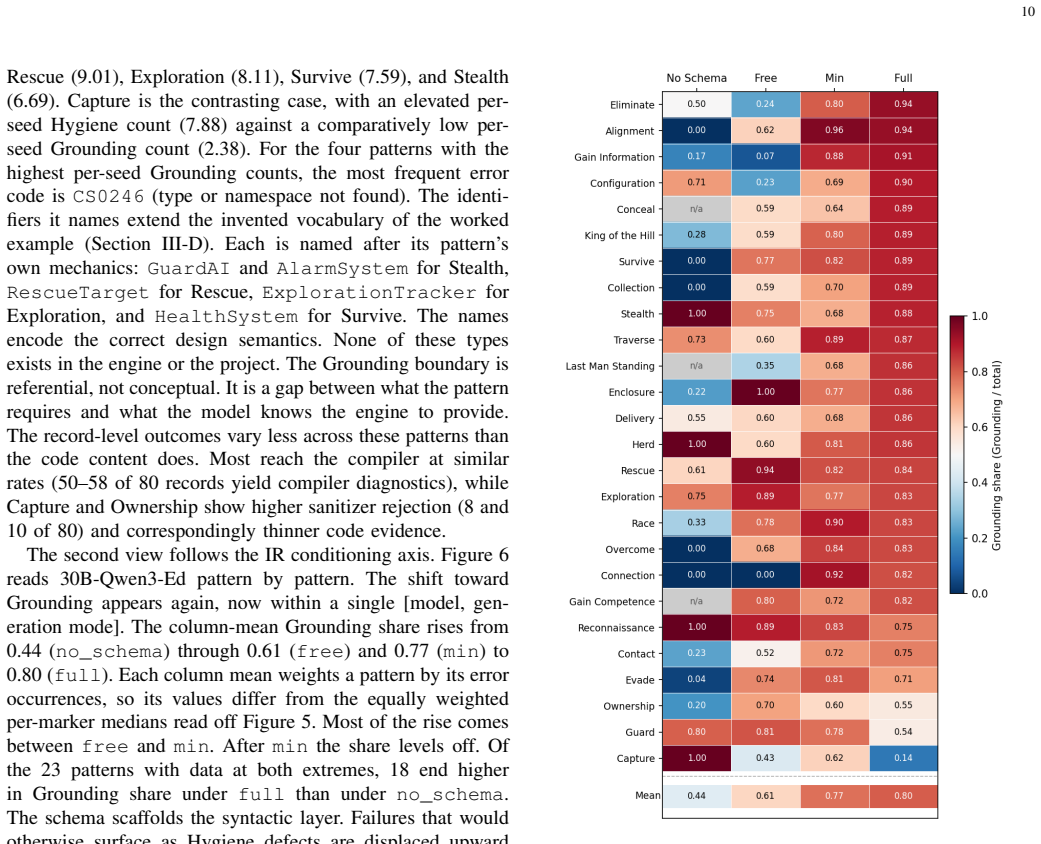
The Grounding/Hygiene error taxonomy: 18 Grounding codes (need Unity type/API knowledge to resolve) versus 81 Hygiene codes (lexical/syntactic defects needing none). Applied as a census over 90,673 error occurrences from 10,400 single-pass generations of Goal Playable Concepts (playable counterparts of Björk and Holopainen’s 26 goal patterns), it turns compiler diagnostics into an ordering of design concepts by engine-knowledge demand.
Load-bearing premise
That the one current 2D Unity scene per goal pattern—built from the same primitives and prompted the same way—is representative enough that differences in error profiles can be read as differences in the abstract goals rather than quirks of those particular implementations.
What would settle it
A single-pass generation under the same harness that compiles and exposes a valid entry point for any of the 26 patterns—or a replication with alternate Unity instantiations of the same goals that erases or reverses the Grounding/Hygiene ordering—would overturn the central claim that engine knowledge is the hard bottleneck and that the census orders the patterns themselves.
If this is right
- Designers can treat high-Grounding goals (Stealth, Rescue, Survive, Exploration) as needing external Unity knowledge (retrieval, fine-tuning, or hand-authoring), not better generic prompts.
- Low-Grounding goals (e.g., Capture) are better candidates for syntax repair, sanitizers, or grammar-constrained decoding because their failures are mostly structural.
- Strict schema conditioning on sub-20B models is largely wasted: most records die at the format gate before any compiler evidence appears.
- Under single-pass constraints, choosing a model is choosing which failure layer to face (syntax versus engine APIs), not buying a runnable scene within this open-weight tier.
- An iterative repair loop would have to supply real Unity API knowledge for high-Grounding patterns; for low-Grounding ones a local fix may suffice.
Where Pith is reading between the lines
- The near-zero compile floor may generalize beyond these 26 goals to any engine-coupled generation where the model must invent scene structure and bind to live APIs rather than fill a fixed library call.
- If Grounding share predicts repair difficulty, multi-turn repair studies could use this census as a prior: high-Grounding patterns should need more external knowledge per round.
- The same taxonomy could be ported to other engines (Unreal, Godot) to test whether the ordering tracks perception/physics coupling or Unity-specific training data gaps.
- Training or retrieval that injects only real Unity type and member names—without full docs—might shift mass from Grounding to Hygiene and make structural tools newly useful.
Editorial analysis
A structured set of objections, weighed in public.
Referee Report
Summary. The paper evaluates single-pass (no compiler-feedback repair) generation of executable Unity C# scenes for 26 Goal Playable Concepts drawn from Björk and Holopainen’s goal patterns. Across a fully crossed grid of 10,400 records (five [model, generation mode] pairings spanning 7B–30B open-weight models; four IR conditioning levels; 26 patterns; 20 seeds), no script both compiles and exposes a valid entry point. From 90,673 compiler-error occurrences over 99 C# codes the authors induce a Grounding/Hygiene taxonomy (18 vs 81 codes), report per-pattern composition profiles, and argue that the bottleneck is missing engine-specific knowledge rather than scale, schema structure, or Editor vs Runtime generation mode. The census is offered as an empirical ordering of the current Unity instantiations by engine-knowledge demand.
Significance. If the zero-compilation result and the Grounding/Hygiene census hold under the stated single-pass protocol, the paper supplies a rare, large-scale negative result that cleanly isolates parametric knowledge from iterative repair—an evaluation design that most LLM game-generation demos conflate. Strengths include a fully reported factor grid, mutually exclusive outcome taxonomy, deterministic mapping from standard C# diagnostics to categories, open-weight reproducibility, and an explicit all-fail corpus that removes survivorship bias. The per-pattern profiles and design-semantics reading give practitioners a concrete map of where unaided generation breaks (perception/physics-coupled concepts vs plain state logic). That combination is useful both for PCG evaluation at the game-design layer and for diagnosing interventions (retrieval/fine-tuning vs syntactic repair).
major comments (2)
- [§IV-A2, §III-D, Table V] §IV-A2 and the Stealth worked example (§III-D): CS0246 is treated as the flagship Grounding code (12,297 occurrences) because invented names such as GuardAI/EnemyAI “exist in neither the engine nor the project.” Resolving CS0246 for a user-defined type can be done by emitting the missing class definition in the same compilation unit, which requires no Unity API knowledge; Runtime prompts even instruct the model to define all gameplay classes in-file. The diagnostic therefore conflates (i) hallucinated engine/project types with (ii) incomplete emission of types the model itself introduced. Given that CS0246 dominates the Grounding share and underpins the claim that the bottleneck is “missing engine-specific knowledge” and the per-pattern ordering by engine demand, the manuscript should either subdivide CS0246 (e.g., UnityEngine.*/project assets vs model-invented identifiers; defined-in-fi
- [Abstract; §V(a); §VI] Abstract vs §V(a)/§VI: the abstract states that “the census orders goal patterns by that demand,” while Limitation (a) and the conclusion correctly restrict the ordering to the 26 current 2D Unity instantiations (one per pattern, same primitives and prompt template). Because cross-pattern differences are the main design takeaway sold to readers, the abstract and early contribution list should carry the same qualifier as §VI (“their current specific Unity instantiations”) so the interpretive claim is not stronger than the controlled implementation set supports. The zero-compilation and composition results do not depend on the stronger reading; the ordering claim does.
minor comments (5)
- [Table III, §IV-A1, Fig. 3] Table III outcome labels vs body text: results prose refers to timeout_with_cs while the table uses Comp. err / TO/noCS; align naming so the five mutually exclusive outcomes are identically labeled in text, table, and Figure 3.
- [Title page / affiliations] Author names and place names show encoding artifacts in the compiled text (e.g., “Kıvanc ¸ Tatar”, “G ¨oteborg”, “Bj ¨ork”). Clean UTF-8 / LaTeX accents before production.
- [Fig. 5] Figure 5 panel counts (117/86/82/83) and the “below one error per seed” shading are important for reading selection; a one-sentence reminder in the caption that markers are conditional on compiler output would help skimmers.
- [§IV-A3, §V-B] §IV-A3 notes 22B-Codestral contributes 76% of raw occurrences via verbose/markdown bleed; the paper already switches to per-seed counts and shares, but a short explicit “do not rank models by raw error totals” callout in §V-B would further protect misreading.
- [Contributions; Table II] Generation-mode contrast is only at 30B (acknowledged). A single clarifying sentence in the contributions list that mode effects are not claimed below 30B would match the experimental design in Table II/Fig. 2.
Circularity Check
Empirical single-pass census with no circular derivation; only a non-load-bearing companion self-citation.
specific steps
-
self citation load bearing
[Section II-B / Ref. [29]; also Abstract and Section V-D]
"Closest to our setting, the contemporaneous Mage benchmark [29] evaluates LLM-generated executable game scenes along multiple quality axes on a related class of goal-pattern tasks. The two efforts are complementary and differ in their unit of analysis. Mage measures how well generation succeeds under benchmark metrics, whereas the present study measures how generation fails at the granularity of individual compiler error occurrences."
Same-author companion paper. Not circular in the load-bearing sense: the zero-compilation result and the Grounding/Hygiene census are obtained from the present 10,400-record pipeline and do not depend on Mage's metrics or scenes. Cited only as complementary context. Score contribution is therefore minor (self-citation present but not premise-forcing).
full rationale
The paper's load-bearing claims are observational: zero runnable scenes in 10,400 single-pass records, 90,673 compiler-error occurrences across 99 codes, and a Grounding/Hygiene split induced from the compiler's own diagnostic semantics (CS0246 etc. require external Unity types; CS1002/CS1003 do not). Success is defined by the external Unity/C# compiler and entry-point check, not by any quantity fitted from the same data. Goal patterns and GPCs are taken from independent prior literature (Björk & Holopainen; Lyu et al.). The IR schema was frozen offline before generation and is not tuned to outcomes. No parameter is fitted and then re-presented as a prediction; no uniqueness theorem is imported; no ansatz is smuggled via self-citation. The sole self-citation of note is the contemporaneous Mage benchmark by the same authors, explicitly framed as complementary (different unit of analysis) rather than as a premise that forces the zero-compilation or per-pattern results. That citation is therefore not load-bearing. Limitation (a) correctly bounds the stronger reading of the census as an ordering of abstract patterns rather than of the 26 concrete 2D instantiations; that is a scope caveat, not circularity. The derivation chain is self-contained against the compiler oracle.
Axiom & Free-Parameter Ledger
free parameters (2)
- compilation watchdog timeout =
120 s
- generation temperature / top-p / token budgets =
0.2 / 0.95 / 2k–8k
axioms (4)
- domain assumption A C# compiler diagnostic is a reliable, objective signal of the failure mode of a generated script.
- domain assumption Single-pass generation (no compiler-error feedback) isolates the model’s parametric knowledge from repair skill.
- domain assumption The 26 goal patterns of Björk & Holopainen, realized as the current GPC Unity instantiations, form a theoretically grounded and comparable evaluation target.
- ad hoc to paper An error code is Grounding precisely when resolving its diagnostic requires type/member/namespace information external to the script (i.e., supplied only by Unity/project).
invented entities (2)
-
Grounding / Hygiene error taxonomy for Unity C#
no independent evidence
-
Single-pass IR-conditioned generation pipeline with four schema levels
no independent evidence
read the original abstract
Large language models (LLMs) write Unity C\# for game scenes. Yet nearly all demonstrations rest on an iterative repair loop that regenerates code until it compiles, conflating what the model writes with what the loop fixes. We remove the loop and evaluate a single pass, where the first draft is final. This isolates the model's parametric knowledge, the most stringent test of unaided generation. Models instantiate Goal Playable Concepts, playable counterparts of goal patterns, across 10,400 generations (four open-weight models, 7B--30B; two generation modes; four intermediate-representation (IR) conditioning levels; 26 goal patterns; 20 seeds). None compiled into a runnable scene, leaving no survivorship bias. To understand how the generated C\# scripts fail, we categorize the 99 error codes behind 90{,}673 compiler-error occurrences as Grounding (invented or misused Unity types and APIs) or Hygiene (structural defects needing no Unity knowledge). The split differs sharply by goal pattern (e.g., Stealth fails mostly on invented engine references; Capture on plain C\# structure). Larger models, stricter IRs, and different generation modes move the errors but never yield a compiling scene. The bottleneck is missing engine-specific knowledge. The census orders goal patterns by that demand, showing designers where single-pass generation breaks.
Figures


Reference graph
Works this paper leans on
-
[1]
Formal abstract design tools,
D. Church, “Formal abstract design tools,”Game Developer, vol. 6, no. 8, pp. 44–50, 1999
1999
-
[2]
I have no words & i must design: Toward a critical vocab- ulary for games,
G. Costikyan, “I have no words & i must design: Toward a critical vocab- ulary for games,” inComputer Games and Digital Cultures Conference Proceedings, 2002
2002
-
[3]
The case for game design patterns,
B. Kreimeier, “The case for game design patterns,” 2002
2002
-
[4]
Future design of accessibility in games: A design vocabulary,
P. Cairns, C. Power, M. Barlet, and G. Haynes, “Future design of accessibility in games: A design vocabulary,”International Journal of Human-Computer Studies, vol. 131, pp. 64–71, 2019
2019
-
[5]
Why video game genres fail: A classificatory analysis,
R. I. Clarke, J. H. Lee, and N. Clark, “Why video game genres fail: A classificatory analysis,”Games and Culture, vol. 12, no. 5, pp. 445–465, 2017
2017
-
[6]
Video game genre, evolution and innovation,
D. Arsenault, “Video game genre, evolution and innovation,”Eludamos: Journal for computer game culture, vol. 3, no. 2, pp. 149–176, 2009
2009
-
[7]
Juul,Half-real: Video games between real rules and fictional worlds
J. Juul,Half-real: Video games between real rules and fictional worlds. MIT press, 2011
2011
-
[8]
Goal playable concepts coupling gameplay design patterns with playable concepts,
Z. Lyu, J. Holopainen, and S. Bj ¨ork, “Goal playable concepts coupling gameplay design patterns with playable concepts,” inProceedings of the 26th International Academic Mindtrek Conference, 2023, pp. 57–66
2023
-
[9]
Bjork and J
S. Bjork and J. Holopainen,Patterns in game design. Charles River Media Hingham, 2005, vol. 11
2005
-
[10]
Game research methods: An overview,
P. Lankoski and S. Bj ¨ork, “Game research methods: An overview,” 2015
2015
-
[11]
Evaluating large language models trained on code,
M. Chen, J. Tworek, H. Jun, Q. Yuan, H. P. D. O. Pinto, J. Kaplan, H. Edwards, Y . Burda, N. Joseph, G. Brockmanet al., “Evaluating large language models trained on code,”arXiv preprint arXiv:2107.03374, 2021
Pith/arXiv arXiv 2021
-
[12]
Program synthesis with large language models,
J. Austin, A. Odena, M. Nye, M. Bosma, H. Michalewski, D. Dohan, E. Jiang, C. Cai, M. Terry, Q. Leet al., “Program synthesis with large language models,”arXiv preprint arXiv:2108.07732, 2021
Pith/arXiv arXiv 2021
-
[13]
Beyond synthetic benchmarks: Evaluating llm performance on real-world class-level code generation,
M. Rahman, S. Khatoonabadi, and E. Shihab, “Beyond synthetic benchmarks: Evaluating llm performance on real-world class-level code generation,”arXiv preprint arXiv:2510.26130, 2025
arXiv 2025
-
[14]
A survey on large language models for code generation,
J. Jiang, F. Wang, J. Shen, S. Kim, and S. Kim, “A survey on large language models for code generation,”ACM Transactions on Software Engineering and Methodology, vol. 35, no. 2, pp. 1–72, 2026
2026
-
[15]
Swe-bench: Can language models resolve real-world github issues?
C. E. Jimenez, J. Yang, A. Wettig, S. Yao, K. Pei, O. Press, and K. Narasimhan, “Swe-bench: Can language models resolve real-world github issues?” vol. 2024, pp. 54 107–54 157, 2024
2024
-
[16]
Shaker, J
N. Shaker, J. Togelius, and M. J. Nelson,Procedural content generation in games. Springer, 2016
2016
-
[17]
Search- based procedural content generation: A taxonomy and survey,
J. Togelius, G. N. Yannakakis, K. O. Stanley, and C. Browne, “Search- based procedural content generation: A taxonomy and survey,”IEEE Transactions on Computational Intelligence and AI in Games, vol. 3, no. 3, pp. 172–186, 2011
2011
-
[18]
Procedural content generation via machine learning (pcgml),
A. Summerville, S. Snodgrass, M. Guzdial, C. Holmg ˚ard, A. K. Hoover, A. Isaksen, A. Nealen, and J. Togelius, “Procedural content generation via machine learning (pcgml),”IEEE Transactions on Games, vol. 10, no. 3, pp. 257–270, 2018
2018
-
[19]
Large language models and games: A survey and roadmap,
R. Gallotta, G. Todd, M. Zammit, S. Earle, A. Liapis, J. Togelius, and G. N. Yannakakis, “Large language models and games: A survey and roadmap,”IEEE Transactions on Games, 2024
2024
-
[20]
Level generation through large language models,
G. Todd, S. Earle, M. U. Nasir, M. C. Green, and J. Togelius, “Level generation through large language models,” inProceedings of the 18th International Conference on the Foundations of Digital Games, 2023, pp. 1–8
2023
-
[21]
Mariogpt: Open-ended text2level generation through large language models,
S. Sudhakaran, M. Gonz ´alez-Duque, M. Freiberger, C. Glanois, E. Na- jarro, and S. Risi, “Mariogpt: Open-ended text2level generation through large language models,”Advances in Neural Information Processing Systems, vol. 36, pp. 54 213–54 227, 2023
2023
-
[22]
Procedural content generation for games: A survey,
M. Hendrikx, S. Meijer, J. Van Der Velden, and A. Iosup, “Procedural content generation for games: A survey,”ACM Transactions on Multi- media Computing, Communications, and Applications (TOMM), vol. 9, no. 1, pp. 1–22, 2013
2013
-
[23]
Barney,Pattern language for game design
C. Barney,Pattern language for game design. CRC Press, 2020
2020
-
[24]
Towards an ontological language for game analysis,
J. P. Zagal, M. Mateas, C. Fern ´andez-Vara, B. Hochhalter, and N. Lichti, “Towards an ontological language for game analysis,”Worlds in play: International perspectives on digital games research, vol. 21, p. 21, 2007
2007
-
[25]
An ontology for videogame interop- erability,
J. Parkkila, F. Radulovic, D. Garijo, M. Poveda-Villal ´on, J. Ikonen, J. Porras, and A. G ´omez-P´erez, “An ontology for videogame interop- erability,”Multimedia tools and applications, vol. 76, no. 4, pp. 4981– 5000, 2017
2017
-
[26]
Modeling the video game environment: the videowl ontology
S. De Martino, M. N. Asmundo, S. A. Rizzo, and D. F. Santamaria, “Modeling the video game environment: the videowl ontology.” inWOA, 2023, pp. 191–205
2023
-
[27]
Towards a video game description language,
M. Ebner, J. Levine, S. M. Lucas, T. Schaul, T. Thompson, and J. Togelius, “Towards a video game description language,” 2013
2013
-
[28]
General video game ai: A multitrack framework for evaluating agents, games, and content generation algorithms,
D. Perez-Liebana, J. Liu, A. Khalifa, R. D. Gaina, J. Togelius, and S. M. Lucas, “General video game ai: A multitrack framework for evaluating agents, games, and content generation algorithms,”IEEE Transactions on Games, vol. 11, no. 3, pp. 195–214, 2019
2019
-
[29]
Mage: Multi-axis evaluation of llm-generated executable game scenes beyond compile-pass rate,
H. X. Liu and K. Tatar, “Mage: Multi-axis evaluation of llm-generated executable game scenes beyond compile-pass rate,” 2026. [Online]. Available: https://arxiv.org/abs/2605.07342
Pith/arXiv arXiv 2026
-
[30]
37 million compilations: Investigating novice programming mistakes in large-scale student data,
A. Altadmri and N. C. Brown, “37 million compilations: Investigating novice programming mistakes in large-scale student data,” inPro- ceedings of the 46th ACM technical symposium on computer science education, 2015, pp. 522–527
2015
-
[31]
Do enhanced compiler error mes- sages help students? results inconclusive
R. S. Pettit, J. Homer, and R. Gee, “Do enhanced compiler error mes- sages help students? results inconclusive.” inProceedings of the 2017 ACM SIGCSE Technical Symposium on Computer Science Education, 2017, pp. 465–470
2017
-
[32]
Bugs in large language models generated code: An empirical study,
F. Tambon, A. Moradi-Dakhel, A. Nikanjam, F. Khomh, M. C. Des- marais, and G. Antoniol, “Bugs in large language models generated code: An empirical study,”Empirical Software Engineering, vol. 30, no. 3, p. 65, 2025
2025
-
[33]
What is wrong with your code generated by large language models? an extensive study,
S. Dou, H. Jia, S. Wu, H. Zheng, M. Wu, Y . Tao, M. Zhang, M. Chai, J. Fan, Z. Xiet al., “What is wrong with your code generated by large language models? an extensive study,”Science China Information Sciences, vol. 69, no. 1, p. 112107, 2026
2026
-
[34]
A review on nlp zero-shot and few-shot learning: methods and applications,
G. Ramesh, M. Sahil, S. A. Palan, D. Bhandary, T. A. Ashok, J. Shreyas, and N. Sowjanya, “A review on nlp zero-shot and few-shot learning: methods and applications,”Discover Applied Sciences, vol. 7, no. 966, 2025
2025
-
[35]
Qwen2. 5-coder technical report,
B. Hui, J. Yang, Z. Cui, J. Yang, D. Liu, L. Zhang, T. Liu, J. Zhang, B. Yu, K. Luet al., “Qwen2. 5-coder technical report,”arXiv preprint arXiv:2409.12186, 2024
Pith/arXiv arXiv 2024
-
[36]
Deepseek-coder-v2: Breaking the barrier of closed-source models in code intelligence,
Q. Zhu, D. Guo, Z. Shao, D. Yang, P. Wang, R. Xu, Y . Wu, Y . Li, H. Gao, S. Maet al., “Deepseek-coder-v2: Breaking the barrier of closed-source models in code intelligence,”arXiv preprint arXiv:2406.11931, 2024
Pith/arXiv arXiv 2024
-
[37]
Qwen3 technical report,
A. Yang, A. Li, B. Yang, B. Zhang, B. Hui, B. Zheng, B. Yu, C. Gao, C. Huang, C. Lvet al., “Qwen3 technical report,” 2025
2025
-
[38]
Hygienic macro expansion,
E. Kohlbecker, D. P. Friedman, M. Felleisen, and B. Duba, “Hygienic macro expansion,” inProceedings of the 1986 ACM Conference on LISP and Functional Programming, 1986, pp. 151–161
1986
-
[39]
Washing behind your ears: Principles of software hygiene
D. M. Tilbrook and J. McMullen, “Washing behind your ears: Principles of software hygiene.”
-
[40]
Z. R. Tam, C.-K. Wu, Y .-L. Tsai, C.-Y . Lin, H.-y. Lee, and Y .- N. Chen, “Let me speak freely? a study on the impact of format restrictions on performance of large language models,”arXiv preprint arXiv:2408.02442, 2024
Pith/arXiv arXiv 2024
-
[41]
Jsonschemabench: A rigorous benchmark of structured outputs for language models,
S. Geng, H. Cooper, M. Moskal, S. Jenkins, J. Berman, N. Ranchin, R. West, E. Horvitz, and H. Nori, “Jsonschemabench: A rigorous benchmark of structured outputs for language models,”arXiv preprint arXiv:2501.10868, 2025
Pith/arXiv arXiv 2025
-
[42]
Docprompting: Generating code by retrieving the docs,
S. Zhou, U. Alon, F. F. Xu, Z. Jiang, and G. Neubig, “Docprompting: Generating code by retrieving the docs,” inThe Eleventh International Conference on Learning Representations, 2022
2022
-
[43]
Self-planning code generation with large language models,
X. Jiang, Y . Dong, L. Wang, Z. Fang, Q. Shang, G. Li, Z. Jin, and W. Jiao, “Self-planning code generation with large language models,” ACM Transactions on Software Engineering and Methodology, vol. 33, no. 7, pp. 1–30, 2024
2024
-
[44]
Grammar prompting for domain-specific language generation with large language models,
B. Wang, Z. Wang, X. Wang, Y . Cao, R. A Saurous, and Y . Kim, “Grammar prompting for domain-specific language generation with large language models,” vol. 36, 2023, pp. 65 030–65 055. 15 TABLE VII IRSCHEMA ITERATION HISTORY FROM INITIAL DRAFT TO FROZEN V0.2-RUNTIME-EVIDENCE. # Iteration What Changed Why Impact 1v0 static draft Defined six top-level field...
2023
-
[45]
scripts[].object_id must reference objects[].id
-
[46]
scripts are per-instance (no sharing across objects)
-
[47]
no implicit aggregate placeholders
-
[48]
scene" | string
rules[].evidence_type is required, in { direct_code, scene_override, inferred } APPENDIXB FULLERRORCODECENSUS 16 TABLE VIII: All 99 observed C# compiler error codes, categorized as Grounding (G) or Hygiene (H), with total occurrence count and message template. Quoted identifiers are shown asX; for Grounding codes, a representative identifier from the logs...
-
[49]
Every scripts[].object_id MUST reference a real objects[].id (no dangling refs)
-
[50]
Scripts are per-instance; no shared script entries across objects
-
[51]
Every entity must be listed explicitly in objects (no aggregate placeholders)
-
[52]
direct_code
Every rules[] entry MUST include evidence_type in { "direct_code", "scene_override", "inferred" }. <PATTERN_MD>
discussion (0)
Sign in with ORCID, Apple, or X to comment. Anyone can read and Pith papers without signing in.