REVIEW 3 major objections 5 minor 1 cited by
This paper argues that the chiral spin-2 collective mode of fractional quantum Hall states is the massive gauge field of area-preserving diffeomorphisms, with a gap set by alignment to a reference metric.
Reviewed by Pith at T0; open to challenge. T0 means a machine referee read the full paper against a public rubric. the ladder, T0–T4 →
By gauging area-preserving diffeomorphisms and adding a Stueckelberg mass term, the paper constructs a nonlinear effective theory whose quadratic limit reproduces the bimetric description of the chiral spin-2 magnetoroton.
T0 review reviewed 2026-08-05 challenge →
load-bearing objection A promising APD-Stueckelberg framework for the FQH graviton, but the quadratic theory's two propagating branches and unproven ghost-freedom mean the central claim is not yet established. the 3 major comments →
Chiral Graviton Theory of Fractional Quantum Hall States
The pith
A machine-rendered reading of the paper's core claim, the machinery that carries it, and where it could break.
The reading
Core claim
The paper constructs the effective Lagrangian L[A0,g,ĝ] = (c1/4)(∇t gij)^2 − c2 R^2 − (m/2)([K^2]−[K]^2) + L_top, where gij is a unimodular spatial metric, A0 is a scalar temporal potential, R is the Ricci scalar of g, K ≡ 1 − sqrt(δ − G), with Gij = ĝb_ij(X) − gij, and L_top collects parity-odd geometric Chern-Simons terms. Every term is invariant under area-preserving diffeomorphisms because Gij is built from covariant coordinates X^α that transform as scalars. At quadratic order about flat aligned backgrounds the potential becomes −(m/8)(hij − ĥb_ij)^2, the familiar bimetric mass term, so the Stueckelberg field is eaten in unitary gauge, the APD symmetry is nonlinearly realized, and the
What carries the argument
The load-bearing object is the APD gauge redundancy, realized geometrically by a unimodular spatial metric gij and a scalar temporal potential A0. The Stueckelberg construction adds a field ϕ and covariant coordinates X^α = x^α + ℓ^2 ε^{αβ} D_β ϕ, which pull a reference metric back to a covariant tensor ĝb_ij(X); the difference Gij = ĝb_ij(X) − gij is APD-covariant, and the invariant potential −(m/2)([K^2]−[K]^2), K = δ − sqrt(δ − G), supplies the mass. This mechanism converts the would-be Goldstone mode of the gauge redundancy into the massive longitudinal part of the spin-2 field, giving the tunable gap without breaking any global symmetry.
Load-bearing premise
The load-bearing premise is that the nonlinear Stueckelberg potential is ghost-free — that the massive spin-2 sector still contains exactly one dynamical degree of freedom at all orders, not just at quadratic order; the paper states this around Eq. (71) but gives no Hamiltonian or constraint analysis.
What would settle it
Run the Hamiltonian constraint analysis of L[A0,g,ĝ] to full nonlinear order: if the constraint count yields more than one propagating mode in the massive spin-2 sector, the ghost-free claim fails. On the experimental side, in a tunable moiré FQH or fractional Chern insulator device, measure the q → 0 spin-2 gap while tuning across the isotropic-nematic transition; the Stueckelberg mechanism requires the gap to close continuously at the predicted critical coupling rather than abruptly or not at all.
If this is right
- The zero-momentum gap of the chiral spin-2 mode is controlled by one mass parameter m; as m → 0 the mode softens and the theory reaches an isotropic-nematic quantum critical point, so Raman or THz experiments can map the phase diagram by tracking the gap.
- The projected static structure factor is fixed at small momentum: the q^4 coefficient by the shift and the q^6 coefficient by the chiral central charge, making the universal long-wavelength data predictions of the symmetry rather than free fits.
- The quadratic graviton action maps linearly to the quadrupolar harmonics u±2 of bosonized composite Fermi liquid theory, connecting the gapped incompressible description to Fermi-surface dynamics near half filling.
- The same gauged-volume-preserving-diffeomorphism construction carries to fractional Chern insulators by identifying the band quantum metric with the dynamical metric, and to non-Abelian paired states, where a spin-3/2 neutral mode partners the graviton.
- In (3+1) dimensions the construction yields propagating transverse shear modes with linear dispersion and no longitudinal propagating mode, offering a concrete higher-dimensional extension.
Where Pith is reading between the lines
- If the Stueckelberg mechanism is the operative one, then in moiré fractional Chern insulators the graviton gap should track band-geometry uniformity: changing the Berry curvature or quantum metric should move the gap and the nematic instability together.
- The linear dictionary to Fermi-surface quadrupoles hints that the full infinite tower of higher angular-momentum harmonics could be organized by the same APD gauge principle, making the chiral graviton the first member of an infinite higher-spin family; the paper mentions this but leaves the truncation analysis open.
- A check the paper does not perform is a full nonlinear Hamiltonian constraint analysis of the Stueckelberg potential; that analysis would settle whether the massive spin-2 sector really contains exactly one physical degree of freedom at all orders.
Editorial analysis
A structured set of objections, weighed in public.
Referee Report
Summary. The paper constructs a (2+1)-dimensional effective field theory for the chiral spin-2 magnetoroton ('graviton') mode in fractional quantum Hall states. The organizing principle is invariance under area-preserving diffeomorphisms (APDs), realized with a unimodular spatial metric g_ij and a temporal scalar A0. The full Lagrangian (80) combines a parity-even Maxwell kinetic term c1(∇_t g)^2/4, a curvature term -c2 R^2, Wen-Zee and gravitational Chern-Simons terms, and a Stueckelberg mass potential built from an APD-covariant coordinate X^α. The Stueckelberg potential is APD-invariant and reduces at quadratic order to the bimetric mass -m/8 (h_ij - ĥ_ij)^2. The paper derives dispersions (Eq. (100)), the projected static structure factor coefficients s4 and s6, an isotropic-nematic phase diagram, and a linear dictionary to quadrupolar Fermi-surface deformations in composite Fermi liquid bosonization. It also sketches extensions to fractional Chern insulators, (3+1) dimensions, and non-Abelian states via super-APD constructions.
Significance. If the mode-counting issue is resolved, this is a substantial and useful contribution: it offers a gauge-invariant nonlinear completion of the bimetric mass term, unifies the connection and geometric APD realizations, and correctly reproduces universal long-wavelength structure-factor constraints. The paper is candid that the kinetic and mass coefficients are phenomenological and that the gap is a tunable input rather than a predicted number. The main advertised physical prediction—a single gapped chiral spin-2 mode—is, however, not yet established by the analysis presented.
major comments (3)
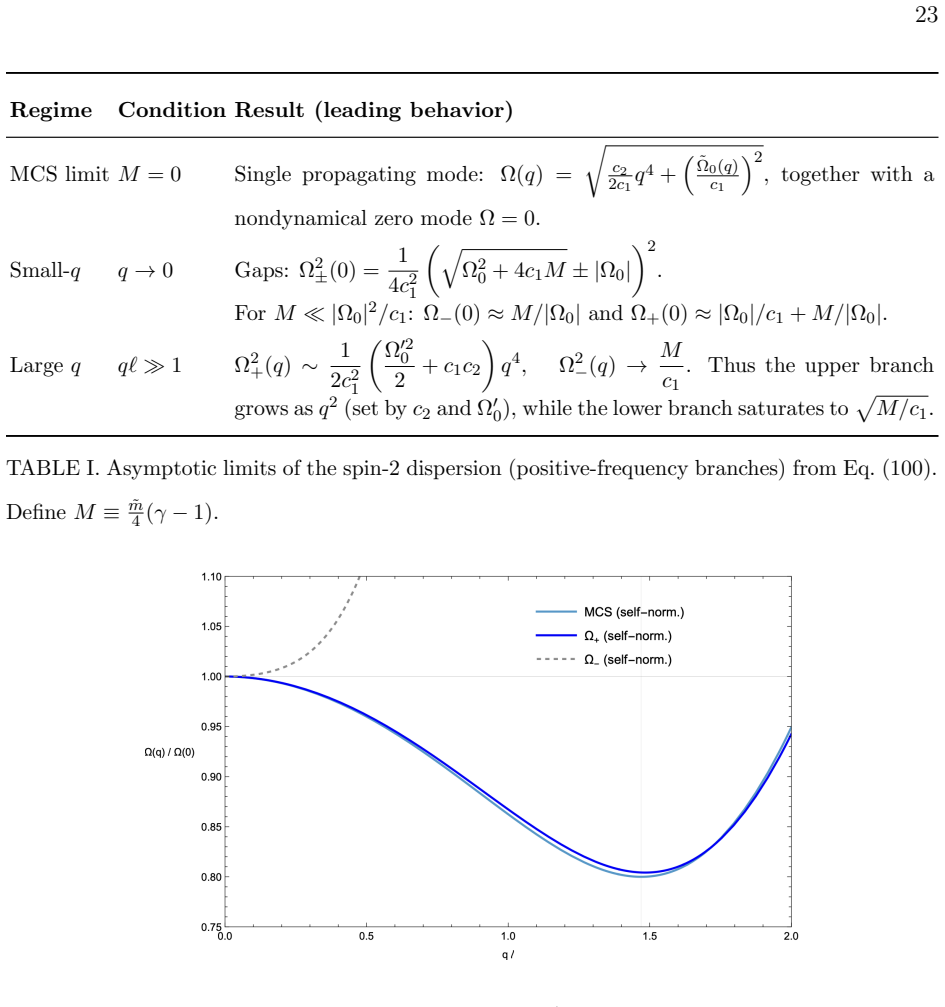
- [Sec. III C 1, Eq. (100), Table I] The central claim that action (80) describes a single chiral spin-2 magnetoroton is not established by the quadratic analysis. Eq. (98) combines a second-order Maxwell term c1 \dot h^2, a first-order Wen-Zee term, and a mass term M h^2. For M≠0, Eq. (100) gives two positive-frequency branches Ω_+ and Ω_-; Table I lists both, and the Conclusion explicitly speaks of 'two chiral spin-2 GMP-precursor branches.' At M=0 one branch is a nondynamical zero mode, and the Stueckelberg mass gaps it into a propagating mode. No Hamiltonian/Dirac constraint analysis is supplied, and the assertion near Eq. (71) that the potential is ghost-free is unsupported. If both branches are positive-norm, the EFT overcounts the single observed mode; if one has negative norm, the theory is unstable. Please provide a constraint analysis or demonstrate explicitly that one branch is an unphysical shadow that decouples
- [Sec. III A, Eqs. (71)-(73)] The statement that the nonlinear Stueckelberg potential is 'ghost-free' is an assertion, not a demonstration. The potential depends on √γ and the nonlinear K tensor, and no Ostrogradsky/constraint analysis is given for the full action (80). This matters because the nonlinear theory is advertised as having the same single physical degree of freedom as the linearized theory. In addition, the reduction from Eq. (72) to Eq. (73) uses Tr G = 0, which follows from unimodularity only at linear order; the paper should state which tensor is traceless at nonlinear order and at which order Eq. (73) is valid.
- [Sec. IV A, Eqs. (116)-(118)] The linear dictionary to composite Fermi liquid bosonization is not demonstrated. Substituting u_2 = -i/(4ℓ) Q and u_{-2} = i/(4ℓ) \bar Q into the Wen-Zee term of Eq. (97) appears to give the opposite sign of the first term in Eq. (118) when κ ≈ (2N+1)/4; the paper does not show the substitution or the form of the bosonized DCF action from which Eq. (118) is taken. If a sign or total-derivative convention is responsible, it should be spelled out. As written, the claimed 'equivalence' of the two quadratic actions is not verifiable from the text.
minor comments (5)
- [Sec. II D] Typo: 'transfromation' should be 'transformation'.
- [Eq. (116) and surrounding text] The notation 'u_2 = - i/4 p_F Q' is dimensionally ambiguous. It should be written as -i p_F Q/4 or, using p_F = 1/ℓ, as -i Q/(4ℓ). Please correct the typesetting.
- [Figs. 2 and 5] The dispersions are plotted only for 'ν=1/3'; please specify the values of c1, c2, κ, ĉ, m (or M), and γ used, and state how the QCP curve in Fig. 5 is obtained.
- [Table I and Eq. (100)] For the isotropic side M<0, the square root in Eq. (100) is real only if 4c1|M| ≤ Ω_0^2. Please state this validity range and discuss what happens if the bound is violated (unstable region), since it is relevant to the phase diagram.
- [Sec. III A, Eq. (73)] Please clarify that the unimodular constraint det g = det ĝ = 1 implies Tr G = 0 only to linear order; as written, Eq. (73) appears to be stated as an exact implication.
Circularity Check
No significant circularity: the APD-invariant Stueckelberg action is a self-contained EFT construction; its reduction to bimetric mass and CFL dictionary are explicit equivalences, not hidden reuse of the target.
full rationale
The paper is an effective-field-theory construction, and an EFT ansatz with free couplings is not circular. The central Stueckelberg potential (71) is built from APD-covariant tensors, and its quadratic expansion (72)-(75) is shown, not assumed, to equal the bimetric mass with the identification m=2 mtilde(1-gamma) (Eq. 96). This is an explicit equivalence between two independently written potentials, not a prediction recycled as input. The gap is controlled by the phenomenological parameter m; the paper does not claim to compute its numerical value, so there is no fitted-input-called-prediction pattern. The computed observables (dispersion Eq. 100, SSF coefficients Eqs. 49-50) are derived from the Lagrangian after fixing coefficients by external universal data (Wen-Zee shift, chiral central charge), which is standard EFT matching rather than circularity. The CFL dictionary (Eqs. 114-118) is a linear variable change derived from the same background metric deformation, and the action agreement follows from taking kappa and c-hat from prior bimetric literature [5,6]; it is presented as a correspondence, not as an independent prediction. Self-citations [31,33,61] supply background formalism and are not used as uniqueness theorems or to forbid alternatives. One non-circular weakness should be noted: the assertion near Eq. (71) that L_pot is ghost-free is unproved, and the quadratic dispersion (100) shows two positive-frequency branches, so the single-chiral-graviton interpretation requires a constraint analysis. This is a correctness/verification gap, not a circularity, and does not raise the circularity score.
Axiom & Free-Parameter Ledger
free parameters (4)
- c1, Maxwell kinetic coefficient for the metric =
not fixed in paper
- c2, R^2 curvature coefficient =
not fixed in paper
- m, Stueckelberg mass scale =
not fixed in paper
- gamma, bimetric control parameter =
not fixed in paper
axioms (5)
- domain assumption The low-energy neutral collective excitations of incompressible FQH states are described by a unimodular spatial metric g_ij with APD transformations as a local gauge redundancy.
- ad hoc to paper The Stueckelberg field phi is an element of the APD Lie algebra and the covariant-coordinate map X_alpha = x_alpha + ell^2 epsilon_alpha beta D_beta phi generates the reference metric; the potential built from G_ij is the correct mass term.
- ad hoc to paper The nonlinear potential -(m/2)([K^2]-[K]^2) is ghost-free and has a healthy massive spin-2 spectrum.
- domain assumption The Wen-Zee and gravitational Chern-Simons coefficients kappa and c-hat are fixed by universal data (shift S and chiral central charge), and the compact charge sector decouples from the neutral geometric sector.
- ad hoc to paper The linear dictionary u_+-2 = -(/) i/(4 ell) Q and the coefficient identifications kappa ~ (2N+1)/4, c-hat ~ N^2(2N+3)/24 map the chiral graviton action to the quadrupolar sector of bosonized composite Fermi liquid.
invented entities (2)
-
Stueckelberg field phi (would-be APD Nambu-Goldstone)
no independent evidence
-
Gravitino field Psi_{i alpha} and super-APD multiplet for nu = 5/2
no independent evidence
Cite this review
Pith. "Pith review of Chiral Graviton Theory of Fractional Quantum Hall States." pith.science (2026). https://pith.science/paper/DY3AG55R
@misc{pith2026250904408,
  author       = {Pith},
  title        = {Pith review of: Chiral Graviton Theory of Fractional Quantum Hall States},
  year         = {2026},
  howpublished = {\url{https://pith.science/paper/DY3AG55R}},
  note         = {Machine review of arXiv:2509.04408}
}
read the original abstract
Recent polarized Raman scattering experiments indicate that fractional quantum Hall systems host a chiral spin-2 neutral collective mode, the long-wavelength limit of the magnetoroton, which behaves as a condensed-matter graviton. We present a nonlinear, gauge-invariant effective theory by gauging area-preserving diffeomorphisms (APDs) with a unimodular spatial metric as the gauge field. A Stueckelberg construction introduces an APD-invariant local potential that aligns the dynamical metric with a reference geometry, opening a tunable gap while preserving gauge redundancy. Together with a geometric Maxwell kinetic sector and the Wen-Zee and gravitational Chern-Simons terms, the theory yields a gapped chiral spin-2 excitation consistent with universal long-wavelength constraints. The tunable gap emerges naturally from symmetry and provides a route to an isotropic-nematic quantum critical point where the spin-2 mode softens. We further establish a linear dictionary to quadrupolar deformations in composite Fermi liquid bosonization, and outline applications to fractional Chern insulators as well as higher-dimensional generalizations. Finally, the approach can be extended to non-Abelian fractional quantum Hall states, capturing both spin-2 and spin-3/2 neutral modes.
Figures




Forward citations
Cited by 1 Pith paper
-
Non-Perturbative SDiff Covariance of Fractional Quantum Hall Excitations
The effective Maxwell-Chern-Simons theory for FQH excitations admits a non-perturbative unitary SDiff-equivariant construction that is nevertheless non-differentiable.
Reference graph
Works this paper leans on
-
[1]
Dispersion of the neutral collective mode We diagonalize the quadratic theory by inserting a plane-wave ansatz hij(t, x) = ¯hij ei(q·x−Ωt). For the Lagrangian L[hij] = − κ 32πℓ2 εijhik ˙hjk + ˆc 16π εijεabεcd∂ahbi∂c ˙hd j+ c1 ˙h2 ij − c2R2 + M h2 ij , (98) with M ≡ ˜m 4 (γ − 1) , ˜Ω0(q) ≡ Ω0 + 1 2 Ω′ 0q2 , Ω0 ≡ − κ 32πℓ2 , Ω′ 0 ≡ ˆc 16π . (99) The dispers...
-
[2]
Chern–Simons
Advances beyond bimetric theory Our approach complements and extends bimetric descriptions in several ways. First, we formulate the neutral sector as a genuine gauge theory of APDs and obtain the graviton gap via a Stueckelberg (Higgs) mechanism—a local, gauge-invariant potential that aligns the dy- 24 namical unimodular metric with a reference geometry. ...
-
[3]
graviton
Order parameter and kinematics We parameterize the unimodular metric by a symmetric traceless field Qij via the matrix exponential, gij = exp Qij , Q ij = Qji , Q ii = 0 , (102) which makes detg = 1 and positivity manifest while providing a faithful nonlinear realization of the nematic order parameter. For small perturbations, gij = δij + Qij + O(Q2) , (1...
-
[4]
(165) These are the propagating shear modes with linear dispersion Ω = vsq with v2 s = c2/(4c1)
Transverse shear sector (a, b) ∈ {(1, 1), (2, 2), (1, 2)}: 2c1Ω2hab − c2 2 q2hab = 0 ⇒ Ω2 = c2 4c1 q2 . (165) These are the propagating shear modes with linear dispersion Ω = vsq with v2 s = c2/(4c1)
-
[5]
(166) 39 These components are nondynamical at quadratic order
Mixed longitudinal–transverse sector (a, b) ∈ {(1, 3), (2, 3), (3, 1), (3, 2)}: 2c1Ω2hab = 0 ⇒ Ω = 0 (or hab = 0) . (166) 39 These components are nondynamical at quadratic order
-
[6]
Wen–Zee–like
Pure longitudinal sector (a, b) = (3, 3): 2c1Ω2h33 + c2 6 q2h33 = 0 . (167) For c1, c2 > 0 this equation admits no real, propagating solution (other than h33 = 0 once constraints such as tracelessness or incompressibility are imposed). Hence there is no longitudinal propagating mode in the present Gaussian, incompressible theory. In (2+1) dimensions we ha...
-
[7]
Gauge symmetry and Chern-Simons term An alternative route is to realize supersymmetry via super–area-preserving diffeomor- phisms (super-APD). We formulate this theory on a supermanifold M(m|n) with extended superspace coordinates zA ≡ (xi, ξα, ¯ξ ˙α) , (172) 42 where xi (i = 1, · · ·, m) are bosonic and ξα (α = 1, · · ·, n) are Grassmann-valued fermionic...
-
[8]
gravi- ton,
Operator quantization Now, we employ the graded commutator (B6) to define the supersymmetric generalization of the Moyal bracket, hereafter referred to as the super-Moyal bracket [94, 95]: { {f, g} }ξ ≡ 1 i f ⋆ξ g − g ⋆ξ f (−1)[f ][g] , f ⋆ ξ g = f exp h← ∂ A ΩAB → ∂ B i g , (193) where [ f ] = 0 for bosons and [ f ] = 1 for fermions, determined by the Gr...
-
[9]
F. D. M. Haldane, “Hall viscosity” and intrinsic metric of incompressible fractional Hall fluids (2009), arXiv:0906.1854 [cond-mat.str-el]
Pith/arXiv arXiv 2009
-
[10]
F. D. M. Haldane, Geometrical Description of the Fractional Quantum Hall Effect, Phys. Rev. Lett. 107, 116801 (2011), arXiv:1106.3375
work page internal anchor Pith review Pith/arXiv arXiv 2011
-
[11]
Field theory of the quantum Hall nematic transition
J. Maciejko, B. Hsu, S. A. Kivelson, Y. Park, and S. L. Sondhi, Field theory of the quantum Hall nematic transition, Phys. Rev. B 88, 125137 (2013), arXiv:1303.3041
work page internal anchor Pith review Pith/arXiv arXiv 2013
-
[12]
Spectral Sum Rules and Magneto-Roton as Emergent Graviton in Fractional Quantum Hall Effect
S. Golkar, D. X. Nguyen, and D. T. Son, Spectral sum rules and magneto-roton as emergent graviton in fractional quantum Hall effect, J. High Energy Phys.2016 (1), 21, arXiv:1309.2638. 51
work page internal anchor Pith review Pith/arXiv arXiv 2016
-
[13]
Gromov and D
A. Gromov and D. T. Son, Bimetric theory of fractional quantum hall states, Phys. Rev. X 7, 041032 (2017)
2017
-
[14]
D. X. Nguyen, A. Gromov, and D. T. Son, Fractional quantum Hall systems near nematicity: bimetric theory, composite fermions, and Dirac brackets, Phys. Rev. B 97, 195103 (2018), arXiv:1712.08169
work page internal anchor Pith review Pith/arXiv arXiv 2018
-
[15]
S.-F. Liou, F. D. M. Haldane, K. Yang, and E. H. Rezayi, Chiral Gravitons in Fractional Quantum Hall Liquids, Phys. Rev. Lett. 123, 146801 (2019), arXiv:1904.12231
work page internal anchor Pith review Pith/arXiv arXiv 2019
-
[16]
S. M. Girvin, A. H. MacDonald, and P. M. Platzman, Magneto-roton theory of collective excitations in the fractional quantum Hall effect, Phys. Rev. B 33, 2481 (1986)
1986
-
[17]
D. X. Nguyen and D. T. Son, Probing the spin structure of the fractional quantum Hall magne- toroton with polarized Raman scattering, Phys. Rev. Res. 3, 023040 (2021), arXiv:2101.02213
work page internal anchor Pith review Pith/arXiv arXiv 2021
-
[18]
Liang, Z
J. Liang, Z. Liu, Z. Yang, Y. Huang, U. Wurstbauer, C. R. Dean, K. W. West, L. N. Pfeiffer, L. Du, and A. Pinczuk, Evidence for chiral graviton modes in fractional quantum Hall liquids, Nature 628, 78 (2024)
2024
-
[19]
J. Cai, E. Anderson, C. Wang, X. Zhang, X. Liu, W. Holtzmann, Y. Zhang, F. Fan, T. Taniguchi, K. Watanabe, Y. Ran, T. Cao, L. Fu, D. Xiao, W. Yao, and X. Xu, Signatures of fractional quantum anomalous hall states in twisted mote2, Nature 622, 63–68 (2023)
2023
-
[20]
H. Park, J. Cai, E. Anderson, Y. Zhang, J. Zhu, X. Liu, C. Wang, W. Holtzmann, C. Hu, Z. Liu, T. Taniguchi, K. Watanabe, J.-H. Chu, T. Cao, L. Fu, W. Yao, C.-Z. Chang, D. Cob- den, D. Xiao, and X. Xu, Observation of fractionally quantized anomalous hall effect, Nature 622, 74–79 (2023)
2023
-
[21]
Y. Zeng, Z. Xia, K. Kang, J. Zhu, P. Kn¨ uppel, C. Vaswani, K. Watanabe, T. Taniguchi, K. F. Mak, and J. Shan, Thermodynamic evidence of fractional chern insulator in moir´ e mote2, Nature 622, 69 (2023)
2023
-
[22]
Z. Lu, T. Han, Y. Yao, A. P. Reddy, J. Yang, J. Seo, K. Watanabe, T. Taniguchi, L. Fu, and L. Ju, Fractional quantum anomalous hall effect in multilayer graphene, Nature 626, 759 (2024)
2024
-
[23]
Y. Xie, A. T. Pierce, J. M. Park, D. E. Parker, E. Khalaf, P. Ledwith, Y. Cao, S. H. Lee, S. Chen, P. R. Forrester, K. Watanabe, T. Taniguchi, A. Vishwanath, P. Jarillo-Herrero, and A. Yacoby, Fractional chern insulators in magic-angle twisted bilayer graphene, Nature 600, 439–443 (2021). 52
2021
-
[24]
E. M. Spanton, A. A. Zibrov, H. Zhou, T. Taniguchi, K. Watanabe, M. P. Zaletel, and A. F. Young, Observation of fractional chern insulators in a van der waals heterostructure, Science 360, 62–66 (2018)
2018
-
[25]
S. H. Aronson, T. Han, Z. Lu, Y. Yao, K. Watanabe, T. Taniguchi, L. Ju, and R. C. Ashoori, Displacement field-controlled fractional chern insulators and charge density waves in a graphene/hbn moir´ e superlattice (2024), arXiv:2408.11220 [cond-mat.mes-hall]
arXiv 2024
-
[26]
N. Paul, A. Abouelkomsan, A. Reddy, and L. Fu, Shining light on collective modes in moir´ e fractional chern insulators (2025), arXiv:2502.17569 [cond-mat.mes-hall]
Pith/arXiv arXiv 2025
-
[27]
B. M. Kousa, N. Morales-Dur´ an, T. M. R. Wolf, E. Khalaf, and A. H. MacDonald, Theory of magnetoroton bands in moir´ e materials (2025), arXiv:2502.17574 [cond-mat.mes-hall]
Pith/arXiv arXiv 2025
-
[28]
Einstein, Spielen Gravitationsfelder im Aufbau der materiellen Elementarteilchen eine wesentliche Rolle?, Sitzungsber
A. Einstein, Spielen Gravitationsfelder im Aufbau der materiellen Elementarteilchen eine wesentliche Rolle?, Sitzungsber. Preuss. Akad. Wiss. Berlin (Math. Phys.) 1919, 349 (1919)
1919
-
[29]
J. L. Anderson and D. Finkelstein, Cosmological constant and fundamental length, Am. J. Phys. 39, 901 (1971)
1971
-
[30]
C. Nayak, S. H. Simon, A. Stern, M. Freedman, and S. Das Sarma, Non-abelian anyons and topological quantum computation, Rev. Mod. Phys. 80, 1083 (2008), arXiv:0707.1889
Pith/arXiv arXiv 2008
-
[31]
C. Nayak and F. Wilczek, 2 n-quasihole states realize 2 n−1-dimensional spinor braiding statis- tics in paired quantum Hall states, Nucl. Phys. B 479, 529 (1996), arXiv:cond-mat/9605145
work page internal anchor Pith review Pith/arXiv arXiv 1996
-
[32]
Kitaev, Fault-tolerant quantum computation by anyons, Annals of Physics 303, 2 (2003)
A. Kitaev, Fault-tolerant quantum computation by anyons, Annals of Physics 303, 2 (2003)
2003
-
[33]
A. Gromov, E. J. Martinec, and S. Ryu, Collective Excitations at Filling Factor 5 /2: The View from Superspace, Phys. Rev. Lett. 125, 077601 (2020), arXiv:1909.06384
Pith/arXiv arXiv 2020
-
[34]
D. X. Nguyen, K. Prabhu, A. C. Balram, and A. Gromov, Supergravity model of the Haldane- Rezayi fractional quantum Hall state, Phys. Rev. B 107, 125119 (2023), arXiv:2212.00686
Pith/arXiv arXiv 2023
-
[35]
Read and E
N. Read and E. Rezayi, Beyond paired quantum hall states: Parafermions and incompressible states in the first excited landau level, Phys. Rev. B 59, 8084 (1999)
1999
-
[36]
Wen, Projective construction of non-abelian quantum hall liquids, Phys
X.-G. Wen, Projective construction of non-abelian quantum hall liquids, Phys. Rev. B 60, 8827 (1999)
1999
-
[37]
Barkeshli and X.-G
M. Barkeshli and X.-G. Wen, u(1) × u(1) ⋊ Z2 chern-simons theory and Z4 parafermion fractional quantum hall states, Phys. Rev. B 81, 045323 (2010)
2010
-
[38]
M. Barkeshli and X.-G. Wen, Effective field theory and projective construction for Zk parafermion fractional quantum hall states, Phys. Rev. B 81, 155302 (2010). 53
work page 2010
-
[39]
Y.-H. Du, U. Mehta, and D. T. Son, Noncommutative gauge symmetry in the fractional quantum hall effect, Journal of High Energy Physics 2024, 10.1007/JHEP08(2024)125 (2024)
-
[40]
In contrast to compact non-Abelian gauge theories, the APD connection lives in a non- compact, infinite-dimensional gauge redundancy. Consequently, “Chern–Simons” we mean functionals built with the Poisson bracket: SPCS = k 4π R x εµνρ Aµ ∂νAρ + 1 3 Aµ{Aν, Aρ} . Because the APD gauge algebra is non-compact and infinite-dimensional, these terms are best vi...
-
[41]
Y.-H. Du, U. Mehta, D. X. Nguyen, and D. T. Son, Volume-preserving diffeomorphism as non- abelian higher-rank gauge symmetry, SciPost Phys. 12, 050 (2022), arXiv:2103.09826 [cond- mat.str-el]
Pith/arXiv arXiv 2022
-
[42]
Z.-C. Gu and X.-G. Wen, A lattice bosonic model as a quantum theory of gravity (2006), arXiv:gr-qc/0606100 [gr-qc]
Pith/arXiv arXiv 2006
-
[43]
C. Xu, Novel algebraic boson liquid phase with soft graviton excitations (2006), arXiv:cond- mat/0602443 [cond-mat.str-el]
-
[44]
Y.-H. Du, H. T. Lam, and L. Radzihovsky, Quantum vortex lattice: Lifshitz duality, topolog- ical defects, and multipole symmetries, Phys. Rev. B 110, 035164 (2024)
work page 2024
-
[45]
D. X. Nguyen and S. Moroz, On quantum melting of superfluid vortex crystals: from lifshitz scalar to dual gravity, SciPost Physics 17, 10.21468/scipostphys.17.6.164 (2024)
-
[46]
R. B. Laughlin, Anomalous quantum hall effect: An incompressible quantum fluid with frac- tionally charged excitations, Phys. Rev. Lett. 50, 1395 (1983)
work page 1983
-
[47]
Moore and N
G. Moore and N. Read, Nonabelions in the fractional quantum hall effect, Nuclear Physics B 360, 362 (1991)
1991
-
[48]
J. K. Jain, Composite-fermion approach for the fractional quantum hall effect, Phys. Rev. Lett. 63, 199 (1989)
1989
-
[49]
D. X. Nguyen, F. D. M. Haldane, E. H. Rezayi, D. T. Son, and K. Yang, Multiple magnetoro- tons and spectral sum rules in fractional quantum hall systems, Phys. Rev. Lett. 128, 246402 (2022)
work page 2022
-
[50]
C. Nayak and F. Wilczek, Non-fermi liquid fixed point in 2 + 1 dimensions, Nuclear Physics 54 B 417, 359–373 (1994)
work page 1994
-
[51]
C. Nayak and F. Wilczek, Renormalization group approach to low temperature properties of a non-fermi liquid metal, Nuclear Physics B 430, 534 (1994)
work page 1994
-
[52]
X. G. Wen, Vacuum degeneracy of chiral spin states in compactified space, Phys. Rev. B 40, 7387 (1989)
work page 1989
-
[53]
X. G. Wen and Q. Niu, Ground-state degeneracy of the fractional quantum hall states in the presence of a random potential and on high-genus riemann surfaces, Phys. Rev. B 41, 9377 (1990)
work page 1990
-
[54]
E. Fradkin and A. Tseytlin, Renormalizable asymptotically free quantum theory of gravity, Nuclear Physics B 201, 469 (1982)
work page 1982
-
[55]
E. S. Fradkin and A. A. Tseytlin, Asymptotic freedom in renormalisable gravity and super- gravity, in Quantum Gravity , edited by M. A. Markov and P. C. West (Springer US, Boston, MA, 1984) pp. 29–45
work page 1984
-
[56]
K. S. Stelle, Renormalization of higher-derivative quantum gravity, Phys. Rev. D 16, 953 (1977)
work page 1977
-
[57]
S. Deser and Z. Yang, Is topologically massive gravity renormalisable?, Classical and Quantum Gravity 7, 1603 (1990)
work page 1990
-
[58]
P. Hoˇ rava, Quantum gravity at a lifshitz point, Physical Review D 79, 10.1103/phys- revd.79.084008 (2009)
doi:10.1103/phys- 2009
-
[59]
X. G. Wen, Chiral luttinger liquid and the edge excitations in the fractional quantum hall states, Phys. Rev. B 41, 12838 (1990)
work page 1990
-
[60]
X.-G. Wen, Theory of the Edge States in Fractional Quantum Hall Effects, International Journal of Modern Physics B 6, 1711 (1992)
work page 1992
-
[61]
R. Floreanini and R. Jackiw, Selfdual Fields as Charge Density Solitons, Phys. Rev. Lett. 59, 1873 (1987)
work page 1987
-
[62]
F. Bastianelli and P. van Nieuwenhuizen, Gravitational anomalies from the action for self-dual antisymmetric tensor fields in 4k+2 dimensions, Phys. Rev. Lett. 63, 728 (1989)
work page 1989
-
[63]
X. G. Wen and A. Zee, Shift and Spin Vector: New Topological Quantum Numbers for the Hall fluids, Phys. Rev. Lett. 69, 953 (1992)
work page 1992
-
[64]
E. Witten, Quantum field theory and the jones polynomial, Communications in Mathematical Physics 121, 351 (1989). 55
work page 1989
-
[65]
D. Bar-Natan and E. Witten, Perturbative expansion of chern-simons theory with non- compact gauge group, Communications in Mathematical Physics 141, 423 (1991)
work page 1991
- [66]
-
[67]
C. de Rham, G. Gabadadze, and A. J. Tolley, Resummation of massive gravity, Phys. Rev. Lett. 106, 231101 (2011)
work page 2011
- [68]
-
[69]
L. V. Delacr´ etaz, Y.-H. Du, U. Mehta, and D. T. Son, Nonlinear bosonization of fermi surfaces: The method of coadjoint orbits, Phys. Rev. Res. 4, 033131 (2022)
work page 2022
-
[70]
B. I. Halperin, P. A. Lee, and N. Read, Theory of the half-filled landau level, Phys. Rev. B 47, 7312 (1993)
work page 1993
-
[71]
D. T. Son, Is the composite fermion a dirac particle?, Phys. Rev. X 5, 031027 (2015)
work page 2015
-
[72]
F. D. M. Haldane, Luttinger’s theorem and Bosonization of the Fermi surface, in Perspectives in Many-Particle Physics , Proceedings of the International School of Physics “Enrico Fermi,” Course CXXI, edited by R. Broglia and S. J.R. (North-Holland, Amsterdam, 1994) arXiv:cond- mat/0505529
-
[73]
A. H. Castro Neto and E. Fradkin, Bosonization of Fermi liquids, Phys. Rev. B 49, 10877 (1994), arXiv:cond-mat/9307005
work page internal anchor Pith review Pith/arXiv arXiv 1994
-
[74]
A. Houghton, H.-J. Kwon, and J. B. Marston, Multidimensional bosonization, Adv. Phys. 49, 141 (2000), arXiv:cond-mat/9810388
work page internal anchor Pith review Pith/arXiv arXiv 2000
-
[75]
Wen, Low-energy effective field theories of fermion liquids and the mixed u(1) × Rd anomaly, Phys
X.-G. Wen, Low-energy effective field theories of fermion liquids and the mixed u(1) × Rd anomaly, Phys. Rev. B 103, 165126 (2021)
work page 2021
-
[76]
(B3) The Laplacian is ∆ = ∂i∂i = 4∂ ¯∂
We define the complex coordinates z = x + iy , ¯z = x − iy , (B2) and derivatives: ∂ ≡ ∂z = 1 2 (∂x − i∂y) , ¯∂ ≡ ∂¯z = 1 2 (∂x + i∂y) . (B3) The Laplacian is ∆ = ∂i∂i = 4∂ ¯∂ . (B4) 56 We take εz ¯z = −ε¯zz = 2i . (B5)
-
[77]
A. Cappelli and E. Randellini, Multipole expansion in the quantum hall effect, Journal of High Energy Physics 2016, 10.1007/JHEP03(2016)105 (2016)
-
[78]
Y.-H. Du, S. Moroz, D. X. Nguyen, and D. T. Son, Noncommutative field theory of the tkachenko mode: Symmetries and decay rate, Phys. Rev. Res. 6, L012040 (2024)
work page 2024
-
[79]
S. A. Parameswaran, R. Roy, and S. L. Sondhi, Fractional chern insulators and the W∞ algebra, Phys. Rev. B 85, 241308 (2012)
work page 2012
-
[80]
S. A. Parameswaran, R. Roy, and S. L. Sondhi, Fractional quantum hall physics in topological flat bands, Comptes Rendus. Physique 14, 816–839 (2013)
work page 2013
This paper was first reviewed by deepseek-v4-flash on August 5, 2026.
discussion (0)
Sign in with ORCID, Apple, or X to comment. Anyone can read and Pith papers without signing in.