REVIEW 3 major objections 4 minor 1 cited by
How Should We Meta-Learn Reinforcement Learning Algorithms?
T0 review · 3 major / 4 minor · reviewed 2026-08-06 · deepseek-v4-flash
Pith's one-line read The paper compares four meta-learning strategies—black-box evolution, black-box distillation, symbolic distillation, and LLM proposal—for discovering reinforcement learning algorithms and distils practical guidelines for choosing among…
desk verdict A genuinely useful first systematic comparison of meta-learning methods for learned RL algorithms, but the method rankings are single-seed stories; send it out and ask for meta-seed replication. read the letter →
The pith
A machine-rendered reading of the paper's core claim, the machinery that carries it, and where it could break.
The reading
What carries the argument
The comparison is carried by a suite of target algorithms chosen to vary along three axes: number of inputs, recurrent versus feed-forward structure, and which part of the RL pipeline they replace. They are LPO, a seven-input drift function for PPO; LPG, a recurrent policy-update rule with nineteen inputs trained by meta-gradients; OPEN, an optimiser conditioning on twenty features including neuron dormancy and training progress; and No Features, an eight-input optimiser. Against these, the paper runs four meta-learning mechanisms: evolution strategies over black-box networks; black-box distillation, in which a student network is fit to the teacher's outputs by L2 regression on synthetically generated inputs with no extra environment samples; symbolic distillation, in which the PySR package evolves abstract-syntax-tree programs to match the teacher; and LLM proposal, in which the language model GPT o3-mini iterates on code proposals with in-context fitness feedback, warm-started from a handcrafted algorithm. The load-bearing mechanism for the LLM results is the warm-start initialisation together with per-environment learning-rate tuning: removing either degrades or disables that method, as the paper notes when it cannot apply LLM proposal to LPG. Results are aggregated as interquartile-mean returns with stratified bootstrap confidence intervals over sixteen environment seeds.
What would settle it
A replication that meta-trains each method under comparison for several independent seeds, with identical budgets, and checks whether LLM proposal's advantage and distillation's gains persist across seeds, would settle whether the reported guidelines describe the methods or their single runs.
Extended reading notes
Core claim
The paper's central claim is that the choice of meta-learning algorithm, not just the choice of learned algorithm, determines whether meta-learning RL algorithms is practical, and that this choice can be guided by a few properties of the target component. Concretely, it reports that LLM-driven proposal, warm-started from a handcrafted algorithm such as PPO or Adam, is the most sample-efficient method studied and produces the most generalisable and interpretable algorithms, provided the component has few inputs the LLM can understand and a per-environment learning rate can be tuned at meta-test time. It reports that distilling a black-box learned algorithm into a same-size network often improves out-of-distribution generalisation without extra environment samples, while smaller distillation frequently hurts. It reports that symbolic distillation, despite yielding interpretable functions, fails to scale: it degrades on the eight-input No Features optimiser, collapses to near-constant functions on OPEN's twenty inputs, and is infeasible for recurrent algorithms with long unrolls such as LPG and recurrent OPEN. On this basis the paper recommends prompting an LLM when a warm-start exists and inputs are interpretable, preferring LLM proposal over symbolic distillation, trying same-size black-box distillation as a cheap regulariser, and relying on black-box learning when input dimensionality or unroll length is large.
Load-bearing premise
The rankings assume that one meta-training run per method, without meta-hyperparameter tuning, as the paper states in Section 6, is representative of that method, so a lucky or unlucky single run could drive the observed differences.
Editorial extensions
If this is right
- Researchers meta-learning simple, interpretable RL components with few inputs should warm-start an LLM proposer and budget for meta-test-time learning-rate tuning, since this yields strong generalisation with far fewer environment samples than black-box learning.
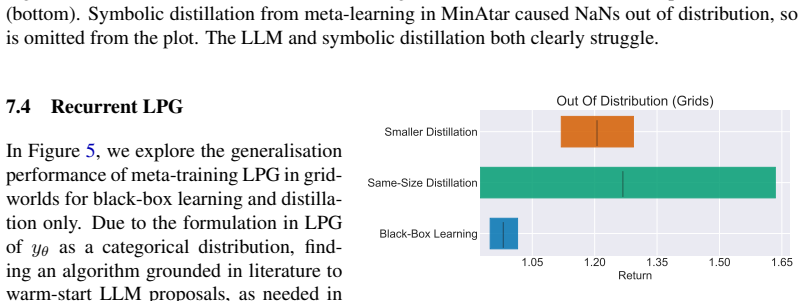
- For any feed-forward or short-rollout algorithm learned as a black box, training a same-size distilled copy is worth trying: it adds no environment samples and often improves out-of-distribution generalisation, while a smaller student can reduce performance.
- Symbolic distillation should not be the default route to interpretable learned RL algorithms: at eight or more inputs it degrades, and for recurrent or long-unroll algorithms it is either infeasible or poor, so LLM proposal is the better interpretability route when warm-starting is possible.
- When the learned component has many inputs or long recurrent unrolls, as with OPEN, black-box learning remains the only scalable meta-learner, so practitioners should expect high sample costs there rather than trying symbolic or LLM shortcuts.
- LLM proposal requires a performant initialisation function to exist; for components with no such baseline, which the paper notes for LPG, LLM proposal is not directly applicable.
- LLM-proposed algorithms usually underperform black-box learning in-distribution, so users who prioritise peak training performance over sample cost and interpretability should still prefer the black-box route.
- A natural test the paper does not run: meta-training each method over several seeds would reveal whether the reported rankings, such as LLM proposal beating black-box learning on Ant and MinAtar, are stable or an artifact of the paper's single-seed protocol.
- Blending meta-learners, which the paper only floats as future work, is the natural next lever: warm-starting LLM proposal from a symbolically distilled function, or feeding black-box-encoded inputs into symbolic search, could combine the sample efficiency and interpretability observed separately.
Reading between the lines
- Not run in the paper: meta-training each method over several seeds would reveal whether the reported rankings, such as LLM proposal beating black-box learning on Ant and MinAtar, are stable or an artifact of the paper's single-seed protocol.
- Blending meta-learners, which the paper only floats as future work, is the natural next lever: warm-starting LLM proposal from a symbolically distilled function, or feeding black-box-encoded inputs into symbolic search, could combine the sample efficiency and interpretability observed separately.
- LLM proposal's edge likely reflects how well gradient-based optimisation is represented in the model's training corpus; components that stray from familiar optimiser and loss families would probably narrow the gap to black-box learning, sharpening the boundary of the paper's first guideline.
- The regularising effect of same-size distillation parallels self-distillation results in supervised learning, suggesting the gains might compound when distillation is applied repeatedly or when the teacher is an ensemble, which would be a testable extension.
Editorial analysis
A structured set of objections, weighed in public.
Referee Report
Summary. The paper presents an empirical comparison of four meta-learning algorithms for discovering RL algorithms: black-box evolution, same-size and smaller black-box distillation, symbolic distillation, and LLM-based proposal. These are applied to several learned components (LPO, a No-Features learned optimiser, feed-forward and recurrent OPEN, and LPG) and evaluated on in-distribution and out-of-distribution returns, sample cost, runtime, interpretability, and scalability. The central claims are that LLM proposal is sample-efficient when warm-started from a strong handcrafted algorithm, that same-size black-box distillation sometimes improves generalisation without extra environment samples, and that symbolic distillation does not scale to recurrent or many-input algorithms. The paper concludes with a set of design recommendations for meta-learning RL algorithms.
Significance. If the findings hold, this is a useful and timely contribution: the community lacks direct comparisons of meta-learning algorithms for RL, and the proposed guidelines could save substantial compute and guide method choice. The paper is unusually transparent for an empirical study: all hyperparameters are in Supplementary A, discovered functions and LLM prompts are in Supplementary C/D, an example LLM conversation is included, and the limitations of single-seed meta-training are explicitly acknowledged. The use of IQM with bootstrap confidence intervals and a diverse set of external environments is also a strength. However, the central claims are empirical guidelines whose statistical basis is weakened by the single-seed meta-training protocol; the paper's significance is therefore conditional on that limitation being addressed or the claims being appropriately reframed.
major comments (3)
- [Section 6, "Due to the high cost of meta-learning ..." and Figures 2-6] The paper meta-trains each algorithm for a single seed and without meta-hyperparameter tuning, yet the reported IQM confidence intervals are over 16 environment seeds. These intervals therefore measure environment-level stochasticity conditional on one meta-training draw, not the variability of the meta-learning method itself. This is load-bearing because several central recommendations, e.g., LLM proposal being "by far the strongest baseline" for No Features in Ant (Section 7.2) and symbolic distillation collapsing on OPEN (Section 7.3), are comparisons between individual stochastic runs of ES, one LLM conversation, and one PySR search. A different meta-training seed could plausibly change the rankings. The paper should either run multiple meta-training seeds for at least the main comparisons, or provide evidence that meta-training seed variance is small relative to the reported effects; otherwise the guidelines should be explicitly reframed as case-study observations rather than robust method comparisons.
- [Section 6 (hyperparameter specification) and Section 7.2] LLM proposals are given per-environment learning-rate tuning for their warm-start initialisation, and checkpoint selection is done by in-distribution return, whereas black-box learning is explicitly not meta-hyperparameter-tuned. This asymmetry creates an unequal comparison: the sample-efficiency and performance advantages attributed to LLM proposal may partly reflect the extra tuning budget and meta-test-time evaluation, not the LLM's search ability. The paper acknowledges the learning-rate dependence qualitatively, but the guidelines in Section 8, especially the first bullet, would be more defensible if the comparison included a tuned black-box baseline or a sensitivity analysis showing that the qualitative conclusions are robust to the tuning budget.
- [Section 7.2/7.3, Figures 3 and 4] Symbolic distillation results are omitted from the plots when the discovered optimiser produces NaN returns out of distribution, with only a brief mention in the captions. Since one of the central claims is that symbolic representations do not scale well to recurrent or many-input algorithms, the paper should quantify how often symbolic distillation produced NaN or otherwise invalid behaviour, and report the failure rate alongside the IQM of the non-NaN runs. Omitting failed runs entirely makes the aggregate plots difficult to interpret and weakens the very scalability claim the paper wants to support.
minor comments (4)
- [Introduction, first paragraph] The text states "We provide our code in an open-source library for meta-learning algorithms" but no repository name, URL, or citation is given; please add a link or a footnote.
- [Figure 2 caption] Typo: "algroithm" should be "algorithm".
- [Supplementary F captions] Typo: "envrionments" should be "environments"; also "gridwords" should be "gridworlds" in the caption of Figure 15.
- [Section 7.4] The phrase "it needssomethingto start from" appears to be a formatting error; insert spaces for readability.
Circularity Check
No circular derivation: the paper's guidelines are empirical comparisons against external RL benchmarks; self-citations appear only as baselines and are not load-bearing proof.
full rationale
The paper makes empirical claims about meta-learning algorithms and does not present a formal derivation in which a prediction reduces to its inputs. LLM proposal is explicitly conditional on a warm-start ('so long as there is a good algorithm from which to kickstart meta-training'), and the paper acknowledges that its good out-of-distribution results are partly inherited from the warm-start PPO or Adam and from per-environment tuned learning rates. Those are disclosed design choices, not hidden fitted parameters renamed as predictions. Distillation results are measured by evaluating students on external environments after checkpoint selection on in-distribution return, so the reported generalisation gains are not forced by the selection procedure. The exclusion of symbolic distillation for recurrent algorithms is argued from input dimensionality before any conclusion is drawn, and the empirical failures of symbolic distillation on OPEN are measured rather than assumed. The only self-citations (e.g., Goldie et al. 2024 for OPEN, No Features, and the pretrained recurrent OPEN optimizer) provide external baselines and prior architecture choices; they do not define the paper's conclusions. Single-seed meta-training is a statistical weakness that limits the strength of the rankings, but it is not circularity: no equation equates an output to an input by construction, and no fitted value is renamed as a prediction. Therefore the appropriate circularity score is 0.
Assumptions & free parameters
free parameters (5)
- per-environment optimizer learning rates =
e.g., SGD LR 0.52 for MinAtar Breakout, 0.17 for Ant; L2O Adam LR 3e-3 for Breakout, 3e-4 for Ant (Tables 4-6)
- ES meta-learning hyperparameters =
ES LR 3e-2, sigma init 3e-2, sigma decay 0.999, population size 64 (Table 8)
- distillation learning rate =
sweep over [0.1, 0.02, 0.001], best checkpoint selected by in-distribution return (Appendix A.3)
- symbolic distillation budgets =
Max Size 40 or 60, Populations 31 or 160, 400 effective PySR iterations (Table 10)
- LLM model and prompt =
GPT o3-mini with DiscoPOP-style prompts (Sections 4.5 and Appendix D)
assumptions (5)
- standard math Markov decision process formalism and discounted-return objective
- domain assumption Mirror learning drift validity conditions (nonnegative, zero at identity, zero gradient at identity)
- ad hoc to paper Single-seed meta-training is representative of each meta-learning algorithm
- domain assumption The selected learned algorithms cover the relevant design space
- domain assumption LLM pretraining contains enough optimization knowledge to propose performant algorithms
Cite this review
Pith. "Pith review of How Should We Meta-Learn Reinforcement Learning Algorithms?." pith.science (2026). https://pith.science/paper/DZSMDMJM
@misc{pith2026250717668,
  author       = {Pith},
  title        = {Pith review of: How Should We Meta-Learn Reinforcement Learning Algorithms?},
  year         = {2026},
  howpublished = {\url{https://pith.science/paper/DZSMDMJM}},
  note         = {Machine review of arXiv:2507.17668}
}
read the original abstract
The process of meta-learning algorithms from data, instead of relying on manual design, is growing in popularity as a paradigm for improving the performance of machine learning systems. Meta-learning shows particular promise for reinforcement learning (RL), where algorithms are often adapted from supervised or unsupervised learning despite their suboptimality for RL. However, until now there has been a severe lack of comparison between different meta-learning algorithms, such as using evolution to optimise over black-box functions or LLMs to propose code. In this paper, we carry out this empirical comparison of the different approaches when applied to a range of meta-learned algorithms which target different parts of the RL pipeline. In addition to meta-train and meta-test performance, we also investigate factors including the interpretability, sample cost and train time for each meta-learning algorithm. Based on these findings, we propose several guidelines for meta-learning new RL algorithms which will help ensure that future learned algorithms are as performant as possible.
Figures


Figures from the paper (15 more)



Forward citations
Cited by 1 Pith paper
-
LEMUR: Learning to Align with Multi-Objective Reinforcement Learning from Preference Feedback
LEMUR jointly learns a separate reward model for each teacher's preferences and uses them to train a population of multi-objective policies, beating baselines that merge feedback into one reward.
Reference graph
Works this paper leans on
-
[1]
Zaheer Abbas, Rosie Zhao, Joseph Modayil, Adam White, and Marlos C. Machado. Loss of Plasticity in Continual Deep Reinforcement Learning , March 2023. URL http://arxiv.org/abs/2303.07507
arXiv 2023
-
[2]
Towards characterizing divergence in deep q-learning
Joshua Achiam, Ethan Knight, and Pieter Abbeel. Towards characterizing divergence in deep q-learning. arXiv preprint arXiv:1903.08894, 2019
arXiv 1903
-
[3]
A Method for Evaluating Hyperparameter Sensitivity in Reinforcement Learning , February 2025
Jacob Adkins, Michael Bowling, and Adam White. A Method for Evaluating Hyperparameter Sensitivity in Reinforcement Learning , February 2025. URL http://arxiv.org/abs/2412.07165. arXiv:2412.07165 [cs]
arXiv 2025
-
[4]
Deep reinforcement learning at the edge of the statistical precipice
Rishabh Agarwal, Max Schwarzer, Pablo Samuel Castro, Aaron Courville, and Marc G Bellemare. Deep reinforcement learning at the edge of the statistical precipice. Advances in Neural Information Processing Systems, 2021
2021
-
[5]
A Generalizable Approach to Learning Optimizers , June 2021
Diogo Almeida, Clemens Winter, Jie Tang, and Wojciech Zaremba. A Generalizable Approach to Learning Optimizers , June 2021. URL http://arxiv.org/abs/2106.00958
arXiv 2021
-
[6]
Hoffman, David Pfau, Tom Schaul, Brendan Shillingford, and Nando de Freitas
Marcin Andrychowicz, Misha Denil, Sergio Gómez Colmenarejo, Matthew W. Hoffman, David Pfau, Tom Schaul, Brendan Shillingford, and Nando de Freitas. Learning to learn by gradient descent by gradient descent. In Proceedings of the 30th international conference on neural information processing systems, NIPS '16, pp.\ 3988--3996, Red Hook, NY, USA, 2016. Curr...
2016
-
[7]
An information-theoretic perspective on intrinsic motivation in reinforcement learning: A survey
Arthur Aubret, Laetitia Matignon, and Salima Hassas. An information-theoretic perspective on intrinsic motivation in reinforcement learning: A survey. Entropy, 25 0 (2): 0 327, 2023
2023
-
[8]
A Survey of Meta - Reinforcement Learning , August 2024
Jacob Beck, Risto Vuorio, Evan Zheran Liu, Zheng Xiong, Luisa Zintgraf, Chelsea Finn, and Shimon Whiteson. A Survey of Meta - Reinforcement Learning , August 2024. URL http://arxiv.org/abs/2301.08028
arXiv 2024
Show all 85 references
-
[9]
OpenAI gym, 2016
Greg Brockman, Vicki Cheung, Ludwig Pettersson, Jonas Schneider, John Schulman, Jie Tang, and Wojciech Zaremba. OpenAI gym, 2016
2016
-
[10]
Exploration by random network distillation
Yuri Burda, Harrison Edwards, Amos Storkey, and Oleg Klimov. Exploration by random network distillation. arXiv preprint arXiv:1810.12894, 2018
2018 arXiv
-
[11]
Boltzmann exploration done right
Nicol \`o Cesa-Bianchi, Claudio Gentile, G \'a bor Lugosi, and Gergely Neu. Boltzmann exploration done right. Advances in neural information processing systems, 30, 2017
2017
-
[12]
Xiangning Chen, Chen Liang, Da Huang, Esteban Real, Kaiyuan Wang, Yao Liu, Hieu Pham, Xuanyi Dong, Thang Luong, Cho-Jui Hsieh, Yifeng Lu, and Quoc V. Le. Symbolic Discovery of Optimization Algorithms , May 2023. URL http://arxiv.org/abs/2302.06675
2023 arXiv
-
[13]
Interpretable Machine Learning for Science with PySR and SymbolicRegression .jl, May 2023
Miles Cranmer. Interpretable Machine Learning for Science with PySR and SymbolicRegression .jl, May 2023. URL http://arxiv.org/abs/2305.01582. arXiv:2305.01582 [astro-ph]
2023 arXiv
-
[14]
Discovering Symbolic Models from Deep Learning with Inductive Biases , November 2020
Miles Cranmer, Alvaro Sanchez-Gonzalez, Peter Battaglia, Rui Xu, Kyle Cranmer, David Spergel, and Shirley Ho. Discovering Symbolic Models from Deep Learning with Inductive Biases , November 2020. URL http://arxiv.org/abs/2006.11287
2020 arXiv
-
[15]
DeepSeek-AI , Daya Guo, Dejian Yang, Haowei Zhang, Junxiao Song, Ruoyu Zhang, Runxin Xu, Qihao Zhu, Shirong Ma, Peiyi Wang, Xiao Bi, Xiaokang Zhang, Xingkai Yu, Yu Wu, Z. F. Wu, Zhibin Gou, Zhihong Shao, Zhuoshu Li, Ziyi Gao, Aixin Liu, Bing Xue, Bingxuan Wang, Bochao Wu, Bei ...
2025 arXiv
-
[16]
Emergent Complexity and Zero -shot Transfer via Unsupervised Environment Design , February 2021
Michael Dennis, Natasha Jaques, Eugene Vinitsky, Alexandre Bayen, Stuart Russell, Andrew Critch, and Sergey Levine. Emergent Complexity and Zero -shot Transfer via Unsupervised Environment Design , February 2021. URL http://arxiv.org/abs/2012.02096
2021 arXiv
-
[17]
Loss of plasticity in deep continual learning
Shibhansh Dohare, J Fernando Hernandez-Garcia, Qingfeng Lan, Parash Rahman, A Rupam Mahmood, and Richard S Sutton. Loss of plasticity in deep continual learning. Nature, 632 0 (8026): 0 768--774, 2024
2024
-
[18]
Rl ^2 : Fast reinforcement learning via slow reinforcement learning
Yan Duan, John Schulman, Xi Chen, Peter L Bartlett, Ilya Sutskever, and Pieter Abbeel. Rl ^2 : Fast reinforcement learning via slow reinforcement learning. arXiv preprint arXiv:1611.02779, 2016
2016 arXiv
-
[19]
Jackson, Andrei Lupu, Alexander D
Benjamin Ellis, Matthew T. Jackson, Andrei Lupu, Alexander D. Goldie, Mattie Fellows, Shimon Whiteson, and Jakob Foerster. Adam on Local Time : Addressing Nonstationarity in RL with Relative Adam Timesteps , December 2024. URL http://arxiv.org/abs/2412.17113. arXiv:2412.17113 [cs]
2024 arXiv
-
[20]
OMNI - EPIC : Open -endedness via Models of human Notions of Interestingness with Environments Programmed in Code , May 2024
Maxence Faldor, Jenny Zhang, Antoine Cully, and Jeff Clune. OMNI - EPIC : Open -endedness via Models of human Notions of Interestingness with Environments Programmed in Code , May 2024. URL http://arxiv.org/abs/2405.15568. arXiv:2405.15568 [cs]
2024 arXiv
-
[21]
Model-agnostic meta-learning for fast adaptation of deep networks
Chelsea Finn, Pieter Abbeel, and Sergey Levine. Model-agnostic meta-learning for fast adaptation of deep networks. In International conference on machine learning, pp.\ 1126--1135. PMLR, 2017
2017
-
[22]
Noisy Networks for Exploration , July 2019
Meire Fortunato, Mohammad Gheshlaghi Azar, Bilal Piot, Jacob Menick, Ian Osband, Alex Graves, Vlad Mnih, Remi Munos, Demis Hassabis, Olivier Pietquin, Charles Blundell, and Shane Legg. Noisy Networks for Exploration , July 2019. URL http://arxiv.org/abs/1706.10295. arXiv:1706....
2019 arXiv
-
[23]
Daniel Freeman, Erik Frey, Anton Raichuk, Sertan Girgin, Igor Mordatch, and Olivier Bachem
C. Daniel Freeman, Erik Frey, Anton Raichuk, Sertan Girgin, Igor Mordatch, and Olivier Bachem. Brax - a differentiable physics engine for large scale rigid body simulation, 2021. URL http://github.com/google/brax
2021
-
[24]
Lipton, Michael Tschannen, Laurent Itti, and Anima Anandkumar
Tommaso Furlanello, Zachary C. Lipton, Michael Tschannen, Laurent Itti, and Anima Anandkumar. Born Again Neural Networks , June 2018. URL http://arxiv.org/abs/1805.04770. arXiv:1805.04770 [stat]
2018 arXiv
-
[25]
Goldie, Chris Lu, Matthew T
Alexander D. Goldie, Chris Lu, Matthew T. Jackson, Shimon Whiteson, and Jakob N. Foerster. Can Learned Optimization Make Reinforcement Learning Less Difficult ? In Advances in Neural Information Processing Systems , volume 37, pp.\ 5454--5497, 2024
2024
-
[26]
Benchmarking the spectrum of agent capabilities
Danijar Hafner. Benchmarking the spectrum of agent capabilities. arXiv preprint arXiv:2109.06780, 2021
2021 arXiv
-
[27]
Distilling the Knowledge in a Neural Network , March 2015
Geoffrey Hinton, Oriol Vinyals, and Jeff Dean. Distilling the Knowledge in a Neural Network , March 2015. URL http://arxiv.org/abs/1503.02531. arXiv:1503.02531 [stat]
2015 arXiv
-
[28]
Long short-term memory
Sepp Hochreiter and J\" u rgen Schmidhuber. Long short-term memory. Neural Comput., 9 0 (8): 0 1735–1780, November 1997. ISSN 0899-7667. doi:10.1162/neco.1997.9.8.1735. URL https://doi.org/10.1162/neco.1997.9.8.1735
1997 doi
-
[29]
Automated Design of Agentic Systems , August 2024
Shengran Hu, Cong Lu, and Jeff Clune. Automated Design of Agentic Systems , August 2024. URL http://arxiv.org/abs/2408.08435
2024 arXiv
-
[30]
Transient non-stationarity and generalisation in deep reinforcement learning
Maximilian Igl, Gregory Farquhar, Jelena Luketina, Wendelin Boehmer, and Shimon Whiteson. Transient non-stationarity and generalisation in deep reinforcement learning. In International Conference on Learning Representations, 2021 a . URL https://openreview.net/forum?id=Qun8fv4qSby
2021
-
[31]
Transient non-stationarity and generalisation in deep reinforcement learning
Maximilian Igl, Gregory Farquhar, Jelena Luketina, Wendelin Boehmer, and Shimon Whiteson. Transient non-stationarity and generalisation in deep reinforcement learning. In International conference on learning representations, 2021 b . URL https://openreview.net/forum?id=Qun8fv4qSby
2021
-
[32]
Discovering General Reinforcement Learning Algorithms with Adversarial Environment Design , October 2023
Matthew Thomas Jackson, Minqi Jiang, Jack Parker-Holder, Risto Vuorio, Chris Lu, Gregory Farquhar, Shimon Whiteson, and Jakob Nicolaus Foerster. Discovering General Reinforcement Learning Algorithms with Adversarial Environment Design , October 2023. URL http://arxiv.org/abs/2...
2023 arXiv
-
[33]
Discovering temporally-aware reinforcement learning algorithms
Matthew Thomas Jackson, Chris Lu, Louis Kirsch, Robert Tjarko Lange, Shimon Whiteson, and Jakob Nicolaus Foerster. Discovering temporally-aware reinforcement learning algorithms. In The Twelfth International Conference on Learning Representations, 2024. URL https://openreview....
2024
-
[34]
Improving policy optimization with generalist-specialist learning
Zhiwei Jia, Xuanlin Li, Zhan Ling, Shuang Liu, Yiran Wu, and Hao Su. Improving policy optimization with generalist-specialist learning. In International Conference on Machine Learning, pp.\ 10104--10119. PMLR, 2022
2022
-
[35]
Meta Learning Backpropagation And Improving It , March 2022
Louis Kirsch and Jürgen Schmidhuber. Meta Learning Backpropagation And Improving It , March 2022. URL http://arxiv.org/abs/2012.14905
2022 arXiv
-
[36]
Improving generalization in meta reinforcement learning using learned objectives
Louis Kirsch, Sjoerd van Steenkiste, and Juergen Schmidhuber. Improving generalization in meta reinforcement learning using learned objectives. In International Conference on Learning Representations, 2020. URL https://openreview.net/forum?id=S1evHerYPr
2020
-
[37]
Mirror Learning : A Unifying Framework of Policy Optimisation , November 2024
Jakub Grudzien Kuba, Christian Schroeder de Witt, and Jakob Foerster. Mirror Learning : A Unifying Framework of Policy Optimisation , November 2024. URL http://arxiv.org/abs/2201.02373. arXiv:2201.02373 [cs]
2024 arXiv
-
[38]
Rupam Mahmood, Shuicheng Yan, and Zhongwen Xu
Qingfeng Lan, A. Rupam Mahmood, Shuicheng Yan, and Zhongwen Xu. Learning to Optimize for Reinforcement Learning , June 2024. URL http://arxiv.org/abs/2302.01470
2024 arXiv
-
[39]
gymnax: A JAX -based reinforcement learning environment library, 2022 a
Robert Tjarko Lange. gymnax: A JAX -based reinforcement learning environment library, 2022 a . URL http://github.com/RobertTLange/gymnax
2022
-
[40]
evosax: JAX -based Evolution Strategies
Robert Tjarko Lange. evosax: JAX -based Evolution Strategies . arXiv preprint arXiv:2212.04180, 2022 b
2022 arXiv
-
[41]
In-context reinforcement learning with algorithm distillation
Michael Laskin, Luyu Wang, Junhyuk Oh, Emilio Parisotto, Stephen Spencer, Richie Steigerwald, DJ Strouse, Steven Stenberg Hansen, Angelos Filos, Ethan Brooks, maxime gazeau, Himanshu Sahni, Satinder Singh, and Volodymyr Mnih. In-context reinforcement learning with algorithm di...
2023
-
[42]
Joel Lehman, Jonathan Gordon, Shawn Jain, Kamal Ndousse, Cathy Yeh, and Kenneth O. Stanley. Evolution through Large Models , June 2022. URL http://arxiv.org/abs/2206.08896
2022 arXiv
-
[43]
Rediscovering orbital mechanics with machine learning
Pablo Lemos, Niall Jeffrey, Miles Cranmer, Shirley Ho, and Peter Battaglia. Rediscovering orbital mechanics with machine learning. Machine Learning: Science and Technology, 4 0 (4): 0 045002, 2023
2023
-
[44]
Discovered policy optimisation
Chris Lu, Jakub Kuba, Alistair Letcher, Luke Metz, Christian Schroeder de Witt, and Jakob Foerster. Discovered policy optimisation. Advances in Neural Information Processing Systems, 35: 0 16455--16468, 2022
2022
-
[45]
Chan, Jakob Foerster, Mihaela van der Schaar, and Robert Tjarko Lange
Chris Lu, Samuel Holt, Claudio Fanconi, Alex J. Chan, Jakob Foerster, Mihaela van der Schaar, and Robert Tjarko Lange. Discovering Preference Optimization Algorithms with and for Large Language Models , September 2024. URL http://arxiv.org/abs/2406.08414
2024 arXiv
-
[46]
Behaviour Distillation
Andrei Lupu, Chris Lu, Jarek Luca Liesen, Robert Tjarko Lange, and Jakob Nicolaus Foerster. Behaviour Distillation . In The Twelfth International Conference on Learning Representations , 2024. URL https://openreview.net/forum?id=qup9xD8mW4
2024
-
[47]
Understanding plasticity in neural networks, August 2023
Clare Lyle, Zeyu Zheng, Evgenii Nikishin, Bernardo Avila Pires, Razvan Pascanu, and Will Dabney. Understanding plasticity in neural networks, August 2023. URL http://arxiv.org/abs/2303.01486
2023 arXiv
-
[48]
Craftax: a lightning-fast benchmark for open-ended reinforcement learning
Michael Matthews, Michael Beukman, Benjamin Ellis, Mikayel Samvelyan, Matthew Jackson, Samuel Coward, and Jakob Foerster. Craftax: a lightning-fast benchmark for open-ended reinforcement learning. In International conference on machine learning ( ICML ) , 2024
2024
-
[49]
Interpretable machine learning methods applied to jet background subtraction in heavy-ion collisions
Tanner Mengel, Patrick Steffanic, Charles Hughes, Antonio Carlos Oliveira da Silva, and Christine Nattrass. Interpretable machine learning methods applied to jet background subtraction in heavy-ion collisions. Physical Review C, 108 0 (2): 0 L021901, 2023
2023
-
[50]
Meta- Learning Update Rules for Unsupervised Representation Learning , February 2019 a
Luke Metz, Niru Maheswaranathan, Brian Cheung, and Jascha Sohl-Dickstein. Meta- Learning Update Rules for Unsupervised Representation Learning , February 2019 a . URL http://arxiv.org/abs/1804.00222. arXiv:1804.00222 [cs, stat]
2019 arXiv
-
[51]
Daniel Freeman, and Jascha Sohl-Dickstein
Luke Metz, Niru Maheswaranathan, Jeremy Nixon, C. Daniel Freeman, and Jascha Sohl-Dickstein. Understanding and correcting pathologies in the training of learned optimizers, June 2019 b . URL http://arxiv.org/abs/1810.10180
2019 arXiv
-
[52]
Daniel Freeman, Ben Poole, and Jascha Sohl-Dickstein
Luke Metz, Niru Maheswaranathan, C. Daniel Freeman, Ben Poole, and Jascha Sohl-Dickstein. Tasks, stability, architecture, and compute: Training more effective learned optimizers, and using them to train themselves, September 2020. URL http://arxiv.org/abs/2009.11243
2020 arXiv
-
[53]
Daniel Freeman, Samuel S
Luke Metz, C. Daniel Freeman, Samuel S. Schoenholz, and Tal Kachman. Gradients are Not All You Need , January 2022 a . URL http://arxiv.org/abs/2111.05803. arXiv:2111.05803 [cs]
2022 arXiv
-
[54]
Daniel Freeman, Amil Merchant, Lucas Beyer, James Bradbury, Naman Agrawal, Ben Poole, Igor Mordatch, Adam Roberts, and Jascha Sohl-Dickstein
Luke Metz, James Harrison, C. Daniel Freeman, Amil Merchant, Lucas Beyer, James Bradbury, Naman Agrawal, Ben Poole, Igor Mordatch, Adam Roberts, and Jascha Sohl-Dickstein. VeLO : Training Versatile Learned Optimizers by Scaling Up , November 2022 b . URL http://arxiv.org/abs/2...
2022 arXiv
-
[55]
Self-distillation amplifies regularization in hilbert space
Hossein Mobahi, Mehrdad Farajtabar, and Peter Bartlett. Self-distillation amplifies regularization in hilbert space. Advances in Neural Information Processing Systems, 33: 0 3351--3361, 2020
2020
-
[56]
Small batch deep reinforcement learning
Johan Obando Ceron, Marc Bellemare, and Pablo Samuel Castro. Small batch deep reinforcement learning. Advances in Neural Information Processing Systems, 36: 0 26003--26024, 2023
2023
-
[57]
Discovering reinforcement learning algorithms
Junhyuk Oh, Matteo Hessel, Wojciech M Czarnecki, Zhongwen Xu, Hado P van Hasselt, Satinder Singh, and David Silver. Discovering reinforcement learning algorithms. Advances in Neural Information Processing Systems, 33: 0 1060--1070, 2020
2020
-
[58]
Openai o3-mini, January 2025
OpenAI. Openai o3-mini, January 2025. URL https://openai.com/index/openai-o3-mini/
2025
-
[59]
Stabilizing transformers for reinforcement learning
Emilio Parisotto, Francis Song, Jack Rae, Razvan Pascanu, Caglar Gulcehre, Siddhant Jayakumar, Max Jaderberg, Raphael Lopez Kaufman, Aidan Clark, Seb Noury, et al. Stabilizing transformers for reinforcement learning. In International conference on machine learning, pp.\ 7487--...
2020
-
[60]
Evolving Curricula with Regret - Based Environment Design
Jack Parker-Holder, Minqi Jiang, Michael Dennis, Mikayel Samvelyan, Jakob Foerster, Edward Grefenstette, and Tim Rocktäschel. Evolving Curricula with Regret - Based Environment Design . In Kamalika Chaudhuri, Stefanie Jegelka, Le Song, Csaba Szepesvari, Gang Niu, and Sivan Sab...
2022
-
[61]
Chen, Xi Chen, Tamim Asfour, Pieter Abbeel, and Marcin Andrychowicz
Matthias Plappert, Rein Houthooft, Prafulla Dhariwal, Szymon Sidor, Richard Y. Chen, Xi Chen, Tamim Asfour, Pieter Abbeel, and Marcin Andrychowicz. Parameter Space Noise for Exploration , January 2018. URL http://arxiv.org/abs/1706.01905. arXiv:1706.01905 [cs]
2018 arXiv
-
[62]
Tunability: Importance of hyperparameters of machine learning algorithms
Philipp Probst, Anne-Laure Boulesteix, and Bernd Bischl. Tunability: Importance of hyperparameters of machine learning algorithms. Journal of Machine Learning Research, 20 0 (53): 0 1--32, 2019
2019
-
[63]
Evolutionsstrategie : Optimierung technischer systeme nach prinzipien der biologischen evolution
Ingo Rechenberg. Evolutionsstrategie : Optimierung technischer systeme nach prinzipien der biologischen evolution. 1973. URL https://api.semanticscholar.org/CorpusID:60975248
1973
-
[64]
Pawan Kumar, Emilien Dupont, Francisco J
Bernardino Romera-Paredes, Mohammadamin Barekatain, Alexander Novikov, Matej Balog, M. Pawan Kumar, Emilien Dupont, Francisco J. R. Ruiz, Jordan S. Ellenberg, Pengming Wang, Omar Fawzi, Pushmeet Kohli, and Alhussein Fawzi. Mathematical discoveries from program search with larg...
2024 doi
-
[65]
Rusu, Sergio Gomez Colmenarejo, Caglar Gulcehre, Guillaume Desjardins, James Kirkpatrick, Razvan Pascanu, Volodymyr Mnih, Koray Kavukcuoglu, and Raia Hadsell
Andrei A. Rusu, Sergio Gomez Colmenarejo, Caglar Gulcehre, Guillaume Desjardins, James Kirkpatrick, Razvan Pascanu, Volodymyr Mnih, Koray Kavukcuoglu, and Raia Hadsell. Policy Distillation , January 2016. URL http://arxiv.org/abs/1511.06295. arXiv:1511.06295 [cs]
2016 arXiv
-
[66]
Evolution Strategies as a Scalable Alternative to Reinforcement Learning , September 2017
Tim Salimans, Jonathan Ho, Xi Chen, Szymon Sidor, and Ilya Sutskever. Evolution Strategies as a Scalable Alternative to Reinforcement Learning , September 2017. URL http://arxiv.org/abs/1703.03864. arXiv:1703.03864 [cs, stat]
2017 arXiv
-
[67]
Proximal Policy Optimization Algorithms , August 2017
John Schulman, Filip Wolski, Prafulla Dhariwal, Alec Radford, and Oleg Klimov. Proximal Policy Optimization Algorithms , August 2017. URL http://arxiv.org/abs/1707.06347
2017 arXiv
-
[68]
High- Dimensional Continuous Control Using Generalized Advantage Estimation , October 2018
John Schulman, Philipp Moritz, Sergey Levine, Michael Jordan, and Pieter Abbeel. High- Dimensional Continuous Control Using Generalized Advantage Estimation , October 2018. URL http://arxiv.org/abs/1506.02438
2018 arXiv
-
[69]
The Dormant Neuron Phenomenon in Deep Reinforcement Learning , June 2023
Ghada Sokar, Rishabh Agarwal, Pablo Samuel Castro, and Utku Evci. The Dormant Neuron Phenomenon in Deep Reinforcement Learning , June 2023. URL http://arxiv.org/abs/2302.12902
2023 arXiv
-
[70]
Distilling Reinforcement Learning Algorithms for In - Context Model - Based Planning , February 2025
Jaehyeon Son, Soochan Lee, and Gunhee Kim. Distilling Reinforcement Learning Algorithms for In - Context Model - Based Planning , February 2025. URL http://arxiv.org/abs/2502.19009. arXiv:2502.19009 [cs]
2025 arXiv
-
[71]
Generalizable Symbolic Optimizer Learning
Xiaotian Song, Peng Zeng, Yanan Sun, and Andy Song. Generalizable Symbolic Optimizer Learning . 2024 a
2024
-
[72]
Position: Leverage Foundational Models for Black - Box Optimization , May 2024 b
Xingyou Song, Yingtao Tian, Robert Tjarko Lange, Chansoo Lee, Yujin Tang, and Yutian Chen. Position: Leverage Foundational Models for Black - Box Optimization , May 2024 b . URL http://arxiv.org/abs/2405.03547
2024 arXiv
-
[73]
Maxinfo RL : Boosting exploration in reinforcement learning through information gain maximization
Bhavya Sukhija, Stelian Coros, Andreas Krause, Pieter Abbeel, and Carmelo Sferrazza. Maxinfo RL : Boosting exploration in reinforcement learning through information gain maximization. In The Thirteenth International Conference on Learning Representations, 2025. URL https://ope...
2025
-
[74]
Sutton and Andrew Barto
Richard S. Sutton and Andrew Barto. Reinforcement learning: an introduction. Adaptive computation and machine learning. The MIT Press, Cambridge, Massachusetts London, England, second edition edition, 2020. ISBN 978-0-262-03924-6
2020
-
[75]
Improving deep reinforcement learning by reducing the chain effect of value and policy churn
Hongyao Tang and Glen Berseth. Improving deep reinforcement learning by reducing the chain effect of value and policy churn. In The Thirty-eighth Annual Conference on Neural Information Processing Systems, 2024. URL https://openreview.net/forum?id=cQoAgPBARc
2024
-
[76]
MuJoCo : A physics engine for model-based control
Emanuel Todorov, Tom Erez, and Yuval Tassa. MuJoCo : A physics engine for model-based control. In 2012 IEEE / RSJ international conference on intelligent robots and systems , pp.\ 5026--5033. IEEE, 2012. doi:10.1109/IROS.2012.6386109
2012
-
[77]
Deep reinforcement learning and the deadly triad
Hado Van Hasselt, Yotam Doron, Florian Strub, Matteo Hessel, Nicolas Sonnerat, and Joseph Modayil. Deep reinforcement learning and the deadly triad. arXiv preprint arXiv:1812.02648, 2018
2018 arXiv
-
[78]
Gomez, Lukasz Kaiser, and Illia Polosukhin
Ashish Vaswani, Noam Shazeer, Niki Parmar, Jakob Uszkoreit, Llion Jones, Aidan N. Gomez, Lukasz Kaiser, and Illia Polosukhin. Attention Is All You Need , August 2023. URL http://arxiv.org/abs/1706.03762. arXiv:1706.03762 [cs]
2023 arXiv
-
[79]
Tongzhou Wang, Jun-Yan Zhu, Antonio Torralba, and Alexei A. Efros. Dataset Distillation , February 2020. URL http://arxiv.org/abs/1811.10959. arXiv:1811.10959 [cs]
2020 arXiv
-
[80]
Natural Evolution Strategies , June 2011
Daan Wierstra, Tom Schaul, Tobias Glasmachers, Yi Sun, and Jürgen Schmidhuber. Natural Evolution Strategies , June 2011. URL http://arxiv.org/abs/1106.4487
2011 arXiv
-
[81]
Understanding short-horizon bias in stochastic meta-optimization
Yuhuai Wu, Mengye Ren, Renjie Liao, and Roger Grosse. Understanding short-horizon bias in stochastic meta-optimization. In International Conference on Learning Representations, 2018. URL https://openreview.net/forum?id=H1MczcgR-
2018
-
[82]
MinAtar : An atari-inspired testbed for thorough and reproducible reinforcement learning experiments
Kenny Young and Tian Tian. MinAtar : An atari-inspired testbed for thorough and reproducible reinforcement learning experiments. arXiv preprint arXiv:1903.03176, 2019
1903 arXiv
-
[83]
Self-distillation as instance-specific label smoothing
Zhilu Zhang and Mert Sabuncu. Self-distillation as instance-specific label smoothing. Advances in Neural Information Processing Systems, 33: 0 2184--2195, 2020
2020
-
[84]
Symbolic Learning to Optimize : Towards Interpretability and Scalability , May 2022
Wenqing Zheng, Tianlong Chen, Ting-Kuei Hu, and Zhangyang Wang. Symbolic Learning to Optimize : Towards Interpretability and Scalability , May 2022. URL http://arxiv.org/abs/2203.06578
2022 arXiv
-
[85]
write newline
" write newline "" before.all 'output.state := FUNCTION n.dashify 't := "" t empty not t #1 #1 substring "-" = t #1 #2 substring "--" = not "--" * t #2 global.max substring 't := t #1 #1 substring "-" = "-" * t #2 global.max substring 't := while if t #1 #1 substring * t #2 gl...
Reviewed August 6, 2026 · model on record in the stance chip above.
Discussion (0). Sign in to comment.