The free boundary problem in general relativity
Pith reviewed 2026-06-26 23:27 UTC · model grok-4.3
The pith
Treating the cosmological singularity as a free boundary imposes conditions that exclude Kasner and BKL spacetimes but allow regular FLRW models.
A machine-rendered reading of the paper's core claim, the machinery that carries it, and where it could break.
Core claim
Demanding stationarity of the Einstein-Hilbert action under unconstrained variations at a singular boundary yields on-shell boundary conditions that exclude Kasner and BKL singularities while admitting conformally regular spacetimes with 0 ≤ P < ρ fluids; for FLRW, perturbations satisfy reflecting conditions at the bang.
What carries the argument
The free boundary treatment of the singularity in the variational principle, deriving boundary conditions directly from action stationarity without regularization.
If this is right
- Kasner and BKL spacetimes are excluded by the boundary conditions.
- Conformally regular spacetimes with fluids 0 ≤ P < ρ are allowed.
- FLRW linear scalar, vector, and tensor perturbations must satisfy reflecting boundary conditions at the singularity.
- This selection is consistent with cosmological observations on large scales.
Where Pith is reading between the lines
- Such boundary conditions could provide a principle for selecting initial conditions in quantum gravity approaches to the big bang.
- Similar free boundary methods might apply to other singularities like those in black holes.
- Reflecting conditions suggest a kind of symmetry in perturbation evolution through the singularity.
- This approach could be tested by checking consistency with CMB data on large scales.
Load-bearing premise
It is valid to apply the standard action principle by treating the singularity directly as a free boundary without regularization or modification.
What would settle it
Deriving that a Kasner spacetime satisfies the stationarity condition under free variations at the singularity would falsify the claim, or observing non-reflecting perturbations in cosmology.
Figures
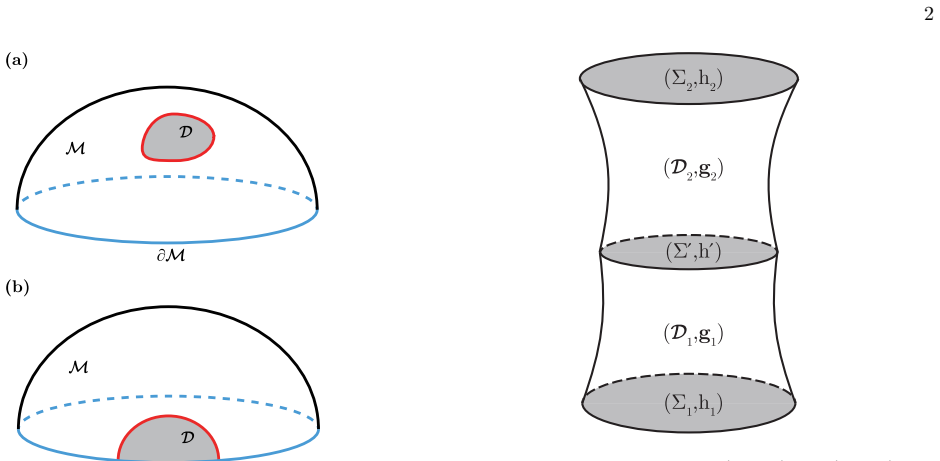
read the original abstract
We study the action principle for space-times whose boundary is singular. We suggest that it is natural to treat the singularity as a {\it free} boundary, where the variation is unconstrained. Demanding that the action is stationary under such free variations then implies certain (on-shell) boundary conditions at the singularity. We derive these boundary conditions for the case of Einstein gravity coupled to matter and show that, when applied to an initial spacelike singularity, they exclude Kasner-like or BKL space-times, but admit conformally regular space-times (including FLRW models) sourced by fluids satisfying $0 \leq P < \rho$. For standard hot big bang FLRW cosmologies, the admissible linear (scalar, vector, tensor) perturbations satisfy reflecting boundary conditions at the bang, in agreement with large-scale cosmological observations.
Editorial analysis
A structured set of objections, weighed in public.
Referee Report
Summary. The manuscript proposes treating singular boundaries in general relativity as free boundaries with unconstrained variations in the Einstein-Hilbert action coupled to matter. Stationarity of the action under such variations yields on-shell boundary conditions at an initial spacelike singularity that exclude Kasner-like and BKL spacetimes while admitting conformally regular solutions, including FLRW cosmologies sourced by perfect fluids satisfying 0 ≤ P < ρ. For FLRW backgrounds the admissible linear scalar, vector, and tensor perturbations obey reflecting boundary conditions at the bang, consistent with large-scale observations.
Significance. If the central derivation holds, the work supplies a variational criterion for admissible singularities that is free of additional parameters or regularization and directly selects against chaotic BKL behavior while permitting observationally viable FLRW perturbations. This constitutes a parameter-free selection mechanism grounded in the standard action principle, with potential implications for early-universe cosmology.
minor comments (2)
- The abstract states that the boundary conditions are derived for Einstein gravity coupled to matter, but the explicit variation (including the precise form of the boundary term that must vanish) should be written out with equation numbers in the main text to allow direct verification of the exclusion of Kasner/BKL solutions.
- Notation for the fluid equation of state (0 ≤ P < ρ) and the definition of conformal regularity should be introduced with a brief reminder of the relevant curvature invariants or metric ansatz when first used.
Simulated Author's Rebuttal
We thank the referee for their positive summary, assessment of significance, and recommendation for minor revision. No specific major comments were raised in the report.
Circularity Check
No significant circularity
full rationale
The paper applies the standard variational principle by treating the singularity as a free boundary with unconstrained variations, then derives on-shell boundary conditions for Einstein gravity plus matter. This is a direct logical extension of the action principle to a new setting; the resulting conditions (excluding Kasner/BKL while admitting conformally regular FLRW with 0 ≤ P < ρ, and reflecting perturbations) follow from stationarity without any reduction to fitted parameters, self-definitional loops, or load-bearing self-citations. No equations or steps in the provided abstract or description reduce the claimed result to its inputs by construction. The approach is self-contained as a proposal whose validity is the central claim itself.
Axiom & Free-Parameter Ledger
axioms (1)
- domain assumption The action principle can be applied to space-times with singular boundaries by treating the singularity as a free boundary where variations are unconstrained.
Reference graph
Works this paper leans on
-
[1]
Solutions like these occur both in pure gravity (where ∑i p2 i =1) and also for stiff matter, or massless scalars, where ∑i p2 i <1 [18–21]
A subclass of such geometries are homogeneous (but anisotropic)Kasner-like geometriesof the form g=−dt⊗dt+ 3 ∑ i=1 t2pi ei⊗ei,(9) where Σ is a 3-manifold with co-framee i, and thep i are functions on Σ satisfying ∑i pi =1. Solutions like these occur both in pure gravity (where ∑i p2 i =1) and also for stiff matter, or massless scalars, where ∑i p2 i <1 [1...
-
[2]
For stiff fluids,w=1, the on-shell action is not finite
If 0≤w<1, the solution(M, 0g)satisfies (6), and is therefore a critical point of the action. For stiff fluids,w=1, the on-shell action is not finite
-
[3]
physically acceptable
For 0≤w<1, the perturbationsδgthat satisfy the linearized version of (6) (Eq. (20) below) obey ∂ϕB ∂η ∣ η=0 = ∂hij ∂η ∣ η=0 =0,(10) 4 whereηis the conformal time,ϕ B is the Bardeen potential, andh ij are the tensor perturbations. No vector perturbations are allowed and the perturbed geometry is conformally regular. In the special cases of dust or perfect ...
-
[4]
S. W. Hawking and G. F. R. Ellis,The Large Scale Struc- ture of Space-Time, Cambridge Monographs on Mathe- matical Physics (Cambridge University Press, 1973)
1973
-
[5]
Christodoulou,The Action Principle and Partial Dif- ferential Equations, Annals of Mathematics Studies No
D. Christodoulou,The Action Principle and Partial Dif- ferential Equations, Annals of Mathematics Studies No. 146 (Princeton University Press, 2000)
2000
-
[6]
Polchinski,String theory
J. Polchinski,String theory. Vol. 1: An introduction to the bosonic string, Cambridge Monographs on Mathe- matical Physics (Cambridge University Press, 2007)
2007
-
[7]
Lovelock, J
D. Lovelock, J. Math. Phys.12, 498 (1971)
1971
-
[8]
Lovelock, J
D. Lovelock, J. Math. Phys.13, 874 (1972)
1972
-
[9]
Chern, Annals of Mathematics45, 747 (1944)
S.-S. Chern, Annals of Mathematics45, 747 (1944)
1944
-
[10]
Chern, Annals of Mathematics46, 674 (1945)
S.-s. Chern, Annals of Mathematics46, 674 (1945)
1945
-
[11]
Eguchi, P
T. Eguchi, P. B. Gilkey, and A. J. Hanson, Physics re- ports66, 213 (1980)
1980
-
[12]
R. C. Myers, Physical Review D36, 392 (1987). 8
1987
-
[13]
S. W. Hawking, The path integral approach to quantum gravity, inGeneral Relativity: An Einstein Centenary Survey(Cambridge University Press, 1979) pp. 746–789
1979
-
[14]
J. W. York, Phys. Rev. Lett.28, 1082 (1972)
1972
-
[15]
G. W. Gibbons and S. W. Hawking, Phys. Rev. D15, 2752 (1977)
1977
-
[16]
Straumann,General Relativity, 2nd ed., Graduate Texts in Physics (Springer, 2013)
N. Straumann,General Relativity, 2nd ed., Graduate Texts in Physics (Springer, 2013)
2013
-
[17]
Krasnov,Formulations of General Relativity: Gravity, Spinors and Differential Forms, Cambridge Monographs on Mathematical Physics (Cambridge University Press, 2020)
K. Krasnov,Formulations of General Relativity: Gravity, Spinors and Differential Forms, Cambridge Monographs on Mathematical Physics (Cambridge University Press, 2020)
2020
-
[18]
K. P. Tod, Classical and Quantum Gravity8, L77 (1991)
1991
-
[19]
R. P. A. C. Newman, Proceedings of the Royal Society of London. Series A: Mathematical and Physical Sciences 443, 473 (1993)
1993
-
[20]
R. P. A. C. Newman, Proceedings of the Royal Society of London. Series A: Mathematical and Physical Sciences 443, 493 (1993)
1993
-
[21]
L. Andersson and A. D. Rendall, Commun. Math. Phys. 218, 479 (2001), arXiv:gr-qc/0001047
Pith/arXiv arXiv 2001
-
[22]
G. Fournodavlos, I. Rodnianski, and J. Speck, J. Am. Math. Soc.36, 827 (2023), arXiv:2012.05888 [math.AP]
arXiv 2023
-
[23]
G. Fournodavlos and J. Luk, Am. J. Math.145, 1183 (2023), arXiv:2003.13591 [gr-qc]
arXiv 2023
-
[24]
N. Athanasiou and G. Fournodavlos, Commun. Math. Phys.406, 252 (2025), arXiv:2412.16630 [math.AP]
arXiv 2025
-
[25]
V. A. Belinsky, I. M. Khalatnikov, and E. M. Lifshitz, Adv. Phys.19, 525 (1970)
1970
-
[26]
V. a. Belinsky, I. m. Khalatnikov, and E. m. Lifshitz, Adv. Phys.31, 639 (1982)
1982
-
[27]
T. Damour, M. Henneaux, B. Julia, and H. Nicolai, Physics Letters B509, 323 (2001), arXiv:hep-th/0103094 [hep-th]
Pith/arXiv arXiv 2001
-
[28]
M. J. Perry, JHEP05(161), arXiv:2301.03443 [hep-th]
-
[29]
C. M. Claudel and K. P. Newman, Proceedings of the Royal Society of London Series A454, 1073 (1998)
1998
-
[30]
K. Anguige and K. P. Tod, Annals of Physics276, 257 (1999), arXiv:gr-qc/9903008 [gr-qc]
Pith/arXiv arXiv 1999
-
[31]
K. Anguige and K. P. Tod, Annals of Physics276, 294 (1999), arXiv:gr-qc/9903009 [gr-qc]
Pith/arXiv arXiv 1999
-
[32]
L. Boyle, K. Finn, and N. Turok, Phys. Rev. Lett.121, 251301 (2018), arXiv:1803.08928 [hep-ph]
Pith/arXiv arXiv 2018
- [33]
-
[34]
N. Turok and L. Boyle, Phys. Lett. B849, 138443 (2024), arXiv:2201.07279 [hep-th]
arXiv 2024
-
[35]
L. Boyle and N. Turok, Phys. Lett. B849, 138442 (2024), arXiv:2210.01142 [gr-qc]
arXiv 2024
-
[36]
J. B. Hartle and S. W. Hawking, Phys. Rev. D28, 2960 (1983)
1983
-
[37]
J. Feldbrugge, J.-L. Lehners, and N. Turok, Phys. Rev. D95, 103508 (2017), arXiv:1703.02076 [hep-th]
Pith/arXiv arXiv 2017
-
[38]
J. Feldbrugge, J.-L. Lehners, and N. Turok, Phys. Rev. Lett.119, 171301 (2017), arXiv:1705.00192 [hep-th]
Pith/arXiv arXiv 2017
-
[39]
J. Feldbrugge, J.-L. Lehners, and N. Turok, Phys. Rev. D97, 023509 (2018), arXiv:1708.05104 [hep-th]
Pith/arXiv arXiv 2018
- [40]
-
[41]
K. Tzanavaris, L. Boyle, and N. Turok, arXiv e-prints , arXiv:2412.09558 (2024), arXiv:2412.09558 [hep-th]
arXiv 2024
-
[42]
G. T. Horowitz and R. C. Myers, Gen. Rel. Grav.27, 915 (1995), arXiv:gr-qc/9503062
Pith/arXiv arXiv 1995
-
[43]
B. F. Schutz, Phys. Rev. D2, 2762 (1970)
1970
-
[44]
Tzanavaris (2026), in preparation
K. Tzanavaris (2026), in preparation
2026
-
[45]
J. M. Stewart, Class. Quant. Grav.7, 1169 (1990)
1990
discussion (0)
Sign in with ORCID, Apple, or X to comment. Anyone can read and Pith papers without signing in.