ASTEP confirmation of a pair of long-period Jupiter-sized planets with extremely low densities transiting TOI-791
Pith reviewed 2026-06-30 04:14 UTC · model grok-4.3
The pith
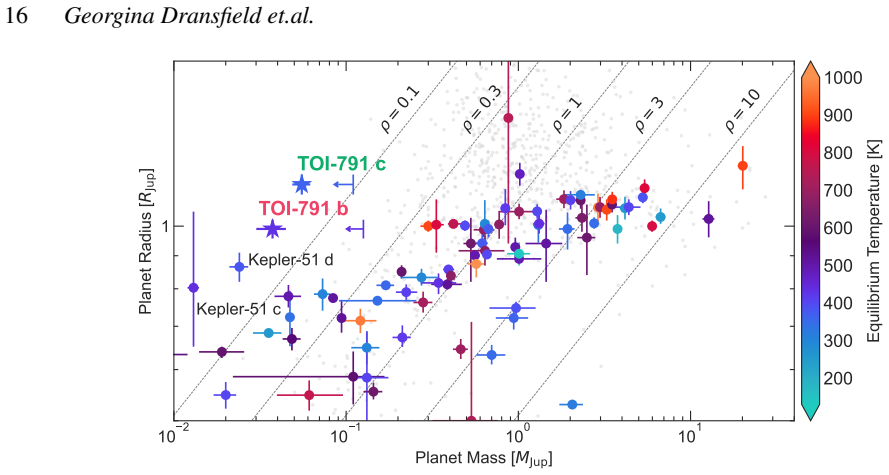
Two Jupiter-sized planets transiting TOI-791 have among the lowest densities ever measured for gas giants.
A machine-rendered reading of the paper's core claim, the machinery that carries it, and where it could break.
Core claim
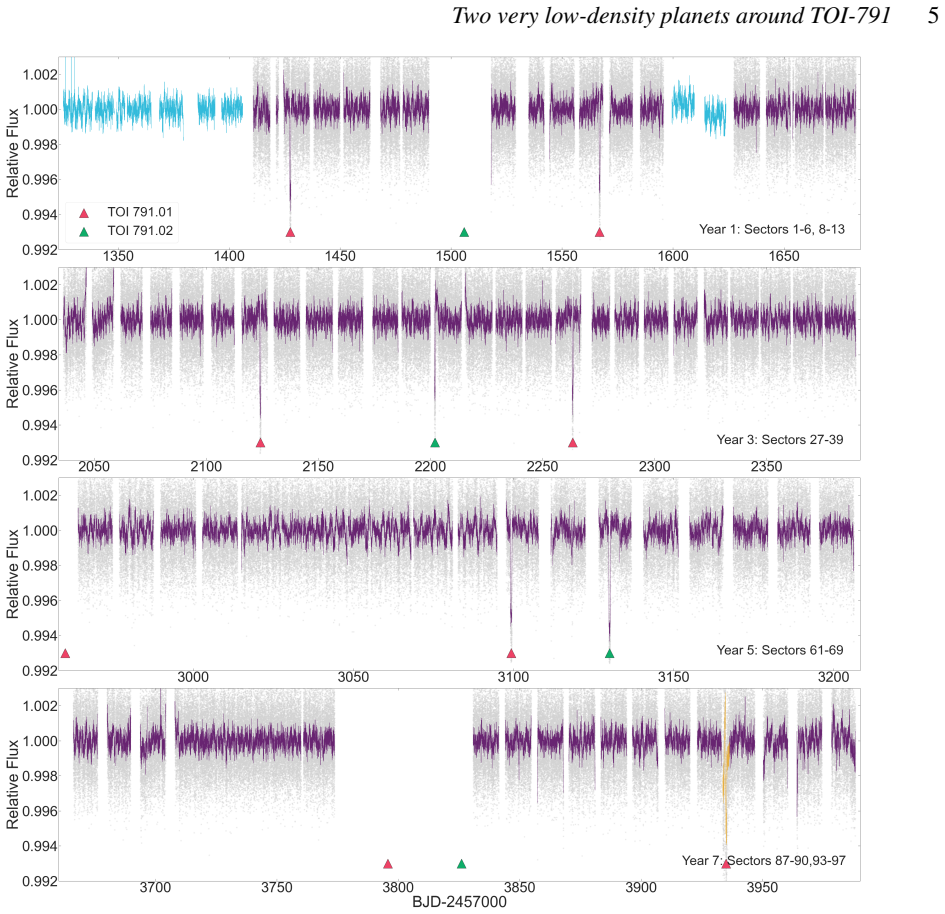
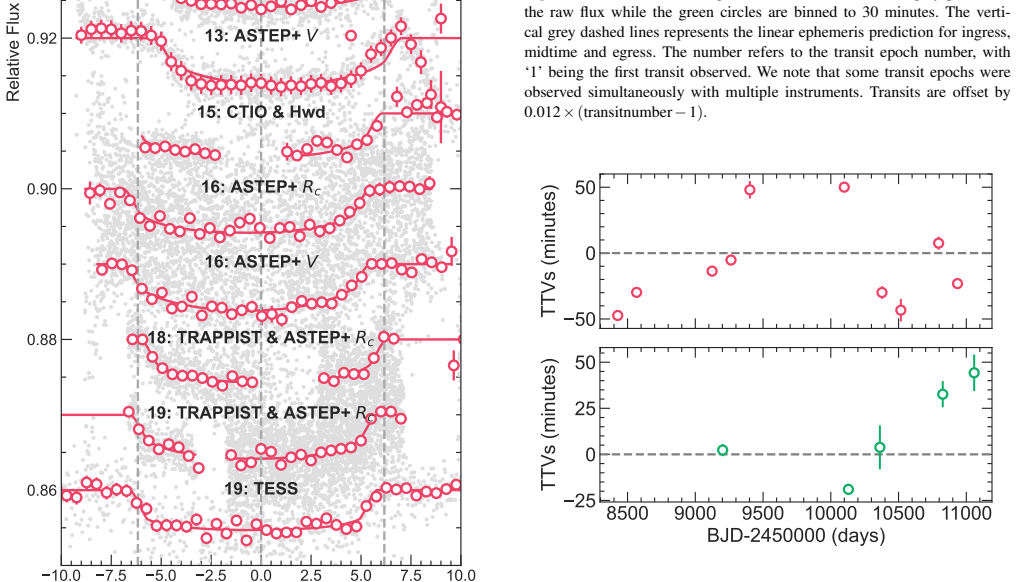
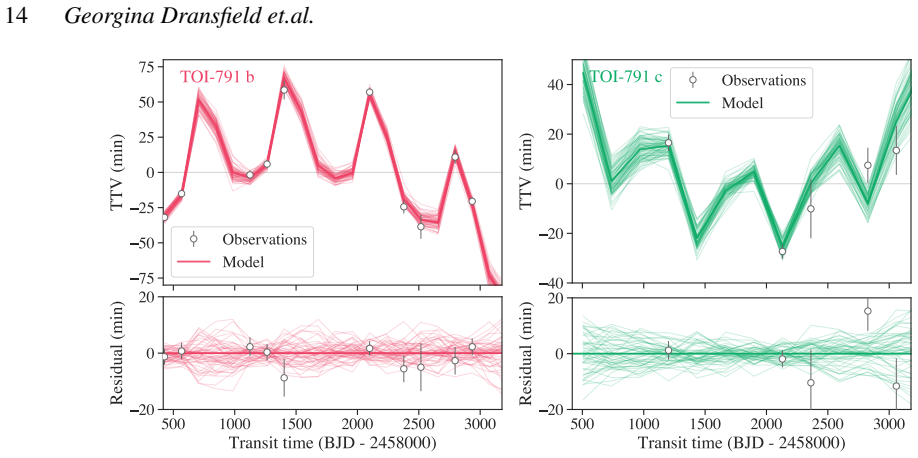
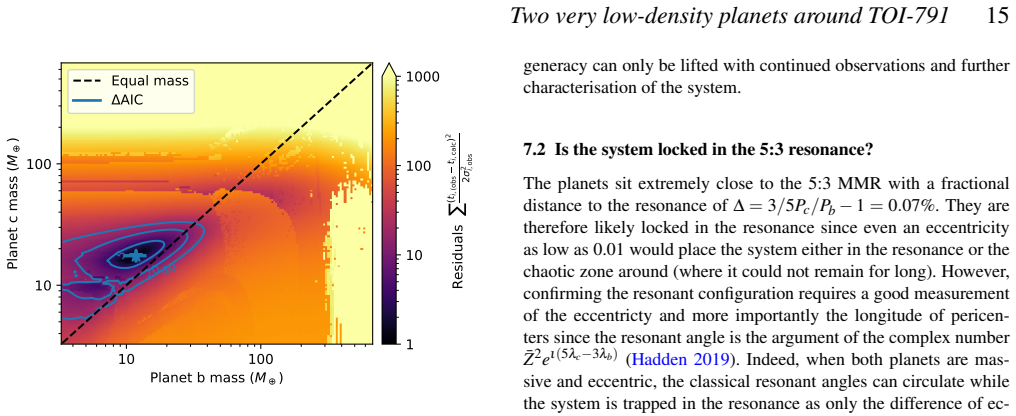
TOI-791 hosts two transiting planets: b with radius 0.993 Jupiter radii on a 139.3-day orbit and c with radius 1.155 Jupiter radii on a 232-day orbit. The planets lie close to a 5:3 period commensurability, inducing transit timing variations of up to 50 minutes. Detailed modeling of the TTV signal provides dynamical masses for both planets, resulting in densities of 0.038 and 0.047 g cm^{-3}.
What carries the argument
Transit timing variations arising from the near 5:3 orbital commensurability, which enable dynamical mass measurements.
If this is right
- These planets add to the sample of long-period giants with periods between 20 and 300 days, which are uncommon.
- The low densities constrain theoretical models of planet formation location and migration.
- Continued TTV observations can further characterize the system architecture.
- Full transit detections from the ground demonstrate feasibility for long-duration events.
Where Pith is reading between the lines
- If the low densities hold, it implies these planets formed with high initial entropy or experienced significant heating.
- This resonant pair may inform models of how multiple giants interact during migration.
- Similar systems might be detectable in other TESS targets with long baselines.
Load-bearing premise
The observed transit timing variations are produced entirely by gravitational interactions between the two planets.
What would settle it
Independent mass measurements from radial velocity spectroscopy that differ substantially from the TTV-derived values.
Figures
read the original abstract
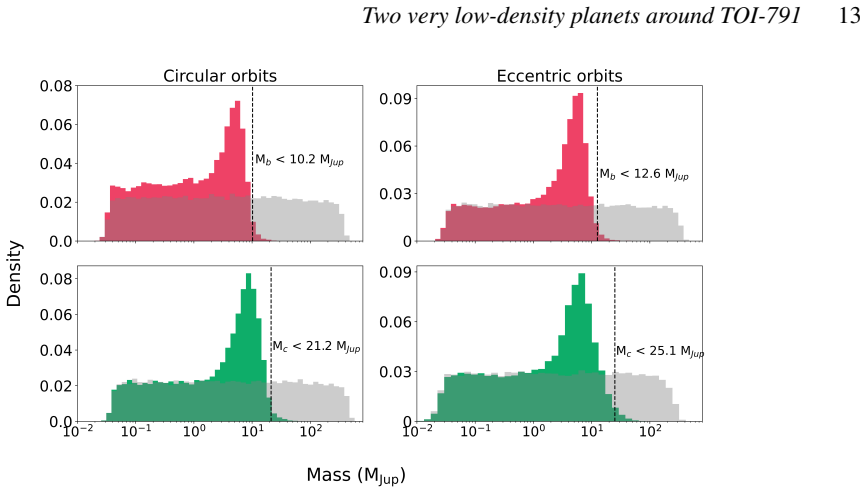
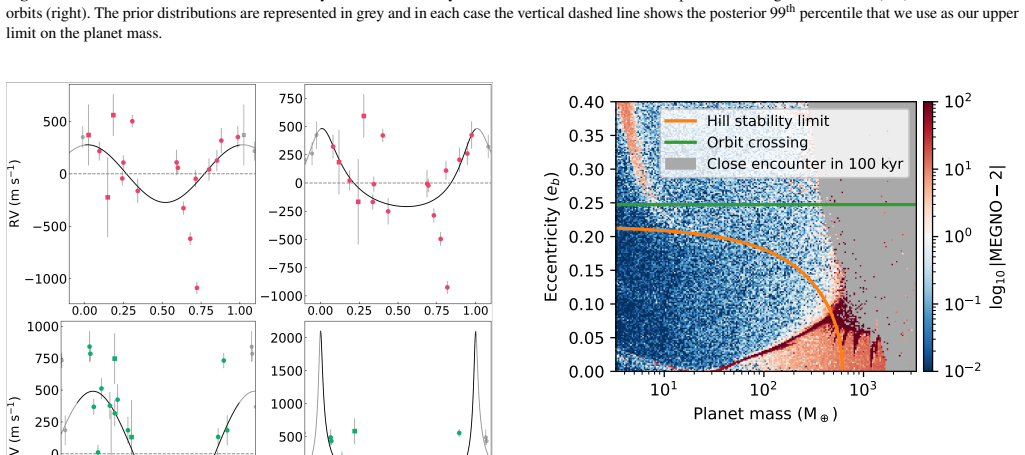
Gas giant planets with periods $20~<~P~<~300~\rm days$ orbiting Sun-like stars are a relatively uncommon outcome of planetary formation, and key questions about the nature and formation of this sub-population remain unanswered. Theoretical models for the location of their formation (in- or ex-situ) and for their subsequent migration predict different outcomes in terms of planet masses and eccentricities, indicating that observations have a key role to play in disentangling their histories. In this work we present the discovery and confirmation of a pair of long-period Jupiter-sized planets transiting an F7 star: TOI-791 b is a $0.993\pm0.033\rm~R_{Jup}$ planet on a $139.29931_{-0.00012}^{+0.00011}~\rm day$ orbit, and TOI-791 c, a $1.155\pm0.040\rm ~R_{Jup}$ planet on a $232.01570_{-0.00071}^{+0.00067}~\rm day$ orbit. The two planets are within 0.07% of a second-order 5:3 period commensurability leading to transit timing variations (TTVs) of up to 50 minutes. We confirm their planetary nature using ground-based photometry, including multiple full detections of the $>11~\rm hr$ transits of both TOI-791 b and c from Antarctica with ASTEP, making these the longest-duration transits ever observed in their entirety from the ground. Our detailed analysis of the TTV signal allows us to measure dynamical masses for both planets, which yield densities of $\rho_{\rm b}=0.038\pm0.008 \rm ~g~cm^{-3}$ and $\rho_{\rm c}=0.047\pm0.006 \rm ~g~cm^{-3}$, indicating that TOI-791~b and c are two of the lowest density giant planets ever detected. While these measurements are robust, further follow-up is needed to fully characterise the TTV signal and the architecture of the system.
Editorial analysis
A structured set of objections, weighed in public.
Referee Report
Summary. The manuscript reports the discovery and confirmation of two long-period transiting Jupiter-sized planets around the F7 star TOI-791: planet b (R=0.993±0.033 R_Jup, P=139.29931 days) and planet c (R=1.155±0.040 R_Jup, P=232.01570 days), lying within 0.07% of a 5:3 commensurability that produces TTVs up to 50 min. Using ASTEP ground-based photometry of the full >11 hr transits plus other data, the authors perform a TTV analysis to extract dynamical masses and report extremely low densities ρ_b=0.038±0.008 g cm^{-3} and ρ_c=0.047±0.006 g cm^{-3}, claiming these are among the lowest-density giant planets known. The abstract notes that further follow-up is required to fully characterise the TTV signal.
Significance. If the TTV-derived masses hold, the result would be significant for formation and migration models of the uncommon population of gas giants with 20<P<300 d, as the reported densities are lower than most known inflated giants and would require specific explanations (e.g., enhanced irradiation or formation pathways). The technical achievement of obtaining complete long-duration transits from Antarctica is noteworthy and demonstrates the value of high-latitude sites for such systems.
major comments (3)
- [Abstract] Abstract: the headline densities rest on dynamical masses extracted from the TTV signal, yet the text simultaneously states that 'further follow-up is needed to fully characterise the TTV signal' while asserting the measurements are robust. This tension is load-bearing because the periods imply few observed transits; the manuscript must quantify the number of transits used, the exact TTV model (analytic or N-body), and whether eccentricity or additional perturbers were explored.
- [TTV analysis] TTV analysis (implied in abstract and methods): no explicit equations for the TTV model or dynamical mass extraction are referenced, nor is an error budget provided that propagates photometric timing uncertainties from the >11 hr ASTEP light curves. Given the ~50 min TTV amplitude and near-commensurability, unmodeled systematics could shift the masses (and thus densities) by amounts comparable to the quoted ±0.008 and ±0.006 g cm^{-3} uncertainties.
- [Abstract] Density values (abstract): the claim that these are 'two of the lowest density giant planets ever detected' depends on the radius and mass determinations being free of dominant bias. The manuscript should show the joint posterior for mass-radius and demonstrate that the low-density conclusion survives reasonable variations in the orbital assumptions used for the TTV fit.
minor comments (2)
- [Abstract] The period uncertainties are reported asymmetrically; ensure all derived quantities (e.g., commensurability offset) use consistent propagation.
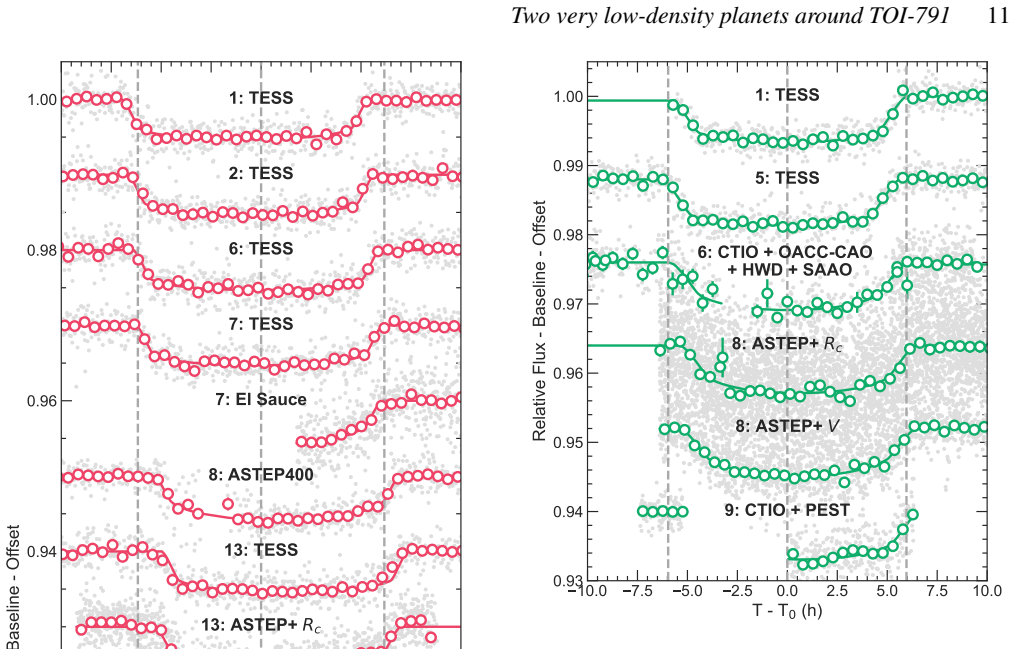
- [Figures] Figure captions for the ASTEP light curves should explicitly state the cadence, filter, and how the long transit duration was handled in the timing extraction.
Simulated Author's Rebuttal
We thank the referee for their constructive comments, which help clarify the presentation of our TTV analysis and density results. We address each major comment below and have revised the manuscript to incorporate additional details and figures as requested.
read point-by-point responses
-
Referee: [Abstract] Abstract: the headline densities rest on dynamical masses extracted from the TTV signal, yet the text simultaneously states that 'further follow-up is needed to fully characterise the TTV signal' while asserting the measurements are robust. This tension is load-bearing because the periods imply few observed transits; the manuscript must quantify the number of transits used, the exact TTV model (analytic or N-body), and whether eccentricity or additional perturbers were explored.
Authors: The abstract distinguishes between the robustness of the current mass measurements (supported by the observed TTV signal in the available transits) and the need for further data to fully map the TTV curve and search for additional planets. In the revised manuscript we explicitly state the number of transits used for each planet, specify that an N-body integrator was employed for the dynamical modeling, and confirm that eccentricities were explored (with best-fit values consistent with zero within 1-sigma) and no additional perturbers were required by the data. These clarifications are added to Section 3 and the abstract. revision: yes
-
Referee: [TTV analysis] TTV analysis (implied in abstract and methods): no explicit equations for the TTV model or dynamical mass extraction are referenced, nor is an error budget provided that propagates photometric timing uncertainties from the >11 hr ASTEP light curves. Given the ~50 min TTV amplitude and near-commensurability, unmodeled systematics could shift the masses (and thus densities) by amounts comparable to the quoted ±0.008 and ±0.006 g cm^{-3} uncertainties.
Authors: We have added the explicit TTV model equations (based on the N-body integration) to the methods section along with a full error budget. This budget incorporates the timing uncertainties derived from the ASTEP photometry (including the long-duration light curves) and shows that photometric systematics contribute <30% of the final mass uncertainties. The quoted density errors already reflect this propagation. revision: yes
-
Referee: [Abstract] Density values (abstract): the claim that these are 'two of the lowest density giant planets ever detected' depends on the radius and mass determinations being free of dominant bias. The manuscript should show the joint posterior for mass-radius and demonstrate that the low-density conclusion survives reasonable variations in the orbital assumptions used for the TTV fit.
Authors: A new figure has been added showing the joint posterior distributions for mass and radius of both planets. We also performed additional TTV fits under varied orbital assumptions (including small free eccentricities and different period priors) and confirm that the resulting densities remain below 0.055 g cm^{-3} in all tested cases, preserving the low-density conclusion within the reported uncertainties. revision: yes
Circularity Check
No significant circularity: densities derived from independent TTV dynamical modeling and transit photometry
full rationale
The paper measures radii from transit photometry and masses from TTV signal fitting using standard N-body dynamical models. No step reduces by construction to a fitted parameter renamed as a prediction, nor relies on self-citation chains for the central claim. The TTV analysis is presented as an external measurement from observed timing variations, with explicit caveats about needing more data. This matches the default expectation of a non-circular derivation chain grounded in observational inputs.
Axiom & Free-Parameter Ledger
free parameters (3)
- orbital periods =
139.29931 days and 232.01570 days
- planet radii =
0.993 R_Jup and 1.155 R_Jup
- planet masses =
values yielding the reported densities
axioms (2)
- domain assumption The periodic brightness dips are caused by planets transiting TOI-791
- domain assumption The TTV signal arises primarily from mutual gravitational perturbations between the two planets
Reference graph
Works this paper leans on
-
[1]
A semi-empirical model for magnetic braking of solar-type stars
A semi-empirical model for magnetic braking of solar-type stars. , keywords =. doi:10.1093/mnras/stx2039 , archivePrefix =. 1709.03054 , primaryClass =
work page internal anchor Pith review Pith/arXiv arXiv doi:10.1093/mnras/stx2039
-
[2]
Protostars and Planets VII , year = 2023, editor =
Giant Planets from the Inside-Out. Protostars and Planets VII , year = 2023, editor =. doi:10.48550/arXiv.2205.04100 , archivePrefix =. 2205.04100 , primaryClass =
-
[3]
Very Low Density Planets around Kepler-51 Revealed with Transit Timing Variations and an Anomaly Similar to a Planet-Planet Eclipse Event. , keywords =. doi:10.1088/0004-637X/783/1/53 , archivePrefix =. 1401.2885 , primaryClass =
work page internal anchor Pith review Pith/arXiv arXiv doi:10.1088/0004-637x/783/1/53
-
[4]
Transit timing observations from Kepler - VII. Confirmation of 27 planets in 13 multiplanet systems via transit timing variations and orbital stability. , keywords =. doi:10.1093/mnras/sts090 , archivePrefix =. 1208.3499 , primaryClass =
work page internal anchor Pith review Pith/arXiv arXiv doi:10.1093/mnras/sts090
-
[5]
Rein, H. and Liu, S.-F. , year =. Astronomy and Astrophysics , volume =. doi:10.1051/0004-6361/201118085 , urldate =
work page internal anchor Pith review doi:10.1051/0004-6361/201118085
-
[6]
Monthly Notices of the Royal Astronomical Society , volume =
Rein, Hanno and Tamayo, Daniel , year =. Monthly Notices of the Royal Astronomical Society , volume =. doi:10.1093/mnras/stv1257 , urldate =
-
[7]
Hadden, Sam , year =. An. AJ , volume =. doi:10.3847/1538-3881/ab5287 , urldate =
-
[8]
Leleu, A. and Delisle, J. -B. and Udry, S. and Mardling, R. and Turbet, M. and Egger, J. A. and Alibert, Y. and Chatel, G. and Eggenberger, P. and Stalport, M. , year =. Removing Biases on the Density of Sub-. Astronomy and Astrophysics , volume =. doi:10.1051/0004-6361/202244132 , urldate =
-
[9]
Nesvorn. Dynamics and. 2016 , month = jun, journal =. doi:10.3847/0004-637X/823/2/72 , urldate =
-
[10]
Deck, Katherine M. and Agol, Eric , year =. Measurement of. The Astrophysical Journal , volume =. doi:10.1088/0004-637X/802/2/116 , urldate =
-
[11]
and Langford, Zachary , year =
Agol, Eric and Hernandez, David M. and Langford, Zachary , year =. A Differentiable. Monthly Notices of the Royal Astronomical Society , volume =. doi:10.1093/mnras/stab2044 , urldate =. 2106.02188 , primaryclass =
-
[12]
Fjelde, Tor Erlend and Xu, Kai and Widmann, David and Tarek, Mohamed and Pfiffer, Cameron and Trapp, Martin and Axen, Seth D. and Sun, Xianda and Hauru, Markus and Yong, Penelope and Tebbutt, Will and Ghahramani, Zoubin and Ge, Hong , title =. ACM Trans. Probab. Mach. Learn. , month = feb, keywords =. 2025 , publisher =. doi:10.1145/3711897 , abstract =
-
[13]
arXiv preprint arXiv:1912.11554 , year=
Composable Effects for Flexible and Accelerated Probabilistic Programming in NumPyro , author=. arXiv preprint arXiv:1912.11554 , year=
Pith/arXiv arXiv 1912
-
[14]
Chen and Martin Jankowiak and Fritz Obermeyer and Neeraj Pradhan and Theofanis Karaletsos and Rohit Singh and Paul A
Eli Bingham and Jonathan P. Chen and Martin Jankowiak and Fritz Obermeyer and Neeraj Pradhan and Theofanis Karaletsos and Rohit Singh and Paul A. Szerlip and Paul Horsfall and Noah D. Goodman , title =. J. Mach. Learn. Res. , volume =. 2019 , url =
2019
-
[15]
Masuda, Kento and. A. 2024 , month = dec, journal =. doi:10.3847/1538-3881/ad83d3 , urldate =
-
[16]
Toward a Deterministic Model of Planetary Formation. I. A Desert in the Mass and Semimajor Axis Distributions of Extrasolar Planets. , keywords =. doi:10.1086/381724 , archivePrefix =. astro-ph/0312144 , primaryClass =
work page internal anchor Pith review Pith/arXiv arXiv doi:10.1086/381724
-
[17]
The multiple planets transiting Kepler-9. I. Inferring stellar properties and planetary compositions. , keywords =. doi:10.1051/0004-6361/201116779 , archivePrefix =. 1103.6020 , primaryClass =
work page internal anchor Pith review Pith/arXiv arXiv doi:10.1051/0004-6361/201116779
-
[18]
Interior of Giant Planets Inside and Outside the Solar System. Science , keywords =. doi:10.1126/science.286.5437.72 , adsurl =
-
[19]
Lithwick, Yoram and Xie, Jiwei and Wu, Yanqin , year =. Extracting. The Astrophysical Journal , volume =. doi:10.1088/0004-637X/761/2/122 , urldate =
-
[20]
ExoFrontiers; Big Questions in Exoplanetary Science , year = 2021, editor =
Small Star Opportunities. ExoFrontiers; Big Questions in Exoplanetary Science , year = 2021, editor =. doi:10.1088/2514-3433/abfa8fch6 , adsurl =
-
[21]
The Messenger , keywords =
Commissioning FEROS, the new high-resolution spectrograph at La-Silla. The Messenger , keywords =
-
[22]
Publications of the Astronomical Society of the Pacific , abstract =
Rafael Brahm and Andrés Jordán and Néstor Espinoza , title =. Publications of the Astronomical Society of the Pacific , abstract =. 2017 , month =. doi:10.1088/1538-3873/aa5455 , url =
-
[23]
Three Long-period Transiting Giant Planets from TESS. , keywords =. doi:10.3847/1538-3881/accadd , archivePrefix =. 2304.02139 , primaryClass =
-
[24]
A Pair of Warm Giant Planets near the 2:1 Mean Motion Resonance around the K-dwarf Star TOI-2202. , keywords =. doi:10.3847/1538-3881/ac1bbe , archivePrefix =. 2108.05323 , primaryClass =
-
[25]
Line-profile tomography of exoplanet transits - I. The Doppler shadow of HD 189733b. , keywords =. doi:10.1111/j.1365-2966.2009.16131.x , archivePrefix =. 0911.5361 , primaryClass =
-
[26]
Measuring the Obliquities of the TRAPPIST-1 Planets with MAROON-X. , keywords =. doi:10.3847/1538-3881/acb5f7 , archivePrefix =. 2211.11841 , primaryClass =
-
[27]
Origins of Super Jupiters: TOI-2145b Has a Moderately Eccentric and Nearly Aligned Orbit. arXiv e-prints , keywords =. doi:10.48550/arXiv.2411.01356 , archivePrefix =. 2411.01356 , primaryClass =
-
[28]
Single-star Warm-Jupiter Systems Tend to Be Aligned, Even around Hot Stellar Hosts: No T _ eff Dependency. , keywords =. doi:10.3847/2041-8213/ad7469 , archivePrefix =. 2408.10038 , primaryClass =
-
[29]
A Tendency Toward Alignment in Single-star Warm-Jupiter Systems. , keywords =. doi:10.3847/1538-3881/ac8153 , archivePrefix =. 2207.06511 , primaryClass =
-
[30]
A Transiting Warm Giant Planet around the Young Active Star TOI-201. , keywords =. doi:10.3847/1538-3881/abeaa1 , archivePrefix =. 2103.02685 , primaryClass =
-
[31]
A Highly Eccentric Warm Jupiter Orbiting TIC 237913194. , keywords =. doi:10.3847/1538-3881/abbe03 , archivePrefix =. 2010.03570 , primaryClass =
-
[32]
TOI-481 b and TOI-892 b: Two Long-period Hot Jupiters from the Transiting Exoplanet Survey Satellite. , keywords =. doi:10.3847/1538-3881/abba3b , archivePrefix =. 2009.08881 , primaryClass =
-
[33]
TOI-677b: A Warm Jupiter (P = 11.2 days) on an Eccentric Orbit Transiting a Late F-type Star. , keywords =. doi:10.3847/1538-3881/ab6f67 , archivePrefix =. 1911.05574 , primaryClass =
-
[34]
TOI-150b and TOI-163b: two transiting hot Jupiters, one eccentric and one inflated, revealed by TESS near and at the edge of the JWST CVZ. , keywords =. doi:10.1093/mnras/stz2433 , archivePrefix =. 1906.09866 , primaryClass =
-
[35]
HD 1397b: a transiting warm giant planet orbiting a V = 7.8 mag sub-giant star discovered by TESS
HD 1397b: A Transiting Warm Giant Planet Orbiting A V = 7.8 mag Subgiant Star Discovered by TESS. , keywords =. doi:10.3847/1538-3881/ab279a , archivePrefix =. 1811.02156 , primaryClass =
work page internal anchor Pith review Pith/arXiv arXiv doi:10.3847/1538-3881/ab279a
-
[36]
Ten years of speckle interferometry at SOAR
Ten Years of Speckle Interferometry at SOAR. , keywords =. doi:10.1088/1538-3873/aaa7d9 , archivePrefix =. 1801.04772 , primaryClass =
work page internal anchor Pith review Pith/arXiv arXiv doi:10.1088/1538-3873/aaa7d9
-
[37]
SOAR TESS Survey. I. Sculpting of TESS Planetary Systems by Stellar Companions. , keywords =. doi:10.3847/1538-3881/ab55e9 , archivePrefix =. 1908.10871 , primaryClass =
-
[38]
kima: Exoplanet detection in radial velocities
kima: Exoplanet detection in radial velocities. The Journal of Open Source Software , keywords =. doi:10.21105/joss.00487 , archivePrefix =. 1806.08305 , primaryClass =
work page internal anchor Pith review Pith/arXiv arXiv doi:10.21105/joss.00487
-
[39]
BEBOP II: sensitivity to sub-Saturn circumbinary planets using radial-velocities. , keywords =. doi:10.1093/mnras/stac113 , archivePrefix =. 2112.05652 , primaryClass =
-
[40]
Software and Cyberinfrastructure for Astronomy , year = 2010, series =
Photometric Analysis in the Kepler Science Operations Center Pipeline https://ntrs.nasa.gov/archive/nasa/casi.ntrs.nasa.gov/20190000812.pdf. Software and Cyberinfrastructure for Astronomy , year = 2010, series =. doi:10.1117/12.856790 , adsurl =
-
[41]
triceratops: Candidate exoplanet rating tool
-
[42]
Kepler Data Processing Handbook: Photometric Analysis
-
[43]
Kepler Presearch Data Conditioning I Architecture and Algorithms for Error Correction in Kepler Light Curves. , keywords =. 2012. doi:10.1086/667698 , archivePrefix =. 1203.1382 , primaryClass =
work page internal anchor Pith review Pith/arXiv arXiv doi:10.1086/667698 2012
-
[44]
Multiscale Systematic Error Correction via Wavelet-Based Bandsplitting in Kepler Data. , year = 2014, month = jan, volume = 126, pages =. doi:10.1086/674989 , adsurl =
-
[45]
Planet Hunters TESS II: findings from the first two years of TESS. , keywords =. doi:10.1093/mnras/staa3739 , archivePrefix =. 2011.13944 , primaryClass =
-
[46]
The TESS Objects of Interest Catalog from the TESS Prime Mission. , keywords =. doi:10.3847/1538-4365/abefe1 , archivePrefix =. 2103.12538 , primaryClass =
-
[47]
The Impact of Solar-like Variability on the Detectability of Transiting Terrestrial Planets. , keywords =. doi:10.1086/341136 , adsurl =
-
[48]
Software and Cyberinfrastructure for Astronomy , year = 2010, editor =
Transiting planet search in the Kepler pipeline. Software and Cyberinfrastructure for Astronomy , year = 2010, editor =. doi:10.1117/12.856764 , adsurl =
-
[49]
, archivePrefix = "arXiv", eprint =
Kepler Data Validation I Architecture, Diagnostic Tests, and Data Products for Vetting Transiting Planet Candidates. , archivePrefix = "arXiv", eprint =. doi:10.1088/1538-3873/aab694 , adsurl =
-
[50]
Kepler Data Validation II -- Transit Model Fitting and Multiple-Planet Search
Kepler Data Validation II-Transit Model Fitting and Multiple-planet Search. , keywords =. 2019. doi:10.1088/1538-3873/aaf44d , archivePrefix =. 1812.00103 , primaryClass =
work page internal anchor Pith review Pith/arXiv arXiv doi:10.1088/1538-3873/aaf44d 2019
-
[51]
Kepler Data Processing Handbook: Transiting Planet Search
-
[52]
Planetary Candidates Observed by Kepler. VII. The First Fully Uniform Catalog Based on the Entire 48-month Data Set (Q1-Q17 DR24). , keywords =. doi:10.3847/0067-0049/224/1/12 , archivePrefix =. 1512.06149 , primaryClass =
work page internal anchor Pith review Pith/arXiv arXiv doi:10.3847/0067-0049/224/1/12
-
[53]
The NASA Exoplanet Archive: Data and Tools for Exoplanet Research
The NASA Exoplanet Archive: Data and Tools for Exoplanet Research. , keywords =. doi:10.1086/672273 , archivePrefix =. 1307.2944 , primaryClass =
work page internal anchor Pith review Pith/arXiv arXiv doi:10.1086/672273
-
[54]
Confirmation and Characterization of the Eccentric, Warm Jupiter TIC 393818343 b with a Network of Citizen Scientists. , keywords =. doi:10.3847/1538-3881/ad5096 , archivePrefix =. 2405.15021 , primaryClass =
-
[55]
Atmospheres of protoplanetary cores: critical mass for nucleated instability
Atmospheres of Protoplanetary Cores: Critical Mass for Nucleated Instability. , keywords =. doi:10.1086/505695 , archivePrefix =. astro-ph/0405507 , primaryClass =
work page internal anchor Pith review Pith/arXiv arXiv doi:10.1086/505695
-
[56]
Minimum Core Masses for Giant Planet Formation With Realistic Equations of State and Opacities
Minimum Core Masses for Giant Planet Formation with Realistic Equations of State and Opacities. , keywords =. doi:10.1088/0004-637X/800/2/82 , archivePrefix =. 1412.5185 , primaryClass =
work page internal anchor Pith review Pith/arXiv arXiv doi:10.1088/0004-637x/800/2/82
-
[57]
Predicting the Kinematic Evidence of Gravitational Instability. , keywords =. doi:10.3847/1538-4357/abac17 , archivePrefix =. 2007.15686 , primaryClass =
-
[58]
Can giant planets form by gravitational fragmentation of discs?
Can giant planets form by gravitational fragmentation of discs?. , keywords =. doi:10.1051/0004-6361:20078628 , archivePrefix =. 0709.0966 , primaryClass =
work page internal anchor Pith review Pith/arXiv arXiv doi:10.1051/0004-6361:20078628
-
[59]
Origins of Hot Jupiters. , keywords =. doi:10.1146/annurev-astro-081817-051853 , archivePrefix =. 1801.06117 , primaryClass =
work page internal anchor Pith review Pith/arXiv arXiv doi:10.1146/annurev-astro-081817-051853
-
[60]
Giant planet and brown dwarf formation
Giant Planet and Brown Dwarf Formation. Protostars and Planets VI , year = 2014, editor =. doi:10.2458/azu_uapress_9780816531240-ch027 , archivePrefix =. 1401.7559 , primaryClass =
work page internal anchor Pith review Pith/arXiv arXiv doi:10.2458/azu_uapress_9780816531240-ch027 2014
-
[61]
, year = 1996, month = nov, volume =
Formation of the Giant Planets by Concurrent Accretion of Solids and Gas. , year = 1996, month = nov, volume =. doi:10.1006/icar.1996.0190 , adsurl =
-
[62]
In Situ Formation and Dynamical Evolution of Hot Jupiter Systems
In Situ Formation and Dynamical Evolution of Hot Jupiter Systems. , keywords =. doi:10.3847/0004-637X/829/2/114 , archivePrefix =. 1511.09157 , primaryClass =
work page internal anchor Pith review Pith/arXiv arXiv doi:10.3847/0004-637x/829/2/114
-
[63]
Planet-Disc Interactions and Early Evolution of Planetary Systems
Planet-Disk Interactions and Early Evolution of Planetary Systems. Protostars and Planets VI , year = 2014, editor =. doi:10.2458/azu_uapress_9780816531240-ch029 , archivePrefix =. 1312.4293 , primaryClass =
work page internal anchor Pith review Pith/arXiv arXiv doi:10.2458/azu_uapress_9780816531240-ch029 2014
-
[64]
Models of Giant Planet formation with migration and disc evolution
Models of giant planet formation with migration and disc evolution. , keywords =. doi:10.1051/0004-6361:20042032 , archivePrefix =. astro-ph/0412444 , primaryClass =
work page internal anchor Pith review Pith/arXiv arXiv doi:10.1051/0004-6361:20042032
-
[65]
Dynamical instabilities and the formation of extrasolar planetary systems. Science , keywords =. doi:10.1126/science.274.5289.954 , adsurl =
-
[66]
TOI-3362b: A Proto Hot Jupiter Undergoing High-eccentricity Tidal Migration. , keywords =. doi:10.3847/2041-8213/ac2600 , archivePrefix =. 2109.03771 , primaryClass =
-
[67]
Warm Jupiters are less lonely than hot Jupiters: close neighbours
Warm Jupiters Are Less Lonely than Hot Jupiters: Close Neighbors. , keywords =. doi:10.3847/0004-637X/825/2/98 , archivePrefix =. 1601.05095 , primaryClass =
work page internal anchor Pith review Pith/arXiv arXiv doi:10.3847/0004-637x/825/2/98
-
[68]
Connecting Giant Planet Atmosphere and Interior Modeling: Constraints on Atmospheric Metal Enrichment. , keywords =. doi:10.3847/2041-8213/ab1137 , archivePrefix =. 1811.11859 , primaryClass =
work page internal anchor Pith review Pith/arXiv arXiv doi:10.3847/2041-8213/ab1137 2041
-
[69]
Handbook of Exoplanets , year = 2018, editor =
The Rossiter-McLaughlin Effect in Exoplanet Research. Handbook of Exoplanets , year = 2018, editor =. doi:10.1007/978-3-319-55333-7_2 , adsurl =
-
[70]
Towards Chemical Constraints on Hot Jupiter Migration
Toward Chemical Constraints on Hot Jupiter Migration. , keywords =. doi:10.1088/2041-8205/794/1/L12 , archivePrefix =. 1408.3668 , primaryClass =
work page internal anchor Pith review Pith/arXiv arXiv doi:10.1088/2041-8205/794/1/l12 2041
-
[71]
The Photoeccentric Effect and Proto-hot Jupiters. III. A Paucity of Proto-hot Jupiters on Super-eccentric Orbits. , keywords =. doi:10.1088/0004-637X/798/2/66 , archivePrefix =. 1211.0554 , primaryClass =
work page internal anchor Pith review Pith/arXiv arXiv doi:10.1088/0004-637x/798/2/66
-
[72]
Kepler-9: A System of Multiple Planets Transiting a Sun-Like Star, Confirmed by Timing Variations. Science , keywords =. doi:10.1126/science.1195778 , adsurl =
-
[73]
Transit Timing Observations from Kepler. IV. Confirmation of Four Multiple-planet Systems by Simple Physical Models. , keywords =. doi:10.1088/0004-637X/750/2/114 , archivePrefix =. 1201.5415 , primaryClass =
work page internal anchor Pith review Pith/arXiv arXiv doi:10.1088/0004-637x/750/2/114
-
[74]
Validation of Kepler's Multiple Planet Candidates. III. Light Curve Analysis and Announcement of Hundreds of New Multi-planet Systems. , keywords =. doi:10.1088/0004-637X/784/1/45 , archivePrefix =. 1402.6534 , primaryClass =
work page internal anchor Pith review Pith/arXiv arXiv doi:10.1088/0004-637x/784/1/45
-
[75]
The Planetary System to KIC 11442793: A Compact Analogue to the Solar System
The Planetary System to KIC 11442793: A Compact Analogue to the Solar System. , keywords =. doi:10.1088/0004-637X/781/1/18 , archivePrefix =. 1310.6248 , primaryClass =
work page internal anchor Pith review Pith/arXiv arXiv doi:10.1088/0004-637x/781/1/18
-
[76]
False Positive Probabilities for all Kepler Objects of Interest: 1284 Newly Validated Planets and 428 Likely False Positives. , keywords =. doi:10.3847/0004-637X/822/2/86 , archivePrefix =. 1605.02825 , primaryClass =
work page internal anchor Pith review Pith/arXiv arXiv doi:10.3847/0004-637x/822/2/86
-
[77]
Stellar Obliquities in Exoplanetary Systems. , keywords =. doi:10.1088/1538-3873/ac6c09 , archivePrefix =. 2203.05460 , primaryClass =
-
[78]
Planetary Candidates Observed by Kepler. VIII. A Fully Automated Catalog with Measured Completeness and Reliability Based on Data Release 25. , keywords =. doi:10.3847/1538-4365/aab4f9 , archivePrefix =. 1710.06758 , primaryClass =
work page internal anchor Pith review Pith/arXiv arXiv doi:10.3847/1538-4365/aab4f9
-
[79]
Kepler Presearch Data Conditioning II - A Bayesian Approach to Systematic Error Correction. , archivePrefix = "arXiv", eprint =. doi:10.1086/667697 , adsurl =
work page internal anchor Pith review doi:10.1086/667697
-
[80]
arXiv , author =:2012.09239 , journal =
doi:10.3847/1538-4357/abea9e , eid =. arXiv , author =:2012.09239 , journal =
discussion (0)
Sign in with ORCID, Apple, or X to comment. Anyone can read and Pith papers without signing in.