REVIEW 3 major objections 6 minor 2 cited by
Iterative Harrow-Hassidim-Lloyd quantum algorithm for solving resonances with eigenvector continuation
T0 review · 3 major / 6 minor · reviewed 2026-08-06 · deepseek-v4-flash
Pith's one-line read The paper claims that solving the fixed-point equation $C(E,1)\phi=\phi$ with the iterative HHL algorithm yields nuclear resonance energies, demonstrated on the $\alpha$-$\alpha$ G-wave resonance at $11.8211-1.8107i$ MeV in agreement with…
desk verdict A correct fixed-point rewrite of the complex-scaled eigenvalue problem with a new EC+IHHL combination, but the demonstration is curated and the convergence claim outruns the evidence; proof-of-principle, conditional. read the letter →
The pith
A machine-rendered reading of the paper's core claim, the machinery that carries it, and where it could break.
The reading
What carries the argument
The load-bearing object is the matrix $C(E,\beta)$ defined by $C_{ij}(E,\beta)=(\phi_i|e^{-2i\theta}T+V_N(re^{i\theta})+e^{-i\theta}V_C-(E-\beta)|\phi_j)/\beta$, with $\beta=1$ so the Schrodinger equation becomes the fixed-point condition $C(E,1)\phi=\phi$. The algorithm starts from a trial wavefunction $\phi$ and its expectation energy $E$, embeds the non-Hermitian $C$ into the larger Hermitian matrix $A$, solves $Ax=b$ with HHL, reads off a new wavefunction $\phi^*$, and recomputes $E^*$ until the change falls below $\varepsilon$; the c-product replaces the usual inner product because the complex-scaled states are not Hermitian-conjugate. Eigenvector continuation provides the small orthonormal basis: bound-state wavefunctions at several coupling parameters are orthogonalized and used to build the complex-scaled matrix, which cuts the Hilbert-space dimension and hence the qubit count. A projection step makes each newly found eigenvector orthogonal to previously found ones, allowing successive eigenvalues to be extracted.
What would settle it
Run the same iterative HHL scheme starting from a random initial wavefunction on the $8\times8$ complex-scaled Hamiltonian $H_{\theta=20^\circ}$ of the appendix and check whether the sequence of energies converges to $11.8079-1.8110i$ MeV, converges to a different eigenpair, or fails to converge; alternatively, compute the spectral radius of the iteration map at the resonance energy to test whether it is a contractive fixed point.
Extended reading notes
Core claim
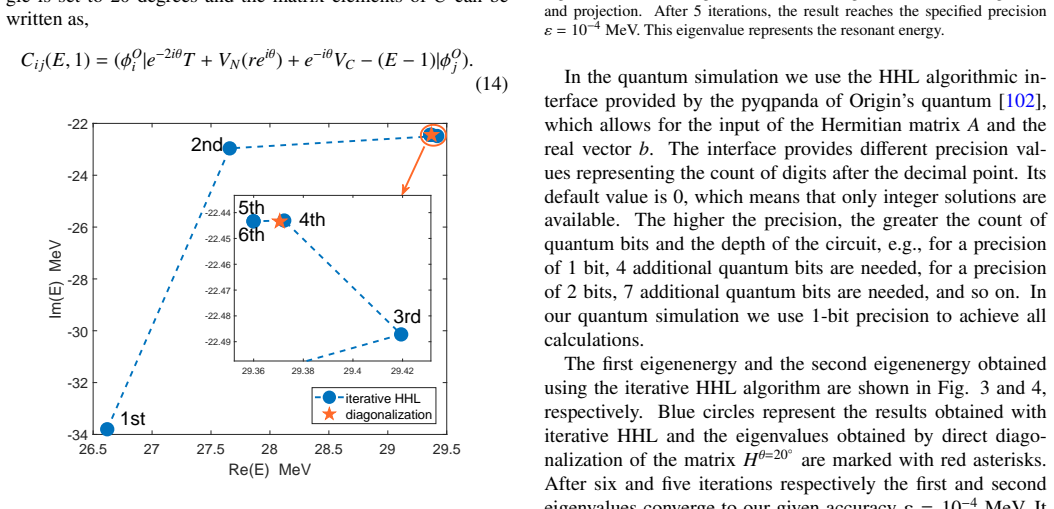
The central claim is that the fixed-point iteration $C(E,1)\phi=\phi$, with $C(E,1)=H_\theta-(E-1)I$ acting in the c-product, converges to the eigenpairs of the complex-scaled Hamiltonian $H_\theta$. Each iteration solves a linear system $Ax=b$ by HHL, where $A$ is the Hermitian block embedding $A=\begin{pmatrix}0&C\\C^\dagger&0\end{pmatrix}$, and the updated energy is the c-expectation value of $H_\theta$ with the new wavefunction. Numerically, six iterations at tolerance $\varepsilon=10^{-4}$ MeV produce the first eigenpair and five iterations produce the second, which is the resonance at $11.8211-1.8107i$ MeV, in agreement with direct diagonalization ($11.8079-1.8110i$ MeV) and with the R-matrix result ($11.8079-1.8085i$ MeV). The authors take this agreement as evidence that the iterative HHL algorithm reliably computes eigenvalues of non-Hermitian matrices.
Load-bearing premise
The iteration $C(E,1)\phi=\phi$ is assumed to converge to the sought eigenpair, with no proof of contraction or divergence control, and the demonstration relies on two hand-picked initial wavefunctions (given in the appendix) that place the resonance as the second solved eigenvalue.
Editorial extensions
If this is right
- Five iterations of the IHHL algorithm locate the alpha-alpha G-wave resonance at $11.8211-1.8107i$ MeV, within about $0.02$ MeV of the R-matrix value.
- With the projection method, all eight eigenvalues of the complex-scaled Hamiltonian are obtained in ascending order of real part, matching direct diagonalization.
- Eigenvector continuation compresses the problem to a subspace spanned by a handful of bound-state training vectors, reducing the qubit count needed for the quantum solve.
- Because the non-Hermitian operator is embedded in a Hermitian block matrix, the same iterative HHL route applies to other non-Hermitian eigenvalue problems beyond nuclear resonances.
Reading between the lines
- A natural stress test the authors did not run is to vary the initial wavefunction systematically; the admitted sensitivity of the eigenvalue ordering to that choice suggests the iteration may need deflation or a contraction guarantee before it can be a black-box resonance solver.
- The fixed-point formulation could be adapted to compute scattering phase shifts in the complex domain, an extension the paper points toward.
- The quantum advantage of HHL for this problem is not yet demonstrated end to end: the 1-bit precision used in the simulation and the iteration count would need a resource estimate on actual hardware.
- Combining the IHHL iteration with classical subspace methods, such as using several parallel initial vectors, might turn the observed fast local convergence into a robust global eigensolver for non-Hermitian matrices.
Editorial analysis
A structured set of objections, weighed in public.
Referee Report
Summary. The manuscript proposes an iterative Harrow-Hassidim-Lloyd (IHHL) algorithm combined with eigenvector continuation and complex scaling to compute resonant eigenvalues of non-Hermitian Hamiltonians. The central construction is the fixed-point equation C(E,1)φ = φ, Eq. (7), with C(E,1) = H_θ - (E-1)I in the EC basis; the non-Hermitian matrix C is embedded in a larger Hermitian matrix A (Eq. (9)), and HHL is used to solve the resulting linear system iteratively while updating the complex energy from a c-product. The method is demonstrated on the α-α G-wave resonance, yielding 11.8211 - 1.8107i MeV from IHHL versus 11.8079 - 1.8110i MeV by direct diagonalization and 11.8079 - 1.8085i MeV from the R-matrix method.
Significance. The algebraic fixed-point identity behind the algorithm is correct, and the idea of combining eigenvector continuation with complex scaling to reduce the dimension of a quantum eigensolver is a sensible and potentially useful direction. The paper is also transparent about the dependence of eigenvalue ordering on the initial wave function, which is a genuine limitation that the authors do not hide. However, the numerical demonstration is a single 8x8 example with hand-picked initial states, the claimed 10^-4 MeV stopping accuracy is not reflected in the reported table, and no convergence or target-selection analysis is provided. If these gaps are addressed, the method could serve as a useful proof-of-principle; as it stands, the manuscript's general claims are stronger than the evidence presented.
major comments (3)
- [Sec. 2.1, Eqs. (7)-(9), Fig. 1] The fixed-point identity C(E,1)φ = φ is algebraically correct, but the actual iteration used in the HHL loop is not analyzed. From the description of solving A x = b, the map is effectively φ_{n+1} = C(E_n,1)^{-1} φ_n (or an equivalent linear solve), yet no contractivity, spectral-radius, or basin-of-attraction analysis is provided. Because H_θ is non-Hermitian and the c-product is bilinear, standard Hermitian inverse-iteration arguments do not apply, and complex weights can cancel, so convergence to the desired resonance is not guaranteed for generic initial states. The claim in Sec. 3 that "using iterative HHL algorithm the converged eigenenergies will be obtained after a few iterations" is therefore supported only by the single curated example. The authors should add a convergence analysis or, failing that, a numerical basin study over random initial vectors and training intervals.
- [Sec. 3, Table 1] The stated stopping tolerance ε = 10^-4 MeV is inconsistent with the reported results. The IHHL resonance (11.8211 - 1.8107i MeV) differs from direct diagonalization (11.8079 - 1.8110i MeV) by 0.0132 MeV in the real part, and other states differ by up to about 0.03 MeV (e.g., 97.9506 vs 97.9800). If ε refers to the change between successive iterations rather than the error relative to the exact eigenenergy, that definition should be stated and the actual residuals reported; if the discrepancy is due to the 1-bit HHL precision, the text should say so and quantify how this limits the achievable accuracy. As written, the claim that the results "reach the specified precision ε = 10^-4 MeV" is not supported by Table 1.
- [Sec. 3 after Fig. 4; Appendix A, Eqs. (A.2)-(A.3)] The resonance is selected by construction rather than found by a generic criterion. The paper states that the order of eigenvalue solution changes with different initial wave functions, and the initial vectors in Appendix A are chosen so that the resonance appears as the second solved eigenvalue. No procedure is given for identifying which converged complex eigenvalue is the physical resonance when the answer is not already known from R-matrix or direct diagonalization, and only one complex-scaling angle θ = 20° is tested. A demonstration of robustness across initial vectors, training intervals, and scaling angles, or an explicit criterion for resonance identification, is needed to support the claimed general algorithm.
minor comments (6)
- [Sec. 2.1] The sentence about separating real and imaginary parts of complex wave functions for HHL is under-specified; it should state whether two separate HHL runs are made and how the real and imaginary parts of x are recombined to form φ*.
- [Sec. 3] The definition of "1-bit precision" and its relation to "4 additional quantum bits" is unclear; please specify whether precision refers to the number of phase-estimation bits or to a decimal digit count.
- [Sec. 1 and Sec. 4] The paper claims HHL offers exponential speedup, but no end-to-end complexity accounting is given for the iterative loop, including the cost of estimating the new energy E* from the output state; a resource estimate (qubits, circuit depth, number of measurements) would strengthen the quantum-advantage claim.
- [Appendix A] The matrices and vectors are typeset in a way that is hard to read (spaces within numbers, e.g., "0 .0808"); please typeset them properly and consider making the data available in machine-readable form.
- [Throughout] There are several typographical issues: "o ffers" in the abstract, "As a important topic" in Sec. 1, and "int he" in Appendix A should be corrected.
- [References] Reference [102] is a bare URL without version or access date; please provide a full citation for the pyQPanda package.
Circularity Check
No significant circularity: the IHHL fixed-point iteration genuinely solves the complex-scaled eigenproblem; the observed limitations are convergence and selection concerns, not circular reductions.
full rationale
The derivation chain is self-contained rather than circular. The fixed-point map C(E,1) phi = phi in Eqs. (7)-(9) is algebraically equivalent to the Schrodinger equation H_theta phi = E phi: with beta=1, C(E,1)=H_theta-(E-1)I, so C phi = phi iff H_theta phi = E phi. The IHHL loop is therefore a genuine fixed-point iteration over the same non-Hermitian matrix H_theta, not a quantity fitted to the R-matrix value; the benchmark energy 11.8079-1.8085i MeV enters only as an external comparison, not as an input or constraint. The EC training vectors, training interval [1.45,1.75], theta=20 degrees, and initial vectors are chosen with knowledge of the bound spectrum and of where the resonance appears (Appendix A, Sec. 3), which weakens the generality of the demonstration, and the paper explicitly notes that the order of solved eigenvalues can change with different initial vectors and that no stabilization over theta is performed. These are correctness and completeness limitations, not circular reductions: none of the final numbers (11.8211-1.8107i MeV IHHL vs 11.8079-1.8110i diagonalization) is forced by construction, and no load-bearing result is imported solely from the authors' previous work.
Assumptions & free parameters
free parameters (5)
- Training parameter interval [1.45, 1.75]
- Complex scaling angle theta =
20 degrees
- Initial wave functions phi0^(1st), phi0^(2nd)
- Convergence tolerance epsilon =
1e-4 MeV
- beta in C(E,beta) =
1
assumptions (5)
- domain assumption Complex scaling (ABC theorem) turns resonances into L2 eigenstates of a non-Hermitian Hamiltonian
- domain assumption The c-product is the correct inner product for complex-scaled wavefunctions
- domain assumption Training eigenvectors from bound states span a subspace containing the target resonance
- ad hoc to paper The fixed-point iteration C(E,1) phi = phi converges to the desired eigenpair
- ad hoc to paper HHL with 1-bit precision provides sufficient accuracy for the iteration
Cite this review
Pith. "Pith review of Iterative Harrow-Hassidim-Lloyd quantum algorithm for solving resonances with eigenvector continuation." pith.science (2026). https://pith.science/paper/E7PEVJHK
@misc{pith2026250620929,
  author       = {Pith},
  title        = {Pith review of: Iterative Harrow-Hassidim-Lloyd quantum algorithm for solving resonances with eigenvector continuation},
  year         = {2026},
  howpublished = {\url{https://pith.science/paper/E7PEVJHK}},
  note         = {Machine review of arXiv:2506.20929}
}
abstract
We propose a novel quantum algorithm for solving nuclear resonances, which is based on the iterative Harrow-Hassidim-Lloyd algorithm and eigenvector continuation with complex scaling. To validate this approach, we compute the resonant states of $\alpha-\alpha$ system and achieve results in good agreement with traditional methods. Our study offers a new perspective on calculating eigenvalues of non-Hermitian operators and lays some groundwork for further exploration of nuclear resonances using quantum computing.
Figures


Figures from the paper (1 more)
Forward citations
Cited by 2 Pith papers
-
Data-driven trap theory for nuclear scattering
A data-calibrated quantization condition is proposed to extract nuclear scattering phase shifts from harmonic-trap spectra for neutral and charged particles.
-
Studying few cluster resonances with quantum neural network driven iterative Harrow-Hassidim-Lloyd algorithm
A quantum neural network generates eigenvector-continuation basis states, and an iterative HHL routine solves the resulting generalized eigenvalue problem for the 4+ resonance of 9ΛBe.
Reference graph
Works this paper leans on
-
[1]
M. J. Savage, Quantum computing for nuclear physics, EPJ Web Conf. 296 (2024) 01025. doi:10.1051/epjconf/202429601025. arXiv:2312.07617
arXiv 2024
-
[2]
N. Klco, A. Roggero, M. J. Savage, Standard model physics and the digital quantum revolution: thoughts about the interface, Reports on Progress in Physics 85 (2022) 064301. doi: 10.1088/1361-6633/ ac58a4
-
[3]
C. M. Ho, S. D. H. Hsu, Entanglement and fast quantum thermalization in heavy ion collisions, Modern Physics Letters A 31 (2016) 1650110. doi:10.1142/s0217732316501108
-
[4]
D. E. Kharzeev, E. M. Levin, Deep inelastic scattering as a probe of en- tanglement, Phys. Rev. D 95 (2017) 114008. doi:10.1103/PhysRevD. 95.114008
doi:10.1103/physrevd 2017
-
[5]
O. K. Baker, D. E. Kharzeev, Thermal radiation and entanglement in proton-proton collisions at energies available at the cern large hadron collider, Phys. Rev. D 98 (2018) 054007. doi:10.1103/PhysRevD.98. 054007
-
[6]
S. R. Beane, D. B. Kaplan, N. Klco, M. J. Savage, Entanglement sup- pression and emergent symmetries of strong interactions, Phys. Rev. Lett. 122 (2019) 102001. doi:10.1103/PhysRevLett.122.102001
-
[7]
Z. Tu, D. E. Kharzeev, T. Ullrich, Einstein-podolsky-rosen paradox and quantum entanglement at subnucleonic scales, Physical Review Letters 124 (2020). doi:10.1103/physrevlett.124.062001
- [8]
Show all 98 references
-
[9]
Iskander, J
G. Iskander, J. Pan, M. Tyler, C. Weber, O. Baker, Quantum en- tanglement and thermal behavior in charged-current weak interactions, Physics Letters B 811 (2020) 135948. doi: https://doi.org/10. 1016/j.physletb.2020.135948
2020
-
[10]
A. T. Kruppa, J. Kov ´acs, P. Salamon, ¨O. Legeza, Entanglement and correlation in two-nucleon systems, Journal of Physics G: Nuclear and Particle Physics 48 (2021) 025107. doi:10.1088/1361-6471/abc2dd
2021 doi
-
[11]
S. R. Beane, R. C. Farrell, M. Varma, Entanglement minimization in hadronic scattering with pions, International Journal of Modern Physics A 36 (2021) 2150205. doi: 10.1142/S0217751X21502055. arXiv:https://doi.org/10.1142/S0217751X21502055
2021 doi
-
[12]
D. E. Kharzeev, E. Levin, Deep inelastic scattering as a probe of en- tanglement: Confronting experimental data, Phys. Rev. D 104 (2021) L031503. doi:10.1103/PhysRevD.104.L031503
2021 doi
-
[13]
A. T. Kruppa, J. Kov ´acs, P. Salamon, ¨O. Legeza, G. Zar ´and, Entangle- ment and seniority, Phys. Rev. C 106 (2022) 024303. doi: 10.1103/ PhysRevC.106.024303
2022
-
[14]
Robin, M
C. Robin, M. J. Savage, N. Pillet, Entanglement rearrangement in self-consistent nuclear structure calculations, Phys. Rev. C 103 (2021) 034325. doi:10.1103/PhysRevC.103.034325
2021 doi
-
[15]
I. Low, T. Mehen, Symmetry from entanglement suppression, Phys. Rev. D 104 (2021) 074014. doi:10.1103/PhysRevD.104.074014
2021 doi
-
[16]
W. Gong, G. Parida, Z. Tu, R. Venugopalan, Measurement of bell- type inequalities and quantum entanglement from Λ-hyperon spin cor- relations at high energy colliders, Phys. Rev. D 106 (2022) L031501. doi:10.1103/PhysRevD.106.L031501
2022 doi
-
[17]
D. Bai, Z. Ren, Entanglement generation in few-nucleon scatter- ing, Phys. Rev. C 106 (2022) 064005. doi: 10.1103/PhysRevC.106. 064005
2022 doi
-
[18]
C. W. Johnson, O. C. Gorton, Proton-neutron entanglement in the nu- clear shell model, Journal of Physics G: Nuclear and Particle Physics 50 (2023) 045110. doi:10.1088/1361-6471/acbece
2023 doi
-
[19]
P. J. Ehlers, Entanglement between valence and sea quarks in hadrons of 1 +1 dimensional qcd, Annals of Physics 452 (2023) 169290. doi:https://doi.org/10.1016/j.aop.2023.169290
2023
-
[20]
Tichai, S
A. Tichai, S. Knecht, A. Kruppa, ¨O. Legeza, C. Moca, A. Schwenk, M. Werner, G. Zarand, Combining the in-medium similarity renormal- ization group with the density matrix renormalization group: Shell struc- ture and information entropy, Physics Letters B 845 (2023) 138139. doi...
2023
-
[21]
Pazy, Entanglement entropy between short range correlations and the fermi sea in nuclear structure, Physical Review C 107 (2023)
E. Pazy, Entanglement entropy between short range correlations and the fermi sea in nuclear structure, Physical Review C 107 (2023). doi: 10. 1103/physrevc.107.054308
2023
-
[22]
Bulgac, Entanglement entropy, single-particle occupation proba- bilities, and short-range correlations, Physical Review C 107 (2023)
A. Bulgac, Entanglement entropy, single-particle occupation proba- bilities, and short-range correlations, Physical Review C 107 (2023). doi:10.1103/physrevc.107.l061602
2023 doi
-
[23]
J. Faba, V . Mart´ın, L. Robledo, Analysis of quantum correlations within the ground state of a three-level lipkin model, Phys. Rev. A 105 (2022) 062449. doi:10.1103/PhysRevA.105.062449
2022 doi
-
[24]
Bulgac, M
A. Bulgac, M. Kafker, I. Abdurrahman, Measures of complexity and en- tanglement in many-fermion systems, Phys. Rev. C 107 (2023) 044318. doi:10.1103/PhysRevC.107.044318
2023 doi
-
[25]
M. A. Jafarizadeh, M. Ghapanvari, N. Amiri, Entanglement entropy as a signature of a quantum phase transition in nuclei in the framework of the interacting boson model and interacting boson-fermion model, Phys. Rev. C 105 (2022) 014307. doi:10.1103/PhysRevC.105.014307
2022 doi
-
[26]
Bai, Quantum information in nucleon-nucleon scattering, Phys
D. Bai, Quantum information in nucleon-nucleon scattering, Phys. Rev. C 107 (2023) 044005. doi:10.1103/PhysRevC.107.044005
2023 doi
-
[27]
C. E. P. Robin, M. J. Savage, Quantum simulations in e ffective model spaces: Hamiltonian-learning variational quantum eigensolver using digital quantum computers and application to the lipkin-meshkov-glick model, Physical Review C 108 (2023). doi: 10.1103/physrevc.108. 024313
2023 doi
-
[28]
C. Gu, Z. H. Sun, G. Hagen, T. Papenbrock, Entanglement entropy of nuclear systems, Physical Review C 108 (2023). doi: 10.1103/ physrevc.108.054309
2023
-
[29]
Z. H. Sun, G. Hagen, T. Papenbrock, Coupled-cluster theory for strong entanglement in nuclei, Physical Review C 108 (2023). doi: 10.1103/ physrevc.108.014307
2023
-
[30]
Bai, Spin entanglement in neutron-proton scattering, Phys
D. Bai, Spin entanglement in neutron-proton scattering, Phys. Lett. B 845 (2023) 138162. doi:10.1016/j.physletb.2023.138162
2023
-
[32]
D. Bai, Z. Ren, Spin entanglement of multinucleons: experimental prospects (2024). arXiv:2404.09116
2024 arXiv
-
[33]
G. A. Miller, Entanglement maximization in low-energy neutron- proton scattering, 2023. URL: https://arxiv.org/abs/2306. 03239. arXiv:2306.03239
2023 arXiv
-
[34]
S. M. Hengstenberg, C. E. P. Robin, M. J. Savage, Multi-body en- tanglement and information rearrangement in nuclear many-body sys- tems: a study of the lipkin–meshkov–glick model, The European Physi- cal Journal A 59 (2023). URL:http://dx.doi.org/10.1140/epja/ s10050-023-0114...
2023 doi
-
[35]
P ´erez-Obiol, S
A. P ´erez-Obiol, S. Masot-Llima, A. M. Romero, J. Men ´endez, A. Rios, A. Garc ´ıa-S´aez, B. Juli ´a-D´ıaz, Quantum entangle- ment patterns in the structure of atomic nuclei within the nuclear shell model, The European Physical Journal A 59 (2023). URL: http://dx.doi.org/10.1...
2023 doi
-
[36]
O. C. Gorton, C. W. Johnson, Weak entanglement approxi- mation for nuclear structure, Physical Review C 110 (2024). URL: http://dx.doi.org/10.1103/PhysRevC.110.034305. doi:10.1103/physrevc.110.034305
2024 doi
-
[37]
Roggero, J
A. Roggero, J. Carlson, Dynamic linear response quantum algorithm, Physical Review C 100 (2019). URL:http://dx.doi.org/10.1103/ PhysRevC.100.034610. doi:10.1103/physrevc.100.034610
2019 doi
-
[38]
Mueller, A
N. Mueller, A. Tarasov, R. Venugopalan, Deeply inelastic scattering structure functions on a hybrid quantum computer, Physical Review D 102 (2020). URL: http://dx.doi.org/10.1103/PhysRevD.102. 016007. doi:10.1103/physrevd.102.016007
2020 doi
-
[39]
Turro, T
F. Turro, T. Chistolini, A. Hashim, Y . Kim, W. Livingston, J. M. Kreike- baum, K. A. Wendt, J. L. Dubois, F. Pederiva, S. Quaglioni, D. I. Santiago, I. Siddiqi, Demonstration of a quantum-classical copro- cessing protocol for simulating nuclear reactions, Physical Review A 10...
2023 doi
-
[40]
Baroni, J
A. Baroni, J. Carlson, R. Gupta, A. C. Li, G. Perdue, A. Roggero, Nu- clear two point correlation functions on a quantum computer, Phys- ical Review D 105 (2022). URL: http://dx.doi.org/10.1103/ PhysRevD.105.074503. doi:10.1103/physrevd.105.074503
2022 doi
-
[41]
P. F. Bedaque, R. Khadka, G. Rupak, M. Yusf, Radiative processes on a quantum computer, 2022. URL: https://arxiv.org/abs/2209. 09962. arXiv:2209.09962. 7
2022 arXiv
-
[42]
Turro, K
F. Turro, K. A. Wendt, S. Quaglioni, F. Pederiva, A. Roggero, Evalu- ation of phase shifts for non-relativistic elastic scattering using quan- tum computers, 2024. URL: https://arxiv.org/abs/2407.04155. arXiv:2407.04155
2024 arXiv
-
[43]
W. Du, J. P. Vary, X. Zhao, W. Zuo, Quantum sim- ulation of nuclear inelastic scattering, Physical Review A 104 (2021). URL: http://dx.doi.org/10.1103/PhysRevA.104. 012611. doi:10.1103/physreva.104.012611
2021 doi
-
[44]
A. W. Harrow, A. Hassidim, S. Lloyd, Quantum algorithm for linear sys- tems of equations, Phys. Rev. Lett. 103 (2009) 150502. URL:https:// link.aps.org/doi/10.1103/PhysRevLett.103.150502. doi:10. 1103/PhysRevLett.103.150502
2009 doi
-
[45]
A. Y . Kitaev, Quantum measurements and the abelian stabilizer prob- lem (1995). URL: https://arxiv.org/abs/quant-ph/9511026. arXiv:quant-ph/9511026
1995 arXiv
-
[46]
M. A. Nielsen, I. L. Chuang, Quantum Computation and Quantum Infor- mation: 10th Anniversary Edition, Cambridge University Press, 2010
2010
-
[48]
Peruzzo, J
A. Peruzzo, J. McClean, P. Shadbolt, M.-H. Yung, X.-Q. Zhou, P. J. Love, A. Aspuru-Guzik, J. L. O’Brien, A variational eigenvalue solver on a photonic quantum processor, Nature Communications 5 (2014). doi:10.1038/ncomms5213
2014 doi
-
[49]
J. R. McClean, J. Romero, R. Babbush, A. Aspuru-Guzik, The theory of variational hybrid quantum-classical algorithms, New Journal of Physics 18 (2016) 023023. doi:10.1088/1367-2630/18/2/023023
2016 doi
-
[50]
E. F. Dumitrescu, A. J. McCaskey, G. Hagen, G. R. Jansen, T. D. Morris, T. Papenbrock, R. C. Pooser, D. J. Dean, P. Lougovski, Cloud quantum computing of an atomic nucleus, Phys. Rev. Lett. 120 (2018) 210501. doi:10.1103/PhysRevLett.120.210501
2018 doi
-
[51]
Bharti, A
K. Bharti, A. Cervera-Lierta, T. H. Kyaw, T. Haug, S. Alperin-Lea, A. Anand, M. Degroote, H. Heimonen, J. S. Kottmann, T. Menke, W.-K. Mok, S. Sim, L.-C. Kwek, A. Aspuru-Guzik, Noisy intermediate-scale quantum algorithms, Rev. Mod. Phys. 94 (2022) 015004. doi:10.1103/ RevModPh...
2022
-
[53]
Higgott, D
O. Higgott, D. Wang, S. Brierley, Variational quantum compu- tation of excited states, Quantum 3 (2019) 156. doi: 10.22331/ q-2019-07-01-156
2019
-
[54]
McArdle, T
S. McArdle, T. Jones, S. Endo, Y . Li, S. C. Benjamin, X. Yuan, Varia- tional ansatz-based quantum simulation of imaginary time evolution, npj Quantum Information 5 (2019). doi:10.1038/s41534-019-0187-2
2019 doi
-
[55]
X. Yuan, S. Endo, Q. Zhao, Y . Li, S. C. Benjamin, Theory of vari- ational quantum simulation, Quantum 3 (2019) 191. doi: 10.22331/ q-2019-10-07-191
2019
-
[56]
H. R. Grimsley, S. E. Economou, E. Barnes, N. J. Mayhall, An adap- tive variational algorithm for exact molecular simulations on a quan- tum computer, Nature Communications 10 (2019). doi: 10.1038/ s41467-019-10988-2
2019
-
[57]
P. J. Ollitrault, A. Kandala, C.-F. Chen, P. K. Barkoutsos, A. Mezza- capo, M. Pistoia, S. Sheldon, S. Woerner, J. M. Gambetta, I. Tavernelli, Quantum equation of motion for computing molecular excitation ener- gies on a noisy quantum processor, Phys. Rev. Res. 2 (2020) 043140...
2020 doi
-
[58]
Stokes, J
J. Stokes, J. Izaac, N. Killoran, G. Carleo, Quantum natural gradient, Quantum 4 (2020) 269. doi:10.22331/q-2020-05-25-269
2020 doi
-
[59]
Gomes, A
N. Gomes, A. Mukherjee, F. Zhang, T. Iadecola, C. Wang, K. Ho, P. P. Orth, Y . Yao, Adaptive variational quantum imaginary time evolution approach for ground state preparation, Advanced Quantum Technolo- gies 4 (2021). doi:10.1002/qute.202100114
2021 doi
-
[60]
H. L. Tang, V . Shkolnikov, G. S. Barron, H. R. Grimsley, N. J. Mayhall, E. Barnes, S. E. Economou, Qubit-adapt-vqe: An adaptive algorithm for constructing hardware-efficient ans ¨atze on a quantum processor, PRX Quantum 2 (2021) 020310. doi:10.1103/PRXQuantum.2.020310
2021 doi
-
[61]
A. M. Romero, J. Engel, H. L. Tang, S. E. Economou, Solving nu- clear structure problems with the adaptive variational quantum algo- rithm, Phys. Rev. C 105 (2022) 064317. doi:10.1103/PhysRevC.105. 064317
2022 doi
-
[62]
Koczor, S
B. Koczor, S. C. Benjamin, Quantum natural gradient generalized to noisy and nonunitary circuits, Physical Review A 106 (2022). doi: 10. 1103/physreva.106.062416
2022
-
[63]
I. Cong, S. Choi, M. D. Lukin, Quantum convolutional neural networks, Nature Physics 15 (2019) 1273–1278. URL: http://dx.doi.org/10.1038/s41567-019-0648-8 . doi:10.1038/s41567-019-0648-8
2019 doi
-
[64]
K. Beer, D. Bondarenko, T. Farrelly, T. J. Osborne, R. Salzmann, D. Scheiermann, R. Wolf, Training deep quantum neural networks, Nature Communications 11 (2020). URL: http://dx.doi.org/10. 1038/s41467-020-14454-2 . doi:10.1038/s41467-020-14454-2
2020 doi
-
[65]
Abbas, D
A. Abbas, D. Sutter, C. Zoufal, A. Lucchi, A. Figalli, S. Wo- erner, The power of quantum neural networks, Nature Computa- tional Science 1 (2021) 403–409. URL: http://dx.doi.org/10. 1038/s43588-021-00084-1 . doi:10.1038/s43588-021-00084-1
2021 doi
-
[66]
X. Pan, Z. Lu, W. Wang, Z. Hua, Y . Xu, W. Li, W. Cai, X. Li, H. Wang, Y .-P. Song, C.-L. Zou, D.-L. Deng, L. Sun, Deep quantum neural networks on a superconducting processor, Nature Communications 14 (2023). URL: http://dx.doi.org/10.1038/ s41467-023-39785-8 . doi:10.1038/s41...
2023 doi
-
[67]
Jin, H.-Z
Y .-X. Jin, H.-Z. Xu, Z.-A. Wang, W.-F. Zhuang, K.-X. Huang, Y .-H. Shi, W.-G. Ma, T.-M. Li, C.-T. Chen, K. Xu, Y .-L. Feng, P. Liu, M. Chen, S.- S. Li, Z.-P. Yang, C. Qian, Y .-H. Ma, X. Xiao, P. Qian, Y . Gu, X.-D. Chai, Y .-N. Pu, Y .-P. Zhang, S.-J. Wei, J.-F. Zeng, H. Li,...
2024 doi
-
[68]
Zhang, J
X. Zhang, J. Detwiler, C. Wiseman, The lowest-radiation environ- ments in the Solar System: new opportunities for underground rare- event searches (2024). arXiv:2411.09634
2024 arXiv
-
[69]
Zhang, D
H. Zhang, D. Bai, Z. Ren, Quantum computing for extracting nu- clear resonances, Phys. Lett. B 860 (2025) 139187. doi: 10.1016/j. physletb.2024.139187. arXiv:2409.06340
2025
-
[70]
Aguilar, J
J. Aguilar, J. M. Combes, A class of analytic perturbations for one-body schr¨odinger hamiltonians, Commun. Math. Phys. 22 (1971) 269–279
1971
-
[71]
Balslev, J
E. Balslev, J. M. Combes, Spectral properties of many-body schr¨odinger operators with dilatation-analytic interactions, Commun. Math. Phys. 22 (1971) 280–294
1971
-
[72]
Aoyama, T
S. Aoyama, T. Myo, K. Kat ¯o, K. Ikeda, The Complex Scaling Method for Many-Body Resonances and Its Applications to Three-Body Reso- nances, Prog. Theor. Phys. 116 (2006) 1–35. doi:10.1143/PTP.116.1
2006 doi
-
[73]
T. Myo, Y . Kikuchi, H. Masui, K. Kat¯o, Recent development of complex scaling method for many-body resonances and continua in light nuclei, Prog. Part. Nucl. Phys. 79 (2014) 1–56. doi: 10.1016/j.ppnp.2014. 08.001
2014 doi
-
[74]
Odsuren, K
M. Odsuren, K. Kat ¯o, M. Aikawa, T. Myo, Decomposition of scatter- ing phase shifts and reaction cross sections using the complex scaling method, Phys. Rev. C 89 (2014) 034322. doi:10.1103/PhysRevC.89. 034322
2014 doi
-
[75]
Zhang, D
H. Zhang, D. Bai, Z. Wang, Z. Ren, Complex scaled nonlocalized clus- ter model for Be8, Phys. Rev. C 105 (2022) 054317. doi: 10.1103/ PhysRevC.105.054317
2022
-
[76]
Zhang, D
H. Zhang, D. Bai, Z. Wang, Z. Ren, Complex scaled nonlocalized cluster model with continuum level density, Phys. Rev. C 107 (2023) 064304. doi:10.1103/PhysRevC.107.064304
2023 doi
-
[77]
T. Myo, H. Takemoto, Resonances and scattering in microscopic cluster models with the complex-scaled generator coordinate method, Phys. Rev. C 107 (2023) 064308. doi:10.1103/PhysRevC.107.064308
2023 doi
-
[78]
Zhang, A non-Hermitian quantum mechanics approach for extracting and emulating continuum physics based on bound-state-like calculations (2024)
X. Zhang, A non-Hermitian quantum mechanics approach for extracting and emulating continuum physics based on bound-state-like calculations (2024). arXiv:2408.03309
2024
-
[79]
Zhang, A non-Hermitian quantum mechanics approach for extract- ing and emulating continuum physics based on bound-state-like calcu- lations: technical details (2024)
X. Zhang, A non-Hermitian quantum mechanics approach for extract- ing and emulating continuum physics based on bound-state-like calcu- lations: technical details (2024). arXiv:2411.06712
2024
-
[80]
Zhang, D
H. Zhang, D. Bai, Z.-Z. Ren, Analytic continuation in the coupling constant for resonances in 9 Λbe, Chinese Physics C (2024). URL: http: //iopscience.iop.org/article/10.1088/1674-1137/ad88fa
2024 doi
-
[81]
Zhang, C
H. Zhang, C. Chen, Z.-Z. Ren, X.-R. Zhou, Resonance of hyper- 8 nuclei with complex momentum representation, Chinese Physics C (2024). URL: http://iopscience.iop.org/article/10.1088/ 1674-1137/ad9a8c
2024
-
[82]
Frame, R
D. Frame, R. He, I. Ipsen, D. Lee, D. Lee, E. Rrapaj, Eigenvector con- tinuation with subspace learning, Phys. Rev. Lett. 121 (2018) 032501. URL: https://link.aps.org/doi/10.1103/PhysRevLett.121. 032501. doi:10.1103/PhysRevLett.121.032501
2018 doi
-
[84]
Demol, T
P. Demol, T. Duguet, A. Ekstr ¨om, M. Frosini, K. Hebeler, S. K ¨onig, D. Lee, A. Schwenk, V . Som `a, A. Tichai, Improved many-body ex- pansions from eigenvector continuation, Phys. Rev. C 101 (2020) 041302. URL: https://link.aps.org/doi/10.1103/PhysRevC. 101.041302. doi:10.1...
2020 doi
-
[85]
K ¨onig, A
S. K ¨onig, A. Ekstr ¨om, K. Hebeler, D. Lee, A. Schwenk, Eigen- vector continuation as an e fficient and accurate emulator for un- certainty quantification, Physics Letters B 810 (2020) 135814. URL: https://www.sciencedirect.com/science/article/ pii/S0370269320306171. doi: ht...
2020
-
[86]
Companys Franzke, A
M. Companys Franzke, A. Tichai, K. Hebeler, A. Schwenk, Excited states from eigenvector continuation: The anhar- monic oscillator, Physics Letters B 830 (2022) 137101. URL: https://www.sciencedirect.com/science/article/pii/ S0370269322002350. doi: https://doi.org/10.1016/j. ph...
2022
-
[87]
Yoshida, N
S. Yoshida, N. Shimizu, Constructing approximate shell-model wavefunctions by eigenvector continuation, Progress of Theoretical and Experimental Physics 2022 (2022) 053D02. URL: https:// doi.org/10.1093/ptep/ptac057. doi: 10.1093/ptep/ptac057. arXiv:https://academic.oup.com/pt...
2022 doi
-
[88]
Sarkar, D
A. Sarkar, D. Lee, Convergence of eigenvector continuation, Phys. Rev. Lett. 126 (2021) 032501. URL: https://link.aps.org/doi/ 10.1103/PhysRevLett.126.032501. doi:10.1103/PhysRevLett. 126.032501
2021 doi
-
[89]
J. A. Melendez, C. Drischler, R. J. Furnstahl, A. J. Garcia, X. Zhang, Model reduction methods for nuclear emulators, Journal of Physics G: Nuclear and Particle Physics 49 (2022) 102001. URL: https://dx. doi.org/10.1088/1361-6471/ac83dd. doi:10.1088/1361-6471/ ac83dd
2022 doi
-
[90]
Bonilla, P
E. Bonilla, P. Giuliani, K. Godbey, D. Lee, Training and projecting: A reduced basis method emulator for many-body physics, Phys. Rev. C 106 (2022) 054322. URL: https://link.aps.org/doi/10.1103/ PhysRevC.106.054322. doi:10.1103/PhysRevC.106.054322
2022 doi
-
[91]
Drischler, J
C. Drischler, J. A. Melendez, R. J. Furnstahl, A. J. Garcia, X. Zhang, Buqeye guide to projection-based emulators in nuclear physics, Fron- tiers in Physics 10 (2023). URL: https://www.frontiersin.org/ journals/physics/articles/10.3389/fphy.2022.1092931. doi:10.3389/fphy.2022.1092931
2023
-
[92]
Furnstahl, A
R. Furnstahl, A. Garcia, P. Millican, X. Zhang, E fficient emula- tors for scattering using eigenvector continuation, Physics Letters B 809 (2020) 135719. URL: https://www.sciencedirect.com/ science/article/pii/S0370269320305220. doi: https://doi. org/10.1016/j.physletb.2020.135719
2020
-
[93]
Drischler, M
C. Drischler, M. Quinonez, P. Giuliani, A. Lovell, F. Nunes, Toward emulating nuclear reactions using eigenvector continuation, Physics Letters B 823 (2021) 136777. URL: https://www.sciencedirect. com/science/article/pii/S0370269321007176. doi: https:// doi.org/10.1016/j.physl...
2021
-
[94]
D. Bai, Z. Ren, Generalizing the calculable r-matrix the- ory and eigenvector continuation to the incoming-wave boundary condition, Phys. Rev. C 103 (2021) 014612. URL: https: //link.aps.org/doi/10.1103/PhysRevC.103.014612. doi: 10. 1103/PhysRevC.103.014612
2021 doi
-
[95]
Bai, New extensions of eigenvector continuation r-matrix theory based on analyticity in momentum and angular momentum, Phys
D. Bai, New extensions of eigenvector continuation r-matrix theory based on analyticity in momentum and angular momentum, Phys. Rev. C 106 (2022) 024611. URL: https://link.aps.org/doi/10.1103/ PhysRevC.106.024611. doi:10.1103/PhysRevC.106.024611
2022 doi
-
[96]
A. J. Garcia, C. Drischler, R. J. Furnstahl, J. A. Melendez, X. Zhang, Wave-function-based emulation for nucleon-nucleon scattering in mo- mentum space, Phys. Rev. C 107 (2023) 054001. URL: https: //link.aps.org/doi/10.1103/PhysRevC.107.054001. doi: 10. 1103/PhysRevC.107.054001
2023 doi
-
[97]
Zhang, D
H. Zhang, D. Bai, Z. Wang, Z. Ren, Microscopic cluster model in har- monic oscillator traps, Phys. Rev. C 109 (2024) 034307. doi:10.1103/ PhysRevC.109.034307
2024
-
[98]
Zhang, D
H. Zhang, D. Bai, Z. Wang, Z. Ren, Charged particle scattering in harmonic traps, Phys. Lett. B 850 (2024) 138490. doi: 10.1016/j. physletb.2024.138490
2024
-
[99]
Zhang, D
H. Zhang, D. Bai, Z. Ren, Harmonic trap method for complex short- range potentials, Phys. Lett. B 855 (2024) 138861. doi: 10.1016/j. physletb.2024.138861
2024
-
[100]
Jordan, E
P. Jordan, E. Wigner, ¨Uber das paulische ¨aquivalenzverbot, Zeitschrift f¨ur Physik 47 (1928) 631–651
1928
-
[101]
doi: https://doi.org/10.1016/ 0375-9474(77)90287-1
Local potential models for the scattering of complex nuclei, Nuclear Physics A 275 (1977) 246–268. doi: https://doi.org/10.1016/ 0375-9474(77)90287-1
1977
-
[102]
https://qcloud.originqc.com.cn/zh, 2024. 9
2024
Reviewed August 6, 2026 · model on record in the stance chip above.
Discussion (0). Sign in to comment.