REVIEW 2 major objections 5 minor 37 references
Constructing edge zero modes through domain wall angle conservation
T0 review · 2 major / 5 minor · reviewed 2026-08-14 · deepseek-v4-flash
Pith's one-line read The paper's central claim is that a conserved total domain wall angle makes the edge zero mode of a Z3 clock chain constructible order by order, while any angle-breaking resonance cuts the expansion off at a finite order.
desk verdict Genuinely useful obstruction result; the all-orders construction is an honest conjecture that deserves proof, and the paper deserves peer review. read the letter →
The pith
A machine-rendered reading of the paper's core claim, the machinery that carries it, and where it could break.
The reading
What carries the argument
The load-bearing object is the super-operator commutator picture: H0 = [H0, ·] and V = [V, ·] act on operators viewed as states of two chains, where H0 is diagonal and the kernel Null(H0) consists of operators whose left and right spins coincide on their last active site. Within this picture the total domain wall angle P supplies the selection rule: when it is conserved, every operator in Null(H0) also has matching first spins, which makes P0(Vψ_q^(k) ⊗ I1) terminate one site early and keeps the construction local. The recursive identity H0 ψ^(k+1) = −V ψ^(k), together with the conjectured ansatz (74) and the coefficient-finding algorithm of Section 10, is what actually produces the operators order by order; the coefficients Γ are constants independent of θ and φ for the Z3 chain. A separate normalization mechanism—adding multiples of σ1 at each order with constants ξ_j = −Re(λ″_j) − (i/3)Im(λ″_j)—forces $ψ^{2}$ = ψ† + O(f^L), which then makes $ψ^{3}$ = IL + O($f^{{-L}}$) and ψ†ψ = IL + O($f^{{-L}}$) hold simultaneously. The same machinery is applied to the XYZ chain, a non-integrable Ising model, and non-hermitian free parafermions.
What would settle it
Compute ψ_p^(6) for the Z3 chain at a generic angle-conserving θ, say θ = π/12 with φ = 0, by directly solving P0(Vψ_p^(k) ⊗ I1) = −P0(Vψ_q^(k) ⊗ I1), then test whether the result is a linear combination of terms Γ_l P0 V S_{$\ell^1$} V ... V ψ_p^(0) with constant coefficients Γ. The paper reports that a sixth-order solution exists but could not check the ansatz form; a successful match at sixth and seventh order would support the all-orders conjecture, while any irreducible deviation would refute it.
Extended reading notes
Core claim
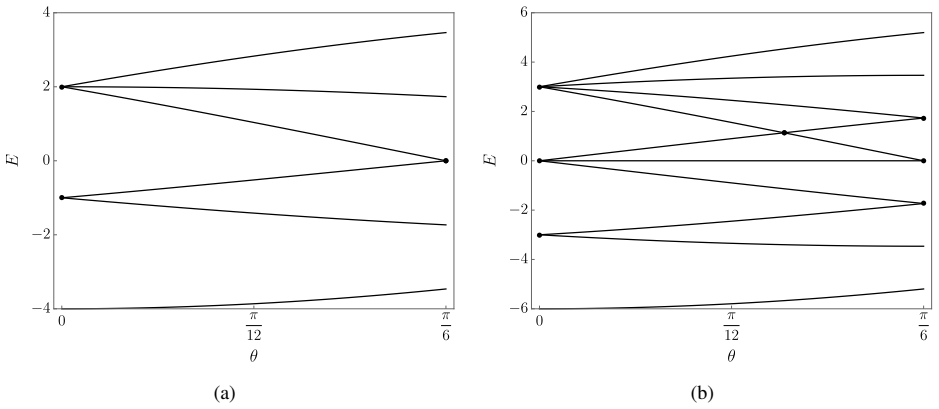
The central discovery is that the total domain wall angle, P = σ†_1 σ_L, with eigenvalue p = n1 + 2n2 mod 3, is not just a symmetry of the unperturbed spectrum but the mechanism that keeps the zero-mode expansion local. After mapping operators to states on two chains, the commutator [H0, ·] becomes a diagonal super-operator, and a zero mode is built recursively from H0 ψ^(k+1) = −V ψ^(k). The paper proves that if a local solution exists up to order k and the total domain wall angle is conserved, then P0(Vψ_q^(k) ⊗ I1) = β_p^(k) ⊗ I1: the dangerous part of the perturbation, projected into the kernel of H0, never reaches further along the chain, so the next null-space piece can be chosen local (Property 4). At resonant values of θ where different H0 bands cross with different angles, operators with i1 ≠ j1 are unavoidably produced and cannot be cancelled by any local ψ_p^(k); the expansion therefore exists only up to the order at which the resonance first appears (Property 5). The paper further conjectures that every null-space piece has the form ψ_p^(k) = Σ Γ_l P0 V S_{$\ell^1$} V S_{$\ell^2$} ... V ψ_p^(0), with S_l = P0 for l = 0 and S_l = (Q0/H0)^l otherwise, and gives a recursive algorithm, verified symbolically through fifth order, for the coefficients.
Load-bearing premise
The construction collapses if the conjectured form of the null-space piece, ψ_p^(k) = Σ Γ_l P0 V S_{$\ell^1$} V ... V ψ_p^(0), fails at any order beyond the checked fifth; the paper assumes this ansatz to make the algorithm work and has no proof of it in general.
Editorial extensions
If this is right
- When the total domain wall angle is conserved, including all non-resonant θ, the zero-mode expansion can be constructed to arbitrary order with each term localized on a chain of length k+1, so the edge mode remains localized by construction.
- At an angle-breaking resonance, the expansion terminates at the order equal to the length of the smallest chain that exhibits the resonance, matching the known perturbative energy-splitting analysis and explaining the divergences seen in earlier iterative schemes.
- The zero mode can always be normalized: by adding suitable multiples of σ1 at each order, ψ^3 = IL + O(f^{-L}) and ψ†ψ = IL + O(f^{-L}) hold simultaneously, so the mode's algebraic properties at f = 0 persist order by order.
- The same ansatz and algorithm extend to other spin chains, including non-integrable models where no symmetry protects the mode; there the formal expansion still exists but the mode is not normalizable, indicating no thermodynamic-limit zero mode.
- The coefficient ansatz (74) reproduces the known zero-mode constructions in the XYZ model and long-coherence-time edge-spin models, suggesting a common super-operator origin for these iterative methods.
Reading between the lines
- If the ansatz (74) is eventually proven at all orders, the entire zero-mode expansion reduces to counting and weighting sequences of projections P0 and resolvents (Q0/H0)^l; the radius-of-convergence problem then becomes a growth estimate for the Γ coefficients, which the paper does not address.
- The locality criterion of Property 4 may serve as a practical diagnostic for candidate spin models: one only needs to inspect the first order at which P0(Vψ_q ⊗ I1) fails to factor as β_p ⊗ I1, and that order bounds the zero-mode expansion from above.
- The non-normalizable formal zero mode in the symmetry-breaking non-integrable model suggests that normalization, not just formal existence, is what separates true strong zero modes from algebraic artefacts; linking this distinction to slow thermalization of local operators is a natural next step.
Signed reviews
Editorial analysis
A structured set of objections, weighed in public.
Referee Report
Summary. The paper studies the existence and explicit construction of strong edge zero modes in a Z3 quantum clock chain (parafermion chain) by working in the spin/super-operator representation. The recursive equations H0 psi^(k+1) = -V psi^(k) are recast as a constrained degenerate perturbation theory. The authors prove several structural results: a characterization of the null space of H0 (Property 1), uniqueness of the local starting point (Property 3), a locality condition on P0(V psi_q^(k)) when the total domain wall angle is conserved (Property 4), and a negative result stating that at resonances where the total domain wall angle is not conserved, no local expansion can pass the order at which the resonance first appears (Property 5). They also prove order-by-order conditions for normalization (Properties 6-8). The main constructive claim is a conjectured ansatz for the null-space component psi_p^(k) of the solution (Eq. 74) and an iterative algorithm (Section 10) to compute it, verified symbolically up to 5th order and with a 6th-order solution computed but not checked against the ansatz. Numerical evidence is presented for a finite radius of convergence.
Significance. If the conjectured ansatz holds, the paper would provide a systematic, model-independent perturbative construction of edge zero modes and would unify and generalize earlier iterative approaches (Fendley, Kemp et al.). The rigorous negative results (Property 5) and the locality and normalization theorems are solid and constitute the paper's most secure contribution. The symbolic checks to 5th order and the successful construction of the 6th-order solution provide substantial evidence, and the explicit formulas for the first few orders are useful. However, the central positive claim of existence of the expansion to all orders is not proven; it rests on the unproven ansatz (74), as the authors themselves acknowledge.
major comments (2)
- [Section 7, Eq. (74); Section 10] The central positive claim—that when the total domain wall angle is conserved the recursive equations can be solved to all orders with local operators—is not established. The only general proposal for solving Eq. (58) (finding psi_p^(k) in Null(H0) such that P0V(psi_p^(k) tensor I1) = -P0V(psi_q^(k) tensor I1)) is the conjectured ansatz (74), together with the algorithm of Section 10. The authors state in Section 10 that they cannot prove that this algorithm works at all orders without assuming the ansatz, and the ansatz is verified only up to 5th order; the 6th-order solution was computed but explicitly not checked against the ansatz. A failure of the ansatz at any higher order would invalidate the claimed all-orders construction, while leaving the negative resonance results intact. The paper should either supply a proof of the ansatz or of an inductive existence step for psi_p^(k), or clearly restate the construction as a conjecture and limit the announced results accordingly.
- [Section 10] The algorithmic construction is demonstrated only for non-resonant values of theta (the worked example uses theta=pi/12), and the text explicitly says the analysis works only when we are not at a resonant point and must be changed case by case for resonant values. Yet the key physical case advertised in the paper, theta=pi/6, is a resonance at which the total domain wall angle is conserved. No details of the case-by-case modification are given for such resonances, so the evidence for the central claim at the most interesting points is weaker than for generic theta. Please provide at least a worked resonant-conserving example (e.g., theta=pi/6) or clarify that the all-orders claim is presently supported only away from resonances.
minor comments (5)
- [Sections 1, 11, Appendix B] There are several typos: 'Kitev chain' in Section 1; 'constuction' in Section 11; 'haHs' and 'Null ()0' in the proof of Property 4 in Appendix B.
- [Section 3, Property 1] Property 1's description of the restricted basis is notationally confusing: the expression |i1, i_{k-2}, i_k>|i1, j_{k-1}, i_k> seems to omit ellipses and may mislead; please rewrite with explicit index lists or ellipses.
- [Section 4] Throughout the text, the same symbols H0 and V denote both the physical operators and the super-operators [H0,·], [V,·]; although the paper notes this, a consistent notation (e.g., H0^, V^) would improve readability.
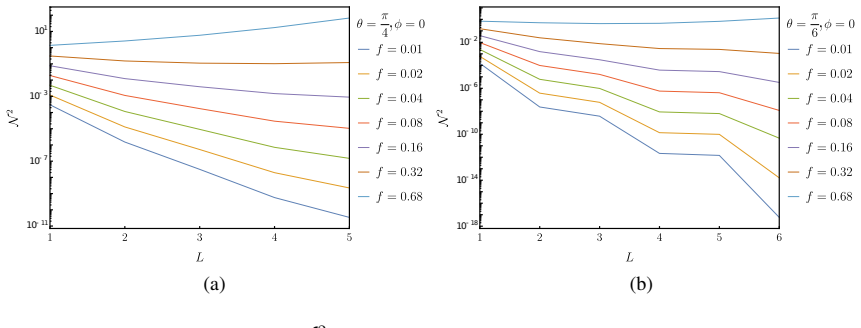
- [Section 9] The quantity N2 is introduced as a measure of normalization error, but the definition (110) uses Tr(psi-dagger psi), and the statement about the Frobenius norm of psi is slightly ambiguous; specifying the normalization convention explicitly would help.
- [Section 7, Eq. (74)] Eq. (74) uses the notation S_l with S_0 = P0 and S_l = (Q0/H0)^l for l>0; since Q0/H0 is a pseudo-inverse on the range of Q0, a short remark defining this operation on the orthogonal complement would prevent confusion.
Circularity Check
No significant circularity: the zero-mode recursion is solved self-consistently, and the unproven all-orders ansatz is an acknowledged conjecture rather than a fitted input.
full rationale
The central recursion (20)/(34) is not circular: at each order one chooses ψ_p^(k) satisfying (58) and then obtains ψ_q^(k+1) by inverting H0 on −V(ψ_p^(k)+ψ_q^(k)) (Eq. (61)). The locality statements are proved from the diagonal structure of H0 and the null-space characterization, not assumed. Property 4 is proved in Appendix B, and Property 5 follows from that proof once the resonant chain length is identified. The positive all-orders construction is explicitly conjectural: Section 10 states, 'Strictly speaking we cannot prove that this algorithm works at all orders, as we need to assume our ansatz (74) to hold true in order for it to work,' and the ansatz was checked through 5th order, with ψ_p^(6) computed but not checked against the ansatz. A higher-order counterexample would falsify a conjecture, not reveal circularity, because the ansatz coefficients are solved from the recursion equations in Appendix D rather than fitted to the target zero mode. The total-domain-wall-angle criterion is taken from the same authors' Ref. [26], but the new locality results do not reduce to that citation: Property 4 is proved independently, and the proof of Property 5 is self-contained once the resonant chain length is given. Ref. [26] is corroborative, not the load-bearing derivation. The normalization argument (Properties 6-8) also follows from the symmetries of the recursion and from the freedom to add multiples of σ1, rather than from assuming ψ†ψ=1 or ψ^3=1 beforehand. Overall no derived expression is equivalent to its input by construction.
Assumptions & free parameters
assumptions (4)
- domain assumption The zero mode admits a formal power series in f, psi = sum_i f^i psi^(i), with psi^(0) = sigma_1, and each psi^(k) acts non-trivially only on chains of length k+1.
- ad hoc to paper The general ansatz psi_p^(k) = sum Gamma P0 V S_l1 ... V psi_p^(0) (Eq. 74) holds at all orders.
- domain assumption Strong zero modes may occur only at theta values where either no bands cross or crossing bands share the same total domain wall angle.
- domain assumption The formal perturbative series for the zero mode has a finite radius of convergence and yields a normalizable operator in the thermodynamic limit.
Cite this review
Pith. "Pith review of Constructing edge zero modes through domain wall angle conservation." pith.science (2026). https://pith.science/paper/EADK7ZT7
@misc{pith2026190803459,
  author       = {Pith},
  title        = {Pith review of: Constructing edge zero modes through domain wall angle conservation},
  year         = {2026},
  howpublished = {\url{https://pith.science/paper/EADK7ZT7}},
  note         = {Machine review of arXiv:1908.03459}
}
abstract
We investigate the existence, normalization and explicit construction of edge zero modes in topologically ordered spin chains. In particular we give a detailed treatment of zero modes in a $\mathbb{Z}_3$ generalization of the Ising/Kitaev chain, which can also be described in terms of parafermions. We analyze when it is possible to iteratively construct strong zero modes, working completely in the spin picture. An important role is played by the so called total domain wall angle, a symmetry which appears in all models with strong zero modes that we are aware of. We show that preservation of this symmetry guarantees locality of the iterative construction, that is, it imposes locality conditions on the successive terms appearing in the zero mode's perturbative expansion. The method outlined here summarizes and generalizes some of the existing techniques used to construct zero modes in spin chains and sheds light on some surprising common features of all these types of methods. We conjecture a general algorithm for the perturbative construction of zero mode operators and test this on a variety of models, to the highest order we can manage. We also present analytical formulas for the zero modes which apply to all models investigated, but which feature a number of model dependent coefficients.
Figures

Figures from the paper (1 more)

Reference graph
Works this paper leans on
-
[1]
¨Onder G¨ul, Hao Zhang, Jouri D. S. Bommer, Michiel W. A. de Moor, Diana Car, S ´ebastien R. Plissard, Erik P. A. M. Bakkers, Attila Geresdi, Kenji Watanabe, Takashi Taniguchi, and Leo P. Kouwenhoven. Ballistic majorana nanowire devices. Nature Nanotechnology, 13(3):192–197, 2018
work page 2018
-
[2]
M. T. Deng, S. Vaitiekenas, E. B. Hansen, J. Danon, M. Leijnse, K. Flensberg, J. Nyg ˚ard, P. Krogstrup, and C. M. Marcus. Majorana bound state in a coupled quantum-dot hybrid- nanowire system. Science, 354(6319):1557–1562, 2016
work page 2016
-
[3]
Michael Ruby, Falko Pientka, Yang Peng, Felix von Oppen, Benjamin W. Heinrich, and Katha- rina J. Franke. End states and subgap structure in proximity-coupled chains of magnetic adatoms. Phys. Rev. Lett., 115:197204, Nov 2015
work page 2015
-
[4]
Drozdov, Jian Li, Hua Chen, Sangjun Jeon, Jungpil Seo, Allan H
Stevan Nadj-Perge, Ilya K. Drozdov, Jian Li, Hua Chen, Sangjun Jeon, Jungpil Seo, Allan H. MacDonald, B. Andrei Bernevig, and Ali Yazdani. Observation of majorana fermions in ferro- magnetic atomic chains on a superconductor. Science, 346(6209):602–607, 2014
work page 2014
-
[5]
Simon, Ady Stern, Michael Freedman, and Sankar Das Sarma
Chetan Nayak, Steven H. Simon, Ady Stern, Michael Freedman, and Sankar Das Sarma. Non- abelian anyons and topological quantum computation. Rev. Mod. Phys. , 80:1083–1159, Sep 2008
work page 2008
-
[6]
A. Y . Kitaev. Unpaired majorana fermions in quantum wires. Phys. Usp., 44:131, Oct 2001
work page 2001
-
[7]
Helical liquids and majorana bound states in quantum wires
Yuval Oreg, Gil Refael, and Felix von Oppen. Helical liquids and majorana bound states in quantum wires. Phys. Rev. Lett., 105:177002, Oct 2010. 26
work page 2010
-
[8]
P. Fendley. Parafermionic edge zero modes in zn-invariant spin chains. J. Stat. Mech., 11:11020, Nov 2012
work page 2012
Show all 37 references
-
[9]
Huse, Rahul Nandkishore, Vadim Oganesyan, Arijeet Pal, and S
David A. Huse, Rahul Nandkishore, Vadim Oganesyan, Arijeet Pal, and S. L. Sondhi. Localization-protected quantum order. Physical Review B, 88(1):014206, Jul 2013
2013
-
[10]
Majorana edge states in interacting one-dimensional systems
Suhas Gangadharaiah, Bernd Braunecker, Pascal Simon, and Daniel Loss. Majorana edge states in interacting one-dimensional systems. Phys. Rev. Lett., 107:036801, Jul 2011
2011
-
[11]
Strong zero modes and eigenstate phase transitions in the XYZ interacting majo- rana chain
Paul Fendley. Strong zero modes and eigenstate phase transitions in the XYZ interacting majo- rana chain. Journal of Physics A: Mathematical and Theoretical, 49(30):30LT01, Jun 2016
2016
-
[12]
G. Kells. Many-body Majorana operators and the equivalence of parity sectors. Phys. Rev. B, 92(8):081401, Aug 2015
2015
-
[13]
G. Kells. Multiparticle content of Majorana zero modes in the interacting p -wave wire. Phys. Rev. B, 92(15):155434, Oct 2015
2015
-
[14]
Long coherence times for edge spins
Jack Kemp, Norman Y Yao, Christopher R Laumann, and Paul Fendley. Long coherence times for edge spins. Journal of Statistical Mechanics: Theory and Experiment, 2017(6):063105, Jun 2017
2017
-
[15]
Kells, N
G. Kells, N. Moran, and D. Meidan. Localization enhanced and degraded topological order in interactingp-wave wires. Phys. Rev. B, 97:085425, Feb 2018
2018
-
[16]
P. Fendley. Free parafermions. J. Phys. A Math. Theor., 47(7):075001, February 2014
2014
-
[17]
Fradkin and L
E. Fradkin and L. P. Kadanoff. Disorder variables and para-fermions in two-dimensional statis- tical mechanics. Nucl. Phys. B, (1):1–15, 1980
1980
-
[18]
Kadanoff, and Marcel Den Nijs
Steven Howes, Leo P. Kadanoff, and Marcel Den Nijs. Quantum model for commensurate- incommensurate transitions. Nuclear Physics B, 215(2):169 – 208, 1983
1983
-
[19]
von Gehlen and V
G. von Gehlen and V . Rittenberg. Zn-symmetric quantum chains with an infinite set of conserved charges and zn zero modes. Nuclear Physics B, 257:351 – 370, 1985
1985
-
[20]
S. Ostlund. Incommensurate and commensurate phases in asymmetric clock models. Phys. Rev. B, 24:398–405, Jul 1981
1981
-
[21]
Ortiz, E
G. Ortiz, E. Cobanera, and Z. Nussinov. Dualities and the phase diagram of the p-clock model. Nuclear Physics B, 854(3):780–814, Jan 2012
2012
-
[22]
Lindner, Erez Berg, Gil Refael, and Ady Stern
Netanel H. Lindner, Erez Berg, Gil Refael, and Ady Stern. Fractionalizing majorana fermions: Non-abelian statistics on the edges of abelian quantum hall states. Phys. Rev. X, 2:041002, Oct 2012
2012
-
[23]
D. J. Clarke, J. Alicea, and K. Shtengel. Exotic non-abelian anyons from conventional fractional quantum hall states. Nat. Comm., 4:1348, Jan 2013
2013
-
[24]
Topological phases with parafermions: Theory and blueprints
Jason Alicea and Paul Fendley. Topological phases with parafermions: Theory and blueprints. Annual Review of Condensed Matter Physics, 7:119–139, Mar 2016
2016
-
[25]
A. S. Jermyn, R. S. K. Mong, J. Alicea, and P. Fendley. Stability of zero modes in parafermion chains. Phys. Rev. B, 90(16):165106, Oct 2014
2014
-
[26]
Moran, D
N. Moran, D. Pellegrino, J. K. Slingerland, and G. Kells. Parafermionic clock models and quantum resonance. Phys. Rev. B, 95:235127, Jun 2017. 27
2017
-
[27]
Else, Paul Fendley, Jack Kemp, and Chetan Nayak
Dominic V . Else, Paul Fendley, Jack Kemp, and Chetan Nayak. Prethermal strong zero modes and topological qubits. Physical Review X, 7(4):041062, Oct 2017
2017
-
[28]
Morten I. K. Munk, Asbjørn Rasmussen, and Michele Burrello. Dyonic zero-energy modes. Phys. Rev. B, 98:245135, Dec 2018
2018
-
[29]
Positive linear maps on c*-algebras
Man-Duen Choi. Positive linear maps on c*-algebras. Canadian Journal of Mathematics , 24(3):520529, 1972
1972
-
[30]
Jamiokowski
A. Jamiokowski. Linear transformations which preserve trace and positive semidefiniteness of operators. Reports on Mathematical Physics, 3(4):275 – 278, 1972
1972
-
[31]
Open Quantum Systems Far from Equilibrium
Gernot Shaller. Open Quantum Systems Far from Equilibrium. Springer, 2014
2014
-
[32]
An effective hamiltonian and time-independent perturbation theory
C E Soliverez. An effective hamiltonian and time-independent perturbation theory. Journal of Physics C: Solid State Physics, 2(12):2161–2174, dec 1969
1969
-
[33]
D. J. Klein. Degenerate perturbation theory. The Journal of Chemical Physics, 61(3):786–798, 1974
1974
-
[34]
A. A. Ovchinnikov, D. V . Dmitriev, V . Ya. Krivnov, and V . O. Cheranovskii. Antiferromag- netic Ising chain in a mixed transverse and longitudinal magnetic field. Physical Review B , 68(21):214406, Dec 2003
2003
-
[35]
Chakrabarti, Uma Divakaran, Thomas F
Amit Dutta, Gabriel Aeppli, Bikas K. Chakrabarti, Uma Divakaran, Thomas F. Rosenbaum, and Diptiman Sen. Quantum Phase Transitions in Transverse Field Spin Models: From Statistical Physics to Quantum Information. Cambridge University Press, 2015
2015
-
[36]
Ignacio Cirac, Matthew B
Hyungwon Kim, Mari Carmen Ba ˜nuls, J. Ignacio Cirac, Matthew B. Hastings, and David A. Huse. Slowest local operators in quantum spin chains. Phys. Rev. E, 92:012128, Jul 2015
2015
-
[37]
Vasiloiu, Federico Carollo, Matteo Marcuzzi, and Juan P
Loredana M. Vasiloiu, Federico Carollo, Matteo Marcuzzi, and Juan P. Garrahan. Strong zero modes in a class of generalised Ising spin ladders with plaquette interactions. arXiv e-prints, page arXiv:1901.10211, Jan 2019. A Proof of Property 2 and 3 In this appendix we will prov...
1901 arXiv
Reviewed August 14, 2026 · model on record in the stance chip above.
Discussion (0). Continue with ORCID to comment.