sft-wick: A formalism and package for Feynman-diagram expansion and evaluation in stochastic field theories
Pith reviewed 2026-06-26 18:31 UTC · model grok-4.3
The pith
sft-wick enumerates topologically distinct Feynman diagrams for stochastic field theories and evaluates their integrals from supplied response and cumulant functions.
A machine-rendered reading of the paper's core claim, the machinery that carries it, and where it could break.
Core claim
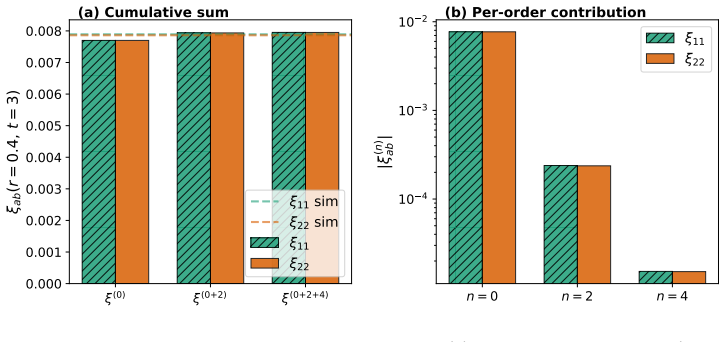
Given an action and an observable, sft-wick produces a table of diagrams by enumerating spatial topologies before routing component indices through tensor vertices; during enumeration it enforces vanishing response-response contractions, the Ito prescription, and the absence of causal response loops. For each retained topology it computes the algebraic coefficient (multiplicity, coupling sum, sign) and evaluates the corresponding integral from user-supplied response and cumulant functions, with the final perturbative prediction matching direct Langevin simulation within statistical noise.
What carries the argument
Core enumeration algorithm that generates spatial topologies before component-index routing while enforcing response-field constraints during the process.
If this is right
- Perturbative series for multi-component fields with matrix propagators and non-Gaussian noise become computable without hand enumeration of contractions.
- The same input format yields diagram tables for any observable once the action is supplied.
- Numerical evaluation of each diagram integral proceeds directly from the user's response and cumulant functions.
- Predictions remain consistent with the underlying stochastic dynamics as verified by Langevin simulation.
Where Pith is reading between the lines
- The topology-first ordering may reduce computational cost relative to contraction-by-contraction methods when the number of components is large.
- The package could be used to generate effective theories by systematically integrating out fast modes in stochastic models.
- Users might test the constraint enforcement on exactly solvable Gaussian cases where only a few diagrams survive.
- Extending the numerical integrator to handle singular integrals or to return symbolic expressions would broaden applicability.
Load-bearing premise
The enumeration algorithm identifies every topologically distinct diagram and applies all response-field constraints without omission or overcounting.
What would settle it
A concrete low-order observable in a simple model for which the package's diagram table or numerical value differs from an exhaustive manual count or from an exact analytic result.
Figures
read the original abstract
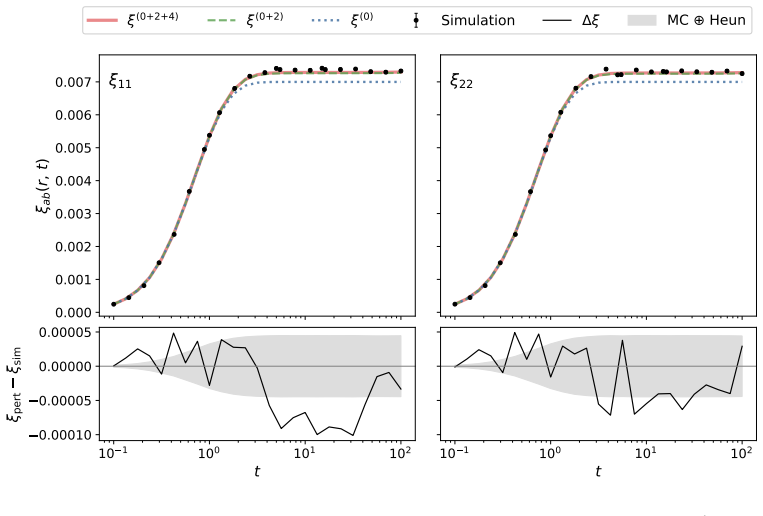
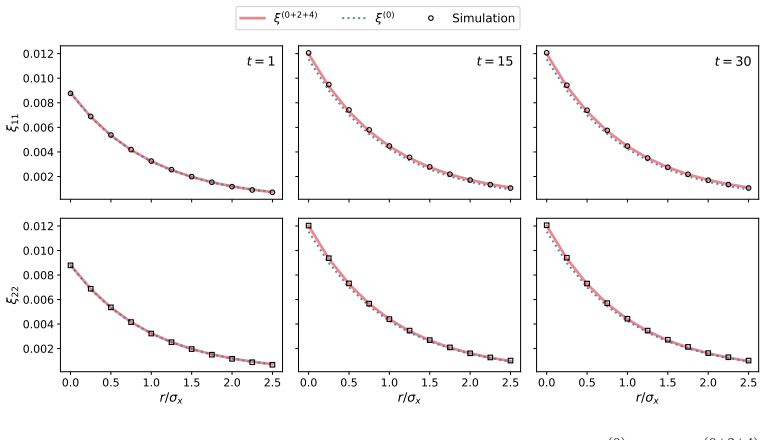
When stochastic field dynamics are cast into a path-integral formulation, perturbation theory becomes systematic but the resulting expansion quickly grows combinatorially large. The setting targeted here includes multi-component, multi-dimensional fields with matrix propagators, tensor-valued couplings, and non-Gaussian driving noise specified by arbitrary $n$-point cumulants. Wick pairings grow factorially, and component indices must be routed through the tensor-valued vertices. The useful output is not a raw contraction list, but a diagram table: one entry per topology, with multiplicities, coupling sums, signs, and causal constraints resolved. We present sft-wick, an open-source Python package that constructs these diagram tables and computes their integrals numerically. Given an action and an observable, it enumerates topologically distinct Feynman diagrams, derives their algebraic coefficients, and evaluates the resulting diagram integrals from user-supplied response and cumulant functions. The core algorithm enumerates spatial topologies before routing component indices, avoiding contraction-by-contraction Wick expansion. Response-field constraints, including vanishing response-response contractions, the ito prescription, and the absence of causal response loops, are enforced during enumeration. Predictions are validated against direct Langevin simulation, agreeing to within the simulation's statistical noise.
Editorial analysis
A structured set of objections, weighed in public.
Referee Report
Summary. The manuscript presents sft-wick, an open-source Python package for automating Feynman-diagram expansions in stochastic field theories formulated as path integrals. Given an action and observable, the package enumerates topologically distinct diagrams (via spatial topologies followed by index routing), derives algebraic coefficients and signs, enforces response-field constraints (vanishing response-response contractions, Itô prescription, no causal response loops), and evaluates the resulting integrals numerically from user-supplied response and cumulant functions. Predictions are validated by comparison to direct Langevin simulations, with reported agreement within statistical noise for the tested cases.
Significance. If the core enumeration and constraint logic are correct, the package addresses a practical bottleneck in perturbative calculations for multi-component, multi-dimensional stochastic fields with matrix propagators, tensor couplings, and arbitrary n-point noise cumulants. By producing compact diagram tables rather than raw Wick contractions, it could enable higher-order work that is otherwise combinatorially prohibitive. Credit is given for the open-source release, the topology-first algorithm design, and the end-to-end numerical validation against simulations.
major comments (1)
- [Validation paragraph (abstract and results section)] Validation paragraph (abstract and results section): The agreement with direct Langevin simulations within statistical noise constitutes an integrated end-to-end test. However, this does not isolate the correctness of the topology-enumeration algorithm or the enforcement of the three response constraints (vanishing response-response contractions, Itô prescription, absence of causal response loops). An undercount, overcount, or incorrect constraint application could remain undetected due to statistical fluctuations, cancellation, or limited test cases. A stronger verification—such as exhaustive enumeration for small systems with known analytic results or machine-checked comparison to a reference implementation—is required to support the central claim that the algorithm produces exactly the complete set of diagrams.
Simulated Author's Rebuttal
We thank the referee for the thoughtful review and for identifying a genuine limitation in the strength of the validation. We address the major comment below and will revise the manuscript accordingly.
read point-by-point responses
-
Referee: The agreement with direct Langevin simulations within statistical noise constitutes an integrated end-to-end test. However, this does not isolate the correctness of the topology-enumeration algorithm or the enforcement of the three response constraints (vanishing response-response contractions, Itô prescription, absence of causal response loops). An undercount, overcount, or incorrect constraint application could remain undetected due to statistical fluctuations, cancellation, or limited test cases. A stronger verification—such as exhaustive enumeration for small systems with known analytic results or machine-checked comparison to a reference implementation—is required to support the central claim that the algorithm produces exactly the complete set of diagrams.
Authors: We agree that the existing numerical comparisons constitute an integrated test and do not separately certify the enumeration and constraint logic. In the revised manuscript we will add a dedicated subsection (in Results) that performs exhaustive enumeration for low-order diagrams in two minimal models (scalar Gaussian noise and a two-component linear system) for which the complete diagram tables are known analytically from the literature. The generated tables, multiplicities, signs, and constraint applications will be compared directly to these analytic references. We will also release the corresponding test scripts with the package so that the verification is reproducible and machine-checkable. revision: yes
Circularity Check
No circularity: enumeration algorithm and validation are independent of fitted inputs or self-referential definitions
full rationale
The paper describes a computational package whose core is an enumeration algorithm that takes user-supplied response and cumulant functions as explicit inputs and produces diagram integrals. No equations reduce a claimed prediction to a fitted parameter by construction, no uniqueness theorems are imported via self-citation, and no ansatz is smuggled. Validation against direct Langevin simulation constitutes an external numerical check rather than a tautological one. The derivation chain is therefore self-contained against the stated inputs and external benchmarks.
Axiom & Free-Parameter Ledger
Forward citations
Cited by 1 Pith paper
-
Statistical Field Theory for Weak Gravitational Lensing
Formulates weak lensing as a stochastic field theory generating diagrammatic expansions for arbitrary n-point lensing observables, with linear propagation as the lowest-order limit and a selection rule for hierarchy mixing.
Reference graph
Works this paper leans on
-
[1]
P. C. Martin, E. D. Siggia, H. A. Rose, Statistical Dynamics of Classical Systems, Phys. Rev. A8 (1) (1973) 423–437.doi:10.1103/PhysRevA.8.423
-
[2]
H.-K. Janssen, On a Lagrangean for classical field dynamics and renormaliza- tion group calculations of dynamical critical properties, Zeitschrift fur Physik B Condensed Matter 23 (4) (1976) 377–380.doi:10.1007/BF01316547
-
[3]
C. de Dominicis, TECHNIQUES DE RENORMALISATION DE LA THÉORIE DES CHAMPS ET DYNAMIQUE DES PHÉNOMÈNES CRI- TIQUES, Journal de Physique Colloques 37 (C1) (1976) C1–247–C1–253. doi:10.1051/jphyscol:1976138. URLhttps://hal.science/jpa-00216466
-
[4]
Wyld Jr, Formulation of the theory of turbulence in an incompressible fluid, Annals of Physics 14 (1961) 143–165
H. Wyld Jr, Formulation of the theory of turbulence in an incompressible fluid, Annals of Physics 14 (1961) 143–165
1961
-
[5]
C. de Dominicis, L. Peliti, Field-theory renormalization and critical dynam- ics above Tc: Helium, antiferromagnets, and liquid-gas systems, Phys. Rev. B18 (1) (1978) 353–376.doi:10.1103/PhysRevB.18.353. 29
-
[6]
A. A. Starobinsky, Stochastic de sitter (inflationary) stage in the early uni- verse, in: Field Theory, Quantum Gravity and Strings: Proceedings of a Seminar Series Held at DAPHE, Observatoire de Meudon, and LPTHE, Uni- versitéPierreetMarieCurie, Paris, BetweenOctober1984andOctober1985, Springer, 2005, pp. 107–126
2005
-
[7]
Vennin, A
V. Vennin, A. A. Starobinsky, Correlation functions in stochastic inflation, The European Physical Journal C 75 (9) (2015) 413
2015
-
[8]
Bartelmann, F
M. Bartelmann, F. Fabis, D. Berg, E. Kozlikin, R. Lilow, C. Viermann, A microscopic, non-equilibrium, statistical field theory for cosmic structure formation, New Journal of Physics 18 (4) (2016) 043020
2016
-
[9]
U. C. Täuber, Critical dynamics: a field theory approach to equilibrium and non-equilibrium scaling behavior, Cambridge University Press, 2014
2014
-
[10]
J. A. Hertz, Y. Roudi, P. Sollich, Path integral methods for the dynamics of stochastic and disordered systems, Journal of Physics A: Mathematical and Theoretical 50 (3) (2017) 033001
2017
-
[11]
Parisi, N
G. Parisi, N. Sourlas, Random magnetic fields, supersymmetry, and negative dimensions, Physical Review Letters 43 (11) (1979) 744
1979
-
[12]
C. C. Chow, M. A. Buice, Path integral methods for stochastic differential equations, The Journal of Mathematical Neuroscience (JMN) 5 (1) (2015) 8
2015
-
[13]
Kamenev, Field theory of non-equilibrium systems, Cambridge University Press, 2023
A. Kamenev, Field theory of non-equilibrium systems, Cambridge University Press, 2023
2023
-
[14]
Altland, B
A. Altland, B. D. Simons, Condensed matter field theory, Cambridge univer- sity press, 2010
2010
-
[15]
Zhang, Statistical field theory for gravitational weak lensingIn preparation (2025)
Z. Zhang, Statistical field theory for gravitational weak lensingIn preparation (2025)
2025
-
[16]
Hahn, Generating feynman diagrams and amplitudes with feynarts 3, Computer Physics Communications 140 (3) (2001) 418–431
T. Hahn, Generating feynman diagrams and amplitudes with feynarts 3, Computer Physics Communications 140 (3) (2001) 418–431
2001
-
[17]
Peeters, Cadabra: a field-theory motivated symbolic computer algebra system, Computer Physics Communications 176 (8) (2007) 550–558
K. Peeters, Cadabra: a field-theory motivated symbolic computer algebra system, Computer Physics Communications 176 (8) (2007) 550–558
2007
-
[18]
Meurer, C
A. Meurer, C. P. Smith, M. Paprocki, O. Čertík, S. B. Kirpichev, M. Rock- lin, A. Kumar, S. Ivanov, J. K. Moore, S. Singh, et al., Sympy: symbolic computing in python, PeerJ Computer Science 3 (2017) e103. 30
2017
-
[19]
Bernardeau, S
F. Bernardeau, S. Colombi, E. Gaztañaga, R. Scoccimarro, Large-scale struc- ture of the universe and cosmological perturbation theory, Physics reports 367 (1-3) (2002) 1–248
2002
-
[20]
Gardiner, Stochastic methods, Vol
C. Gardiner, Stochastic methods, Vol. 4, Springer Berlin Heidelberg, 2009
2009
-
[21]
B. D. McKay, A. Piperno, Practical graph isomorphism, ii, Journal of sym- bolic computation 60 (2014) 94–112. 31 Table B.2: Modules and principal public symbols insft-wick. Module Class/Function Description Field definitions fields FieldDeclare a field type (φorψ) with component count FieldOperatorConcrete field instance with UID, index, spatial arg Inter...
2014
discussion (0)
Sign in with ORCID, Apple, or X to comment. Anyone can read and Pith papers without signing in.