REVIEW 4 major objections 4 minor 19 references
This paper claims that reasoning LLMs can be trained to detect ambiguous or missing premises and ask the user for clarification mid-reasoning, which yields higher accuracy, fewer wasted tokens, and fewer interaction turns than blind chain-o
Reviewed by Pith at T0; open to challenge. T0 means a machine referee read the full paper against a public rubric. the ladder, T0–T4 →
T0 review · deepseek-v4-flash
2026-08-03 06:42 UTC pith:ECJSYGGF
load-bearing objection Solid training recipe for proactive clarification, but the simulator's access to ground-truth intent makes the 'in the wild' numbers oracle-driven and needs a blind ablation before they can be believed. the 4 major comments →
Reasoning While Asking: Transforming Reasoning Large Language Models from Passive Solvers to Proactive Inquirers
The pith
A machine-rendered reading of the paper's core claim, the machinery that carries it, and where it could break.
Core claim
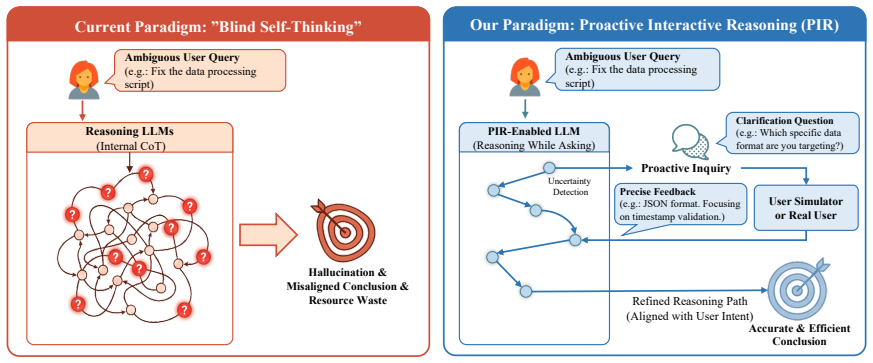
The paper's central claim is that the main failure mode of reasoning LLMs in real interaction is not knowledge gaps but premise- and intent-level uncertainty, and that this can be addressed directly by training the model to ask. PIR's contribution is a two-phase method: first, detect where the model's own uncertainty spikes during a chain-of-thought trace (via normalized predictive entropy), and at those points insert a clarification question plus a simulated user answer, turning a monologue into a think–ask–respond trajectory; supervised fine-tuning on this data gives the model the structural ability to ask. Second, US-GRPO optimizes the interactive policy with a user simulator conditioned
What carries the argument
The central mechanism is uncertainty-aware data augmentation: normalized predictive entropy is computed for each reasoning step, and high-entropy steps are selected as clarification points where a strong instruction-following model inserts an assistant question and a simulated user response, producing a think–ask–respond trajectory. This trajectory format is the object that carries the method; it converts the model's internal uncertainty into an explicit training signal for when to ask. The second machinery is US-GRPO, a policy-gradient method (group-relative policy optimization) wrapped around a dynamic user simulator, with a composite reward: an output reward for matching the ground-truth
Load-bearing premise
The load-bearing premise is that an LLM prompted with the ground-truth task intent behaves enough like a real user that preferences learned from it transfer; the paper's Limitations section concedes that the simulator "may not fully capture the linguistic noise and dynamic intent of real-world human interactions," and if real users answer less cooperatively or reward different behavior, the reported accuracy and efficiency gains may shrink.
What would settle it
Run PIR and its base reasoning model on the same ambiguous math, code, and document-editing tasks, but have a human (or a held-out simulator with a different ambiguity distribution) answer the clarification questions, with the ground-truth intent never revealed to the answerer; compare final accuracy and turns to resolution. If PIR does not beat the base model on accuracy or does not reduce turns, the central claim that proactive interaction improves correctness and efficiency outside the simulated environment is falsified.
If this is right
- On the three simulated benchmarks, PIR outperforms all baselines in accuracy, pass rate, or BLEU while using fewer tokens and fewer turns to resolution, implying that proactive clarification is compatible with efficiency rather than being an added cost.
- Ablations show that removing the reasoning-oriented reward degrades accuracy and increases interaction turns, so the helpfulness–efficiency balance in the reward is load-bearing for stable learning.
- PIR trained only on Math-Chat transfers to TriviaQA, SQuAD, and missing-premise variants of GSM8K and MATH, suggesting the asking skill generalizes across different uncertainty types without task-specific interactive training data.
- PIR reduces token use even on non-interactive benchmarks, indicating the model learns to stop and ask rather than reason blindly, which could lower compute costs in deployment.
- On factual-knowledge benchmarks such as MMLU the gains are small, indicating that the model learns to use interaction selectively rather than asking indiscriminately.
Where Pith is reading between the lines
- The strongest untested extension is a human-participant study on the same ambiguous math, code, and document-editing tasks; the simulator is prompted with the ground-truth intent, so real users who answer less cooperatively or judge helpfulness differently could yield smaller or larger gains than reported.
- Because the training signal is constructed from any chain-of-thought trace via predictive-entropy gating, the same recipe could convert existing reasoning corpora into interactive training data without new human annotation, offering a cheap way to retrofit deployed reasoning models.
- In long-horizon agentic workflows such as multi-step tool use or planning, the per-task token savings could compound, and treating premise uncertainty as a first-class signal may reduce cascading errors from early wrong assumptions.
- A testable consequence of the reward design: if the LLM helpfulness judge were replaced with human ratings or a different judge, the learned asking behavior would likely shift; probing this could reveal how much of the reported gains depend on the specific judge.
Editorial analysis
A structured set of objections, weighed in public.
Referee Report
Summary. The paper proposes Proactive Interactive Reasoning (PIR), a two-phase training procedure to make reasoning LLMs ask clarification questions while reasoning. Phase I builds an uncertainty-aware SFT dataset by inserting simulated clarification–response pairs into DeepSeek-R1 reasoning traces at high-predictive-entropy points. Phase II applies a user-simulator-based GRPO variant (US-GRPO) with a composite reward combining output correctness, interaction efficiency, and LLM-judged helpfulness. Experiments on MATH-Chat, BigCodeBench-Chat, and DocEdit-Chat report accuracy/pass-rate/BLEU gains (up to 32.70%, 22.90%, and 41.36, respectively) while reducing token counts and interaction turns. Additional evaluations on MMLU, TriviaQA, SQuAD, and missing-premise math tasks claim generalization to non-interactive settings.
Significance. The idea of training reasoning models to detect premise- and intent-level uncertainty and ask the user before committing to long chains of thought is timely and practically relevant. The paper's main evidence is partly grounded in external, non-circular metrics: task accuracy, pass rate, BLEU, and token/turn counts are computed independently of the RL reward. The release of code and the inclusion of reward-ablation training curves are also strengths. However, the strength of the empirical claims is limited by (i) the user simulator's access to ground-truth intent during both training and evaluation, (ii) the use of the same LLM judge for the reported 'helpfulness' metric and the training reward, and (iii) the absence of variance estimates. If these issues are addressed, the paper would make a useful contribution to interactive reasoning.
major comments (4)
- [§5.1, Table 2; §3.2.1, Eq. (4); Appendix Table 8] The 'reliability in the wild' evaluation is oracle-driven. The user simulator S is conditioned on user intent I, where I includes the 'Complete Prompt or Reference Goal' (Table 8). In the missing-premise tests (MIP-GSM8K/MATH) and QA benchmarks (TriviaQA/SQuAD), every clarification question is answered by a simulator with access to the ground-truth answer or premise. On MIP tasks, PIR's 15.81/25.00 accuracy is achieved by asking for the missing premise and receiving it from an omniscient simulator; a real user who does not know the premise cannot provide it. On TriviaQA/SQuAD, the model could in principle ask 'what is the answer?' and receive it. The paper's Limitations section concedes that the simulator 'may not fully capture linguistic noise and dynamic intent', but this understates the problem: the simulator does not merely lack noise; it has ground-truth access. Therefore, the claim
- [§4.2, Table 1 'Help.'; §3.2.2, Eq. (8); Appendix Table 9] The reported helpfulness scores are circular as evidence of quality. The 'Help.' metric in Table 1 is computed with the same H_LLM judge prompt (Table 9) that is used as the intrinsic reward in Eq. (8). Thus the high helpfulness values (0.44/0.46/0.66) mostly measure the model's success at optimizing the training reward, not its helpfulness to real users. Report a human-annotated helpfulness evaluation on a sample, or at least cross-check with a different, non-training judge, and present the agreement.
- [§4.1.3, 'Interactive Environment Construction', and Table 1] The comparison in Table 1 is asymmetric in termination handling. Multi-turn baselines are given an explicit [TERMINATE CHAT] signal once the objective is achieved, whereas PIR models receive no such signal and learn their own stopping behavior. This can inflate PIR's efficiency gains (Tokens, TTR) and may also affect accuracy/pass-rate because baselines stop at a correct response while PIR may continue. Please run a sensitivity check where all methods use the same termination rules, or at least report what changes if the baselines' termination signal is removed.
- [Tables 1–2 generally] All main results are reported as single points without error bars, seed variations, or significance tests. Given the stochastic decoding (temperature 0.6) and RL training, the differences between conditions (e.g., 32.70 vs 34.00 in Fig. 3; 22.90 vs 19.70 in Table 1) could fall within run-to-run noise. Please report means and standard deviations over at least three independent training runs, or provide confidence intervals for the test-set metrics.
minor comments (4)
- [§4.1.3] Typo: 'shown in in the Appendix' should be 'shown in the Appendix'.
- [Table 2] In Table 2, the 'EM' column is ambiguous—does it denote exact match, and is it computed with the same pass@1 setting as the other columns? Please clarify in the caption or text.
- [§5.1] The phrase 'accuracy increases dramatically—by 26.74 on TriviaQA and 29.69 on SQuAD' is confusing because those are not accuracy differences in percentage points on the same scale as the numbers in the table; please state explicitly which rows are being compared and whether these are percentage-point or relative changes.
- [§A.5, Table 8] The user simulator prompt instructs the model to 'Occasionally Make Mistakes' and 'Mention Personal Preferences', but the evaluation protocols and Tables 1–2 do not report how often such behaviors were observed. A short analysis of the simulator's fidelity would strengthen the reliability of the interactive metrics.
Circularity Check
Reliability-in-the-wild and helpfulness results are measured with the same oracle-conditioned simulator and reward used in training, so those 'predictions' reduce by construction; the main task-accuracy comparisons retain external grounding.
specific steps
-
fitted input called prediction
[Section 5.1 (Table 2), Section 3.2.1 (Eq. 4), Appendix A.5 (Table 8)]
"Complete Prompt or Reference Goal: This field may include the complete user request/query or a reference answer to user’s request. Use this field to understand the user’s intent, requirements, or what would count as a satisfactory outcome. ... with a strong user simulator, accuracy increases dramatically—by 26.74 on TriviaQA and 29.69 on SQuAD."
The 'reliability in the wild' evaluation (Table 2) uses the training-time simulator: S is conditioned on hidden ground-truth intent I (Eq. 4) and its prompt (Table 8) includes the 'Complete Prompt or Reference Goal' (the answer). Thus every clarification question is answered by an oracle knowing the missing premise/answer. The MIP gains (8.59→15.81; 7.68→25.00) and QA gains (19.77→45.51) measure querying a reference, not real-user robustness. Since US-GRPO trained with the same oracle-conditioned simulator, the generalization claim restates the training environment. Limitations only concede noise/dynamic-intent gaps, but the simulator has ground-truth access.
-
fitted input called prediction
[Section 3.2.2 (Eq. 8), Section 4.1.3 (Evaluation Paradigm), Table 1]
"Helpfulness of Asking (Help.) uses the HLLM(r) reward to evaluate the helpfulness of model’s asking. ... Rreason(r, o, g) = I(o=g)·Iask [ Sbase ·E(r)·H LLM(r)]"
The policy is optimized to maximize HLLM via Rreason (Eq. 8); the Help. column in Table 1 is computed with the same HLLM judge and prompt (Table 9). High helpfulness scores (0.44/0.46/0.66) are therefore the training objective evaluated on the optimized policy, not an independent measure of user satisfaction. Reporting the reward as a metric makes the helpfulness result true by construction.
full rationale
The paper's central accuracy and token-efficiency comparisons on Math-Chat, BigCodeBench-Chat, and DocEdit-Chat (Table 1) are evaluated against ground-truth task outcomes, so they are not circular in the narrow sense: the final-answer correctness and token counts are external to the training objective. However, two load-bearing 'predictions' are self-referential. First, the Section 5.1 'Reliability in the Wild' generalization claims (Table 2) are generated in an interactive environment whose user simulator is prompted with the hidden reference answer (Table 8) and is the same type of simulator used in training (Eq. 4). Asking for a missing premise and receiving it from an oracle is true by construction, so the MIP and QA gains do not support the claim of robustness to real-world user ignorance. The Limitations section concedes only that the simulator lacks noise/dynamic intent, but the actual issue is stronger: the simulator has ground-truth access. Second, the Help. metric is the HLLM reward itself, making the reported helpfulness improvement an evaluation of the objective, not an independent check. No load-bearing self-citation chain was found: the only noticeable self-citation (Yang et al. 2025 for 'aha moments') is motivational and not required for the Predictive-Entropy mechanism. Overall score 6 reflects that some reported 'predictions' reduce by construction, while the main task-accuracy results retain independent content.
Axiom & Free-Parameter Ledger
free parameters (4)
- S_base (reward scale) =
not reported
- N_max (max interaction turns) =
5
- Top-k PE percentile for clarification injection =
not specified
- SFT dataset size =
4000
axioms (4)
- domain assumption Predictive-entropy spikes in reasoning traces mark points where clarification is needed
- domain assumption An LLM prompted with ground-truth intent simulates real human user responses
- domain assumption GPT-4o-mini's helpfulness judgment H_LLM captures genuine clarification quality
- domain assumption Ground-truth final answer availability in RL is representative of deployment
read the original abstract
Reasoning-oriented Large Language Models (LLMs) have achieved remarkable progress with Chain-of-Thought (CoT) prompting, yet they remain fundamentally limited by a \emph{blind self-thinking} paradigm: performing extensive internal reasoning even when critical information is missing or ambiguous. We propose Proactive Interactive Reasoning (PIR), a new reasoning paradigm that transforms LLMs from passive solvers into proactive inquirers that interleave reasoning with clarification. Unlike existing search- or tool-based frameworks that primarily address knowledge uncertainty by querying external environments, PIR targets premise- and intent-level uncertainty through direct interaction with the user. PIR is implemented via two core components: (1) an uncertainty-aware supervised fine-tuning procedure that equips models with interactive reasoning capability, and (2) a user-simulator-based policy optimization framework driven by a composite reward that aligns model behavior with user intent. Extensive experiments on mathematical reasoning, code generation, and document editing demonstrate that PIR consistently outperforms strong baselines, achieving up to 32.70\% higher accuracy, 22.90\% higher pass rate, and 41.36 BLEU improvement, while reducing nearly half of the reasoning computation and unnecessary interaction turns. Further reliability evaluations on factual knowledge, question answering, and missing-premise scenarios confirm the strong generalization and robustness of PIR. Model and code are publicly available at: \href{https://github.com/SUAT-AIRI/Proactive-Interactive-R1}
Figures


Reference graph
Works this paper leans on
-
[1]
I prefer short answers,
Dialogue Generation: - Generate one round: Assistant asks, User answers. - Must fully reflect the reasoning logic and conclusion. - Do not add information absent from the reasoning/answer/history. ## 2. Questioning Rules - If reasoning shows ambiguity, multiple options, or missing info: ask the User. - If multiple options: let the User choose (must match ...
-
[2]
If not, what specific part of the problem or solution are you struggling with?
-
[3]
Has the AI asked you to perform a task or answer a question? If so, how should you approach it?
-
[4]
Missing premise exacerbates overthinking: Are reasoning models losing critical thinking skill? CoRR, abs/2504.06514. Dan Hendrycks, Collin Burns, Saurav Kadavath, Akul Arora, Steven Basart, Eric Tang, Dawn Song, and Ja- cob Steinhardt. 2021. Measuring mathematical prob- lem solving with the MATH dataset. InProceedings of the Neural Information Processing ...
Pith/arXiv arXiv 2021
-
[5]
OpenReview.net. An Yang, Beichen Zhang, Binyuan Hui, Bofei Gao, Bowen Yu, Chengpeng Li, Dayiheng Liu, Jian- hong Tu, Jingren Zhou, Junyang Lin, Keming Lu, Mingfeng Xue, Runji Lin, Tianyu Liu, Xingzhang Ren, and Zhenru Zhang. 2024. Qwen2.5-math tech- nical report: Toward mathematical expert model via self-improvement.CoRR, abs/2409.12122. Shu Yang, Junchao...
Pith/arXiv arXiv 2024
-
[6]
think-ask-respond
OpenReview.net. A Appendix A.1 Uncertainty Analysis of PIR Framework To validate the effectiveness of theUncertainty- Aware Data Augmentationmechanism proposed in Section 3.1, we conducted a quantitative analysis on the model’s behavior after the Cold-Start SFT phase. The core premise of the PIR framework is that the model should not ask questions randoml...
2021
-
[8]
Have you obtained a satisfactory solution from the AI? If yes, you can terminate this chat
-
[11]
Are you noticing any patterns or potential misunderstandings that need clarification?
-
[12]
Stop immediately when the user’s response is completed
If you’re stuck, how can you phrase your question to get the most helpful response while demonstrating your current understanding? - “response“ (str): Based on your thought process, respond to the AI as the user you are role-playing. Stop immediately when the user’s response is completed. Remember to stay in character as a user throughout your response, f...
-
[13]
Alignment with Intent: Does the response address the user’s question or request as understood from the chat history?
-
[14]
Usefulness: Does the response provide actionable, relevant, and sufficient information to assist the user effectively?
-
[15]
thought":
Clarity: Is the response expressed clearly and in a way that is easy for the user to understand? Scoring Criteria: - 0.0: The response is completely unhelpful. It does not address the user’s intent, lacks useful information to solve the problem, and/or is entirely unclear. - 0.2: The response is minimally helpful. It barely addresses the user’s intent, la...
-
[16]
- Acknowledge previous interactions to maintain context and continuity in the conversation
Understanding and Engagement - Accurately interpret the user’s intent throughout the conversation. - Acknowledge previous interactions to maintain context and continuity in the conversation
-
[17]
Do you have any further questions? Let me know
Interactivity (Important!) - Ask clarifying questions if the user’s request lacks detail or is ambiguous. Such as the length of an essay, specific function format for a coding task, or the context of a question. - Ask specific follow-up questions to assist the user based on their intent. Avoid general questions like "Do you have any further questions? Let...
-
[18]
- When asking for feedback or presenting options, provide multiple-choice suggestions or specific prompts to make it easier for the user to respond quickly
Efficiency and User Consideration - Be mindful of how much the user needs to read or type, keeping the interaction concise and focused. - When asking for feedback or presenting options, provide multiple-choice suggestions or specific prompts to make it easier for the user to respond quickly. - Avoid repeating information from earlier in the conversation u...
-
[19]
I don’t know,
Communication Style - Be honest in your responses. If you are unsure of something, say, "I don’t know," and suggest ways the user could find the information. - Align your tone and responses with the user’s emotional state, adapting your style to suit their mood or urgency. - Ensure your responses are clear, well-structured, and free from grammatical error...
-
[2024]
CLARINET: augmenting language models to ask clarification questions for retrieval.CoRR, abs/2405.15784. Fabio Chiusano. 2024. Medium articles dataset. https://huggingface.co/datasets/ fabiochiu/medium-articles. A dataset of Medium articles collected through web scraping, including metadata such as titles, authors, publication dates, tags, and content. Ale...
Pith/arXiv arXiv 2024
-
[2025]
The danger of overthinking: Examining the reasoning-action dilemma in agentic tasks.CoRR, abs/2502.08235. DeepSeek-AI. 2025. Deepseek-r1: Incentivizing rea- soning capability in llms via reinforcement learning. CoRR, abs/2501.12948. Pierre Erbacher and Laure Soulier. 2023. CIRCLE: multi-turn query clarifications with reinforcement learning.CoRR, abs/2311....
Pith/arXiv arXiv 2025
-
[4468]
Chenrui Fan, Ming Li, Lichao Sun, and Tianyi Zhou
Association for Computational Linguistics. Chenrui Fan, Ming Li, Lichao Sun, and Tianyi Zhou
discussion (0)
Sign in with ORCID, Apple, or X to comment. Anyone can read and Pith papers without signing in.