Error-Resilient Fast Entangling Gates for Scalable Ion-Trap Quantum Processors
Pith reviewed 2026-05-21 23:20 UTC · model grok-4.3
The pith
New search scheme produces error-resilient fast two-qubit gates for ion-trap processors with up to 50 ions at 99.9% fidelity
A machine-rendered reading of the paper's core claim, the machinery that carries it, and where it could break.
Core claim
The authors claim that an improved gate search scheme using multi-objective optimization to include dominant error sources, generalization to unpaired pulses, and imposition of symmetries on pulse sequences eliminates susceptibility to laser phase noise and enables microsecond two-qubit gates with fidelities approaching 99.9% between arbitrary ion pairs in linear ion-trap processors of up to 50 ions, even in the presence of random and systematic experimental errors.
What carries the argument
The multi-objective machine design approach that incorporates error sources into pulse sequence optimization, together with symmetry constraints and allowance for unpaired pulses during gate evolution.
Load-bearing premise
The multi-objective optimization accurately captures the dominant experimental error sources and the resulting pulse sequences stay compatible with existing fast laser control hardware without new unmodeled effects.
What would settle it
An experiment that implements one of the proposed pulse sequences on a linear ion trap with 20 to 50 ions, applies the gate to a pair of ions, and measures the resulting entanglement fidelity under typical levels of laser intensity noise and motional heating.
Figures




read the original abstract
Non-adiabatic two-qubit gate proposals for trapped-ion systems offer superior performance and flexibility over adiabatic schemes at the cost of increased laser control requirements. Existing fast gate schemes are limited by single-qubit transition errors, which constrain the total number of pulses in high-fidelity solutions. We introduce an improved gate search scheme that enables both local and non-local two-qubit gates in chains containing tens of ions. These protocols use a multi-objective machine design approach that incorporates dominant sources of error in the design to ensure the solutions are compatible with existing fast laser controls. We also generalize previous schemes by allowing for unpaired pulses during the gate evolution. By imposing symmetries on the pulse sequences, we eliminate susceptibility to laser phase noise and further simplify the multi-mode control over the state-dependent motion of the ion crystal. We perform a comprehensive analysis of expected gate performance in the presence of random and systematic experimental errors to demonstrate the feasibility of performing microsecond two-qubit gates between arbitrary ion pairs in current linear ion-trap processors of up to $50$ ions with fidelities approaching $99.9\%$.
Editorial analysis
A structured set of objections, weighed in public.
Referee Report
Summary. The paper introduces an improved multi-objective optimization scheme for designing non-adiabatic two-qubit entangling gates in linear ion traps. By incorporating dominant experimental errors into the design process, allowing unpaired pulses, and imposing symmetries on the pulse sequences to eliminate laser phase noise susceptibility, the authors claim to enable microsecond-scale gates between arbitrary ion pairs in chains of up to 50 ions. Comprehensive simulations under random and systematic errors are presented to support fidelities approaching 99.9%.
Significance. If the error modeling and optimization results hold under real hardware conditions, this approach would represent a meaningful advance for scalable trapped-ion quantum processors by relaxing constraints on pulse count and control complexity while maintaining high fidelity for non-local gates. The work builds on prior fast-gate schemes with concrete improvements in error resilience and symmetry constraints, potentially enabling more practical implementations in current hardware.
major comments (2)
- [Error analysis and simulation sections] The central fidelity claims for 50-ion chains rely on the multi-objective optimization capturing all dominant error sources at microsecond timescales. However, the error model appears to omit or underweight correlated laser-intensity jitter across pulses and position-dependent AC-Stark shifts from fast control beams, which could couple to the unpaired-pulse degrees of freedom and reduce fidelity below 99.9% even when the reported budget is met. A concrete test or additional simulation including these terms is needed to substantiate the headline performance.
- [Gate search scheme and symmetry constraints] The generalization to arbitrary ion pairs in long chains assumes the imposed symmetries fully simplify multi-mode motional control without introducing new vulnerabilities. It is unclear from the optimization details whether the resulting pulse sequences remain robust when motional heating rates scale with ion number and gate speed, as this could undermine the cross-pair scalability claim.
minor comments (3)
- [Methods] Clarify the exact definition and weighting of the multi-objective function, including how the free parameters for error incorporation are chosen, to improve reproducibility of the search method.
- [Results] Add explicit comparison tables or figures showing fidelity improvements over previous schemes (e.g., with and without unpaired pulses) under identical error conditions.
- [Simulation details] Ensure all simulation parameters (e.g., ion number, gate duration, specific error magnitudes) are tabulated for the 50-ion case to allow direct verification.
Simulated Author's Rebuttal
We thank the referee for their careful reading and constructive feedback on our manuscript. We have revised the paper to strengthen the error analysis and clarify the robustness of the symmetry constraints. Our point-by-point responses to the major comments follow.
read point-by-point responses
-
Referee: [Error analysis and simulation sections] The central fidelity claims for 50-ion chains rely on the multi-objective optimization capturing all dominant error sources at microsecond timescales. However, the error model appears to omit or underweight correlated laser-intensity jitter across pulses and position-dependent AC-Stark shifts from fast control beams, which could couple to the unpaired-pulse degrees of freedom and reduce fidelity below 99.9% even when the reported budget is met. A concrete test or additional simulation including these terms is needed to substantiate the headline performance.
Authors: We thank the referee for identifying these potential additional error channels. Our optimization already incorporates laser intensity fluctuations as random errors and uses symmetries to suppress phase noise. To address the specific concerns, we have added new simulations in the revised manuscript that explicitly include correlated intensity jitter (at levels consistent with current laser systems) and position-dependent AC-Stark shifts. These results show that the unpaired-pulse degrees of freedom remain robust, with gate fidelities staying above 99.85% for 50-ion chains. A new subsection and supplementary figures have been included to document the updated error budget. revision: yes
-
Referee: [Gate search scheme and symmetry constraints] The generalization to arbitrary ion pairs in long chains assumes the imposed symmetries fully simplify multi-mode motional control without introducing new vulnerabilities. It is unclear from the optimization details whether the resulting pulse sequences remain robust when motional heating rates scale with ion number and gate speed, as this could undermine the cross-pair scalability claim.
Authors: The symmetries are chosen to reduce control complexity for the multi-mode motion while canceling laser phase noise. Our existing simulations for up to 50 ions already include motional heating at rates typical of current traps. In the revision we have added an explicit discussion of heating-rate scaling with ion number and gate duration, together with quantitative estimates showing that the resulting infidelity contribution remains below the 0.1% threshold for the microsecond gates considered. This supports the claimed scalability to arbitrary pairs; we have updated the relevant section and added a scaling plot. revision: yes
Circularity Check
Multi-objective optimization and symmetry imposition provide independent design for fast gates
full rationale
The paper's core contribution is a new gate search scheme employing multi-objective optimization that directly incorporates dominant experimental error sources into the pulse-sequence design process. This yields protocols for microsecond two-qubit gates in chains up to 50 ions. The approach generalizes earlier schemes by permitting unpaired pulses and imposing symmetries to remove laser-phase-noise sensitivity, but these extensions are presented as novel features rather than reductions to prior fitted results. Performance claims of ~99.9% fidelity under random and systematic errors rest on explicit simulation of the modeled error channels, not on any parameter that is fitted to the target fidelity and then re-labeled as a prediction. Self-references to previous schemes exist but are not load-bearing for the central feasibility demonstration, which retains independent content from the optimization and symmetry constraints. The derivation chain is therefore self-contained against the stated error models.
Axiom & Free-Parameter Ledger
free parameters (1)
- multi-objective weights
axioms (1)
- domain assumption Dominant error sources can be accurately modeled and incorporated into the gate design process without significant unaccounted effects.
Lean theorems connected to this paper
-
IndisputableMonolith/Cost/FunctionalEquation.leanwashburn_uniqueness_aczel unclear?
unclearRelation between the paper passage and the cited Recognition theorem.
We use a two-stage optimization over z and t using the theoretical gate error (Eq. (10)) as our cost function
What do these tags mean?
- matches
- The paper's claim is directly supported by a theorem in the formal canon.
- supports
- The theorem supports part of the paper's argument, but the paper may add assumptions or extra steps.
- extends
- The paper goes beyond the formal theorem; the theorem is a base layer rather than the whole result.
- uses
- The paper appears to rely on the theorem as machinery.
- contradicts
- The paper's claim conflicts with a theorem or certificate in the canon.
- unclear
- Pith found a possible connection, but the passage is too broad, indirect, or ambiguous to say the theorem truly supports the claim.
Forward citations
Cited by 2 Pith papers
-
High-Fidelity Raman Spin-Dependent Kicks in the Presence of Micromotion
A scheme using modulated Raman pulses achieves spin-dependent kick infidelities below 10^{-5} in trapped ions despite micromotion by optimizing RF parameters to cancel backward kicks.
-
Radial Fast Entangling Gates Under Micromotion in Trapped-Ion Quantum Computers
Micromotion enables high-fidelity fast entangling gates on radial modes of trapped-ion crystals with operation times of hundreds of nanoseconds.
Reference graph
Works this paper leans on
-
[1]
Anharmonic trapping potential Anharmonic potentials have been used in trapped-ion experiments to confine large linear chains of ions with 6 FIG. 3. Example optimized fast gate schemes: Optimized gate solutions for (a) a supersonic gate and (b) a subsonic gate between ions 4 and 5 in a 10-ion chain, assuming a 500 MHz SDK repetition rate. Both gate schemes...
-
[2]
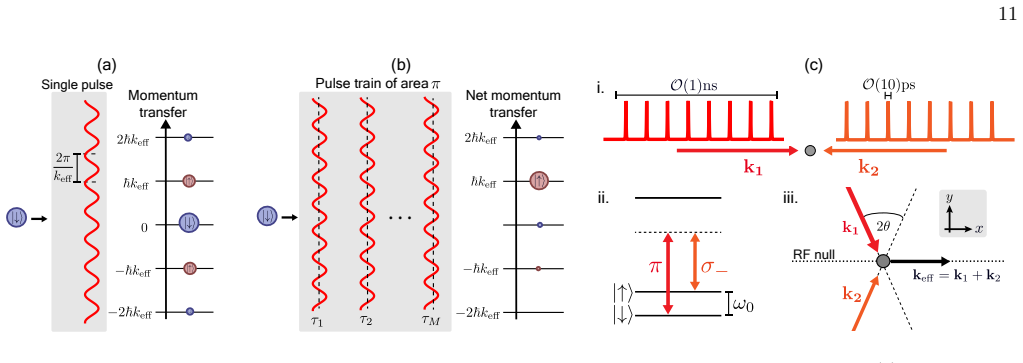
SDKs with individual π-pulses Previous theoretical work on fast gate design has ex- clusively considered fast entangling gates based on paired SDKs implemented using counter-propagating π-pulses [4, 41–43, 45, 46, 49, 66]. These SDK pairs were as- sumed to be separated by a very short delay such that free evolution of the ion motion between them can be ig...
-
[3]
For chains with more than 20 ions, the gate 9 FIG
we generalize this to consider the performance of non- local gates. For chains with more than 20 ions, the gate 9 FIG. 6. Gate performance with different SDK repetition rates: (a) Minimum SDK repetition rate required to perform gates above a 99 .9% threshold fidelity as a function of gate time. All gates were optimized for a local ion pair at the edge of ...
-
[4]
Repetition rate errors Miscalibrations of the SDK repetition rate typically arise in pulsed lasers due to drifts of the repetition rate. These drifts are much slower than the gates we consider [52, 60, 74], so we treat them as a systematic shift in the SDK repetition rate during the gate. Figure 11(a) demonstrates the impact of this shift on the gate erro...
-
[5]
Pulse timing errors A separate source of error is the imperfect timing of SDKs, which we analyze independently of variations in the repetition rate. Given that pulsed lasers exhibit sub- picosecond timing jitters [75], we assume the timings within each group to be highly stable as they are locked to the repetition rate of the laser. Therefore, the most li...
-
[6]
Motional heating This was previously investigated in Ref. [42], where the authors found gate fidelities were significantly damaged if heating of the axial modes occurs during the operation. The gates considered in this work are much faster than trap heating rates [64, 80, 81], making them resilient to this type of error. Specifically, for heating rates of...
-
[7]
Coulomb nonlinearities For efficient computation of the mode structure in long ion chains, we truncate the effective potential experi- enced by each ion to second order (see Appendix D). Ref.[48] found that non-linearities in the Coulomb po- tential introduce errors on the order of 10 −6. We antici- pate that errors from the Coulomb non-linearity will be ...
-
[8]
Anharmonicities in the trapping potential We also consider anharmonicities in the trapping po- tential due to the quartic term. On length scales smaller than the ion separation, these anharmonicities are small relative to the harmonic potential ( zmin ≪ p κ2/κ4). Given that the ions only experience small displacements relative to their separation ( ∼ 0.1%...
-
[9]
First consider the distribution of 2Q gate errors conditioned on exactly m = 1 SDK error in the sequence, P1(εG)
-
[10]
Generate S1 = 10 4 samples of errant SDK se- quences, {zk}, following the rule Eq. (B1)
-
[11]
For each errant SDK sequence, compute the 2Q gate error from Eq. (10). This gives a set of S1 samples of {εG} for the m = 1 error order
-
[12]
Estimate the conditional PDF by sorting the sam- ples of εG into Nbins with width ∆ x, i.e. P1(εG) ≈ (1/S1) X bin i count(i) ∆x(i) χi(εG) , (B3) where count(i) is the number of data samples in the i-th bin with width ∆ ε(i) = ε(i+1) − ε(i) described by the indicator function: χi(ε) = 1 /∆ε(i) for ε ∈ [ε(i), ε(i+1)] and zero elsewhere
-
[13]
Repeat steps 1-4 for increasing error order m ≤ mmax ≤ N . We use mmax = 3, which we find to 16 be sufficient for computing the full 2Q error PDF in the regime of small pulse error probability, i.e. ϵ ≪ 1
-
[14]
(B2), trun- cating the sum at m = mmax
Reconstruct the full error PDF from Eq. (B2), trun- cating the sum at m = mmax. Appendix C: Derivation of fast gate unitary As operators on different motional modes commute, we will only consider the evolution of a single motional mode during the fast gate operation in this Appendix. For notational simplicity, we omit the explicit time-ordering operator. ...
-
[15]
(X → −X and Y → −Y ). We calculate the phase accumulated at time tj due to a single SDK at time t0 by considering the difference between the unkicked coherent state, |βα(tj)⟩, βα(tj) = 1√ 2 (Xα(t0) + iYα(t0)) e−iωαtj , (D8) and the kicked coherent state, |β′ α(tj)⟩ β′ α(tj) = 1√ 2 (Xα(t0) + i(Yα(t0) + ∆Yα)) e−iωαtj , (D9) where ∆ Yα = ± √ 2zjb(±) α ηα dep...
-
[16]
P. Wang, C.-Y. Luan, M. Qiao, M. Um, J. Zhang, Y. Wang, X. Yuan, M. Gu, J. Zhang, and K. Kim, Na- ture Communications 12, 233 (2021), arXiv:2008.00251 [quant-ph]
-
[17]
J. I. Cirac and P. Zoller, Physical Review Letters 74, 4091 (1995)
work page 1995
-
[18]
Entanglement and quantum computation with ions in thermal motion
A. Sorensen and K. Molmer, Physical Review A 62, 022311 (2000), arXiv:quant-ph/0002024
work page internal anchor Pith review Pith/arXiv arXiv 2000
-
[19]
J. Garc´ ıa-Ripoll, P. Zoller, and J. Cirac, Physical review letters 91, 157901 (2003)
work page 2003
-
[20]
Quantinuum Dominates the Quantum Landscape: New World-Record in Quantum Volume,
“Quantinuum Dominates the Quantum Landscape: New World-Record in Quantum Volume,” . 18
- [21]
-
[22]
M. C. Smith, A. D. Leu, K. Miyanishi, M. F. Gely, and D. M. Lucas, Physical Review Letters 134, 230601 (2025)
work page 2025
-
[23]
Scalable, high-fidelity all-electronic control of trapped-ion qubits,
C. M. L¨ oschnauer, J. M. Toba, A. C. Hughes, S. A. King, M. A. Weber, R. Srinivas, R. Matt, R. Nour- shargh, D. T. C. Allcock, C. J. Ballance, C. Matthiesen, M. Malinowski, and T. P. Harty, “Scalable, high-fidelity all-electronic control of trapped-ion qubits,” (2024), arXiv:2407.07694 [quant-ph]
-
[24]
C. R. Clark, H. N. Tinkey, B. C. Sawyer, A. M. Meier, K. A. Burkhardt, C. M. Seck, C. M. Shappert, N. D. Guise, C. E. Volin, S. D. Fallek, H. T. Hayden, W. G. Rel- lergert, and K. R. Brown, Physical Review Letters 127, 130505 (2021), arXiv:2105.05828 [physics, physics:quant- ph]
- [25]
-
[26]
P. H. Leung and K. R. Brown, Physical Review A 98, 032318 (2018), arXiv:1808.02555 [physics, physics:quant- ph]
work page internal anchor Pith review Pith/arXiv arXiv 2018
-
[27]
C. Figgatt, A. Ostrander, N. M. Linke, K. A. Landsman, D. Zhu, D. Maslov, and C. Monroe, Nature 572, 368 (2019), arXiv:1810.11948 [quant-ph]
-
[28]
Benchmarking a trapped-ion quan- tum computer with 29 algorithmic qubits,
J.-S. Chen, E. Nielsen, M. Ebert, V. Inlek, K. Wright, V. Chaplin, A. Maksymov, E. P´ aez, A. Poudel, P. Maunz, and J. Gamble, “Benchmarking a trapped-ion quan- tum computer with 29 algorithmic qubits,” (2023), arXiv:2308.05071
-
[29]
N. Grzesiak, R. Bl¨ umel, K. Wright, K. M. Beck, N. C. Pisenti, M. Li, V. Chaplin, J. M. Amini, S. Debnath, J.- S. Chen, and Y. Nam, Nature Communications 11, 2963 (2020)
work page 2020
-
[30]
S. A. Moses, C. H. Baldwin, M. S. Allman, R. An- cona, L. Ascarrunz, C. Barnes, J. Bartolotta, B. Bjork, P. Blanchard, M. Bohn, J. G. Bohnet, N. C. Brown, N. Q. Burdick, W. C. Burton, S. L. Campbell, J. P. Campora, C. Carron, J. Chambers, J. W. Chan, Y. H. Chen, A. Chernoguzov, E. Chertkov, J. Colina, J. P. Curtis, R. Daniel, M. DeCross, D. Deen, C. Delan...
work page 2023
-
[31]
J. M. Pino, J. M. Dreiling, C. Figgatt, J. P. Gaebler, S. A. Moses, M. S. Allman, C. H. Baldwin, M. Foss-Feig, D. Hayes, K. Mayer, C. Ryan-Anderson, and B. Neyen- huis, Nature 592, 209 (2021)
work page 2021
- [32]
-
[33]
V. Kaushal, B. Lekitsch, A. Stahl, J. Hilder, D. Pijn, C. Schmiegelow, A. Bermudez, M. M¨ uller, F. Schmidt- Kaler, and U. Poschinger, AVS Quantum Science 2, 014101 (2020)
work page 2020
- [34]
-
[35]
C. Mordini, A. Ricci Vasquez, Y. Motohashi, M. M¨ uller, M. Malinowski, C. Zhang, K. K. Mehta, D. Kienzler, and J. P. Home, Physical Review X 15, 011040 (2025)
work page 2025
-
[36]
J. D. Sterk, H. Coakley, J. Goldberg, V. Hietala, J. Lecht- enberg, H. McGuinness, D. McMurtrey, L. P. Parazzoli, J. Van Der Wall, and D. Stick, npj Quantum Information 8, 68 (2022)
work page 2022
-
[37]
D. Schoenberger, S. Hillmich, M. Brandl, and R. Wille, IEEE Transactions on Computer-Aided Design of Inte- grated Circuits and Systems 44, 2144 (2025)
work page 2025
-
[38]
Distributed Quan- tum Computing across an Optical Network Link,
D. Main, P. Drmota, D. P. Nadlinger, E. M. Ainley, A. Agrawal, B. C. Nichol, R. Srinivas, G. Araneda, and D. M. Lucas, “Distributed Quantum Computing across an Optical Network Link,” (2024), arXiv:2407.00835 [quant-ph]
- [39]
-
[40]
Integrated photonic structures for photon- mediated entanglement of trapped ions,
F. W. Knollmann, E. Clements, P. T. Callahan, M. Gehl, J. D. Hunker, T. Mahony, R. McConnell, R. Swint, C. Sorace-Agaskar, I. L. Chuang, J. Chiaverini, and D. Stick, “Integrated photonic structures for photon- mediated entanglement of trapped ions,” (2024), arXiv:2401.06850 [physics, physics:quant-ph]
- [41]
- [42]
-
[43]
High-fidelity remote entanglement of trapped atoms mediated by time-bin photons,
S. Saha, M. Shalaev, J. O’Reilly, I. Goetting, G. Toh, A. Kalakuntla, Y. Yu, and C. Monroe, “High-fidelity remote entanglement of trapped atoms mediated by time- bin photons,” (2024), arXiv:2406.01761 [quant-ph]
-
[44]
J. O’Reilly, G. Toh, I. Goetting, S. Saha, M. Sha- laev, A. L. Carter, A. Risinger, A. Kalakuntla, T. Li, A. Verma, and C. Monroe, Physical Review Letters 133, 090802 (2024)
work page 2024
-
[45]
J. P. Gaebler, T. R. Tan, Y. Lin, Y. Wan, R. Bowler, A. C. Keith, S. Glancy, K. Coakley, E. Knill, D. Leibfried, and D. J. Wineland, Physical Review Letters117, 060505 (2016), arXiv:1604.00032
work page internal anchor Pith review Pith/arXiv arXiv 2016
-
[46]
K. A. Landsman, Y. Wu, P. H. Leung, D. Zhu, N. M. Linke, K. R. Brown, L. Duan, and C. Monroe, Physical Review A 100, 022332 (2019)
work page 2019
-
[47]
J. J. Garcia-Ripoll, P. Zoller, and J. I. Cirac, Physical Review A 71, 062309 (2005), arXiv:quant-ph/0411103
work page internal anchor Pith review Pith/arXiv arXiv 2005
-
[48]
A. M. Steane, G. Imreh, J. P. Home, and D. Leibfried, New Journal of Physics 16, 053049 (2014)
work page 2014
-
[49]
M. Palmero, S. Mart´ ınez-Garaot, D. Leibfried, D. J. 19 Wineland, and J. G. Muga, Physical Review A 95, 022328 (2017)
work page 2017
- [50]
-
[51]
V. M. Sch¨ afer, C. J. Ballance, K. Thirumalai, L. J. Stephenson, T. G. Ballance, A. M. Steane, and D. M. Lucas, Nature 555, 75 (2018)
work page 2018
-
[52]
Scal- able entangling gates on ion qubits via structured light addressing,
X. Mai, L. Zhang, Q. Yu, J. Zhang, and Y. Lu, “Scal- able entangling gates on ion qubits via structured light addressing,” (2025), arXiv:2506.19535 [quant-ph]
-
[53]
T. Choi, S. Debnath, T. A. Manning, C. Figgatt, Z.-X. Gong, L.-M. Duan, and C. Monroe, Physical Review Letters 112, 190502 (2014)
work page 2014
-
[54]
N. H. Nickerson, J. F. Fitzsimons, and S. C. Benjamin, Physical Review X 4, 041041 (2014)
work page 2014
-
[55]
R. Nigmatullin, C. J. Ballance, N. de Beaudrap, and S. C. Benjamin, New Journal of Physics 18, 103028 (2016)
work page 2016
-
[56]
C. D. B. Bentley, A. R. R. Carvalho, and J. J. Hope, New Journal of Physics 17, 103025 (2015)
work page 2015
-
[57]
R. L. Taylor, C. D. B. Bentley, J. S. Pedernales, L. Lamata, E. Solano, A. R. R. Carvalho, and J. J. Hope, Scientific Reports 7, 46197 (2017)
work page 2017
-
[58]
A. K. Ratcliffe, R. L. Taylor, J. J. Hope, and A. R. R. Carvalho, Physical Review Letters 120, 220501 (2018)
work page 2018
- [59]
- [60]
-
[61]
C. D. B. Bentley, A. R. R. Carvalho, D. Kielpinski, and J. J. Hope, New Journal of Physics 15, 043006 (2013), arXiv:1211.7156 [quant-ph]
work page internal anchor Pith review Pith/arXiv arXiv 2013
-
[62]
Duan, Physical Review Letters 93, 100502 (2004)
L.-M. Duan, Physical Review Letters 93, 100502 (2004)
work page 2004
-
[63]
E. P. G. Gale, Z. Mehdi, L. M. Oberg, A. K. Ratcliffe, S. A. Haine, and J. J. Hope, Physical Review A 101, 052328 (2020)
work page 2020
-
[64]
Fast mixed-species quantum logic gates for trapped-ion quantum networks,
Z. Mehdi, V. D. Vaidya, I. Savill-Brown, P. Grosser, A. K. Ratcliffe, H. Liu, S. A. Haine, J. J. Hope, and C. R. Viteri, “Fast mixed-species quantum logic gates for trapped-ion quantum networks,” (2025), arXiv:2412.07185 [quant-ph]
-
[65]
High-speed and high-connectivity two-qubit gates in long chains of trapped ions
I. Savill-Brown, J. J. Hope, A. K. Ratcliffe, V. D. Vaidya, H. Liu, S. A. Haine, C. R. Viteri, and Z. Mehdi, “High-speed and high-connectivity two-qubit gates in long chains of trapped ions,” (2025), arXiv:2506.11385 [quant-ph]
work page internal anchor Pith review Pith/arXiv arXiv 2025
-
[66]
C. D. B. Bentley, R. L. Taylor, A. R. R. Carvalho, and J. J. Hope, Physical Review A 93, 042342 (2016)
work page 2016
-
[67]
K. G. Johnson, J. D. Wong-Campos, B. Neyenhuis, J. Mizrahi, and C. Monroe, Nature Communications 8, 697 (2017)
work page 2017
-
[68]
K. G. Johnson, B. Neyenhuis, J. Mizrahi, J. D. Wong- Campos, and C. Monroe, Physical Review Letters 115, 213001 (2015)
work page 2015
- [69]
-
[70]
D. Heinrich, M. Guggemos, M. Guevara-Bertsch, M. I. Hussain, C. F. Roos, and R. Blatt, New Journal of Physics 21, 073017 (2019)
work page 2019
-
[71]
J. D. Wong-Campos, S. A. Moses, K. G. Johnson, and C. Monroe, Physical Review Letters 119, 230501 (2017)
work page 2017
-
[72]
M. I. Hussain, M. J. Petrasiunas, C. D. B. Bentley, R. L. Taylor, A. R. R. Carvalho, J. J. Hope, E. W. Streed, M. Lobino, and D. Kielpinski, Optics Express 24, 16638 (2016)
work page 2016
- [73]
-
[74]
J. Mizrahi, C. Senko, B. Neyenhuis, K. G. Johnson, W. C. Campbell, C. W. S. Conover, and C. Monroe, Physical Review Letters 110, 203001 (2013)
work page 2013
-
[75]
J. Mizrahi, B. Neyenhuis, K. G. Johnson, W. C. Camp- bell, C. Senko, D. Hayes, and C. Monroe, Applied Physics B 114, 45 (2014)
work page 2014
- [76]
- [77]
-
[78]
T. Manovitz, Y. Shapira, L. Gazit, N. Akerman, and R. Ozeri, PRX Quantum 3, 010347 (2022)
work page 2022
- [79]
- [80]
discussion (0)
Sign in with ORCID, Apple, or X to comment. Anyone can read and Pith papers without signing in.