REVIEW 3 major objections 4 minor 68 references
Interfacial Effects Determine Nonequilibrium Phase Behaviors in Chemically Driven Fluids
T0 review · 3 major / 4 minor · reviewed 2026-08-07 · deepseek-v4-flash
Pith's one-line read In chemically driven fluids, the condensate interface—not the bulk—sets phase coexistence, fluxes, and droplet sizes.
desk verdict Real progress on nonequilibrium coexistence, but the 'first-principles' label is undercut by an untested equilibrium input in the boundary conditions. read the letter →
The pith
A machine-rendered reading of the paper's core claim, the machinery that carries it, and where it could break.
The reading
What carries the argument
The load-bearing machinery is the Fixed Local Environment approximation (FLEX), which treats the microscopically sharp interface as a boundary between the two bulk descriptions. FLEX solves the steady-state balance of reactions and diffusive exchange at a tagged interface site for each local environment $n_B$, assuming the marginal environment distribution $p(n_B)$ is unperturbed by the drive; from this it computes the conditional species distribution $p_{B/I}(n_B)$ and the interfacial flux. The dilute phase is described by a linearized reaction–diffusion equation with a reaction–diffusion length $\xi$, and the two descriptions are joined by the flux-matching boundary condition (Eq. 4) and the coexistence condition (Eq. 5) with the Gibbs–Thomson term $\beta\sigma R^{-1}$ for finite droplets. The coupling of these two conditions is what forces the non-Boltzmann statistics: stationarity plus flux conservation plus a Boltzmann ansatz is an overdetermined system unless the flux-to-mobility ratio vanishes.
What would settle it
The cleanest test is the paper's own control scheme: driving the fluid with concentration-independent reaction rate constants is predicted to produce zero net mesoscopic fluxes and Boltzmann interfacial statistics despite dissipation everywhere. Running the same lattice simulation with uniform rate constants and detecting a persistent steady-state flux loop, a non-Boltzmann interface population, or a shift in the coexistence curve would refute the claim that interfacial fluctuations are the mechanism coupling the chemical drive to mesoscopic phase behavior.
Extended reading notes
Core claim
The central claim is that steady-state mesoscopic fluxes in a phase-separated chemically driven fluid originate at the condensate interface, and that these interfacial effects determine the conditions for phase coexistence and the size scaling of droplets. Within the theory, the flux-matching boundary condition (Eq. 4) and the particle–hole-symmetric phase-coexistence condition with a Gibbs–Thomson correction (Eq. 5) replace the usual equilibrium requirements of equal chemical potentials and pressures at a sharp interface. These conditions are mutually consistent only if the interfacial conditional distribution $p_{B/I}(n_B)$ is non-Boltzmann whenever $j_B(R^+)/\Lambda \neq 0$; a Boltzmann distribution on the interface would overdetermine the system unless the entire fluid is governed by a single effective equilibrium, which occurs only when the dilute-phase concentration gradient vanishes. The droplet-size data further imply a nonequilibrium interfacial tension $\sigma$ that departs systematically from the equilibrium value and correlates with the measured capillary fluctuation amplitude. The simulations also isolate a control case: a reaction scheme whose rates do not depend on local concentration dissipates energy everywhere yet produces no mesoscopic fluxes and no interfacial deviations from equilibrium.
Load-bearing premise
The load-bearing premise is that each interface site's local environment is frozen while single-site reactions and diffusion relax—so the drive reshuffles state populations but not the distribution of neighbor counts—and that the condensed phase is strongly phase-separated, with negligible internal fluxes and an unperturbed concentration; when diffusion is fast or conditions approach criticality, that timescale separation fails and the theory's quantitative prediction of capillary fluctuations degrades.
Editorial extensions
If this is right
- Equilibrium-interface theories for chemically driven condensates—which impose equal chemical potentials and pressures across a sharp interface with no reactions on the interface—agree with the simulations only for weak driving or in the fast-diffusion limit $\Lambda \to \infty$, where the system approaches a global effective equilibrium.
- Nonequilibrium coexistence becomes mobility-dependent: at fixed reaction rates, the far-field concentration at coexistence shifts with $\Lambda$, a signature that equilibrium boundary conditions cannot produce.
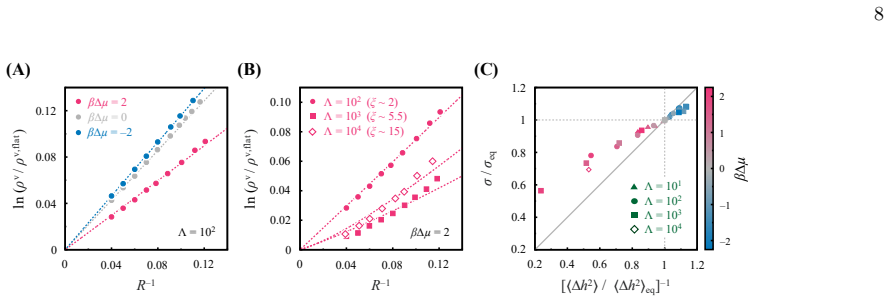
- Droplet size scaling reports a nonequilibrium interfacial tension: $\ln(\rho^v/\rho^v_{\rm flat})$ is linear in $R^{-1}$ in the regime $\xi \ll R$ with slope set by $\sigma \neq \sigma_{\rm eq}$, and becomes nonlinear when $\xi \gtrsim R$ because the flux boundary condition itself acquires $R$-dependence.
- Driving with concentration-independent reaction rate constants produces no mesoscopic fluxes and no non-Boltzmann interfacial statistics, so molecular-scale dissipation alone does not imply observable nonequilibrium phase behavior.
- The inferred nonequilibrium interfacial tension tracks the capillary fluctuation amplitude in a consistent linear trend across both size-scaling regimes, indicating that the chemical drive acts on condensation through interfacial softening or stiffening.
Reading between the lines
- A concrete test the paper does not spell out: because coexistence concentrations are predicted to move with mobility at fixed reaction rates, experiments or simulations that change viscosity or crowding—while holding fuel chemical potential fixed—should shift droplet coexistence and size distributions, a purely nonequilibrium signature.
- Nucleation is the natural probe: the barrier height scales with interfacial tension, so the predicted drive-dependent $\sigma$ implies nucleation rates that classical theory with $\sigma_{\rm eq}$ would misestimate; counting nucleation events versus driving strength and sign would measure the nonequilibrium tension directly.
- The homogeneous-reaction control doubles as an in vivo diagnostic: if steady flux loops or altered capillary fluctuations near condensate surfaces are observed, they indicate that the relevant enzymatic activity is concentrated or concentration-dependent, whereas uniform catalysis would leave interfaces near equilibrium-like behavior.
- Whether interfacial control persists near critical points is open: the theory's quantitative reach is limited where capillary fluctuations are large, so the near-critical regime is the natural place to test whether the interface remains the dominant seat of nonequilibrium effects.
Signed reviews
Editorial analysis
A structured set of objections, weighed in public.
Referee Report
Summary. This paper presents a lattice-gas model of a chemically driven fluid in which molecules interconvert between bonding (B) and inert (I) states through passive and fuel-driven reaction pathways. Using kinetic Monte Carlo simulations, the authors show that steady-state mesoscopic diffusive and reactive fluxes localize near condensate interfaces, that interfacial compositional and capillary fluctuations deviate from equilibrium, and that these deviations are coupled to the chemical drive. They then develop a microscopic–mesoscopic theory: the dilute phase is described by linearized reaction–diffusion equations, while the interface is treated with a Fixed Local Environment approximation (FLEX) encoded in boundary conditions Eqs. (4) and (5). Flat-interface coexistence curves are compared with simulations over a range of Δμ and Λ, along with the reaction–diffusion length, integrated flux, and capillary fluctuations. Finite-droplet size scaling is analyzed through a Gibbs–Thomson-like correction, with the interfacial tension σ as the sole fitting parameter. The paper concludes that equilibrium interface models are generically invalid for chemically driven fluids and that nonequilibrium interfacial effects control coexistence and droplet size scaling.
Significance. If the flat-interface coexistence predictions are quantitatively robust, this is an important step: it offers a route from microscopic reaction rates to nonequilibrium phase diagrams without fitting to the target coexistence data, and it makes the falsifiable prediction of Λ-dependent coexistence curves that qualitatively distinguish the theory from equilibrium boundary-condition approaches. The simulation effort is substantial, the code is provided, and the authors test alternative reaction schemes, which strengthens the generality claims. The main caveats are that the droplet-size-scaling comparison relies on a fitted interfacial tension and that the central FLEX input p(nB) is demonstrably perturbed at the conditions used. A sensitivity check on the latter is needed before the 'first-principles' designation can be fully credited.
major comments (3)
- [Main text, paragraph before Eq. (4); SI BC(3); Fig. S5] The FLEX boundary conditions use the equilibrium marginal distribution p(nB), while the paper's own Fig. S5 shows that p(nB) is measurably perturbed under the same conditions used for the main coexistence results (βΔμ = 2, Λ = 10^2, with nB = 1 and nB = 3 depleted and nB = 2 enhanced relative to equilibrium). Because BC(3) and BC(4) average over p(nB), this is a load-bearing input rather than a cosmetic one. The manuscript never tests how the coexistence curves in Fig. 4A shift if the simulated nonequilibrium p(nB) is used instead of the equilibrium distribution. Please add such a sensitivity analysis; if the predictions are robust, that should be stated explicitly, and if they shift by amounts comparable to the simulation error bars, the 'parameter-free' description should be qualified.
- [Fig. 5A,B; Materials and Methods, final paragraph] The droplet size-scaling comparison is not an independent prediction, because the interfacial tension σ is extracted by fitting the same finite-R simulation data that the theory is then compared with. This is acknowledged in the figure caption and methods, but the abstract and discussion present droplet size scaling as a prediction of the theory. To support the claim, the authors should either obtain σ independently (for example from the flat-interface capillary fluctuation spectrum, with appropriate caveats given Fig. S8) or explicitly label the size-scaling curves as one-parameter fits and adjust the wording accordingly. The correlation in Fig. 5C is suggestive, but the non-unity slope indicates that the interpretation of σ is not quantitatively settled.
- [Discussion, paragraph on FLEX limitations; Fig. 4D] The manuscript acknowledges that FLEX underpredicts capillary fluctuations, especially at large Λ, and that the timescale-separation assumption breaks down in this regime. Since the central claim is a first-principles description of nonequilibrium phase behavior, the paper should state the regime of quantitative validity more precisely. In particular, the capillary-fluctuation predictions are only qualitative (Fig. 4D and the surrounding text), and the theory is restricted to strongly phase-separated conditions by SI BC(1) and BC(2). A concise statement of the expected domain of applicability would prevent overgeneralization of the conclusions.
minor comments (4)
- [Fig. 4D] In the upper row of Fig. 4D, only the theoretical prediction for Λ = 10^2 is shown; to allow the reader to judge the claimed qualitative trend in Λ, the authors should show predictions for the same Λ values as the simulation points.
- [SI Fig. S5] The deviations of p(nB) from equilibrium are presented without error bars or statistical significance. Since this figure is now load-bearing for the sensitivity discussion, uncertainty estimates should be added.
- [Abstract and main text] The theory is described as 'first-principles' and 'parameter-free' in the abstract and main text. Given that p(nB) is taken from an equilibrium simulation and σ is fitted for droplet scaling, the wording should be sharpened (for example, 'parameter-free for flat-interface coexistence curves').
- [Main text, paragraph after Eq. (3)] The predicted reaction–diffusion length ξ uses the ideal-limit expression, while the SI shows that measured self-diffusion coefficients differ from the ideal value; the main text should note that the predicted ξ in Fig. 4B is the ideal-limit value and that empirical ξ is used for the concentration-profile fits.
Circularity Check
The droplet size-scaling 'prediction' is partly enforced by fitting σ to the same finite-droplet data, and the 'first-principles' interface theory imports the self-cited FLEX ansatz together with an equilibrium-simulated p(nB).
-
fitted input called prediction
[Fig. 5 caption; Materials and Methods, 'Microscopic–Mesoscopic Theory of Nonequilibrium Phase Separation']
"Simulation data obtained by varying the total concentration on a lattice with fixed dimensions (marks) are compared to the theory, in which the interfacial tension, σ, is the sole fitting parameter (dotted lines). ... we determine σ by first predicting the conditions for phase coexistence in the limit R→∞ and then fitting the theory to the simulation data ln(ρv/ρv,flat) versus R−1 using σ as the sole fitting parameter."
The theoretical curves in Fig. 5A,B are fit to the same finite-droplet simulation data they are claimed to predict: σ is chosen to match ln(ρv/ρv,flat) versus R−1. Therefore the quantitative 'good agreement' for droplet size scaling is enforced by the fit, not derived. The only genuinely predicted content is the functional form (linear for ξ≪R, nonlinear for ξ≳R); the amplitude is a fitted input. The abstract's claim to 'predict droplet size-scaling relations in good agreement with simulations' is thus partly a fitted-input-called-prediction.
-
ansatz smuggled in via citation
[Main text, section 'A Microscopic Theory Predicts Nonequilibrium Phase Coexistence'; SI, 'Nonequilibrium Interfacial Boundary Conditions Using the FLEX']
"we propose a first-principles theory ... employing a perturbative Fixed Local Environment approXimation (FLEX) [39,40] ... the FLEX approximation implies that the marginal distribution p(nB) is unperturbed relative to equilibrium. ... we utilize the Fixed Local Environment approXimation (FLEX) introduced in Refs. [2,3]."
The central approximation of the 'first-principles' theory is not derived here; it is adopted by citation from the authors' own prior papers (main-text refs. 39,40 = SI refs. 2,3). FLEX fixes the local environment and asserts p(nB) is unperturbed, which is exactly the ansatz those prior papers introduced. The present theory's boundary conditions (Eqs. 4 and 5) therefore rest on a self-cited ansatz rather than on a first-principles derivation, and the claim that the theory predicts nonequilibrium interface statistics is partly an import of the authors' earlier modeling choice.
full rationale
The central coexistence theory is not formally circular: Eqs. (3)–(5), together with the FLEX boundary conditions, solve for nonequilibrium coexistence from the reaction rates and mobility, and the Fig. 4A curves are not fit to the coexistence data they are compared against. However, two issues raise the score. First, the droplet size-scaling 'prediction' in Fig. 5 is partly by construction: σ is the sole fitting parameter and is fit to the same ln(ρv/ρv,flat) versus R−1 data that the theory is then said to reproduce, so the agreement is enforced rather than predicted. Second, the 'first-principles' theory imports its central FLEX ansatz from the authors' own prior work (Refs. [39,40] = SI Refs. [2,3]) and, in SI BC(3), uses the marginal distribution p(nB) 'obtained from an equilibrium simulation' as an input; the paper's own Fig. S5 shows that p(nB) is perturbed at the conditions used for the main results, yet the sensitivity of the coexistence curves to this wrong input is never tested. These are self-citation and empirical-input concerns that weaken the first-principles claim, although the coexistence curves and flux-localization results retain substantial independent content. If the droplet-size section were discounted, the score would be lower; as presented, one headline prediction reduces partly by construction, giving a score of 6.
Assumptions & free parameters
free parameters (2)
- sigma (nonequilibrium interfacial tension) =
varies; e.g., sigma/sigma_eq from about 0.4 to 1.2 in Fig. 5C
- p(nB) (equilibrium marginal distribution of local environments) =
equilibrium distribution at each condition
assumptions (5)
- ad hoc to paper The local environment around a tagged interface site is fixed while single-site fluctuations relax (FLEX timescale separation).
- domain assumption The dilute phase is ideal with nB=0 and a common diffusion coefficient D=Lambda/4.
- domain assumption Fluxes in the condensed phase are negligible and the condensed-phase concentration equals the equilibrium value.
- domain assumption The particle-hole symmetry of the lattice gas defines the nonequilibrium coexistence condition ln(<pB>/(1-<pB>)) = 0.
- standard math Standard mathematical results for reaction-diffusion equations and Bessel functions, and equilibrium capillary wave theory for the height-fluctuation prediction.
Cite this review
Pith. "Pith review of Interfacial Effects Determine Nonequilibrium Phase Behaviors in Chemically Driven Fluids." pith.science (2026). https://pith.science/paper/EDJAXBGU
@misc{pith2026250516824,
  author       = {Pith},
  title        = {Pith review of: Interfacial Effects Determine Nonequilibrium Phase Behaviors in Chemically Driven Fluids},
  year         = {2026},
  howpublished = {\url{https://pith.science/paper/EDJAXBGU}},
  note         = {Machine review of arXiv:2505.16824}
}
read the original abstract
Coupling between chemical fuel consumption and phase separation can lead to condensation at a nonequilibrium steady state, resulting in phase behaviors that are not described by equilibrium thermodynamics. Theoretical models of such "chemically driven fluids" typically invoke near-equilibrium approximations at small length scales. However, because dissipation occurs due to both molecular-scale chemical reactions and mesoscale diffusive transport, it has remained unclear which properties of phase-separated reaction-diffusion systems can be assumed to be at an effective equilibrium. Here we use microscopic simulations to show that mesoscopic fluxes are dependent on nonequilibrium fluctuations at phase-separated interfaces. We further develop a first-principles theory to predict nonequilibrium coexistence curves, localization of mesoscopic fluxes near phase-separated interfaces, and droplet size-scaling relations in good agreement with simulations. Our findings highlight the central role of interfacial properties in governing nonequilibrium condensation and have broad implications for droplet nucleation, coarsening, and size control in chemically driven fluids.
Figures


Figures from the paper (15 more)



Reference graph
Works this paper leans on
-
[1]
A. S. Lyon, W. B. Peeples, and M. K. Rosen, A framework for understanding the functions of biomolecular condensates across scales, Nat. Rev. Mol. Cell Biol. 22, 215 (2021)
work page 2021
-
[2]
J. A. Villegas, M. Heidenreich, and E. D. Levy, Molecular and environmental determinants of biomolecular condensate formation, Nat. Chem. Biol. 18, 1319 (2022)
work page 2022
-
[3]
W. M. Jacobs, Theory and simulation of multiphase coexistence in biomolecular mixtures, J. Chem. Theory Comput. 19, 3429 (2023)
work page 2023
-
[4]
R. V. Pappu, S. R. Cohen, F. Dar, M. Farag, and M. Kar, Phase transitions of associative biomacromolecules, Chem. Rev. 123, 8945 (2023)
work page 2023
-
[5]
J. S¨ oding, D. Zwicker, S. Sohrabi-Jahromi, M. Boehning, and J. Kirschbaum, Mechanisms for active regulation of biomolecular condensates, Trends Cell Biol. 30, 4 (2020)
work page 2020
-
[6]
K. Weis and M. Hondele, The role of DEAD-box ATPases in gene expression and the regulation of RNA–protein condensates, Annu. Rev. Biochem. 91, 197 (2022)
work page 2022
-
[7]
B. Guilhas, J.-C. Walter, J. Rech, G. David, N. Olewalliser, J. Palmeri, C. Mathieu-Demaziere, A. Parmeggiani, J.-Y. Bouet, and A. Le Gall, ATP-driven separation of liquid phase condensates in bacteria, Mol. Cell 79, 293 (2020)
work page 2020
-
[8]
S. Saurabh, T. N. Chong, C. Bayas, P. D. Dahlberg, H. N. Cartwright, W. E. Moerner, and L. Shapiro, ATP-responsive biomolecular condensates tune bacterial kinase signaling, Sci. Adv. 8, eabm6570 (2022)
work page 2022
Show all 68 references
-
[9]
D. B. McAffee, M. K. O’Dair, J. J. Lin, S. T. Low-Nam, K. B. Wilhelm, S. Kim, S. Morita, and J. T. Groves, Discrete LAT condensates encode antigen information from single pMHC:TCR binding events, Nat. Commun. 13, 7446 (2022)
2022
-
[10]
D. W. Sanders, N. Kedersha, D. S. Lee, A. R. Strom, V. Drake, J. A. Riback, D. Bracha, J. M. Eeftens, A. I. Iwanicki, A. Wang, M.-T. Wei, G. Whitney, S. M. L. Lyons, P. A. Anderson, W. M. Jacobs, P. Ivanov, and C. P. Brangwynne, Competing protein-RNA interaction networks contr...
2020
-
[11]
P. Yang, C. Mathieu, R.-M. Kolaitis, P. Zhang, J. Messing, U. Yurtsever, Z. Yang, J. Wu, Y. Li, Q. Pan, J. Yu, E. W. Martin, T. Mittag, H. J. Kim, and J. P. Taylor, G3BP1 is a tunable switch that triggers phase 12 separation to assemble stress granules, Cell 181, 325 (2020)
2020
-
[12]
Guill´ en-Boixet, A
J. Guill´ en-Boixet, A. Kopach, A. S. Holehouse, S. Wittmann, M. Jahnel, R. Schl¨ ußler, K. Kim, I. R. E. A. Trussina, J. Wang, D. Mateju, I. Poser, S. Maharana, M. Ruer-Gruß, D. Richter, X. Zhang, Y.-T. Chang, J. Guck, A. Honigmann, J. Mahamid, A. A. Hyman, R. V. Pappu, S. Al...
2020
-
[13]
S. F. Shimobayashi, P. Ronceray, D. W. Sanders, M. P. Haataja, and C. P. Brangwynne, Nucleation landscape of biomolecular condensates, Nature 599, 503 (2021)
2021
-
[14]
A. R. Strom, J. M. Eeftens, Y. Polyachenko, C. J. Weaver, H.-F. Watanabe, D. Bracha, N. D. Orlovsky, C. C. Jumper, W. M. Jacobs, and C. P. Brangwynne, Interplay of condensation and chromatin binding underlies BRD4 targeting, Mol. Biol. Cell 35, ar88 (2024)
2024
-
[15]
S. C. Glotzer, E. A. Di Marzio, and M. Muthukumar, Reaction-controlled morphology of phase-separating mixtures, Phys. Rev. Lett. 74, 2034 (1995)
1995
-
[16]
Berry, C
J. Berry, C. P. Brangwynne, and M. Haataja, Physical principles of intracellular organization via active and passive phase transitions, Rep. Prog. Phys. 81, 046601 (2018)
2018
-
[17]
C. A. Weber, D. Zwicker, F. J¨ ulicher, and C. F. Lee, Physics of active emulsions, Rep. Prog. Phys. 82, 064601 (2019)
2019
-
[18]
J¨ ulicher and C
F. J¨ ulicher and C. A. Weber, Droplet physics and intracellular phase separation, Ann. Rev. Condens. Matt. Phys. 15, 237 (2024)
2024
-
[19]
Zwicker, A
D. Zwicker, A. A. Hyman, and F. J¨ ulicher, Suppression of Ostwald ripening in active emulsions, Phys. Rev. E 92, 012317 (2015)
2015
-
[20]
J. D. Wurtz and C. F. Lee, Chemical-reaction-controlled phase separated drops: Formation, size selection, and coarsening, Phys. Rev. Lett. 120, 078102 (2018)
2018
-
[21]
Bauermann, G
J. Bauermann, G. Bartolucci, J. Boekhoven, F. J¨ ulicher, and C. A. Weber, Critical transition between intensive and extensive active droplets, arXiv:2409.03629 (2024)
2024 arXiv
-
[22]
Nasouri and R
B. Nasouri and R. Golestanian, Exact phoretic interaction of two chemically active particles, Phys. Rev. Lett. 124, 168003 (2020)
2020
-
[23]
Demarchi, A
L. Demarchi, A. Goychuk, I. Maryshev, and E. Frey, Enzyme-enriched condensates show self-propulsion, positioning, and coexistence, Phys. Rev. Lett. 130, 128401 (2023)
2023
-
[24]
H¨ afner and M
G. H¨ afner and M. M¨ uller, Reaction-driven diffusiophoresis of liquid condensates: Potential mechanisms for intracellular organization, ACS Nano 18, 16530 (2024)
2024
-
[25]
C. M. E. Kriebisch, B. A. K. Kriebisch, G. H¨ afner, H. Soria-Carrera, Y. Fei, M. M¨ uller, and J. Boekhoven, Chemically fueled active transport, Angew. Chem. Int. Ed. , e202500243 (2025, in press)
2025
-
[26]
Donau, F
C. Donau, F. Sp¨ ath, M. Stasi, A. M. Bergmann, and J. Boekhoven, Phase transitions in chemically fueled, multiphase complex coacervate droplets, Angew. Chem. Int. Ed. 61, e202211905 (2022)
2022
-
[27]
A. M. Bergmann, J. Bauermann, G. Bartolucci, C. Donau, M. Stasi, A.-L. Holtmannspo¨ otter, F. J¨ ulicher, C. A. Weber, and J. Boekhoven, Liquid spherical shells are a non-equilibrium steady state of active droplets, Nat. Commun. 14, 6552 (2023)
2023
-
[28]
K. R. Prathyusha, S. Saha, and R. Golestanian, Anomalous fluctuations in a droplet of chemically active colloids or enzymes, Phys. Rev. Lett. 133, 058401 (2024)
2024
-
[29]
B. A. Grzybowski, K. J. Bishop, C. J. Campbell, M. Fialkowski, and S. K. Smoukov, Micro-and nanotechnology via reaction–diffusion, Soft Matter 1, 114 (2005)
2005
-
[30]
Fialkowski, K
M. Fialkowski, K. J. Bishop, R. Klajn, S. K. Smoukov, C. J. Campbell, and B. A. Grzybowski, Principles and implementations of dissipative (dynamic) self-assembly, J. Phys. Chem. B 110, 2482 (2006)
2006
-
[31]
B. Rieß, R. K. Gr¨ otsch, and J. Boekhoven, The design of dissipative molecular assemblies driven by chemical reaction cycles, Chem 6, 552 (2020)
2020
-
[32]
Penocchio, R
E. Penocchio, R. Rao, and M. Esposito, Thermodynamic efficiency in dissipative chemistry, Nat. Commun. 10, 3865 (2019)
2019
-
[33]
Avanzini, T
F. Avanzini, T. Aslyamov, E. Fodor, and M. Esposito, Nonequilibrium thermodynamics of non-ideal reaction–diffusion systems: Implications for active self-organization., J. Chem. Phys. 161, 174108 (2024)
2024
-
[34]
Hondele, S
M. Hondele, S. Heinrich, P. De Los Rios, and K. Weis, Membraneless organelles: Phasing out of equilibrium, Emerg. Top. Life Sci. 4, 343 (2020)
2020
-
[35]
B. G. O’Flynn and T. Mittag, The role of liquid–liquid phase separation in regulating enzyme activity, Curr. Opin. Cell Biol. 69, 70 (2021)
2021
-
[36]
Kirschbaum and D
J. Kirschbaum and D. Zwicker, Controlling biomolecular condensates via chemical reactions, J. R. Soc. Interface 18, 20210255 (2021)
2021
-
[37]
Zwicker, The intertwined physics of active chemical reactions and phase separation, Curr
D. Zwicker, The intertwined physics of active chemical reactions and phase separation, Curr. Opin. Colloid Interface Sci. 61, 101606 (2022)
2022
-
[38]
Bauermann, C
J. Bauermann, C. A. Weber, and F. J¨ ulicher, Energy and matter supply for active droplets, Ann. Phys. 534, 2200132 (2022)
2022
-
[39]
Cho and W
Y. Cho and W. M. Jacobs, Tuning nucleation kinetics via nonequilibrium chemical reactions, Phys. Rev. Lett. 130, 128203 (2023)
2023
-
[40]
Cho and W
Y. Cho and W. M. Jacobs, Nonequilibrium interfacial properties of chemically driven fluids, J. Chem. Phys. 159, 154101 (2023)
2023
-
[41]
G. S. Redner, C. G. Wagner, A. Baskaran, and M. F. Hagan, Classical nucleation theory description of active colloid assembly, Phys. Rev. Lett. 117, 148002 (2016)
2016
-
[42]
Paliwal, V
S. Paliwal, V. Prymidis, L. Filion, and M. Dijkstra, Non-equilibrium surface tension of the vapour-liquid interface of active lennard-jones particles, J. Chem. Phys. 147, 084902 (2017)
2017
-
[43]
Fausti, E
G. Fausti, E. Tjhung, M. Cates, and C. Nardini, Capillary interfacial tension in active phase separation, Phys. Rev. Lett. 127, 068001 (2021)
2021
-
[44]
R. K. Pathria, Statistical mechanics , 2nd ed. (Butterworth-Heinemann, Oxford, 1996)
1996
-
[45]
Van den Broeck and M
C. Van den Broeck and M. Esposito, Ensemble and trajectory thermodynamics: A brief introduction, Physica A 418, 6 (2015)
2015
-
[46]
J. S. Rowlinson and B. Widom, Molecular Theory of Capillarity (Dover Publications, New York, 1982)
1982
-
[47]
D. A. Porter, K. E. Easterling, and M. Y. Sherif, Phase Transformations in Metals and Alloys , 3rd ed. (CRC Press, Boca Raton, 2021). 13
2021
-
[49]
Seifert, From stochastic thermodynamics to thermodynamic inference, Ann
U. Seifert, From stochastic thermodynamics to thermodynamic inference, Ann. Rev. Condens. Matt. Phys. 10, 171 (2019)
2019
-
[50]
Shelest, H
A. Shelest, H. Le Roy, D. M. Busiello, and P. De Los Rios, Phase boundaries promote chemical reactions through localized fluxes, J. Chem. Phys. 162, 024112 (2025)
2025
-
[51]
B. S. Schuster, R. M. Regy, E. M. Dolan, A. Kanchi Ranganath, N. Jovic, S. D. Khare, Z. Shi, and J. Mittal, Biomolecular condensates: Sequence determinants of phase separation, microstructural organization, enzymatic activity, and material properties, J. Phys. Chem. B 125, 3441 (2021)
2021
-
[52]
Ziethen, J
N. Ziethen, J. Kirschbaum, and D. Zwicker, Nucleation of chemically active droplets, Phys. Rev. Lett. 130, 248201 (2023)
2023
-
[53]
Li and W
T. Li and W. M. Jacobs, Predicting the morphology of multiphase biomolecular condensates from protein interaction networks, PRX Life 2, 023013 (2024)
2024
-
[54]
E. M. Zhao, N. Suek, M. Z. Wilson, E. Dine, N. L. Pannucci, Z. Gitai, J. L. Avalos, and J. E. Toettcher, Light-based control of metabolic flux through assembly of synthetic organelles, Nat. Chem. Biol. 15, 589 (2019)
2019
-
[55]
J. A. Riback, J. M. Eeftens, D. S. Lee, S. A. Quinodoz, A. Donlic, N. Orlovsky, L. Wiesner, L. Beckers, L. A. Becker, A. R. Strom, et al. , Viscoelasticity and advective flow of rna underlies nucleolar form and function, Mol. Cell 83, 3095 (2023)
2023
-
[56]
M. R. King, K. M. R. Ruff, A. Z. Lin, A. Pant, M. Farag, J. M. Lalmansingh, T. W. Wu, M. J. Fossat, W. Ouyang, M. D. Lew, E. Lundberg, M. D. Vahey, and R. V. Pappu, Macromolecular condensation organizes nucleolar sub-phases to set up a pH gradient, Cell 187, 1889 (2024)
2024
-
[57]
Interfacial Effects Determine Nonequil ibrium Phase Behaviors in Chemically Driven Fluids
D. T. Gillespie, Stochastic simulation of chemical kinetics, Annu. Rev. Phys. Chem. 58, 35 (2007). Supplementary Information for “Interfacial Effects Determine Nonequil ibrium Phase Behaviors in Chemically Driven Fluids” Yongick Cho 1 and William M. Jacobs 1, ∗ 1Department of C...
2007
-
[58]
R. A. Silverman, Special functions and their applications (Dover Publications, New York, 1972)
1972
-
[59]
Cho and W
Y. Cho and W. M. Jacobs, Tuning nucleation kinetics via no nequilibrium chemical reactions, Phys. Rev. Lett. 130, 128203 (2023)
2023
-
[60]
Cho and W
Y. Cho and W. M. Jacobs, Nonequilibrium interfacial propertie s of chemically driven fluids, J. Chem. Phys. 159, 154101 (2023)
2023
-
[61]
Kirschbaum and D
J. Kirschbaum and D. Zwicker, Controlling biomolecular cond ensates via chemical reactions, J. R. Soc. Interface 18, 20210255 (2021)
2021
-
[62]
Seifert, From stochastic thermodynamics to thermodynamic inference, Annu
U. Seifert, From stochastic thermodynamics to thermodynamic inference, Annu. Rev. Condens. Matter Phys. 10, 171 (2019)
2019
-
[63]
S. R. De Groot and P. Mazur, Non-equilibrium thermodynamics (Dover Publications, New York, 2011)
2011
-
[64]
Saito, Statistical physics of crystal growth (World Scientific, Singapore, 1996)
Y. Saito, Statistical physics of crystal growth (World Scientific, Singapore, 1996)
1996
-
[65]
D. A. Porter, K. E. Easterling, and M. Y. Sherif, Phase Transformations in Metals and Alloys , 3rd ed. (CRC Press, Boca Raton, 2021)
2021
-
[66]
J. D. Wurtz and C. F. Lee, Chemical-reaction-controlled phas e separated drops: Formation, size selection, and coarsening, Phys. Rev. Lett. 120, 078102 (2018)
2018
-
[67]
Bauermann, C
J. Bauermann, C. A. Weber, and F. J¨ ulicher, Energy and matte r supply for active droplets, Ann. Phys. 534, 2200132 (2022)
2022
-
[68]
V. A. Shneidman, K. A. Jackson, and K. M. Beatty, On the ap plicability of the classical nucleation theory in an Ising system, J. Chem. Phys. 111, 6932 (1999)
1999
-
[69]
J. S. Rowlinson and B. Widom, Molecular theory of capillarity (Dover Publication, New York, 1982). 12 JB (B) 1032 1031 100 101 102 · 0 32 34 36 (× 1032) 1032 1031 100 101 102 · 1032 1031 100 101 102 · 0 3³&µ ³&f 3 ³&feq (A) (C) &Ã / Ãeq (%) 0 310 320 330 FIG. 1. Mesoscopic non...
1982
Reviewed August 7, 2026 · model on record in the stance chip above.
Discussion (0). Continue with ORCID to comment.