CLOSER-VLN: Closed-Loop Self-Verified Retrieval-Augmented Reasoning for Aerial Vision-Language Navigation
Pith reviewed 2026-06-30 01:32 UTC · model grok-4.3
The pith
A closed-loop verification-retrieval-correction process improves aerial vision-language navigation to 32.01 percent success on unseen environments without task-specific training.
A machine-rendered reading of the paper's core claim, the machinery that carries it, and where it could break.
Core claim
The paper claims that sequentially executing action reasoning, multidimensional reliability verification, verification-triggered multimodal retrieval, and action correction in a closed loop before concrete execution prevents error accumulation and raises navigation performance in unseen aerial environments.
What carries the argument
The CLOSER loop that chains a hierarchical reasoner, a multidimensional action verifier, and a verification-triggered multimodal retriever which activates only on failed verification.
If this is right
- Candidate actions are generated, checked, and corrected internally before execution, reducing the chance of irreversible path errors.
- Retrieval occurs only when verification fails, limiting unnecessary external calls while still supplying targeted exemplars.
- No task-specific navigation policy is trained, so the same components can be applied across different aerial VLN environments.
- Performance gains appear on the test-unseen split, indicating better generalization than open-loop baselines.
Where Pith is reading between the lines
- The same verification-triggered retrieval pattern could be inserted into other instruction-following agents where early mistakes compound.
- Replacing the current reasoner with a stronger multimodal model might further raise the baseline before the loop even activates.
- Measuring cumulative trajectory deviation at each step would directly test whether the loop reduces error growth as claimed.
Load-bearing premise
Minor errors in intermediate actions accumulate rapidly into large trajectory deviations in aerial VLN, and the verification-retrieval-correction loop can stop this accumulation without any task-specific policy training.
What would settle it
Disabling the verifier and retriever components and measuring whether success rate and SPL on the test-unseen split fall back to open-loop levels, or recording whether trajectory deviation still occurs at the reported rates when the full loop is active.
Figures




read the original abstract
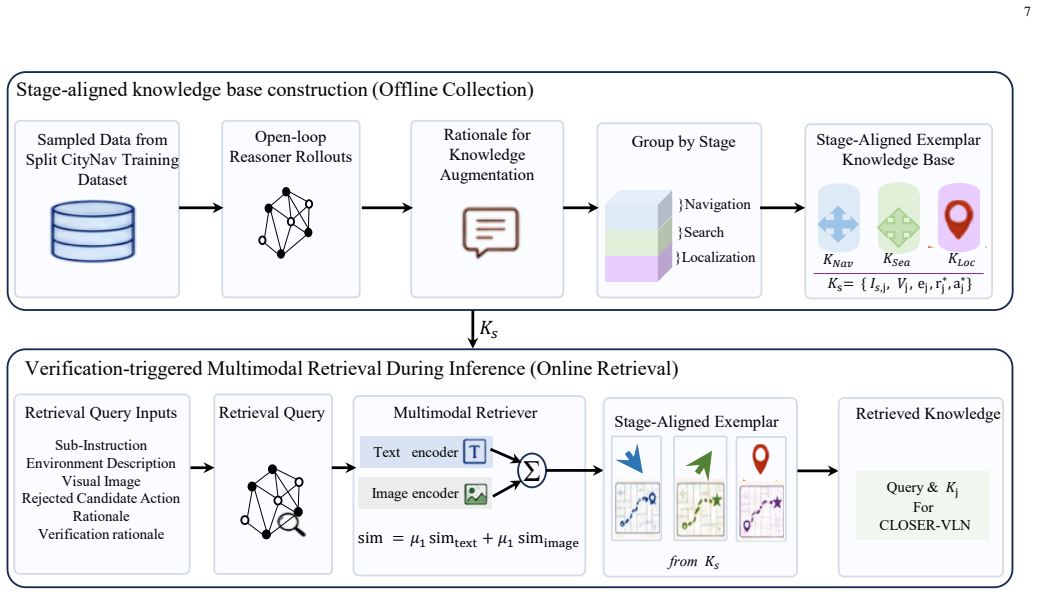
Vision-language navigation (VLN) has recently advanced with large language and multimodal models, enabling agents to follow natural-language instructions in unseen environments without training a task-specific navigation policy. However, most existing VLN methods relying on large models still adopt an open-loop decision-execution approach, where candidate actions are generated from instructions and observations but are rarely verified or corrected before execution. This causes critical issues in aerial VLN, where minor errors in intermediate actions may quickly accumulate into large trajectory deviations and lead to target loss. To address this issue, we propose Closed-loop Self-verified Retrieval-augmented Reasoning (CLOSER), a training-policy-free method that sequentially performs action reasoning, reliability verification, targeted retrieval, and action correction in a closed-loop manner before executing concrete actions. We instantiate the CLOSER in aerial VLN tasks and develop a CLOSER-VLN framework, which is composed of three components: a hierarchical reasoner for generating candidate actions based on available information, a multidimensional action verifier for assessing the reliability of actions generated by the reasoner, and a verification-triggered multimodal retriever for retrieving targeted exemplars from a memory bank only when verification fails. We conduct experimental evaluations on the CityNav benchmark, where CLOSER-VLN achieves 32.01% SR and 21.28% SPL on the test-unseen split, confirming the effectiveness of closed-loop reasoning.
Editorial analysis
A structured set of objections, weighed in public.
Referee Report
Summary. The paper proposes CLOSER-VLN, a training-free closed-loop framework for aerial vision-language navigation consisting of a hierarchical reasoner that generates candidate actions, a multidimensional action verifier that assesses reliability, and a verification-triggered multimodal retriever that fetches targeted exemplars from a memory bank only on verification failure. The method performs sequential reasoning-verification-retrieval-correction before action execution to mitigate error accumulation. On the CityNav benchmark it reports 32.01% SR and 21.28% SPL on the test-unseen split.
Significance. If the reported numbers are supported by appropriate open-loop baselines, component ablations, and statistical analysis, the work would demonstrate that a verification-retrieval-correction loop can improve long-horizon aerial VLN performance without task-specific policy training. The selective use of retrieval only on verification failure is an efficient design choice that could generalize to other embodied reasoning settings.
minor comments (3)
- [Abstract] Abstract: the reported SR and SPL values are presented without any reference to the corresponding open-loop baseline numbers or to the number of evaluation runs, which makes it impossible to judge the magnitude of improvement from the closed-loop components.
- [§3] §3 (Method): the description of the multidimensional verifier does not specify the exact dimensions or scoring functions used to assess action reliability; a concrete example or pseudocode would clarify how verification triggers retrieval.
- [§4] §4 (Experiments): the paper should include an ablation table isolating the contribution of the verifier and the retriever (e.g., reasoner-only vs. reasoner+verifier vs. full CLOSER-VLN) to substantiate the central claim that the closed loop is responsible for the gains.
Simulated Author's Rebuttal
We thank the referee for the positive assessment of CLOSER-VLN and the recommendation for minor revision. No major comments were raised.
Circularity Check
No significant circularity
full rationale
The paper describes an empirical method (CLOSER-VLN) and reports direct experimental metrics (SR 32.01%, SPL 21.28%) on the CityNav test-unseen split. No derivation chain, equations, or fitted parameters exist that reduce the claimed performance to a self-definition, renamed input, or self-citation load-bearing premise. The framework components are presented as procedural steps whose effectiveness is measured externally on held-out data, satisfying the condition for a self-contained empirical result.
Axiom & Free-Parameter Ledger
Reference graph
Works this paper leans on
-
[1]
Dream to recall: Imagination-guided expe- rience retrieval for memory-persistent vision-and-language navigation,
Y . Xu, Y . Pan, and Z. Liu, “Dream to recall: Imagination-guided expe- rience retrieval for memory-persistent vision-and-language navigation,” IEEE Transactions on Pattern Analysis and Machine Intelligence, 2026. 13
2026
-
[2]
Etpnav: Evolving topological planning for vision-language navigation in continuous environments,
D. An, H. Wang, W. Wang, Z. Wang, Y . Huang, K. He, and L. Wang, “Etpnav: Evolving topological planning for vision-language navigation in continuous environments,”IEEE Transactions on Pattern Analysis and Machine Intelligence, 2024
2024
-
[3]
Fine-grained alignment supervision matters in vision-and-language navigation,
K. He, Y . Huang, Y . Jing, Q. Wu, and L. Wang, “Fine-grained alignment supervision matters in vision-and-language navigation,”IEEE Transac- tions on Pattern Analysis and Machine Intelligence, 2026
2026
-
[4]
Correctable landmark discovery via large models for vision-language navigation,
B. Lin, Y . Nie, Z. Wei, Y . Zhu, H. Xu, S. Ma, J. Liu, and X. Liang, “Correctable landmark discovery via large models for vision-language navigation,”IEEE Transactions on Pattern Analysis and Machine Intel- ligence, vol. 46, no. 12, pp. 8534–8548, 2024
2024
-
[5]
Evolvenav: Empowering llm-based vision- language navigation via self-improving embodied reasoning,
B. Lin, Y . Nie, K. L. Zai, Z. Wei, M. Han, R. Xu, M. Niu, J. Han, H. Zhang, L. Linet al., “Evolvenav: Empowering llm-based vision- language navigation via self-improving embodied reasoning,”IEEE Transactions on Pattern Analysis and Machine Intelligence, 2026
2026
-
[6]
Constraint-aware zero-shot vision-language navigation in continuous environments,
K. Chen, D. An, Y . Huang, R. Xu, Y . Su, Y . Ling, I. Reid, and L. Wang, “Constraint-aware zero-shot vision-language navigation in continuous environments,”IEEE Transactions on Pattern Analysis and Machine Intelligence, 2025
2025
-
[7]
Do as i can, not as i say: Grounding language in robotic affordances,
M. Ahn, A. Brohan, N. Brown, Y . Chebotar, O. Cortes, B. David, C. Finn, C. Fu, K. Gopalakrishnan, K. Hausmanet al., “Do as i can, not as i say: Grounding language in robotic affordances,” inConference on Robot Learning. PMLR, 2022, pp. 287–318
2022
-
[8]
Imaginenav++: Prompting vision-language models as embodied navigator through scene imagina- tion,
T. Wang, X. Zhao, W. Cai, and C. Sun, “Imaginenav++: Prompting vision-language models as embodied navigator through scene imagina- tion,”IEEE Transactions on Pattern Analysis and Machine Intelligence, 2026
2026
-
[9]
Navcot: Boosting llm-based vision-and-language navigation via learning disentangled reasoning,
B. Lin, Y . Nie, Z. Wei, J. Chen, S. Ma, J. Han, H. Xu, X. Chang, and X. Liang, “Navcot: Boosting llm-based vision-and-language navigation via learning disentangled reasoning,”IEEE Transactions on Pattern Analysis and Machine Intelligence, 2025
2025
-
[10]
Flightgpt: Towards generalizable and interpretable uav vision-and-language navigation with vision-language models,
H. Cai, J. Dong, J. Tan, J. Deng, S. Li, Z. Gao, H. Wang, Z. Su, A. Sumalee, and R. Zhong, “Flightgpt: Towards generalizable and interpretable uav vision-and-language navigation with vision-language models,” inProceedings of the 2025 Conference on Empirical Methods in Natural Language Processing, 2025, pp. 6670–6687
2025
-
[11]
Navgpt: Explicit reasoning in vision- and-language navigation with large language models,
G. Zhou, Y . Hong, and Q. Wu, “Navgpt: Explicit reasoning in vision- and-language navigation with large language models,” inProceedings of the AAAI Conference on Artificial Intelligence, vol. 38, no. 7, 2024, pp. 7641–7649
2024
-
[12]
Open-nav: Exploring zero-shot vision-and-language navigation in continuous environment with open-source llms,
Y . Qiao, W. Lyu, H. Wang, Z. Wang, Z. Li, Y . Zhang, M. Tan, and Q. Wu, “Open-nav: Exploring zero-shot vision-and-language navigation in continuous environment with open-source llms,” in2025 IEEE International Conference on Robotics and Automation (ICRA). IEEE, 2025, pp. 6710–6717
2025
-
[13]
Inner monologue: Embodied reasoning through planning with language models,
W. Huang, P. Abbeel, D. Pathak, and I. Mordatch, “Inner monologue: Embodied reasoning through planning with language models,” inCon- ference on Robot Learning. PMLR, 2022, pp. 1769–1782
2022
-
[14]
Rt-2: Vision- language-action models transfer web knowledge to robotic control,
A. Brohan, N. Brown, J. Carbajal, Y . Chebotar, X. Chen, K. Choro- manski, T. Ding, D. Driess, A. Dubey, C. Finnet al., “Rt-2: Vision- language-action models transfer web knowledge to robotic control,” in Conference on Robot Learning. PMLR, 2023, pp. 2165–2183
2023
-
[15]
Mapgpt: Map-guided prompting with adaptive path planning for vision-and- language navigation,
J. Chen, B. Lin, R. Xu, Z. Chai, X. Liang, and K.-Y . Wong, “Mapgpt: Map-guided prompting with adaptive path planning for vision-and- language navigation,” inProceedings of the 62nd Annual Meeting of the Association for Computational Linguistics (Volume 1: Long Papers), 2024, pp. 9796–9810
2024
-
[16]
Cmmr-vln: Vision-and- language navigation via continual multimodal memory retrieval,
H. Li, X. Dong, H. Jiang, Y . Zhou, and X. Ma, “Cmmr-vln: Vision-and- language navigation via continual multimodal memory retrieval,”arXiv preprint arXiv:2603.07997, 2026
-
[17]
L. Luo and Q. Bai, “Ragnav: A retrieval-augmented topological reason- ing framework for multi-goal visual-language navigation,”arXiv preprint arXiv:2603.03745, 2026
-
[18]
Aeri- alvln: Vision-and-language navigation for uavs,
S. Liu, H. Zhang, Y . Qi, P. Wang, Y . Zhang, and Q. Wu, “Aeri- alvln: Vision-and-language navigation for uavs,” inProceedings of the IEEE/CVF International Conference on Computer Vision, 2023, pp. 15 384–15 394
2023
-
[19]
Citynav: A large-scale dataset for real-world aerial navigation,
J. Lee, T. Miyanishi, S. Kurita, K. Sakamoto, D. Azuma, Y . Matsuo, and N. Inoue, “Citynav: A large-scale dataset for real-world aerial navigation,” inProceedings of the IEEE/CVF International Conference on Computer Vision, 2025, pp. 5912–5922
2025
-
[20]
Improving language models by retrieving from trillions of tokens,
S. Borgeaud, A. Mensch, J. Hoffmann, T. Cai, E. Rutherford, K. Milli- can, G. B. van den Driessche, J.-B. Lespiau, B. Damoc, A. Clarket al., “Improving language models by retrieving from trillions of tokens,” in International Conference on Machine Learning. PMLR, 2022, pp. 2206–2240
2022
-
[21]
Rana: Retrieval-augmented navigation,
G. Monaci, R. S. Rezende, R. Deffayet, G. Csurka, G. Bono, H. D ´ejean, S. Clinchant, and C. Wolf, “Rana: Retrieval-augmented navigation,” arXiv preprint arXiv:2504.03524, 2025
-
[22]
Exploratory retrieval- augmented planning for continual embodied instruction following,
M. Yoo, J. Jang, W.-J. Park, and H. Woo, “Exploratory retrieval- augmented planning for continual embodied instruction following,”Ad- vances in Neural Information Processing Systems, vol. 37, pp. 67 034– 67 060, 2024
2024
-
[23]
Geonav: Empowering mllms with dual-scale geospatial reasoning for language- goal aerial navigation,
H. Xu, Y . Hu, C. Gao, Z. Zhu, Y . Zhao, and Q. Yin, “Geonav: Empowering mllms with dual-scale geospatial reasoning for language- goal aerial navigation,”Pattern Recognition, p. 113365, 2026
2026
-
[24]
Topo- logical planning with transformers for vision-and-language navigation,
S. Chen, P.-L. Guhur, M. Tapaswi, C. Schmid, and I. Laptev, “Topo- logical planning with transformers for vision-and-language navigation,” inProceedings of the IEEE/CVF Conference on Computer Vision and Pattern Recognition, 2021, pp. 11 276–11 286
2021
-
[25]
Object goal navigation using goal-oriented semantic exploration,
D. S. Chaplot, D. Gandhi, A. Gupta, and R. Salakhutdinov, “Object goal navigation using goal-oriented semantic exploration,” inAdvances in Neural Information Processing Systems, vol. 33, 2020, pp. 4247– 4258
2020
-
[26]
X. Dong, H. Zhao, J. Gao, H. Li, X. Ma, Y . Zhou, F. Chen, and J. Liu, “Se-vln: A self-evolving vision-language navigation framework based on multimodal large language models,”arXiv preprint arXiv:2507.13152, 2025
-
[27]
Exploring spatial representation to enhance llm reasoning in aerial vision-language navigation,
Y . Gao, Z. Wang, P. Han, L. Jing, D. Wang, and B. Zhao, “Exploring spatial representation to enhance llm reasoning in aerial vision-language navigation,”arXiv preprint arXiv:2410.08500, 2024
-
[28]
Citynavagent: Aerial vision-and-language navigation with hierarchical semantic planning and global memory,
W. Zhang, C. Gao, S. Yu, R. Peng, B. Zhao, Q. Zhang, J. Cui, X. Chen, and Y . Li, “Citynavagent: Aerial vision-and-language navigation with hierarchical semantic planning and global memory,” inProceedings of the 63rd Annual Meeting of the Association for Computational Linguistics (Volume 1: Long Papers), 2025, pp. 31 292–31 309
2025
-
[29]
H. Tong, X. Dong, X. Ma, H. Zhao, Y . Zhou, and C. Lin, “Visa-enhanced aerial vln: A visual-spatial reasoning enhanced framework for aerial vision-language navigation,”arXiv preprint arXiv:2603.08007, 2026
-
[30]
Synthesizing scientific literature with retrieval-augmented language models,
A. Asai, J. He, R. Shao, W. Shi, A. Singh, J. C. Chang, K. Lo, L. Soldaini, S. Feldman, M. D’Arcyet al., “Synthesizing scientific literature with retrieval-augmented language models,”Nature, pp. 1–7, 2026
2026
-
[31]
Embodied large language models enable robots to complete complex tasks in unpredictable environments,
R. Mon-Williams, G. Li, R. Long, W. Du, and C. G. Lucas, “Embodied large language models enable robots to complete complex tasks in unpredictable environments,”Nature Machine Intelligence, vol. 7, no. 4, pp. 592–601, 2025
2025
-
[32]
A retrieval-augmented framework enabling vlm spatial awareness for object-centric robot manipulation,
K. Chen, C. Li, C. Tu, J. Pan, Y . Ma, W. Chen, Z. Zhou, X. Xu, S. James, C.-W. Fuet al., “A retrieval-augmented framework enabling vlm spatial awareness for object-centric robot manipulation,”Science Robotics, vol. 11, no. 113, p. eaea2092, 2026
2026
-
[33]
Embodied-RAG: General non-parametric Embodied Memory for Retrieval and Generation
Q. Xie, S. Y . Min, P. Ji, Y . Yang, T. Zhang, K. Xu, A. Bajaj, R. Salakhutdinov, M. Johnson-Roberson, and Y . Bisk, “Embodied-rag: General non-parametric embodied memory for retrieval and generation,” arXiv preprint arXiv:2409.18313, 2024
-
[34]
Chain-of-thought prompting elicits reasoning in large language models,
J. Wei, X. Wang, D. Schuurmans, M. Bosma, B. Ichter, F. Xia, E. H. Chi, Q. V . Le, and D. Zhou, “Chain-of-thought prompting elicits reasoning in large language models,” inAdvances in Neural Information Processing Systems, vol. 35, 2022, pp. 24 824–24 837
2022
-
[35]
Self-consistency improves chain of thought reasoning in language models,
X. Wang, J. Wei, D. Schuurmans, Q. V . Le, E. H. Chi, S. Narang, A. Chowdhery, and D. Zhou, “Self-consistency improves chain of thought reasoning in language models,” inInternational Conference on Learning Representations, 2023
2023
-
[36]
React: Synergizing reasoning and acting in language models,
S. Yao, J. Zhao, D. Yu, N. Du, I. Shafran, K. Narasimhan, and Y . Cao, “React: Synergizing reasoning and acting in language models,” in International Conference on Learning Representations, 2023
2023
-
[37]
Tree of thoughts: Deliberate problem solving with large language models,
S. Yao, D. Yu, J. Zhao, I. Shafran, T. L. Griffiths, Y . Cao, and K. Narasimhan, “Tree of thoughts: Deliberate problem solving with large language models,” inAdvances in Neural Information Processing Systems, vol. 36, 2023
2023
-
[38]
Judging llm-as-a-judge with mt-bench and chatbot arena,
L. Zheng, W.-L. Chiang, Y . Sheng, S. Zhuang, Z. Wu, Y . Zhuang, Z. Lin, Z. Li, D. Li, E. Xinget al., “Judging llm-as-a-judge with mt-bench and chatbot arena,”Advances in neural information processing systems, vol. 36, pp. 46 595–46 623, 2023
2023
-
[39]
Self-refine: Iter- ative refinement with self-feedback,
A. Madaan, N. Tandon, P. Gupta, S. Hallinan, L. Gao, S. Wiegreffe, U. Alon, N. Dziri, S. Prabhumoye, Y . Yanget al., “Self-refine: Iter- ative refinement with self-feedback,”Advances in neural information processing systems, vol. 36, pp. 46 534–46 594, 2023
2023
-
[40]
Re- flexion: Language agents with verbal reinforcement learning,
N. Shinn, F. Cassano, A. Gopinath, K. Narasimhan, and S. Yao, “Re- flexion: Language agents with verbal reinforcement learning,”Advances in neural information processing systems, vol. 36, pp. 8634–8652, 2023
2023
-
[41]
Chain-of-verification reduces hallucination in large 14 language models,
S. Dhuliawala, M. Komeili, J. Xu, R. Raileanu, X. Li, A. Celikyilmaz, and J. Weston, “Chain-of-verification reduces hallucination in large 14 language models,” inFindings of the association for computational linguistics: ACL 2024, 2024, pp. 3563–3578
2024
-
[42]
Critic: Large language models can self-correct with tool-interactive critiquing,
Z. Gou, Z. Shao, Y . Gong, Y . Yang, N. Duan, W. Chenet al., “Critic: Large language models can self-correct with tool-interactive critiquing,” inInternational Conference on Learning Representations, vol. 2024, 2024, pp. 57 734–57 811
2024
-
[43]
Augmenting multimodal llms with self-reflective tokens for knowledge- based visual question answering,
F. Cocchi, N. Moratelli, M. Cornia, L. Baraldi, and R. Cucchiara, “Augmenting multimodal llms with self-reflective tokens for knowledge- based visual question answering,” inProceedings of the Computer Vision and Pattern Recognition Conference, 2025, pp. 9199–9209
2025
-
[44]
A. Yang, A. Li, B. Yang, B. Zhang, B. Hui, B. Zheng, B. Yu, C. Gao, C. Huang, C. Lvet al., “Qwen3 technical report,”arXiv preprint arXiv:2505.09388, 2025
work page internal anchor Pith review Pith/arXiv arXiv 2025
-
[45]
DeepSeekMath: Pushing the Limits of Mathematical Reasoning in Open Language Models
Z. Shao, P. Wang, Q. Zhu, R. Xu, J. Song, X. Bi, H. Zhang, M. Zhang, Y . Li, Y . Wuet al., “Deepseekmath: Pushing the limits of mathematical reasoning in open language models,”arXiv preprint arXiv:2402.03300, 2024
work page internal anchor Pith review Pith/arXiv arXiv 2024
-
[46]
Reason-rft: Reinforcement fine-tuning for visual reasoning,
H. Tan, Y . Ji, X. Hao, X. Chen, P. Wang, Z. Wang, and S. Zhang, “Reason-rft: Reinforcement fine-tuning for visual reasoning of vision language models,”arXiv preprint arXiv:2503.20752, 2025
discussion (0)
Sign in with ORCID, Apple, or X to comment. Anyone can read and Pith papers without signing in.