REVIEW 3 major objections 6 minor 57 references
Independent per-instance neural-field weights can serve as semantically structured data representations when they are learned as multiplicative low-rank adaptations of a shared frozen base network.
Reviewed by Pith at T0; open to challenge. T0 means a machine referee read the full paper against a public rubric. the ladder, T0–T4 →
T0 review · deepseek-v4-flash
2026-08-03 19:07 UTC pith:EEEOM4AU
load-bearing objection A useful empirical paper on multiplicative LoRA weight spaces for neural fields, with a shaky theoretical justification for why masking works. the 3 major comments →
Weight Space Representation Learning via Neural Field Adaptation
The pith
A machine-rendered reading of the paper's core claim, the machinery that carries it, and where it could break.
Core claim
The core claim is that weight-space geometry is a design choice. By freezing a shared pre-trained neural field and learning per-instance low-rank factors A and B that act multiplicatively—W' = W ⊙ BA—the paper obtains weights that reconstruct signals, cluster semantically, and support diffusion-based generation. The supplement rewrites mLoRA as a sum of channel-scaling terms diag(b_i) W diag(a_i), and the paper argues that asymmetric masking (zeroing fixed random entries of A) removes permutation ambiguity, aligning the weights with base-network channels and yielding convergence to a linear mode. Empirically, mLoRA-Asym gives the best reconstruction (PSNR 36.9 on FFHQ), the best generation s
What carries the argument
The central object is multiplicative low-rank adaptation (mLoRA), which updates a frozen base weight matrix W elementwise as W' = W ⊙ BA, with A ∈ R^{r×d_in}, B ∈ R^{d_out×r}. The supplement's Theorem 2 rewrites this as W' = Σ_i diag(b_i) W diag(a_i), showing that each rank component independently scales input and output channels. The companion asymmetric masking—randomly freezing (zeroing) a fixed subset of entries in each A, shared across all instances—is the mechanism meant to break the rank-permutation symmetry, so that each (a_i, b_i) is pinned to a specific channel axis. This pair of choices (multiplicative interaction + symmetry-breaking mask) is what the paper credits for the smoothn
Load-bearing premise
The claim that asymmetric masking eliminates the ambiguity of mLoRA weights rests on removing only discrete permutation symmetries, while leaving intact the continuous per-rank rescaling a_i → c_i a_i, b_i → c_i^{-1} b_i; if that continuous gauge freedom remains, the reported 'alignment with base network channels' and the linear mode behaviour lack their stated mechanism.
What would settle it
Fit the same instance twice with mLoRA-Asym under identical masks but different initializations, then check whether the two solutions differ only by per-rank rescalings (a_i → c_i a_i, b_i → c_i^{-1} b_i). If they do, the masking has not removed the continuous symmetry, and any observed linear mode connectivity cannot be attributed to the claimed channel-alignment mechanism; alternatively, normalize A rows before interpolation and see whether the barrier reappears.
If this is right
- Weight-space diffusion becomes viable at higher resolution: mLoRA-Asym produces recognizable 128×128 faces, a scale previous weight-space methods did not reach.
- Because mLoRA weight space is semantically organized, discriminative tasks (1-NN, logistic regression, k-means) can be performed directly on the raw weight parameters without a learned encoder.
- Weight-space smoothness—linear mode connectivity and high cross-initialization similarity—strongly predicts generation quality, motivating future work to engineer flatter weight manifolds.
- The method transfers across modalities through a single base architecture, supporting reconstruction, generation, and classification for both 2D images and 3D shapes.
Where Pith is reading between the lines
- The same masking fails to give additive LoRA the linear-mode benefit, so the paper's hypothesis that feature entanglement (not just permutation symmetry) is the bottleneck would predict that a continuous symmetry-removing regularizer on mLoRA—one that fixes the per-rank rescaling gauge—should reproduce the linear-mode behaviour without freezing parameters.
- If the claimed alignment of mLoRA with base-network channels is correct, individual rank components could be probed semantically by examining which channels they modulate, giving a new interpretability tool for neural-field generators.
- The approach shares its modulation view with style-based generators (weight modulation via per-channel scaling), suggesting that weight-space learning could connect to existing latent-space editing and animation techniques for such models.
Editorial analysis
A structured set of objections, weighed in public.
Referee Report
Summary. The paper proposes to treat the weights of neural fields as data representations by fitting each instance with a multiplicative low-rank adaptation (mLoRA) of a shared, pre-trained base network. The mLoRA weight update is W' = W ⊙ BA, optionally combined with asymmetric masking to reduce rank-permutation symmetry. The authors compare six representations (standalone MLP, additive LoRA, multiplicative LoRA, each with and without asymmetric masking) on FFHQ and ShapeNet across reconstruction, weight-space stability, diffusion-based generation, and classification/clustering. Their main empirical findings are that mLoRA and mLoRA-Asym give better reconstruction, smoother weight-space behavior, better generation metrics, and better semantic separability than additive LoRA and standalone MLP weights, and that mLoRA-Asym in particular exhibits low linear-interpolation barriers.
Significance. If the empirical results hold, this is a useful step for weight-space representation learning: it shows that independent optimization, when constrained by a shared base model and multiplicative adaptation, can produce weight representations that are simultaneously high-fidelity, learnable by diffusion, and semantically structured. The paper's strengths are the controlled comparisons across parameterization and symmetry-breaking, the use of multiple generation metrics (FD, MMD, mMD/COV/1-NNA), and the supplementary ablation of the hierarchical diffusion encoder. The main reservation is that the theoretical mechanism offered for the headline linear-mode result is not valid as written, and one implementation detail (the role of the base model's latent codes) is unspecified. These are fixable in revision.
major comments (3)
- [Supplementary §6.2, Corollary 2.2; main §3.2, §4.2] Corollary 2.2 is invalid as stated. Equation (18) gives W' = Σ_i diag(b_i) W diag(a_i). For any nonzero c_i, the transformation a_i -> c_i a_i and b_i -> c_i^{-1} b_i leaves each b_i a_i^T (and hence W') unchanged. Asymmetric masking only zeroes fixed entries of A; a diagonal scaling preserves the zero pattern, so this continuous gauge freedom survives the mask. The corollary's conclusion that 'each rank component i is uniquely identified' therefore does not follow; the proof assumes the uniqueness it is proving. Because §4.2 explicitly attributes the exceptional linear-mode connectivity of mLoRA-Asym to Corollary 2.2, the mechanistic explanation in the paper is unsupported. To retain this claim, the authors need to fix the gauge explicitly (e.g., canonicalize each a_i) or downgrade the claim to an empirical observation.
- [§3.3 and Algorithm 1] The paper never says what happens to the per-instance latent codes {z_i} learned during base-model training (Eq. 4) when the LoRA adaptation in Eq. (2) is performed. The base architecture (Fig. 7b) takes a style vector derived from z_i as input. Algorithm 1 omits z_i in Stage 2, and Eq. (2) writes f(p|LoRA(W, φ)) without a latent argument. If z_i is retained as a conditioning input, then the representation is not the LoRA weights alone, undermining the claim that each instance is represented by φ_i. If z_i is discarded or set to a fixed value, this must be stated, because the base network's behavior is otherwise undefined. Please clarify this step; it is needed to interpret the classification and generation results.
- [§4.2, Figure 3] The stability analysis reports cosine similarity and linear-interpolation barrier of raw LoRA factors. Both quantities are gauge-dependent: two optimizations can represent identical functions but differ by the residual scaling symmetry noted above, making the cosine similarity arbitrarily low while the functional barrier remains zero. The high similarity of mLoRA-Asym in Figure 3 may therefore reflect the shared initialization and the shared zero mask rather than a canonical alignment of optimization paths. To support the 'converge to a linear mode' claim, the authors should either gauge-align the factors before computing similarity or report a function-space or invariance-aware distance.
minor comments (6)
- [§4.3] Typo: 'recg-nizable' should be 'recognizable'.
- [§3.4] The phrase 'zeroing out frozen entries ... removes the corresponding rank component's contribution' is imprecise: zeroing one entry in A removes one input channel for that rank component, not the whole rank component.
- [§9.1] The Fréchet Distance formula divides by N_feature, which is nonstandard and changes the scale of the metric. Please state why this normalization is used, since it makes FD values difficult to compare with prior work.
- [Figure 3] Please define the range and meaning of λ on the x-axis and label the y-axis units explicitly; currently the reader must infer them from the text.
- [§4.3] The statement that HyperDiffusion 'fails to produce recognizable face images' is qualitative; Table 2 gives FD 0.241 for HyperDiffusion, so a brief quantitative characterization of the failure mode would strengthen the comparison.
- [References] Several references have inconsistent page-number formatting (e.g., [2], [19]); please harmonize.
Circularity Check
No significant circularity: the mLoRA weight-space claims are empirical and benchmarked externally; the questionable Corollary 2.2 is a proof-gap issue, not a circular derivation.
full rationale
The paper's central derivation chain is empirical rather than definitional. Representations are obtained by optimizing L_recon, and then evaluated through reconstruction quality, weight-space similarity/linear-mode connectivity, diffusion-based generation, and discriminative tasks. None of these downstream evaluations is forced by construction: generation is assessed on newly sampled weights via distributional metrics against reference sets, classification/clustering use external ShapeNet labels, and the linear-mode connectivity result is an observed geometric phenomenon rather than a quantity derived from the fitting loss. The only mildly self-referential element is that reconstruction quality is measured on the same fitting objective used to create the representation, but this is an intrinsic benchmark of representation capacity, not a renamed prediction of an independent quantity. The paper does not rely on load-bearing self-citations; prior-work dependencies such as asymmetric masking [25], GL(r) equivalence [24], and LoRA [18] are external. Corollary 2.2 is invoked as a mechanistic explanation for the mLoRA-Asym linear-mode behavior, but even if its proof is mathematically incomplete—the masked multiplicative LoRA factors retain a continuous per-rank scaling gauge freedom, so 'uniquely identified' does not strictly follow from Eq. 18—that is a correctness/rigor concern, not circularity. No step reduces the paper's conclusions to its own inputs by definition or by fitted-parameter renaming.
Axiom & Free-Parameter Ledger
free parameters (6)
- LoRA rank r =
not reported
- Fourier feature frequency omega_0 =
32 (FFHQ), 1 (ShapeNet)
- Asymmetric mask size =
sqrt(d_out) frozen entries per row of A
- Frozen-entry variance kappa =
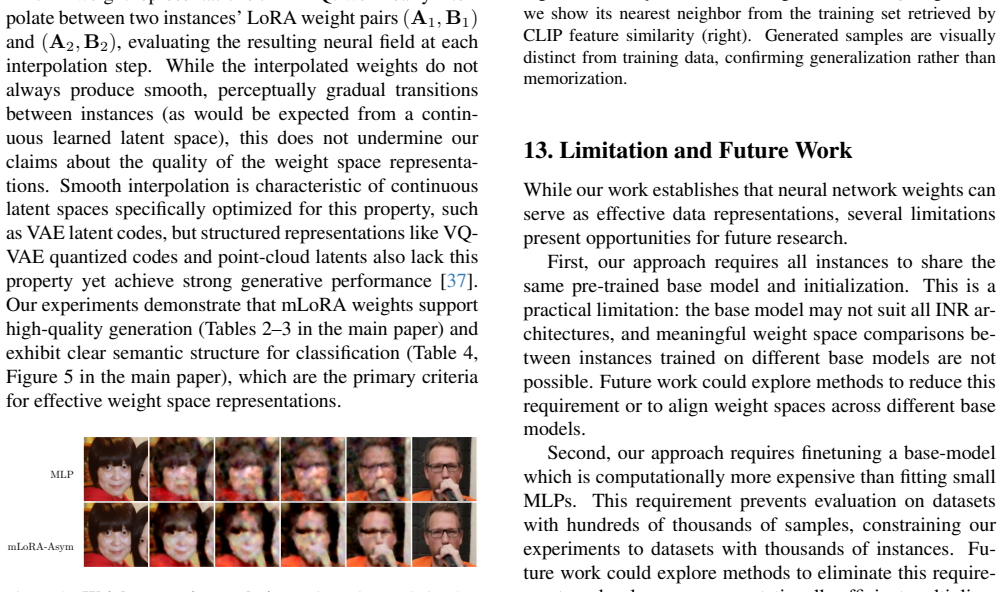
6
- Latent regularization lambda_r =
1e-4
- Diffusion noise schedule beta_1, beta_T, T =
1e-4, 2e-2, 500
axioms (5)
- domain assumption A base neural field trained by variational autodecoding on a dataset captures transferable features that LoRA can adapt per instance.
- domain assumption LoRA weight updates lie in a meaningful low-dimensional subspace so that constraining to LoRA induces structure.
- domain assumption Permutation/GL(r) symmetry is the main cause of multi-modality in weight space, and breaking it yields unimodal, linearly connected weight spaces.
- ad hoc to paper Asymmetric masking removes internal symmetries for multiplicative LoRA as it does for additive LoRA.
- ad hoc to paper Feature entanglement in additive composition explains why additive LoRA is worse than multiplicative LoRA.
read the original abstract
We investigate the potential of weights to serve as effective representations, focusing on neural fields. Our key insight is that constraining the optimization space through a pre-trained base model and low-rank adaptation (LoRA) can induce structure in weight space. Across reconstruction, generation, and analysis tasks on 2D and 3D data, we find that multiplicative LoRA weights achieve high representation quality while exhibiting distinctiveness and semantic structure. When used with latent diffusion models, multiplicative LoRA weights enable higher-quality generation than existing weight-space methods.
Figures




Reference graph
Works this paper leans on
-
[1]
Image generators with conditionally-independent pixel synthesis
Ivan Anokhin, Kirill Demochkin, Taras Khakhulin, Gleb Sterkin, Victor Lempitsky, and Denis Korzhenkov. Image generators with conditionally-independent pixel synthesis. InProceedings of the IEEE/CVF conference on computer vi- sion and pattern recognition, pages 14278–14287, 2021. 1, 2, 3, 5
2021
-
[2]
Demystifying mmd gans.arXiv preprint arXiv:1801.01401, 2018
Mikołaj Bi ´nkowski, Danica J Sutherland, Michael Arbel, and Arthur Gretton. Demystifying mmd gans.arXiv preprint arXiv:1801.01401, 2018. 6, 7, 5
Pith/arXiv arXiv 2018
-
[3]
pi-gan: Periodic implicit generative adversarial networks for 3d-aware image synthesis
Eric R Chan, Marco Monteiro, Petr Kellnhofer, Jiajun Wu, and Gordon Wetzstein. pi-gan: Periodic implicit generative adversarial networks for 3d-aware image synthesis. arxiv e- prints, page.arXiv preprint arXiv:2012.00926, 2020. 1, 2, 3, 5
Pith/arXiv arXiv 2012
-
[4]
Shapenet: An information-rich 3d model repository.arXiv preprint arXiv:1512.03012, 2015
Angel X Chang, Thomas Funkhouser, Leonidas Guibas, Pat Hanrahan, Qixing Huang, Zimo Li, Silvio Savarese, Manolis Savva, Shuran Song, Hao Su, et al. Shapenet: An information-rich 3d model repository.arXiv preprint arXiv:1512.03012, 2015. 5
Pith/arXiv arXiv 2015
-
[5]
Transformers as meta- learners for implicit neural representations
Yinbo Chen and Xiaolong Wang. Transformers as meta- learners for implicit neural representations. InEuropean Conference on Computer Vision, pages 170–187. Springer,
-
[6]
Interpreting the weight space of customized dif- fusion models.Advances in Neural Information Processing Systems, 37:137334–137371, 2024
Amil Dravid, Yossi Gandelsman, Kuan-Chieh Wang, Rameen Abdal, Gordon Wetzstein, Alexei Efros, and Kfir Aberman. Interpreting the weight space of customized dif- fusion models.Advances in Neural Information Processing Systems, 37:137334–137371, 2024. 2
2024
-
[7]
Coin: Compression with implicit neural representations.arXiv preprint arXiv:2103.03123,
Emilien Dupont, Adam Goli ´nski, Milad Alizadeh, Yee Whye Teh, and Arnaud Doucet. Coin: Compression with implicit neural representations.arXiv preprint arXiv:2103.03123,
-
[8]
Emilien Dupont, Hyunjik Kim, S. M. Ali Eslami, Danilo Rezende, and Dan Rosenbaum. From data to functa: Your data point is a function and you can treat it like one. InIn- ternational Conference on Machine Learning, 2022. 2
2022
-
[9]
Hyperdiffusion: Generating implicit neural fields with weight-space diffusion
Ziya Erkoc ¸, Fangchang Ma, Cengiz ¨Oztireli, and Pascal Fua. Hyperdiffusion: Generating implicit neural fields with weight-space diffusion. InInternational Conference on Computer Vision, 2023. 1, 2, 3, 4, 6, 7, 5
2023
-
[10]
Amer Essakine, Yanqi Cheng, Chun-Wun Cheng, Lipei Zhang, Zhongying Deng, Lei Zhu, Carola-Bibiane Sch¨onlieb, and Angelica I Aviles-Rivero. Where do we stand with implicit neural representations? a technical and performance survey.arXiv preprint arXiv:2411.03688,
-
[11]
Linear mode connectivity and the lot- tery ticket hypothesis
Jonathan Frankle, Gintare Karolina Dziugaite, Daniel Roy, and Michael Carbin. Linear mode connectivity and the lot- tery ticket hypothesis. InInternational Conference on Ma- chine Learning, pages 3259–3269. PMLR, 2020. 6
2020
-
[12]
Sur la distance de deux lois de probabilit´e
Maurice Fr ´echet. Sur la distance de deux lois de probabilit´e. InAnnales de l’ISUP, pages 183–198, 1957. 6, 5
1957
-
[13]
Revisiting model merging: A statistical perspective.arXiv preprint, 2024
Y Gao and Others. Revisiting model merging: A statistical perspective.arXiv preprint, 2024. 2, 3
2024
-
[14]
D’oh: Decoder-only ran- dom hypernetworks for implicit neural representations
Cameron Gordon, Lachlan E MacDonald, Hemanth Saratchandran, and Simon Lucey. D’oh: Decoder-only ran- dom hypernetworks for implicit neural representations. In Proceedings of the Asian Conference on Computer Vision, pages 2507–2526, 2024. 2
2024
-
[15]
Hypernetworks
David Ha, Andrew Dai, and Quoc V Le. Hypernetworks. InInternational Conference on Learning Representations,
-
[16]
Gans trained by a two time-scale update rule converge to a local nash equilib- rium.Advances in neural information processing systems, 30, 2017
Martin Heusel, Hubert Ramsauer, Thomas Unterthiner, Bernhard Nessler, and Sepp Hochreiter. Gans trained by a two time-scale update rule converge to a local nash equilib- rium.Advances in neural information processing systems, 30, 2017. 6, 7, 5
2017
-
[17]
Meta- learning in neural networks: a survey
T Hospedales, A Antoniou, P Micaelli, and A Storkey. Meta- learning in neural networks: a survey. arxiv preprint arxiv: 200405439. 2020. 1
2020
-
[18]
Lora: Low-rank adaptation of large language models.ICLR, 1(2):3, 2022
Edward J Hu, Yelong Shen, Phillip Wallis, Zeyuan Allen- Zhu, Yuanzhi Li, Shean Wang, Lu Wang, Weizhu Chen, et al. Lora: Low-rank adaptation of large language models.ICLR, 1(2):3, 2022. 1, 3
2022
-
[19]
Re- thinking fid: Towards a better evaluation metric for image generation
Sadeep Jayasumana, Srikumar Ramalingam, Andreas Veit, Daniel Glasner, Ayan Chakrabarti, and Sanjiv Kumar. Re- thinking fid: Towards a better evaluation metric for image generation. InProceedings of the IEEE/CVF Conference on Computer Vision and Pattern Recognition, pages 9307– 9315, 2024. 5
2024
-
[20]
A style-based generator architecture for generative adversarial networks
Tero Karras, Samuli Laine, and Timo Aila. A style-based generator architecture for generative adversarial networks. InProceedings of the IEEE/CVF conference on computer vi- sion and pattern recognition, pages 4401–4410, 2019. 2, 5
2019
-
[21]
Alias-free generative adversarial networks.Advances in neural infor- mation processing systems, 34:852–863, 2021
Tero Karras, Miika Aittala, Samuli Laine, Erik H ¨ark¨onen, Janne Hellsten, Jaakko Lehtinen, and Timo Aila. Alias-free generative adversarial networks.Advances in neural infor- mation processing systems, 34:852–863, 2021. 1, 2, 3, 5
2021
-
[22]
Hypernetwork functional image representation
Sylwester Klocek, Łukasz Maziarka, Maciej Wołczyk, Jacek Tabor, Jakub Nowak, and Marek ´Smieja. Hypernetwork functional image representation. InInternational Conference on Artificial Neural Networks, pages 496–510. Springer,
-
[23]
Graph neural net- works for learning equivariant representations of neural net- works
M Kofinas, B Knyazev, Y Zhang, Y Chen, G J Burghouts, E Gavves, C G M Snoek, and D W Zhang. Graph neural net- works for learning equivariant representations of neural net- works. InThe Twelfth International Conference on Learning Representations, 2024. 2
2024
-
[24]
D Lim, Y Gelberg, S Jegelka, H Maron, et al. Learning on lo- ras: Gl-equivariant processing of low-rank weight spaces for large finetuned models.arXiv preprint arXiv:2410.04207,
-
[25]
The empirical impact of neural param- eter symmetries, or lack thereof.Advances in Neural Infor- mation Processing Systems, 37:28322–28358, 2024
Derek Lim, Theo Putterman, Robin Walters, Haggai Maron, and Stefanie Jegelka. The empirical impact of neural param- eter symmetries, or lack thereof.Advances in Neural Infor- mation Processing Systems, 37:28322–28358, 2024. 1, 4
2024
-
[26]
Diffusion probabilistic models for 3d point cloud generation
Shitong Luo and Wei Hu. Diffusion probabilistic models for 3d point cloud generation. InProceedings of the IEEE/CVF conference on computer vision and pattern recognition, pages 2837–2845, 2021. 7, 5
2021
-
[27]
Equivariant architectures for learning in deep weight spaces
A Navon, A Shamsian, I Achituve, E Fetaya, G Chechik, and H Maron. Equivariant architectures for learning in deep weight spaces. InInternational Conference on Machine Learning, pages 25790–25816, 2023. 2, 3 9
2023
-
[28]
Fusion of graph convolutional net- works via optimal transport.arXiv preprint, 2025
O Ormaniec and Others. Fusion of graph convolutional net- works via optimal transport.arXiv preprint, 2025. 2
2025
-
[29]
Deepsdf: Learning con- tinuous signed distance functions for shape representation
Jeong Joon Park, Peter Florence, Julian Straub, Richard Newcombe, and Steven Lovegrove. Deepsdf: Learning con- tinuous signed distance functions for shape representation. InProceedings of the IEEE/CVF conference on computer vi- sion and pattern recognition, pages 165–174, 2019. 2, 3
2019
-
[30]
William Peebles, Ilija Radosavovic, Tim Brooks, Alexei A Efros, and Jitendra Malik. Learning to learn with genera- tive models of neural network checkpoints.arXiv preprint arXiv:2209.12892, 2023. 1, 2, 4
Pith/arXiv arXiv 2023
-
[31]
Scalable diffusion mod- els with transformers
William S Peebles and Saining Xie. Scalable diffusion mod- els with transformers. 2023 ieee. InCVF International Con- ference on Computer Vision (ICCV), 2022. 4
2023
-
[32]
Pointnet++: Deep hierarchical feature learning on point sets in a metric space.Advances in neural information processing systems, 30, 2017
Charles Ruizhongtai Qi, Li Yi, Hao Su, and Leonidas J Guibas. Pointnet++: Deep hierarchical feature learning on point sets in a metric space.Advances in neural information processing systems, 30, 2017. 7, 5
2017
-
[33]
Learning transferable visual models from natural language supervi- sion
Alec Radford, Jong Wook Kim, Chris Hallacy, Aditya Ramesh, Gabriel Goh, Sandhini Agarwal, Girish Sastry, Amanda Askell, Pamela Mishkin, Jack Clark, et al. Learning transferable visual models from natural language supervi- sion. InInternational conference on machine learning, pages 8748–8763. PmLR, 2021. 6, 7, 5
2021
-
[34]
Model fusion via optimal transport
C Singh and M Jaggi. Model fusion via optimal transport. In Advances in Neural Information Processing Systems, 2020. 2
2020
-
[35]
Hyper-align: Efficient modality alignment via hy- pernetworks
Jaisidh Singh, Diganta Misra, and Boris Knyazev6 Antonio Orvieto. Hyper-align: Efficient modality alignment via hy- pernetworks. InWorkshop on Neural Network Weights as a New Data Modality. 1
-
[36]
Fourier features let networks learn high frequency functions in low dimen- sional domains.Advances in neural information processing systems, 33:7537–7547, 2020
Matthew Tancik, Pratul Srinivasan, Ben Mildenhall, Sara Fridovich-Keil, Nithin Raghavan, Utkarsh Singhal, Ravi Ra- mamoorthi, Jonathan Barron, and Ren Ng. Fourier features let networks learn high frequency functions in low dimen- sional domains.Advances in neural information processing systems, 33:7537–7547, 2020. 3
2020
-
[37]
Lion: Latent point dif- fusion models for 3d shape generation.Advances in Neural Information Processing Systems, 35:10021–10039, 2022
Arash Vahdat, Francis Williams, Zan Gojcic, Or Litany, Sanja Fidler, Karsten Kreis, et al. Lion: Latent point dif- fusion models for 3d shape generation.Advances in Neural Information Processing Systems, 35:10021–10039, 2022. 7, 5, 6
2022
-
[38]
Learning transferable features for implicit neural representations.Advances in Neural Information Processing Systems, 37:42268–42291, 2024
Kushal Vyas, Ahmed I Humayun, Aniket Dashpute, Richard G Baraniuk, Ashok Veeraraghavan, and Guha Bal- akrishnan. Learning transferable features for implicit neural representations.Advances in Neural Information Processing Systems, 37:42268–42291, 2024. 2
2024
-
[39]
Scaling weight space generative mod- els.arXiv preprint, 2025
K Wang and Others. Scaling weight space generative mod- els.arXiv preprint, 2025. 2
2025
-
[40]
Neural network diffusion.arXiv preprint arXiv:2402.13144,
K Wang, Z Xu, Y Zhou, Z Zang, T Darrell, Z Liu, and Y You. Neural network diffusion.arXiv preprint arXiv:2402.13144,
-
[41]
Neural fields in visual computing and beyond
Yiheng Xie, Towaki Takikawa, Shunsuke Saito, Or Litany, Shiqin Yan, Numair Khan, Federico Tombari, James Tomp- kin, Vincent Sitzmann, and Srinath Sridhar. Neural fields in visual computing and beyond. InComputer graphics forum, pages 641–676. Wiley Online Library, 2022. 1, 2
2022
-
[42]
Enneng Yang, Li Shen, Guibing Guo, Xingwei Wang, Xi- aochun Cao, Jie Zhang, and Dacheng Tao. Model merging in llms, mllms, and beyond: Methods, theories, applications and opportunities.arXiv preprint arXiv:2408.07666, 2024. 1
Pith/arXiv arXiv 2024
-
[43]
A structured dictionary perspective on implicit neural representations
Gizem Y ¨uce, Guillermo Ortiz-Jim ´enez, Beril Besbinar, and Pascal Frossard. A structured dictionary perspective on implicit neural representations. InProceedings of the IEEE/CVF Conference on Computer Vision and Pattern Recognition, pages 19228–19238, 2022. 3, 6
2022
-
[44]
Symmetry in neural network parameter spaces.arXiv preprint arXiv:2506.13018, 2025
Bo Zhao, Robin Walters, and Rose Yu. Symmetry in neural network parameter spaces.arXiv preprint arXiv:2506.13018, 2025. 1, 3
arXiv 2025
-
[45]
Permutation equivariant neural functionals.Advances in neural information processing systems, 36:24966–24992,
Allan Zhou, Kaien Yang, Kaylee Burns, Adriano Cardace, Yiding Jiang, Samuel Sokota, J Zico Kolter, and Chelsea Finn. Permutation equivariant neural functionals.Advances in neural information processing systems, 36:24966–24992,
-
[46]
Neural functional transformers.Advances in neural infor- mation processing systems, 36:77485–77502, 2023
Allan Zhou, Kaien Yang, Yiding Jiang, Kaylee Burns, Win- nie Xu, Samuel Sokota, J Zico Kolter, and Chelsea Finn. Neural functional transformers.Advances in neural infor- mation processing systems, 36:77485–77502, 2023. 1, 2, 5
2023
-
[47]
3d shape generation and completion through point-voxel diffusion
Linqi Zhou, Yilun Du, and Jiajun Wu. 3d shape generation and completion through point-voxel diffusion. InProceed- ings of the IEEE/CVF international conference on computer vision, pages 5826–5835, 2021. 7, 5 10 Weight Space Representation Learning via Neural Field Adaptation Supplementary Material This supplementary material provides additional theoreti- ...
2021
-
[48]
Permutation Symmetry in LoRA We provide a formal proof that permutation symmetry ex- ists within both additive and multiplicative LoRA parame- terizations. 6.1. Permutation Symmetry in Additive LoRA Theorem 1.The adapted weight matrix from additive LoRA exhibits permutation symmetry with respect to the rank di- mensions. Proof.Consider the additive LoRA f...
-
[49]
INRs repre- sent signals as continuous functionsΦ :R n →R m, where a neural network mapsn-dimensional coordinates tom- dimensional quantities
Related Works -Implicit Neural Representations Implicit Neural Representations (INRs), also known as neu- ral fields, are continuous functions parameterized by neural networks that map coordinates to signal values. INRs repre- sent signals as continuous functionsΦ :R n →R m, where a neural network mapsn-dimensional coordinates tom- dimensional quantities....
-
[50]
Standalone MLP As shown in Figure 7(a), The standalone MLP is a Fourier Feature [36] layerα 1 = sin(ω0 ·(W 1p+b 1))followed by 2linear layers
Implementation Details 8.1. Standalone MLP As shown in Figure 7(a), The standalone MLP is a Fourier Feature [36] layerα 1 = sin(ω0 ·(W 1p+b 1))followed by 2linear layers. •ω 0 is the frequency scaling factor for the Fourier Feature layer. For 2D FFHQ, we setω 0 = 32; For 3D ShapeNet, we setω 0 = 1. This value is chosen empiracally and shared with its LoRA...
-
[51]
For 3D, we also calculate distance-based metrics
Evaluation Metrics for Generation We calculate distributional metrics for both 2D and 3D. For 3D, we also calculate distance-based metrics. All metrics are calculated between2,048generated samples and2,048 reference samples. 9.1. Distributional Difference These metrics operate on features extracted by deep learned models, as deep learned feature extractor...
-
[52]
Following the practice of KID [2], we choose γp = 1/Nfeature
Polynomial kernel (MMD-P) ψp(x,y) = (γ p ·x T y+c) d with degreed= 3and offset c= 1. Following the practice of KID [2], we choose γp = 1/Nfeature
-
[53]
Gaussian RBF kernel (MMD-G) ψg(x,y) = exp(−γ g∥x−y∥ 2 2)withγ g = 1/(2σ2 g); we chooseσ g =N feature. 9.2. Distance-based Metrics for 3D Shapes For 3D shapes, we calculate distance-based metrics follow- ing [9, 26, 37, 47]. We denote the distance function as D(x,y)for the Chamfer Distance between two shapesx andy. The metrics are defined as: mMD(P, Q) =Ey...
-
[54]
To isolate its contribution, we train a baseline diffusion model without the layer encoder on the ShapeNet multi-category dataset
Ablation Study We examine the effectiveness of the hierarchical LoRA layer encoder introduced in Section 3.5. To isolate its contribution, we train a baseline diffusion model without the layer encoder on the ShapeNet multi-category dataset. This baseline treats each weight matrix as an independent token, directly feeding flattened LoRA matrices into the t...
-
[55]
We linearly inter- polate between two instances’ LoRA weight pairs(A1,B 1) and(A 2,B 2), evaluating the resulting neural field at each interpolation step
Weight Space Interpolation Figure 8 visualizes linear interpolations between pairs of mLoRA weight representations on FFHQ. We linearly inter- polate between two instances’ LoRA weight pairs(A1,B 1) and(A 2,B 2), evaluating the resulting neural field at each interpolation step. While the interpolated weights do not always produce smooth, perceptually grad...
-
[56]
Please see Figure 10 for results on ShapeNet Air- planes, Figure 11 for results on ShapeNet Multi, and Fig- ure 12 for results on FFHQ
Additional Qualitative Results We provide additional qualitative results on diffusion gen- eration. Please see Figure 10 for results on ShapeNet Air- planes, Figure 11 for results on ShapeNet Multi, and Fig- ure 12 for results on FFHQ. To verify that generated samples are novel rather than memorized reproductions of training data, we perform a CLIP-based ...
-
[57]
First, our approach requires all instances to share the same pre-trained base model and initialization
Limitation and Future Work While our work establishes that neural network weights can serve as effective data representations, several limitations present opportunities for future research. First, our approach requires all instances to share the same pre-trained base model and initialization. This is a practical limitation: the base model may not suit all...
discussion (0)
Sign in with ORCID, Apple, or X to comment. Anyone can read and Pith papers without signing in.