Studies of Z to 4ell decays in proton-proton collisions at sqrt{s} = 8 and 13 TeV
Pith reviewed 2026-06-29 23:26 UTC · model grok-4.3
The pith
The inclusive branching fraction for Z decays to four charged leptons is measured as 4.67 times 10 to the minus 6.
A machine-rendered reading of the paper's core claim, the machinery that carries it, and where it could break.
Core claim
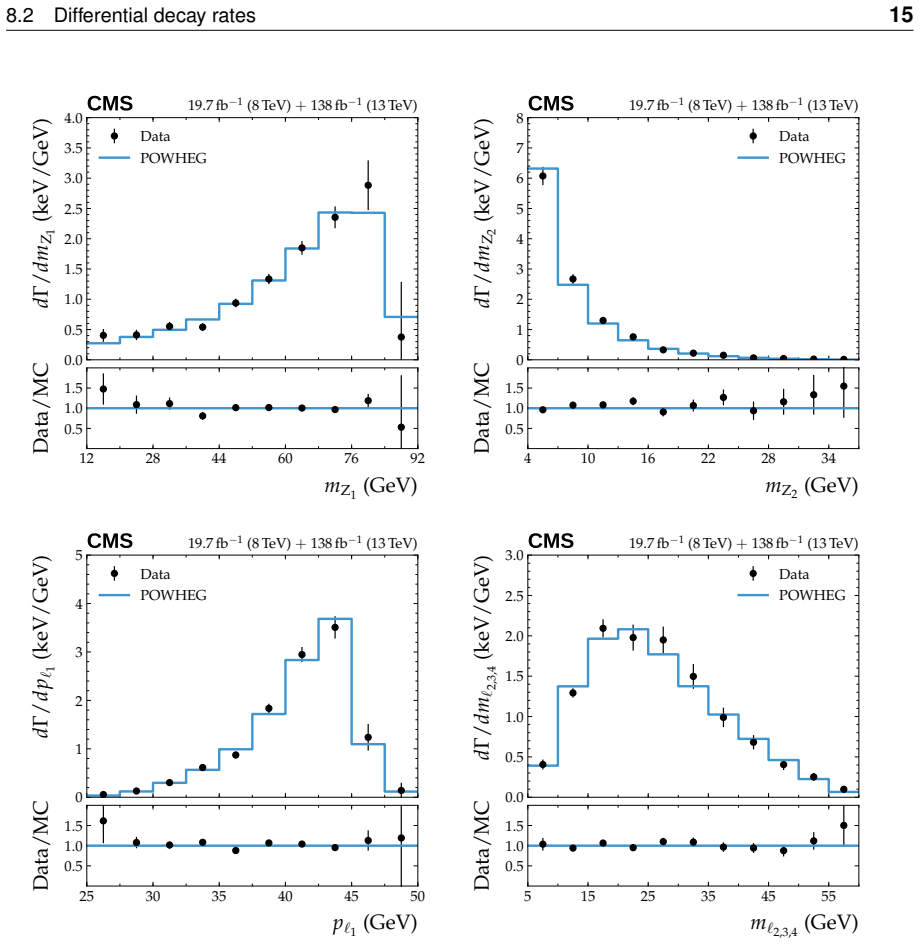
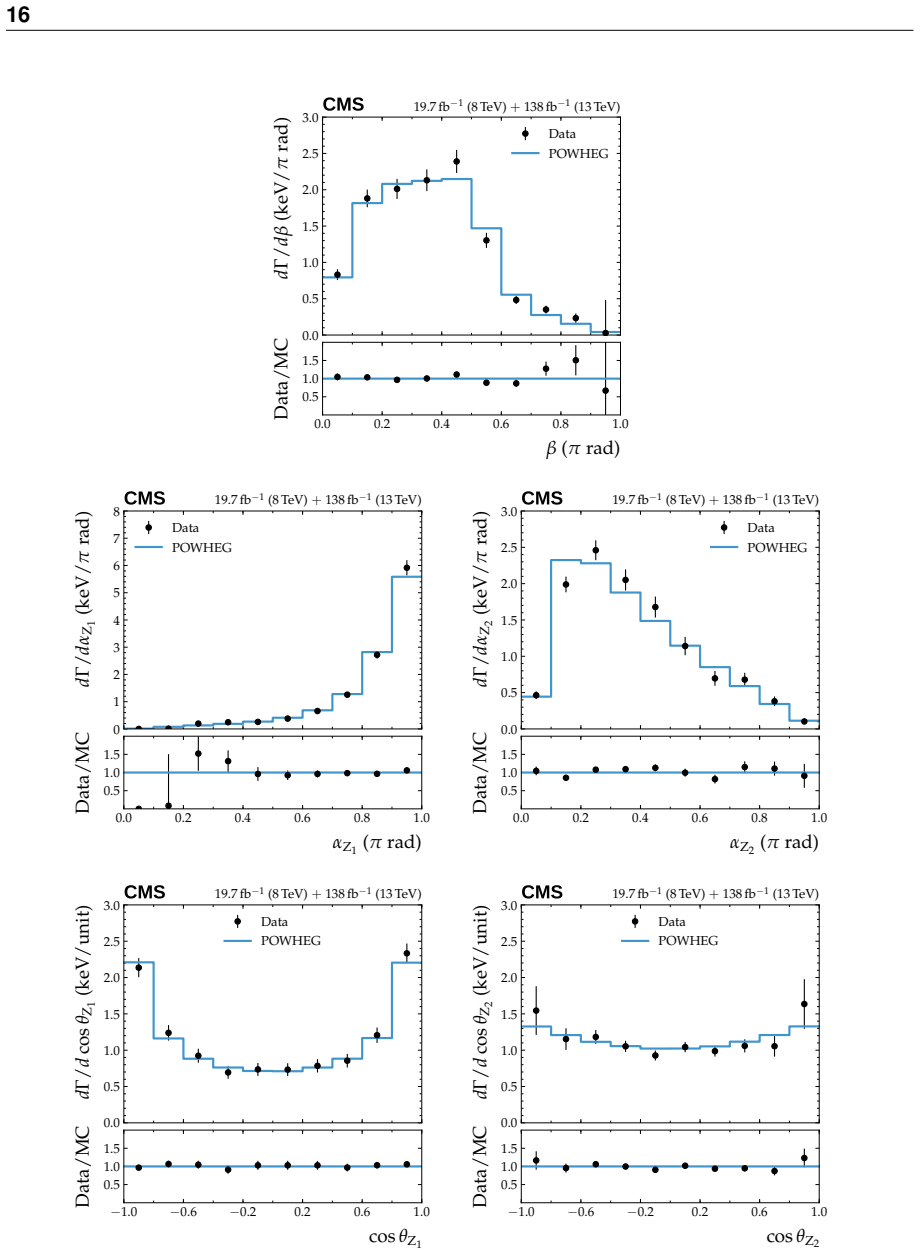
The measured value of the inclusive branching fraction for all four-lepton decay modes, B(Z to 4l), is 4.67 plus or minus 0.11 statistical plus or minus 0.10 systematic times 10 to the minus 6. Measurements of the individual branching fractions for Z to 4 muons, Z to 4 electrons, and Z to 2 muons 2 electrons are also reported. Differential decay rates are presented as functions of kinematic and angular quantities in the Z boson rest frame. Measurements of triple-product asymmetries are performed and the results are compared with standard model predictions to set limits on the production of new gauge bosons.
What carries the argument
The four-lepton final states from Z boson decays, examined through kinematic variables and triple-product asymmetries in the Z rest frame to determine branching fractions and test symmetry invariance.
If this is right
- Individual branching fractions are determined for the 4 muon, 4 electron, and mixed 2 muon 2 electron channels.
- Differential decay rates are extracted as functions of kinematic and angular quantities.
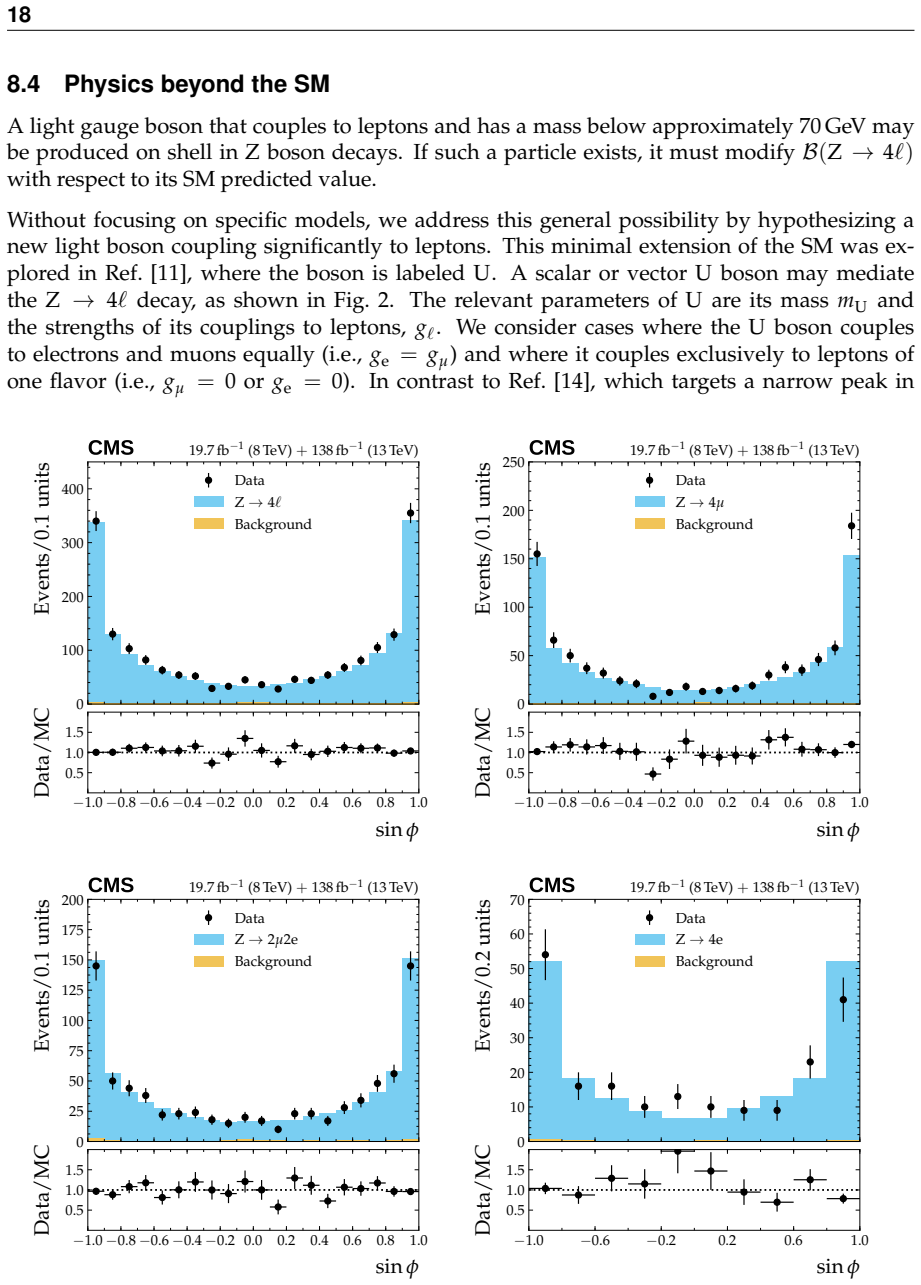
- Triple-product asymmetries are measured to constrain possible charge conjugation and parity violations.
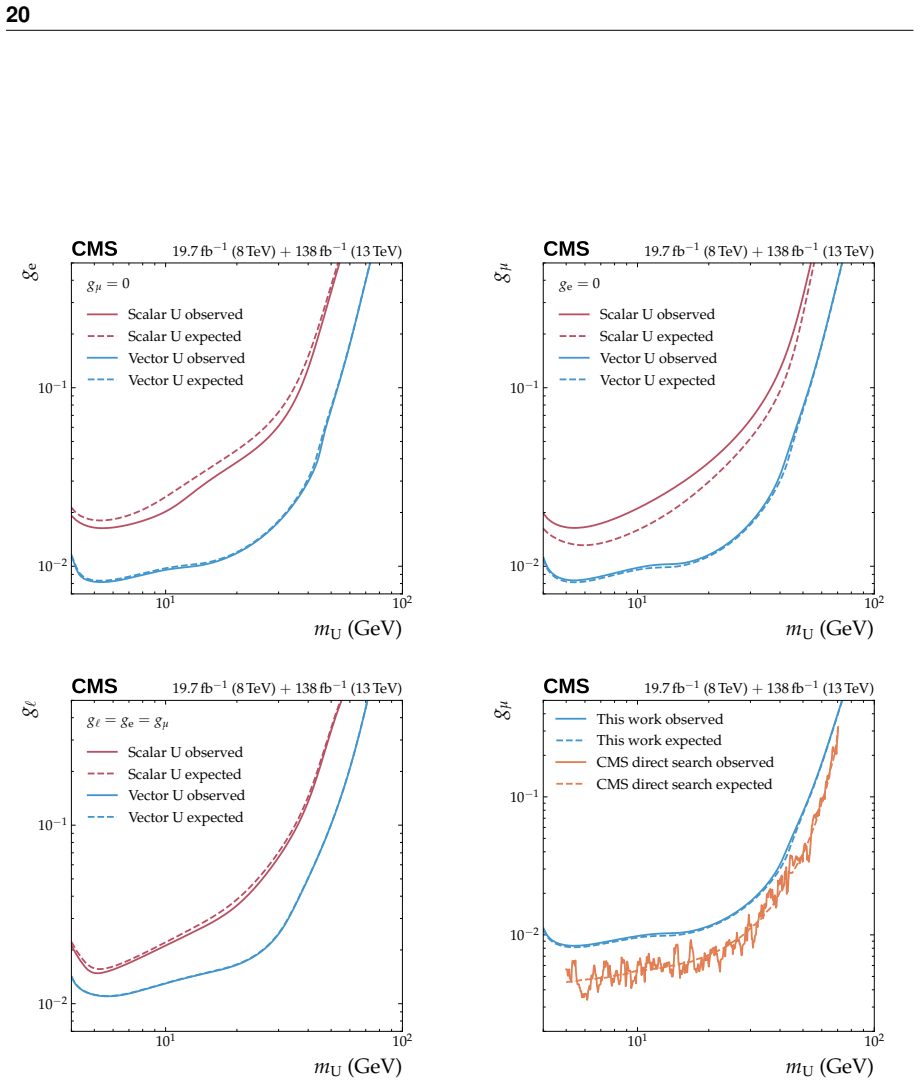
- Limits are set on the production of new gauge bosons that could contribute to the observed decays.
Where Pith is reading between the lines
- Future runs with higher integrated luminosity could tighten the uncertainty and allow smaller deviations from the standard model to be probed.
- The combination of datasets from different collision energies improves statistical power and reduces some systematic effects.
- These four-lepton measurements can serve as reference points for calculations of higher-order electroweak corrections.
Load-bearing premise
Background contributions are correctly subtracted and lepton identification efficiencies are accurately modeled by simulation.
What would settle it
A measured inclusive branching fraction lying well outside 4.4 to 4.9 times 10 to the minus 6, or triple-product asymmetries inconsistent with standard model expectations, would falsify the reported consistency.
Figures
read the original abstract
Decays of Z bosons to four charged leptons (electrons and muons) are studied in proton-proton collisions at $\sqrt{s}$ = 8 and 13 TeV. The analysis is based on data collected with the CMS detector at the LHC corresponding to an integrated luminosity of 19.7 fb$^{-1}$ at 8 TeV and 138 fb$^{-1}$ at 13 TeV. The measured value of the inclusive branching fraction for all four-lepton decay modes, $\mathcal{B}$(Z $\to$ 4$\ell$), is [4.67 $\pm$ 0.11 (stat) $\pm$ 0.10 (syst)] $\times$ 10$^{-6}$, which has a precision of about 3% limited by both statistical and systematic uncertainties. Measurements of the individual branching fractions for the decays Z $\to$ 4$\mu$, Z $\to$ 4e, and Z $\to$ 2$\mu$2e are also reported. Differential decay rates are presented as functions of kinematic and angular quantities in the Z boson rest frame. Measurements of triple-product asymmetries, which are sensitive to possible violations of charge conjugation and parity invariance, are performed for Z $\to$ 4$\ell$ decays. The results are compared with standard model predictions and used to set limits on the production of new gauge bosons.
Editorial analysis
A structured set of objections, weighed in public.
Referee Report
Summary. The paper measures Z boson decays to four charged leptons (electrons and muons) in CMS pp collision data at √s = 8 TeV (19.7 fb⁻¹) and 13 TeV (138 fb⁻¹). The central result is the inclusive branching fraction B(Z → 4ℓ) = [4.67 ± 0.11 (stat) ± 0.10 (syst)] × 10^{-6} (∼3% precision), with separate measurements of B(Z → 4μ), B(Z → 4e), and B(Z → 2μ2e). It also reports differential decay rates versus kinematic and angular variables in the Z rest frame, triple-product asymmetries testing C and P invariance, comparisons to SM predictions, and limits on new gauge bosons.
Significance. If the result holds, this constitutes a precision test of the SM for the rare Z → 4ℓ decay, achieving the quoted 3% total uncertainty that is explicitly both statistically and systematically limited. The dual-energy dataset provides useful cross-checks, and the differential distributions plus asymmetry observables add sensitivity to potential new physics beyond the inclusive rate. The measurement is normalized directly to measured luminosity with no circular parameter fitting.
minor comments (2)
- [Abstract] Abstract: the quoted result would benefit from an immediate parenthetical comparison to the SM prediction to allow readers to assess agreement at a glance.
- [Analysis method] The description of background subtraction and lepton-efficiency corrections (mentioned as key assumptions in the analysis) would be clearer if the dominant systematic sources were tabulated with their individual contributions to the 0.10 syst uncertainty.
Simulated Author's Rebuttal
We thank the referee for their careful reading of the manuscript, the positive assessment of its significance, and the recommendation for minor revision. No major comments were raised in the report.
Circularity Check
No circularity: direct data-driven measurement
full rationale
The paper reports an experimental measurement of B(Z → 4ℓ) extracted from proton-proton collision data at 8 and 13 TeV, normalized to measured integrated luminosity. The central result is obtained via standard background subtraction and simulation-based efficiency corrections, with the quoted precision explicitly limited by both statistical and systematic uncertainties. No equations, self-citations, or ansatze reduce the reported branching fraction to a fitted parameter or prior result defined by the same data. The analysis contains no theoretical derivation chain that could exhibit self-definition, fitted-input predictions, or load-bearing self-citations.
Axiom & Free-Parameter Ledger
free parameters (2)
- integrated luminosity at 8 TeV =
19.7 fb^{-1}
- integrated luminosity at 13 TeV =
138 fb^{-1}
axioms (1)
- domain assumption The CMS detector response and lepton identification efficiencies are accurately modeled by Monte Carlo simulation.
Reference graph
Works this paper leans on
-
[1]
Observation of Z decays to four leptons with the CMS detector at the LHC
CMS Collaboration, “Observation of Z decays to four leptons with the CMS detector at the LHC”,JHEP12(2012) 034,doi:10.1007/JHEP12(2012)034, arXiv:1210.3844
work page internal anchor Pith review Pith/arXiv arXiv doi:10.1007/jhep12(2012)034 2012
-
[2]
CMS Collaboration, “Measurement of the ZZ production cross section and Z→ℓ +ℓ−ℓ′+ℓ′− branching fraction in pp collisions at √s=13 TeV”,Phys. Lett. B763 (2016) 280,doi:10.1016/j.physletb.2016.10.054,arXiv:1607.08834. Erratum:doi:10.1016/j.physletb.2017.09.030
work page internal anchor Pith review Pith/arXiv arXiv doi:10.1016/j.physletb.2016.10.054 2016
-
[3]
CMS Collaboration, “Measurements of the pp→ZZ production cross section and the Z→4ℓbranching fraction, and constraints on anomalous triple gauge couplings at√s=13 TeV”,Eur. Phys. J. C78(2018) 165, doi:10.1140/epjc/s10052-018-5567-9,arXiv:1709.08601
work page internal anchor Pith review Pith/arXiv arXiv doi:10.1140/epjc/s10052-018-5567-9 2018
-
[4]
ATLAS Collaboration, “Measurements of four-lepton production at the Z resonance in pp collisions at √s=7 and 8 TeV with ATLAS”,Phys. Rev. Lett.112(2014) 231806, doi:10.1103/PhysRevLett.112.231806,arXiv:1403.5657
work page internal anchor Pith review Pith/arXiv arXiv doi:10.1103/physrevlett.112.231806 2014
-
[5]
ATLAS Collaboration, “Measurement of the four-lepton invariant mass spectrum in 13 TeV proton-proton collisions with the ATLAS detector”,JHEP04(2019) 048, doi:10.1007/JHEP04(2019)048,arXiv:1902.05892
work page internal anchor Pith review Pith/arXiv arXiv doi:10.1007/jhep04(2019)048 2019
-
[6]
ATLAS Collaboration, “Measurements of differential cross-sections in four-lepton events in 13 TeV proton-proton collisions with the ATLAS detector”,JHEP07(2021) 005, doi:10.1007/JHEP07(2021)005,arXiv:2103.01918
-
[7]
J. Alwall et al., “The automated computation of tree-level and next-to-leading order differential cross sections, and their matching to parton shower simulations”,JHEP07 (2014) 079,doi:10.1007/JHEP07(2014)079,arXiv:1405.0301
work page internal anchor Pith review Pith/arXiv arXiv doi:10.1007/jhep07(2014)079 2014
-
[8]
Search for the Z boson decay toττµµin proton-proton collisions at√s=13 TeV
CMS Collaboration, “Search for the Z boson decay toττµµin proton-proton collisions at√s=13 TeV”,Phys. Rev. Lett.133(2024) 161805, doi:10.1103/PhysRevLett.133.161805,arXiv:2404.18298
-
[9]
Study of the rare decay J/ψ→µ +µ −µ +µ −
LHCb Collaboration, “Study of the rare decay J/ψ→µ +µ −µ +µ −”,JHEP12(2024) 062, doi:10.1007/JHEP12(2024)062,arXiv:2408.16646
-
[10]
Observation of the J/ψ→µ +µ −µ +µ − decay in proton-proton collisions at √s=13 TeV
CMS Collaboration, “Observation of the J/ψ→µ +µ −µ +µ − decay in proton-proton collisions at √s=13 TeV”,Phys. Rev. D109(2024) L111101, doi:10.1103/PhysRevD.109.L111101,arXiv:2403.11352
-
[11]
Branching fraction for $Z$ decays to four leptons and constraints on new physics
J. L. Rainbolt and M. Schmitt, “Branching fraction for Z decays to four leptons and constraints on new physics”,Phys. Rev. D99(2019) 013004, doi:10.1103/PhysRevD.99.013004,arXiv:1805.05791
work page internal anchor Pith review Pith/arXiv arXiv doi:10.1103/physrevd.99.013004 2019
-
[12]
Constraints on $U(1)_{L_\mu-L_\tau}$ from LHC Data
M. Drees, M. Shi, and Z. Zhang, “Constraints onU(1) Lµ −L τ from LHC Data”,Phys. Lett. B791(2019) 130,doi:10.1016/j.physletb.2019.02.029,arXiv:1811.12446. 24
work page internal anchor Pith review Pith/arXiv arXiv doi:10.1016/j.physletb.2019.02.029 2019
-
[13]
Leptophilic Dark Matter with $Z'$ interactions
N. F. Bell, Y. Cai, R. K. Leane, and A. D. Medina, “Leptophilic dark matter with Z ′ interactions”,Phys. Rev. D90(2014) 035027,doi:10.1103/PhysRevD.90.035027, arXiv:1407.3001
work page internal anchor Pith review Pith/arXiv arXiv doi:10.1103/physrevd.90.035027 2014
-
[14]
CMS Collaboration, “Search for anL µ −L τ gauge boson using Z→4µevents in proton-proton collisions at √s=13 TeV”,Phys. Lett. B792(2019) 345, doi:10.1016/j.physletb.2019.01.072,arXiv:1808.03684
work page internal anchor Pith review Pith/arXiv arXiv doi:10.1016/j.physletb.2019.01.072 2019
-
[15]
Search for a new Z ′ gauge boson in 4µevents with the ATLAS experiment
ATLAS Collaboration, “Search for a new Z ′ gauge boson in 4µevents with the ATLAS experiment”,JHEP07(2023) 090,doi:10.1007/JHEP07(2023)090, arXiv:2301.09342
-
[16]
Precision luminosity measurement in proton-proton collisions at√s=13 TeV in 2015 and 2016 at CMS
CMS Collaboration, “Precision luminosity measurement in proton-proton collisions at√s=13 TeV in 2015 and 2016 at CMS”,Eur. Phys. J. C81(2021) 800, doi:10.1140/epjc/s10052-021-09538-2,arXiv:2104.01927
-
[17]
CMS luminosity measurement for the 2017 data-taking period at√s=13 TeV
CMS Collaboration, “CMS luminosity measurement for the 2017 data-taking period at√s=13 TeV”, CMS Physics Analysis Summary CMS-PAS-LUM-17-004, 2018
2017
-
[18]
CMS luminosity measurement for the 2018 data-taking period at√s=13 TeV
CMS Collaboration, “CMS luminosity measurement for the 2018 data-taking period at√s=13 TeV”, CMS Physics Analysis Summary CMS-PAS-LUM-18-002, 2019
2018
-
[19]
Observation of the Z $\to\psi\ell^+\ell^-$ decay in pp collisions at $\sqrt{s}=$ 13 TeV
CMS Collaboration, “Observation of the Z→ψℓ +ℓ− decay in pp collisions at√s=13 TeV”,Phys. Rev. Lett.121(2018) 141801, doi:10.1103/PhysRevLett.121.141801,arXiv:1806.04213
work page internal anchor Pith review Pith/arXiv arXiv doi:10.1103/physrevlett.121.141801 2018
-
[20]
Particle Data Group Collaboration, “Review of particle physics”,Phys. Rev. D110(2024) 030001,doi:10.1103/PhysRevD.110.030001
-
[21]
C, P, and CP asymmetry observables based on triple product asymmetries
A. J. Bevan, “C,P, andC Pasymmetry observables based on triple product asymmetries”, 2014.arXiv:1408.3813
work page internal anchor Pith review Pith/arXiv arXiv 2014
-
[22]
C, P, and CP asymmetry observables based on triple product asymmetries
A. J. Bevan, “C,P, andC Pasymmetry observables based on triple product asymmetries”, inProceedings, 7th International Workshop on Charm Physics, CHARM 2015: Detroit, USA, May 18-22, 2015. 2015.arXiv:1506.04246
work page internal anchor Pith review Pith/arXiv arXiv 2015
-
[23]
Search for $CP$ violation with kinematic asymmetries in the $D^0 \to K^+ K^- \pi^+ \pi^-$ decay
Belle Collaboration, “Search forC Pviolation with kinematic asymmetries in the D0 →K +K−π +π − decay”,Phys. Rev. D99(2019) 011104, doi:10.1103/PhysRevD.99.011104,arXiv:1810.06457
work page internal anchor Pith review Pith/arXiv arXiv doi:10.1103/physrevd.99.011104 2019
-
[24]
Investigation of K 0 L,S →π +π −e+e− decays
NA48 Collaboration, “Investigation of K 0 L,S →π +π −e+e− decays”,Eur. Phys. J. C30 (2003) 33,doi:10.1140/epjc/s2003-01252-y
-
[25]
The CMS experiment at the CERN LHC
CMS Collaboration, “The CMS experiment at the CERN LHC”,JINST3(2008) S08004, doi:10.1088/1748-0221/3/08/S08004
-
[26]
Particle-flow reconstruction and global event description with the CMS detector
A. M. Sirunyan et al., “Particle-flow reconstruction and global event description with the CMS detector”,JINST12(2017) P10003,doi:10.1088/1748-0221/12/10/P10003, arXiv:1706.04965
work page internal anchor Pith review Pith/arXiv arXiv doi:10.1088/1748-0221/12/10/p10003 2017
-
[27]
CMS Collaboration, “Performance of the CMS muon detector and muon reconstruction with proton-proton collisions at √s=13 TeV”,JINST13(2018) P06015, doi:10.1088/1748-0221/13/06/P06015,arXiv:1804.04528. References 25
work page internal anchor Pith review Pith/arXiv arXiv doi:10.1088/1748-0221/13/06/p06015 2018
-
[28]
Performance of CMS muon reconstruction in pp collision events at sqrt(s) = 7 TeV
CMS Collaboration, “Performance of CMS muon reconstruction in pp collision events at√s=7 TeV”,JINST7(2012) P10002,doi:10.1088/1748-0221/7/10/P10002, arXiv:1206.4071
work page internal anchor Pith review Pith/arXiv arXiv doi:10.1088/1748-0221/7/10/p10002 2012
-
[29]
Electron and photon reconstruction and identification with the CMS experiment at the CERN LHC
CMS Collaboration, “Electron and photon reconstruction and identification with the CMS experiment at the CERN LHC”,JINST16(2021) P05014, doi:10.1088/1748-0221/16/05/P05014,arXiv:2012.06888
-
[30]
CMS Collaboration, “Performance of electron reconstruction and selection with the CMS detector in proton-proton collisions at √s=8 TeV”,JINST10(2015) P06005, doi:10.1088/1748-0221/10/06/P06005,arXiv:1502.02701
work page internal anchor Pith review Pith/arXiv arXiv doi:10.1088/1748-0221/10/06/p06005 2015
-
[31]
CMS Collaboration, “Performance of missing transverse momentum reconstruction in proton-proton collisions at √s=13 TeV using the CMS detector”,JINST14(2019) P07004,doi:10.1088/1748-0221/14/07/P07004,arXiv:1903.06078
work page internal anchor Pith review Pith/arXiv arXiv doi:10.1088/1748-0221/14/07/p07004 2019
-
[32]
Jet performance in pp collisions at √s=7 TeV
CMS Collaboration, “Jet performance in pp collisions at √s=7 TeV”, CMS Physics Analysis Summary CMS-PAS-JME-10-003, CERN, 2010
2010
-
[33]
Pileup mitigation at CMS in 13 TeV data
CMS Collaboration, “Pileup mitigation at CMS in 13 TeV data”,JINST15(2020) P09018, doi:10.1088/1748-0221/15/09/P09018,arXiv:2003.00503
-
[34]
The anti-k_t jet clustering algorithm
M. Cacciari, G. P . Salam, and G. Soyez, “The anti-kT jet clustering algorithm”,JHEP04 (2008) 063,doi:10.1088/1126-6708/2008/04/063,arXiv:0802.1189
work page internal anchor Pith review Pith/arXiv arXiv doi:10.1088/1126-6708/2008/04/063 2008
-
[35]
M. Cacciari, G. P . Salam, and G. Soyez, “FastJet user manual”,Eur. Phys. J. C72(2012) 1896,doi:10.1140/epjc/s10052-012-1896-2,arXiv:1111.6097
work page internal anchor Pith review Pith/arXiv arXiv doi:10.1140/epjc/s10052-012-1896-2 2012
-
[36]
CMS Collaboration, “The CMS trigger system”,JINST12(2017) P01020, doi:10.1088/1748-0221/12/01/P01020,arXiv:1609.02366
work page internal anchor Pith review Pith/arXiv arXiv doi:10.1088/1748-0221/12/01/p01020 2017
-
[37]
Performance of the CMS Level-1 trigger in proton-proton collisions at √s=13 TeV
CMS Collaboration, “Performance of the CMS level-1 trigger in proton-proton collisions at √s=13 TeV”,JINST15(2020) P10017,doi:10.1088/1748-0221/15/10/P10017, arXiv:2006.10165
-
[38]
A New Method for Combining NLO QCD with Shower Monte Carlo Algorithms
P . Nason, “A new method for combining NLO QCD with shower Monte Carlo algorithms”,JHEP11(2004) 040,doi:10.1088/1126-6708/2004/11/040, arXiv:hep-ph/0409146
work page internal anchor Pith review Pith/arXiv arXiv doi:10.1088/1126-6708/2004/11/040 2004
-
[39]
Matching NLO QCD computations with Parton Shower simulations: the POWHEG method
S. Frixione, P . Nason, and C. Oleari, “Matching NLO QCD computations with parton shower simulations: the POWHEG method”,JHEP11(2007) 070, doi:10.1088/1126-6708/2007/11/070,arXiv:0709.2092
work page internal anchor Pith review Pith/arXiv arXiv doi:10.1088/1126-6708/2007/11/070 2007
-
[40]
A general framework for implementing NLO calculations in shower Monte Carlo programs: the POWHEG BOX
S. Alioli, P . Nason, C. Oleari, and E. Re, “A general framework for implementing NLO calculations in shower Monte Carlo programs: the POWHEG BOX”,JHEP06(2010) 043, doi:10.1007/JHEP06(2010)043,arXiv:1002.2581
work page internal anchor Pith review Pith/arXiv arXiv doi:10.1007/jhep06(2010)043 2010
-
[41]
W+W-, WZ and ZZ production in the POWHEG BOX
T. Melia, P . Nason, R. R¨ontsch, and G. Zanderighi, “W+W−, WZ and ZZ production in the POWHEG BOX”,JHEP11(2011) 078,doi:10.1007/JHEP11(2011)078, arXiv:1107.5051
work page internal anchor Pith review Pith/arXiv arXiv doi:10.1007/jhep11(2011)078 2011
-
[42]
Parton distributions for the LHC Run II
NNPDF Collaboration, “Parton distributions for the LHC Run II”,JHEP04(2015) 040, doi:10.1007/JHEP04(2015)040,arXiv:1410.8849. 26
work page internal anchor Pith review Pith/arXiv arXiv doi:10.1007/jhep04(2015)040 2015
-
[43]
Parton distributions from high-precision collider data
NNPDF Collaboration, “Parton distributions from high-precision collider data”,Eur. Phys. J. C77(2017) 663,doi:10.1140/epjc/s10052-017-5199-5, arXiv:1706.00428
work page internal anchor Pith review Pith/arXiv arXiv doi:10.1140/epjc/s10052-017-5199-5 2017
-
[44]
New parton distributions for collider physics
H.-L. Lai et al., “New parton distributions for collider physics”,Phys. Rev. D82(2010) 074024,doi:10.1103/PhysRevD.82.074024,arXiv:1007.2241
work page internal anchor Pith review Pith/arXiv arXiv doi:10.1103/physrevd.82.074024 2010
-
[45]
Parton distributions with LHC data
NNPDF Collaboration, “Parton distributions with LHC data”,Nucl. Phys. B867(2013) 244,doi:10.1016/j.nuclphysb.2012.10.003,arXiv:1207.1303
work page internal anchor Pith review Pith/arXiv arXiv doi:10.1016/j.nuclphysb.2012.10.003 2013
-
[46]
High-Energy-Physics Event Generation with PYTHIA 6.1
T. Sj ¨ostrand et al., “High-energy physics event generation with PYTHIA 6.1”,Comput. Phys. Commun.135(2001) 238,doi:10.1016/S0010-4655(00)00236-8, arXiv:hep-ph/0010017
work page internal anchor Pith review Pith/arXiv arXiv doi:10.1016/s0010-4655(00)00236-8 2001
-
[47]
T. Sj ¨ostrand et al., “An introduction to PYTHIA 8.2”,Comput. Phys. Commun.191(2015) 159,doi:10.1016/j.cpc.2015.01.024,arXiv:1410.3012
work page internal anchor Pith review Pith/arXiv arXiv doi:10.1016/j.cpc.2015.01.024 2015
-
[48]
Event generator tunes obtained from underlying event and multiparton scattering measurements
CMS Collaboration, “Event generator tunes obtained from underlying event and multiparton scattering measurements”,Eur. Phys. J. C76(2016) 155, doi:10.1140/epjc/s10052-016-3988-x,arXiv:1512.00815
work page internal anchor Pith review Pith/arXiv arXiv doi:10.1140/epjc/s10052-016-3988-x 2016
-
[49]
Investigations of the impact of the parton shower tuning in PYTHIA8 in the modelling of t t at √s=8 and 13 TeV
CMS Collaboration, “Investigations of the impact of the parton shower tuning in PYTHIA8 in the modelling of t t at √s=8 and 13 TeV”, CMS Physics Analysis Summary CMS-PAS-TOP-16-021, CERN, 2016
2016
-
[50]
Extraction and validation of a new set of CMS PYTHIA8 tunes from underlying-event measurements
CMS Collaboration, “Extraction and validation of a new set of CMS PYTHIA8 tunes from underlying-event measurements”,Eur. Phys. J. C80(2020) 4, doi:10.1140/epjc/s10052-019-7499-4,arXiv:1903.12179
-
[51]
Study of the underlying event at forward rapidity in pp collisions at sqrt(s) = 0.9, 2.76, and 7 TeV
CMS Collaboration, “Study of the underlying event at forward rapidity in pp collisions at √s=0.9, 2.76, and 7 TeV”,JHEP04(2013) 072,doi:10.1007/JHEP04(2013)072, arXiv:1302.2394
work page internal anchor Pith review Pith/arXiv arXiv doi:10.1007/jhep04(2013)072 2013
-
[52]
Agostinelli et al.,Geant4—a simulation toolkit, Nucl
GEANT4 Collaboration, “GEANT4—a simulation toolkit”,Nucl. Instrum. Meth. A506 (2003) 250,doi:10.1016/S0168-9002(03)01368-8
-
[53]
Geant4 developments and appli- cations
GEANT4 Collaboration, “GEANT4 developments and applications”,IEEE T rans. Nucl. Sci.53(2006) 270,doi:10.1109/TNS.2006.869826
-
[54]
FeynRules 2.0 - A complete toolbox for tree-level phenomenology
A. Alloul et al., “FEYNRULES2.0—A complete toolbox for tree-level phenomenology”, Comput. Phys. Commun.185(2014) 2250,doi:10.1016/j.cpc.2014.04.012, arXiv:1310.1921
work page internal anchor Pith review Pith/arXiv arXiv doi:10.1016/j.cpc.2014.04.012 2014
-
[55]
Pileup subtraction using jet areas
M. Cacciari and G. P . Salam, “Pileup subtraction using jet areas”,Phys. Lett. B659(2008) 119,doi:10.1016/j.physletb.2007.09.077,arXiv:0707.1378
work page internal anchor Pith review Pith/arXiv arXiv doi:10.1016/j.physletb.2007.09.077 2008
-
[56]
Measurement of the Inclusive W and Z Production Cross Sections in pp Collisions at sqrt(s) = 7 TeV
CMS Collaboration, “Measurement of the inclusive W and Z production cross sections in pp collisions at √s=7 TeV”,JHEP10(2011) 132,doi:10.1007/JHEP10(2011)132, arXiv:1107.4789
work page internal anchor Pith review Pith/arXiv arXiv doi:10.1007/jhep10(2011)132 2011
-
[57]
HEPData record for this analysis
“HEPData record for this analysis”, 2025.doi:10.17182/hepdata.159754
-
[58]
How to combine correlated estimates of a single physical quantity
L. Lyons, D. Gibaut, and P . Clifford, “How to combine correlated estimates of a single physical quantity”,Nucl. Instrum. Meth. A270(1988) 110, doi:10.1016/0168-9002(88)90018-6. References 27
-
[59]
PyUnfold: A Python Package for Iterative Unfolding
J. Bourbeau and Z. Hampel-Arias, “PyUnfold: A Python package for iterative unfolding”, J. Open Source Softw.3(2018) 741,doi:10.21105/joss.00741,arXiv:1806.03350
work page internal anchor Pith review Pith/arXiv arXiv doi:10.21105/joss.00741 2018
-
[60]
A multidimensional unfolding method based on Bayes’ theorem
G. D’Agostini, “A multidimensional unfolding method based on Bayes’ theorem”,Nucl. Instrum. Meth. A362(1995) 487,doi:10.1016/0168-9002(95)00274-X
-
[61]
New-Physics Effects on Triple-Product Correlations in Lambda_b Decays
W. Bensalem, A. Datta, and D. London, “New physics effects on triple product correlations inΛ b decays”,Phys. Rev. D66(2002) 094004, doi:10.1103/PhysRevD.66.094004,arXiv:hep-ph/0208054
work page internal anchor Pith review Pith/arXiv arXiv doi:10.1103/physrevd.66.094004 2002
-
[62]
Four-lepton Z boson decay constraints on the standard model EFT
R. Boughezal, C.-Y. Chen, F. Petriello, and D. Wiegand, “Four-lepton Z boson decay constraints on the standard model EFT”,Phys. Rev. D103(2021) 055015, doi:10.1103/PhysRevD.103.055015,arXiv:2010.06685. 28 29 A The CMS Collaboration Yerevan Physics Institute, Yerevan, Armenia A. Tumasyan Institut f ¨ ur Hochenergiephysik, Vienna, Austria W. Adam , J.W. And...
discussion (0)
Sign in with ORCID, Apple, or X to comment. Anyone can read and Pith papers without signing in.