REVIEW 2 major objections 4 minor 43 references
A shared sech basis plus 1D projection keeps KAN size near MLP levels
Reviewed by Pith at T0; open to challenge. T0 means a machine referee read the full paper against a public rubric. the ladder, T0–T4 →
T0 review · deepseek-v4-flash
2026-08-02 09:19 UTC pith:EF5P3HIR
load-bearing objection Competent, incremental KAN variant with clean parameter counting and honest ablations, but its strongest PDE claims are undermined by test-set-selected configurations and inconsistent reporting; worth refereeing after revision. the 2 major comments →
SechKAN: Kolmogorov-Arnold Networks with Hyperbolic Secant Functions
The pith
A machine-rendered reading of the paper's core claim, the machinery that carries it, and where it could break.
Core claim
SechKAN establishes that a KAN layer does not need an edge-specific basis expansion to be competitive. By applying one shared sech basis Φ(x′)=s·sech((x′−C)/w)+δ over G learnable grid centers, then mapping the G responses per feature to a single scalar via a 1D linear projection, SechKAN reduces the parameter count to d_in·d_out + d_out + 2G + 3 + I_width, which is MLP's count plus a small additive term. The paper argues that this preserved the nonlinear basis representation of KAN while cutting the edge-wise parameterization, and substantiates it with experiments: best average MSE on 10 function-fitting benchmarks, best relative L2 error among baselines on the Shallow Water PDE, competitive
What carries the argument
The load-bearing mechanism is the shared sech basis plus gridwise bottleneck: each layer learns one vector of G grid centers, one scalar scale, one scalar bias, and optionally one scalar width, so the basis itself contributes only G+3 trainable parameters regardless of layer width. The 1D linear projection W_G∈R^{G×1} then squeezes the G basis responses of each feature down to one scalar, after which a standard linear layer W_F∈R^{d_in×d_out} mixes features. That two-stage factorization—per-feature nonlinear expansion followed by across-feature linear mixing—is what keeps the parameter count near MLP level while retaining a KAN-style functional form.
Load-bearing premise
The paper assumes that sharing one sech basis across all features and neurons, instead of giving each edge its own learned function, loses little expressive power once enough layers are stacked.
What would settle it
Take a two-variable function with sharply different feature scales, such as f(x1,x2)=sin(12πx1)·cos(x2), and train a single-layer SechKAN with G=8 and a single-layer KAN with comparable parameters. If SechKAN's error stays orders of magnitude above the KAN's even as width grows, the shared-basis-plus-depth premise fails; conversely, close errors would confirm it.
If this is right
- SechKAN layers can be substituted for MLP layers at nearly the same parameter budget, making them practical as drop-in replacements in larger architectures.
- The parameter and FLOP formulas let practitioners predict model size and cost before training: SechKAN adds only 2G+3+I_width parameters per layer over an MLP.
- On the Shallow Water PDE surrogate task, SechKAN posts the lowest test relative L2 error among evaluated models, and on Navier–Stokes it matches EfficientKAN's accuracy with substantially lower training time.
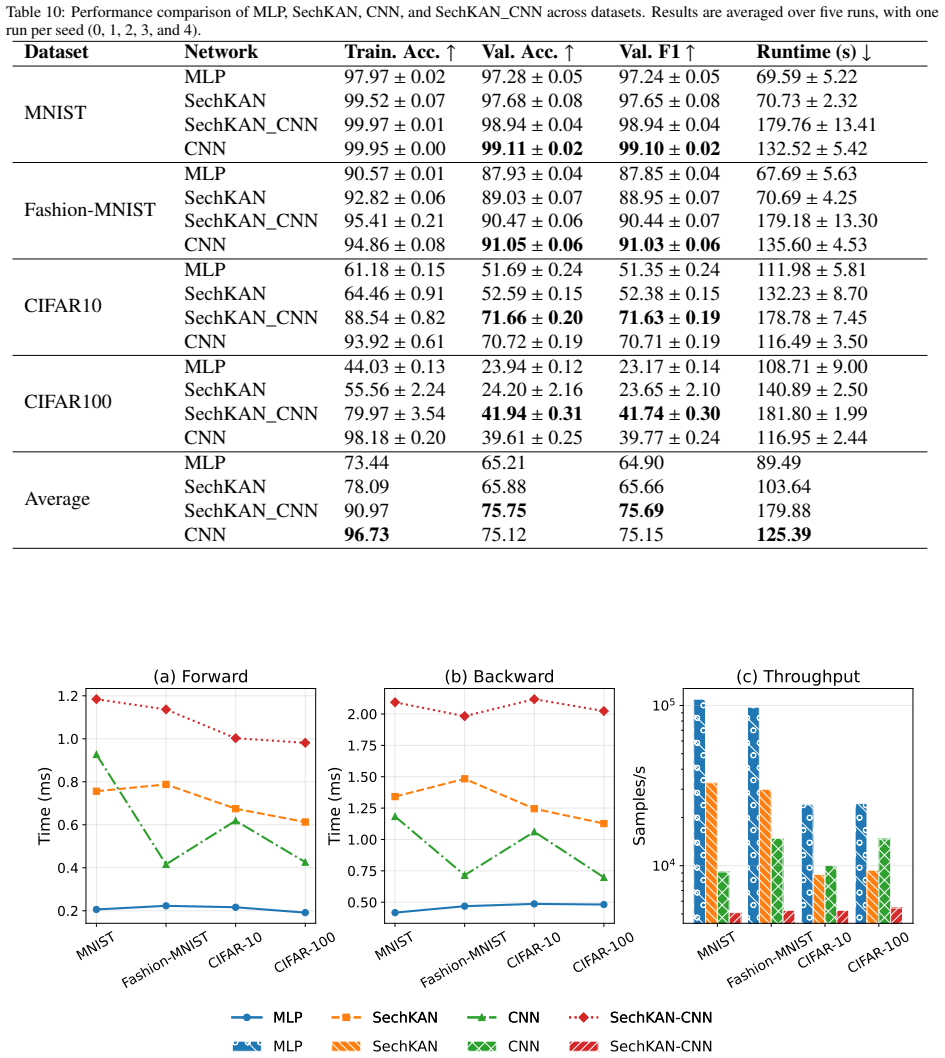
- On image classification, SechKAN outperforms the evaluated KAN variants on all four datasets, and replacing an MLP classifier head with SechKAN in a CNN improves generalization while increasing compute.
- The sech basis forward pass is roughly 12× faster than the compared B-spline implementation in the paper's GPU benchmark, suggesting the architecture has a runtime advantage over spline-based KANs despite higher cost than MLPs.
Where Pith is reading between the lines
- The paper's own ablation on CIFAR-10 and CIFAR-100 shows the sech basis alone is worse than the B-spline basis, with the 1D projection delivering most of the accuracy gain; a testable prediction is that any cheap bell-shaped basis combined with the same projection would behave similarly on hard vision tasks.
- The design assumes depth can compensate for the loss of per-edge adaptivity. A natural stress test is to measure single-layer SechKAN vs single-layer KAN on functions with wildly different per-feature scales; if accuracy collapses without width, that assumption is the bottleneck.
- SechKAN's shared-basis bottleneck is a form of weight tying, so it should be directly portable to other KAN application areas such as time-series forecasting or physics-informed training, where parameter budgets are tight.
- The normalization-position sensitivity reported in the ablations is a practical guide: BatchNorm before the basis for regression, LayerNorm after the projection for classification and PDEs—but these are empirical rules, not theory.
Editorial analysis
A structured set of objections, weighed in public.
Referee Report
Summary. The paper proposes SechKAN, a Kolmogorov-Arnold Network variant that replaces B-spline or RBF edge functions with a hyperbolic secant (sech) basis and compresses the G basis responses per feature through a 1D linear projection. The main technical contribution is a parameter-count calculation (Eq. 22: SechKAN_param = MLP_param + 2G + 3 + I_width) and a FLOP analysis showing that the sech basis is inexpensive to evaluate. The empirical claims are that SechKAN is competitive or better than MLPs and representative KAN variants on three task families: synthetic function fitting (10 functions), PDE surrogate modeling of a single Navier–Stokes trajectory and a single Shallow Water trajectory, and image classification on MNIST, Fashion-MNIST, CIFAR-10, and CIFAR-100. Extensive ablations cover grid size, activation function, normalization position, basis/projection contributions, and gradient-flow behavior.
Significance. If the results hold, SechKAN is a useful data point in the parameter-efficient KAN literature. The paper is transparent about the parameter-reduction mechanism, which is closely related to the Feature Weight Vector strategy in PRKAN, and it provides clean, easily checkable parameter and FLOP counts. The experiments are extensive, the code is public, and the ablation/gradient analysis is more thorough than in many KAN papers. The main source of uncertainty is the PDE evaluation protocol, where configurations are selected using test-set performance and the reported Shallow Water configuration is internally inconsistent. Because PDE surrogate modeling is one of the three task families supporting the central claim, that issue must be fixed before the headline comparisons can be accepted.
major comments (2)
- [Sec. 5.3.2 / App. C / Tables C.17–C.18] The PDE configuration is selected using the test set, which makes the reported test Rel L2 values in Tables 7 and 8 optimistic and the comparison not a clean holdout evaluation. Appendix C explicitly says the normalization mode is adopted 'due to the test results', and Tables C.17–C.18 mark SechKAN5 for Table 7 and SechKAN1 for Table 8 as the variants with the lowest test Rel L2. Section 5.3.2 also says configurations are 'selected based on the best model performance observed in experiments'. I note that the validation columns in C.17–C.18 happen to favor the same two variants, which mitigates the practical impact, but the stated protocol is still a multiple-testing use of the test set and is not acceptable as reported. Please select the configuration on validation only, or pre-specify one configuration, and then report test results once.
- [Sec. 5.3.2 / Table 8 / App. C] The winning Shallow Water configuration is described inconsistently in three places, so Table 8 is not reproducible from the text. Section 5.3.2 states 'SechKAN applies Min-Max Norm at Norm2' with num_grids = 4; Table 8's caption says 'Min-Max Norm at Norm1' and num_grids = 4; Appendix C states that the selected model, SechKAN1, uses LayerNorm at Norm1 with num_grids = 8. These three statements cannot all be true. Please correct the main text and captions to match the actual configuration used, and include the exact normalization type, normalization position, and grid size for both PDE experiments.
minor comments (4)
- [Sec. 4.2 / Eq. (18)] Equation (12) denotes the learnable grid as the vector C, but Eq. (18) calls it a 'single learnable grid vector G'. Using the same symbol as the grid size G is confusing. Please use C or another distinct symbol for the grid vector.
- [Sec. 6.1 / Table 11] In the no-normalization, 3-seed ablation, SechKAN has a higher average MSE than EfficientKAN (3.94×10^-2 vs 2.03×10^-2). Since this differs from the main function-fitting result in Table 4 (where SechKAN is lower), the text should explicitly discuss the role of BatchNorm/Min-Max normalization in the full configuration and explain why the ablation setup reverses the ranking.
- [Table D.20] The FasterKAN row for CIFAR-100 lists the network structure as (3072, 32, 10). CIFAR-100 has 100 classes, so this appears to be a typo; please check whether the output dimension should be 100.
- [Sec. 5.3.1 / Abstract] The paper correctly states in Section 5.3.1 that the PDE tasks learn a single simulation trajectory, not an operator that generalizes across initial/boundary conditions or physical parameters. The abstract and conclusion should carry this caveat, since 'PDE surrogate modeling' without qualification may overstate the scope.
Circularity Check
PDE surrogate claim rests on test-set-selected configuration; architecture derivation itself is not circular
specific steps
-
fitted input called prediction
[Appendix C (PDE experimental details), model selection for Tables 7–8; see also Sec. 5.3.2]
"Based on the results in Table C.17, SechKAN5 is selected for the main experiments reported in Table 7 on the Navier–Stokes dataset. For the Shallow Water dataset, SechKAN1 achieves the lowest test Relative L2 error in Table C.18 and is therefore selected for the experiments reported in Table 8."
The same test-set Rel L2 metric used to screen SechKAN variants is then reported as SechKAN's PDE performance. The reported test scores (0.27695 Navier–Stokes, 0.29879 Shallow Water) are, by construction, minima over the variants in Tables C.17–C.18, so the favorable comparison against baselines is not an independent out-of-sample prediction. Sec. 5.3.2 confirms 'These configurations are selected based on the best model performance observed in experiments.' The Shallow Water setup is also inconsistent (5.3.2 says Min-Max at Norm2, Table 8 caption says Min-Max at Norm1, Appendix C says SechKAN1 uses LayerNorm at Norm1 with num_grids=8), so the result is not reproducible as stated. This affects only the PDE prong; parameter-count derivation is unaffected.
full rationale
The SechKAN architecture, parameter formulas (Eqs. 18–22), FLOPs, and basis-function motivation are derived from explicit definitions and are not circular. Self-citations to PRKAN [34] and BSRBF-KAN [20] are acknowledgements/baselines rather than load-bearing justifications; no uniqueness theorem or ansatz is imported from them. The function-fitting and image-classification evaluations are independent external benchmarks and the ablation honestly discloses that the sech basis alone is weaker than B-splines on CIFAR, with the 1D projection doing most of the work. The one substantial issue is the PDE surrogate modeling prong: the exact SechKAN configuration reported in Tables 7–8 is chosen using the test-set Rel L2 values, so those numbers are selected rather than predicted, and the Shallow Water configuration is described inconsistently across the main text, table caption, and appendix. This is a partial empirical circularity in one of the three central task claims, hence the score of 4 rather than 0–2.
Axiom & Free-Parameter Ledger
free parameters (4)
- Grid size G =
4, 8, 16, 32 depending on task
- Normalization type and position =
BatchNorm Norm1 for f3-f10; LayerNorm Norm1 or Min-Max Norm2 for PDE; LayerNorm Norm2 for classification
- Activation function =
SELU for function fitting; SiLU for PDE and classification
- Learnable width/scale/bias and skip-connection toggles =
on/off per task
axioms (3)
- standard math Kolmogorov-Arnold Representation Theorem
- ad hoc to paper Stacked layers recover lost per-layer expressivity
- domain assumption sech basis properties transfer to optimization gains
read the original abstract
In recent years, Kolmogorov-Arnold Networks (KANs) have attracted increasing attention due to their effectiveness in machine learning and scientific computing, offering a new paradigm for neural network design. In this paper, we present SechKAN, a novel KAN based on hyperbolic secant (sech) functions. The hyperbolic secant basis is adopted for its smooth bell-shaped form, localized responses, and well-behaved gradients. We employ a 1D linear projection to reduce the number of parameters, allowing SechKAN to maintain a model size comparable to that of multilayer perceptrons (MLPs). Experimental results show the effectiveness of SechKAN on function fitting, PDE surrogate modeling, and image classification benchmarks, including MNIST, Fashion-MNIST, CIFAR-10, and CIFAR-100. On function fitting, SechKAN achieves performance comparable to both MLPs and representative KAN variants. On PDE surrogate modeling, it outperforms MLPs and achieves competitive or better performance than representative KAN variants. On image classification benchmarks, SechKAN achieves the best performance among the evaluated KAN variants while remaining competitive with MLPs using a comparable number of parameters. However, SechKAN still incurs higher computational cost than MLPs and some KAN variants. Our source code is publicly available at https://github.com/hoangthangta/All-KAN.
Figures




Reference graph
Works this paper leans on
-
[1]
Blealtan, efficient-kan,https://github.com/Blealtan/efficient-kan, 2024
2024
-
[2]
Z. Liu, Y . Wang, S. Vaidya, F. Ruehle, J. Halverson, M. Soljacic, T. Hou, M. Tegmark, Kan: Kolmogorov–arnold networks, in: International conference on learning representations, volume 2025, 2025, pp. 70367–70413
2025
-
[3]
A. N. Kolmogorov, On the representation of continuous functions of many variables by superposition of continuous functions of one variable and addition, in: Doklady Akademii Nauk, volume 114, Russian Academy of Sciences, 1957, pp. 953–956
1957
-
[4]
Braun, M
J. Braun, M. Griebel, On a constructive proof of kolmogorov’s superposition theorem, Constructive approximation 30 (2009) 653–675
2009
-
[5]
P.-E. Leni, Y . D. Fougerolle, F. Truchetet, The kolmogorov spline network for image processing, in: Image Processing: Concepts, Methodologies, Tools, and Applications, IGI Global, 2013, pp. 54–78
2013
-
[6]
H. van Deventer, P. J. van Rensburg, A. Bosman, Kasam: Spline additive models for function approximation, arXiv preprint arXiv:2205.06376 (2022)
Pith/arXiv arXiv 2022
-
[7]
Igelnik, N
B. Igelnik, N. Parikh, Kolmogorov’s spline network, IEEE transactions on neural networks 14 (2003) 725–733
2003
-
[8]
Fakhoury, E
D. Fakhoury, E. Fakhoury, H. Speleers, Exsplinet: An interpretable and expressive spline-based neural network, Neural Networks 152 (2022) 332–346
2022
-
[9]
Y . Wang, J. Sun, J. Bai, C. Anitescu, M. S. Eshaghi, X. Zhuang, T. Rabczuk, Y . Liu, Kolmogorov–arnold-informed neural network: A physics-informed deep learning framework for solving forward and inverse problems based on kolmogorov–arnold networks, Computer Methods in Applied Mechanics and Engineering 433 (2025) 117518. 35
2025
-
[10]
B. C. Koenig, S. Kim, S. Deng, Kan-odes: Kolmogorov–arnold network ordinary differential equations for learning dynamical systems and hidden physics, Computer Methods in Applied Mechanics and Engineering 432 (2024) 117397
2024
-
[11]
R. Genet, H. Inzirillo, A temporal kolmogorov-arnold transformer for time series forecasting, arXiv preprint arXiv:2406.02486 (2024)
Pith/arXiv arXiv 2024
-
[12]
K. Xu, L. Chen, S. Wang, Kolmogorov-arnold networks for time series: Bridging predictive power and interpretability, arXiv preprint arXiv:2406.02496 (2024)
Pith/arXiv arXiv 2024
-
[13]
C. J. Vaca-Rubio, L. Blanco, R. Pereira, M. Caus, Kolmogorov-arnold networks (kans) for time series analysis, in: 2024 IEEE Globecom Workshops (GC Wkshps), IEEE, 2024, pp. 1–6
2024
-
[14]
C. Li, X. Liu, W. Li, C. Wang, H. Liu, Y . Liu, Z. Chen, Y . Yuan, U-kan makes strong backbone for medical image segmentation and generation, in: Proceedings of the AAAI conference on artificial intelligence, volume 39, 2025, pp. 4652–4660
2025
-
[15]
M. Cheon, Demonstrating the efficacy of kolmogorov-arnold networks in vision tasks, arXiv preprint arXiv:2406.14916 (2024)
Pith/arXiv arXiv 2024
-
[16]
R. Ge, X. Yu, Y . Chen, F. Jia, S. Zhu, D. Zeng, C. Wang, Q. Liu, S. Niu, Tc-kanrecon: High-quality and accelerated mri reconstruction via adaptive kan mechanisms and intelligent feature scaling, IEEE Journal of Biomedical and Health Informatics (2025)
2025
-
[17]
Kundu, A
A. Kundu, A. Sarkar, A. Sadhu, Kanqas: Kolmogorov-arnold network for quantum architecture search, EPJ Quantum Technology 11 (2024) 76
2024
-
[18]
D. W. Abueidda, P. Pantidis, M. E. Mobasher, Deepokan: Deep operator network based on kolmogorov arnold networks for mechanics problems, Computer Methods in Applied Mechanics and Engineering 436 (2025) 117699
2025
-
[19]
Somvanshi, S
S. Somvanshi, S. A. Javed, M. M. Islam, D. Pandit, S. Das, A survey on kolmogorov-arnold network, ACM Computing Surveys 58 (2025) 1–35
2025
-
[20]
H.-T. Ta, Bsrbf-kan: A combination of b-splines and radial basis functions in kolmogorov-arnold networks, in: International Symposium on Information and Communication Technology, Springer, 2024, pp. 3–15
2024
-
[21]
S. S. Bhattacharjee, Torchkan: Simplified kan model with variations,https://github.com/1ssb/torchkan /, 2024
2024
-
[22]
S. SS, Chebyshev polynomial-based kolmogorov-arnold networks: An efficient architecture for nonlinear function approximation, arXiv preprint arXiv:2405.07200 (2024)
Pith/arXiv arXiv 2024
-
[23]
S. Teymoor Seydi, Exploring the potential of polynomial basis functions in kolmogorov-arnold networks: A comparative study of different groups of polynomials, arXiv e-prints (2024) arXiv–2406
2024
-
[24]
Z. Li, Kolmogorov-arnold networks are radial basis function networks, arXiv preprint arXiv:2405.06721 (2024)
Pith/arXiv arXiv 2024
-
[25]
Z. Chen, X. Zhang, Lss-skan: Efficient kolmogorov-arnold networks based on single-parameterized function, arXiv preprint arXiv:2410.14951 (2024)
arXiv 2024
-
[26]
Q. Qiu, T. Zhu, H. Gong, L. Chen, H. Ning, Relu-kan: New kolmogorov-arnold networks that only need matrix addition, dot multiplication, and relu, in: 2025 IEEE Smart World Congress (SWC), IEEE, 2025, pp. 1686–1694
2025
-
[27]
J. Xu, Z. Chen, J. Li, S. Yang, W. Wang, X. Hu, E. C.-H. Ngai, Fourierkan-gcf: Fourier kolmogorov-arnold network–an effective and efficient feature transformation for graph collaborative filtering, arXiv preprint arXiv:2406.01034 (2024). 36
Pith/arXiv arXiv 2024
-
[28]
Z. Bozorgasl, H. Chen, Wav-kan: Wavelet kolmogorov-arnold networks, arXiv preprint arXiv:2405.12832 (2024)
Pith/arXiv arXiv 2024
-
[29]
S. T. Seydi, Unveiling the power of wavelets: A wavelet-based kolmogorov-arnold network for hyperspectral image classification, arXiv preprint arXiv:2406.07869 (2024)
Pith/arXiv arXiv 2024
-
[30]
A. A. Aghaei, M. Hosseinzadeh, K. Parand, rkan: Rational kolmogorov-arnold networks, Neural Networks (2026) 108888
2026
-
[31]
A. A. Aghaei, fkan: Fractional kolmogorov–arnold networks with trainable jacobi basis functions, Neurocomputing 623 (2025) 129414
2025
-
[32]
Delis, Fasterkan,https://github.com/AthanasiosDelis/faster-kan/, 2024
A. Delis, Fasterkan,https://github.com/AthanasiosDelis/faster-kan/, 2024
2024
-
[33]
X. Yang, X. Wang, Kolmogorov-arnold transformer, in: International Conference on Learning Representations, volume 2025, 2025, pp. 76063–76086
2025
-
[34]
H.-T. Ta, D.-Q. Thai, A. Tran, G. Sidorov, A. Gelbukh, Prkan: Parameter-reduced kolmogorov-arnold networks, arXiv preprint arXiv:2501.07032 (2025)
Pith/arXiv arXiv 2025
-
[35]
O. Eliasson, Gs-kan: Parameter-efficient kolmogorov-arnold networks via sprecher-type shared basis functions, arXiv preprint arXiv:2512.09084 (2025)
Pith/arXiv arXiv 2025
-
[36]
B. C. Koenig, S. Kim, S. Deng, Leankan: a parameter-lean kolmogorov-arnold network layer with improved memory efficiency and convergence behavior, Neural Networks (2025) 107883
2025
-
[37]
G. Li, A. P. Majeed, M. Ateeq, A. Nguyen, F. Zhang, Groupkan: Rethinking nonlinearity with grouped spline-based kan modeling for efficient medical image segmentation, arXiv preprint arXiv:2511.05477 (2025)
Pith/arXiv arXiv 2025
-
[38]
R. Qiu, Y . Miao, S. Wang, Y . Zhu, L. Yu, X.-S. Gao, Powermlp: An efficient version of kan, in: Proceedings of the AAAI Conference on Artificial Intelligence, volume 39, 2025, pp. 20069–20076
2025
-
[39]
V . E. Ismailov, Addressing common misinterpretations of kart and uat in neural network literature, Neural Networks (2025) 108361
2025
-
[40]
Ta, D.-Q
H.-T. Ta, D.-Q. Thai, A. B. S. Rahman, G. Sidorov, A. Gelbukh, Fc-kan: Function combinations in kolmogorov-arnold networks, Information Sciences (2026) 123103
2026
-
[41]
R. Yu, W. Yu, X. Wang, Kan or mlp: A fairer comparison, arXiv preprint arXiv:2407.16674 (2024)
Pith/arXiv arXiv 2024
-
[42]
Udrescu, M
S.-M. Udrescu, M. Tegmark, Ai feynman: A physics-inspired method for symbolic regression, Science advances 6 (2020) eaay2631
2020
-
[43]
Noorizadegan, S
A. Noorizadegan, S. Wang, L. Ling, J. P. Dominguez-Morales, A practitioner’s guide to kolmogorov–arnold networks, Computer Science Review 62 (2026) 100991. 37
2026
discussion (0)
Sign in with ORCID, Apple, or X to comment. Anyone can read and Pith papers without signing in.