REVIEW 4 major objections 5 minor 25 references
Quantum Entanglement as Super-Confounding: From Bell's Theorem to Robust Machine Learning
T0 review · 4 major / 5 minor · reviewed 2026-08-15 · deepseek-v4-flash
Pith's one-line read The paper recasts quantum entanglement as a super-confounder—a non-classical common cause that violates Bell's classical causal bounds—and turns this into a circuit-based do-calculus that improves quantum machine-learning robustness.
desk verdict A clean but largely terminological restatement of known quantum causal models, with a solid toy QML demonstration and an unsupported identification of the project-prepare surgery with Pearl's do-operator. read the letter →
The pith
A machine-rendered reading of the paper's core claim, the machinery that carries it, and where it could break.
The reading
What carries the argument
Three pieces carry the argument. The super-confounder is the entangled state $\rho_{AB}$ itself, treated as a non-classical common cause whose joint probabilities are given by the non-factorizable Born rule rather than by the local hidden-variable factorization $P(A,B|a,b,\Lambda)=P(A|a,\Lambda)P(B|b,\Lambda)$. The Confounding Strength $CS = |S|/2$ is a normalization of the CHSH parameter that recasts the classical and quantum bounds as $CS \le 1$ and $CS \le \sqrt{2}$. The project-prepare surgery is a two-stage completely-positive trace-preserving map — a non-selective projective measurement on qubit A that severs the entanglement, followed by preparation of A in the target state — which the paper uses to implement the do-operator in a circuit, turning an observational correlation into an interventional one. Together these pieces let the paper move from a foundational reinterpretation of Bell violations to a quantitative resource metric and a concrete causal feature-selection protocol for quantum machine learning.
What would settle it
A concrete falsifier would be to add a genuine direct causal coupling from A to B on top of the shared entanglement (for example, a weak entangling gate applied after the Bell-state preparation) and compare the surgery's output $P(B|\mathrm{do}(A=a))$ with the interventional distribution computed from a formal quantum causal model, such as the process-matrix formalism. If the two disagree beyond statistical error, the project-prepare surgery is not a faithful do-operator and the feature-selection result does not follow; agreement, by contrast, would confirm the surgery's validity in a setting where a genuine causal effect must be recovered rather than set to zero.
Extended reading notes
Core claim
The central discovery is the equivalence 'entanglement = super-confounding': the entangled state $\rho_{AB}$, through the Born rule $P(A,B|a,b) = \mathrm{Tr}[\rho_{AB}(M_{A,a}\otimes M_{B,b})]$, acts as a non-factorizable common cause that generates correlations beyond the classical causal bound, exactly the behavior observed in Bell tests. The paper reports that a maximally entangled state reaches $CS = \sqrt{2}$, about 41% above the classical maximum of $1$, and that for the fixed-angle protocol the Confounding Strength is directly linear in the concurrence, $CS = (1+C)/\sqrt{2}$. It further claims that a non-selective projective measurement on one qubit followed by resetting that qubit to a fixed state is a valid circuit implementation of the do-operator, producing $P(B|\mathrm{do}(A=a)) \approx 0.5$ for a Bell pair. In the machine-learning application, this intervention correctly identifies the true causal feature, and the resulting causal classifier outperforms the naive classifier by 11.3 absolute percentage points on average across test domains where the spurious correlation is weakened or removed.
Load-bearing premise
The load-bearing premise is that a non-selective projective measurement on one qubit, followed by resetting that qubit to a fixed state, exactly implements the do-operator of causal inference for a quantum system; if this 'project-prepare surgery' gives a distribution different from the true interventional one, the observational-versus-interventional distinction and the claimed robustness gain are unsupported.
Editorial extensions
If this is right
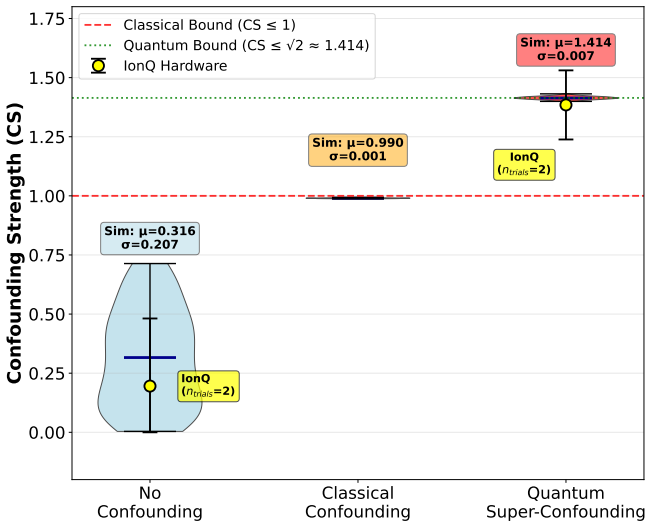
- The measured hierarchy (quantum $CS=1.414$ versus classical $CS \le 1$) means entanglement is a genuinely stronger confounding resource than any local hidden variable, a claim now backed by trapped-ion hardware results ($CS=1.385\pm0.017$) as well as simulation.
- The continuous, linear relation $CS=(1+C)/\sqrt{2}$ implies that confounding strength can be tuned by adjusting the degree of entanglement, so designers can set the amount of spurious correlation in a quantum experiment at will.
- The circuit-based do-calculus provides a practical way to separate genuine causal influence from entanglement-induced spurious correlation, confirming $P(B|A)\ne P(B|\mathrm{do}(A=a))$ in a fully quantum-confounded system.
- In the 3-qubit feature-selection task, the causal classifier trained only on the true cause stays accurate as the A–C confounding is removed, while the naive classifier's accuracy collapses; the mean advantage is 11.3 absolute percentage points with $p<10^{-9}$.
- The same normalization (classical bound mapped to 1 or 0) gives a unified causal reading of CHSH, CH, Hardy's paradox, and Mermin tests, so the framework is not specific to one Bell inequality.
Reading between the lines
- If the project-prepare surgery is accepted as a faithful do-operator, the same two-stage circuit recipe could be reused for causal discovery on arbitrary multi-qubit states without full process-matrix tomography, which would make quantum causal analysis practical on near-term hardware.
- The linear relation between CS and concurrence suggests that Confounding Strength could serve as an entanglement monotone, giving a new bridge between Bell nonlocality and entanglement quantification; the paper does not itself develop this resource-theoretic reading.
- A testable extension would apply the surgery to temporal or sequential correlations: if the framework is right, the interventional distribution should stay uniform whenever the correlation is purely confounder-induced, and deviate from uniform only when a genuine direct causal channel exists.
- The robustness claim could be probed by running the same feature-selection pipeline on real hardware across a range of decoherence levels; if the 11.3% gain persists under noise, the practical benefit is hardware-realistic, whereas a sharp drop would mark where the method needs error mitigation.
Signed reviews
Editorial analysis
A structured set of objections, weighed in public.
Referee Report
Summary. The paper proposes to reinterpret Bell-inequality violation as evidence that an entangled state acts as a "super-confounder," a non-classical common cause. It defines a Confounding Strength metric CS=|S|/2, simulates three CHSH scenarios (no confounding, classical confounding, quantum super-confounding), validates them on an IonQ QPU, and measures CS as a function of entanglement. It introduces a "project-prepare surgery" as a circuit implementation of Pearl's do-operator and reports P(B|A)≠P(B|do(A)) for a Bell state. It then applies this calculus to a 3-qubit quantum machine learning task, claiming causal feature selection yields an 11.3% average absolute robustness improvement. The abstract frames these as three contributions: a physical hierarchy of confounding, a circuit-based quantum do-calculus, and a practical application to robust QML.
Significance. If the formal identification with the do-operator were established, the framework could provide a useful bridge between quantum foundations and causal inference, and the QML application would be a valuable proof of concept. The computational demonstrations are internally consistent, the CHSH calculations are standard, and the authors provide open code and data, which is a strength. The hardware run on IonQ, though small, confirms the expected Bell violation. However, as written the central novelty is largely terminological: the quantum-classical hierarchy is a restatement of Bell's theorem, the do-calculus identification is asserted rather than derived, and the QML result is a constructed demonstration of shortcut learning. The paper will need substantial reworking to justify its stated claims.
major comments (4)
- [Methods, Experiment 4 (pp. 18-19)] The project-prepare surgery is asserted, not derived, to realize Pearl's do-operator. The operation maps any input state to |a0><a0|_A ⊗ Tr_A(ρ_AB); for a Bell state this gives a uniform marginal for B, but every operation that severs the A-B correlation has the same effect. To support the claim that this is the quantum analogue of graph surgery in a quantum causal model, the authors need to specify the underlying quantum causal model and prove that this CPTP map corresponds to the do-operator under the axioms of refs. [7,8]. Without this, Experiments 4 and 5 cannot validate the quantum DO-calculus.
- [Defining and measuring Confounding Strength, Eq. (1)] CS is defined as |S|/2, so the inequalities CS≤1 (classical) and CS≤√2 (quantum) are exactly the CHSH and Tsirelson bounds. The "physical hierarchy of confounding" claimed in Experiment 2 is therefore true by construction and not an independent prediction. Similarly, the theoretical curve CS(θ)=|(1+sin(2θ))/√2| in Experiment 3 is obtained from the same quantum measurement formalism used to simulate the data, so the reported R²>0.999 measures agreement of the simulator with standard quantum theory, not validation of the new framework.
- [Experiment 5: Causal feature selection (pp. 11-12; Methods p. 20)] The robustness gain is baked into the experimental design: the test domains are constructed by removing the C-A confounding while keeping A→B unchanged, so a classifier trained on A alone must outperform one trained on A+C when the spurious correlation disappears. The 11.3% improvement therefore illustrates shortcut learning rather than providing evidence for the proposed do-calculus unless the project-prepare identification (Major Comment 1) is established. In addition, the statistical test is under-specified: a paired t-test across five domains with p<1e-9 requires a stated effective sample size and a clear explanation of how the 20 seeds enter the comparison.
- [Methods, Experiment 1 (p. 17)] The no-signaling check confirms that B's marginal does not depend on whether A is measured, which is a statistical consequence of quantum mechanics; it does not by itself establish that there is no direct causal path in the postulated graph. The causal interpretation requires additional assumptions about the quantum causal model, which are not articulated in the manuscript.
minor comments (5)
- [Fig. 5 caption, p. 12] "represending" should be "representing."
- [Fig. 2, p. 8] The 'No Confounding' simulation yields CS=0.316, which is not "near-zero"; the positive bias of |S|/2 from finite sampling should be acknowledged or the estimator bias-corrected.
- [Eq. (1) and Table I, pp. 6, 14] The term "Confounding Strength" suggests a general causal measure, but the manuscript only defines it for specific Bell tests; the generalizations to CH and Hardy scenarios in Table I are definitional and should be labeled as such.
- [Experiment 3, p. 10] The fixed measurement angles cause CS(0)=1/√2; this is explained, but it should be repeated where the baseline is called "non-zero" to avoid misreading.
- [Discussion, p. 14] The claim that the framework provides "a single, unified causal interpretation" for many Bell-type tests is not operationalized beyond redefining a normalized violation; consider tempering this claim.
Circularity Check
The 'super-confounding' hierarchy is a normalized restatement of Bell/Tsirelson bounds, and the project-prepare claim to realize Pearl's do-operator makes the reported intervention result true by construction.
-
renaming known result
[Results, 'Defining and measuring Confounding Strength' (Eq. 1, p. 6)]
"we define this metric as a normalization of the Bell parameter S: CS≡|S| 2 (1) ... The classical limit of |S|≤ 2 becomes a simple bound of CS ≤ 1 ... In contrast, the quantum Tsirelson bound of |S|≤ 2√2 is transformed into a quantum limit of CS≤√2≈ 1.414."
Because CS is defined as |S|/2, the claimed confounding hierarchy (CS_quantum=1.414 > CS_classical=1) is just the CHSH local-realist bound and the Tsirelson bound divided by two. The 'prediction' that quantum resources are over 41% stronger is an algebraic consequence of the chosen normalization, not a new first-principles result of the Bell-Confounding framework.
-
other
[Methods, Experiment 3 (p. 18)]
"From the resulting correlations, the Bell parameter S was computed using the combination S = E(a,b) + E(a,b′) + E(a′,b) − E(a′,b′), and the CS was then derived as CS = |S|/2. This specific protocol is predicted by theory to yield the relationship CS(θ) = |(1 + sin(2θ))/√2|, which results in a non-zero baseline of CS(0) = 1/√2 for separable states."
The 'theoretical prediction' CS(θ)=|(1+sin(2θ))/√2| is an analytic Born-rule calculation for the same fixed measurement angles used to construct the Qiskit AerSimulator circuits. The simulation is generated by the same quantum formalism that produces the analytical curve, so the reported R²>0.999 verifies internal consistency between the formula and the simulator rather than providing an independent test of the paper's causal framework.
1 more flagged steps
-
self definitional
[Methods, Experiment 4 (p. 19)]
"This non-selective measurement collapses the entanglement between A and B while preserving the marginal distribution of B, thereby realizing the effect of Pearl's DO-operator in a circuit-based quantum system."
The project-prepare surgery implements the CPTP map ρ → |a0⟩⟨a0|_A ⊗ Tr_A(ρ). By construction this map always destroys all A-B correlations, so the reported P(B|DO(A=0))≈P(B|DO(A=1))≈0.5 for a Bell state is an identity of the operation itself, not an empirical discovery. Calling the operation 'Pearl's DO-operator' is an assertion rather than a derivation from the quantum causal models in refs. [6-8], so the claimed 'empirical confirmation of P(B|A)≠P(B|DO(A))' is built into the definition of the intervention. Experiment 5's feature-selection conclusion inherits this unsupported identification.
full rationale
The paper contains no load-bearing self-citation; the cited quantum-causal-model works are external, and the Bell/CHSH bounds are standard textbook results. However, the framework's quantitative claims reduce in several places to definitions or to the very quantum formalism used to generate the data. Equation (1) defines CS as |S|/2, so the purported hierarchy (CS_quantum=1.414 above CS_classical=1) is exactly the CHSH and Tsirelson bounds divided by two; Experiment 2's 'prediction' is thus a normalization restatement. Experiment 3's CS(θ) formula is an analytic Born-rule result for the same measurement angles used in the Qiskit simulation, so the excellent fit demonstrates self-consistency rather than an independent validation of the new framework. Experiment 4's project-prepare surgery is asserted, without derivation from refs. [6-8], to be Pearl's do-operator; the CPTP map |a0⟩⟨a0|_A ⊗ Tr_A(ρ) makes the uniform interventional distribution true by construction, so the observational-versus-interventional contrast is a property of the chosen circuit, not an empirical confirmation of a quantum causal calculus. Experiment 5's 11.3% robustness gain follows from training on the known true cause A in a dataset whose label was generated only from A, so it does not independently validate the causal identification either. These are definitional and self-referential features of the presentation, even though the underlying quantum mechanical calculations are standard and the code and data are publicly available.
Assumptions & free parameters
assumptions (5)
- standard math Standard quantum mechanics: the Born rule and completely positive trace-preserving maps describe state evolution and measurement.
- domain assumption No-signaling: measurement on one party does not affect the marginal statistics of a distant party.
- domain assumption The causal inference framework (structural causal models and Pearl's do-calculus) can be applied to quantum systems in the way the authors assume, with the entangled state playing the role of a common cause.
- ad hoc to paper The project-prepare circuit operation realizes the do-operator.
- domain assumption No local hidden variables: the entangled state alone is the common cause; local hidden variable explanations are excluded.
invented entities (1)
-
Super-confounder
Cite this review
Pith. "Pith review of Quantum Entanglement as Super-Confounding: From Bell's Theorem to Robust Machine Learning." pith.science (2026). https://pith.science/paper/EGO3X3BT
@misc{pith2026250819327,
  author       = {Pith},
  title        = {Pith review of: Quantum Entanglement as Super-Confounding: From Bell's Theorem to Robust Machine Learning},
  year         = {2026},
  howpublished = {\url{https://pith.science/paper/EGO3X3BT}},
  note         = {Machine review of arXiv:2508.19327}
}
abstract
Bell's theorem reveals a profound conflict between quantum mechanics and local realism, a conflict we reinterpret through the modern lens of causal inference. We propose and computationally validate a framework where quantum entanglement acts as a "super-confounding" resource, generating correlations that violate the classical causal bounds set by Bell's inequalities. This work makes three key contributions: First, we establish a physical hierarchy of confounding (Quantum > Classical) and introduce Confounding Strength (CS) to quantify this effect. Second, we provide a circuit-based implementation of the quantum $\mathcal{DO}$-calculus to distinguish causality from spurious correlation. Finally, we apply this calculus to a quantum machine learning problem, where causal feature selection yields a statistically significant 11.3% average absolute improvement in model robustness. Our framework bridges quantum foundations and causal AI, offering a new, practical perspective on quantum correlations.
Figures


Figures from the paper (2 more)


Reference graph
Works this paper leans on
-
[1]
was measured to be 1.0, indicating a perfect correlation, the interventional probability plummeted toP (B = 1|DO(C = 1))≈ 0.5 after severing the confounding entanglement link. 11 Conditioned on A=0 Conditioned on A=10.0 0.2 0.4 0.6 0.8 1.0Probability P(B=0) 1.000 0.000 0.501 0.501 Independence (Prob = 0.5) Observational: P(B = 0|A) Interventional: P(B = 0...
-
[2]
[12], whereas classical models incorrectly predict that the correlations are constrained by the classical bound of |S|≤ 2. Furthermore, this re-framing moves the source of correlation from an unobservable, hypothetical variable (Λ) to a tangible, physical entity ( ρAB) that can be engineered and manipulated. This transforms the phenomenon from a philosoph...
-
[3]
J. S. Bell, On the Einstein Podolsky Rosen Paradox, Physics Physique Fizika 1, 195 (1964)
1964
-
[4]
G. Brassard, Profile of John Clauser, Alain Aspect and Anton Zeilinger: 2022 Nobel laureates in Physics, Proceedings of the National Academy of Sciences 120, e2304809120 (2023)
work page 2023
-
[5]
Pearl, Causality: Models, Reasoning and Inference , 2nd ed
J. Pearl, Causality: Models, Reasoning and Inference , 2nd ed. (Cambridge University Press, USA, 2009)
2009
-
[6]
P. Spirtes, C. Glymour, and R. Scheines, Causation, Prediction, and Search , 2nd ed. (MIT press, 2000)
work page 2000
-
[7]
Pearl, Causal Diagrams for Empirical Research, Biometrika 82, 669 (1995)
J. Pearl, Causal Diagrams for Empirical Research, Biometrika 82, 669 (1995)
work page 1995
-
[8]
F. Costa and S. Shrapnel, Quantum causal modelling, New Journal of Physics 18, 063032 (2016)
work page 2016
Show all 25 references
-
[9]
J.-M. A. Allen, J. Barrett, D. C. Horsman, C. M. Lee, and R. W. Spekkens, Quantum Common Causes and Quantum Causal Models, Phys. Rev. X 7, 031021 (2017)
2017
-
[10]
Barrett, R
J. Barrett, R. Lorenz, and O. Oreshkov, Quantum Causal Models (2020), arXiv:1906.10726 [quant-ph]
2020 arXiv
-
[11]
J. F. Clauser, M. A. Horne, A. Shimony, and R. A. Holt, Proposed experiment to test local hidden-variable theories, Phys. Rev. Lett. 23, 880 (1969)
1969
-
[12]
J. S. Bell, The theory of local beables, Epistemological Letters (1976), TH-2053-CERN (July 28, 1975); presented at the Sixth GIFT Seminar, Jaca, 2-7 June 1975
1976
-
[13]
M. A. Nielsen and I. L. Chuang, Quantum Computation and Quantum Information , 10th ed. (Cambridge University Press, 2010)
2010
-
[14]
B. S. Cirel’son, Quantum generalizations of Bell’s inequality, Letters in Mathematical Physics 4, 93 (1980)
1980
-
[15]
N. D. Mermin, Extreme quantum entanglement in a superposition of macroscopically distinct states, Phys. Rev. Lett. 65, 1838 (1990). 22
1990
-
[16]
J. F. Clauser and M. A. Horne, Experimental consequences of objective local theories, Phys. Rev. D 10, 526 (1974)
1974
-
[17]
Hardy, Quantum mechanics, local realistic theories, and lorentz-invariant realistic theories, Phys
L. Hardy, Quantum mechanics, local realistic theories, and lorentz-invariant realistic theories, Phys. Rev. Lett. 68, 2981 (1992)
1992
-
[18]
Arjovsky, L
M. Arjovsky, L. Bottou, I. Gulrajani, and D. Lopez-Paz, Invariant risk minimization (2020), arXiv:1907.02893 [stat.ML]
2020 arXiv
-
[19]
Geirhos, J.-H
R. Geirhos, J.-H. Jacobsen, C. Michaelis, R. Zemel, W. Brendel, M. Bethge, and F. A. Wich- mann, Shortcut learning in deep neural networks, Nature Machine Intelligence 2, 665 (2020)
2020
-
[20]
Javadi-Abhari, M
A. Javadi-Abhari, M. Treinish, K. Krsulich, C. J. Wood, J. Lishman, J. Gacon, S. Martiel, P. D. Nation, L. S. Bishop, A. W. Cross, B. R. Johnson, and J. M. Gambetta, Quantum Computing with Qiskit (2024), arXiv:2405.08810 [quant-ph]
2024 arXiv
-
[21]
C. R. Harris, K. J. Millman, S. J. van der Walt, R. Gommers, P. Virtanen, D. Cournapeau, E. Wieser, J. Taylor, S. Berg, N. J. Smith, R. Kern, M. Picus, S. Hoyer, M. H. van Kerkwijk, M. Brett, A. Haldane, J. F. del R´ ıo, M. Wiebe, P. Peterson, P. G´ erard-Marchant, K. Sheppard...
2020
-
[22]
Virtanen, R
P. Virtanen, R. Gommers, T. E. Oliphant, M. Haberland, T. Reddy, D. Cournapeau, E. Burovski, P. Peterson, W. Weckesser, J. Bright, S. J. van der Walt, M. Brett, J. Wil- son, K. J. Millman, N. Mayorov, A. R. J. Nelson, E. Jones, R. Kern, E. Larson, C. J. Carey, ˙I. Polat, Y. Fe...
2020
-
[23]
Pedregosa, G
F. Pedregosa, G. Varoquaux, A. Gramfort, V. Michel, B. Thirion, O. Grisel, M. Blondel, P. Prettenhofer, R. Weiss, V. Dubourg, J. Vanderplas, A. Passos, D. Cournapeau, M. Brucher, M. Perrot, and ´Edouard Duchesnay, Scikit-learn: Machine Learning in Python, Journal of Machine Le...
2011
-
[24]
J. D. Hunter, Matplotlib: A 2D Graphics Environment, Computing in Science & Engineering 9, 90 (2007)
2007
-
[25]
M. L. Waskom, seaborn: statistical data visualization, Journal of Open Source Software 6, 3021 (2021). 24
2021
Reviewed August 15, 2026 · model on record in the stance chip above.
Discussion (0). Continue with ORCID to comment.