REVIEW 3 major objections 4 minor 61 references
Pixel-level Certified Explanations via Randomized Smoothing
T0 review · 3 major / 4 minor · reviewed 2026-08-15 · deepseek-v4-flash
Pith's one-line read The paper claims that any black-box attribution method can be smoothed and binarized so that every pixel receives a provably stable important/unimportant label inside an ℓ2 ball around the input, making explanation robustness a per-pixel…
desk verdict The central certified radius is invalid for the abstaining smoothed function, so the paper's main guarantee does not hold as stated. read the letter →
The pith
A machine-rendered reading of the paper's core claim, the machinery that carries it, and where it could break.
The reading
What carries the argument
The load-bearing construction is the composition of two maps. Sparsification h_K thresholds an attribution map by relative rank — pixels in the top K% become 1, the rest 0 — which is what makes the output a two-class segmentation map rather than a vector of real values. The smoothed sparsified attribution h̄_{τ,K} then applies the randomized-smoothing-for-segmentation recipe: for each pixel, Monte Carlo sampling estimates the probability that it is 1 under Gaussian input noise, and the pixel is certified when that probability beats threshold τ, with radius R = σΦ⁻¹(τ) coming from the standard Gaussian CDF. This identity — smoothed sparsified attribution equals smoothed segmentation — is what lets a theorem proven for segmentation models carry over to explanations unchanged. The empirical evaluation is carried by three metrics the paper defines: %certified (coverage), Certified GridPG (localization within 2×2 image grids), and deletion-based faithfulness (class-confidence drop when certified pixels are removed).
What would settle it
Sample many perturbations δ with ‖δ‖₂ ≤ R around certified images and record how often a certified pixel changes label or the model's predicted class changes: a flip rate above the advertised α=0.001 would break the statistical guarantee, and any prediction flip inside the ball while the certified map stays identical would expose that the certificate attests to the explanation but not to the decision it explains. At the assumption level, take a pair of images whose top-K% binary maps coincide but whose attribution magnitudes or sign patterns point to different evidence, and check whether the certified maps are treated as equally faithful by a deletion test.
Extended reading notes
Core claim
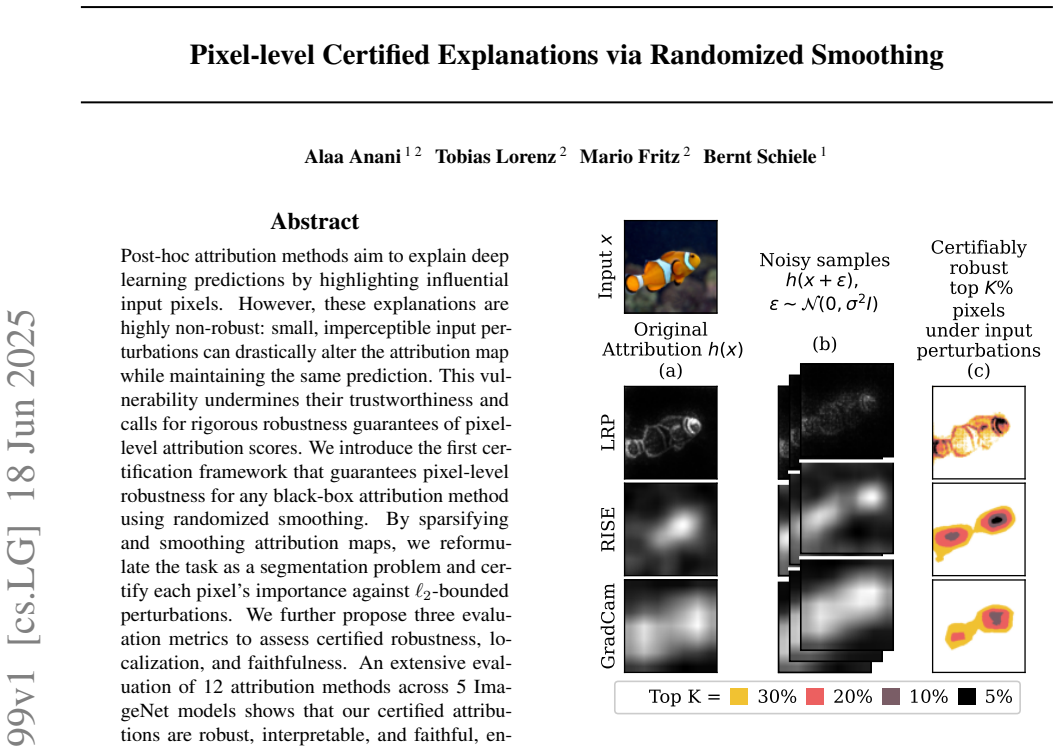
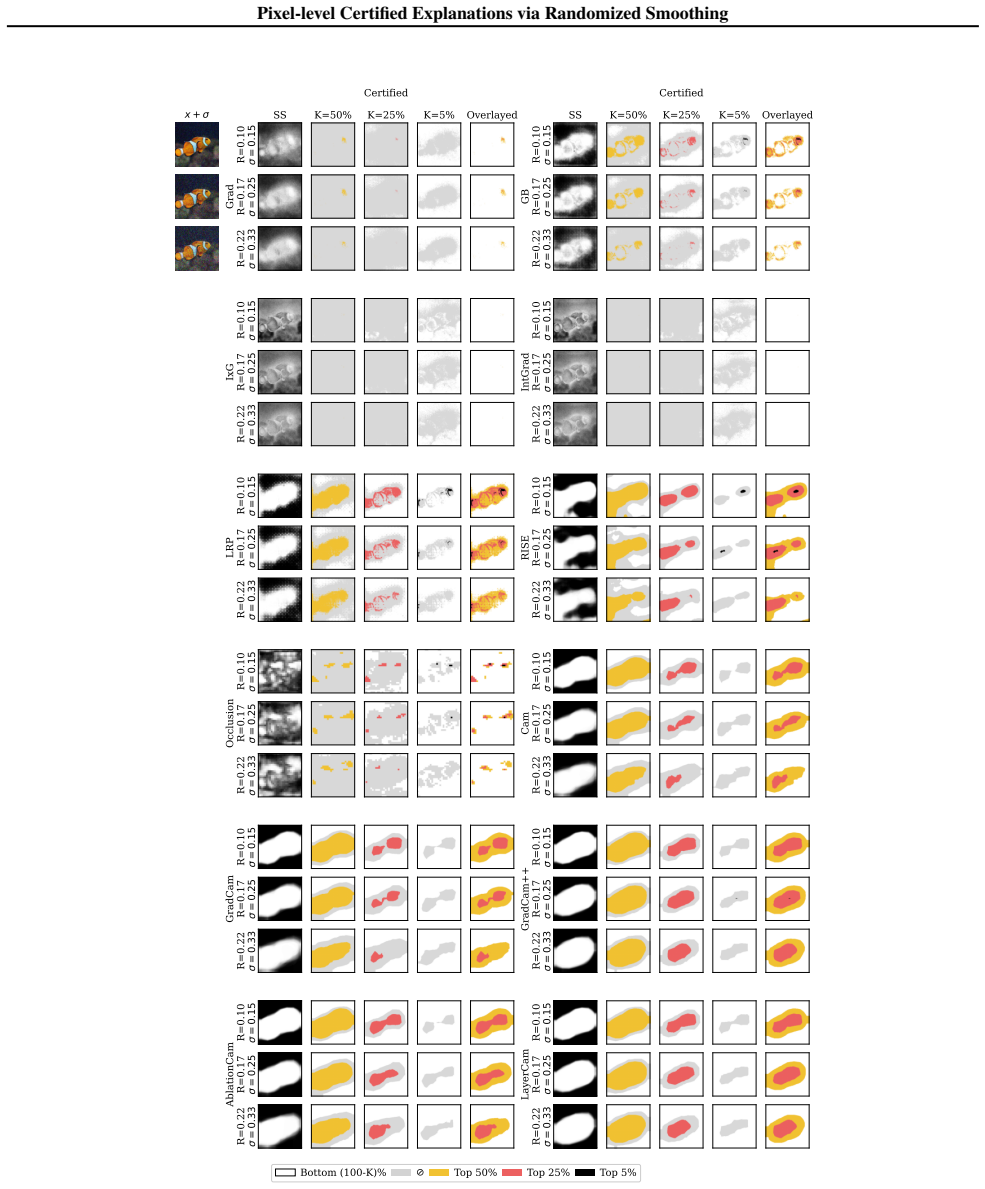
The central claim is that pixel-level attribution robustness reduces to a segmentation-certification problem. Given any attribution map h(x), the paper binarizes it by rank: the top K% of values become 1, the rest 0, producing a sparsified map h_K. Its Gaussian-smoothed version h̄_{τ,K} estimates, per pixel, the probability that the pixel keeps its class under input noise, and certifies the pixel as '1' or '0' when that probability exceeds τ, otherwise abstaining. Because h̄_{τ,K} is exactly a smoothed segmentation model, the randomized-smoothing theorem applies verbatim: every non-abstaining pixel keeps its certified label for all perturbations within radius R = σΦ⁻¹(τ), with confidence 1−α from Monte Carlo estimation. The paper then compares 12 attribution methods on 5 ImageNet models with three new metrics — %certified, Certified GridPG, and deletion faithfulness — and reports that LRP and RISE dominate the robustness-localization-faithfulness trade-off, with final-layer attributions generally certifying better than input-layer ones.
Load-bearing premise
The load-bearing premise is that the relative rank of attribution values — which pixels land in the top K% — is what an explanation means, so that certifying a binarized, noise-smoothed version of a map certifies the explanation itself: if the absolute values or the positive/negative evidence structure carry the information, the certificate protects a thresholded proxy, and it also says nothing about whether the model's prediction itself stays fixed inside the certified ball.
Editorial extensions
If this is right
- Any black-box attribution method can be wrapped to emit per-pixel certificates — important, unimportant, or abstain — with the label provably fixed for every ℓ2 perturbation inside radius R = σΦ⁻¹(τ).
- Certified maps are immediately usable in downstream tasks: the paper produces the first such maps and shows that deleting LRP/RISE certified pixels collapses class confidence, so the certified pixels are the ones the model truly leans on.
- Attribution families differ sharply in certifiability: IxG and IntGrad certify almost no input-layer pixels, while LRP and RISE certify across radii, models, and layers, giving practitioners a principled way to pick an explainer.
- The certification is tunable: raising the threshold τ or lowering K trades coverage for precision, so users can dial in how conservative their stability guarantee is.
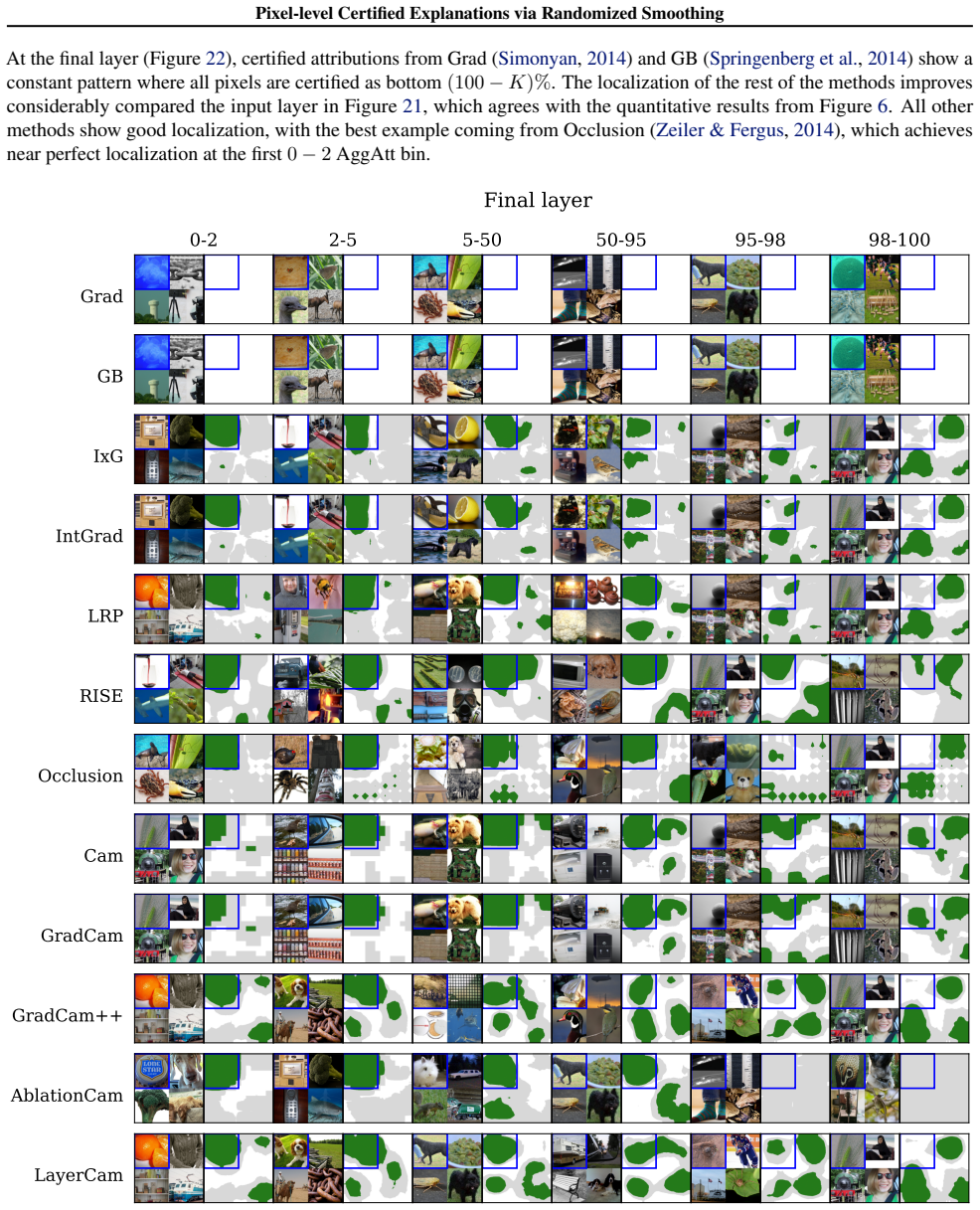
- Final-layer explanations certify better than input-layer ones across nearly all methods, pointing to coarse, high-level attribution maps as the more certifiable target.
Reading between the lines
- The certificate can outlive the decision: nothing in the framework prevents the model's predicted class from changing inside the certified ball, so a certified map may stay intact for a prediction the model no longer makes. A natural extension is to certify the joint object (prediction, explanation), or to condition the certificate on the predicted class.
- The construction only needs black-box access plus a smoothing distribution, so the same scheme should transfer to ℓ1 or ℓ∞ balls by swapping Gaussian noise for Laplacian or uniform noise — the segmentation theorem carries over with the corresponding level-set radius and inverse CDF.
- Binarizing by rank discards the sign and magnitude structure of attributions, which matters for methods like LRP where positive and negative relevance carry distinct semantics; a testable extension is to certify the signed evidence structure, separating certified positive from certified negative pixels.
Signed reviews
Editorial analysis
A structured set of objections, weighed in public.
Referee Report
Summary. The paper proposes a certification method for pixel-level robustness of post-hoc attribution maps. The authors binarize attribution maps by labeling the top K% of pixels as 'important' and the rest as 'not important', smooth the resulting binary map with Gaussian noise, and then apply randomized smoothing for segmentation to label each pixel as certified '1', certified '0', or abstaining. They introduce three evaluation metrics—%certified, Certified GridPG, and a deletion-based faithfulness score—and report an extensive comparison of 12 attribution methods on 5 ImageNet classifiers. The central claim is that any black-box attribution method can be wrapped so that the binarized importance label of every certified pixel is provably invariant under l2-bounded input perturbations.
Significance. The conceptual reduction of attribution certification to binary segmentation certification is elegant, and the experimental breadth (12 methods, 5 models, multiple layers and sparsification levels) is commendable. The proposed metrics are natural and would be useful if the underlying certificates were valid. The paper is clearly written and provides a code link, and the reformulation of sparsified attributions as a segmentation problem is a simple but productive idea. However, the central theoretical guarantee, Theorem 3.1, is incorrect as stated, and this undermines the quantitative evaluation built on it. If the radius issue is corrected and the experiments are recomputed, the framework could be a valuable contribution to certified explainability.
major comments (3)
- [3.2, Theorem 3.1, Eq. (3)] Theorem 3.1 is false as stated for the abstaining smoothed function g_tau defined in Eq. (3). The radius R = sigma * Phi^{-1}(tau) does not guarantee that the top-class probability remains above tau; it only bounds the classification margin under the assumption p_A > tau. For a binary pixel with p_1(x) = 0.76, tau = 0.75, and sigma = 0.15, the paper's radius is R = 0.101, but at ||delta||_2 = 0.09 the Neyman-Pearson lower bound is p_1(x+delta) >= Phi(Phi^{-1}(0.76) - 0.09/0.15) = Phi(0.706 - 0.600) = Phi(0.106) = 0.542, which is below tau. Hence Eq. (3) returns the abstain symbol at x+delta even though the pixel was certified as '1' at x, so the asserted equality g_tau_i(x+delta) = g_tau_i(x) fails. The correct radius preserving non-abstention is per-pixel and equals sigma * (Phi^{-1}(p_A(x)) - Phi^{-1}(tau)) in the binary case, which tends to zero as p_A approaches tau. The fixed radius R = sigma * Phi^{-1}(tau) used throughout the paper is therefore not a valid certificate for the declared guarantee.
- [5, 6, 7] Because Theorem 3.1 is invalid, the quantitative evaluation built on it does not certify the claimed property. Section 6 states that 'all certified results are robust with confidence 1-alpha w.r.t the radius R=0.10', but with a correct per-pixel radius each pixel is certified only up to its own radius, and pixels with p_A just above tau have certified radius near zero. Consequently, the %certified and Certified GridPG scores in Figures 5-7 and the appendix do not report certified robustness at the stated radii, and the comparative conclusions (e.g., that LRP and RISE strike the best balance) may change when valid per-pixel certificates are used. The experiments need to be recomputed with the corrected radius definition.
- [6] The Monte Carlo confidence statement is incomplete. The paper sets n=100 and alpha=0.001 but does not describe how a lower confidence bound on the top-class probability is obtained before applying the radius formula. With n=100, a nominal confidence level of 0.999 requires a substantial margin between the observed frequency and the threshold tau; using point estimates or an unspecified estimator would void the 'with confidence 1-alpha' claim. The certification procedure must specify the confidence-bound computation, especially because the corrected per-pixel radius depends directly on the estimated p_A.
minor comments (4)
- [4.1] The sparsification parameter K is defined for K in [50,100], but the experiments use K=30, 10, and 5; the admissible range should be clarified or extended to (0,100].
- [Appendix E] Several appendix figure captions (e.g., Figures 15-18) refer to 'certified radiusK' where the correct term is 'certified radius R'.
- [1] The contributions list contains a typo: 'trustworhty' should be 'trustworthy'.
- [7.1] The abbreviation 'SS' is used without a formal definition in the main text; it should be defined when first introduced.
Circularity Check
No material circularity: the certificate is imported from Fischer et al. (2021), and the only self-citation is contextual.
full rationale
The central guarantee is not derived from the paper's own outputs. Section 4.1 defines the sparsified attribution h_K (Eq. 4), Section 4.2 constructs the smoothed sparsified attribution hbar (Eq. 5), and Section 4.3 identifies hbar with the smoothed segmentation model g_tau of Eq. 3, whose robustness certificate is stated as Theorem 3.1 and attributed to Fischer et al. (2021), an external source. No parameter is fitted to a subset of data and then reported as a prediction: the certified radius R = sigma*Phi^{-1}(tau) is a function of the pre-chosen noise level and threshold, not of the attribution maps. The three evaluation metrics (%certified, Certified GridPG, faithfulness) are measurements on certified outputs and do not feed back into the certificate. The only self-citation, Anani et al. (2024), appears in Section 1 as part of the phrase "Randomized Smoothing (Fischer et al., 2021; Anani et al., 2024)" and in Related Work; the operationally load-bearing theorem is expressly from Fischer et al. (2021), so the self-citation is not load-bearing. The skeptic's objection that Theorem 3.1's radius may not be valid for the abstaining smoothed function is a correctness/mathematical-validity concern about a quoted external result, not a demonstration that the paper's conclusion is equivalent to its inputs by construction; under the circularity rubric it does not raise the score. Score 2 reflects only the presence of a minor, non-load-bearing self-citation.
Assumptions & free parameters
free parameters (5)
- sigma (Gaussian noise level) =
0.15 (swept to 0.25, 0.33 for radii 0.17, 0.22)
- tau (abstention threshold) =
0.75
- K (sparsification percentage) =
50, 30, 10, 5 (swept)
- n (Monte Carlo samples) =
100
- alpha (type I error) =
0.001
assumptions (5)
- standard math Randomized smoothing certification theorem (Fischer et al. 2021): if the top-class probability exceeds tau, the predicted label is constant within l2 radius sigma * Phi^{-1}(tau).
- domain assumption Attribution methods can be treated as black-box functions of the input, mapping an image to N real-valued scores.
- domain assumption The top-K percent rank threshold preserves the semantically meaningful content of an attribution map.
- domain assumption The target class for which attributions are computed is fixed across all noisy inputs.
- domain assumption The 100 high-confidence ImageNet images and 100 grids are representative for comparing attribution methods.
Cite this review
Pith. "Pith review of Pixel-level Certified Explanations via Randomized Smoothing." pith.science (2026). https://pith.science/paper/EJD225KQ
@misc{pith2026250615499,
  author       = {Pith},
  title        = {Pith review of: Pixel-level Certified Explanations via Randomized Smoothing},
  year         = {2026},
  howpublished = {\url{https://pith.science/paper/EJD225KQ}},
  note         = {Machine review of arXiv:2506.15499}
}
abstract
Post-hoc attribution methods aim to explain deep learning predictions by highlighting influential input pixels. However, these explanations are highly non-robust: small, imperceptible input perturbations can drastically alter the attribution map while maintaining the same prediction. This vulnerability undermines their trustworthiness and calls for rigorous robustness guarantees of pixel-level attribution scores. We introduce the first certification framework that guarantees pixel-level robustness for any black-box attribution method using randomized smoothing. By sparsifying and smoothing attribution maps, we reformulate the task as a segmentation problem and certify each pixel's importance against $\ell_2$-bounded perturbations. We further propose three evaluation metrics to assess certified robustness, localization, and faithfulness. An extensive evaluation of 12 attribution methods across 5 ImageNet models shows that our certified attributions are robust, interpretable, and faithful, enabling reliable use in downstream tasks. Our code is at https://github.com/AlaaAnani/certified-attributions.
Figures


Figures from the paper (20 more)





Reference graph
Works this paper leans on
-
[1]
write newline
" write newline "" before.all 'output.state := FUNCTION n.dashify 't := "" t empty not t #1 #1 substring "-" = t #1 #2 substring "--" = not "--" * t #2 global.max substring 't := t #1 #1 substring "-" = "-" * t #2 global.max substring 't := while if t #1 #1 substring * t #2 global.max substring 't := if while FUNCTION format.date year duplicate empty "emp...
-
[2]
Adaptive hierarchical certification for segmentation using randomized smoothing
Anani, A., Lorenz, T., Schiele, B., and Fritz, M. Adaptive hierarchical certification for segmentation using randomized smoothing. In International Conference on Machine Learning (ICML), 2024
work page 2024
-
[3]
Who explains the explanation? quantitatively assessing feature attribution methods
Arias-Duart, A., Par \'e s, F., and Garcia-Gasulla, D. Who explains the explanation? quantitatively assessing feature attribution methods. arXiv preprint arXiv:2109.15035, 2021
arXiv 2021
-
[4]
On pixel-wise explanations for non-linear classifier decisions by layer-wise relevance propagation
Bach, S., Binder, A., Montavon, G., Klauschen, F., M \"u ller, K.-R., and Samek, W. On pixel-wise explanations for non-linear classifier decisions by layer-wise relevance propagation. PloS one, 2015
work page 2015
-
[5]
Baniecki, H. and Biecek, P. Adversarial attacks and defenses in explainable artificial intelligence: A survey. Information Fusion, 2024
work page 2024
-
[6]
Convolutional dynamic alignment networks for interpretable classifications
Bohle, M., Fritz, M., and Schiele, B. Convolutional dynamic alignment networks for interpretable classifications. In Computer Vision and Pattern Recognition (CVPR), 2021
work page 2021
-
[7]
Carmichael, Z. and Scheirer, W. J. Unfooling perturbation-based post hoc explainers. In AAAI Conference on Artificial Intelligence (AAAI), 2023
work page 2023
-
[8]
Chattopadhay, A., Sarkar, A., Howlader, P., and Balasubramanian, V. N. Grad-cam++: Generalized gradient-based visual explanations for deep convolutional networks. In Winter Conference on Applications of Computer Vision (WACV), 2018
work page 2018
Show all 61 references
-
[9]
Provable robust saliency-based explanations
Chen, C., Guo, C., Ma, G., Zeng, M., Zhang, X., and Xie, S. Provable robust saliency-based explanations. arXiv preprint arXiv:2212.14106, 2022
2022 arXiv
-
[10]
Robust attribution regularization
Chen, J., Wu, X., Rastogi, V., Liang, Y., and Jha, S. Robust attribution regularization. In Advances in Neural Information Processing Systems (NeurIPS), 2019
2019
-
[11]
Certified adversarial robustness via randomized smoothing
Cohen, J., Rosenfeld, E., and Kolter, Z. Certified adversarial robustness via randomized smoothing. In International Conference on Machine Learning (ICML), 2019
2019
-
[12]
and Gal, Y
Dabkowski, P. and Gal, Y. Real time image saliency for black box classifiers. In Advances in Neural Information Processing Systems (NeurIPS), 2017
2017
-
[13]
Dhurandhar, A., Haldar, S., Wei, D., and Ramamurthy, K. N. Trust regions for explanations via black-box probabilistic certification. In International Conference on Machine Learning (ICML), 2024
2024
-
[14]
Explanations can be manipulated and geometry is to blame
Dombrowski, A.-K., Alber, M., Anders, C., Ackermann, M., M \"u ller, K.-R., and Kessel, P. Explanations can be manipulated and geometry is to blame. In Advances in Neural Information Processing Systems (NeurIPS), 2019
2019
-
[15]
J., M \"u ller, K.-R., and Kessel, P
Dombrowski, A.-K., Anders, C. J., M \"u ller, K.-R., and Kessel, P. Towards robust explanations for deep neural networks. Pattern Recognition, 2022
2022
-
[16]
An image is worth 16x16 words: Transformers for image recognition at scale
Dosovitskiy, A., Beyer, L., Kolesnikov, A., Weissenborn, D., Zhai, X., Unterthiner, T., Dehghani, M., Minderer, M., Heigold, G., Gelly, S., et al. An image is worth 16x16 words: Transformers for image recognition at scale. International Conference for Learning Representations ...
2020
-
[17]
Scalable certified segmentation via randomized smoothing
Fischer, M., Baader, M., and Vechev, M. Scalable certified segmentation via randomized smoothing. In International Conference on Machine Learning (ICML), 2021
2021
-
[18]
Fong, R. C. and Vedaldi, A. Interpretable explanations of black boxes by meaningful perturbation. In International Conference on Computer Vision (ICCV), 2017
2017
-
[19]
Ghalebikesabi, S., Ter-Minassian, L., DiazOrdaz, K., and Holmes, C. C. On locality of local explanation models. In Advances in Neural Information Processing Systems (NeurIPS), 2021
2021
-
[20]
Interpretation of neural networks is fragile
Ghorbani, A., Abid, A., and Zou, J. Interpretation of neural networks is fragile. In AAAI conference on artificial intelligence (AAAI), 2019
2019
-
[21]
Deep learning-based image segmentation on multimodal medical imaging
Guo, Z., Li, X., Huang, H., Guo, N., and Li, Q. Deep learning-based image segmentation on multimodal medical imaging. IEEE Transactions on Radiation and Plasma Medical Sciences, 2019
2019
-
[22]
Deep residual learning for image recognition
He, K., Zhang, X., Ren, S., and Sun, J. Deep residual learning for image recognition. In Computer Vision and Pattern Recognition (CVPR), 2016
2016
-
[23]
Layercam: Exploring hierarchical class activation maps for localization
Jiang, P.-T., Zhang, C.-B., Hou, Q., Cheng, M.-M., and Wei, Y. Layercam: Exploring hierarchical class activation maps for localization. IEEE Transactions on Image Processing (TIP), 2021
2021
-
[24]
Very deep convolutional networks for large-scale image recognition
Karen, S. Very deep convolutional networks for large-scale image recognition. In International Conference for Learning Representations (ICLR), 2015
2015
-
[25]
Cnn-based segmentation of medical imaging data
Kayalibay, B., Jensen, G., and van der Smagt, P. Cnn-based segmentation of medical imaging data. arXiv preprint arXiv:1701.03056, 2017
2017 arXiv
-
[26]
and U c ar, A
Kaymak, C . and U c ar, A. A brief survey and an application of semantic image segmentation for autonomous driving. Handbook of Deep Learning Applications, 2019
2019
-
[27]
u tt, K. T., D \
Kindermans, P.-J., Hooker, S., Adebayo, J., Alber, M., Sch \"u tt, K. T., D \"a hne, S., Erhan, D., and Kim, B. The (un) reliability of saliency methods. Explainable AI: Interpreting, explaining and visualizing deep learning, 2019
2019
-
[28]
and Le-Khac, N.-A
Kuppa, A. and Le-Khac, N.-A. Black box attacks on explainable artificial intelligence (xai) methods in cyber security. In International Joint Conference on Neural Networks (IJCNN), 2020
2020
-
[29]
Certified robustness to adversarial examples with differential privacy
Lecuyer, M., Atlidakis, V., Geambasu, R., Hsu, D., and Jana, S. Certified robustness to adversarial examples with differential privacy. In IEEE Symposium on Security and Privacy (SP), 2019
2019
-
[30]
Certifiably robust interpretation in deep learning
Levine, A., Singla, S., and Feizi, S. Certifiably robust interpretation in deep learning. arXiv preprint arXiv:1905.12105, 2019
1905 arXiv
-
[31]
On the robustness of removal-based feature attributions
Lin, C., Covert, I., and Lee, S.-I. On the robustness of removal-based feature attributions. In Advances in Neural Information Processing Systems (NeurIPS), 2024
2024
-
[32]
Certifiably robust interpretation via r \'e nyi differential privacy
Liu, A., Chen, X., Liu, S., Xia, L., and Gan, C. Certifiably robust interpretation via r \'e nyi differential privacy. Artificial Intelligence, 2022
2022
-
[33]
Explaining nonlinear classification decisions with deep taylor decomposition
Montavon, G., Lapuschkin, S., Binder, A., Samek, W., and Müller, K.-R. Explaining nonlinear classification decisions with deep taylor decomposition. Pattern Recognition, 2017
2017
-
[34]
Digital technologies and artificial intelligence’s present and foreseeable impact on lawyering, judging, policing and law enforcement
Nissan, E. Digital technologies and artificial intelligence’s present and foreseeable impact on lawyering, judging, policing and law enforcement. Ai & Society, 2017
2017
-
[35]
Rise: Randomized input sampling for explanation of black-box models
Petsiuk, V., Das, A., and Saenko, K. Rise: Randomized input sampling for explanation of black-box models. In British Machine Vision Conference (BMVC), 2018 a
2018
-
[36]
Rise: Randomized input sampling for explanation of black-box models
Petsiuk, V., Das, A., and Saenko, K. Rise: Randomized input sampling for explanation of black-box models. In British Machine Vision Conference (BMVC), 2018 b
2018
-
[37]
Ramaswamy, H. G. et al. Ablation-cam: Visual explanations for deep convolutional network via gradient-free localization. In Winter Conference on Applications of Computer Vision (WACV), 2020
2020
-
[38]
Better understanding differences in attribution methods via systematic evaluations
Rao, S., B \"o hle, M., and Schiele, B. Better understanding differences in attribution methods via systematic evaluations. Computer Vision and Pattern Recognition (CVPR), 2022
2022
-
[39]
why should i trust you?
Ribeiro, M. T., Singh, S., and Guestrin, C. " why should i trust you?" explaining the predictions of any classifier. In International Conference on Knowledge Discovery and Data Mining (ICKDD), 2016
2016
-
[40]
Imagenet large scale visual recognition challenge
Russakovsky, O., Deng, J., Su, H., Krause, J., Satheesh, S., Ma, S., Huang, Z., Karpathy, A., Khosla, A., Bernstein, M., et al. Imagenet large scale visual recognition challenge. International Journal of Computer Vision (IJCV), 2015
2015
-
[41]
R., Cogswell, M., Das, A., Vedantam, R., Parikh, D., and Batra, D
Selvaraju, R. R., Cogswell, M., Das, A., Vedantam, R., Parikh, D., and Batra, D. Grad-cam: Visual explanations from deep networks via gradient-based localization. In International Conference on Computer Vision (ICCV), 2017
2017
-
[42]
and Pardeshi, M
Sheu, R.-K. and Pardeshi, M. S. A survey on medical explainable ai (xai): recent progress, explainability approach, human interaction and scoring system. Sensors, 2022
2022
-
[43]
Learning important features through propagating activation differences
Shrikumar, A., Greenside, P., and Kundaje, A. Learning important features through propagating activation differences. In International Conference on Machine Learning (ICML), 2017
2017
-
[44]
A., Narodytska, N., Ignatiev, A., Meel, K
Shrotri, A. A., Narodytska, N., Ignatiev, A., Meel, K. S., Marques-Silva, J., and Vardi, M. Y. Constraint-driven explanations for black-box ml models. In AAAI Conference on Artificial Intelligence (AAAI), 2022
2022
-
[45]
Deep inside convolutional networks: Visualising image classification models and saliency maps
Simonyan, K. Deep inside convolutional networks: Visualising image classification models and saliency maps. In International Conference for Learning Representations Worshop (ICLR-W), 2014
2014
-
[46]
T., Dosovitskiy, A., Brox, T., and Riedmiller, M
Springenberg, J. T., Dosovitskiy, A., Brox, T., and Riedmiller, M. Striving for simplicity: The all convolutional net. In International Conference for Learning Representations Worshop (ICLR-W), 2014
2014
-
[47]
Fooling network interpretation in image classification
Subramanya, A., Pillai, V., and Pirsiavash, H. Fooling network interpretation in image classification. In International Conference on Computer Vision (ICCV), 2019
2019
-
[48]
Axiomatic attribution for deep networks
Sundararajan, M., Taly, A., and Yan, Q. Axiomatic attribution for deep networks. In International Conference on Machine Learning (ICML), 2017
2017
-
[49]
and Tian, Y
Tan, Z. and Tian, Y. Robust explanation for free or at the cost of faithfulness. In International Conference on Machine Learning (ICML), 2023
2023
-
[50]
Defense against explanation manipulation
Tang, R., Liu, N., Yang, F., Zou, N., and Hu, X. Defense against explanation manipulation. Frontiers in Big Data, 2022
2022
-
[51]
and Robnik- S ikonja, M
Vre s , D. and Robnik- S ikonja, M. Preventing deception with explanation methods using focused sampling. Data Mining and Knowledge Discovery (DMKD), 2024
2024
-
[52]
and Kong, A
Wang, F. and Kong, A. W.-K. A practical upper bound for the worst-case attribution deviations. In Computer Vision and Pattern Recognition (CVPR), 2023
2023
-
[53]
and Kong, A
Wang, F. and Kong, A. W.-K. Certified _2 attribution robustness via uniformly smoothed attributions. arXiv preprint arXiv:2405.06361, 2024
2024 arXiv
-
[54]
Smoothed geometry for robust attribution
Wang, Z., Wang, H., Ramkumar, S., Mardziel, P., Fredrikson, M., and Datta, A. Smoothed geometry for robust attribution. In Advances in Neural Information Processing systems (NeurIPS), 2020
2020
-
[55]
Cancer omic data based explainable ai drug recommendation inference: A traceability perspective for explainability
Xi, J., Wang, D., Yang, X., Zhang, W., and Huang, Q. Cancer omic data based explainable ai drug recommendation inference: A traceability perspective for explainability. Biomedical Signal Processing and Control, 2023
2023
-
[56]
and Komodakis, N
Zagoruyko, S. and Komodakis, N. Wide residual networks. arXiv preprint, 2016
2016
-
[57]
Visualizing and understanding convolutional networks
Zeiler, M. Visualizing and understanding convolutional networks. In European Conference on Computer Vision (ECCV), 2014
2014
-
[58]
Zeiler, M. D. and Fergus, R. Visualizing and understanding convolutional networks. In European Conference on Computer Vision (ECCV), 2014
2014
-
[59]
Interpretable deep learning under fire
Zhang, X., Wang, N., Shen, H., Ji, S., Luo, X., and Wang, T. Interpretable deep learning under fire. In USENIX security symposium ( USENIX ) , 2020
2020
-
[60]
Instance-level segmentation for autonomous driving with deep densely connected mrfs
Zhang, Z., Fidler, S., and Urtasun, R. Instance-level segmentation for autonomous driving with deep densely connected mrfs. In Computer Vision and Pattern Recognition (CVPR), 2016
2016
-
[61]
Learning deep features for discriminative localization
Zhou, B., Khosla, A., Lapedriza, A., Oliva, A., and Torralba, A. Learning deep features for discriminative localization. In Conference on Computer Vision and Pattern Recognition (CVPR), 2016
2016
Reviewed August 15, 2026 · model on record in the stance chip above.
Discussion (0). Continue with ORCID to comment.