REVIEW 3 major objections 5 minor 2 cited by
Optimization and Generation in Aerodynamics Inverse Design
T0 review · 3 major / 5 minor · reviewed 2026-08-03 · deepseek-v4-flash
Pith's one-line read Aerodynamic inverse design reduces to a single tilted distribution that couples shape-preserving optimization with guided generation.
desk verdict The optimization side is solid and the SKL loss is a real contribution, but SA-MC as written omits the sigma_t^2/alpha_t scale from its own Eq. 20, so the headline generation numbers come from an unstated variant. read the letter →
The pith
A machine-rendered reading of the paper's core claim, the machinery that carries it, and where it could break.
The reading
What carries the argument
The central object is the tilted design distribution q_λ(x) ∝ p(x) exp(−λJ(x)), which unifies optimization and generation. The computational workhorse is the secant-pair recursion of Theorem 2.3: B_{k+1} = u_k(V_k^T B_k V_k + ρ_k y_k y_k^T) + w_k I, which approximates the Jacobian ∇_x v_t of the flow-matching velocity field using trajectory differences (s_k, r_k). This low-rank compact representation B = γI + UΓU^T permits a semi-numerical matrix square root, giving an affordable estimate of the conditional covariance for guidance. The symmetric-KL minibatch loss for the λ-conditioned cost predictor is the other key piece; it replaces plain mean-squared-error training to emphasize the region
What would settle it
Run SA-MC on a low-dimensional problem where the exact Jacobian ∇_x v_t and the true conditional covariance can be computed analytically, and compare the guided samples with those produced by the exact covariance. A second check is to compare SA-MC with and without the σ_t^2/α_t scale factor explicitly applied, since the paper's Eq. 20 defines the covariance that way but the pseudocode leaves the computed scale unused.
Extended reading notes
Core claim
The paper's central claim is that inverse design has two canonical solutions—a point solution and a distributional solution—and that both arise from the same tilted target q_λ(x) ∝ p(x) exp(−λJ(x)), where p is the learned distribution of plausible shapes and J is the aerodynamic cost. With p as the prior, the MAP estimate of this tilted distribution is the optimal design (optimization), and sampling from it is guided generation. The paper then shows that existing training-free guidance estimators differ precisely in how they approximate the conditional covariance, and that a correct Gaussian approximation requires the Jacobian of the velocity field. It introduces SA-MC, which estimates this
Load-bearing premise
The load-bearing premise is that the secant-pair recursion over ODE trajectory differences yields a good positive-definite approximation of the velocity-field Jacobian (and hence of the conditional covariance), and that the algorithm uses the correct covariance scale; if this approximation or the σ_t^2/α_t scaling is off, the guidance targets a distribution different from the one claimed.
Editorial extensions
If this is right
- Optimization in a learned latent space with a density-gradient term keeps refined shapes plausible while lowering drag—5.8% for vehicles and 28.8% for the aircraft drag-to-lift objective in the paper's measurements.
- View-based guided generation from the same input view produces lower-cost candidates than unguided generation—3.0% better vehicle drag and 68.6% better aircraft drag-to-lift in the paper's comparisons.
- The covariance-matching analysis shows why existing shortcut guidance can be biased: some methods ignore the covariance dependence and others assume a fixed covariance, whereas SA-MC estimates it online.
- The SKL-trained cost predictor better preserves global low-cost basins than an MSE-trained predictor, reducing systematic drift during guided generation.
- The same guidance procedure transfers to offline reinforcement learning planning, where it improves average normalized scores relative to unguided planning in the paper's benchmarks.
Reading between the lines
- If the tilted-distribution framing holds, the same optimization-plus-guidance recipe could transfer to other physics objectives, such as thermal or structural inverse design, by swapping the cost term; the paper demonstrates aerodynamics and offline RL but not those settings.
- A controlled robustness test would be to measure guided-generation gains on out-of-distribution inputs with per-input guidance-scale selection; the paper itself notes fluctuations in that regime, so a practical prescription might involve tuning λ per input or early stopping.
- The secant-based covariance estimator is derived from the generation trajectory itself, which suggests the same machinery could support uncertainty-aware sampling in other flow-matching inverse problems, not just aerodynamics.
- Because the paper finds that SKL training preserves global low-cost basins better than MSE, a natural next step is to check whether that advantage persists with noisy or biased cost labels, as would occur with real wind-tunnel measurements.
Editorial analysis
A structured set of objections, weighed in public.
Referee Report
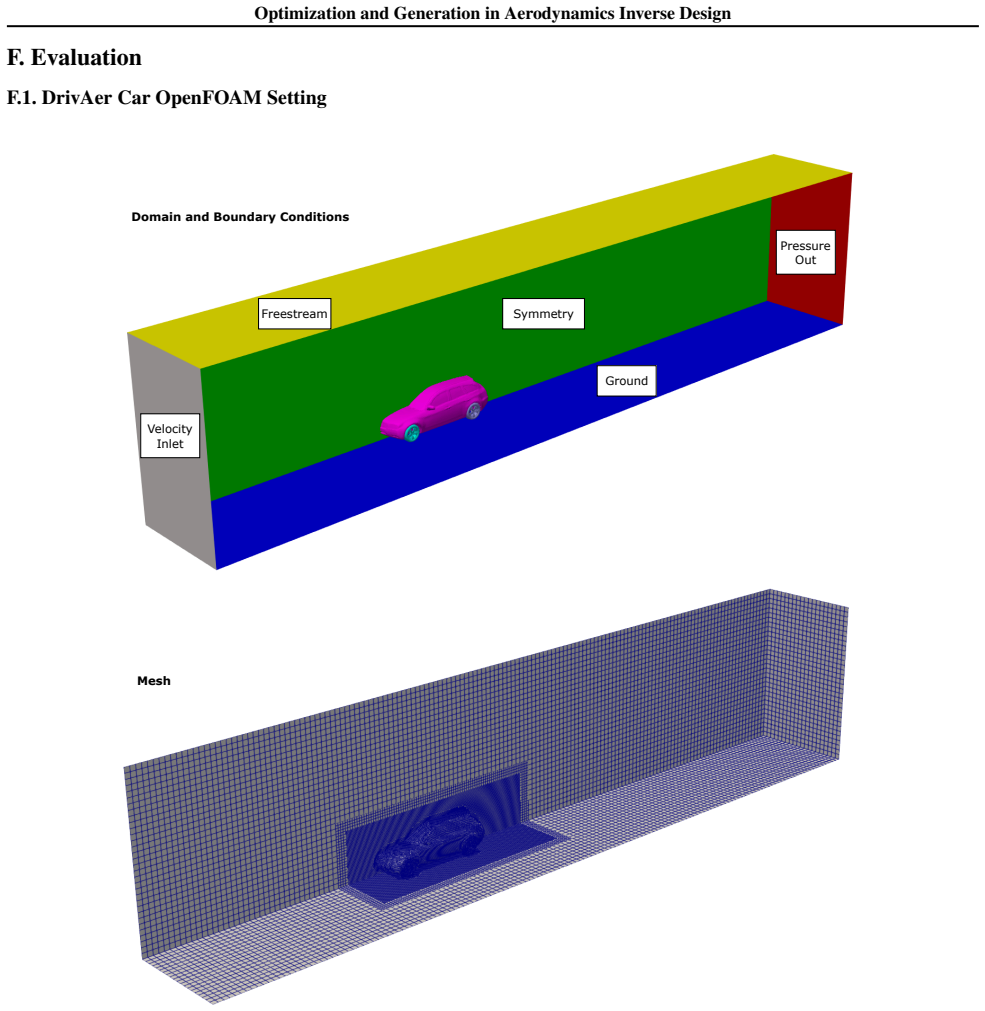
Summary. The manuscript proposes a unified probabilistic treatment of aerodynamic inverse design, linking point-solution optimization to distributional guided generation. It introduces a symmetric-KL training loss for cost predictors, a density-gradient optimization method using a flow-matching score prior, and a new algorithm, SA-MC, for estimating the conditional covariance in SIM-style guidance via secant updates along the ODE trajectory. Experiments include a 2D controlled study, 3D vehicle and aircraft optimization/generation with OpenFOAM evaluations, wind-tunnel smoke tests, and offline RL benchmarks. The headline claims are that visual-feature-preserving optimization reduces vehicle drag by 5.8% and aircraft Cd/Cl by 28.8%, and that guided generation reduces vehicle drag by 3.0% and aircraft Cd/Cl by 68.6% relative to unguided generation, while maintaining visual consistency.
Significance. If the central claims held, the paper would offer a practical and theoretically grounded route to shape-preserving aerodynamic inverse design, unifying existing guidance estimators and providing an efficient high-dimensional covariance approximation. The theoretical organization (Theorems 2.1–2.5) and the SKL training objective are valuable contributions in their own right, and the inclusion of OpenFOAM and wind-tunnel validation is a strength. However, the main generation claim is undermined by an apparent mismatch between the derived covariance scaling and the implemented algorithm. The reported gains are also selected over a guidance-scale sweep, which inflates the headline percentages. With correction, the framework may be useful, but the current empirical evidence does not support the paper's central claims.
major comments (3)
- [Sec. 2.5, Algorithms 5–6] Equation (20) requires the perturbation covariance to be Sigma_t = (sigma_t^2/alpha_t) * grad_{x_t} E[x_1|x_t]. Theorem 2.3 approximates the gradient by B_k, but Theorem 2.5 and Algorithm 5 factorize B_k, not Sigma_t, as L L^T. Algorithm 6 line 6 sets xi^(i) = L epsilon^(i) without multiplying by sqrt(sigma_t^2/alpha_t), even though line 4 computes sigma(t) and leaves it unused. For the typical schedule alpha_t=t, sigma_t=1-t, the missing factor varies by orders of magnitude across t. Consequently, the sampled perturbations have covariance B_k rather than (sigma_t^2/alpha_t) B_k, changing both the scale and the selection of samples and therefore the guidance direction. The generation results in Secs. 4.3–4.4 and the abstract are not produced by the algorithm as derived; they reflect an unstated perturbation scheme.
- [Sec. 4.4, Fig. 5c] The headline 68.6% aircraft Cd/Cl improvement is obtained by selecting the best lambda in {1,10,100} for each method ('To mirror practice, we select the best lambda...'). This is a best-of-three selection on the evaluation set, not a fixed-scale comparison. No standard errors or confidence intervals are reported for the selected value, and Fig. 4c shows that SA-MC can underperform unguided generation at other scales (e.g., lambda=10 with the MSE-trained predictor). The abstract presents this fitted maximum as a general generation gain, which is misleading.
- [Sec. 2.5, Theorem 2.3] The entire SA-MC method rests on the assumption that secant pairs (s_k, r_k) from the ODE trajectory yield an accurate positive-definite approximation B_k to the Jacobian grad_{x_t} v_t and hence to the conditional covariance. This assumption is load-bearing but is not validated independently. In the 2D controlled study (Sec. 4.2), where the true velocity field and Jacobian are computable, the paper does not report the error between B_k and the ground-truth Jacobian, nor the sensitivity of guidance to the secant initialization and memory length. Without this validation, the quantitative generation results cannot be attributed to the proposed covariance estimator.
minor comments (5)
- [Sec. 3.1 heading] The heading 'Optimzation' contains a typo; should be 'Optimization'.
- [Algorithm 6] The computed sigma(t) on line 4 is never used. Either remove it or apply it as sqrt(sigma_t^2/alpha_t) to the perturbation, and update the surrounding text accordingly.
- [Sec. 4.1 / Table 1] The baseline grouping in Table 1 is somewhat coarse; the text states that existing car-shape optimization methods are 'instantiations or variants' of DPS/LGD-MC/SIM-MC, but no explicit mapping is provided for each baseline. This makes the comparison hard to reproduce.
- [Sec. 2.2, Eq. (8)] The softmax notation is used before defining w_B^(J,lambda). Consider moving the weight definition earlier to avoid confusion.
- [Appendix H, Table 6] The offline RL results report only the best score over a hyperparameter sweep, with some entries missing (marked '–'). This is acceptable for an exploratory comparison, but the absence of a fixed-configuration evaluation weakens the claim of 'best average score'.
Circularity Check
Partially circular empirical reporting: generation gains are best-λ selections on the evaluation set, while the theoretical derivation is self-contained.
-
fitted input called prediction
[Sec. 4.4 (Fig. 5c) and abstract generation claims; also Sec. 4.3 (Fig. 4c)]
"To mirror practice, we select the best λ∈{1,10,100} for each method."
The abstract's generation improvements (vehicle drag -3.0%; aircraft Cd/Cl -68.6%) are the best results after sweeping the guidance scale λ on the same OpenFOAM evaluation set used to report them. The reported 'prediction' is the maximum over the fitted hyperparameter, so the headline gain is selected rather than predicted; the comparison is statistically forced by the choice of the best λ.
full rationale
The derivation chain (Gibbs target, SKL loss, density-gradient optimization, secant-based covariance guidance) is not definitionally circular: the target q∝p exp(-λJ) is fixed by external CFD costs, and the optimization/generation claims are checked with independent OpenFOAM and wind-tunnel evaluations. The paper also does not rely on load-bearing self-citations; all cited foundations are external. The circularity score is raised only by the empirical reporting protocol for generation: the headline gains are obtained by selecting the best guidance scale λ∈{1,10,100} on the same evaluation set used to report them, so those numbers are best-of-n selections rather than independent predictions. Separate from circularity, Algorithm 6 computes σ(t)=√(σ_t^2/α_t) but never applies it to ξ^(i)=L ε^(i), so the implemented perturbation covariance is B_k rather than Eq. 20's Σ_t=(σ_t^2/α_t)B_k; this is an implementation/theory mismatch and a correctness risk, not a circular dependence.
Assumptions & free parameters
free parameters (6)
- guidance_scale_lambda =
lambda in {1,10,100} (best selected per method on evaluation set)
- MC_sample_size_S =
32 for 3D, up to 128 for D4RL
- memory_queue_length_m =
not stated beyond fixed capacity
- damping_bounds_sigma2_sigma3 =
sigma2, sigma3 in (0,1), values not given
- time_annealing_bounds =
t_min >= 0.02, t_max <= 0.98
- optimization_step_size_eta_and_steps_K =
not stated
assumptions (5)
- domain assumption p0 = p (data distribution)
- domain assumption Pretrained Hunyuan3D Shape-VAE/DiT provides a faithful latent generative model of car/aircraft shapes
- standard math Tweedie/covariance identity Sigma_t = sigma_t^2/alpha_t * grad_{x_t} E[x1] holds for the flow-matching conditional
- ad hoc to paper Secant pairs from the ODE trajectory approximate the Jacobian of the velocity field
- domain assumption CFD labels (OpenFOAM/FUN3D) in DrivAerNet++ and BlendedNet are accurate enough as ground truth
Cite this review
Pith. "Pith review of Optimization and Generation in Aerodynamics Inverse Design." pith.science (2026). https://pith.science/paper/EN3G6ON2
@misc{pith2026260203582,
  author       = {Pith},
  title        = {Pith review of: Optimization and Generation in Aerodynamics Inverse Design},
  year         = {2026},
  howpublished = {\url{https://pith.science/paper/EN3G6ON2}},
  note         = {Machine review of arXiv:2602.03582}
}
read the original abstract
Aerodynamic inverse design can improve vehicle and aircraft efficiency, but practical design rarely seeks performance alone: vehicle refinement must reduce drag while preserving visual features linked to design language, brand recognition and user perception. Traditional CFD-driven optimization is accurate but slow for broad exploration, and current learning-based methods are still largely performance-driven and lack a coherent target linking optimization, generation and visual consistency. Here we formulate visual preservation and aerodynamic improvement as one probability target. Designs consistent with a reference shape or view define a learned visual design distribution, which is reweighted by aerodynamic cost. Optimization then refines an initial geometry toward a low-cost, high-probability design, whereas guided generation samples lower-cost 3D candidates from the same input view. OpenFOAM evaluation shows that visual-feature-preserving optimization reduces vehicle drag by 5.8\% relative to the initial vehicle and reduces the best valid aircraft drag-to-lift objective by 28.8\% relative to the initial aircraft while preserving input visual features. For view-based generation, guidance reduces vehicle drag by 3.0\% and the aircraft drag-to-lift objective by 68.6\% relative to direct generation from the same view, while maintaining visual consistency. Wind-tunnel tests with 3D-printed vehicle prototypes provide an independent wake-level check, and controlled analyses explain the distributional mechanisms behind these results. This work provides a probabilistic foundation and practical route for visual-feature-preserving aerodynamic refinement and early-stage 3D design exploration.
Figures


Figures from the paper (8 more)




Forward citations
Cited by 2 Pith papers
-
Planar Symmetric Pattern Generation
A new framework enforces planar group symmetries on 2D continuous functions without breaking continuity, with math formulation, approximation proofs, and validation on four design tasks.
-
Knowledge-Constrained Shape Optimization with a Mixture-of-Experts Neural Operator for High-Confidence Design
A knowledge-to-DFFD design-space pipeline plus MoE neural-operator surrogate with Mahalanobis uncertainty gates yields CFD-validated 4–10% vehicle drag reductions and ~1.16% MAPE on heterogeneous aero data.
Reference graph
Works this paper leans on
-
[2]
17 Optimization and Generation in Aerodynamics Inverse Design B.3
Taking expectation underq (Jt) t and substitutinge t(xt) =∥∆ t(xt)∥2 2 gives ∥gLGD t −g SIM t ∥2 2 ≤b 2 t ∥Σ−1 t ∥2 2 Eq(Jt ) t ∥zt∥2 2 et(xt), which concludes the proof. 17 Optimization and Generation in Aerodynamics Inverse Design B.3. Proof of Theorem 2.3 Proof.Recall that ∇xt Ep1|t(x1|xt)[x1] =− at bt I+ 1 bt ∇xt vt(xt).(51) At iterationk, letJ k ≈ ∇x...
2006
-
[7]
Jun, H. and Nichol, A. Shap-e: Generating conditional 3d implicit functions.arXiv preprint arXiv:2305.02463,
-
[9]
Levine, S. Reinforcement learning and control as proba- bilistic inference: Tutorial and review.arXiv preprint arXiv:1805.00909,
-
[11]
T., Lopez-Paz, D., Ben-Hamu, H., and Gat, I
Lipman, Y ., Havasi, M., Holderrieth, P., Shaul, N., Le, M., Karrer, B., Chen, R. T., Lopez-Paz, D., Ben-Hamu, H., and Gat, I. Flow matching guide and code.arXiv preprint arXiv:2412.06264,
-
[13]
P., Kumar, A., Er- mon, S., and Poole, B
Song, Y ., Sohl-Dickstein, J., Kingma, D. P., Kumar, A., Er- mon, S., and Poole, B. Score-based generative modeling through stochastic differential equations.arXiv preprint arXiv:2011.13456,
arXiv 2011
-
[15]
Vatani, P., Elrefaie, M., Nazarpour, F., and Ahmed, F. Tripoptimizer: Generative 3d shape optimization and drag prediction using triplane vae networks.arXiv preprint arXiv:2509.12224,
-
[16]
Wu, H., Luo, H., Wang, H., Wang, J., and Long, M. Tran- solver: A fast transformer solver for pdes on general geometries.arXiv preprint arXiv:2402.02366,
-
[17]
3d shapenets: A deep representation for volumetric shapes
Wu, Z., Song, S., Khosla, A., Yu, F., Zhang, L., Tang, X., and Xiao, J. 3d shapenets: A deep representation for volumetric shapes. InProceedings of the IEEE conference on computer vision and pattern recognition, pp. 1912– 1920,
1912
Show all 28 references
-
[20]
Hunyuan3d 2.0: Scaling diffusion models for high resolution textured 3d assets generation.arXiv preprint arXiv:2501.12202,
Zhao, Z., Lai, Z., Lin, Q., Zhao, Y ., Liu, H., Yang, S., Feng, Y ., Yang, M., Zhang, S., Yang, X., et al. Hunyuan3d 2.0: Scaling diffusion models for high resolution textured 3d assets generation.arXiv preprint arXiv:2501.12202,
-
[21]
15 B.2 Proof of Theorem 2.2
11 Optimization and Generation in Aerodynamics Inverse Design Contents of Appendix A Related Work 13 B Proof 15 B.1 Proof of Theorem 2.1 . . . . . . . . . . . . . . . . . . . . . . . . . . . . . . . . . . . . . . . . . . . . . 15 B.2 Proof of Theorem 2.2 . . . . . . . . . . . ...
2007
-
[22]
Guided generation.As discussed in Sec
and TRELLIS series(Xiang et al., 2025b;a), employ V AE to compress geometry into compact latent feature fields, and subsequently utilize diffusion models as the generative prior, enabling high-fidelity geometric synthesis with scalable compute. Guided generation.As discussed i...
2022
-
[25]
+O S Cfwd J , where C fwd J denotes the cost of a single forward pass of the cost predictor. The remaining operations (computing ℓmax, forming the normalized weights, and the weighted sum) contribute O(S) scalar work and O(Sd) vector accumulations, which are dominated by the t...
2024
-
[90]
34 Optimization and Generation in Aerodynamics Inverse Design G
and report both representative snapshots and their time-averaged image for comparison. 34 Optimization and Generation in Aerodynamics Inverse Design G. Additional Analysis of Experiment Results G.1. Why do guided methods with an MSE-trained predictor exhibit a consistent drift...
2025
-
[95]
step size
22 Optimization and Generation in Aerodynamics Inverse Design Theorem C.2 highlights two regimes. For small λ, SKL behaves like a (scaled) variance of the prediction error and is therefore controlled by MSE. For large λ, SKL depends primarily on how well Jθ matches therelative...
2006
-
[256]
The critic shares the same backbone and uses the last token as the value head; it is trained for 104 steps with batch size 64 and learning rate 2×10 −4
It is trained for 105 steps with batch size 32, learning rate 2×10 −4, and cosine-annealing scheduling. The critic shares the same backbone and uses the last token as the value head; it is trained for 104 steps with batch size 64 and learning rate 2×10 −4. The discount factor ...
2025
-
[2005]
URL https://epubs.siam
doi: 10.1137/ 1.9780898717921. URL https://epubs.siam. org/doi/abs/10.1137/1.9780898717921. Tran, J., Fukami, K., Inada, K., Umehara, D., Ono, Y ., Ogawa, K., and Taira, K. Aerodynamics-guided machine learning for design optimization of electric vehicles.Com- munications Engin...
-
[2007]
B., and Levine, S
Janner, M., Du, Y ., Tenenbaum, J. B., and Levine, S. Plan- ning with diffusion for flexible behavior synthesis.arXiv preprint arXiv:2205.09991,
-
[2009]
D4rl: Datasets for deep data-driven reinforcement learning.arXiv preprint arXiv:2004.07219,
Fu, J., Kumar, A., Nachum, O., Tucker, G., and Levine, S. D4rl: Datasets for deep data-driven reinforcement learning.arXiv preprint arXiv:2004.07219,
2004 arXiv
-
[2013]
Hunyuan3d 2.1: From images to high-fidelity 3d as- sets with production-ready pbr material.arXiv preprint arXiv:2506.15442,
Hunyuan3D, T., Yang, S., Yang, M., Feng, Y ., Huang, X., Zhang, S., He, Z., Luo, D., Liu, H., Zhao, Y ., et al. Hunyuan3d 2.1: From images to high-fidelity 3d as- sets with production-ready pbr material.arXiv preprint arXiv:2506.15442,
-
[2015]
J., et al
Xiang, J., Chen, X., Xu, S., Wang, R., Lv, Z., Deng, Y ., Zhu, H., Dong, Y ., Zhao, H., Yuan, N. J., et al. Native and compact structured latents for 3d generation.arXiv preprint arXiv:2512.14692, 2025a. Xiang, J., Lv, Z., Xu, S., Deng, Y ., Wang, R., Zhang, B., Chen, D., Tong...
-
[2016]
T., Klasky, M
Chung, H., Kim, J., Mccann, M. T., Klasky, M. L., and Ye, J. C. Diffusion posterior sampling for general noisy in- verse problems.arXiv preprint arXiv:2209.14687,
-
[2018]
Fourier neural operator for parametric partial differential equa- tions.arXiv preprint arXiv:2010.08895,
Li, Z., Kovachki, N., Azizzadenesheli, K., Liu, B., Bhat- tacharya, K., Stuart, A., and Anandkumar, A. Fourier neural operator for parametric partial differential equa- tions.arXiv preprint arXiv:2010.08895,
2010 arXiv
-
[2019]
Physgen: Physically grounded 3d shape generation for industrial design.arXiv preprint arXiv:2512.00422,
You, Y ., Zhao, C., Zhang, H., Xu, M., and Fua, P. Physgen: Physically grounded 3d shape generation for industrial design.arXiv preprint arXiv:2512.00422,
-
[2020]
Hyperparameters are tuned per method following Feng et al
(Feng et al., 2025). Hyperparameters are tuned per method following Feng et al. (2025): covariance- gradient guidances sweep multiple λt schedules (e.g., constant/decay families) and global scales; gMC sweeps the reward scaling and uses up to 128 Monte Carlo samples with a sma...
2025
-
[2021]
Point-e: A system for generating 3d point clouds from complex prompts.arXiv preprint arXiv:2212.08751,
Nichol, A., Jun, H., Dhariwal, P., Mishkin, P., and Chen, M. Point-e: A system for generating 3d point clouds from complex prompts.arXiv preprint arXiv:2212.08751,
-
[2023]
Kingma, D. P. and Welling, M. Auto-encoding variational bayes.arXiv preprint arXiv:1312.6114,
-
[2024]
On the guid- ance of flow matching.arXiv preprint arXiv:2502.02150,
Feng, R., Yu, C., Deng, W., Hu, P., and Wu, T. On the guid- ance of flow matching.arXiv preprint arXiv:2502.02150,
-
[2025]
and Martinelli, L
Jameson, A. and Martinelli, L. Aerodynamic shape opti- mization techniques based on control theory. InComputa- tional Mathematics Driven by Industrial Problems: Lec- tures given at the 1st Session of the Centro Internazionale Matematico Estivo (CIME) held in Martina Franca, It...
1999
Reviewed August 3, 2026 · model on record in the stance chip above.
Discussion (0). Sign in to comment.