REVIEW 3 major objections 6 minor 88 references
A knowledge-constrained framework with a mixture-of-experts neural operator turns engineering rules into editable shape variables and uses selective CFD feedback to cut vehicle drag by about 4–10%.
Reviewed by Pith at T0; open to challenge. T0 means a machine referee read the full paper against a public rubric. the ladder, T0–T4 →
T0 review · grok-4.5
2026-07-14 16:10 UTC pith:AITY4O6O
load-bearing objection Solid industrial systems paper: MoE-NO + dual CFD gates deliver real accuracy and validated Cd cuts; the knowledge-constraint story is the softest link, not the surrogate math. the 3 major comments →
Knowledge-Constrained Shape Optimization with a Mixture-of-Experts Neural Operator for High-Confidence Design
The pith
A machine-rendered reading of the paper's core claim, the machinery that carries it, and where it could break.
Core claim
The paper establishes that translating domain knowledge and user intent into DFFD editable control boxes, admissible deformation spaces, and preservation constraints, then guiding search with a Mixture-of-Experts Neural Operator and Mahalanobis-percentile uncertainty gates, yields high-confidence knowledge-constrained shape optimization: MoE-NO improves drag MAPE to 1.16% and trend accuracy to 94.34% on heterogeneous vehicle data, and selective physics-solver feedback for OOD and uncertain candidates produces CFD-validated Cd reductions of about 4% to 10%.
What carries the argument
Mixture-of-Experts Neural Operator (MoE-NO): a geometry encoder with a gating network that routes each shape to multiple expert predictors; the same latent features drive Mahalanobis-distance OOD detection and uncertainty-gated CFD enrichment inside a knowledge-derived DFFD design space.
Load-bearing premise
The method assumes that language and vision models correctly turn design rules into editable 3D boxes and deformation bounds that match what engineers would actually allow.
What would settle it
Run the full pipeline on a new production vehicle family and check whether the optimized shapes either violate packaging, safety, or manufacturability constraints a human engineer would reject, or lose their reported drag reductions when re-meshed and re-solved under an independent high-fidelity CFD configuration.
If this is right
- Engineering constraints can live inside the optimizer as editable regions and bounds rather than as post-hoc filters.
- Heterogeneous vehicle databases benefit from multi-expert routing instead of a single global neural operator for reliable drag ranking.
- High-fidelity CFD can be reserved for distribution-level and uncertainty gates instead of every candidate design.
- An unseen vehicle family can be brought into reliable optimization by local resampling and adding one new expert branch.
- Latent-space uncertainty can decide when a surrogate optimum is safe to accept versus when it must be refined with CFD.
Where Pith is reading between the lines
- The same knowledge-to-DFFD grounding could carry packaging and manufacturability rules into multi-objective vehicle design without rewriting the search loop.
- Selective Mahalanobis-gated enrichment is portable to other expensive physics loops such as thermal or structural shape optimization.
- Richer internal design-rule corpora become a direct competitive advantage because they define a tighter admissible space before any CFD is run.
- Trend accuracy near 94% suggests the surrogate can serve as a ranking prior inside evolutionary or Bayesian optimizers even when absolute error is imperfect.
Editorial analysis
A structured set of objections, weighed in public.
Referee Report
Summary. The paper proposes a knowledge-constrained, surrogate-assisted shape-optimization framework for vehicle aerodynamics. Domain knowledge and multi-view geometry are converted via RAG, LLM, and VLM into editable DFFD control boxes C, admissible deformation space Ω(C), and preservation constraints H; a Mixture-of-Experts Neural Operator (MoE-NO) predicts Cd on heterogeneous MPV/SUV/Sedan data; and dual physics-solver gates use encoder-space OOD detection and Mahalanobis-percentile uncertainty to trigger local CFD enrichment and online refinement. On an in-house 450-sample ID database, MoE-NO reports test MAPE 1.16% and trend accuracy 94.34% versus best baselines 1.52% and ~90.34%. CFD-validated optimizations yield Cd reductions of roughly 4–10% (MPV 10.52%, Sedan 4.17%, refined SUV 7.96%, adapted OOD Sedantest 7.43%), with an OOD adaptation ablation improving R² from −18.42 to 0.9525 on a held-out sedan family.
Significance. If the results hold under broader validation, the work is a useful systems-level contribution at the intersection of geometry parameterization, neural operators, and industrial aerodynamic design. Strengths include CFD-validated optima rather than surrogate-only claims, explicit dual-gate solver-in-the-loop design (distribution-level OOD adaptation and optimization-level Mahalanobis refinement), a multi-family train/val/test protocol with Transolver and DragSolver baselines (Table 5), grid-convergence for labeling (Table 1), an online-refinement ablation on SUV (Table 7), and a public geometry dataset. The MoE-NO accuracy/trend gains and selective CFD enrichment are practically relevant for expensive external-flow optimization. The knowledge-grounding pipeline is ambitious and timely given multi-agent design work, but its industrial significance depends on whether grounded (C, Ω, H) truly encode engineer-admissible packaging, safety, manufacturability, and design-identity constraints—an aspect the manuscript asserts more than it measures.
major comments (3)
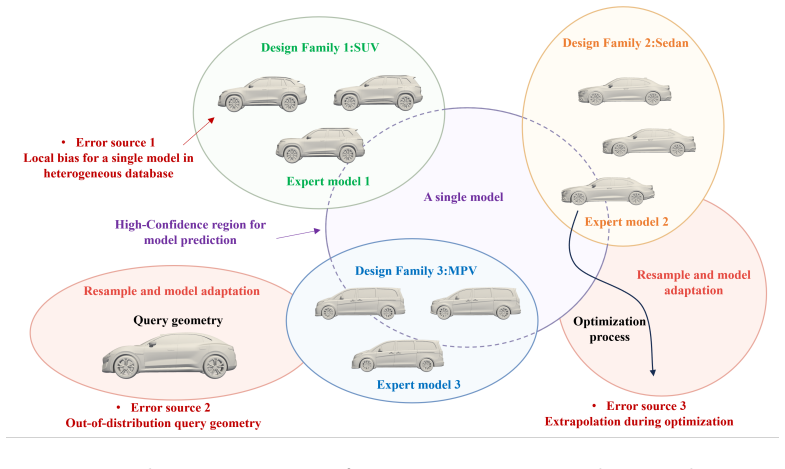
- [Sec. 2.1, 2.3; Eqs. 11, 23–29; Fig. 7; Table 4] Sec. 2.1 (after Eq. 11) and Sec. 2.3 state that preservation constraints H are not imposed as independent analytic inequalities but are “embedded” in C, Ω(C), and D. DFFD (Eqs. 23–29) further allows induced displacements outside editable boxes. The central “knowledge-constrained / high-confidence design” claim therefore rests on the fidelity of RAG+VLM grounding (Fig. 7, Table 4). There is no quantitative check against engineer-specified admissible regions, packaging/safety/manufacturability bounds, or design-identity criteria—only qualitative multi-view figures and reconstructed boxes. CFD Cd reductions (Tables 7, 9) can be real physics improvements while still violating industrial admissibility. Please add an independent validation protocol (e.g., expert review scores, constraint-violation rates, or comparison to hand-specified engineer bounds) or narrow the claim to “knowledge-informe
- [Tables 2, 5, 8; Sec. 3.3, 4.2, 4.5] ID and OOD quantitative claims rest on very small held-out sets: 15 test samples per ID family (Table 2) and 15 OOD Sedantest test samples (Tables 5, 8). MAPE 1.16%, Acc_tre 94.34%, and the OOD jump from R²=−18.42 / MAPE 14.88% to R²=0.9525 / MAPE 1.84% are directionally convincing but statistically fragile; a few outliers can dominate. Please report confidence intervals or bootstrap variability for MAPE/Acc_tre, clarify whether family-wise metrics differ, and temper absolute claims in the abstract/conclusions accordingly. Larger held-out or cross-family leave-one-family-out tests would substantially strengthen the MoE-NO generalization argument.
- [Secs. 2.4.2–2.4.4; Fig. 12; Table 7] The dual-gate mechanism depends on several free thresholds (η_σ=0.6, η_CFD=0.025, α_ex=0.1, N_KNN=5, p_cal, DFFD β, expert-addition schedule) that are stated without sensitivity analysis (Secs. 2.4.2–2.4.4). For SUV, online refinement is activated by σ>η_σ and e_phys>η_CFD and improves CFD-validated reduction from 4.36% to 7.96% (Table 7)—a useful ablation, but it is unclear how often refinement would fire under alternate thresholds or whether MPV/Sedan acceptance is robust. A short sensitivity study on η_σ and η_CFD (and reporting how many CFD calls each gate consumed) is needed to support the “high-confidence” and cost-efficiency narrative.
minor comments (6)
- [Abstract; Table 5] Abstract and Sec. 4.2 cite best baseline trend accuracy as 90.34%, while Table 5 lists Transolver test Acc_tre=0.9051 and DragSolver 0.8495; reconcile the rounded figure with the table.
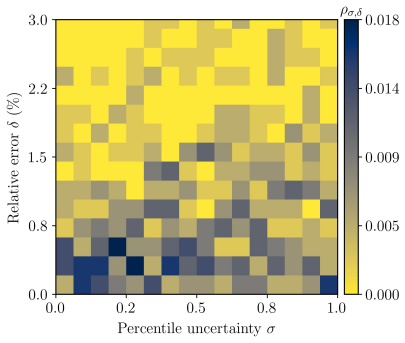
- [Fig. 10; Sec. 4.2] Fig. 10 joint density of σ vs δ is informative but would benefit from a calibration curve (e.g., error rate vs σ bins) and explicit false-negative rate for high-error cases, since the text argues low upper-left mass.
- [Secs. 2.4.1, 2.4.3] Clarify MoE training details: number of experts N_exp for the ID model, how the new expert E_{N_exp+1} is initialized, and whether the encoder is frozen during OOD fine-tuning (Sec. 2.4.3).
- [Table 5] Table 5 DragSolver train MAPE 0.98% with 57.20% of samples having MAPE>1% is possible but surprising; a brief note on error distribution would help readers interpret the metric.
- [Sec. 1; References] Several references are arXiv preprints dated 2025–2026; ensure citation completeness and that concurrent related multi-agent aero-design works are fairly positioned in the introduction.
- [Secs. 2.1, 2.4] Notation: J_phys, Ć_d, and Ć_ϕ are used interchangeably for drag; a short symbol table would reduce friction.
Circularity Check
No significant circularity: MoE-NO metrics and Cd reductions are checked against independent CFD labels, not forced by construction or self-citation chains.
full rationale
The paper is an engineering ML + optimization pipeline, not a first-principles derivation. Load-bearing claims are (i) MoE-NO test MAPE/trend vs Transolver and DragSolver on held-out ID splits (Table 5; train/val/test 8:1:1) and (ii) CFD-validated Cd reductions after surrogate-guided search (Tables 7, 9). Both compare surrogate outputs to external physics labels J_phys / C_d from TF-Lattice CFD, so they are not tautologies of fitted parameters. The encoder is inherited from DragSolver [2] (partial author overlap), but that is a reusable backbone component; MoE-NO is trained and scored against CFD and against DragSolver itself as a baseline, which is standard and not a self-definitional or uniqueness-import loop. Knowledge constraints (C, Ω(C), H) are constructed from RAG+VLM and embedded in DFFD; whether they match industrial admissibility is a validity question, not circularity—the reported drag drops are still CFD measurements inside the constructed space, not quantities defined from the same fit. OOD adaptation and Mahalanobis gates use leave-one-out / enrichment then held-out evaluation. No step reduces a claimed prediction to its own inputs by construction.
Axiom & Free-Parameter Ledger
free parameters (6)
- η_σ (Mahalanobis percentile acceptance threshold)
- η_CFD / η_phys (relative surrogate–physics tolerance)
- α_ex (OOD sampling expansion factor)
- N_KNN and p_cal (OOD distance calibration)
- MoE expert count / new-expert addition and training schedule
- DFFD smoothness weight β and lattice resolution
axioms (5)
- domain assumption High-fidelity LBM CFD labels (medium mesh) are accurate enough proxies for true Cd for ranking and optimization.
- ad hoc to paper RAG-retrieved rules plus VLM multi-view grounding yield control boxes and bounds that encode real packaging, safety, manufacturability, and design-identity constraints.
- domain assumption Mixture-of-experts routing in latent space can represent heterogeneous vehicle-family geometry–drag maps better than a single global operator.
- domain assumption Mahalanobis percentile in the frozen encoder latent space is a reliable uncertainty signal for search-induced extrapolation.
- standard math Standard supervised MSE training and DE search over Ω(C) are valid for the stated optimization problem.
invented entities (3)
-
MoE-NO (encoder + expert branches + gate for Cd)
independent evidence
-
Knowledge-constrained DFFD design-space construction via RAG/VLM/LLM
no independent evidence
-
Dual physics-solver gates (distribution-level OOD adaptation + optimization-level Mahalanobis refinement)
independent evidence
read the original abstract
Engineering shape optimization faces challenges in both expert-dependent problem setup and surrogate-model reliability. In practical aerodynamic design, optimization settings such as editable regions, deformation ranges, and design-preservation constraints are typically specified manually by experienced engineers, while surrogate-based optimization may become unreliable for heterogeneous geometry databases and out-of-distribution designs. To address these challenges, we propose a knowledge-constrained shape-optimization framework that translates knowledge-based constraints and user intent into quantifiable parameters of DFFD-based deformation operators, enabling engineering-aware and controllable constrained optimization. We further develop a Mixture-of-Experts Neural Operator (MoE-NO) to improve drag prediction and trend consistency over heterogeneous aerodynamic datasets. Based on the MoE-NO encoder and Mahalanobis distance, an uncertainty-estimation strategy is introduced to detect out-of-distribution geometries and selectively trigger physics-solver feedback for local sample enrichment. Experiments on in-house MPV, SUV, and Sedan datasets show that MoE-NO achieves a test-set MAPE of $1.16\%$ and a trend-prediction accuracy of $94.34\%$, outperforming the best baseline results of $1.52\%$ and $90.34\%$, respectively. Vehicle shape-optimization experiments further yield CFD-validated drag coefficient reductions of approximately $4\%$ to $10\%$.
Figures




Reference graph
Works this paper leans on
-
[1]
H. Wu, H. Luo, H. Wang, J. Wang, M. Long, Transolver: A fast transformer solver for PDEs on general geometries, arXiv preprint arXiv:2402.02366 (2024)
Pith/arXiv arXiv 2024
-
[2]
Y. Liu, Y. Chen, Dragsolver: A multi-scale transformer for real-world automotive drag coefficient estimation, in: Forty-second International Conference on Machine Learning, 2025
2025
-
[3]
Jameson, Aerodynamic design via control theory, Journal of Scientific Computing 3 (1988) 233–260
A. Jameson, Aerodynamic design via control theory, Journal of Scientific Computing 3 (1988) 233–260
1988
-
[4]
J. R. Martins, Aerodynamic design optimization: Challenges and perspectives, Computers & Fluids 239 (2022) 105391
2022
-
[5]
S. N. Skinner, H. Zare-Behtash, State-of-the-art in aerodynamic shape optimisation meth- ods, Applied Soft Computing 62 (2018) 933–962
2018
-
[6]
H. YUAN, J. KOU, W. ZHANG, A resolvent-analysis-based optimization design method for airfoils at low reynolds number, Acta Aeronautica et Astronautica Sinica 47 (2026)
2026
-
[7]
Park, D.-H
K. Park, D.-H. Choi, K.-S. Lee, Numerical shape optimization for high performance of a heat sink with pin-fins, Numerical Heat Transfer, Part A: Applications 46 (2004) 909–927
2004
-
[8]
W. A. Wall, M. A. Frenzel, C. Cyron, Isogeometric structural shape optimization, Computer methods in applied mechanics and engineering 197 (2008) 2976–2988
2008
-
[9]
J. A. Samareh, Survey of shape parameterization techniques for high-fidelity multidisci- plinary shape optimization, AIAA Journal 39 (2001) 877–884
2001
-
[10]
J. R. Martins, A. Ning, Engineering design optimization, Cambridge University Press, 2021
2021
-
[11]
Z. Wei, A. Yang, J. Li, M. Bauerheim, R. P. Liem, P. Fua, Deepgeo: Deep geometric mapping for automated and effective parameterization in aerodynamic shape optimization, in: AIAA AVIATION FORUM AND ASCEND 2024, 2024, p. 3839
2024
-
[12]
Moukalled, L
F. Moukalled, L. Mangani, M. Darwish, The finite volume method, in: The finite volume method in computational fluid dynamics: An advanced introduction with OpenFOAM® and Matlab, Springer, 2015, pp. 103–135
2015
-
[13]
Versteeg, W
H. Versteeg, W. Malalasekera, Computational fluid dynamics, The finite volume method (1995) 1–26
1995
-
[14]
D. R. Jones, M. Schonlau, W. J. Welch, Efficient global optimization of expensive black-box functions, Journal of Global optimization 13 (1998) 455–492
1998
-
[15]
X.-Y. Liu, D. Bodaghi, Q. Xue, X. Zheng, J.-X. Wang, Asynchronous parallel reinforce- ment learning for optimizing propulsive performance in fin ray control, Engineering with Computers 41 (2025) 2201–2218
2025
-
[16]
Umetani, B
N. Umetani, B. Bickel, Learning three-dimensional flow for interactive aerodynamic design, ACM Transactions on Graphics 37 (2018) 1–10
2018
-
[17]
J. Li, X. Du, J. R. Martins, Machine learning in aerodynamic shape optimization, Progress in Aerospace Sciences 134 (2022) 100849
2022
-
[18]
H. Chen, N. Lin, L. Chen, J. Cen, R. Zhang, W. Huang, C. Li, H. Sun, Optimization and generation in aerodynamics inverse design, arXiv preprint arXiv:2602.03582 (2026). 29
Pith/arXiv arXiv 2026
-
[19]
G. Sun, T. Miao, H. Huang, H. Chen, H. Wan, R. Zhang, H. Sun, Geometry-aware neural optimizer for shape optimization and inversion, arXiv preprint arXiv:2605.04474 (2026)
Pith/arXiv arXiv 2026
-
[20]
J. R. Crandall, K. S. Bhalla, N. Madeley, Designing road vehicles for pedestrian protection, Bmj 324 (2002) 1145–1148
2002
-
[21]
W. Hu, S. S. Monfort, J. B. Cicchino, The association between passenger-vehicle front-end profiles and pedestrian injury severity in motor vehicle crashes, Journal of safety research 90 (2024) 115–127
2024
-
[22]
Hucho, Aerodynamics of road vehicles: from fluid mechanics to vehicle engineering, Elsevier, 2013
W.-H. Hucho, Aerodynamics of road vehicles: from fluid mechanics to vehicle engineering, Elsevier, 2013
2013
-
[23]
T. C. Schuetz, Aerodynamics of road vehicles, Sae International, 2015
2015
-
[24]
R. H. Barnard, Road vehicle aerodynamic design-an introduction, 2001
2001
-
[25]
S. R. Ahmed, G. Ramm, G. Faltin, Some salient features of the time-averaged ground vehicle wake, in: SAE international congress and exposition, SAE Technical Paper, 1984
1984
-
[26]
A. I. Heft, T. Indinger, N. A. Adams, Introduction of a new realistic generic car model for aerodynamic investigations, Technical Report, SAE Technical Paper, 2012
2012
-
[27]
Ekman, D
P. Ekman, D. Wieser, S. Virdung, M. Karlsson, Assessment of hybrid rans-les methods for accurate automotive aerodynamic simulations, Journal of Wind Engineering and Industrial Aerodynamics 206 (2020) 104301
2020
-
[28]
C. B. Chapman, M. Pinfold, The application of a knowledge based engineering approach to the rapid design and analysis of an automotive structure, Advances in engineering software 32 (2001) 903–912
2001
-
[29]
La Rocca, Knowledge based engineering: Between ai and cad
G. La Rocca, Knowledge based engineering: Between ai and cad. review of a language based technology to support engineering design, Advanced engineering informatics 26 (2012) 159– 179
2012
-
[30]
Kuegler, F
P. Kuegler, F. Dworschak, B. Schleich, S. Wartzack, The evolution of knowledge-based engineering from a design research perspective: Literature review 2012–2021, Advanced Engineering Informatics 55 (2023) 101892
2012
-
[31]
L. Yue, P. Xu, T. Zhang, N. Somasekharan, S. Pan, Foamgpt: Fine-tuning large language model for agentic automation of cfd simulations with openfoam, Advances in Neural Infor- mation Processing Systems (2025)
2025
-
[32]
T. R. Sarker, M. J. Zulqernine, L. Yue, S. Pan, C. Wang, S. Lin, A multi-ai-agent framework enabling end-to-end finite element analysis for solid mechanics problems, arXiv preprint arXiv:2606.00138 (2026)
Pith/arXiv arXiv 2026
-
[33]
Y. Liu, S. Li, H. Yang, J. Gu, W. Fan, Z. Yang, D. Wang, S. Chen, Z. Jiang, Y. Bin, et al., Aeroagent: A vision-physics-decision framework for aerodynamic vehicle design, in: Proceedings of the IEEE/CVF Conference on Computer Vision and Pattern Recognition, 2026, pp. 11694–11703
2026
-
[34]
L. Fang, P. He, Agentic ai for conversational aerodynamic analysis and optimization of airfoils and wings, in: AIAA SCITECH 2026 Forum, 2026, p. 2395
2026
-
[35]
Y. Fan, H. Zhan, M. Zhang, B. Mi, Airfoilagent: Airfoil aerodynamics optimization design via large language model multi-agent collaborations, Advanced Engineering Informatics 71 (2026) 104246. 30
2026
-
[36]
Elrefaie, J
M. Elrefaie, J. Qian, R. Wu, Q. Chen, A. Dai, F. Ahmed, Ai agents in engineering design: a multi-agent framework for aesthetic and aerodynamic car design, in: International Design Engineering Technical Conferences and Computers and Information in Engineering Confer- ence, volume 89237, American Society of Mechanical Engineers, 2025, p. V03BT03A048
2025
-
[37]
C. Lee, G. Cinar, J. R. Martins, Aerodynamic design and optimization via a specialized agentic generative ai framework, arXiv preprint (2025)
2025
-
[38]
X. Jin, S. Yan, Q. Wang, S. Deng, Y. Jiang, S. Zhao, A closed-loop multi-agent framework for aerodynamics-aware automotive styling design, arXiv preprint arXiv:2508.03370 (2025)
Pith/arXiv arXiv 2025
-
[39]
P. Qin, A. Ricci, B. Blocken, Cfd simulation of aerodynamic forces on the drivaer car model: Impact of computational parameters, Journal of Wind Engineering and Industrial Aerodynamics 248 (2024) 105711
2024
-
[40]
L. Lu, P. Jin, G. Pang, Z. Zhang, G. E. Karniadakis, Learning nonlinear operators via deeponet based on the universal approximation theorem of operators, Nature machine intelligence 3 (2021) 218–229
2021
-
[41]
Z. Li, N. Kovachki, K. Azizzadenesheli, B. Liu, K. Bhattacharya, A. Stuart, A. Anandku- mar, Fourier neural operator for parametric partial differential equations, arXiv preprint arXiv:2010.08895 (2020)
Pith/arXiv arXiv 2010
-
[42]
Kanchi, B
R. Kanchi, B. Melanson, N. Somasekharan, S. Pan, S. He, Unifoil: A universal dataset of airfoils in transitional and turbulent regimes for subsonic and transonic flows, Advances in Neural Information Processing Systems 38 (2026)
2026
-
[43]
J. Kou, W. Zhang, Data-driven modeling for unsteady aerodynamics and aeroelasticity, Progress in Aerospace Sciences 125 (2021) 100725
2021
-
[44]
Zhang, H
K. Zhang, H. Liao, Y. Liu, W. Zhang, A new perspective on efficient and high-fidelity prediction of unsteady flow in airfoil dynamic stall, Aerospace Science and Technology (2026) 112183
2026
-
[45]
R. Cui, Q. Zhang, W. Zhang, W. Lu, L. Gao, High-fidelity three-dimensional aerodynamic flowpredictiononwingswithphysics-constraineddual-parallelattentionunet++, Aerospace Science and Technology (2026) 111846
2026
-
[46]
H. Zhao, L. Jiang, J. Jia, P. H. Torr, V. Koltun, Point transformer, in: Proceedings of the IEEE/CVF International Conference on Computer Vision (ICCV), 2021, pp. 16259–16268
2021
-
[47]
X. Wu, L. Jiang, P.-S. Wang, Z. Liu, X. Liu, Y. Qiao, W. Ouyang, T. He, H. Zhao, Point transformer v3: Simpler faster stronger, in: Proceedings of the IEEE/CVF conference on computer vision and pattern recognition, 2024, pp. 4840–4851
2024
-
[48]
K. Qi, H. Yang, K. Ding, Y. Wang, Y. Chen, Y. Bin, R. Zhang, J. Wang, A geometry-aware triplane field network for vehicle aerodynamic prediction, arXiv preprint arXiv:2606.07724 (2026)
Pith/arXiv arXiv 2026
-
[49]
J. Gu, Y. Chen, Y. Bin, S. Chen, Geoformer: Mesh-free geometry-to-flow alignment frame- work for real-time aerodynamics on non-watertight vehicle geometries, Physics of Fluids 38 (2026)
2026
-
[50]
B. Zhang, H. Yang, Y. Wang, Y. Chen, Y. Bin, R. Zhang, J. Wang, Reto: A rotary-enhanced transformer operator for high-fidelity prediction of automotive aerodynamics, arXiv preprint arXiv:2605.00062 (2026). 31
Pith/arXiv arXiv 2026
-
[51]
H. Yang, J. Gu, Y. Chen, Y. Bin, J. Wang, S. Chen, Spatially-aware transformer operator for real-time aerodynamic evaluations of arbitrary three-dimensional vehicles, Journal of Computational Physics 540 (2025) 114456
2025
-
[52]
M. A. Pimentel, D. A. Clifton, L. Clifton, L. Tarassenko, A review of novelty detection, Signal Processing 99 (2014) 215–249
2014
-
[53]
Chandola, A
V. Chandola, A. Banerjee, V. Kumar, Anomaly detection: A survey, ACM Computing Surveys (CSUR) 41 (2009) 1–58
2009
-
[54]
M. Kaya, H. Ş. Bilge, Deep metric learning: A survey, Symmetry 11 (2019) 1066
2019
-
[55]
Lewis, E
P. Lewis, E. Perez, A. Piktus, F. Petroni, V. Karpukhin, N. Goyal, H. Küttler, M. Lewis, W.-t. Yih, T. Rocktäschel, et al., Retrieval-augmented generation for knowledge-intensive nlp tasks, Advances in neural information processing systems 33 (2020) 9459–9474
2020
-
[56]
Y. Gao, Y. Xiong, X. Gao, K. Jia, J. Pan, Y. Bi, Y. Dai, J. Sun, M. Wang, H. Wang, Retrieval-augmented generation for large language models: A survey, arXiv preprint arXiv:2312.10997 (2023)
Pith/arXiv arXiv 2023
-
[57]
Radford, J
A. Radford, J. W. Kim, C. Hallacy, A. Ramesh, G. Goh, S. Agarwal, G. Sastry, A. Askell, P. Mishkin, J. Clark, et al., Learning transferable visual models from natural language supervision, in: International conference on machine learning, PmLR, 2021, pp. 8748–8763
2021
-
[58]
T. W. Sederberg, S. R. Parry, Free-form deformation of solid geometric models, in: Pro- ceedings of the 13th annual conference on Computer graphics and interactive techniques, 1986, pp. 151–160
1986
-
[59]
W. M. Hsu, J. F. Hughes, H. Kaufman, Direct manipulation of free-form deformations, ACM Siggraph Computer Graphics 26 (1992) 177–184
1992
-
[60]
H. J. Lamousin, W. N. Waggenspack, Nurbs-based free-form deformations, IEEE Computer Graphics and Applications 14 (1994) 59–65
1994
-
[61]
Jakobsson, O
S. Jakobsson, O. Amoignon, Mesh deformation using radial basis functions for gradient- based aerodynamic shape optimization, Computers & Fluids 36 (2007) 1119–1136
2007
-
[62]
E. Luke, E. Collins, E. Blades, A fast mesh deformation method using explicit interpolation, Journal of Computational Physics 231 (2012) 586–601
2012
-
[63]
J. Witteveen, Explicit and robust inverse distance weighting mesh deformation for cfd, in: 48th AIAA Aerospace Sciences Meeting Including the New Horizons Forum and Aerospace Exposition, 2010, p. 165
2010
-
[64]
R. A. Jacobs, M. I. Jordan, S. J. Nowlan, G. E. Hinton, Adaptive mixtures of local experts, Neural computation 3 (1991) 79–87
1991
-
[65]
M. I. Jordan, R. A. Jacobs, Hierarchical mixtures of experts and the em algorithm, Neural computation 6 (1994) 181–214
1994
-
[66]
Zhou, Ensemble methods: foundations and algorithms, Chapman and Hall/CRC, 2012
Z.-H. Zhou, Ensemble methods: foundations and algorithms, Chapman and Hall/CRC, 2012
2012
-
[67]
Elrefaie, F
M. Elrefaie, F. Morar, A. Dai, F. Ahmed, Drivaernet++: A large-scale multimodal car dataset with computational fluid dynamics simulations and deep learning benchmarks, Ad- vances in Neural Information Processing Systems 37 (2024). 32
2024
-
[68]
J. Qiu, L. Kuang, G. Wang, Y. Xu, L. Cui, S. Fu, Y. Zhu, R. Zhang, Drivaerstar: An industrial-grade cfd dataset for vehicle aerodynamic optimization, Advances in Neural In- formation Processing Systems 38 (2026)
2026
-
[69]
U. E. Feldinger, S. Kleemann, T. Vietor, et al., Automotive styling: Supporting engineering- styling convergence through surface-centric knowledge based engineering, in: DS 87-4 Pro- ceedings of the 21st International Conference on Engineering Design (ICED 17) Vol 4: Design Methods and Tools, Vancouver, Canada, 21-25.08. 2017, 2017, pp. 139–148
2017
-
[70]
Y. Qi, K. Kim, Evaluation of electric car styling based on analytic hierarchy process and kansei engineering: A study on mainstream chinese electric car brands, Heliyon 10 (2024)
2024
-
[71]
Pinfold, C
M. Pinfold, C. Chapman, The application of kbe techniques to the fe model creation of an automotive body structure, Computers in Industry 44 (2001) 1–10
2001
-
[72]
Naiju, Dfma for product designers: A review, Materials Today: Proceedings 46 (2021) 7473–7478
C. Naiju, Dfma for product designers: A review, Materials Today: Proceedings 46 (2021) 7473–7478
2021
-
[73]
Thomas, O
S. Thomas, O. Carsten, et al., Adjoint optimization for vehicle external aerodynamics, International Journal of Automotive Engineering 7 (2016) 1–7
2016
-
[74]
M. N. Sudin, M. A. Abdullah, S. A. Shamsuddin, F. R. Ramli, M. M. Tahir, Review of re- searchonvehiclesaerodynamicdragreductionmethods, InternationalJournalofMechanical and Mechatronics Engineering 14 (2014) 35–47
2014
-
[75]
Collin, S
C. Collin, S. Mack, T. Indinger, J. Mueller, A numerical and experimental evaluation of open jet wind tunnel interferences using the drivaer reference model, SAE International Journal of Passenger Cars-Mechanical Systems 9 (2016) 657–679
2016
-
[76]
M. D. McKay, R. J. Beckman, W. J. Conover, A comparison of three methods for selecting values of input variables in the analysis of output from a computer code, Technometrics 42 (2000) 55–61
2000
-
[77]
M. D. Morris, T. J. Mitchell, Exploratory designs for computational experiments, Journal of statistical planning and inference 43 (1995) 381–402
1995
-
[78]
liang et al., Journal of Membrane Computing 7 (2025) 108– 127
J.Liang, Y.Lou, M.Yu, Y.Bi, K.Yu, Asurveyofsurrogate-assistedevolutionaryalgorithms for expensive optimization: J. liang et al., Journal of Membrane Computing 7 (2025) 108– 127
2025
-
[79]
K. Lee, K. Lee, H. Lee, J. Shin, A simple unified framework for detecting out-of-distribution samples and adversarial attacks, in: Advances in Neural Information Processing Systems, volume 31, 2018
2018
-
[80]
Ledoit, M
O. Ledoit, M. Wolf, A well-conditioned estimator for large-dimensional covariance matrices, Journal of Multivariate Analysis 88 (2004) 365–411
2004
discussion (0)
Sign in with ORCID, Apple, or X to comment. Anyone can read and Pith papers without signing in.