Limitations of Using BCA Codes for Modeling the Sputtering Behavior of Planetary Surfaces
Pith reviewed 2026-06-27 07:48 UTC · model grok-4.3
The pith
BCA codes cannot simultaneously match both sputter yield and angular distribution for helium-irradiated mineral targets
A machine-rendered reading of the paper's core claim, the machinery that carries it, and where it could break.
Core claim
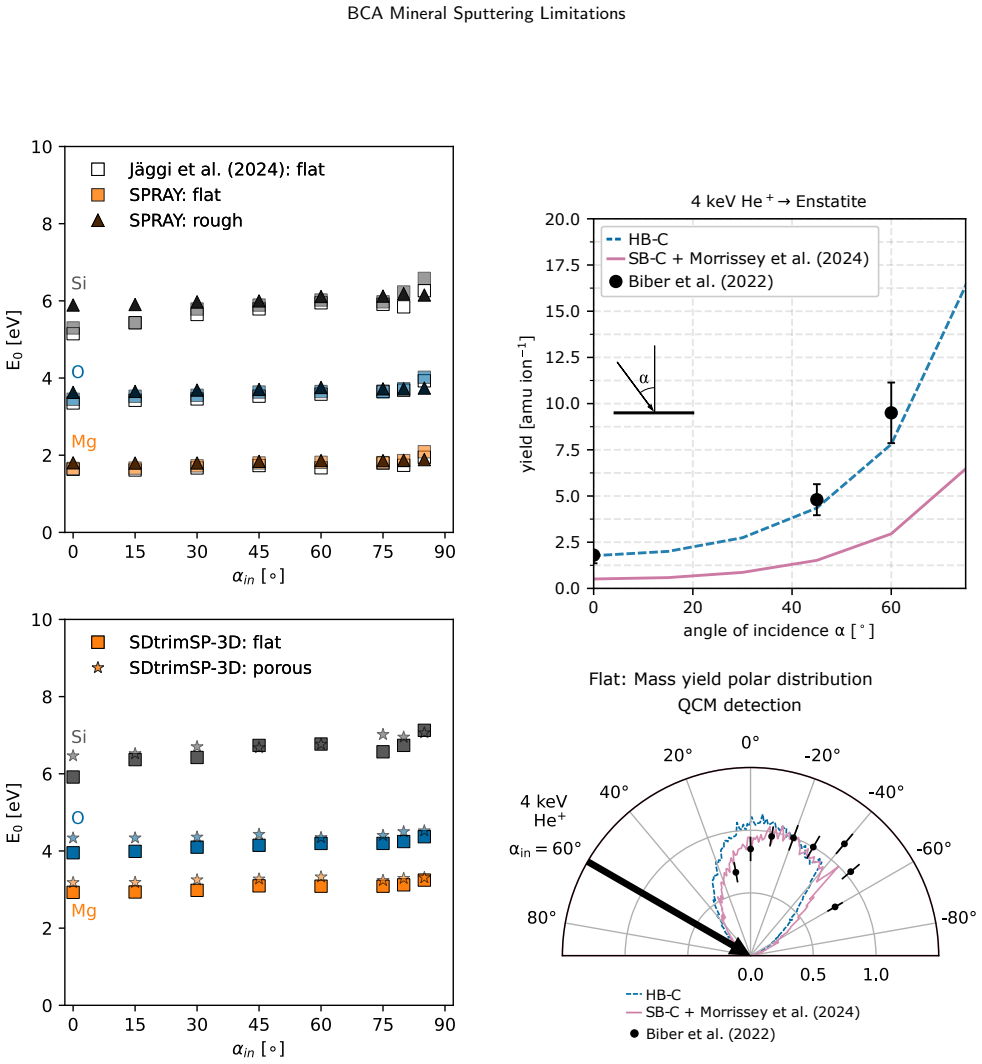
The BCA model cannot simultaneously reproduce both the sputter yield and the sputter angle distribution arising from He irradiation of mineral targets, either due to the inherent geometric simplicity of the BCA or because the model neglects yield-enhancing processes such as molecule and cluster sputtering. This demonstrates a structural limitation of current BCA-based models when realistic surface morphologies are considered, rather than a problem that can be resolved by parameter tuning alone.
What carries the argument
Binary collision approximation (BCA) codes such as SDTrimSP that simulate successive two-body collisions to compute sputter yields and angular distributions, tested against experimental angle-resolved measurements at large ion incidence angles on enstatite and plagioclase targets.
If this is right
- Sputtering predictions for porous planetary regolith will systematically misplace the directions of most ejected particles if they rely on flat-surface BCA calibrations tuned only to total yield.
- Raising surface binding energies to suppress back-sputtering improves angular fidelity at the direct expense of mass-yield accuracy.
- The discrepancy between yield and angle data persists across parameter choices and therefore cannot be removed by further tuning within current BCA implementations.
- Models of space weathering and exosphere supply on airless bodies inherit directional errors when they inherit BCA outputs calibrated on flat targets.
Where Pith is reading between the lines
- Explicit incorporation of surface roughness geometry beyond the current BCA framework will be required to restore consistency between yield and angle predictions.
- Hybrid BCA-molecular-dynamics schemes that add cluster and molecule ejection channels offer a testable route to close the observed gap.
- Exosphere composition models that depend on angle-resolved ejecta from regolith may need independent experimental constraints until the BCA limitation is resolved.
Load-bearing premise
The laboratory angular distribution measurements at large ion incidence angles are accurate and the observed mismatch with BCA predictions arises from the code's geometric simplicity or neglected processes rather than from an undetected error in the experimental setup or in the specific SDTrimSP implementation.
What would settle it
A new measurement on the same mineral target that records both the absolute sputter yield and the complete angular distribution under identical helium irradiation conditions at grazing incidence, or a modified BCA run that incorporates explicit cluster ejection and reproduces both observables within experimental uncertainty.
Figures
read the original abstract
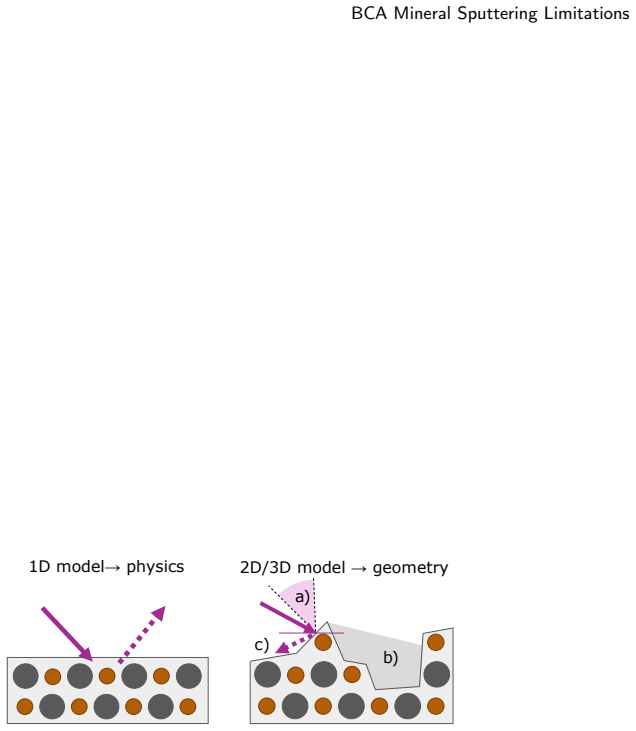
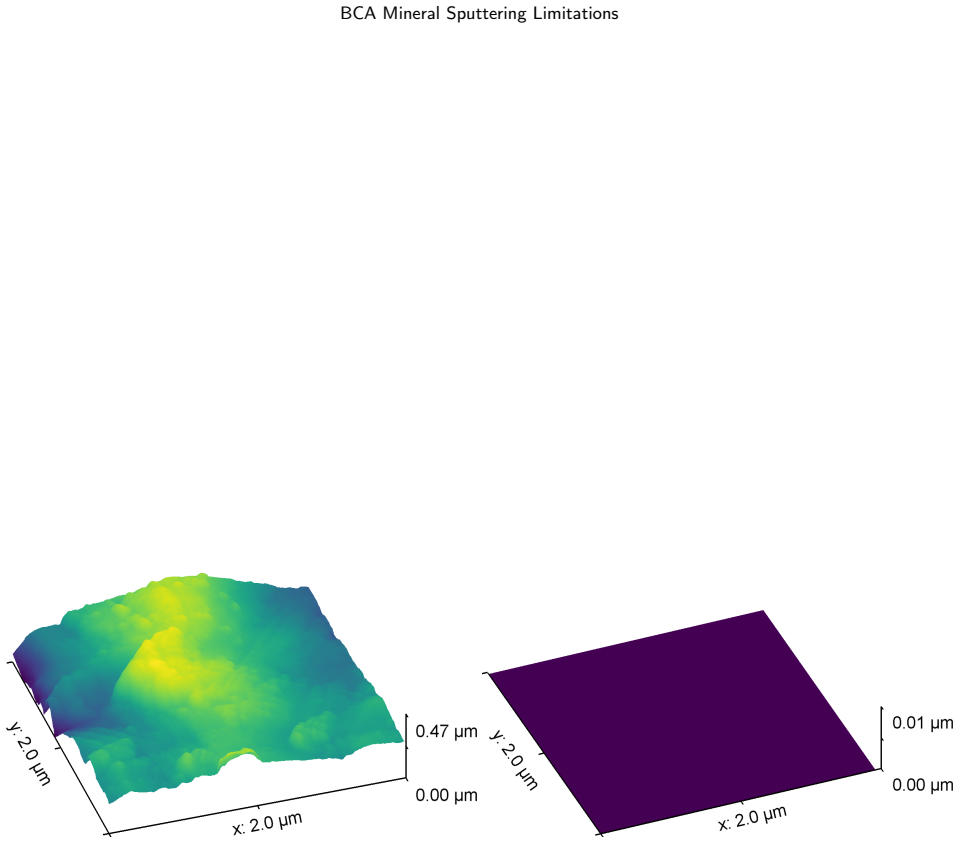
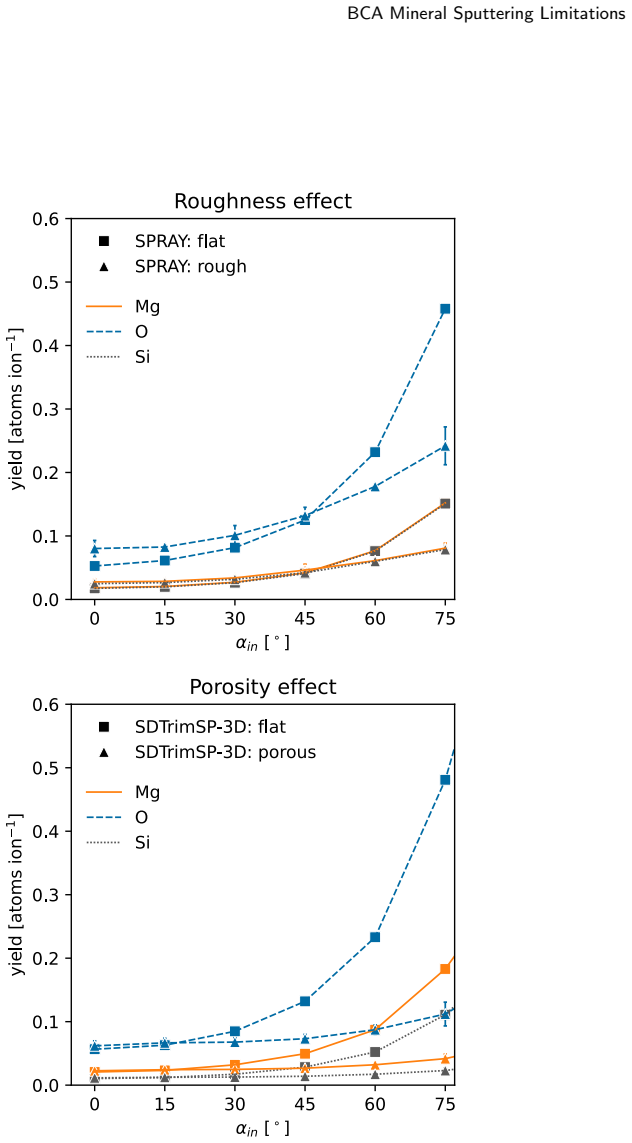
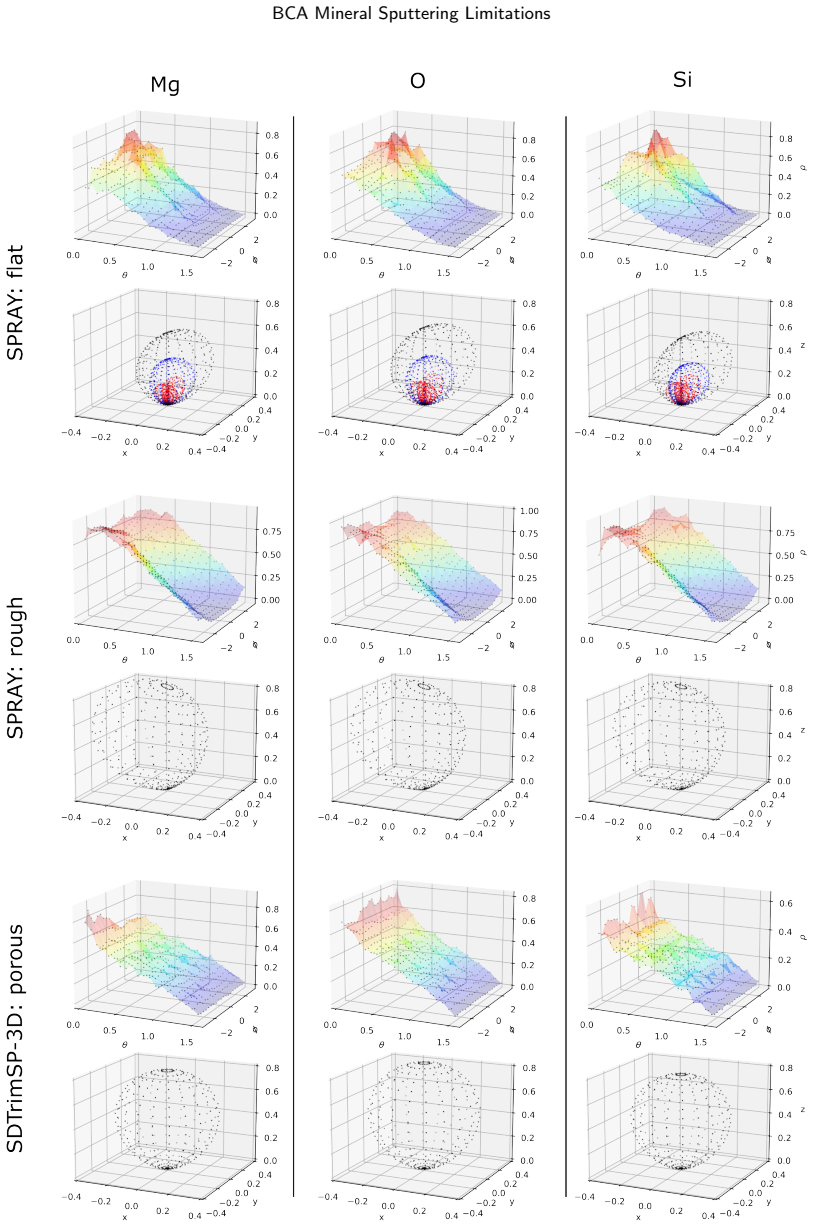
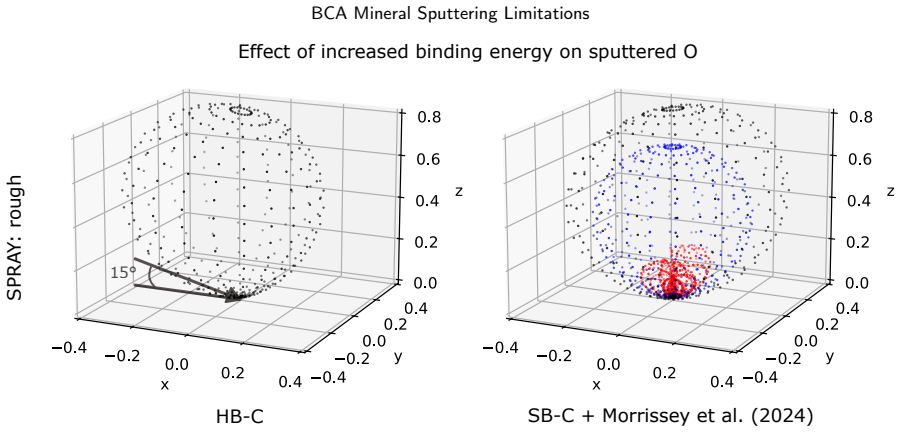
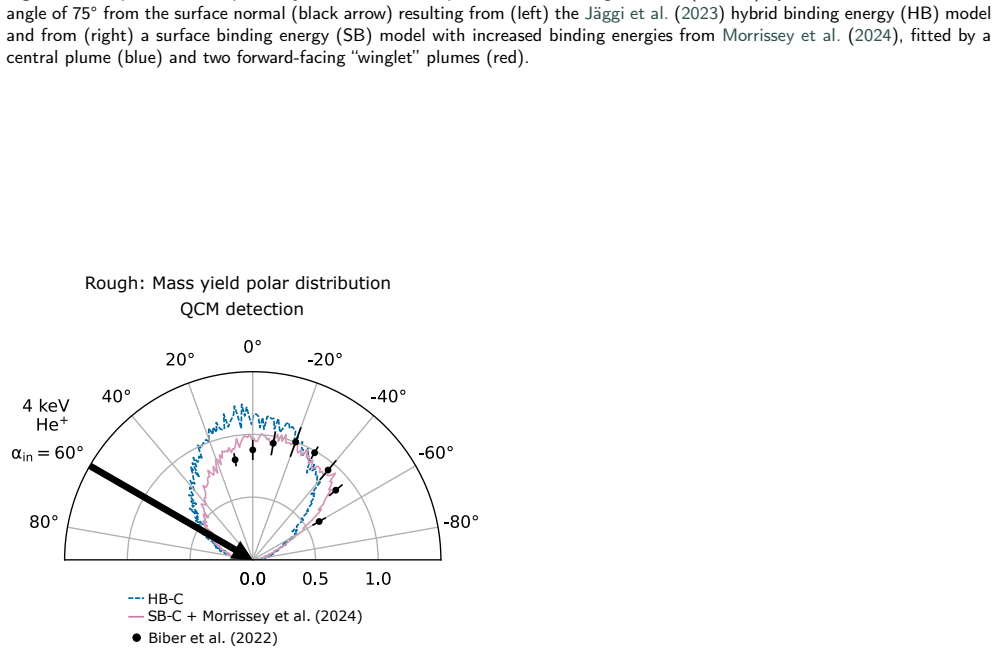
Binary collision approximation (BCA) codes are potentially powerful tools to simulate ion irradiation ejecta properties, such as the composition and the angular and energy distributions of the sputter yield. However, recent advances in the sputtering of minerals have highlighted the low predictive fidelity of BCA codes such as SDTrimSP when compared to experimental measurements. We demonstrate how a sputtering model that underestimates the forward sputtering on a flat surface at large ion incidence angles from surface normal will lead to an erroneous result for rough and porous surfaces, where most ejected particles are directed along the surface normal. We demonstrate how this is the case for an existing model, which reliably predicts sputtering mass yields from a flat enstatite surface but fails to accurately reproduce the angular distribution of sputtered particles. We then compare this to a BCA model incorporating higher surface-binding energies$-$based on a molecular dynamics description of plagioclase$-$which underestimates mass yields but significantly reduces back-sputtering and better reproduces laboratory sputter angle distributions measured at large ion incidence angles. We conclude that the BCA model cannot simultaneously reproduce both the sputter yield and the sputter angle distribution arising from He irradiation of mineral targets, either due to the inherent geometric simplicity of the BCA or because the model neglects yield-enhancing processes such as molecule and cluster sputtering. This demonstrates a structural limitation of current BCA-based models when realistic surface morphologies are considered, rather than a problem that can be resolved by parameter tuning alone.
Editorial analysis
A structured set of objections, weighed in public.
Referee Report
Summary. The manuscript claims that BCA codes such as SDTrimSP cannot simultaneously reproduce both the sputter yield and the angular distribution of sputtered particles for He irradiation of mineral targets. A standard parameterization matches experimental yields from flat enstatite surfaces but underestimates forward sputtering at large incidence angles, while a variant using higher surface-binding energies (drawn from plagioclase MD simulations) reduces back-sputtering and better matches laboratory angular distributions yet underestimates yields. The authors conclude this trade-off reveals a structural limitation of BCA models for realistic rough/porous surfaces, arising from geometric simplicity or neglected processes such as molecule/cluster sputtering, rather than a problem solvable by parameter tuning alone.
Significance. If the central comparison holds, the result is significant for planetary surface and space-weathering modeling because angular distributions control the net ejection direction on non-flat surfaces; demonstrating that yield agreement does not guarantee angular fidelity therefore affects predictions of exosphere formation and surface evolution. The work merits credit for explicitly testing an MD-informed binding-energy variant against the same experimental benchmarks and for framing the outcome as a model-structure issue rather than a fitting failure.
major comments (2)
- [Abstract] Abstract: the claim that the mismatch 'demonstrates a structural limitation ... rather than a problem that can be resolved by parameter tuning alone' is load-bearing, yet the manuscript only contrasts the default SDTrimSP run against one higher-binding-energy variant; without a systematic exploration of the surface-binding-energy parameter space (the sole free parameter listed) or other adjustable inputs, it remains possible that an intermediate value could reduce the trade-off.
- [Abstract] Abstract and results comparison: the conclusion that the observed angle-yield trade-off originates in BCA geometric simplicity or neglected cluster sputtering treats the laboratory angular-distribution data at large incidence angles as definitive ground truth. No quantitative error analysis, cross-check against independent measurements, or discussion of possible systematic effects (incidence-angle calibration, surface morphology, detector acceptance) is supplied, which directly affects whether the mismatch can be attributed to the code rather than the benchmark.
minor comments (1)
- The abstract would be clearer if the specific mineral targets (enstatite, plagioclase) and ion species (He) were named in the first sentence rather than later.
Simulated Author's Rebuttal
We thank the referee for their constructive comments and for recognizing the potential significance of our findings for planetary surface and space-weathering modeling. We address each major comment below, indicating where revisions will be made to strengthen the manuscript.
read point-by-point responses
-
Referee: [Abstract] Abstract: the claim that the mismatch 'demonstrates a structural limitation ... rather than a problem that can be resolved by parameter tuning alone' is load-bearing, yet the manuscript only contrasts the default SDTrimSP run against one higher-binding-energy variant; without a systematic exploration of the surface-binding-energy parameter space (the sole free parameter listed) or other adjustable inputs, it remains possible that an intermediate value could reduce the trade-off.
Authors: We acknowledge that the manuscript compares only the default SDTrimSP parameterization against a single MD-informed variant with elevated surface-binding energies. These represent the standard approach in the literature and a physically motivated adjustment drawn from plagioclase MD simulations. The observed trade-off (yield agreement but poor angular fidelity in the default case, versus improved angular distributions but underestimated yields in the variant) suggests that no single binding-energy value will simultaneously satisfy both metrics. To directly address the concern, the revised manuscript will include additional simulations scanning intermediate binding-energy values to demonstrate that the trade-off persists across the parameter space. revision: yes
-
Referee: [Abstract] Abstract and results comparison: the conclusion that the observed angle-yield trade-off originates in BCA geometric simplicity or neglected cluster sputtering treats the laboratory angular-distribution data at large incidence angles as definitive ground truth. No quantitative error analysis, cross-check against independent measurements, or discussion of possible systematic effects (incidence-angle calibration, surface morphology, detector acceptance) is supplied, which directly affects whether the mismatch can be attributed to the code rather than the benchmark.
Authors: The angular-distribution measurements are taken from published experimental benchmarks on He-irradiated minerals, which we adopt consistently with prior BCA validation studies. We agree that an explicit discussion of potential experimental uncertainties is warranted. The revised manuscript will add a dedicated paragraph addressing possible systematic effects, including incidence-angle calibration, surface morphology, and detector acceptance, drawing on details from the original experimental references. However, the source experiments do not report quantitative uncertainties on the angular distributions, which limits the scope of any error-propagation analysis we can perform. revision: partial
Circularity Check
No significant circularity; conclusions rest on external benchmarks
full rationale
The paper compares standard SDTrimSP runs (matching yields but mismatching angular distributions) against laboratory measurements of sputter yields and angle distributions for He on mineral targets, plus a variant using binding energies taken from separate MD simulations of plagioclase. Neither the reported yields nor the angular distributions are obtained by fitting parameters to the target observables or by redefining quantities in terms of themselves. The structural-limitation conclusion follows from the observed trade-off against independent data rather than from any self-definitional step, fitted-input prediction, or load-bearing self-citation chain. The derivation is therefore self-contained against external benchmarks.
Axiom & Free-Parameter Ledger
free parameters (1)
- surface binding energies
axioms (1)
- domain assumption Binary collision approximation accurately captures the dominant physics of ion-induced sputtering in minerals
Reference graph
Works this paper leans on
-
[1]
Monte-. Icarus , author =. 2003 , note =. doi:10.1016/S0019-1035(03)00123-4 , abstract =
-
[2]
PMag , author =. 1968 , pages =. doi:10.1080/14786436808227358 , abstract =
-
[3]
Wilhelm and M.J
R.A. Wilhelm and M.J. Deuzeman and S. Rai and W. Husinsky and P.S. Szabo and H. Biber and R. Stadlmayr and C. Cupak and J. Hundsbichler and C. Lemell and W. Möller and A. Mutzke and G. Hobler and O.O. Versolato and F. Aumayr and R. Hoekstra , doi =. On the missing single collision peak in low energy heavy ion scattering , volume =. Nuclear Instruments and...
-
[4]
On the question whether surface roughness can explain the absence of a prominent single-collision peak in. Nuclear Instruments and Methods in Physics Research Section B: Beam Interactions with Materials and Atoms , author =. 2024 , keywords =. doi:10.1016/j.nimb.2024.165442 , abstract =
-
[5]
Biber and J
H. Biber and J. Brötzner and Noah Jäggi and P. S. Szabo and J. Pichler and C. Cupak and C. Voith and B. Cserveny and A. Nenning and A. Mutzke and M. V. Moro and D. Primetzhofer and K. Mezger and A. Galli and P. Wurz and F. Aumayr , doi =. Sputtering Behavior of Rough, Polycrystalline Mercury Analogs , volume =. The Planetary Science Journal , keywords =
-
[6]
SpuBase: Solar Wind Ion Sputter Database for Modeling Purposes , volume =
Noah Jäggi and Herbert Biber and Johannes Brötzner and Paul Stefan Szabo and Andreas Mutzke and Jonathan Gasser and Friedrich Aumayr and Peter Wurz and André Galli , doi =. SpuBase: Solar Wind Ion Sputter Database for Modeling Purposes , volume =. The Planetary Science Journal , keywords =
-
[7]
Hofsäss and K
H. Hofsäss and K. Zhang and A. Mutzke , doi =. Simulation of ion beam sputtering with SDTrimSP, TRIDYN and SRIM , volume =. Applied Surface Science , keywords =
-
[8]
The Planetary Science Journal , author =
New. The Planetary Science Journal , author =. 2023 , note =. doi:10.3847/PSJ/acd056 , abstract =
-
[9]
Journal of Nuclear Materials , author =
Physical sputtering of low-. Journal of Nuclear Materials , author =. 1990 , note =. doi:10.1016/0022-3115(90)90086-3 , abstract =
-
[10]
Journal of Nuclear Materials , author =
Sputtering of low-. Journal of Nuclear Materials , author =. 1991 , note =. doi:10.1016/0022-3115(91)90010-5 , abstract =
-
[11]
Journal of Nuclear Materials , author =
Angular dependence of the sputtering yield of rough beryllium surfaces , volume =. Journal of Nuclear Materials , author =. 1999 , note =. doi:10.1016/S0022-3115(98)00648-5 , abstract =
-
[12]
Angular distributions of heavy particles emitted from a. Nuclear Inst. and Methods in Physics Research, B , author =. 1987 , note =. doi:10.1016/S0168-583X(86)80081-7 , abstract =
-
[13]
Review of Scientific Instruments , author =
An instrument for measuring angular distribution of sputtered neutral atoms , volume =. Review of Scientific Instruments , author =. 1993 , note =. doi:10.1063/1.1144215 , abstract =
-
[14]
Gnaser, Hubert , year =. Low-. doi:10.1007/BFB0110693 , note =
-
[15]
Applied Surface Science , author =
Sputter yields of rough surfaces:. Applied Surface Science , author =. 2021 , note =. doi:10.1016/J.APSUSC.2021.151204 , abstract =
-
[16]
Mutzke, Andreas and Schneider, Ralf and Eckstein, Wolfgang and Dohmen, Renate and Schmid, K and Toussaint, U von and Badelow, G , year =
-
[17]
Sputtering of rough surfaces: a. Physica Scripta , author =. 2017 , note =. doi:10.1088/1402-4896/aa90be , number =
-
[18]
Sputtering of. Surface Science , author =. 1978 , pages =. doi:10.1016/0039-6028(78)90102-4 , abstract =
-
[19]
Angular distribution of particles sputtered from. Nuclear Instruments and Methods in Physics Research Section B: Beam Interactions with Materials and Atoms , author =. 1985 , pages =. doi:10.1016/0168-583X(85)90003-5 , language =
-
[20]
Measurements of angular distributions of sputtered material as a new tool for surface-segregation studies:. Surface Science , author =. 1982 , note =. doi:10.1016/0039-6028(82)90127-3 , abstract =
-
[21]
Nuclear Instruments and Methods in Physics Research , author =
Surface segregation during alloy sputtering and implantation , volume =. Nuclear Instruments and Methods in Physics Research , author =. 1983 , note =. doi:10.1016/0167-5087(83)90843-8 , abstract =
-
[22]
The Planetary Science Journal , author =
The. The Planetary Science Journal , author =. 2025 , note =. doi:10.3847/PSJ/ad95fa , abstract =
-
[23]
The Planetary Science Journal , author =
Establishing a. The Planetary Science Journal , author =. 2023 , note =. doi:10.3847/PSJ/ACC587 , abstract =
-
[24]
Journal of Geophysical Research: Space Physics , author =
Influence of spacecraft outgassing on the exploration of tenuous atmospheres with in situ mass spectrometry , volume =. Journal of Geophysical Research: Space Physics , author =. 2010 , note =. doi:10.1029/2010JA015734 , abstract =
-
[25]
Planetary and Space Science , author =
Self-consistent modelling of. Planetary and Space Science , author =. 2010 , note =. doi:10.1016/J.PSS.2010.08.003 , abstract =
-
[26]
Emission of energetic neutral atoms from water ice under. Icarus , author =. 2016 , keywords =. doi:10.1016/j.icarus.2015.12.043 , abstract =
-
[27]
Angular dependence of the sputtering yield of water ice by 100. Surface Science , author =. 2005 , keywords =. doi:10.1016/j.susc.2005.05.007 , abstract =
-
[28]
Monte. Icarus , author =. 2005 , note =. doi:10.1016/J.ICARUS.2005.02.013 , abstract =
-
[29]
Angular, energy, and mass distribution of sputtered particles , journal =
Hofer, Wolfgang O , year =. Angular, energy, and mass distribution of sputtered particles , journal =
-
[30]
Geophysical Research Letters , author =
Deducing. Geophysical Research Letters , author =. 2022 , note =. doi:10.1029/2022GL101232 , number =
-
[31]
Space Science Reviews , author =
Particles and. Space Science Reviews , author =. 2022 , keywords =. doi:10.1007/s11214-022-00875-6 , abstract =
-
[32]
Creation of. Icarus , author =. 2021 , keywords =. doi:10.1016/j.icarus.2021.114492 , language =
-
[33]
Journal of Geophysical Research: Planets , author =
Energetic. Journal of Geophysical Research: Planets , author =. 2023 , note =. doi:10.1029/2023JE007911 , language =
-
[34]
and Sandoval, Luis and Urbassek, Herbert M
Nietiadi, Maureen L. and Sandoval, Luis and Urbassek, Herbert M. and Möller, Wolfhard , month = jul, year =. Sputtering of. Physical Review B , publisher =. doi:10.1103/PhysRevB.90.045417 , number =
-
[35]
Journal of Applied Physics , author =
Absolute doubly differential angular sputtering yields for 20. Journal of Applied Physics , author =. 2024 , note =. doi:10.1063/5.0184417/3000645 , abstract =
-
[36]
The Planetary Science Journal , author =
Solar. The Planetary Science Journal , author =. 2024 , note =. doi:10.3847/PSJ/ad8eaf , abstract =
-
[37]
Journal of Geophysical Research: Planets , author =
Experimental. Journal of Geophysical Research: Planets , author =. 2020 , note =. doi:10.1029/2020JE006583 , abstract =
-
[38]
The Astrophysical Journal , author =
Dynamic. The Astrophysical Journal , author =. 2020 , keywords =. doi:10.3847/1538-4357/ab7008 , number =
-
[39]
Solar wind sputtering of wollastonite as a lunar analogue material –. Icarus , author =. 2018 , note =. doi:10.1016/J.ICARUS.2018.05.028 , abstract =
-
[40]
Solar wind. Nuclear Instruments and Methods in Physics Research, Section B: Beam Interactions with Materials and Atoms , author =. 2020 , note =. doi:10.1016/j.nimb.2020.07.021 , abstract =
-
[41]
SPRAY – SPuttering simulation via RAYtracing of particles , DOI=
Brötzner, Johannes and Burazor Domazet, Benjamin and Cupak, Christian and Wilhelm, Richard Arthur and Aumayr, Friedrich , year=. SPRAY – SPuttering simulation via RAYtracing of particles , DOI=
-
[42]
Mutzke, A. and Toussaint, U. V. and Eckstein, W. and Dohmen, R. and Schmid, K. , language =. SDTrimSP Version 7.00 , publisher =. doi:10.17617/2.3577532 , url =
-
[43]
The lunar surface-exosphere connection:. Icarus , author =. 2015 , note =. doi:10.1016/J.ICARUS.2014.11.032 , abstract =
-
[44]
Absolute doubly differential angular sputtering yields for ions impacting a loose powder , language =
Bu, C and Verkercke, S and Berhanu, D and Bostick, B C and Chillrud, S N and Clouter-Gergen, B A and Ebel, D S and Hahn, I and Harlow, G E and Ivanov, D A and Lewis, J R and Morrissey, L S and Ross, J and Urbain, X and Savin, D W , month = jul, year =. Absolute doubly differential angular sputtering yields for ions impacting a loose powder , language =
-
[46]
Surfaces and Interfaces , volume=
Analytical model for the sputtering of rough surfaces , author=. Surfaces and Interfaces , volume=. 2022 , publisher=
2022
-
[47]
Experimental and simulated sputtering of
Szabo, Paul Stefan , year =. Experimental and simulated sputtering of. doi:10.34726/hss.2017.37338 , school =
-
[48]
Journal of Nuclear Materials , author =
Sputtering of nanostructured tungsten and comparison to modelling with. Journal of Nuclear Materials , author =. 2020 , note =. doi:10.1016/j.jnucmat.2020.152019 , abstract =
-
[49]
Geophysical Research Letters , author =
Scattering function for energetic neutral hydrogen atoms off the lunar surface , volume =. Geophysical Research Letters , author =. 2011 , note =. doi:10.1029/2011GL049362 , abstract =
-
[50]
Journal of Geophysical Research: Planets , author =
Updated. Journal of Geophysical Research: Planets , author =. 2025 , note =. doi:10.1029/2025JE009058 , abstract =
-
[51]
Schaible, M. J. and Dukes, C. A. and Hutcherson, A. C. and Lee, P. and Collier, M. R. and Johnson, R. E. , month = oct, year =. Solar. Journal of Geophysical Research: Planets , publisher =. doi:10.1002/2017JE005359 , abstract =
-
[52]
Brötzner, Johannes and Biber, Herbert and Szabo, Paul Stefan and Jäggi, Noah and Fuchs, Lea and Nenning, Andreas and Fellinger, Martina and Nagy, Gyula and Pitthan, Eduardo and Primetzhofer, Daniel and Mutzke, Andreas and Wilhelm, Richard Arthur and Wurz, Peter and Galli, André and Aumayr, Friedrich , month = jul, year =. Solar wind erosion of lunar regol...
-
[53]
Computer simulation of ion-solid interactions , volume =
Eckstein, Wolfgang , year =. Computer simulation of ion-solid interactions , volume =. doi:10.1007/978-3-642-73513-4 , publisher =
-
[54]
Behrisch, Rainer and Andersen, H. H. and Bay, H.L. and Robinson, M. T. and Sigmund, H.E. and R, Roosendaal , year =. Sputtering by particle bombardment
-
[55]
Robinson, Mark T. , editor =. Theoretical aspects of monocrystal sputtering , isbn =. Sputtering by. 1981 , keywords =. doi:10.1007/3540105212_8 , language =
-
[56]
Verkercke, S. and Chaufray, J.-Y. and Leblanc, F. and Bringa, E. M. and Tramontina, D. and Morrissey, L. and Woodson, A. , month = oct, year =. Effects of. The Planetary Science Journal , publisher =. doi:10.3847/PSJ/acf6bd , abstract =
-
[57]
Sigmund, Peter , month = aug, year =. Theory of sputtering. Physical Review , publisher =. doi:10.1103/PhysRev.184.383 , abstract =
-
[58]
Journal of Applied Physics , author =
Theoretical ion sputtering yields from loose powders using a multiscale. Journal of Applied Physics , author =. 2026 , pages =. doi:10.1063/5.0316828 , abstract =
-
[59]
Clouter-Gergen, Ben A. and Bu, C. and Mutzke, A. and Verkercke, S. and Morrissey, Liam S. , month = may, year =. Investigating. The Planetary Science Journal , publisher =. doi:10.3847/PSJ/ae6a92 , abstract =
-
[60]
1991 , note =
Lunar sourcebook-. 1991 , note =
1991
-
[61]
McCoy, Timothy J. and Peplowski, Patrick N. and McCubbin, Francis M. and Weider, Shoshana Z. , editor =. The. 2018 , pages =. doi:10.1017/9781316650684 , booktitle =
discussion (0)
Sign in with ORCID, Apple, or X to comment. Anyone can read and Pith papers without signing in.