Recalibration of the Hα surface brightness-radius relation for planetary nebulae using Gaia DR3: new distances and the Milky Way oxygen radial gradient
Pith reviewed 2026-05-21 22:03 UTC · model grok-4.3
The pith
Gaia DR3 recalibration shows the Milky Way's oxygen gradient breaks near the solar radius.
A machine-rendered reading of the paper's core claim, the machinery that carries it, and where it could break.
Core claim
After recalibrating the H alpha surface brightness-radius relation with Gaia DR3 parallaxes, distances derived for 1130 planetary nebulae yield an oxygen-to-hydrogen radial gradient in the Galactic disk that is best described by segmented linear fits with a break near the solar radius of about 8 kpc, showing a flatter or slightly positive slope inward and a steeper negative slope outward. These breaks may arise from the superposition of distinct stellar populations associated with the thin and thick disks or from changes in star formation efficiency linked to the Galactic bar and the corotation resonance of the spiral arms. The two-dimensional O/H map in the Galactic plane further reveals a
What carries the argument
The recalibrated H alpha surface brightness-radius relation that converts observed surface brightness and angular size into physical radius and distance for planetary nebulae.
If this is right
- The O/H radial gradient changes slope near the solar radius, being flatter or slightly positive inside 8 kpc and steeper negative outside.
- This break may reflect changes in star formation efficiency driven by the Galactic bar or the corotation resonance of the spiral arms.
- The breaks may result from the superposition of distinct stellar populations associated with the thin and thick disks.
- The two-dimensional O/H distribution shows modest azimuthal asymmetry with enhanced abundances near the bar at positive longitudes and a bimodal structure between inner and outer solar regions.
Where Pith is reading between the lines
- Chemical-evolution models of the Milky Way must now incorporate non-axisymmetric structures such as the bar to reproduce the observed break in the gradient.
- The same recalibration approach could be tested on other elemental gradients or on H II regions to check whether the break is a general feature of the disk.
- If the inner positive slope holds, it would imply net inward migration of metal-rich gas or stars in the central few kiloparsecs.
Load-bearing premise
The recalibrated H alpha surface brightness-radius relation derived from a subset of PNe with Gaia DR3 parallaxes can be reliably applied to the full sample of 1,130 PNe without introducing systematic biases in the derived distances or the subsequent gradient fits.
What would settle it
Independent high-precision distances for several hundred of the same 1130 planetary nebulae, obtained from a future Gaia data release or from spectroscopic methods, that differ systematically from the recalibrated values would falsify the gradient results.
Figures



read the original abstract
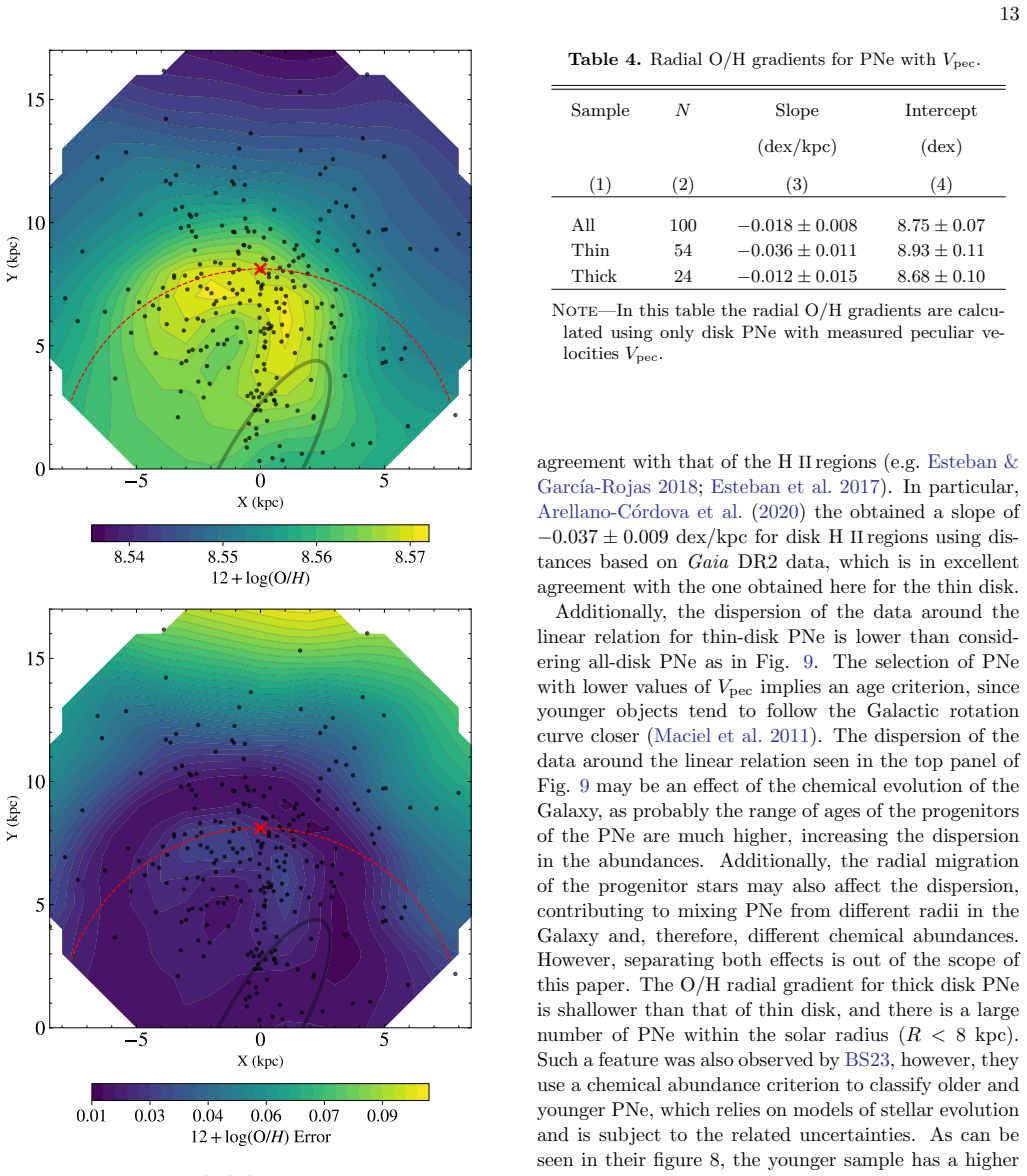
The spatial distribution of chemical elements in the Galactic disk provides key constraints on models of galaxy evolution. However, studies using planetary nebulae (PNe) as tracers have been historically limited by large uncertainties in their distances. To overcome the long-standing distance uncertainties, we recalibrated the H$\alpha$ surface brightness-radius relation from Frew et al. with Gaia DR3 parallaxes, deriving distances for 1,130 PNe of which 415 have Bayesian distances based on Gaia DR3 parallaxes. The O/H radial gradient for 231 disk PNe is fitted considering three models: a single linear gradient and segmented linear fits with one or two breaks. The segmented fits indicate a change in slope near the solar radius (R ~8 kpc), with a flatter or slightly positive gradient inward and a steeper negative gradient outward. This feature may reflect changes in star formation efficiency driven by the Galactic bar or the corotation resonance of the spiral arms. The breaks in the metallicity radial gradients observed in this work may result from the superposition of distinct stellar populations associated with the thin and thick disks. The two-dimensional O/H distribution in the Galactic plane supports the adopted distances and reveals modest azimuthal asymmetry, with enhanced abundances near the bar at positive longitudes, and a bimodal abundance structure between the inner and outer solar regions. Our results provide new constraints on the chemical evolution of the Milky Way, the impact of non-axisymmetric structures, and the possible existence of distinct radial abundance regimes across the Galactic disk.
Editorial analysis
A structured set of objections, weighed in public.
Referee Report
Summary. The manuscript recalibrates the Hα surface brightness-radius relation of Frew et al. using Gaia DR3 parallaxes, derives distances for 1,130 planetary nebulae (415 with direct Bayesian Gaia distances), and fits the O/H radial gradient for 231 disk PNe. It compares a single linear gradient to segmented linear models with one or two breaks, reporting a slope change near R ≈ 8 kpc (flatter or slightly positive inward, steeper negative outward) that may trace the Galactic bar or spiral-arm corotation; the work also presents the 2D O/H distribution in the plane.
Significance. If the recalibrated distances prove unbiased, the segmented gradient and azimuthal asymmetry results would supply useful new constraints on Milky Way chemical evolution, the role of non-axisymmetric structures, and possible thin/thick-disk population differences. The Gaia-based recalibration itself is a clear methodological advance over purely statistical distance scales.
major comments (2)
- [§4] §4 (gradient fitting and sample): the claim that the segmented model with a break near R ~ 8 kpc is physically meaningful rests on distances for the 231 PNe that are largely extrapolated from the recalibrated SBR relation. The manuscript does not report a direct test (e.g., residuals versus Galactocentric radius or versus the 415-object Gaia subset alone) that would demonstrate the break is not an artifact of position-dependent bias in the calibration sample.
- [§3] §3 (recalibration procedure): the selection criteria and properties (morphology, luminosity, spatial distribution) of the Gaia-parallax subset used to recalibrate the SBR relation are not compared in detail to the full 1,130-PN sample. Without this comparison or a cross-validation exercise, the assumption that the relation applies uniformly to inner-bar and outer-disk PNe remains untested and load-bearing for the reported gradient break.
minor comments (2)
- [Abstract] Abstract and §5: the statement that the 2D O/H map 'supports the adopted distances' would be strengthened by an explicit reference to the relevant figure or table showing the azimuthal asymmetry.
- [Throughout] Notation: ensure consistent use of R (or R_g) for Galactocentric radius and explicit units in all tables and equations describing the SBR relation and gradient fits.
Simulated Author's Rebuttal
We thank the referee for their detailed and constructive report. We address the major comments below and have updated the manuscript accordingly to include additional tests and comparisons.
read point-by-point responses
-
Referee: [§4] §4 (gradient fitting and sample): the claim that the segmented model with a break near R ~ 8 kpc is physically meaningful rests on distances for the 231 PNe that are largely extrapolated from the recalibrated SBR relation. The manuscript does not report a direct test (e.g., residuals versus Galactocentric radius or versus the 415-object Gaia subset alone) that would demonstrate the break is not an artifact of position-dependent bias in the calibration sample.
Authors: We agree that demonstrating the robustness of the break against potential biases in the extrapolated distances is important. In the revised manuscript, we have added an analysis of the SBR relation residuals as a function of Galactocentric radius for the 415-object Gaia calibration sample. We also include a new figure and discussion showing the O/H gradient fit performed solely on the subset of PNe with direct Gaia distances. This restricted fit exhibits a similar change in slope near R ≈ 8 kpc, supporting that the feature is not an artifact of the extrapolation. revision: yes
-
Referee: [§3] §3 (recalibration procedure): the selection criteria and properties (morphology, luminosity, spatial distribution) of the Gaia-parallax subset used to recalibrate the SBR relation are not compared in detail to the full 1,130-PN sample. Without this comparison or a cross-validation exercise, the assumption that the relation applies uniformly to inner-bar and outer-disk PNe remains untested and load-bearing for the reported gradient break.
Authors: We acknowledge the need for a more detailed comparison to justify the extrapolation. The revised manuscript now includes a dedicated paragraph in Section 3 comparing the Gaia-parallax subset to the full sample in terms of morphology, luminosity, and spatial distribution. Additionally, we have performed a cross-validation test by randomly splitting the calibration sample into training and validation sets and verifying the consistency of the recalibrated relation. These additions strengthen the case for applying the relation across the disk. revision: yes
Circularity Check
No significant circularity in derivation chain
full rationale
The paper calibrates the Hα surface brightness-radius relation on a Gaia DR3 parallax subset (independent external data), derives distances for the full sample of 1130 PNe, and then fits the O/H radial gradient to a subset of 231 disk PNe. The gradient parameters are outputs only and do not enter the calibration step; no equation or claim reduces the final segmented-fit result to the calibration inputs by construction. No self-citation is invoked as a uniqueness theorem or load-bearing premise for the slope-break claim, and the derivation remains self-contained against the external Gaia benchmark.
Axiom & Free-Parameter Ledger
free parameters (1)
- Parameters of the Hα surface brightness-radius relation
axioms (1)
- domain assumption The Hα surface brightness-radius relation holds for planetary nebulae in the sample
Lean theorems connected to this paper
-
IndisputableMonolith/Foundation/RealityFromDistinction.leanreality_from_one_distinction unclear?
unclearRelation between the paper passage and the cited Recognition theorem.
recalibrated the Hα surface brightness–radius relation from Frew et al. with Gaia DR3 parallaxes, deriving distances for 1,130 PNe... segmented fits indicate a change in slope near the solar radius (R ~8 kpc)
What do these tags mean?
- matches
- The paper's claim is directly supported by a theorem in the formal canon.
- supports
- The theorem supports part of the paper's argument, but the paper may add assumptions or extra steps.
- extends
- The paper goes beyond the formal theorem; the theorem is a base layer rather than the whole result.
- uses
- The paper appears to rely on the theorem as machinery.
- contradicts
- The paper's claim conflicts with a theorem or certificate in the canon.
- unclear
- Pith found a possible connection, but the passage is too broad, indirect, or ambiguous to say the theorem truly supports the claim.
Reference graph
Works this paper leans on
-
[1]
thebibliography [1] 20pt to REFERENCES 6pt =0pt \@twocolumntrue 12pt -12pt 10pt plus 3pt =0pt =0pt =1pt plus 1pt =0pt =0pt -12pt =13pt plus 1pt =20pt =13pt plus 1pt \@M =10000 =-1.0em =0pt =0pt 0pt =0pt =1.0em @enumiv\@empty 10000 10000 `\.\@m \@noitemerr \@latex@warning Empty `thebibliography' environment \@ifnextchar \@reference \@latexerr Missing key o...
work page 2017
-
[2]
1992, Strasbourg - ESO catalogue of galactic planetary nebulae
Acker , A., Marcout , J., Ochsenbein , F., Stenholm , B., & Tylenda , R. 1992, Strasbourg - ESO catalogue of galactic planetary nebulae. Part 1; Part 2 (Garching: European Southern Observatory)
work page 1992
-
[3]
1973, Akad \'e miai Kiad \'o , Budapest
Akaike, H. 1973, Akad \'e miai Kiad \'o , Budapest
work page 1973
-
[4]
Ali , A., Algarni , E., Mindil , A., & Alghamdi , S. A. 2022, Research in Astronomy and Astrophysics, 22, 10.1088/1674-4527/ac7545
-
[5]
Andrievsky , S. M., Martin , R. P., Kovtyukh , V. V., Korotin , S. A., & L \'e pine , J. R. D. 2016, , 461, 4256, 10.1093/mnras/stw1631
-
[6]
Z., Esteban , C., Garc \' a-Rojas , J., & M \'e ndez-Delgado , J
Arellano-C \'o rdova , K. Z., Esteban , C., Garc \' a-Rojas , J., & M \'e ndez-Delgado , J. E. 2020, , 496, 1051, 10.1093/mnras/staa1523
-
[7]
Astropy Collaboration , Price-Whelan , A. M., Lim , P. L., & et al. 2022, , 935, 167, 10.3847/1538-4357/ac7c74
work page internal anchor Pith review doi:10.3847/1538-4357/ac7c74 2022
-
[8]
Bailer-Jones , C. A. L. 2015, , 127, 994, 10.1086/683116
-
[9]
Bailer-Jones , C. A. L., Rybizki , J., Fouesneau , M., Demleitner , M., & Andrae , R. 2021, , 161, 147, 10.3847/1538-3881/abd806
work page internal anchor Pith review doi:10.3847/1538-3881/abd806 2021
-
[10]
Balser , D. S., Rood , R. T., Bania , T. M., & Anderson , L. D. 2011, , 738, 27, 10.1088/0004-637X/738/1/27
-
[11]
Balser , D. S., Wenger , T. V., Anderson , L. D., & Bania , T. M. 2015, , 806, 199, 10.1088/0004-637X/806/2/199
-
[12]
Bensby , T., Feltzing , S., & Oey , M. S. 2014, , 562, A71, 10.1051/0004-6361/201322631
-
[13]
Bresolin , F., Ryan-Weber , E., Kennicutt , R. C., & Goddard , Q. 2009, , 695, 580, 10.1088/0004-637X/695/1/580
-
[14]
2023, , 680, A104, 10.1051/0004-6361/202347519
Bucciarelli , B., & Stanghellini , L. 2023, , 680, A104, 10.1051/0004-6361/202347519
-
[15]
Bundy , K., Bershady , M. A., Law , D. R., & et al. 2015, , 798, 7, 10.1088/0004-637X/798/1/7
work page internal anchor Pith review doi:10.1088/0004-637x/798/1/7 2015
-
[16]
2002, Model Selection and Multimodel Inference : A Practical Information-Theoretic Approach, 2nd edn
Burnham, K., & Anderson, D. 2002, Model Selection and Multimodel Inference : A Practical Information-Theoretic Approach, 2nd edn. (New York, NY: Springer New York : Imprint: Springer)
work page 2002
-
[17]
Cardoso , A. F. S., Cavichia , O., Moll \'a , M., & S \'a nchez-Menguiano , L. 2025, , 980, 45, 10.3847/1538-4357/ad9eab
-
[18]
2019, , 873, 107, 10.3847/1538-4357/aaf28e
Carigi , L., Peimbert , M., & Peimbert , A. 2019, , 873, 107, 10.3847/1538-4357/aaf28e
-
[19]
W., Yong , D., Teixera de Almeida , M
Carney , B. W., Yong , D., Teixera de Almeida , M. L., & Seitzer , P. 2005, , 130, 1111, 10.1086/432541
-
[20]
Cavichia , O., Moll \'a , M., Costa , R. D. D., & Maciel , W. J. 2014, , 437, 3688, 10.1093/mnras/stt2164
-
[21]
Chornay , N., & Walton , N. A. 2020, , 638, A103, 10.1051/0004-6361/202037554
-
[22]
2021, , 656, A110, 10.1051/0004-6361/202142008
---. 2021, , 656, A110, 10.1051/0004-6361/202142008
-
[23]
S., Monteiro , H., L \'e pine , J
Dias , W. S., Monteiro , H., L \'e pine , J. R. D., & Barros , D. A. 2019, , 486, 5726, 10.1093/mnras/stz1196
- [24]
-
[25]
Easeman , B., Schady , P., Wuyts , S., & Yates , R. M. 2022, , 511, 371, 10.1093/mnras/stac017
-
[26]
Esteban , C., Carigi , L., Copetti , M. V. F., et al. 2013, , 433, 382, 10.1093/mnras/stt730
-
[27]
2017, , 471, 987, 10.1093/mnras/stx1624
Esteban , C., Fang , X., Garc \' a-Rojas , J., & Toribio San Cipriano , L. 2017, , 471, 987, 10.1093/mnras/stx1624
-
[28]
2018, , 478, 2315, 10.1093/mnras/sty1168
Esteban , C., & Garc \' a-Rojas , J. 2018, , 478, 2315, 10.1093/mnras/sty1168
-
[29]
Statistical Methods for Astronomy
Feigelson , E. D., & Babu , G. J. 2012, Modern Statistical Methods for Astronomy , 10.48550/arXiv.1205.2064
work page internal anchor Pith review Pith/arXiv arXiv doi:10.48550/arxiv.1205.2064 2012
-
[30]
Fern \'a ndez-Mart \' n , A., P \'e rez-Montero , E., V \' lchez , J. M., & Mampaso , A. 2017, , 597, A84, 10.1051/0004-6361/201628423
-
[31]
2016, MNRAS, 462, L41, doi: 10.1093/mnrasl/slw120
Fragkoudi , F., Athanassoula , E., & Bosma , A. 2016, , 462, L41, 10.1093/mnrasl/slw120
-
[32]
Frew , D. J., Boji c i \'c , I. S., & Parker , Q. A. 2013, , 431, 2, 10.1093/mnras/sts393
-
[33]
Frew , D. J., Parker , Q. A., & Boji c i \'c , I. S. 2016, , 455, 1459, 10.1093/mnras/stv1516
-
[34]
Gaia Collaboration , Brown , A. G. A., Vallenari , A., Prusti , T., & et al. 2018, , 616, A1, 10.1051/0004-6361/201833051
work page internal anchor Pith review doi:10.1051/0004-6361/201833051 2018
-
[35]
Gaia Collaboration , Prusti , T., de Bruijne , J. H. J., Brown , A. G. A., & et al. 2016, , 595, A1, 10.1051/0004-6361/201629272
-
[36]
2023 a , , 674, A38, 10.1051/0004-6361/202243511
Gaia Collaboration , Recio-Blanco , A., Kordopatis , G., de Laverny , P., & et al. 2023 a , , 674, A38, 10.1051/0004-6361/202243511
-
[37]
Gaia Collaboration , Vallenari , A., Brown , A. G. A., Prusti , T., & et al. 2023 b , , 674, A1, 10.1051/0004-6361/202243940
-
[38]
2014, , 566, A37, 10.1051/0004-6361/201323198
Genovali , K., Lemasle , B., Bono , G., et al. 2014, , 566, A37, 10.1051/0004-6361/201323198
-
[39]
Gentile Fusillo , N. P., Tremblay , P. E., Cukanovaite , E., et al. 2021, , 508, 3877, 10.1093/mnras/stab2672
-
[40]
K., Pilkington , K., Brook , C
Gibson , B. K., Pilkington , K., Brook , C. B., Stinson , G. S., & Bailin , J. 2013, , 554, A47, 10.1051/0004-6361/201321239
-
[41]
2021, , 656, A51, 10.1051/0004-6361/202141916
Gonz \'a lez-Santamar \' a , I., Manteiga , M., Manchado , A., et al. 2021, , 656, A51, 10.1051/0004-6361/202141916
-
[42]
2018, , 615, L15, 10.1051/0004-6361/201833718
GRAVITY Collaboration , Abuter , R., Amorim , A., Anugu , N., & et al. 2018, , 615, L15, 10.1051/0004-6361/201833718
-
[43]
M., Schlafly , E., Zucker , C., Speagle , J
Green , G. M., Schlafly , E., Zucker , C., Speagle , J. S., & Finkbeiner , D. 2019, , 887, 93, 10.3847/1538-4357/ab5362
work page internal anchor Pith review doi:10.3847/1538-4357/ab5362 2019
-
[44]
Hayden , M. R., Holtzman , J. A., & et al. 2014, , 147, 116, 10.1088/0004-6256/147/5/116
-
[45]
Henry , R. B. C., Kwitter , K. B., Jaskot , A. E., Balick , B., & et al. 2010, , 724, 748, 10.1088/0004-637X/724/1/748
-
[46]
Henry , R. B. C., & Worthey , G. 1999, , 111, 919, 10.1086/316403
-
[47]
2024, , 60, 227, 10.22201/ia.01851101p.2024.60.02.03
Hern \'a ndez-Ju \'a rez , D., Rodr \' guez , M., & Pe \ n a , M. 2024, , 60, 227, 10.22201/ia.01851101p.2024.60.02.03
-
[48]
Jordi , C., Gebran , M., Carrasco , J. M., et al. 2010, , 523, A48, 10.1051/0004-6361/201015441
-
[49]
2018, , 616, L2, 10.1051/0004-6361/201833647
Kimeswenger , S., & Barr \' a , D. 2018, , 616, L2, 10.1051/0004-6361/201833647
- [50]
-
[51]
2015, , 580, A127, 10.1051/0004-6361/201424599
Kubryk , M., Prantzos , N., & Athanassoula , E. 2015, , 580, A127, 10.1051/0004-6361/201424599
-
[52]
L \'e pine , J. R. D., Cruz , P., Scarano , Jr., S., et al. 2011, , 417, 698, 10.1111/j.1365-2966.2011.19314.x
-
[53]
2018, A&A, 616, A2, doi: 10.1051/0004-6361/201832727
Lindegren , L., Hern \'a ndez , J., Bombrun , A., & et al. 2018, , 616, A2, 10.1051/0004-6361/201832727
-
[54]
Lindegren , L., Klioner , S. A., Hern \'a ndez , J., & et al. 2021, , 649, A2, 10.1051/0004-6361/202039709
-
[55]
L \'o pez-Cob \'a , C., S \'a nchez , S. F., Lin , L., et al. 2022, , 939, 40, 10.3847/1538-4357/ac937b
-
[56]
Abundance gradients in the galactic disk: space and time variations
Maciel , W. J., & Costa , R. D. D. 2009, in IAU Symposium, Vol. 254, IAU Symposium, ed. J. Andersen , Nordstr \"o ara , B. m , & J. Bland-Hawthorn , 38P. 0806.3443
work page internal anchor Pith review Pith/arXiv arXiv 2009
-
[57]
Time variation of the O/H radial gradient in the galactic disk based on planetary nebulae
Maciel , W. J., & Costa , R. D. D. 2013, , 49, 333. 1308.1884
work page internal anchor Pith review Pith/arXiv arXiv 2013
-
[58]
Radial abundance gradients from planetary nebulae at different distances from the galactic plane
Maciel , W. J., Costa , R. D. D., & Cavichia , O. 2015, , 51, 165. 1505.07640
work page internal anchor Pith review Pith/arXiv arXiv 2015
-
[59]
Kinematic ages of central stars of planetary nebulae
Maciel , W. J., Rodrigues , T. S., & Costa , R. D. D. 2011, , 47, 401, 10.48550/arXiv.1108.5307
work page internal anchor Pith review Pith/arXiv arXiv doi:10.48550/arxiv.1108.5307 2011
-
[60]
2023, , 669, A119, 10.1051/0004-6361/202244957
Magrini , L., Viscasillas V \'a zquez , C., Spina , L., & et al. 2023, , 669, A119, 10.1051/0004-6361/202244957
-
[61]
Marshall , D. J., Robin , A. C., Reyl \'e , C., Schultheis , M., & Picaud , S. 2006, , 453, 635, 10.1051/0004-6361:20053842
-
[62]
Martin , R. P., Andrievsky , S. M., Kovtyukh , V. V., et al. 2015, , 449, 4071, 10.1093/mnras/stv590
-
[63]
McCall , M. L., Rybski , P. M., & Shields , G. A. 1985, , 57, 1, 10.1086/190994
-
[64]
E., Amayo , A., Arellano-C \'o rdova , K
M \'e ndez-Delgado , J. E., Amayo , A., Arellano-C \'o rdova , K. Z., et al. 2022, , 510, 4436, 10.1093/mnras/stab3782
-
[65]
H., Sbordone , L., Rojas-Arriagada , A., et al
Minniti , J. H., Sbordone , L., Rojas-Arriagada , A., et al. 2020, , 640, A92, 10.1051/0004-6361/202037575
-
[66]
Moll \'a , M., D \' az , \'A . I., Cavichia , O., & et al. 2019, , 482, 3071, 10.1093/mnras/sty2877
-
[67]
Monteiro , H., Barros , D. A., Dias , W. S., & L \'e pine , J. R. D. 2021, Frontiers in Astronomy and Space Sciences, 8, 62, 10.3389/fspas.2021.656474
-
[68]
Murphy , B. S. 2014, in AGU Fall Meeting Abstracts, Vol. 2014, AGU Fall Meeting Abstracts, H51K--0753
work page 2014
-
[69]
Pagomenos , G. J. S., Bernard-Salas , J., & Pottasch , S. R. 2018, , 615, A29, 10.1051/0004-6361/201730861
-
[70]
Parker , Q. A., Acker , A., Frew , D., & et al. 2006, , 373, 79, 10.1111/j.1365-2966.2006.10950.x
-
[71]
2021, Journal of Open Source Software, 6, 3859, 10.21105/joss.03859
Pilgrim, C. 2021, Journal of Open Source Software, 6, 3859, 10.21105/joss.03859
-
[72]
Pilyugin , L. S., & Tautvai s ien \. e , G. 2024, , 682, A41, 10.1051/0004-6361/202347032
-
[73]
Reddy , A. B. S., Lambert , D. L., & Giridhar , S. 2016, , 463, 4366, 10.1093/mnras/stw2287
-
[74]
Reid , M. J., Menten , K. M., Brunthaler , A., et al. 2019, , 885, 131, 10.3847/1538-4357/ab4a11
-
[75]
F., et al., 2012, @doi [ ] 10.1051/0004-6361/201117353 , http://adsabs.harvard.edu/abs/2012A
S \'a nchez , S. F., Kennicutt , R. C., Gil de Paz , A., & et al. 2012, , 538, A8, 10.1051/0004-6361/201117353
-
[76]
S \'a nchez , S. F., Rosales-Ortega , F. F., Iglesias-P \'a ramo , J., & et al. 2014, , 563, A49, 10.1051/0004-6361/201322343
-
[77]
S \'a nchez-Menguiano , L., S \'a nchez , S. F., P \'e rez , I., & et al. 2016, , 587, A70, 10.1051/0004-6361/201527450
-
[78]
2018, , 609, A119, 10.1051/0004-6361/201731486
---. 2018, , 609, A119, 10.1051/0004-6361/201731486
-
[79]
Maps of Dust IR Emission for Use in Estimation of Reddening and CMBR Foregrounds
Schlegel , D. J., Finkbeiner , D. P., & Davis , M. 1998, , 500, 525, 10.1086/305772
work page internal anchor Pith review doi:10.1086/305772 1998
-
[80]
Shaver , P. A., McGee , R. X., Newton , L. M., Danks , A. C., & Pottasch , S. R. 1983, , 204, 53
work page 1983
discussion (0)
Sign in with ORCID, Apple, or X to comment. Anyone can read and Pith papers without signing in.