REVIEW 4 major objections 5 minor 71 references
Liquid-Hextic-Solid Phase Transition of a Hard-Core Lattice Gas with Third Neighbor Exclusion
T0 review · 4 major / 5 minor · reviewed 2026-08-14 · deepseek-v4-flash
Pith's one-line read Hard-core molecules on a triangular lattice melt in two first-order steps, with a hexatic phase appearing near coverage 0.915.
desk verdict A plausible new lattice analog of two-step melting, but the first-order transitions are asserted from underspecified derivative peaks rather than demonstrated. read the letter →
The pith
A machine-rendered reading of the paper's core claim, the machinery that carries it, and where it could break.
The reading
What carries the argument
The argument runs on two objects. One is the blocking function $\beta(\Theta)$, the fraction of surface area excluded from further adsorption; its success rate in the simulations supplies the adsorption isotherm, and integrating the isotherm through the Gibbs adsorption relation $d\Pi = kT\Theta/(A_a)\,d\ln C$ yields the equation of state. The other is the local sixfold bond orientation order $\Psi(r_j)=(1/N_k)\sum_{k}e^{6i\theta_{jk}}$, whose correlation function $g_6(r)$ separates liquid (exponential decay), hexatic (power-law decay $r^{-\eta}$, $0<\eta<0.25$), and solid (slowly decaying or nearly constant orientational order). The relaxation method—equilibrating at fixed coverage starting from either adsorption-prepared or desorption-prepared configurations—is what lets the authors attribute each $g_6(r)$ curve to an equilibrium phase.
What would settle it
At $\theta=0.915$, run the relaxation from both adsorption-prepared and desorption-prepared states using at least two different diffusion ratios and at least two lattice sizes larger than $196$; if the measured power-law exponent $\eta$ changes with lattice size, depends on the diffusion ratio, or takes different values for the two preparation routes, the claimed equilibrium hexatic phase is not established.
Extended reading notes
Core claim
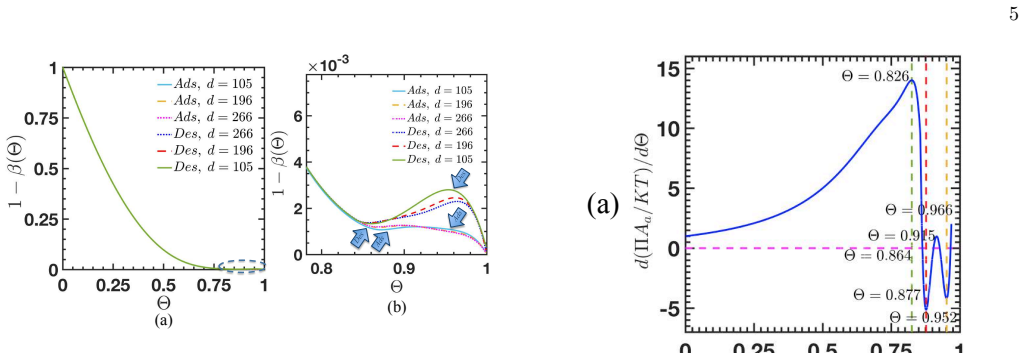
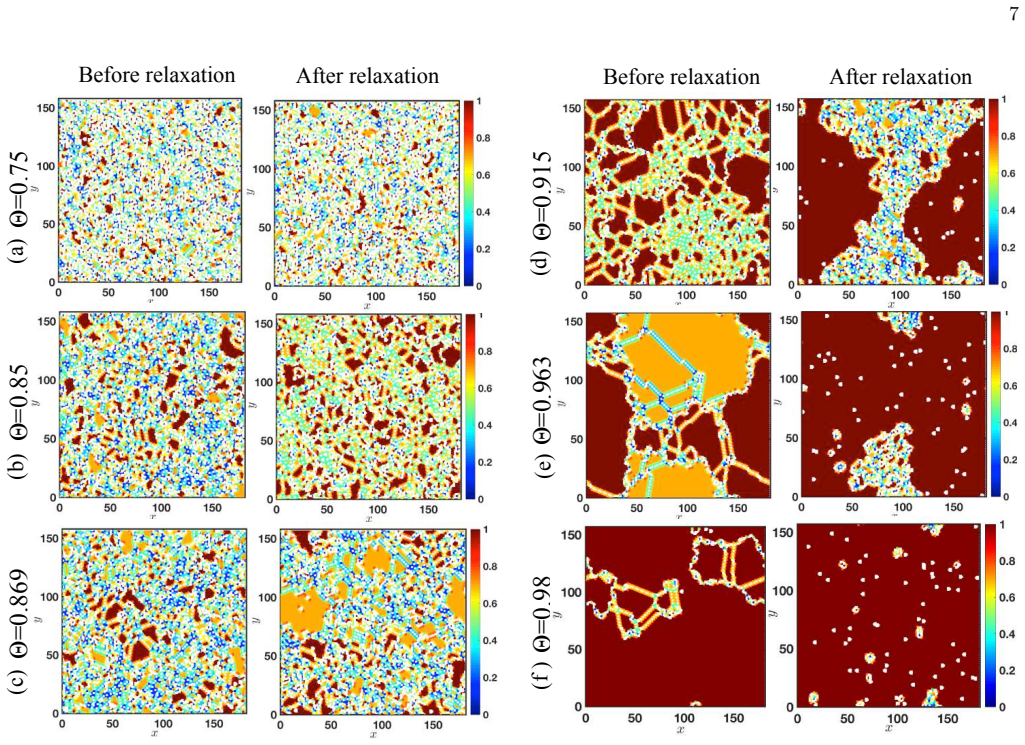
The discovery is the equilibrium phase sequence of the hard-core lattice gas with third-neighbor exclusion. Using the relaxation method, which holds fractional surface coverage fixed while particles diffuse, the authors find that the 'after relaxation' bond orientation correlation function decays exponentially at $\theta=0.75$, $0.85$, and $0.869$; at $\theta=0.915$ it decays algebraically as $g_6(r)\propto r^{-0.25}$, the signature of a hexatic phase with quasi-long-range orientational order; and at $\theta=0.963$ and $0.98$ the exponent $\eta$ drops to $0.08$ and $0.02$, indicating progressively more solid-like order. They assign the peak structure in the derivative of surface pressure with respect to coverage to a first-order liquid-hexatic transition for $0.877\lesssim\theta\lesssim0.915$ and a first-order hexatic-solid transition above $0.915$. The paper also shows that a smaller lattice ($d=105$) produces what looks like a single liquid-solid transition, which it attributes to finite-size effects rather than to the true phase behavior.
Load-bearing premise
The load-bearing premise is that the slow-diffusion relaxation runs on the $196\times196$ lattice genuinely reach equilibrium at every coverage, so the 'after relaxation' $g_6(r)$ curves describe equilibrium phases rather than metastable or glassy configurations.
Editorial extensions
If this is right
- The lattice gas with third-neighbor exclusion becomes a minimal lattice model in which the hexatic phase appears as an equilibrium intermediate, so the two-step melting scenario can be studied without continuum dynamics.
- Finite-size effects can hide the intermediate phase: a $d=105$ lattice shows one first-order transition, while $d=196$ resolves two, so simulations that see only liquid and solid may be misreading their system size.
- At $\theta=0.915$, the hexatic phase has a specific quantitative fingerprint, $g_6(r)\propto r^{-0.25}$, giving other methods a direct target to confirm or refute.
- The blocking-function route to the equation of state, combined with the relaxation check, yields adsorption and desorption branches that overlap in the coexistence region, supporting the use of RSAD-type simulations for lattice-gas phase behavior.
Reading between the lines
- The paper does not report free-energy differences or interface tensions; a direct test of the first-order character would be to measure the order-parameter distribution or droplet free energy across each coexistence window, which the current blocking-function analysis does not provide.
- Because the claim of equilibrium rests on relaxation runs at a single diffusion setting, repeating the relaxation at several diffusion ratios and at $d=196$, $266$, and larger would establish whether the exponent $\eta=0.25$ at $\theta=0.915$ persists in the thermodynamic limit.
- The same $g_6(r)$ plus relaxation protocol could be applied to other extended hard-core lattice gases; if the two-step sequence is generic, some previously reported single liquid-solid transitions in lattice models may be finite-size artifacts.
Signed reviews
Editorial analysis
A structured set of objections, weighed in public.
Referee Report
Summary. The manuscript extends the authors' previous random sequential adsorption with surface diffusion (RSAD) method to a triangular lattice gas with third-neighbor exclusion (a 7-site exclusion pattern). Using kinetic arguments and the Gibbs adsorption isotherm, the paper derives an equation of state from blocking functions obtained by adsorption and desorption simulations, and compares it with the matrix and series-expansion results of Orban and Bellemans for the same model. The authors then classify phases using the bond-orientational correlation function g6(r) computed for individual configurations before and after a relaxation step. The central claim, stated in the abstract and conclusion, is that the system exhibits a first-order two-step liquid-hexatic-solid transition at high surface coverage: liquid below θ≈0.826, a first-order liquid-hexatic transition between θ≈0.877 and θ≈0.915, and a first-order hexatic-to-solid transition above θ≈0.915.
Significance. If the central claim is correct, the paper provides a lattice realization of the two-step melting scenario with an intermediate hexatic phase, complementing the well-studied hard-disk continuum models of Bernard, Krauth, and others. The RSAD route to the equation of state is an original and potentially useful alternative to conventional grand-canonical or canonical Monte Carlo, and the low-coverage agreement with the analytic results of Orban and Bellemans (Fig. 5a) is a genuine success of the method. The use of a relaxation step to compare adsorption- and desorption-derived configurations and to visualize local bond-orientational order is a creative approach. However, the first-order character of the two transitions and their locations rest on a numerical derivative of a polynomial-fitted blocking function and on visual fits to g6(r) from a single lattice size and diffusion ratio; the paper does not provide free-energy comparisons, finite-size scaling, or error estimates for these key quantities. The strengths are the low-coverage EOS validation and the qualitative phase progression; the quantitative classification is not yet established.
major comments (4)
- [Section II and Figure 6] The central thermodynamic evidence for first-order transitions is the derivative dΠ/dθ in Figure 6, computed from an equation of state obtained by inserting a blocking function into Eq. (4). In Section II the blocking function is said to be 'fitted with a polynomial function,' but the polynomial degree, fitting range, and fit diagnostics are never reported. A flexible polynomial can produce spurious oscillations in the derivative, so the peaks at θ≈0.826, 0.915, and 0.963 are not reproducible as stated. The authors should specify the fitting procedure, quote the polynomial form, and provide error bars on the derivative, or, better, replace the derivative-peak criterion with a direct free-energy comparison of candidate phases (e.g., thermodynamic integration or histogram reweighting).
- [Section III, Figure 5] The first-order classification and the Maxwell construction in Figure 5(b) rely on the finite-size pressure loop at d=196 and on the statement that the loop will flatten in the infinite-size limit. No finite-size scaling is performed: the authors show only d=105 and d=196 in Figures 5(b) and 6, and the d=105 curve is dismissed as insufficient. The claim that the equal-area construction gives the coexistence pressure and that the overlap with the flat region 'confirms the tendency of the system to be flat at infinite size' is not quantitatively supported. I would expect at least three system sizes with a scaling analysis of the loop area or the pressure extrema, or a Binder cumulant analysis of the appropriate order parameter, before concluding that either transition is first order.
- [Section III, Figures 7, 8, and 9] The identification of the hexatic phase at θ=0.915 rests on a single power-law fit to g6(r) after relaxation with D=0.01 and d=196, with exponent η=0.25. No error bars on η, no dependence on system size, and no separate confirmation that the configurations are truly equilibrated are provided. The text states that the system reaches equilibrium when the adsorption and desorption blocking functions overlap (e.g., near Figure 3), but this overlap is assessed visually and only for one coverage. Since the same relaxation procedure is used to produce the configurations whose g6(r) shapes define the phases, a quantitative equilibration test (e.g., time-window average, trajectory autocorrelation, or comparison of observables from multiple independent relaxation runs) is needed to rule out metastable arrested states as the origin of the apparent power-law decay.
- [Conclusion and Section III, Figure 6] There is an internal inconsistency in the reported transition boundaries. The text near Figure 6 states the first peak in the phase-transition curve corresponds to θ=0.826 and that the transition between positive and negative slopes occurs at θ=0.864, while the Conclusion states the first-order liquid-hexatic transition occurs 'between surface coverage of 0.877 and 0.915.' The abstract and introduction also describe a 'first-order phase transition occurs in a two-step liquid-hexatic-solid transition,' which is ambiguous about whether both steps are first-order. The authors should reconcile the numerical values and state precisely which transitions are first-order and which are continuous, with the thermodynamic evidence for each.
minor comments (5)
- [Title and throughout] The name 'Orban and Bellman' should be 'Orban and Bellemans' (Ref. [33]); the same misspelling appears in the caption of Figure 5 and in the Conclusion.
- [Section III, Figure 6] The derivative dΠ/dθ is plotted in Figure 6 but the figure caption does not state whether the derivative is taken with respect to θ of the equation of state from the adsorption method only; please clarify which curve is differentiated and how the derivative is computed numerically.
- [Section III, Figure 7] The fits to g6(r) are quoted as equations above the panels (e.g., 'g6(r)∝0.5exp(-0.06r)') but no fitting range or correlation coefficient is given. For the power-law fits, the exponent η should be reported with an uncertainty, and the text should state how the power-law range was selected.
- [Section II] The relaxation method uses 1500 runs, while the blocking-function method uses 500 runs; the paper does not state how many independent runs are used for the g6(r) and Ψ(r) analyses in Figures 7-9, nor how statistical errors are propagated.
- [Section III, Figure 4] Figure 4 shows blocking functions for d=105, 196, and 266, but the equation of state and derivative analysis in Figures 5 and 6 use only d=105 and d=196. The d=266 data should be shown in the EOS comparison to support the claim that d=196 is large enough.
Circularity Check
No significant circularity: the equation of state and the hexatic identification are separate observables, with independent comparison to Orban-Bellemans.
full rationale
The derivation chain is: RSAD simulations yield the blocking function beta(theta) via the success rate of adsorption attempts (Eq. 5); this blocking function is fitted and inserted into the Gibbs adsorption isotherm (Eq. 4) to obtain Pi(theta); transition candidates are then read from dPi/dtheta (Fig. 6); and structural phase assignments are made from g6(r) and local bond-orientation maps in the relaxation runs (Figs. 7-8). None of these steps defines the target result in terms of itself. The power-law decay of g6(r) at theta = 0.915 is a separate observable from the derivative peak at theta = 0.915, and the hexatic-to-solid assignment uses the decrease of eta from 0.25 to 0.08, not the location of the peak. The self-citation to the RSAD model [Darjani et al., Phys. Rev. E 96, 052803] is method inheritance rather than circular proof, and the paper provides independent grounding by comparing its equation of state with Orban and Bellemans' matrix and series-expansion calculations (Fig. 5). The main risks here are correctness risks, not circularity: the unspecified polynomial fit could distort dPi/dtheta, and the adsorption/desorption overlap is a weak equilibration test. These concerns do not make the derivation circular.
Assumptions & free parameters
free parameters (4)
- Surface diffusion attempt ratio D
- Lattice dimension d
- Polynomial fit of blocking function β(θ) =
coefficients not reported
- Bond-orientational correlation fit parameters =
η=0.25 at θ=0.915; η=0.08 at θ=0.963
assumptions (6)
- standard math Gibbs adsorption isotherm (Eq. 1) and its integrated form (Eq. 2) relate surface pressure to the adsorption isotherm.
- domain assumption At equilibrium the adsorption and desorption rates balance (Eq. 3), defining the blocking function β(θ).
- domain assumption RSAD with finite diffusion ratio D samples equilibrium lattice-gas configurations at fixed coverage.
- domain assumption The sixfold bond-orientational order parameter Ψ(r) and g6(r) distinguish liquid, hexatic, and solid phases.
- ad hoc to paper The finite-size pressure loop at d=196 can be Maxwell-constructed and extrapolated to the infinite-system coexistence pressure.
- ad hoc to paper Peaks in the numerical derivative dΠ/dθ identify first-order phase transitions.
Cite this review
Pith. "Pith review of Liquid-Hextic-Solid Phase Transition of a Hard-Core Lattice Gas with Third Neighbor Exclusion." pith.science (2026). https://pith.science/paper/ERS6YD35
@misc{pith2026190805555,
  author       = {Pith},
  title        = {Pith review of: Liquid-Hextic-Solid Phase Transition of a Hard-Core Lattice Gas with Third Neighbor Exclusion},
  year         = {2026},
  howpublished = {\url{https://pith.science/paper/ERS6YD35}},
  note         = {Machine review of arXiv:1908.05555}
}
read the original abstract
The determination of phase behavior and, in particular, the nature of phase transitions in two-dimensional systems is often clouded by finite size effects and by access to the appropriate thermodynamic regime. We address these issues using an alternative route to deriving the equation of state of a two-dimensional hard-core particle system, based on kinetic arguments and the Gibbs adsorption isotherm, by use of the random sequential adsorption with surface diffusion (RSAD) model. Insight into coexistence regions and phase transitions is obtained through direct visualization of the system at any fractional surface coverage via local bond orientation order. The analysis of the bond orientation correlation function for each individual configuration confirms that first-order phase transition occurs in a two-step liquid-hexatic-solid transition at high surface coverage.
Figures


Figures from the paper (5 more)



Reference graph
Works this paper leans on
-
[1]
Vincent Pauchard, Jayant P Rane, and Sanjoy Banerjee, “Asphaltene-laden interfaces form soft glassy layers in contraction experiments: A mechanism for coalescence blocking,” Langmuir 30, 12795–12803 (2014)
work page 2014
-
[2]
The local bond orientation order shown in Figure
, which is an indication of a hexatic phase. The local bond orientation order shown in Figure. 8(d) reveals that 8 t=0 t=21 t=211 t=2113 t=2958 (a) (b) FIG. 9: Local bond orientation order for surface coverage of 0.915 with D=0.01 and d=196, (a) for adsorption method over time, (b) for desorption method over time. at this coverage all the particles tend t...
-
[3]
Mixture effect on the dilatation rheology of asphaltenes-laden interfaces,
Fang Liu, Shaghayegh Darjani, Nelya Akhmetkhanova, Charles Maldarelli, Sanjoy Banerjee, and Vincent Pauchard, “Mixture effect on the dilatation rheology of asphaltenes-laden interfaces,” Langmuir 33, 1927–1942 (2017)
work page 2017
-
[4]
Phase behavior of two-dimensional brownian systems of corner-rounded hexagons,
Zhanglin Hou, Kun Zhao, Yiwu Zong, and Thomas G Mason, “Phase behavior of two-dimensional brownian systems of corner-rounded hexagons,” Physical Review Materials 3, 015601 (2019)
work page 2019
-
[5]
Hexagonal lattice model of the patterns formed by hydrogen-bonded molecules on the surface,
Sara Fortuna, David L Cheung, and Alessandro Troisi, “Hexagonal lattice model of the patterns formed by hydrogen-bonded molecules on the surface,” The Jour- nal of Physical Chemistry B 114, 1849–1858 (2010)
work page 2010
-
[6]
Role of interaction anisotropy in the formation and stability of molecular templates,
UK Weber, VM Burlakov, LMA Perdigao, RHJ Fawcett, PH Beton, NR Champness, JH Jefferson, GAD Briggs, and DG Pettifor, “Role of interaction anisotropy in the formation and stability of molecular templates,” Physical review letters 100, 156101 (2008)
work page 2008
-
[7]
VA Gorbunov, SS Akimenko, AV Myshlyavtsev, VF Fefelov, and MD Myshlyavtseva, “Adsorption of triangular-shaped molecules with directional nearest- neighbor interactions on a triangular lattice,” Adsorption 19, 571–580 (2013)
work page 2013
-
[8]
Per Bak, P Kleban, WN Unertl, J Ochab, G Akinci, NC Bartelt, and TL Einstein, “Phase diagram of se- lenium adsorbed on the ni (100) surface: A physical re- alization of the ashkin-teller model,” Physical review let- ters 54, 1539 (1985)
work page 1985
Show all 71 references
-
[9]
Two-dimensional order- ing of chlorine on ag (100),
David E Taylor, Ellen D Williams, Robert L Park, NC Bartelt, and TL Einstein, “Two-dimensional order- ing of chlorine on ag (100),” Physical Review B 32, 4653 (1985)
1985
-
[10]
Two-step melt- ing in two dimensions: First-order liquid-hexatic transi- tion,
Etienne P Bernard and Werner Krauth, “Two-step melt- ing in two dimensions: First-order liquid-hexatic transi- tion,” Physical review letters 107, 155704 (2011)
2011
-
[11]
Hard-disk equation of state: First-order liquid- hexatic transition in two dimensions with three simula- tion methods,
Michael Engel, Joshua A Anderson, Sharon C Glotzer, Masaharu Isobe, Etienne P Bernard, and Werner Krauth, “Hard-disk equation of state: First-order liquid- hexatic transition in two dimensions with three simula- tion methods,” Physical Review E 87, 042134 (2013)
2013
-
[12]
The adsorption of gases on plane sur- faces of glass, mica and platinum
Irving Langmuir, “The adsorption of gases on plane sur- faces of glass, mica and platinum.” Journal of the Amer- ican Chemical society 40, 1361–1403 (1918)
1918
-
[13]
Applicability of the langmuir equation of state for asphaltene adsorp- tion at the oil–water interface: Coal-derived, petroleum, and synthetic asphaltenes,
Jayant P Rane, Sharli Zarkar, Vincent Pauchard, Oliver C Mullins, Dane Christie, A Ballard Andrews, An- drew E Pomerantz, and Sanjoy Banerjee, “Applicability of the langmuir equation of state for asphaltene adsorp- tion at the oil–water interface: Coal-derived, petroleum, and ...
2015
-
[14]
Interfacial rheology of asphaltenes at oil–water interfaces and interpretation of the equation of state,
Jayant P Rane, Vincent Pauchard, Alexander Couzis, and Sanjoy Banerjee, “Interfacial rheology of asphaltenes at oil–water interfaces and interpretation of the equation of state,” Langmuir 29, 4750–4759 (2013)
2013
-
[15]
Insights into the modeling of adsorption isotherm systems,
Keng Yuen Foo and Bassim H Hameed, “Insights into the modeling of adsorption isotherm systems,” Chemical engineering journal 156, 2–10 (2010)
2010
-
[16]
Collective effects in random sequential adsorption of diffusing hard squares,
Jian-Sheng Wang, Peter Nielaba, and Vladimir Priv- man, “Collective effects in random sequential adsorption of diffusing hard squares,” Modern Physics Letters B 7, 189–196 (1993)
1993
-
[17]
simulations of protein adsorption on nanostructured surfaces,
Berardo M Manzi, Marco Werner, Elena P Ivanova, Rus- sell J Crawford, and Vladimir A Baulin, “simulations of protein adsorption on nanostructured surfaces,” Sci- entific reports 9 (2019)
2019
-
[18]
Adsorption, desorption, and diffusion of k-mers on a one-dimensional lattice,
I Lonˇ carevi´ c, Lj Budinski-Petkovi´ c, SB Vrhovac, and A Beli´ c, “Adsorption, desorption, and diffusion of k-mers on a one-dimensional lattice,” Physical Review E 80, 021115 (2009)
2009
-
[19]
Reversible random sequential adsorption of mixtures on a triangular lattice,
I Lonˇ carevi´ c, Lj Budinski-Petkovi´ c, and SB Vrhovac, “Reversible random sequential adsorption of mixtures on a triangular lattice,” Physical Review E 76, 031104 (2007)
2007
-
[20]
From car parking to protein adsorption: an overview of se- quential adsorption processes,
J Talbot, G Tarjus, PR Van Tassel, and P Viot, “From car parking to protein adsorption: an overview of se- quential adsorption processes,” Colloids and Surfaces A: Physicochemical and Engineering Aspects 165, 287–324 (2000)
2000
-
[21]
Random and cooperative sequential adsorption,
James W Evans, “Random and cooperative sequential adsorption,” Reviews of modern physics 65, 1281 (1993)
1993
-
[22]
Collective properties of adsorption–desorption processes,
PL Krapivsky and E Ben-Naim, “Collective properties of adsorption–desorption processes,” The Journal of chem- ical physics 100, 6778–6782 (1994)
1994
-
[23]
Locally frozen defects in random sequential adsorption with diffusional relaxation,
Jian-Sheng Wang, Peter Nielaba, and Vladimir Privman, “Locally frozen defects in random sequential adsorption with diffusional relaxation,” Physica A: Statistical Me- chanics and its Applications 199, 527–538 (1993)
1993
-
[24]
Response properties in the adsorption–desorption model on a triangular lattice,
JR ˇS´ cepanovi´ c, D Stojiljkovi´ c, ZM Jakˇ si´ c, Lj Budinski- Petkovi´ c, and SB Vrhovac, “Response properties in the adsorption–desorption model on a triangular lattice,” Physica A: Statistical Mechanics and its Applications 451, 213–226 (2016)
2016
-
[25]
Statistical mechanical description of the parking-lot model for vibrated granular materials,
G Tarjus and P Viot, “Statistical mechanical description of the parking-lot model for vibrated granular materials,” Physical Review E 69, 011307 (2004)
2004
-
[26]
Random sequential adsorption model for the differential coverage of gold (111) surfaces by two related silicon phthalocya- nines,
Matthew A Meineke and J Daniel Gezelter, “Random sequential adsorption model for the differential coverage of gold (111) surfaces by two related silicon phthalocya- nines,” The Journal of Physical Chemistry B 105, 6515– 6519 (2001)
2001
-
[27]
Surface exclusion effects in ad- sorption processes,
P Schaaf and J Talbot, “Surface exclusion effects in ad- sorption processes,” The Journal of chemical physics 91, 4401–4409 (1989)
1989
-
[28]
Observation of anomalous diffusion of proteins near surfaces,
Jeremy J Ramsden, “Observation of anomalous diffusion of proteins near surfaces,” The Journal of Physical Chem- istry 96, 3388–3391 (1992)
1992
-
[29]
Two-dimensional ryd- berg gases and the quantum hard-squares model,
S Ji, C Ates, and I Lesanovsky, “Two-dimensional ryd- berg gases and the quantum hard-squares model,” Phys- ical review letters 107, 060406 (2011)
2011
-
[30]
Self-assembly of benzene- dicarboxylic acid isomers at the liquid solid 10 interface: steric aspects of hydrogen bonding,
Markus Lackinger, Stefan Griessl, Thomas Markert, Fer- dinand Jamitzky, and Wolfgang M Heckl, “Self-assembly of benzene- dicarboxylic acid isomers at the liquid solid 10 interface: steric aspects of hydrogen bonding,” The Jour- nal of Physical Chemistry B 108, 13652–13655 (2004)
2004
-
[31]
Accuracy of first-principles lateral interactions: Oxygen at pd (100),
Yongsheng Zhang, Volker Blum, and Karsten Reuter, “Accuracy of first-principles lateral interactions: Oxygen at pd (100),” Physical Review B 75, 235406 (2007)
2007
-
[32]
Rodney J Baxter, Exactly solved models in statistical me- chanics (Elsevier, 2016)
2016
-
[33]
Phase transitions in two-dimensional lattice gases of hard-square molecules,
Andr´ e Bellemans and RK Nigam, “Phase transitions in two-dimensional lattice gases of hard-square molecules,” The Journal of Chemical Physics 46, 2922–2935 (1967)
1967
-
[34]
Phase transitions in two- dimensional lattice gases of hard-core molecules. the tri- angular lattice,
J Orban and A Bellemans, “Phase transitions in two- dimensional lattice gases of hard-core molecules. the tri- angular lattice,” The Journal of Chemical Physics 49, 363–370 (1968)
1968
-
[35]
Phase transition of a hard-core lattice gas. the square lattice with nearest- neighbor exclusion,
Francis H Ree and Dwayne A Chesnut, “Phase transition of a hard-core lattice gas. the square lattice with nearest- neighbor exclusion,” The Journal of Chemical Physics 45, 3983–4003 (1966)
1966
-
[36]
Exact finite method of lattice statistics. ii. honeycomb-lattice gas of hard molecules,
LK Runnels, LL Combs, and James P Salvant, “Exact finite method of lattice statistics. ii. honeycomb-lattice gas of hard molecules,” The Journal of Chemical Physics 47, 4015–4020 (1967)
1967
-
[37]
Exact finite method of lat- tice statistics. i. square and triangular lattice gases of hard molecules,
LK Runnels and LL Combs, “Exact finite method of lat- tice statistics. i. square and triangular lattice gases of hard molecules,” The Journal of Chemical Physics 45, 2482–2492 (1966)
1966
-
[38]
Lattice gas with nearest-and next-to-nearest-neighbor exclusion,
Xiaomei Feng, Henk WJ Bl¨ ote, and Bernard Nienhuis, “Lattice gas with nearest-and next-to-nearest-neighbor exclusion,” Physical Review E 83, 061153 (2011)
2011
-
[39]
Critical exponents from cluster coefficients,
Z Rotman and E Eisenberg, “Critical exponents from cluster coefficients,” Physical Review E 80, 031126 (2009)
2009
-
[40]
Hard-sphere lattice gases. i. plane-square lattice,
D. S. Gaunt and M. E. Fisher, “Hard-sphere lattice gases. i. plane-square lattice,” J. Chem. Phys. 43, 2840–2863 (1965)
1965
-
[41]
Hard-sphere lattice gases. ii. plane- triangular and three-dimensional lattices,
David S Gaunt, “Hard-sphere lattice gases. ii. plane- triangular and three-dimensional lattices,” The Journal of Chemical Physics 46, 3237–3259 (1967)
1967
-
[42]
A first-order phase transition and a super-cooled fluid in a two-dimensional lattice gas model,
E Eisenberg and A Baram, “A first-order phase transition and a super-cooled fluid in a two-dimensional lattice gas model,” EPL (Europhysics Letters) 71, 900 (2005)
2005
-
[43]
High-density equation of state for a lattice gas,
MV Ushcats, “High-density equation of state for a lattice gas,” Physical Review E 91, 052144 (2015)
2015
-
[44]
Virial and high-density expansions for the lee-yang lat- tice gas,
MV Ushcats, LA Bulavin, VM Sysoev, and SJ Ushcats, “Virial and high-density expansions for the lee-yang lat- tice gas,” Physical Review E 94, 012143 (2016)
2016
-
[45]
A bethe model for phase transitions in the hard sphere lattice gas,
ER Cowley, “A bethe model for phase transitions in the hard sphere lattice gas,” The Journal of Chemical Physics 71, 458–461 (1979)
1979
-
[46]
A lattice model of a classical hard sphere gas,
DM Burley, “A lattice model of a classical hard sphere gas,” Proceedings of the Physical Society 75, 262 (1960)
1960
-
[47]
A hard-sphere model on generalized bethe lattices: Statics,
Hendrik Hansen-Goos and Martin Weigt, “A hard-sphere model on generalized bethe lattices: Statics,” Journal of Statistical Mechanics: Theory and Experiment 2005, P04006 (2005)
2005
-
[48]
Phase diagrams and crit- ical behavior in ising square lattices with nearest-and next-nearest-neighbor interactions,
K Binder and DP Landau, “Phase diagrams and crit- ical behavior in ising square lattices with nearest-and next-nearest-neighbor interactions,” Physical Review B 21, 1941 (1980)
1980
-
[49]
A monte carlo study of the thermo- dynamic properties of “hard hexagons
Dwayne A Chesnut, “A monte carlo study of the thermo- dynamic properties of “hard hexagons” on the triangular lattice,” Journal of Computational Physics 7, 409–434 (1971)
1971
-
[50]
Da-Jiang Liu and James W Evans, “Ordering and per- colation transitions for hard squares: Equilibrium versus nonequilibrium models for adsorbed layers with c (2 ×
-
[51]
superlattice ordering,” Physical Review B 62, 2134 (2000)
2000
-
[52]
Monte carlo simulations of two-dimensional hard core lattice gases,
Heitor C Marques Fernandes, Jeferson J Arenzon, and Yan Levin, “Monte carlo simulations of two-dimensional hard core lattice gases,” The Journal of chemical physics 126, 114508 (2007)
2007
-
[53]
Multiple phase transitions in extended hard-core lattice gas models in two dimen- sions,
Trisha Nath and R Rajesh, “Multiple phase transitions in extended hard-core lattice gas models in two dimen- sions,” Physical Review E 90, 012120 (2014)
2014
-
[54]
On the ising problem and mayer’s cluster sums,
George Stanley Rushbrooke and HI Scoins, “On the ising problem and mayer’s cluster sums,” Proceedings of the Royal Society of London. Series A. Mathematical and Physical Sciences 230, 74–90 (1955)
1955
-
[55]
Density functional theory for nearest-neighbor exclusion lattice gases in two and three dimensions,
Luis Lafuente and Jos´ e A Cuesta, “Density functional theory for nearest-neighbor exclusion lattice gases in two and three dimensions,” Physical Review E 68, 066120 (2003)
2003
-
[56]
Extracting the equation of state of lattice gases from random sequential adsorption simulations by means of the gibbs adsorption isotherm,
Shaghayegh Darjani, Joel Koplik, and Vincent Pauchard, “Extracting the equation of state of lattice gases from random sequential adsorption simulations by means of the gibbs adsorption isotherm,” Physical Re- view E 96, 052803 (2017)
2017
-
[57]
Equation of state for hard-square lattice gases,
Heitor C Marques Fernandes, Yan Levin, and Jefer- son J Arenzon, “Equation of state for hard-square lattice gases,” Physical Review E 75, 052101 (2007)
2007
-
[58]
Phase behavior of hard-core lattice gases: A fundamental measure ap- proach,
Luis Lafuente and Jos´ e A Cuesta, “Phase behavior of hard-core lattice gases: A fundamental measure ap- proach,” The Journal of chemical physics 119, 10832– 10843 (2003)
2003
-
[59]
A high density per- turbation expansion for the hard square lattice gas,
Kabir Ramola and Deepak Dhar, “A high density per- turbation expansion for the hard square lattice gas,” in AIP Conference Proceedings, Vol. 1447 (AIP, 2012) pp. 135–136
2012
-
[60]
Esti- mating the critical parameters of the hard square lattice gas model,
Dipanjan Mandal, Trisha Nath, and R Rajesh, “Esti- mating the critical parameters of the hard square lattice gas model,” Journal of Statistical Mechanics: Theory and Experiment 2017, 043201 (2017)
2017
-
[61]
The high density phase of the k-nn hard core lattice gas model,
Trisha Nath and R Rajesh, “The high density phase of the k-nn hard core lattice gas model,” Journal of Statis- tical Mechanics: Theory and Experiment 2016, 073203 (2016)
2016
-
[62]
Lattice-gas modeling of the formation and ordering of oxygen adlayers on pd (1 0 0),
Da-Jiang Liu and JW Evans, “Lattice-gas modeling of the formation and ordering of oxygen adlayers on pd (1 0 0),” Surface science 563, 13–26 (2004)
2004
-
[63]
Melting and the vector coulomb gas in two dimensions,
AP Young, “Melting and the vector coulomb gas in two dimensions,” Physical Review B 19, 1855 (1979)
1979
-
[64]
Dislocation-mediated melting in two dimensions,
David R Nelson and BI Halperin, “Dislocation-mediated melting in two dimensions,” Physical Review B 19, 2457 (1979)
1979
-
[65]
Ordering, metastability and phase transitions in two- dimensional systems,
John Michael Kosterlitz and David James Thouless, “Ordering, metastability and phase transitions in two- dimensional systems,” Journal of Physics C: Solid State Physics 6, 1181 (1973)
1973
-
[66]
Large-scale simulations of the two-dimensional melting of hard disks,
CH Mak, “Large-scale simulations of the two-dimensional melting of hard disks,” Physical Review E 73, 065104 (2006)
2006
-
[67]
Melting of colloidal crystal films,
Yi Peng, Ziren Wang, Ahmed M Alsayed, Arjun G Yodh, and Yilong Han, “Melting of colloidal crystal films,” Physical review letters 104, 205703 (2010)
2010
-
[68]
Phase transition in elas- tic disks,
BJ Alder and TE Wainwright, “Phase transition in elas- tic disks,” Physical Review 127, 359 (1962). 11
1962
-
[69]
Simula- tion of melting of two-dimensional lennard-jones solids,
Keola Wierschem and Efstratios Manousakis, “Simula- tion of melting of two-dimensional lennard-jones solids,” Physical Review B 83, 214108 (2011)
2011
-
[70]
Interfacial tension effects in finite, periodic, two-dimensional systems,
Joseph E Mayer and Wm W Wood, “Interfacial tension effects in finite, periodic, two-dimensional systems,” The Journal of Chemical Physics 42, 4268–4274 (1965)
1965
-
[71]
Sim- ulation of vapor-liquid coexistence in finite volumes: A method to compute the surface free energy of droplets,
Manuel Schrader, Peter Virnau, and Kurt Binder, “Sim- ulation of vapor-liquid coexistence in finite volumes: A method to compute the surface free energy of droplets,” Physical Review E 79, 061104 (2009)
2009
Reviewed August 14, 2026 · model on record in the stance chip above.
Discussion (0). Continue with ORCID to comment.