REVIEW 3 major objections 6 minor 53 references
De-AntiFake: Rethinking the Protective Perturbations Against Voice Cloning Attacks
T0 review · 3 major / 6 minor · reviewed 2026-08-06 · deepseek-v4-flash
Pith's one-line read The paper argues that perturbation-based defenses against voice cloning fail when the attacker first purifies the protected audio, and demonstrates a two-stage purification method that raises speaker-verification acceptance of cloned…
desk verdict First systematic evidence that perturbation-based voice cloning defenses collapse under purification; the proposed two-stage method is plausible and consistently supported, but the key transfer assumption and missing artifacts keep it at conditional rather than accept. read the letter →
The pith
A machine-rendered reading of the paper's core claim, the machinery that carries it, and where it could break.
The reading
What carries the argument
The load-bearing mechanism is the two-stage PhonePuRe pipeline. The Purification stage is an unconditional DiffWave diffusion model applied directly to waveforms: it adds noise over $T_{\text{pur}}$ forward steps and then denoises back, which removes most of the protective perturbation but leaves the audio in a 'purified' distribution. The Refinement stage is a score-based diffusion model (NCSN++) operating in the complex STFT domain, trained to map purified clean spectrograms back to their clean versions; at inference it takes the purified protected spectrogram, concatenates a phoneme representation (average magnitude spectrograms per phoneme, aligned from the transcript), and reverse-samples to land closer to the clean distribution. The argument depends on the observation that the purification stage makes purified clean and purified protected samples distributionally similar, so the refinement mapping learned from clean pairs applies to protected inputs. Phoneme guidance carries the content information that protective perturbations leave intact, steadying the refinement.
What would settle it
Take audio protected with a method or perturbation budget outside the tested range (for example a budget below 0.0025, or a file that passed through a telephone or MP3 codec), purify it, apply the refinement, and measure whether speaker-verification acceptance stays near the claimed levels; separately measure the embedding distance between purified clean and purified protected samples. If the distance is large or the acceptance drops toward the protected-only rate, the distributional-transfer assumption that carries the method fails.
Extended reading notes
Core claim
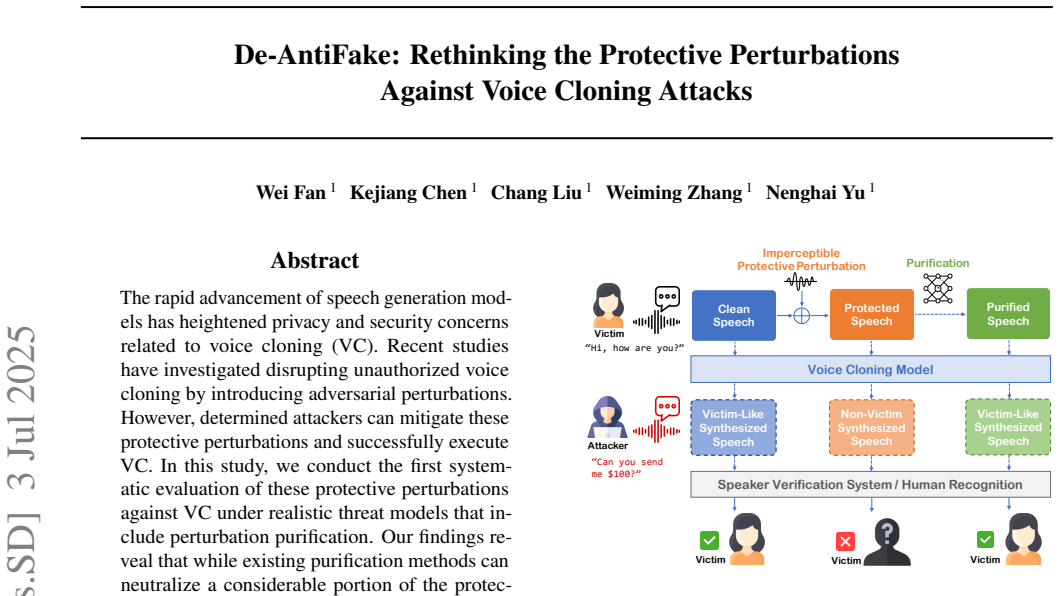
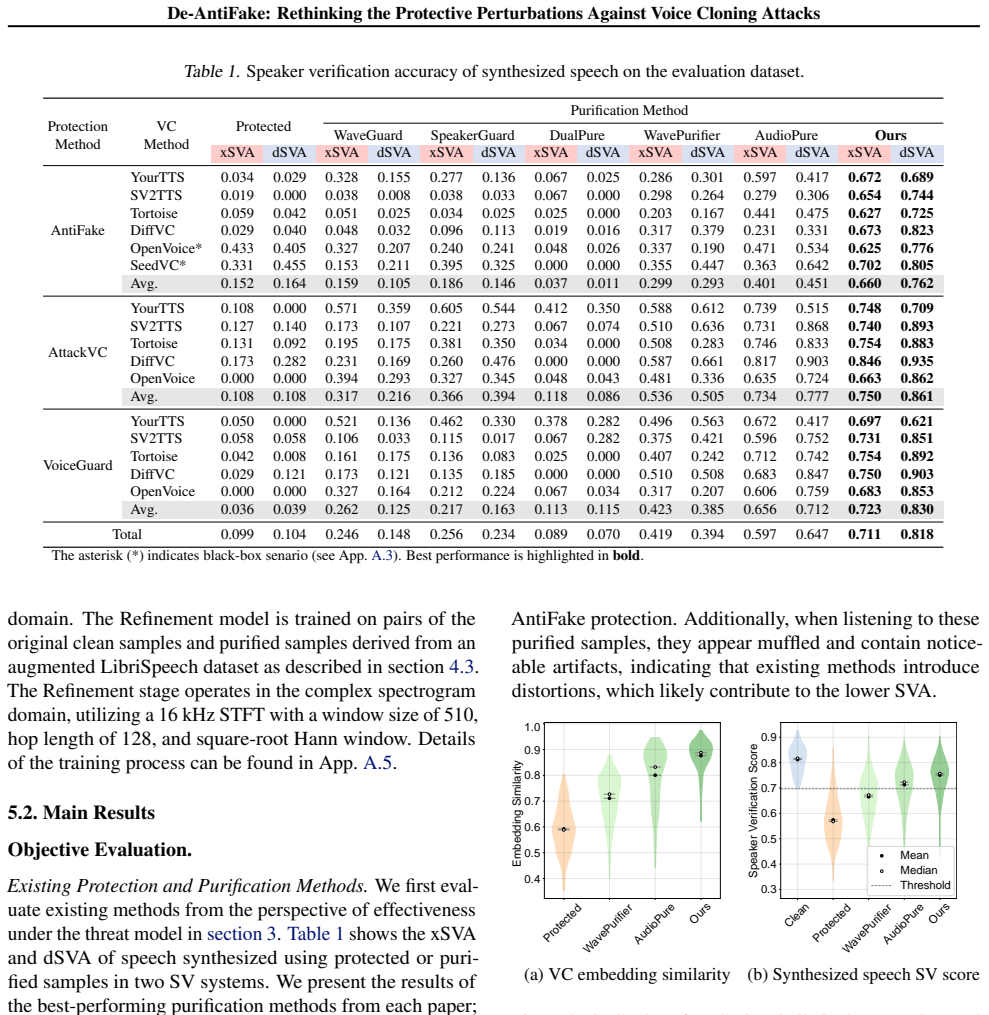
The central claim is that protective perturbations against voice cloning are not robust to adversarial purification: an attacker who purifies protected audio before cloning can recover most of the target speaker's identity. The paper demonstrates this with PhonePuRe, which combines an unconditional diffusion purification stage with a phoneme-guided score-based diffusion refinement stage that operates on complex spectrograms. The key move is training the refinement only on pairs of original clean audio and its purified version; the authors observe that after the purification stage, clean and protected samples look similar in the voice-cloning model's embedding space, so the clean-to-clean mapping transfers to protected inputs. Across AttackVC, AntiFake, and VoiceGuard, and across three TTS and three voice-conversion models, the average speaker-verification accuracy of cloned speech rises from 9.9% (x-vector) and 10.4% (d-vector) on protected audio to 71.1% and 81.8% after purification. Cloned speech from purified samples is also rated closer to the original speaker by human listeners.
Load-bearing premise
The method rests on the assumption that after the first purification pass, protected audio and clean audio look alike to the voice-cloning model, so a refinement model trained on purified clean audio will also pull purified protected audio back toward clean; if that resemblance breaks for another protection method, perturbation budget, or transmission channel, the second stage stops working.
Editorial extensions
If this is right
- An attacker who can apply PhonePuRe before cloning can largely undo all three tested protection methods, so the protection success rates reported in the literature are upper bounds that shrink once purification is in the loop.
- Even white-box adaptive protections — where the protector knows the purification model and uses BPDA or adjoint gradients with expectation over transformation up to size 15 — fail to push the d-vector acceptance below roughly 0.8, so making perturbations purification-proof is much harder than making them cloning-proof.
- Existing purification baselines leave systematic distortions in voice-cloning embedding spaces; the refinement stage, not extra diffusion steps, is what restores the speaker identity, so coarse purification alone is insufficient for voice-cloning tasks.
- The best setting of the pipeline depends on the perturbation budget: smaller budgets favor fewer purification steps, and the full two-stage model beats the purification stage alone across every budget and step count tested.
- If these results hold, future voice-cloning defenses should be evaluated with a purification-capable attacker, otherwise the measured protection rate will overstate real-world safety.
Reading between the lines
- I infer that the distributional-transfer trick can serve as a predictor: measure the distance between purified clean and purified protected samples for any new protection method, and that gap should forecast whether a refinement stage trained on clean pairs will succeed.
- I infer that the approach is a general recipe for attacking defenses that rely on small speaker-level perturbations: purify coarsely, then refine with any content signal the perturbation does not destroy, not necessarily phonemes.
- A natural test the paper leaves open is transmission realism: codecs, telephony, or background noise after purification would add distortions outside the training distribution and may close part of the gap between laboratory success and field success.
- I infer that the defender's plausible counter-move is to combine perturbation with detection or watermarking, because any defense that a learned purification model can preprocess away offers only conditional protection.
Editorial analysis
A structured set of objections, weighed in public.
Referee Report
Summary. The paper evaluates whether protective perturbations against voice cloning survive an attacker who applies adversarial purification before cloning. It tests three protections (AttackVC, AntiFake, VoiceGuard) across six voice-cloning (VC) models and several purification baselines, reporting that existing purification substantially raises speaker-verification accuracy of cloned speech. The authors then propose PhonePuRe, a two-stage pipeline: an unconditional DiffWave purification stage followed by a phoneme-guided score-based diffusion refinement stage trained on pairs of clean and purified-clean audio. On a LibriSpeech test-clean set with 25 speakers, PhonePuRe raises average SVA from about 10% under protection to 71.1% (x-vector) and 81.8% (d-vector), outperforming the best baseline (AudioPure) and showing robustness to two white-box adaptive protection strategies.
Significance. If the reported numbers hold, the paper provides a useful negative result: perturbation-only VC defenses are brittle under a realistic purification-equipped attacker, and PhonePuRe is a strong attack-side baseline for future defense work. The evaluation is broad for this line of work—six VC models, three protection methods, multiple purification baselines, objective and subjective metrics, and component ablations—and the paper is candid about some limitations of its own method, including fixed timesteps and the absence of VC-model information in the purification pipeline. The main weakness is evidentiary: the load-bearing transfer assumption behind the Refinement stage is supported only by qualitative embedding-space plots, and the submission does not include code, data, checkpoints, or audio for independent verification, instead pointing to a project page. These issues make the current version a conditional contribution rather than a fully verified one.
major comments (3)
- [§4.1, App. A.5, Figure 4] The central quantitative claim depends on the Refinement-stage transfer assumption, and that assumption is validated only qualitatively. The Refinement model is trained on pairs (clean audio, purified clean audio) constructed with T_pur=5 and DEMAND noise augmentation (App. A.5), but at inference it is applied to purified protected audio obtained with T_pur=3. The only evidence that the two input distributions match is Figure 4, which shows closeness in ECAPA/AVC/Coqui embedding spaces; the score model, however, operates on complex STFT spectrograms, and closeness in a task-specific embedding space does not imply closeness in the score model's input space. No quantitative distributional distance, no per-method breakdown, and no per-budget check is reported. If the conditional mapping p(m|m_pur) learned from purified clean data does not transfer to purified protected data, the Refinement stage could move protected samples away from the clean manifold, and the claimed gains over AudioPure in Table 1 would not generalize. Please add quantitative spectral-domain distributional comparisons (e.g., MMD or FID over the relevant STFT representations), validate the Refinement stage separately on purified protected inputs for each protection method and a range of budgets and channels, and either align T_pur between training and inference or justify the mismatch.
- [§5.1, §5.2, Table 1] The headline comparison is presented without uncertainty or per-cell sample sizes. The evaluation uses 25 speakers × 5 utterances × 6 VC models, then filters to 739 cloned samples, and each Table 1 cell aggregates over one protection method and one VC model; several cells are therefore based on only about 125 samples or fewer, yet no confidence intervals, significance tests, or standard errors are reported. Some of the claimed advantages over the strongest baseline are small (e.g., AttackVC xSVA 0.750 vs 0.734 for AudioPure in Table 1), so without error bars the reader cannot tell whether the differences are meaningful. Please report per-cell N, confidence intervals, and paired tests (e.g., McNemar) for the key comparisons, especially between PhonePuRe and AudioPure.
- [§5.4, App. C, Figure 8] The adaptive-protection robustness claim is narrower than the text suggests. The evaluation covers only the DiffVC model and the AttackVC protection, and the BPDA variant approximates the full purification as identity (following Nie et al. 2022), while the adjoint variant integrates only the Purification stage. The paper itself notes in App. C that stronger adaptive attacks from the vision literature (Kang et al. 2024; Lee & Kim 2023b) were not adapted to speech. The conclusion that designing adaptive protection for this purification method remains challenging should be restricted to the tested strategies, and the section should state clearly that more sophisticated white-box attacks are untested. As written, the contribution bullet and the conclusion overstate the robustness evidence.
minor comments (6)
- [App. A.4] The heading contains a typo: “Implement Detials” should be “Implementation Details.”
- [Table 4] The caption says that boldface marks the method with the highest average SVA, but no boldface is visible in the rendered table; please indicate the selected configuration explicitly.
- [Figures 2 and 4] The caption text in these figures appears duplicated and garbled in the provided manuscript; please fix the rendering so the figure captions are readable.
- [App. B.5] The sentence “our method’s computational cost of our method” contains a duplicated phrase; please rewrite it.
- [Table 1 caption] The caption contains the typo “senario”; it should be “scenario.”
- [Throughout] Notation is inconsistent for the metric names: the text uses “SV A,” “xSV A,” “dSV A,” and “xSVA/dSVA” interchangeably. Please define and use one consistent notation.
Circularity Check
No significant circularity: the reported SVA gains are produced by independent SV systems on purified audio, and the Refinement model is trained on (clean, purified-clean) pairs without optimizing or being defined in terms of the evaluation metric.
full rationale
The central claim is empirical and self-contained. The Purification stage is a pretrained DiffWave model; the Refinement stage is trained with a score-matching objective (Eq. 7) on pairs of original clean spectrograms and spectrograms obtained by purifying clean audio. Evaluation SVA (Eq. 9) uses x-vector and d-vector speaker verification systems that are independent of the purification and refinement training. The key transfer assumption in Section 4.1—that purified clean and purified protected samples have similar distributions (Figure 4), so a mapping learned on purified clean inputs applies to purified protected inputs—is an inductive generalization claim, not a definitional or fitted equivalence. Training uses Tpur=5 with DEMAND noise augmentation while inference uses Tpur=3, and similarity is shown only in VC-model embedding space rather than in the complex-spectrogram input space of the Refinement model; these are genuine correctness risks about distribution shift, but they do not make the derivation circular. No load-bearing self-citation or imported uniqueness theorem is used; the diffusion backbones (DiffWave, NCSN++) and STFT setup are external. The acknowledged limitations in Appendix C (fixed timesteps, no VC-model information) further indicate that the method's success is treated as an empirical question rather than assumed by construction.
Assumptions & free parameters
free parameters (5)
- T_pur (Purification diffusion steps) =
3 for the main results; 5 for refinement training data; swept up to 9 in Figure 7
- T_ref and N (refinement diffusion time, number of reverse steps) =
T_ref implicit in sigma_max=0.5, sigma_min=0.05, tau_eps=0.03, N=30 (N=15 near-optimal per Figure 11)
- SV threshold for d-vector system =
0.697
- Protection perturbation budgets (epsilon) and VoiceGuard alpha =
Individually adjusted per VC model so that SVA < 20%
- Phoneme dictionary averaging and STFT parameters =
window 510, hop 128, sqrt-Hann; average magnitude spectrogram per phoneme
assumptions (5)
- domain assumption A pretrained unconditional DiffWave model, fine-tuned on LibriSpeech training data, is a valid stand-in for real-world protective perturbation distributions.
- domain assumption Phoneme information is preserved by protective perturbations and provides a useful anchor for refinement.
- domain assumption Distributional similarity between 'purified clean' and 'purified protected' samples observed in Figure 4 extends to the 739-sample evaluation set and to other protection budgets.
- domain assumption The official implementations of the six VC models and the two SV systems used for evaluation behave as described in their papers and as configured with default parameters.
- domain assumption NISQA scores, averaged MOS, and the EER-based threshold for the d-vector SV system are a valid proxy for human-perceived speaker similarity.
invented entities (2)
-
PhonePuRe (Purification-Refinement framework)
independent evidence
-
Average phoneme spectrogram dictionary
independent evidence
Cite this review
Pith. "Pith review of De-AntiFake: Rethinking the Protective Perturbations Against Voice Cloning Attacks." pith.science (2026). https://pith.science/paper/ET2J2QRW
@misc{pith2026250702606,
  author       = {Pith},
  title        = {Pith review of: De-AntiFake: Rethinking the Protective Perturbations Against Voice Cloning Attacks},
  year         = {2026},
  howpublished = {\url{https://pith.science/paper/ET2J2QRW}},
  note         = {Machine review of arXiv:2507.02606}
}
read the original abstract
The rapid advancement of speech generation models has heightened privacy and security concerns related to voice cloning (VC). Recent studies have investigated disrupting unauthorized voice cloning by introducing adversarial perturbations. However, determined attackers can mitigate these protective perturbations and successfully execute VC. In this study, we conduct the first systematic evaluation of these protective perturbations against VC under realistic threat models that include perturbation purification. Our findings reveal that while existing purification methods can neutralize a considerable portion of the protective perturbations, they still lead to distortions in the feature space of VC models, which degrades the performance of VC. From this perspective, we propose a novel two-stage purification method: (1) Purify the perturbed speech; (2) Refine it using phoneme guidance to align it with the clean speech distribution. Experimental results demonstrate that our method outperforms state-of-the-art purification methods in disrupting VC defenses. Our study reveals the limitations of adversarial perturbation-based VC defenses and underscores the urgent need for more robust solutions to mitigate the security and privacy risks posed by VC. The code and audio samples are available at https://de-antifake.github.io.
Figures


Figures from the paper (9 more)


Reference graph
Works this paper leans on
-
[1]
write newline
" write newline "" before.all 'output.state := FUNCTION n.dashify 't := "" t empty not t #1 #1 substring "-" = t #1 #2 substring "--" = not "--" * t #2 global.max substring 't := t #1 #1 substring "-" = "-" * t #2 global.max substring 't := while if t #1 #1 substring * t #2 global.max substring 't := if while FUNCTION format.date year duplicate empty "emp...
-
[2]
I used AI voice cloning to steal £250
Andrews, L. I used AI voice cloning to steal £250 . it took 15 minutes, 2024. URL https://www.thetimes.com/business-money/money/article/i-used-ai-voice-cloning-to-steal-250-it-took-15-minutes-6vj586753
work page 2024
-
[3]
Better speech synthesis through scaling
Betker, J. Better speech synthesis through scaling. arXiv preprint arXiv:2305.07243, 2023
arXiv 2023
-
[4]
Who Are You ( I Really Wanna Know )? Detecting Audio DeepFakes Through Vocal Tract Reconstruction
Blue, L., Warren, K., Abdullah, H., Gibson, C., Vargas, L., O'Dell, J., Butler, K., and Traynor, P. Who Are You ( I Really Wanna Know )? Detecting Audio DeepFakes Through Vocal Tract Reconstruction . In 31st USENIX Security Symposium (USENIX Security 22), pp.\ 2691--2708, 2022
work page 2022
-
[5]
Casanova, E., Weber, J., Shulby, C. D., Junior, A. C., G \"o lge, E., and Ponti, M. A. Yourtts: Towards zero-shot multi-speaker tts and zero-shot voice conversion for everyone. In International Conference on Machine Learning, pp.\ 2709--2720. PMLR, 2022
work page 2022
-
[6]
Towards Understanding and Mitigating Audio Adversarial Examples for Speaker Recognition
Chen, G., Zhao, Z., Song, F., Chen, S., Fan, L., Wang, F., and Wang, J. Towards Understanding and Mitigating Audio Adversarial Examples for Speaker Recognition . IEEE Transactions on Dependable and Secure Computing, 20 0 (5): 0 3970--3987, September 2023. ISSN 1941-0018. doi:10.1109/TDSC.2022.3220673. URL https://ieeexplore.ieee.org/document/9942342/?arnu...
-
[7]
WavMark : Watermarking for Audio Generation , January 2024
Chen, G., Wu, Y., Liu, S., Liu, T., Du, X., and Wei, F. WavMark : Watermarking for Audio Generation , January 2024. URL http://arxiv.org/abs/2308.12770
arXiv 2024
-
[8]
How I broke into a bank account with an AI -generated voice, 2023
Cox, J. How I broke into a bank account with an AI -generated voice, 2023. URL https://www.vice.com/en/article/how-i-broke-into-a-bank-account-with-an-ai-generated-voice/
work page 2023
Show all 53 references
-
[9]
CATCH YOU AND I CAN : Revealing Source Voiceprint Against Voice Conversion
Deng, J., Chen, Y., Zhong, Y., Miao, Q., Gong, X., and Xu, W. CATCH YOU AND I CAN : Revealing Source Voiceprint Against Voice Conversion . USENIX, 2023
2023
-
[10]
ECAPA-TDNN: emphasized channel attention, propagation and aggregation in TDNN based speaker verification
Desplanques, B., Thienpondt, J., and Demuynck, K. ECAPA-TDNN: emphasized channel attention, propagation and aggregation in TDNN based speaker verification. In Meng, H., Xu, B., and Zheng, T. F. (eds.), 21st Annual Conference of the International Speech Communication Associatio...
2020 doi
-
[11]
Active Defense Against Voice Conversion Through Generative Adversarial Network
Dong, S., Chen, B., Ma, K., and Zhao, G. Active Defense Against Voice Conversion Through Generative Adversarial Network . IEEE Signal Processing Letters, 31: 0 706--710, 2024. ISSN 1070-9908, 1558-2361. doi:10.1109/LSP.2024.3365034. URL https://ieeexplore.ieee.org/document/10432955/
2024
-
[12]
FTC submits comment to FCC on work to protect consumers from potential harmful effects of AI , 2024
FTC. FTC submits comment to FCC on work to protect consumers from potential harmful effects of AI , 2024. URL https://www.ftc.gov/news-events/news/press-releases/2024/07/ftc-submits-comment-fcc-work-protect-consumers-potential-harmful-effects-ai
2024
-
[13]
WavePurifier : purifying audio adversarial examples via hierarchical diffusion models
Guo, H., Wang, G., Chen, B., Wang, Y., Zhang, X., Chen, X., Yan, Q., and Xiao, L. WavePurifier : purifying audio adversarial examples via hierarchical diffusion models. In Proceedings of the 30th Annual International Conference on Mobile Computing and Networking, pp.\ 1268--1282, 2024
2024
-
[14]
Y., Lee, H.-y., and Lee, L.-s
Huang, C.-y., Lin, Y. Y., Lee, H.-y., and Lee, L.-s. Defending Your Voice : Adversarial Attack on Voice Conversion . In 2021 IEEE Spoken Language Technology Workshop ( SLT ) , pp.\ 552--559, Shenzhen, China, January 2021. IEEE. ISBN 978-1-7281-7066-4. doi:10.1109/SLT48900.2021...
2021
-
[15]
WaveGuard : Understanding and Mitigating Audio Adversarial Examples
Hussain, S., Neekhara, P., Dubnov, S., McAuley, J., and Koushanfar, F. WaveGuard : Understanding and Mitigating Audio Adversarial Examples . USENIX, 2021
2021
-
[16]
Speech- Forensics : Towards Comprehensive Synthetic Speech Dataset Establishment and Analysis
Ji, Z., Lin, C., Wang, H., and Shen, C. Speech- Forensics : Towards Comprehensive Synthetic Speech Dataset Establishment and Analysis . In Proceedings of the Thirty - Third International Joint Conference on Artificial Intelligence , pp.\ 413--421, Jeju, South Korea, August 202...
2024 doi
-
[17]
Transfer learning from speaker verification to multispeaker text-to-speech synthesis
Jia, Y., Zhang, Y., Weiss, R., Wang, Q., Shen, J., Ren, F., Nguyen, P., Pang, R., Lopez Moreno, I., Wu, Y., et al. Transfer learning from speaker verification to multispeaker text-to-speech synthesis. Advances in neural information processing systems, 31, 2018
2018
-
[18]
Diffattack: Evasion attacks against diffusion-based adversarial purification
Kang, M., Song, D., and Li, B. Diffattack: Evasion attacks against diffusion-based adversarial purification. Advances in Neural Information Processing Systems, 36, 2024
2024
-
[19]
DiffWave : A Versatile Diffusion Model for Audio Synthesis
Kong, Z., Ping, W., Huang, J., Zhao, K., and Catanzaro, B. DiffWave : A Versatile Diffusion Model for Audio Synthesis . In International Conference on Learning Representations, March 2021. URL https://openreview.net/forum?id=a-xFK8Ymz5J
2021
-
[20]
How AI is giving motor neurone disease sufferers their old voices back, 2024
Koronka, P. How AI is giving motor neurone disease sufferers their old voices back, 2024. URL https://www.thetimes.com/uk/healthcare/article/elevenlabs-voice-clone-ai-als-t3ntnpcl7
2024
-
[21]
and Kim, D
Lee, M. and Kim, D. Robust evaluation of diffusion-based adversarial purification. In Proceedings of the IEEE/CVF International Conference on Computer Vision, pp.\ 134--144, 2023 a
2023
-
[22]
and Kim, D
Lee, M. and Kim, D. Robust Evaluation of Diffusion - Based Adversarial Purification . In 2023 IEEE / CVF International Conference on Computer Vision ( ICCV ) , pp.\ 134--144, Paris, France, October 2023 b . IEEE. ISBN 979-8-3503-0718-4. doi:10.1109/ICCV51070.2023.00019. URL ht...
2023
-
[23]
Freevc: Towards high-quality text-free one-shot voice conversion
Li, J., Tu, W., and Xiao, L. Freevc: Towards high-quality text-free one-shot voice conversion. In ICASSP 2023-2023 IEEE International Conference on Acoustics, Speech and Signal Processing (ICASSP), pp.\ 1--5. IEEE, 2023 a
2023
-
[24]
Voice Guard : Protecting Voice Privacy with Strong and Imperceptible Adversarial Perturbation in the Time Domain
Li, J., Ye, D., Tang, L., Chen, C., and Hu, S. Voice Guard : Protecting Voice Privacy with Strong and Imperceptible Adversarial Perturbation in the Time Domain . In Proceedings of the Thirty - Second International Joint Conference on Artificial Intelligence , pp.\ 4812--4820, ...
2023 doi
-
[25]
SafeEar : Content Privacy - Preserving Audio Deepfake Detection
Li, X., Li, K., Zheng, Y., Yan, C., Ji, X., and Xu, W. SafeEar : Content Privacy - Preserving Audio Deepfake Detection . CCS, 2024
2024
-
[26]
Detecting Voice Cloning Attacks via Timbre Watermarking
Liu, C., Zhang, J., Zhang, T., Yang, X., Zhang, W., and Yu, N. Detecting Voice Cloning Attacks via Timbre Watermarking . In Network and Distributed System Security Symposium, 2024 a . doi:10.14722/ndss.2024.24200
2024
-
[27]
Zero-shot voice conversion with diffusion transformers
Liu, S. Zero-shot voice conversion with diffusion transformers. arXiv preprint arXiv:2411.09943, 2024
2024 arXiv
-
[28]
GROOT : Generating Robust Watermark for Diffusion - Model - Based Audio Synthesis
Liu, W., Li, Y., Lin, D., Tian, H., and Li, H. GROOT : Generating Robust Watermark for Diffusion - Model - Based Audio Synthesis . In Proceedings of the 32nd ACM International Conference on Multimedia, pp.\ 3294--3302, 2024 b
2024
-
[29]
Protecting Your Voice from Speech Synthesis Attacks
Liu, Z., Zhang, Y., and Miao, C. Protecting Your Voice from Speech Synthesis Attacks . In Annual Computer Security Applications Conference , pp.\ 394--408, Austin TX USA, December 2023. ACM. ISBN 979-8-4007-0886-2. doi:10.1145/3627106.3627183. URL https://dl.acm.org/doi/10.114...
2023
-
[30]
Montreal forced aligner: Trainable text-speech alignment using kaldi
McAuliffe, M., Socolof, M., Mihuc, S., Wagner, M., and Sonderegger, M. Montreal forced aligner: Trainable text-speech alignment using kaldi. In Interspeech 2017, pp.\ 498--502, 2017. doi:10.21437/Interspeech.2017-1386
2017 doi
-
[31]
NISQA: A deep cnn-self-attention model for multidimensional speech quality prediction with crowdsourced datasets
Mittag, G., Naderi, B., Chehadi, A., and M \" o ller, S. NISQA: A deep cnn-self-attention model for multidimensional speech quality prediction with crowdsourced datasets. In Hermansky, H., Cernock \' y , H., Burget, L., Lamel, L., Scharenborg, O., and Motl \' cek, P. (eds.), 2...
2021 doi
-
[32]
Nick Evershed, J. T. AI can fool voice recognition used to verify identity by centrelink and australian tax office, 2023. URL https://www.theguardian.com/technology/2023/mar/16/voice-system-used-to-verify-identity-by-centrelink-can-be-fooled-by-ai
2023
-
[33]
Diffusion models for adversarial purification
Nie, W., Guo, B., Huang, Y., Xiao, C., Vahdat, A., and Anandkumar, A. Diffusion models for adversarial purification. In International Conference on Machine Learning, pp.\ 16805--16827. PMLR, 2022
2022
-
[34]
Navigating the challenges and opportunities of synthetic voices, 2024
OpenAI. Navigating the challenges and opportunities of synthetic voices, 2024. URL https://openai.com/index/navigating-the-challenges-and-opportunities-of-synthetic-voices/
2024
-
[35]
Librispeech: an asr corpus based on public domain audio books
Panayotov, V., Chen, G., Povey, D., and Khudanpur, S. Librispeech: an asr corpus based on public domain audio books. In 2015 IEEE international conference on acoustics, speech and signal processing (ICASSP), pp.\ 5206--5210. IEEE, 2015
2015
-
[36]
Grad- TTS : A Diffusion Probabilistic Model for Text -to- Speech
Popov, V., Vovk, I., Gogoryan, V., Sadekova, T., and Kudinov, M. Grad- TTS : A Diffusion Probabilistic Model for Text -to- Speech . In International Conference on Machine Learning, pp.\ 8599--8608. PMLR, 2021
2021
-
[37]
S., and Wei, J
Popov, V., Vovk, I., Gogoryan, V., Sadekova, T., Kudinov, M. S., and Wei, J. Diffusion-based voice conversion with fast maximum likelihood sampling scheme. In International Conference on Learning Representations, 2022
2022
-
[38]
Elevenlabs, 2025
Prime Voice AI . Elevenlabs, 2025. URL https://elevenlabs.io/
2025
-
[39]
Openvoice: Versatile instant voice cloning
Qin, Z., Zhao, W., Yu, X., and Sun, X. Openvoice: Versatile instant voice cloning. arXiv preprint arXiv:2312.01479, 2023
2023 arXiv
-
[40]
Who is Speaking Actually ? Robust and Versatile Speaker Traceability for Voice Conversion
Ren, Y., Zhu, H., Zhai, L., Sun, Z., Shen, R., and Wang, L. Who is Speaking Actually ? Robust and Versatile Speaker Traceability for Voice Conversion . In Proceedings of the 31st ACM International Conference on Multimedia, pp.\ 8674--8685, 2023
2023
-
[41]
Proactive Detection of Voice Cloning with Localized Watermarking
San Roman, R., Fernandez, P., Elsahar, H., D \'e fossez, A., Furon, T., and Tran, T. Proactive Detection of Voice Cloning with Localized Watermarking . In ICML 2024-41st International Conference on Machine Learning, volume 235, pp.\ 1--17, 2024
2024
-
[42]
and Solin, A
S \"a rkk \"a , S. and Solin, A. Applied stochastic differential equations, volume 10. Cambridge University Press, 2019
2019
-
[43]
P., Kumar, A., Ermon, S., and Poole, B
Song, Y., Sohl-Dickstein, J., Kingma, D. P., Kumar, A., Ermon, S., and Poole, B. Score-based generative modeling through stochastic differential equations. In International Conference on Learning Representations, 2021
2021
-
[44]
DualPure : An Efficient Adversarial Purification Method for Speech Command Recognition
Tan, H., Liu, X., Zhang, H., Zhang, J., Qian, Y., and Gu, Z. DualPure : An Efficient Adversarial Purification Method for Speech Command Recognition . In Interspeech 2024, pp.\ 1280--1284. ISCA, September 2024. doi:10.21437/Interspeech.2024-855. URL https://www.isca-archive.org...
2024 doi
-
[45]
The diverse environments multi-channel acoustic noise database (demand): A database of multichannel environmental noise recordings
Thiemann, J., Ito, N., and Vincent, E. The diverse environments multi-channel acoustic noise database (demand): A database of multichannel environmental noise recordings. In Proceedings of Meetings on Acoustics, volume 19. AIP Publishing, 2013
2013
-
[46]
Diffusion- Based Mel - Spectrogram Enhancement for Personalized Speech Synthesis with Found Data
Tian, Y., Liu, W., and Lee, T. Diffusion- Based Mel - Spectrogram Enhancement for Personalized Speech Synthesis with Found Data . In 2023 IEEE Automatic Speech Recognition and Understanding Workshop ( ASRU ) , pp.\ 1--7, December 2023. doi:10.1109/ASRU57964.2023.10389748. URL ...
2023
-
[47]
Wan, L., Wang, Q., Papir, A., and Moreno, I. L. Generalized end-to-end loss for speaker verification. In 2018 IEEE International Conference on Acoustics, Speech and Signal Processing (ICASSP), pp.\ 4879--4883. IEEE, 2018
2018
-
[48]
VSMask : Defending Against Voice Synthesis Attack via Real - Time Predictive Perturbation
Wang, Y., Guo, H., Wang, G., Chen, B., and Yan, Q. VSMask : Defending Against Voice Synthesis Attack via Real - Time Predictive Perturbation . In Proceedings of the 16th ACM Conference on Security and Privacy in Wireless and Mobile Networks , pp.\ 239--250, Guildford United Ki...
2023
-
[49]
Speech enhancement with score-based generative models in the complex STFT domain
Welker, S., Richter, J., and Gerkmann, T. Speech enhancement with score-based generative models in the complex STFT domain. In Ko, H. and Hansen, J. H. L. (eds.), 23rd Annual Conference of the International Speech Communication Association, Interspeech 2022, Incheon, Korea, Se...
2022 doi
-
[50]
Hello , It 's Me
Wenger, E., Bronckers, M., Cianfarani, C., Cryan, J., Sha, A., Zheng, H., and Zhao, B. Y. " Hello , It 's Me ": Deep Learning -based Speech Synthesis Attacks in the Real World . In Proceedings of the 2021 ACM SIGSAC Conference on Computer and Communications Security , pp.\ 235...
2021
-
[51]
Defending against adversarial audio via diffusion model
Wu, S., Wang, J., Ping, W., Nie, W., and Xiao, C. Defending against adversarial audio via diffusion model. In The Eleventh International Conference on Learning Representations, 2023. URL https://openreview.net/forum?id=5-Df3tljit7
2023
-
[52]
G., Wu, Y.-T., Su, B.-H., and Lee, C.-C
Yang, C.-Y., Upadhyay, S. G., Wu, Y.-T., Su, B.-H., and Lee, C.-C. RW - VoiceShield : Raw Waveform -based Adversarial Attack on One -shot Voice Conversion . In Interspeech 2024, pp.\ 2730--2734. ISCA, September 2024. doi:10.21437/Interspeech.2024-458. URL https://www.isca-arch...
2024 doi
-
[53]
AntiFake : Using Adversarial Audio to Prevent Unauthorized Speech Synthesis
Yu, Z., Zhai, S., and Zhang, N. AntiFake : Using Adversarial Audio to Prevent Unauthorized Speech Synthesis . In Proceedings of the 2023 ACM SIGSAC Conference on Computer and Communications Security , pp.\ 460--474, Copenhagen Denmark, November 2023. ACM. ISBN 979-8-4007-0050-...
2023
Reviewed August 6, 2026 · model on record in the stance chip above.
Discussion (0). Sign in to comment.