Context-Aware Prediction of Student Quiz Performance with Multimodal Textbook Features
Pith reviewed 2026-06-29 00:58 UTC · model grok-4.3
The pith
Text and image features from textbook chapters improve quiz score prediction by 9.1% over prior performance alone.
A machine-rendered reading of the paper's core claim, the machinery that carries it, and where it could break.
Core claim
The study establishes that multimodal features extracted from review-question text and textbook images enhance prediction of quiz performance, delivering a 9.1% relative gain in student-grouped five-fold cross-validation accuracy over a baseline using only average prior exercise performance, across 4,742 observations from 562 class-student IDs. In leave-chapter-out validation, text features lower prediction error relative to the baseline while image-containing models raise it.
What carries the argument
Chapter-level multimodal content features consisting of text features from review-question wording and image features from textbook visuals, used to augment a prior-performance baseline for predicting end-of-chapter quiz scores.
Load-bearing premise
The chapter-level text and image features extracted from review-question wording and textbook visuals supply predictive signal that is not already contained in a student's average prior exercise performance.
What would settle it
A replication on a separate dataset or platform where adding the same text and image features produces no improvement or increases error in comparable student-grouped five-fold cross-validation would falsify the claim of useful additional signal.
Figures
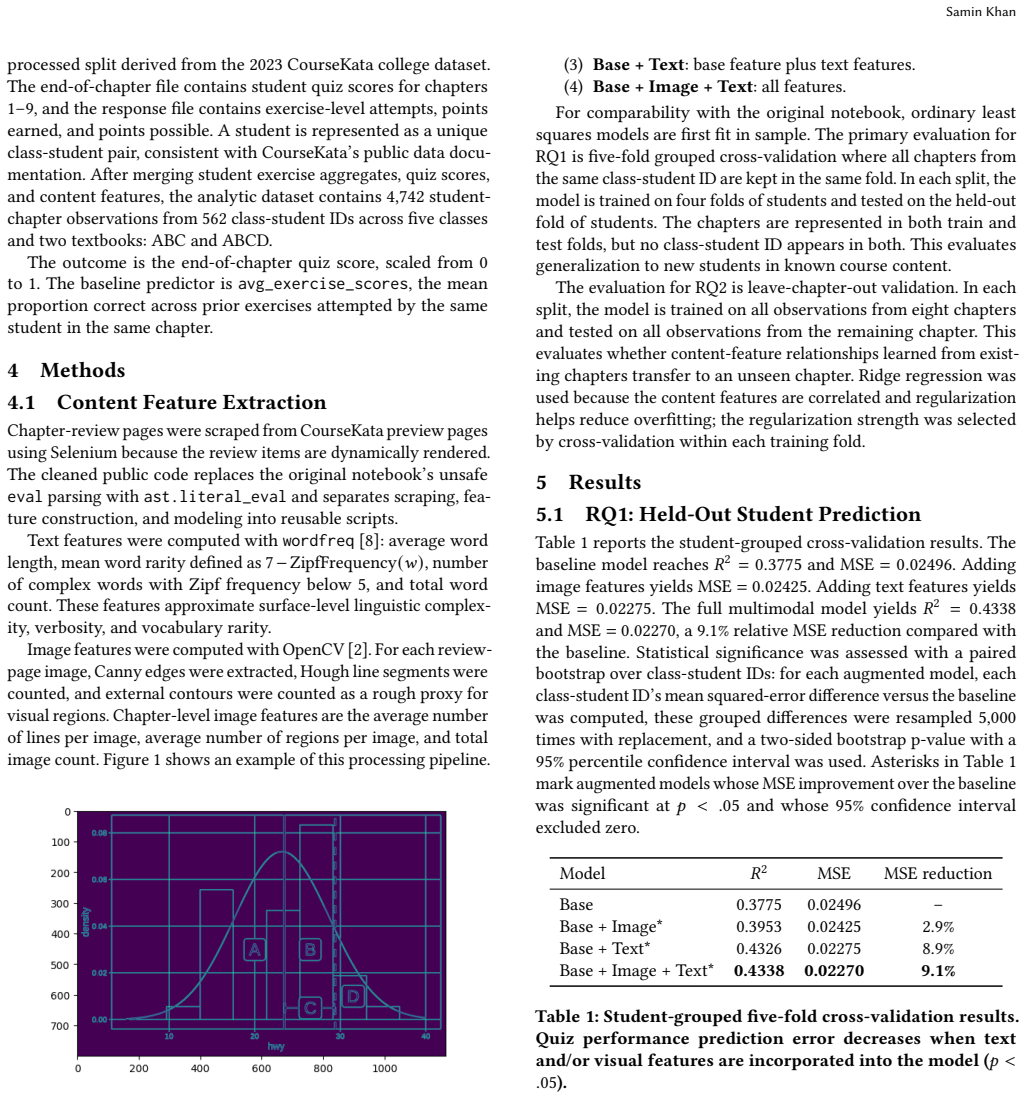
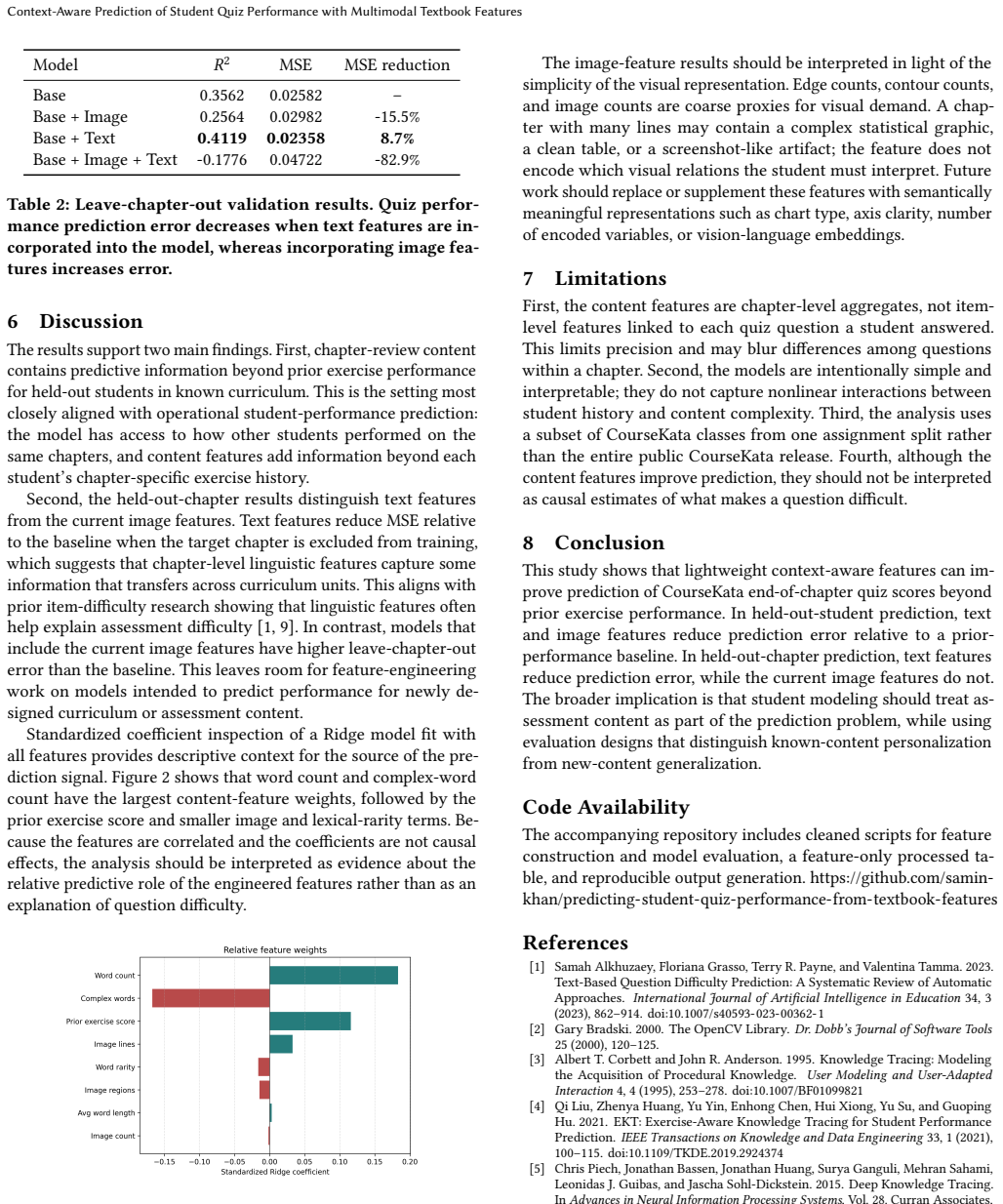
read the original abstract
Educational platforms often predict student performance from prior interactions, but the assessment content itself also varies in linguistic and visual complexity. This paper studies whether lightweight content features extracted from CourseKata chapter-review questions improve prediction of end-of-chapter quiz scores beyond a student's average prior exercise performance. The study combines 2023 CourseKata student response data with chapter-level text features from review-question wording and image features from textbook visuals. Across 4,742 student-chapter observations from 562 class-student IDs, adding content features improves student-grouped five-fold quiz prediction performance by 9.1% relative to a prior-performance baseline. In leave-chapter-out validation, text features reduce prediction error relative to the baseline, while image-containing models have higher error. This paper suggests that a context-aware model adds useful signal about the text and visual features of questions to better predict student quiz performance compared with using past student performance alone.
Editorial analysis
A structured set of objections, weighed in public.
Referee Report
Summary. The paper claims that lightweight multimodal content features (text from review-question wording and images from textbook visuals) extracted from CourseKata chapters improve prediction of end-of-chapter quiz scores beyond a student's average prior exercise performance. Across 4,742 student-chapter observations from 562 class-student IDs, it reports a 9.1% relative improvement in student-grouped five-fold cross-validation when adding these features to the baseline; text features reduce error in leave-chapter-out validation while image-containing models increase error. The paper concludes that context-aware models add useful signal from text and visual features.
Significance. If the central result holds after clarification, the work could contribute to educational prediction by showing that chapter-level content features supply signal independent of prior performance. The differential text vs. image results and the absence of model details, error bars, or tests in the abstract limit the assessed significance, as the multimodal aspect central to the title and conclusion appears unsupported by the reported leave-chapter-out outcomes.
major comments (2)
- [Abstract] Abstract: The claim that multimodal (text + image) content features improve quiz prediction is not supported by the reported leave-chapter-out validation results, where image-containing models have higher error than the prior-performance baseline while text-only reduces error. This indicates the 9.1% relative gain in five-fold CV is likely attributable to text features alone, directly challenging whether the multimodal construction supplies independent predictive value.
- [Abstract] Abstract: The central claim of a 9.1% relative improvement lacks supporting details on the prediction model, exact feature definitions, error bars, statistical tests, or how the multimodal features are combined, preventing verification that the content features are not already contained in the prior-performance baseline.
minor comments (1)
- [Abstract] The abstract should explicitly distinguish the five-fold CV result from the leave-chapter-out results and qualify the multimodal conclusion accordingly.
Simulated Author's Rebuttal
We thank the referee for the thoughtful comments on the abstract. We address each major comment below and agree that revisions are needed to better align the abstract with the reported results and to include key clarifying details.
read point-by-point responses
-
Referee: [Abstract] Abstract: The claim that multimodal (text + image) content features improve quiz prediction is not supported by the reported leave-chapter-out validation results, where image-containing models have higher error than the prior-performance baseline while text-only reduces error. This indicates the 9.1% relative gain in five-fold CV is likely attributable to text features alone, directly challenging whether the multimodal construction supplies independent predictive value.
Authors: We agree that the leave-chapter-out results show image-containing models increase error relative to the baseline while text features reduce it, indicating the 9.1% gain in student-grouped five-fold CV is driven by text. We will revise the abstract to state that the improvement is attributable to text features from review questions, with image features not contributing additional value in the leave-chapter-out setting. This will clarify that the multimodal title and conclusion refer to the feature extraction approach rather than a joint performance gain from both modalities. revision: yes
-
Referee: [Abstract] Abstract: The central claim of a 9.1% relative improvement lacks supporting details on the prediction model, exact feature definitions, error bars, statistical tests, or how the multimodal features are combined, preventing verification that the content features are not already contained in the prior-performance baseline.
Authors: The full manuscript details the model (ridge regression on student history plus chapter features), exact text (TF-IDF and embeddings from question wording) and image (ResNet features from textbook visuals) definitions, and cross-validation metrics in the Methods and Results sections. We will revise the abstract to briefly note the model, that content features are extracted independently from chapter review questions and visuals (distinct from student prior performance), and that gains are assessed via grouped cross-validation. Error bars and formal tests are reported in the full results but cannot be fully enumerated in the abstract due to length constraints; we will add a clause on statistical assessment via cross-validation folds. revision: partial
Circularity Check
No circularity; empirical ML evaluation stands on independent cross-validation
full rationale
The manuscript reports an empirical comparison of quiz-score predictors: a baseline using each student's average prior exercise performance versus models that additionally ingest chapter-level text and image features. No equations, ansatzes, uniqueness theorems, or self-citations appear in the abstract or description that would make the reported 9.1% relative improvement equivalent to the input features by construction. Performance is assessed via student-grouped five-fold cross-validation and leave-chapter-out validation on held-out observations, rendering the result statistically falsifiable rather than tautological. The observation that image features increase error is a correctness concern, not a circularity reduction.
Axiom & Free-Parameter Ledger
free parameters (1)
- prediction model coefficients
axioms (1)
- domain assumption Student quiz performance is predictable from prior exercise averages plus lightweight text and image features of the assessment content
Reference graph
Works this paper leans on
-
[1]
Samah Alkhuzaey, Floriana Grasso, Terry R. Payne, and Valentina Tamma. 2023. Text-Based Question Difficulty Prediction: A Systematic Review of Automatic Approaches.International Journal of Artificial Intelligence in Education34, 3 (2023), 862–914. doi:10.1007/s40593-023-00362-1
-
[2]
Gary Bradski. 2000. The OpenCV Library.Dr. Dobb’s Journal of Software Tools 25 (2000), 120–125
2000
-
[3]
Albert T. Corbett and John R. Anderson. 1995. Knowledge Tracing: Modeling the Acquisition of Procedural Knowledge.User Modeling and User-Adapted Interaction4, 4 (1995), 253–278. doi:10.1007/BF01099821
-
[4]
Qi Liu, Zhenya Huang, Yu Yin, Enhong Chen, Hui Xiong, Yu Su, and Guoping Hu. 2021. EKT: Exercise-Aware Knowledge Tracing for Student Performance Prediction.IEEE Transactions on Knowledge and Data Engineering33, 1 (2021), 100–115. doi:10.1109/TKDE.2019.2924374
-
[5]
Guibas, and Jascha Sohl-Dickstein
Chris Piech, Jonathan Bassen, Jonathan Huang, Surya Ganguli, Mehran Sahami, Leonidas J. Guibas, and Jascha Sohl-Dickstein. 2015. Deep Knowledge Tracing. InAdvances in Neural Information Processing Systems, Vol. 28. Curran Associates, Inc., Red Hook, NY, USA, 505–513. https://papers.nips.cc/paper/5654-deep- knowledge-tracing
2015
-
[6]
Ji Y. Son, Adam B. Blake, Laura Fries, and James W. Stigler. 2021. Modeling First: Applying Learning Science to the Teaching of Introductory Statistics.Journal Samin Khan of Statistics and Data Science Education29, 1 (2021), 4–21. doi:10.1080/10691898. 2020.1844106
-
[7]
Son and James W
Ji Y. Son and James W. Stigler. 2017–2026.Statistics and Data Science: A Modeling Approach. CourseKata, Los Angeles. https://coursekata.org/preview/default/ program Currently available in 7 versions
2017
-
[8]
Robyn Speer. 2022. rspeer/wordfreq: v3.0. https://zenodo.org/records/7199437. doi:10.5281/zenodo.7199437
-
[9]
Lubomír Štěpánek, Jana Dlouhá, and Patrícia Martinková. 2023. Item Difficulty Prediction Using Item Text Features: Comparison of Predictive Performance across Machine-Learning Algorithms.Mathematics11, 19 (2023), 4104. doi:10. 3390/math11194104
2023
-
[10]
Sijie Wang, Lin Ni, Zeyu Zhang, Xiaoxuan Li, Xianda Zheng, and Jiamou Liu
-
[11]
doi:10.1016/j.patrec.2024.03.007
Multimodal Prediction of Student Performance: A Fusion of Signed Graph Neural Networks and Large Language Models.Pattern Recognition Letters181 (2024), 1–8. doi:10.1016/j.patrec.2024.03.007
discussion (0)
Sign in with ORCID, Apple, or X to comment. Anyone can read and Pith papers without signing in.