REVIEW 3 major objections 5 minor 1 cited by
LAGO: Few-shot Crosslingual Embedding Inversion Attacks via Language Similarity-Aware Graph Optimization
T0 review · 3 major / 5 minor · reviewed 2026-08-07 · deepseek-v4-flash
Pith's one-line read Coupling the alignment matrices of linguistically similar languages improves few-shot embedding inversion attacks by 10-20% over independent baselines.
desk verdict A credible graph-constrained extension of ALGEN with real potential, but the causal claim that language similarity drives the gains is not yet supported and the headline 10–20% boost is overstated. read the letter →
The pith
A machine-rendered reading of the paper's core claim, the machinery that carries it, and where it could break.
The reading
What carries the argument
The central object is the language-similarity graph $G=(V,E)$: nodes are languages, and an edge connects two languages when their ASJP lexical distance or Lang2vec typological distance falls below a threshold. This graph carries the argument by coupling the alignment matrices $W_i$ of neighboring languages, so that scarce per-language data is supplemented by parameters learned on related languages. Two optimization updates instantiate the coupling: an inequality-constrained primal-dual update (IEQ-PDMM) and a total-variation-regularized gradient update, both augmented with Frobenius-norm regularization to keep the underdetermined few-shot problem stable.
What would settle it
Run the same two LAGO variants with a random graph, an all-to-all graph, and a deliberately wrong graph (for example, connecting only distant languages) while keeping all data, decoders, and hyperparameters fixed; if any of these non-similarity graphs produces the same 10-20% Rouge-L gain over ALGEN, the claim that language similarity drives the transfer is falsified.
Extended reading notes
Core claim
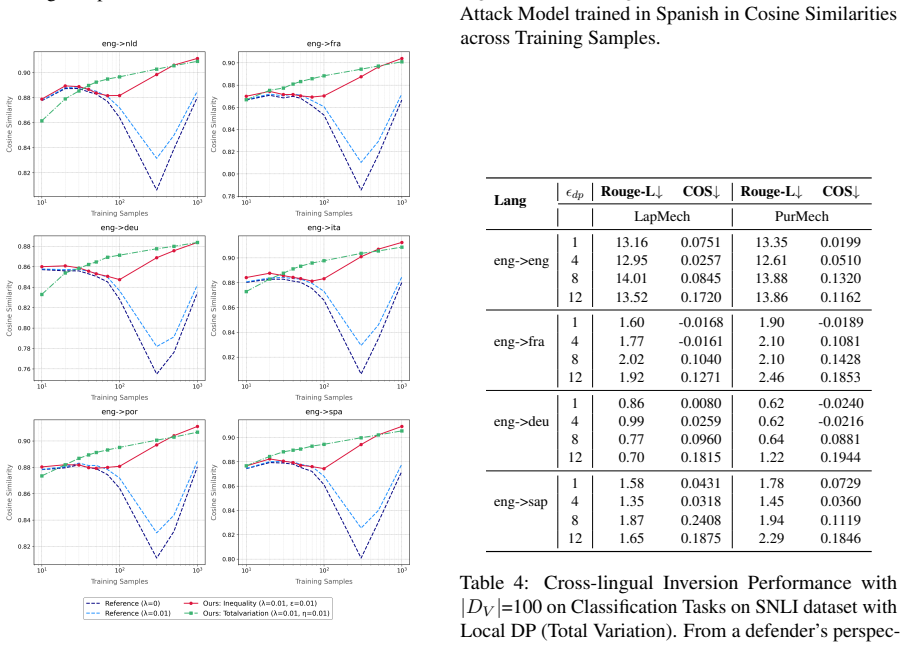
The central claim is that constraining the alignment matrix $W_i$ of each language to stay close to the $W_j$ of similar languages improves cross-lingual embedding inversion under data scarcity. The paper formalizes this as a graph-constrained distributed optimization problem over languages: each node minimizes its own reconstruction loss $\frac{1}{2}\|E_{A,i}-E_{V,i}W_i\|_F^2$ with Frobenius regularization, while edges enforce proximity between neighboring $W$'s either as hard inequalities $\|W_i-W_j\|_{\max}\le\epsilon$ or as a total-variation penalty $\eta\sum_{j\in N_i}\|W_i-W_j\|_{\text{sum}}$. The hard-constraint variant is solved with a primal-dual method (IEQ-PDMM), and the soft variant with a projected gradient step. When the constraints are relaxed ($\epsilon\to\infty$ or $\eta=0$), the problem decouples into independent ALGEN-style per-language alignments, which the paper presents as evidence that LAGO generalizes prior work. Empirically, with as few as 10 samples per language, LAGO improves Rouge-L over ALGEN by 10-20% across French, German, Dutch, Spanish, Italian, and Portuguese, using either an English- or Spanish-trained attack decoder.
Load-bearing premise
The argument stands on the assumption that the language-similarity scores used to build the graph point to the right pairs of languages to share information between, and that the transfer gains come from similarity rather than from coupling itself.
Editorial extensions
If this is right
- With as few as 10 samples per target language, an attacker can reconstruct text from multilingual embeddings 10-20% better in Rouge-L than ALGEN's independent per-language alignment.
- The gain transfers across victim encoders (MT5, E5, and ADA-2) and across attack languages (English and Spanish), so the vulnerability is not specific to one model or source language.
- ALGEN and similar per-language inversion methods are a limiting case of LAGO, so the framework is at least as strong as those baselines by construction.
- Differential privacy suppresses cross-lingual inversion Rouge-L scores below 2, but at a utility cost that drops model accuracy to 40%, so the privacy-vs-utility tradeoff remains sharp.
Reading between the lines
- Editorial inference: the same graph-constrained coupling could be turned into a defense: adding noise or perturbation scaled by a language's position in the similarity graph might suppress transfer more efficiently than uniform per-language noise.
- Editorial inference: the framework gives attackers a concrete selection rule: train the decoder in the language that is topologically closest to the target, since the paper observes one-hop neighbors transfer better than two-hop ones, as with English-German versus Spanish-German.
- Editorial inference: if language similarity is the active cause, related non-Indo-European language clusters should show analogous gains; testing on typologically distant languages would either extend the claim or bound it.
- Editorial inference: the paper's Limitations section notes that its decoder reaches only about 25 Rouge-L even in the monolingual 1k-sample case, so the reported 10-20% gains are relative improvements on a modest absolute reconstruction quality.
Editorial analysis
A structured set of objections, weighed in public.
Referee Report
Summary. The paper proposes LAGO, a graph-constrained distributed optimization framework for few-shot cross-lingual embedding inversion attacks. A language similarity graph is constructed from ASJP (lexical) and Lang2vec (typological) distances, and two optimization variants — linear inequality constraints solved via IEQ-PDMM and total variation regularization — jointly estimate per-language alignment matrices W_i. The paper shows that ALGEN is a special case of the framework when constraints are removed (Section 4.3). Experiments on seven Indo-European languages with English as the attack language report improved cosine similarity and Rouge-L over ALGEN across training sizes, and the paper claims a 10–20% Rouge-L improvement in few-shot settings and that language similarity is a critical factor for attack transferability.
Significance. If the empirical claims were fully supported, the work would highlight a real privacy risk for multilingual embedding services and provide a novel application of distributed optimization to inversion attacks. The theoretical reduction of ALGEN to a special case is correct by construction and is a useful unifying perspective. The paper also shares code, which facilitates reproducibility. However, the current evaluation does not include the control experiments needed to attribute the gains to language similarity, and the headline quantitative claim is not backed by the reported table. The core idea is promising, but the significance as stated depends on experiments that have not yet been run.
major comments (3)
- [§6.1, Table 1, Abstract] The claimed '10–20% boost in Rouge-L over ALGEN' in the abstract and Section 6.1 for low-resource settings (e.g., 10 samples) is not supported by the data in Table 1. At 10 French samples, the Inequality variant gives 10.14 versus ALGEN's 10.07 (+0.7%) and the Total Variation variant gives 10.87 (+7.9%). Even compared with the regularized baseline (Reg. λ=0.01, 10.14), the Inequality gain is zero. The 10–20% range appears only at 100–300 samples. The abstract, Section 6.1, and the contribution bullet should be corrected to state the actual improvements and the training sizes at which they occur.
- [§4.1, §6.2, Fig. 6] The causal claim that language similarity is the active mechanism behind the improvements is not tested. The paper never compares LAGO against a random graph, a complete graph, a degree-matched random graph, or a graph with deliberately incorrect language groupings. All seven test languages are related Indo-European languages, and the ASJP/Lang2vec graphs in Fig. 3 are dense, so the constraints may function simply as a coupling or regularization mechanism that pulls all W_i toward a common solution. Without such controls, the conclusion in the abstract and Section 6 that 'language similarity is a critical factor' is unsupported. Adding control graphs (and ideally languages from different families) is essential to substantiate the central contribution.
- [Table 1, Figs. 4–7] The experimental results appear to be from a single run per configuration; no standard deviations, confidence intervals, or significance tests are reported. Given the small absolute differences in cosine similarity (e.g., +0.0044 at 10 samples in Table 1) and the moderate Rouge-L differences, the claim that LAGO 'consistently outperforms' the baseline is not yet statistically established. Please provide multiple random seeds (or bootstrap over the few-shot samples) and report error bars, so the reader can assess whether the observed gaps exceed run-to-run noise.
minor comments (5)
- [§4.1, Eq. (Adjacency)] The adjacency formula A = (1 - sign(D - r))/2 yields 0.5 when D = r, which is not a binary adjacency value. Since D values are continuous this may never occur, but a strict indicator A = 1_{D < r} would be cleaner and avoids the edge case.
- [§4.1, Fig. 3] The acronym 'AJSP' appears in Section 4.1, Figure 3, and elsewhere, but the correct form is 'ASJP' (the database name). Please standardize the spelling throughout.
- [§5, Table 3] A typo: 'Tabel 3' should be 'Table 3'. Also, the Computational Resources section refers to 'ALGO' but the method is LAGO; please correct the notation.
- [§5, Language Graphs] The threshold r for each graph is only given as examples in Fig. 3; please report the exact r values used in the experiments for ASJP and Lang2vec, and the rule used to set them.
- [§4.2, Eq. (2)] In the update equations, it would help to explicitly state that the comparison and sign operations are element-wise and that W_i is an m×n matrix, so the dimension of the inequality constraint is clear.
Circularity Check
No significant circularity; LAGO's gains are measured against ALGEN and its graph priors come from external linguistic data, not from the evaluation target.
full rationale
The derivation chain is self-contained. LAGO's objective (Section 4.2) is a regularized least-squares problem over per-language alignment matrices W_i, with edges derived from external ASJP/Lang2vec distance matrices (Section 4.1). Nothing in the fitted W_i is constructed from the evaluation metric (Rouge-L or cosine similarity); the reported scores are measured on reconstructed test text. The only theoretical containment claim is Section 4.3: when ϵ→∞ or η=0, the cross-language constraints vanish and each node solves ALGEN's independent per-language least-squares problem (with the same Frobenius regularizer used in the Reg. baseline). This is a correct limiting-case identity, not a derivation of performance, and it is not used as evidence for the empirical gains. The empirical contribution is a direct comparison against ALGEN in the same experimental setup. Prior self-citations (Chen et al. 2024a, 2025a) motivate the importance of language similarity but are not load-bearing; the paper's own experiments provide the support. Missing controls (e.g., random or all-to-all graphs) are a confound/correctness concern, not circularity, because the causal claim about language similarity is not guaranteed by construction.
Assumptions & free parameters
free parameters (6)
- inequality bound epsilon =
0.01
- total variation penalty eta =
0.01
- Frobenius regularization lambda =
0.01
- graph threshold r =
0.9 (ASJP), 0.45 (Lang2vec)
- IEQ-PDMM parameter c =
0.4
- TV learning rate alpha =
0.01
assumptions (5)
- domain assumption Linear map W aligns victim and attacker embedding spaces well enough for text decoding.
- standard math The graph-constrained least-squares objectives are convex and the cited IEQ-PDMM and TV subgradient updates converge within 500 iterations.
- standard math E^T_{V,i}E_{V,i} + lambda I is invertible and well-conditioned.
- domain assumption ASJP and Lang2vec distance thresholds produce a graph whose edges capture alignment-transfer suitability.
- domain assumption An English-only FLAN-T5 decoder can decode aligned embeddings in the seven target languages.
Cite this review
Pith. "Pith review of LAGO: Few-shot Crosslingual Embedding Inversion Attacks via Language Similarity-Aware Graph Optimization." pith.science (2026). https://pith.science/paper/EUYV7QXB
@misc{pith2026250516008,
  author       = {Pith},
  title        = {Pith review of: LAGO: Few-shot Crosslingual Embedding Inversion Attacks via Language Similarity-Aware Graph Optimization},
  year         = {2026},
  howpublished = {\url{https://pith.science/paper/EUYV7QXB}},
  note         = {Machine review of arXiv:2505.16008}
}
read the original abstract
We propose LAGO - Language Similarity-Aware Graph Optimization - a novel approach for few-shot cross-lingual embedding inversion attacks, addressing critical privacy vulnerabilities in multilingual NLP systems. Unlike prior work in embedding inversion attacks that treat languages independently, LAGO explicitly models linguistic relationships through a graph-based constrained distributed optimization framework. By integrating syntactic and lexical similarity as edge constraints, our method enables collaborative parameter learning across related languages. Theoretically, we show this formulation generalizes prior approaches, such as ALGEN, which emerges as a special case when similarity constraints are relaxed. Our framework uniquely combines Frobenius-norm regularization with linear inequality or total variation constraints, ensuring robust alignment of cross-lingual embedding spaces even with extremely limited data (as few as 10 samples per language). Extensive experiments across multiple languages and embedding models demonstrate that LAGO substantially improves the transferability of attacks with 10-20% increase in Rouge-L score over baselines. This work establishes language similarity as a critical factor in inversion attack transferability, urging renewed focus on language-aware privacy-preserving multilingual embeddings.
Figures


Figures from the paper (9 more)




Forward citations
Cited by 1 Pith paper
-
SHARD: cell-keyed residual splitting for alignment-resistant private dense retrieval
SHARD shards private embedding residuals into cell-local keyed groups to raise the anchor requirement for alignment attacks by a factor of C while preserving full-dimensional nDCG@10 via encrypted reranking.
Reference graph
Works this paper leans on
-
[1]
online" 'onlinestring :=
ENTRY address archivePrefix author booktitle chapter edition editor eid eprint eprinttype howpublished institution journal key month note number organization pages publisher school series title type volume year doi pubmed url lastchecked label extra.label sort.label short.list INTEGERS output.state before.all mid.sentence after.sentence after.block STRING...
-
[2]
write newline
" write newline "" before.all 'output.state := FUNCTION n.dashify 't := "" t empty not t #1 #1 substring "-" = t #1 #2 substring "--" = not "--" * t #2 global.max substring 't := t #1 #1 substring "-" = "-" * t #2 global.max substring 't := while if t #1 #1 substring * t #2 global.max substring 't := if while FUNCTION word.in bbl.in capitalize " " * FUNCT...
-
[3]
David Ifeoluwa Adelani, Graham Neubig, Sebastian Ruder, Shruti Rijhwani, Michael Beukman, Chester Palen-Michel, Constantine Lignos, Jesujoba O. Alabi, Shamsuddeen H. Muhammad, Peter Nabende, Cheikh M. Bamba Dione, Andiswa Bukula, Rooweither Mabuya, Bonaventure F. P. Dossou, Blessing Sibanda, Happy Buzaaba, Jonathan Mukiibi, Godson Kalipe, Derguene Mbaye, ...
-
[4]
Verena Blaschke, Masha Fedzechkina, and Maartje ter Hoeve. 2025. Analyzing the effect of linguistic similarity on cross-lingual transfer: Tasks and experimental setups matter. arXiv preprint arXiv:2501.14491
work page Pith review arXiv 2025
-
[5]
Luiz Bonifacio, Vitor Jeronymo, Hugo Queiroz Abonizio, Israel Campiotti, Marzieh Fadaee, Roberto Lotufo, and Rodrigo Nogueira. 2021. mmarco: A multilingual version of the ms marco passage ranking dataset. arXiv preprint arXiv:2108.13897
arXiv 2021
-
[6]
Samuel R Bowman, Gabor Angeli, Christopher Potts, and Christopher D Manning. 2015. A large annotated corpus for learning natural language inference. arXiv preprint arXiv:1508.05326
arXiv 2015
-
[7]
Stephen Boyd. 2010. https://doi.org/10.1561/2200000016 Distributed Optimization and Statistical Learning via the Alternating Direction Method of Multipliers . Foundations and Trends® in Machine Learning, 3(1):1--122
-
[8]
Nicholas Carlini, Ulfar Erlingsson, and Nicolas Papernot. 2019. Prototypical examples in deep learning: Metrics, characteristics, and utility
work page 2019
Show all 39 references
-
[9]
Yiyi Chen, Russa Biswas, Heather Lent, and Johannes Bjerva. 2024 a . Against all odds: Overcoming typology, script, and language confusion in multilingual embedding inversion attacks. arXiv preprint arXiv:2408.11749
2024 arXiv
-
[10]
Yiyi Chen, Heather Lent, and Johannes Bjerva. 2024 b . Text embedding inversion security for multilingual language models. In Proceedings of the 62nd Annual Meeting of the Association for Computational Linguistics (Volume 1: Long Papers), pages 7808--7827
2024
-
[11]
Yiyi Chen, Qiongxiu Li, Russa Biswas, and Johannes Bjerva. 2025 a . https://aclanthology.org/2025.findings-naacl.210/ Large language models are easily confused: A quantitative metric, security implications and typological analysis . In Findings of the Association for Computati...
2025
-
[12]
Yiyi Chen, Qiongkai Xu, and Johannes Bjerva. 2025 b . Algen: Few-shot inversion attacks on textual embeddings using alignment and generation. arXiv preprint arXiv:2502.11308
2025 arXiv
-
[13]
Rochelle Choenni, Dan Garrette, and Ekaterina Shutova. 2023. How do languages influence each other? studying cross-lingual data sharing during lm fine-tuning. arXiv preprint arXiv:2305.13286
2023 arXiv
-
[14]
Hyung Won Chung, Le Hou, Shayne Longpre, Barret Zoph, Yi Tay, William Fedus, Yunxuan Li, Xuezhi Wang, Mostafa Dehghani, Siddhartha Brahma, Albert Webson, Shixiang Shane Gu, Zhuyun Dai, Mirac Suzgun, Xinyun Chen, Aakanksha Chowdhery, Alex Castro-Ros, Marie Pellat, Kevin Robinso...
2022 arXiv
-
[15]
Bowman, Holger Schwenk, and Veselin Stoyanov
Alexis Conneau, Guillaume Lample, Ruty Rinott, Adina Williams, Samuel R. Bowman, Holger Schwenk, and Veselin Stoyanov. 2018. https://arxiv.org/abs/1809.05053 Xnli: Evaluating cross-lingual sentence representations . Preprint, arXiv:1809.05053
2018 arXiv
-
[16]
Wietse de Vries, Martijn Wieling, and Malvina Nissim. 2022. https://doi.org/10.18653/v1/2022.acl-long.529 Make the best of cross-lingual transfer: Evidence from POS tagging with over 100 languages . In Proceedings of the 60th Annual Meeting of the Association for Computational...
2022 doi
-
[17]
Minxin Du, Xiang Yue, Sherman SM Chow, and Huan Sun. 2023. Sanitizing sentence embeddings (and labels) for local differential privacy. In Proceedings of the ACM Web Conference 2023, pages 2349--2359
2023
-
[18]
Vitaly Feldman. 2020. Does learning require memorization? a short tale about a long tail. In Proceedings of the 52nd Annual ACM SIGACT Symposium on Theory of Computing, pages 954--959
2020
-
[19]
Richard Heusdens and Guoqiang Zhang. 2024 a . Distributed nonlinear conic optimisation with partially separable structure. arXiv preprint arXiv:2405.09490
2024 arXiv
-
[20]
Richard Heusdens and Guoqiang Zhang. 2024 b . Distributed optimisation with linear equality and inequality constraints using pdmm. IEEE Transactions on Signal and Information Processing over Networks
2024
-
[21]
Yu-Hsiang Huang, Yuche Tsai, Hsiang Hsiao, Hong-Yi Lin, and Shou-De Lin. 2024. https://doi.org/10.18653/v1/2024.acl-long.230 Transferable Embedding Inversion Attack : Uncovering Privacy Risks in Text Embeddings without Model Queries . In Proceedings of the 62nd Annual Meeting ...
2024 doi
-
[22]
Anne Lauscher, Vinit Ravishankar, Ivan Vulic, and Goran Glavas. 2020. https://api.semanticscholar.org/CorpusID:226262344 From zero to hero: On the limitations of zero-shot language transfer with multilingual transformers . In Conference on Empirical Methods in Natural Language...
2020
-
[23]
Haoran Li, Mingshi Xu, and Yangqiu Song. 2023. https://doi.org/10.18653/v1/2023.findings-acl.881 Sentence embedding leaks more information than you expect: Generative embedding inversion attack to recover the whole sentence . In Findings of the Association for Computational Li...
2023 doi
-
[24]
Qiongxiu Li, Richard Heusdens, and Mads Gr sb ll Christensen. 2020. Privacy-preserving distributed optimization via subspace perturbation: A general framework. IEEE Transactions on Signal Processing, 68:5983--5996
2020
-
[25]
Chin-Yew Lin. 2004. Rouge: A package for automatic evaluation of summaries. In Text summarization branches out, pages 74--81
2004
-
[26]
Patrick Littell, David R Mortensen, Ke Lin, Katherine Kairis, Carlisle Turner, and Lori Levin. 2017. Uriel and lang2vec: Representing languages as typological, geographical, and phylogenetic vectors. In Proceedings of the 15th Conference of the European Chapter of the Associat...
2017
-
[27]
Brendan McMahan, Eider Moore, Daniel Ramage, Seth Hampson, and Blaise Aguera y Arcas. 2017. Communication-efficient learning of deep networks from decentralized data. In Artificial intelligence and statistics, pages 1273--1282. PMLR
2017
-
[28]
John X Morris, Volodymyr Kuleshov, Vitaly Shmatikov, and Alexander M Rush. 2023. Text embeddings reveal (almost) as much as text. arXiv preprint arXiv:2310.06816
2023 arXiv
-
[29]
Yuyuan Ouyang, Yunmei Chen, Guanghui Lan, and Eduardo Pasiliao Jr. 2015. An accelerated linearized alternating direction method of multipliers. SIAM Journal on Imaging Sciences, 8(1):644--681
2015
-
[30]
Jie Peng, Weiyu Li, and Qing Ling. 2021. Byzantine-robust decentralized stochastic optimization over static and time-varying networks. Signal Processing, 183:108020
2021
-
[31]
Fred Philippy, Siwen Guo, and Shohreh Haddadan. 2023. Towards a common understanding of contributing factors for cross-lingual transfer in multilingual language models: A review. arXiv preprint arXiv:2305.16768
2023 arXiv
-
[32]
Michael Rabbat and Robert Nowak. 2004. Distributed optimization in sensor networks. In Proceedings of the 3rd international symposium on Information processing in sensor networks, pages 20--27
2004
-
[33]
Congzheng Song and Ananth Raghunathan. 2020. https://doi.org/10.1145/3372297.3417270 Information leakage in embedding models . In Proceedings of the 2020 ACM SIGSAC Conference on Computer and Communications Security, CCS '20, page 377–390, New York, NY, USA. Association for Co...
2020
-
[34]
Huahua Wang and Arindam Banerjee. 2014. Bregman alternating direction method of multipliers. Advances in neural information processing systems, 27
2014
-
[35]
Liang Wang, Nan Yang, Xiaolong Huang, Binxing Jiao, Linjun Yang, Daxin Jiang, Rangan Majumder, and Furu Wei. 2022. Text embeddings by weakly-supervised contrastive pre-training. arXiv preprint arXiv:2212.03533
2022 arXiv
-
[36]
ASJP Database
Søren Wichmann, Eric W. Holman, and Cecil H. Brown. 2022. https://doi.org/10.5281/zenodo.7079637 CLDF dataset derived from Wichmann et al.'s "ASJP Database" v20 from 2022
2022 doi
-
[37]
Linting Xue, Noah Constant, Adam Roberts, Mihir Kale, Rami Al-Rfou, Aditya Siddhant, Aditya Barua, and Colin Raffel. 2020. mt5: A massively multilingual pre-trained text-to-text transformer. arXiv preprint arXiv:2010.11934
2020 arXiv
-
[38]
Wenrui Yu, Qiongxiu Li, Milan Lopuha \"a -Zwakenberg, Mads Gr sb ll Christensen, and Richard Heusdens. 2024. Provable privacy advantages of decentralized federated learning via distributed optimization. IEEE Transactions on Information Forensics and Security
2024
-
[39]
Guoqiang Zhang and Richard Heusdens. 2017. Distributed optimization using the primal-dual method of multipliers. IEEE Transactions on Signal and Information Processing over Networks, 4(1):173--187
2017
Reviewed August 7, 2026 · model on record in the stance chip above.
Discussion (0). Sign in to comment.