REVIEW 2 major objections 71 references
A latent Q-Barrier shield filters or reweights actions in safe in-context RL using predicted future cost and remaining budget, improving reward-safety tradeoffs under OOD shifts without test-time updates.
Reviewed by Pith at T0; open to challenge. T0 means a machine referee read the full paper against a public rubric. the ladder, T0–T4 →
T0 review · grok-4.3
2026-06-30 11:40 UTC pith:EVLMNV2S
load-bearing objection The paper adds an explicit Q-Barrier filter on top of pre-trained latent dynamics for safe ICRL without test-time updates, with a conditional proof and benchmark gains, but the OOD reliability of the safety margin is not directly checked. the 2 major comments →
Latent Q-Barrier Shielding for Safe In-Context Reinforcement Learning
The pith
A machine-rendered reading of the paper's core claim, the machinery that carries it, and where it could break.
Core claim
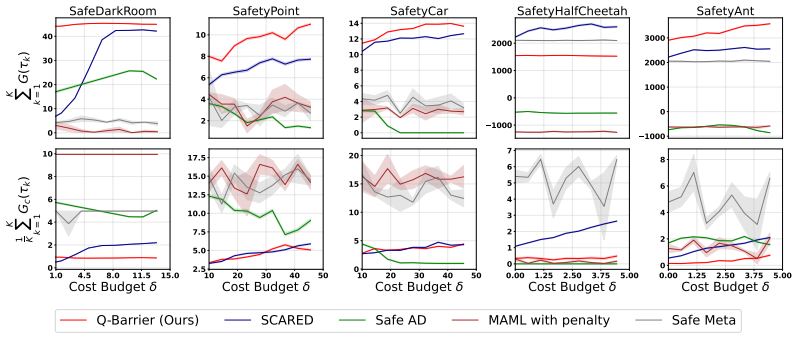
The latent Q-Barrier shield learns a context representation, latent dynamics, and ensemble cost critic before deployment. Without any parameter updates it infers context from interaction history and filters or softly reweights candidate actions using the remaining budget and predicted future cost. It proves a conditional, error-decomposed barrier-margin result: a Q-Barrier-satisfying action leaves the next latent-budget state with an approximately budget-safe continuation under the learned critic, up to Bellman and latent-prediction errors. Across five safe ICRL benchmarks the shield improves deployment-time reward-safety tradeoffs over a strong baseline after a short context window.
What carries the argument
The latent Q-Barrier shield, which combines a learned latent dynamics model and ensemble cost critic to enforce an explicit barrier condition that checks predicted future cost against the remaining safety budget.
Load-bearing premise
The pre-trained latent dynamics and ensemble cost critic remain sufficiently accurate under OOD deployment shifts to allow reliable filtering of unsafe actions using only the remaining budget and predicted future cost.
What would settle it
On a new safe ICRL benchmark with larger distribution shift, if the shielded policy violates the cost budget more frequently than the baseline or fails to raise return while holding cost, the claimed improvement collapses.
If this is right
- Higher return in four of five benchmarks and equal or lower average episode cost in all five after a short context window.
- A conditional barrier-margin guarantee holds for any Q-Barrier-satisfying action up to explicit error terms.
- The shield works on top of any frozen pre-trained safe ICRL policy without online adaptation.
- Explicit action-level cost prediction compensates for the indirect effect of budget information in policy conditioning alone.
Where Pith is reading between the lines
- If latent accuracy persists, the same pre-training-plus-shield pattern could apply to continuous-action robotic tasks with hard safety constraints.
- Replacing the ensemble critic with a single uncertainty-aware network would test whether the method can be made lighter while preserving the margin guarantee.
- Applying the shield in a setting where the safety budget itself changes mid-episode would expose whether the barrier condition remains valid under non-stationary constraints.
Editorial analysis
A structured set of objections, weighed in public.
Referee Report
Summary. The paper proposes Latent Q-Barrier Shielding for safe in-context reinforcement learning. It pre-trains a context encoder, latent dynamics model, and ensemble cost critic offline. At test time, without parameter updates, the shield infers context from history and filters or reweights actions by checking predicted future cost against the remaining safety budget. It states a conditional theorem decomposing the barrier margin into Bellman and latent-prediction errors, and reports that the method yields higher return than a strong safe-ICRL baseline in four of five benchmarks while matching or lowering average episode cost in all five after a short context window.
Significance. If the conditional barrier result holds with verified error bounds under OOD shifts and the benchmark gains are robust, the approach would supply an explicit, model-based safety filter for ICRL that operates purely at inference time. This addresses a gap between frozen policy conditioning and explicit cost budgeting, with potential applicability to domains requiring deployment-time safety guarantees without online adaptation.
major comments (2)
- [Proof of the barrier-margin result and §5 (Experiments)] The barrier-margin theorem (stated in the abstract and detailed in the main text) is explicitly conditional on small Bellman and latent-prediction errors, yet the experimental section provides no measurements or bounds on these errors evaluated on the actual OOD deployment trajectories across the five benchmarks. Without this link, it is impossible to determine whether the reported safety improvements are explained by the theorem or by other factors such as limited distribution shift.
- [§5 (Experiments) and abstract] The empirical claim of improved reward-safety tradeoffs rests on benchmark results, but the manuscript supplies no details on the experimental protocol, including number of random seeds, statistical significance testing, exact context-window lengths, cost-budget values, or how the strong safe-ICRL baseline was implemented and tuned.
Simulated Author's Rebuttal
We thank the referee for the detailed and constructive feedback. We address each major comment below and commit to incorporating the requested clarifications and analyses in the revised manuscript.
read point-by-point responses
-
Referee: [Proof of the barrier-margin result and §5 (Experiments)] The barrier-margin theorem (stated in the abstract and detailed in the main text) is explicitly conditional on small Bellman and latent-prediction errors, yet the experimental section provides no measurements or bounds on these errors evaluated on the actual OOD deployment trajectories across the five benchmarks. Without this link, it is impossible to determine whether the reported safety improvements are explained by the theorem or by other factors such as limited distribution shift.
Authors: We agree that reporting the Bellman and latent-prediction errors on the OOD deployment trajectories would directly strengthen the link between the conditional theorem and the observed safety gains. In the revised manuscript we will add, in Section 5, quantitative measurements of these two error terms computed on the actual test trajectories for each of the five benchmarks, together with a brief discussion of their magnitudes relative to the reported performance improvements. revision: yes
-
Referee: [§5 (Experiments) and abstract] The empirical claim of improved reward-safety tradeoffs rests on benchmark results, but the manuscript supplies no details on the experimental protocol, including number of random seeds, statistical significance testing, exact context-window lengths, cost-budget values, or how the strong safe-ICRL baseline was implemented and tuned.
Authors: We acknowledge that several experimental details were omitted. In the revised Section 5 we will explicitly state: the number of random seeds (10), the statistical testing procedure (mean ± std and paired t-tests), the exact context-window lengths used, the per-environment cost-budget values, and a description of the baseline implementation together with its hyperparameter selection protocol. revision: yes
Circularity Check
No significant circularity; theorem is conditional error bound, not tautological with fits
full rationale
The paper states a conditional barrier-margin theorem decomposed into Bellman and latent-prediction errors, with empirical results on five benchmarks presented separately. No quoted equations show a prediction or margin reducing by construction to fitted parameters, no self-citation load-bearing the central claim, and no renaming of known results as new derivations. The accuracy-under-OOD assumption is an external premise, not a definitional loop. The derivation chain remains self-contained against the stated conditional result.
Axiom & Free-Parameter Ledger
read the original abstract
Safe in-context reinforcement learning (ICRL) adapts online from interaction history without test-time parameter updates while controlling episode cost under a safety budget. Under out-of-distribution (OOD) deployment shifts, pretraining-only safe ICRL can give poor reward-safety tradeoffs because the remaining budget affects behavior only through frozen policy conditioning, not an explicit action-level check against predicted future cost. We propose a latent Q-Barrier shield that learns a context representation, latent dynamics, and an ensemble cost critic before deployment. Without parameter updates, the shield infers context from history and filters or softly reweights candidate actions using the remaining budget and predicted future cost. We prove a conditional, error-decomposed barrier-margin result: a Q-Barrier-satisfying action leaves the next latent-budget state with an approximately budget-safe continuation under the learned critic, up to Bellman and latent-prediction errors. Across five safe ICRL benchmarks, the shield improves deployment-time reward-safety tradeoffs over a strong safe-ICRL baseline: after a short context window, it achieves higher return in four of five benchmarks while matching or lowering average episode cost in all five.
Figures



Reference graph
Works this paper leans on
-
[1]
Constrained policy optimization
Joshua Achiam, David Held, Aviv Tamar, and Pieter Abbeel. Constrained policy optimization. InProceedings of the International Conference on Machine Learning, 2017
work page 2017
-
[2]
Sankalp Agrawal, Junwon Seo, Kensuke Nakamura, Ran Tian, and Andrea Bajcsy. Anysafe: Adapting latent safety filters at runtime via safety constraint parameterization in the latent space. IEEE International Conference on Robotics and Automation (ICRA), 2026
work page 2026
-
[3]
Safe reinforcement learning via shielding
Mohammed Alshiekh, Roderick Bloem, R ¨udiger Ehlers, Bettina K ¨onighofer, Scott Niekum, and Ufuk Topcu. Safe reinforcement learning via shielding. InAAAI Conference on Artificial Intelligence, 2018
work page 2018
- [4]
-
[5]
Actsafe: Active exploration with safety constraints for reinforcement learning
Yarden As, Bhavya Sukhija, Lenart Treven, Carmelo Sferrazza, Stelian Coros, and Andreas Krause. Actsafe: Active exploration with safety constraints for reinforcement learning. InThe Thirteenth International Conference on Learning Representations, 2025
work page 2025
-
[6]
Carolin Benjamins, Theresa Eimer, Frederik Schubert, Aditya Mohan, Sebastian D¨ohler, Andr´e Biedenkapp, Bodo Rosenhahn, Frank Hutter, and Marius Lindauer. Contextualize me – the case for context in reinforcement learning.Transactions on Machine Learning Research, 2023
work page 2023
-
[7]
Safe reinforcement learning via shielding under partial observability
Steven Carr, Nils Jansen, Sebastian Junges, and Ufuk Topcu. Safe reinforcement learning via shielding under partial observability. InThe Thirty-Seventh AAAI Conference on Artificial Intelligence, 2023
work page 2023
-
[8]
Context-aware safe reinforcement learning for non-stationary environments
Baiming Chen, Zuxin Liu, Jiacheng Zhu, Mengdi Xu, Wenhao Ding, Liang Li, and Ding Zhao. Context-aware safe reinforcement learning for non-stationary environments. In2021 IEEE International Conference on Robotics and Automation (ICRA), 2021
work page 2021
-
[9]
An adaptive deep RL method for non-stationary environments with piecewise stable context
Xiaoyu Chen, Xiangming Zhu, Yufeng Zheng, Pushi Zhang, Li Zhao, Wenxue Cheng, Peng Cheng, Yongqiang Xiong, Tao Qin, Jianyu Chen, and Tie-Yan Liu. An adaptive deep RL method for non-stationary environments with piecewise stable context. InAdvances in Neural Information Processing Systems, 2022
work page 2022
-
[10]
Safe and efficient reinforcement learning using disturbance-observer-based control barrier functions
Yikun Cheng, Pan Zhao, and Naira Hovakimyan. Safe and efficient reinforcement learning using disturbance-observer-based control barrier functions. InProceedings of The 5th Annual Learning for Dynamics and Control Conference, 2023
work page 2023
-
[11]
Jason Choi, Fernando Casta ˜neda, Claire J. Tomlin, and Koushil Sreenath. Reinforcement learning for safety-critical control under model uncertainty, using control lyapunov functions and control barrier functions. InRobotics: Science and Systems, 2020
work page 2020
-
[12]
In-context exploration-exploitation for reinforcement learning.ArXiv Preprint, 2024
Zhenwen Dai, Federico Tomasi, and Sina Ghiassian. In-context exploration-exploitation for reinforcement learning.ArXiv Preprint, 2024
work page 2024
-
[13]
Fang, Zhuoran Yang, and Vahid Tarokh
Juncheng Dong, Moyang Guo, Ethan X. Fang, Zhuoran Yang, and Vahid Tarokh. In-context reinforcement learning without optimal action labels. InICML 2024 Workshop on In-Context Learning, 2024
work page 2024
-
[14]
RL2: Fast reinforcement learning via slow reinforcement learning.ArXiv Preprint, 2016
Yan Duan, John Schulman, Xi Chen, Peter L Bartlett, Ilya Sutskever, and Pieter Abbeel. RL2: Fast reinforcement learning via slow reinforcement learning.ArXiv Preprint, 2016. 10
work page 2016
-
[15]
Model-agnostic meta-learning for fast adapta- tion of deep networks
Chelsea Finn, Pieter Abbeel, and Sergey Levine. Model-agnostic meta-learning for fast adapta- tion of deep networks. InProceedings of the International Conference on Machine Learning, 2017
work page 2017
-
[16]
Iterative reachability estimation for safe reinforcement learning
Milan Ganai, Zheng Gong, Chenning Yu, Sylvia Lee Herbert, and Sicun Gao. Iterative reachability estimation for safe reinforcement learning. InThirty-seventh Conference on Neural Information Processing Systems, 2023
work page 2023
-
[17]
Amago: Scalable in-context reinforcement learning for adaptive agents
Jake Grigsby, Linxi Fan, and Yuke Zhu. Amago: Scalable in-context reinforcement learning for adaptive agents. InProceedings of the International Conference on Learning Representations, 2024
work page 2024
-
[18]
Amago-2: Breaking the multi-task barrier in meta-reinforcement learning with transformers
Jake Grigsby, Justin Sasek, Samyak Parajuli, Ikechukwu D Adebi, Amy Zhang, and Yuke Zhu. Amago-2: Breaking the multi-task barrier in meta-reinforcement learning with transformers. In Advances in Neural Information Processing Systems, 2024
work page 2024
-
[19]
Jean-Bastien Grill, Florian Strub, Florent Altch´e, Corentin Tallec, Pierre H. Richemond, Elena Buchatskaya, Carl Doersch, Bernardo Avila Pires, Zhaohan Daniel Guo, Mohammad Gheshlaghi Azar, Bilal Piot, Koray Kavukcuoglu, R´emi Munos, and Michal Valko. Bootstrap your own latent a new approach to self-supervised learning. InProceedings of the 34th Internat...
work page 2020
-
[20]
Enhancing efficiency of safe reinforcement learning via sample manipulation
Shangding Gu, Laixi Shi, Yuhao Ding, Alois Knoll, Costas Spanos, Adam Wierman, and Ming Jin. Enhancing efficiency of safe reinforcement learning via sample manipulation. InThe Thirty-eighth Annual Conference on Neural Information Processing Systems, 2024
work page 2024
-
[21]
Cong Guan, Ruiqi Xue, Ziqian Zhang, Lihe Li, Yi-Chen Li, Lei Yuan, and Yang Yu. Cost-aware offline safe meta reinforcement learning with robust in-distribution online task adaptation. In Proceedings of the International Conference on Autonomous Agents and Multiagent Systems, 2024
work page 2024
-
[22]
Zero-shot transfer of neural ODEs
Tyler Ingebrand, Adam Thorpe, and Ufuk Topcu. Zero-shot transfer of neural ODEs. InThe Thirty-eighth Annual Conference on Neural Information Processing Systems, 2024
work page 2024
-
[23]
Zero-shot reinforcement learning via function encoders
Tyler Ingebrand, Amy Zhang, and Ufuk Topcu. Zero-shot reinforcement learning via function encoders. InProceedings of the 41st International Conference on Machine Learning, 2024
work page 2024
-
[24]
Reinforcement learning with unsupervised auxiliary tasks
Max Jaderberg, V olodymyr Mnih, Wojciech Marian Czarnecki, Tom Schaul, Joel Z Leibo, David Silver, and Koray Kavukcuoglu. Reinforcement learning with unsupervised auxiliary tasks. InInternational Conference on Learning Representations, 2017
work page 2017
-
[25]
Safety gymnasium: A unified safe reinforcement learning benchmark
Jiaming Ji, Borong Zhang, Jiayi Zhou, Xuehai Pan, Weidong Huang, Ruiyang Sun, Yiran Geng, Yifan Zhong, Josef Dai, and Yaodong Yang. Safety gymnasium: A unified safe reinforcement learning benchmark. InAdvances in Neural Information Processing Systems, 2023
work page 2023
-
[26]
A CMDP-within- online framework for meta-safe reinforcement learning
Vanshaj Khattar, Yuhao Ding, Bilgehan Sel, Javad Lavaei, and Ming Jin. A CMDP-within- online framework for meta-safe reinforcement learning. InProceedings of the International Conference on Learning Representations, 2023
work page 2023
-
[27]
A survey of zero-shot generalisation in deep reinforcement learning.ArXiv Preprint, 2021
Robert Kirk, Amy Zhang, Edward Grefenstette, and Tim Rockt¨aschel. A survey of zero-shot generalisation in deep reinforcement learning.ArXiv Preprint, 2021
work page 2021
-
[28]
Freeman, Jascha Sohl-Dickstein, and J¨urgen Schmidhuber
Louis Kirsch, James Harrison, C. Freeman, Jascha Sohl-Dickstein, and J¨urgen Schmidhuber. To- wards general-purpose in-context learning agents. InNeurIPS Foundation Models for Decision Making Workshop, 2023
work page 2023
-
[29]
Sim˜ao, Nils Jansen, and Ufuk Topcu
Cevahir Koprulu, Thiago D. Sim˜ao, Nils Jansen, and Ufuk Topcu. Safety-prioritizing curricula for constrained reinforcement learning. InThe Thirteenth International Conference on Learning Representations, 2025
work page 2025
-
[30]
Can large language models explore in-context?ArXiv Preprint, 2024
Akshay Krishnamurthy, Keegan Harris, Dylan J Foster, Cyril Zhang, and Aleksandrs Slivkins. Can large language models explore in-context?ArXiv Preprint, 2024. 11
work page 2024
-
[31]
Adaptive shielding for safe reinforcement learning under hidden-parameter dynam- ics shifts
Minjae Kwon, Tyler Ingebrand, Ufuk Topcu, and Lu Feng. Adaptive shielding for safe re- inforcement learning under hidden-parameter dynamics shifts, 2026. URL https://arxiv. org/abs/2506.11033
-
[32]
Curl: Contrastive unsupervised represen- tations for reinforcement learning
Michael Laskin, Aravind Srinivas, and Pieter Abbeel. Curl: Contrastive unsupervised represen- tations for reinforcement learning. InProceedings of the International Conference on Machine Learning, 2020
work page 2020
-
[33]
In-context reinforcement learning with algorithm distillation
Michael Laskin, Luyu Wang, Junhyuk Oh, Emilio Parisotto, Stephen Spencer, Richie Steiger- wald, DJ Strouse, Steven Stenberg Hansen, Angelos Filos, Ethan Brooks, Maxime Gazeau, Himanshu Sahni, Satinder Singh, and V olodymyr Mnih. In-context reinforcement learning with algorithm distillation. InProceedings of the International Conference on Learning Represe...
work page 2023
-
[34]
Supervised pretraining can learn in-context reinforcement learning
Jonathan Lee, Annie Xie, Aldo Pacchiano, Yash Chandak, Chelsea Finn, Ofir Nachum, and Emma Brunskill. Supervised pretraining can learn in-context reinforcement learning. In Advances in Neural Information Processing Systems, 2023
work page 2023
-
[35]
Lars Lindemann, Matthew Cleaveland, Gihyun Shim, and George J. Pappas. Safe planning in dynamic environments using conformal prediction.IEEE Robotics and Automation Letters, 2023
work page 2023
-
[36]
Scalable in-context q-learning
Jinmei Liu, Fuhong Liu, Zhenhong Sun, Jianye HAO, Huaxiong Li, Bo Wang, Daoyi Dong, Chunlin Chen, and Zhi Wang. Scalable in-context q-learning. InThe Fourteenth International Conference on Learning Representations, 2026
work page 2026
-
[37]
Adapt to environment sudden changes by learning a context-sensitive policy
Fan-Ming Luo, Shengyi Jiang, Yang Yu, ZongZhang Zhang, and Yi-Feng Zhang. Adapt to environment sudden changes by learning a context-sensitive policy. InProceedings of the AAAI Conference on Artificial Intelligence, 2022
work page 2022
-
[38]
Mesa: Offline meta-rl for safe adaptation and fault tolerance
Michael Luo, Ashwin Balakrishna, Brijen Thananjeyan, Suraj Nair, Julian Ibarz, Jie Tan, Chelsea Finn, Ion Stoica, and Ken Goldberg. Mesa: Offline meta-rl for safe adaptation and fault tolerance. InAdvances in Neural Information Processing Systems, 2021
work page 2021
-
[39]
A survey of in-context reinforcement learning.ArXiv Preprint, 2025
Amir Moeini, Jiuqi Wang, Jacob Beck, Ethan Blaser, Shimon Whiteson, Rohan Chandra, and Shangtong Zhang. A survey of in-context reinforcement learning.ArXiv Preprint, 2025
work page 2025
-
[40]
Safe in-context reinforcement learning
Amir Moeini, Minjae Kwon, Alper Kamil Bozkurt, Yuichi Motai, Rohan Chandra, Lu Feng, and Shangtong Zhang. Safe in-context reinforcement learning. InInternational Conference on Machine Learning (ICML), 2026
work page 2026
-
[41]
Generalizing safety beyond collision- avoidance via latent-space reachability analysis
Kensuke Nakamura, Lasse Peters, and Andrea Bajcsy. Generalizing safety beyond collision- avoidance via latent-space reachability analysis. InRobotics: Science and Systems XXI, 2025
work page 2025
-
[42]
Vintix: Action model via in-context reinforcement learning
Andrei Polubarov, Lyubaykin Nikita, Alexander Derevyagin, Ilya Zisman, Denis Tarasov, Alexander Nikulin, and Vladislav Kurenkov. Vintix: Action model via in-context reinforcement learning. InForty-second International Conference on Machine Learning, 2025
work page 2025
-
[43]
Sai Prasanna, Karim Farid, Raghu Rajan, and Andr´e Biedenkapp. Dreaming of many worlds: Learning contextual world models aids zero-shot generalization.Reinforcement Learning Journal, 2024
work page 2024
-
[44]
Martin L Puterman.Markov decision processes: discrete stochastic dynamic programming. John Wiley & Sons, 2014
work page 2014
-
[45]
Generalization to new sequential decision making tasks with in-context learning.ArXiv Preprint, 2023
Sharath Chandra Raparthy, Eric Hambro, Robert Kirk, Mikael Henaff, and Roberta Raileanu. Generalization to new sequential decision making tasks with in-context learning.ArXiv Preprint, 2023
work page 2023
-
[46]
Benchmarking safe exploration in deep rein- forcement learning.OpenAI
Alex Ray, Joshua Achiam, and Dario Amodei. Benchmarking safe exploration in deep rein- forcement learning.OpenAI. https://cdn.openai.com/safexp-short.pdf, 2019
work page 2019
-
[47]
Conformal safety shielding for imperfect-perception agents
William Scarbro, Calum Imrie, Sinem Getir Yaman, Kavan Fatehi, Corina P ˘as˘areanu, Radu Calinescu, and Ravi Mangal. Conformal safety shielding for imperfect-perception agents. In International Conference on Runtime Verification, 2025. 12
work page 2025
-
[48]
Proximal policy optimization algorithms.ArXiv Preprint, 2017
John Schulman, Filip Wolski, Prafulla Dhariwal, Alec Radford, and Oleg Klimov. Proximal policy optimization algorithms.ArXiv Preprint, 2017
work page 2017
-
[49]
Pretraining representations for data- efficient reinforcement learning
Max Schwarzer, Nitarshan Rajkumar, Michael Noukhovitch, Ankesh Anand, Laurent Charlin, R Devon Hjelm, Philip Bachman, and Aaron Courville. Pretraining representations for data- efficient reinforcement learning. In A. Beygelzimer, Y . Dauphin, P. Liang, and J. Wortman Vaughan, editors,Advances in Neural Information Processing Systems, 2021
work page 2021
-
[50]
Junwon Seo, Kensuke Nakamura, and Andrea Bajcsy. Uncertainty-aware latent safety filters for avoiding out-of-distribution failures.Conference on Robot Learning (CoRL), 2025
work page 2025
-
[51]
Safe pomdp online planning via shielding
Shili Sheng, David Parker, and Lu Feng. Safe pomdp online planning via shielding. In2024 IEEE International Conference on Robotics and Automation, 2024
work page 2024
-
[52]
Shili Sheng, Pian Yu, David Parker, Marta Kwiatkowska, and Lu Feng. Safe pomdp online plan- ning among dynamic agents via adaptive conformal prediction.IEEE Robotics and Automation Letters, 2024
work page 2024
-
[53]
In-context reinforcement learning for variable action spaces
Viacheslav Sinii, Alexander Nikulin, Vladislav Kurenkov, Ilya Zisman, and Sergey Kolesnikov. In-context reinforcement learning for variable action spaces. InForty-first International Confer- ence on Machine Learning, 2024
work page 2024
-
[54]
Distilling reinforcement learning algorithms for in-context model-based planning
Jaehyeon Son, Soochan Lee, and Gunhee Kim. Distilling reinforcement learning algorithms for in-context model-based planning. InProceedings of the International Conference on Learning Representations, 2025
work page 2025
-
[55]
Richard S Sutton and Andrew G Barto.Reinforcement Learning: An Introduction (2nd Edition). MIT Press, 2018
work page 2018
-
[56]
Mujoco: A physics engine for model-based control
Emanuel Todorov, Tom Erez, and Yuval Tassa. Mujoco: A physics engine for model-based control. InProceedings of the International Conference on Intelligent Robots and Systems, 2012
work page 2012
-
[57]
Safe reinforcement learning in constrained markov decision processes
Akifumi Wachi and Yanan Sui. Safe reinforcement learning in constrained markov decision processes. InProceedings of the International Conference on Machine Learning, 2020
work page 2020
-
[58]
Learning to reinforcement learn
Jane X Wang, Zeb Kurth-Nelson, Dhruva Tirumala, Hubert Soyer, Joel Z Leibo, Remi Munos, Charles Blundell, Dharshan Kumaran, and Matt Botvinick. Learning to reinforcement learn. ArXiv Preprint, 2016
work page 2016
-
[59]
Transformers can learn temporal difference methods for in-context reinforcement learning
Jiuqi Wang, Ethan Blaser, Hadi Daneshmand, and Shangtong Zhang. Transformers can learn temporal difference methods for in-context reinforcement learning. InProceedings of the International Conference on Learning Representations, 2025
work page 2025
-
[60]
Towards provable emergence of in-context reinforcement learning
Jiuqi Wang, Rohan Chandra, and Shangtong Zhang. Towards provable emergence of in-context reinforcement learning. InAdvances in Neural Information Processing Systems, 2025
work page 2025
-
[61]
Yixuan Wang, Simon Sinong Zhan, Ruochen Jiao, Zhilu Wang, Wanxin Jin, Zhuoran Yang, Zhaoran Wang, Chao Huang, and Qi Zhu. Enforcing hard constraints with soft barriers: Safe reinforcement learning in unknown stochastic environments. InProceedings of the 40th International Conference on Machine Learning, 2023
work page 2023
-
[62]
Wei Xiao, Tsun-Hsuan Wang, Ramin Hasani, Makram Chahine, Alexander Amini, Xiao Li, and Daniela Rus. Barriernet: Differentiable control barrier functions for learning of safe robot control.IEEE Transactions on Robotics, 2023
work page 2023
-
[63]
Prompting decision transformer for few-shot policy generalization
Mengdi Xu, Yikang Shen, Shun Zhang, Yuchen Lu, Ding Zhao, Joshua Tenenbaum, and Chuang Gan. Prompting decision transformer for few-shot policy generalization. InProceedings of the International Conference on Machine Learning, 2022
work page 2022
-
[64]
Efficient safe meta-reinforcement learning: Provable near- optimality and anytime safety
Siyuan Xu and Minghui Zhu. Efficient safe meta-reinforcement learning: Provable near- optimality and anytime safety. InAdvances in Neural Information Processing Systems, 2025. 13
work page 2025
-
[65]
Single episode policy transfer in reinforcement learning
Jiachen Yang, Brenden Petersen, Hongyuan Zha, and Daniel Faissol. Single episode policy transfer in reinforcement learning. InInternational Conference on Learning Representations, 2020
work page 2020
-
[66]
Constrained update projection approach to safe policy optimization
Long Yang, Jiaming Ji, Juntao Dai, Linrui Zhang, Binbin Zhou, Pengfei Li, Yaodong Yang, and Gang Pan. Constrained update projection approach to safe policy optimization. InAdvances in Neural Information Processing Systems, 2022
work page 2022
-
[67]
Tsung-Yen Yang, Justinian Rosca, Karthik Narasimhan, and Peter J. Ramadge. Projection-based constrained policy optimization. InInternational Conference on Learning Representations, 2020
work page 2020
-
[68]
Safe reinforcement learning via probabilistic logic shields
Wen-Chi Yang, Giuseppe Marra, Gavin Rens, and Luc De Raedt. Safe reinforcement learning via probabilistic logic shields. InProceedings of the Thirty-Second International Joint Conference on Artificial Intelligence, IJCAI-23, 2023
work page 2023
-
[69]
Yiming Zhang, Quan Vuong, and Keith W. Ross. First order constrained optimization in policy space. InProceedings of the 34th International Conference on Neural Information Processing Systems, 2020
work page 2020
-
[70]
Simplified temporal consistency reinforcement learning
Yi Zhao, Wenshuai Zhao, Rinu Boney, Juho Kannala, and Joni Pajarinen. Simplified temporal consistency reinforcement learning. InProceedings of the 40th International Conference on Machine Learning, 2023
work page 2023
-
[71]
Emergence of in-context reinforcement learning from noise distillation.ArXiv Preprint, 2023
Ilya Zisman, Vladislav Kurenkov, Alexander Nikulin, Viacheslav Sinii, and Sergey Kolesnikov. Emergence of in-context reinforcement learning from noise distillation.ArXiv Preprint, 2023. A Proofs A.1 Proof of Theorem 1 Before proving the main theorem, we first prove a value error lemma. Under Assumptions 1 and 2, the lemma shows that latent prediction erro...
work page 2023
discussion (0)
Sign in with ORCID, Apple, or X to comment. Anyone can read and Pith papers without signing in.