REVIEW 3 major objections 5 minor 60 references
An inference-time wrapper refines frozen time-series foundation models for drought forecasting, cutting one-month SPEI error by up to 18.9 percent without retraining the model.
Reviewed by Pith at T0; open to challenge. T0 means a machine referee read the full paper against a public rubric. the ladder, T0–T4 →
A residual-guided, coarse-to-fine inference wrapper consistently improves frozen time-series foundation models for monthly drought-index forecasting, cutting one-month-ahead MSE by up to 18.9%.
T0 review reviewed 2026-08-01 challenge →
load-bearing objection Inference-time residual-guided multi-resolution refinement is a genuinely new wrapper that consistently improves frozen TSFMs for drought forecasting, but the key residual-transfer assumption is untested and the theory is conditional; worth serious refereeing. the 3 major comments →
Residual-Guided Multi-Resolution Refinement of Foundation Models: A Case Study in Drought Forecasting
The pith
A machine-rendered reading of the paper's core claim, the machinery that carries it, and where it could break.
The reading
Core claim
On the paper's own terms, the central claim is that single-pass inference is the bottleneck, not the foundation model's capacity. RGMR operationalizes the climatologist's workflow—look at broad patterns, isolate scales, diagnose residual error, refine—as a plug-in wrapper: block-average the input to a stride, run the frozen model, learn a Ridge regressor that maps simple features (lagged targets, rolling mean/std, linear trend, residual history) to the errors the short-window proposal makes, then at inference combine the long-window proposal at each stride with the previous refined forecast plus an adaptively gated predicted residual. The reported result is that the wrapper consistently lowe
What carries the argument
The carrying object is the residual recursion by(k) = α(k) ¯y(k) + (1−α(k)) ( by(k−1) + η(k) ω(k−1) ⊙ bR(k−1) ). The residual predictor gφ(k−1) is a closed-form Ridge regressor trained on 12-month-window residuals, and the adaptive weight ω(k−1) is a clipped sigmoid of how far the predicted residual exceeds a validation-selected threshold. The projection P_r = U_r ∘ D_r (block average then repeat) creates the five strides {12,6,3,2,1} months. Theorem 4.1 shows that if residual-prediction noise has bounded second moment, each refinement level multiplies the previous expected squared error by a factor below one plus an additive noise floor; Corollary 4.2 gives a finest-level no-harm envelope.
Load-bearing premise
The correction works only if the errors learned from one-year calibration windows are the same systematic errors the long-window proposals make at test time; if those error patterns diverge, the wrapper can inject bias instead of removing it.
What would settle it
Take a stationary synthetic SPEI-like series with no annual cycle and a single regime; train the residual predictors on a 12-month window and evaluate RGMR on a held-out span dominated by a strong climate-regime shift (e.g., a sharp ENSO phase transition). If the wrapper's MSE is not below the frozen baseline in that regime, the short-to-long-window residual-transfer assumption fails.
If this is right
- A user who cannot update a foundation model's weights can still get materially better regional drought forecasts by adding an inference-time correction layer.
- The correction is architecture-agnostic in the tested sense: the same wrapper lowers MSE for three different frozen backbones, so it can be layered onto a model chosen for other reasons.
- Because no weights are touched, the wrapper can be added to operational rolling-origin forecasting pipelines and could be combined with test-time adaptation methods that do update parameters.
- The gains carry over to temperature forecasting, to three regions outside South Australia, and to horizons of 3 and 6 months, so the mechanism appears to correct general systematic output error rather than a SPEI-specific quirk.
- Per-level contraction and a finest-level no-harm condition imply that error reduction is stable rather than oscillatory as refinement proceeds, up to a bounded noise floor.
Where Pith is reading between the lines
- Editorial inference: because RGMR only needs the backbone's forward interface, the same recipe should transfer to API-only foundation models where weights are never exposed; that is a direct, testable consequence of treating the wrapper as black-box.
- Editorial inference: the residual features are handcrafted (lagged values, rolling statistics, linear trend, residual history), so a natural stress test is whether a nonlinear or learned residual predictor preserves the contraction bound or whether the simplicity of Ridge is load-bearing.
- Editorial inference: the one-annual-cycle calibration window (12 months) assumes one year of data exposes the errors that matter; in regimes with multi-year climate modes, a regime-conditioned or longer calibration window may be needed to keep residual transfer valid.
- Editorial inference: the paper reports point forecasts of an index; the same coarse-to-fine residual correction could be applied to probabilistic forecasts or ensemble members, and whether contraction holds at the quantile level is an open question.
Editorial analysis
A structured set of objections, weighed in public.
Referee Report
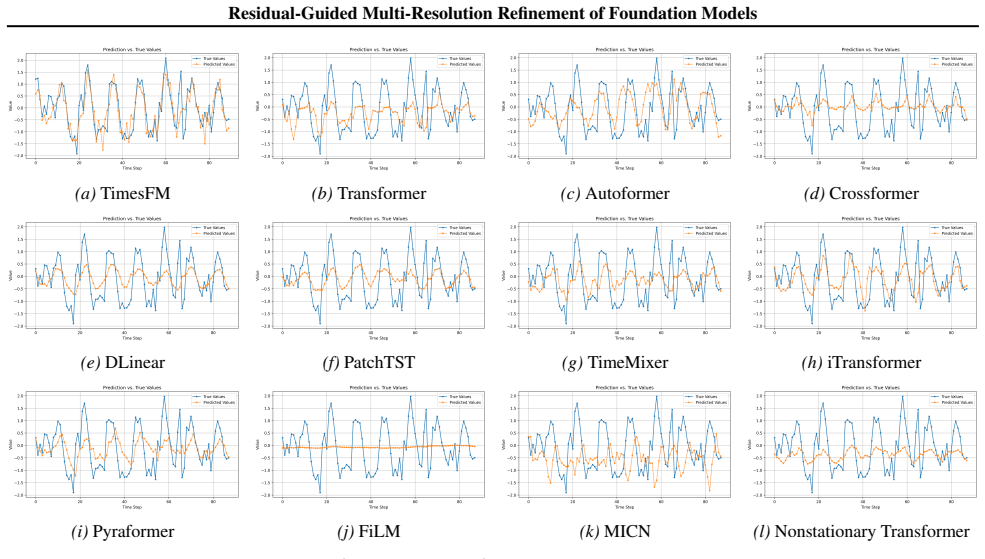
Summary. The paper proposes RGMR, an inference-time wrapper for frozen time-series foundation models (TSFMs). RGMR projects the input into multiple resolutions, obtains base forecasts from a frozen backbone at each resolution, and refines them coarse-to-fine by adding predicted residuals from lightweight Ridge predictors. The residual predictors are trained offline on short-window proposals (Lshort=12) and applied at inference to long-window proposals. The paper evaluates RGMR on one-month-ahead SPEI forecasting at three South Australian sites and three additional regions, reporting consistent MSE reductions over three TSFM backbones (TimesFM, TimeGPT, TabPFN), with up to 18.9% reduction for TimesFM. A contraction-style theorem and a no-harm corollary are provided, along with ablation and sensitivity studies.
Significance. The empirical results, if statistically reliable and attributable to the residual correction, indicate a useful recipe for improving frozen TSFMs in regional climate forecasting without weight updates. The paper includes reproducible code, a careful rolling-origin protocol, and a clean ablation chain showing that multi-resolution averaging and residual weighting both contribute. The theoretical analysis is correct as a conditional bound but is not sufficient on its own to guarantee the observed gains; the empirical claims carry the paper.
major comments (3)
- [§4.3, §4.5, App. D] The residual predictors g(k) are fit on short-window residuals eR(k) = y − e y(k) with Lshort=12, but at inference they are applied to long-window proposals. Theorem 4.1 assumes the prediction error e(k−1) is zero-mean; the paper states (App. B.2) that this 'is a standard simplifying assumption' and absorbs the short-vs-long window mismatch into e. This transfer assumption is never tested. In addition, the feature vector z(k) at inference is built from residual history of final refined predictions by(K) (App. D), while during calibration the residual-history feature is built from short-window proposals, creating a feature distribution shift. The paper should report a direct check of the transfer assumption — e.g., comparing the distributions of training residuals and inference-time residuals on validation, or retraining the residual predictors on long-window residuals and showing that th
- [§5.2, App. C] The test sets are small. With T=444 months and a 70/10/20 chronological split, the test span has ~89 months; for H=1 this yields ~89 non-overlapping rolling origins per site. No confidence intervals, standard errors, or significance tests are reported, so the observed differences (e.g., TimesFM MSE 0.391 → 0.318 at Location 1) may be within sampling variability. Please report bootstrap confidence intervals for MSE differences or paired tests over rolling origins. The cross-region results in Table 10 are also reported only for TimesFM, which weakens the 'architecture-agnostic' generalization claim.
- [§4.5, Eq. (8), Eq. (14)] Theorem 4.1 is a conditional bound: E||R(k)||² ≤ c E||R(k−1)||² + B_k, with c<1. Since B_k contains terms proportional to the proposal error and the residual-prediction noise, this does not imply that the refined forecast improves on the unrefined one; the noise floor can lie above the baseline error. Corollary 4.2's no-harm condition (9) is also not empirically verified. The paper should state this limitation explicitly and, ideally, estimate the empirical noise floor from validation to show that the contraction is operative in the evaluated regime.
minor comments (5)
- [§4.5] Equation (8) uses B_k before its definition; define it in the main text or explicitly refer to App. B.
- [Table 3] Report cumulative MSE per refinement level, since the per-level sample-wise improvement ratio of 48.5% at the finest level (k=5) does not convey whether the final step reduces aggregate MSE.
- [App. C] The practice of retaining the last daily SPEI-30 value in each calendar month changes the temporal aggregation; please justify this or discuss its effect.
- [Figure 2] The residual-history feature (block (iv) of z(k)) is not depicted; clarify how it is generated at training vs. inference.
- [Notation] The symbol φ appears in g(k)_φ but is not defined in the notation table.
Circularity Check
No circularity found: RGMR's central improvement is supported by a held-out rolling-origin evaluation, and the contraction theorem is conditional on an explicit zero-mean residual-error assumption rather than an equation-level reduction to its inputs.
full rationale
The central empirical claim—that RGMR lowers test-set MSE of frozen TSFMs—is not forced by construction. Residual predictors g(k) are fitted offline on training/validation residuals eR(k)=y−ey(k) from short-window proposals (Eq. 2, Alg. 1), then frozen and applied to long-window proposals at inference; test targets are never used for fitting, threshold selection, or the residual-history feature (Sec. 4.3, App. C, App. D). Tables 1, 2, 10, and 11 compare against held-out test periods, so the improvement is an independent empirical result rather than a renamed fit. The theoretical part is explicitly conditional: Theorem 4.1 assumes bR(k−1)=R(k−1)+e(k−1) with E[e]=0 and bounded second moment, and the paper states that e absorbs both Ridge prediction noise and the short-vs-long-window distribution shift (Sec. 4.5, App. B.1). That is an unverified modeling assumption, not a circular definition; the appendix even labels it a 'standard simplifying assumption' (App. B.2). No load-bearing self-citation, imported uniqueness theorem, or ansatz-smuggling citation is present. The main weakness—transfer of short-window residual behavior to long-window inference—is a correctness/robustness risk, not a circularity. Therefore no specific circular step can be exhibited, and the appropriate score is 0.
Axiom & Free-Parameter Ledger
free parameters (8)
- Resolution scale R =
{12,6,3,2,1} months
- Mixing schedule constants =
0.3, 0.5 in α(k)=0.3+0.5(1-r_k/max(R))
- Step size η(k) =
1.0
- Weighting constants γ, ε_min =
γ=3.0, ε_min=1e-3
- Validation-selected residual threshold δ(k) =
quantile on grid {0.60,...,0.90}
- Ridge penalty λ(k) =
grid {1e-4,...,1e2}
- Feature hyperparameters p_lag, q =
p_lag=6, q=12
- Short window L_short =
12 months
axioms (5)
- domain assumption Short-window residual patterns transfer to long-window inference proposals; any distribution shift is zero-mean bounded noise.
- domain assumption Frozen TSFM fθ can ingest the multivariate projected inputs and repeated forward passes at different strides improve or at least do not destroy forecast information.
- standard math Residual-prediction error e(k−1) and proposal error u(k) have finite second moments; e(k−1) is zero-mean.
- ad hoc to paper The fixed resolution scale R matches the dominant SPEI variability scales; nearby variants in the sensitivity table cover the relevant design space.
- domain assumption Public data sources (SPEI-GD, NCEP-NCAR Reanalysis 1, climate indices) are accurate and the split protocol prevents leakage.
Cite this review
Pith. "Pith review of Residual-Guided Multi-Resolution Refinement of Foundation Models: A Case Study in Drought Forecasting." pith.science (2026). https://pith.science/paper/EWI255WM
@misc{pith2026260717507,
  author       = {Pith},
  title        = {Pith review of: Residual-Guided Multi-Resolution Refinement of Foundation Models: A Case Study in Drought Forecasting},
  year         = {2026},
  howpublished = {\url{https://pith.science/paper/EWI255WM}},
  note         = {Machine review of arXiv:2607.17507}
}
read the original abstract
Regional climate prediction presents unique challenges for time series foundation models, which typically process temporal patterns through single-pass inference. Expert climatologists, in contrast, employ multi-scale temporal analysis and iterative refinement based on systematic error diagnosis. We present RGMR (Residual-Guided Multi-Resolution Refinement), an inference-time framework that adapts pre-trained foundation models to perform structured coarse-to-fine refinement for climate forecasting without updating backbone parameters. Applied to drought forecasting using the Standardized Precipitation Evapotranspiration Index (SPEI), RGMR is architecture-agnostic across the three TSFM backbones evaluated per site (TimesFM, TimeGPT, TabPFN) and consistently lowers test-set MSE on three South Australian sites and three additional regions outside South Australia. Applied to TimesFM, the wrapper reduces one-month-ahead SPEI MSE by up to 18.9\% across the three South Australian sites (mean reduction $\approx$18.7\%). Overall, RGMR provides a practical route for deploying frozen TSFMs in regional climate forecasting workflows.
Figures


Reference graph
Works this paper leans on
-
[1]
Vicente-Serrano, Sergio M. and Dom. Long-Term Variability and Trends in Meteorological Droughts in. International Journal of Climatology , volume=. 2020 , doi=
2020
-
[2]
2025 , howpublished =
2025
-
[3]
Current Climate Change Reports , volume=
Climate Change and Drought: a Perspective on Drought Indices , author=. Current Climate Change Reports , volume=. 2018 , publisher=
2018
-
[4]
Sustainability , volume=
Drought Prediction: A Comprehensive Review of Different Drought Prediction Models and Adopted Technologies , author=. Sustainability , volume=. 2023 , issn=
2023
-
[5]
2025 , doi=
Tan, Xuwei and Zhao, Qian and Liu, Yanlan and Zhang, Xueru , booktitle=. 2025 , doi=
2025
-
[6]
Neural Computation , volume=
Long short-term memory , author=. Neural Computation , volume=. 1997 , publisher=
1997
-
[7]
Proceedings of the AAAI Conference on Artificial Intelligence (AAAI) , volume=
Informer: Beyond Efficient Transformer for Long Sequence Time-Series Forecasting , author=. Proceedings of the AAAI Conference on Artificial Intelligence (AAAI) , volume=. 2021 , doi=
2021
-
[8]
Science , volume=
Learning Skillful Medium-Range Global Weather Forecasting , author=. Science , volume=. 2023 , doi=
2023
-
[9]
Accurate Medium-Range Global Weather Forecasting with
Bi, Kaifeng and Xie, Lingxi and Zhang, Hengheng and Chen, Xin and Gu, Xiaotao and Tian, Qi , journal=. Accurate Medium-Range Global Weather Forecasting with. 2023 , publisher=
2023
-
[10]
Proceedings of the International Conference on Learning Representations (ICLR) , year=
Scaleformer: Iterative Multi-scale Refining Transformers for Time Series Forecasting , author=. Proceedings of the International Conference on Learning Representations (ICLR) , year=
-
[11]
2024 , eprint=
Minusformer: Improving Time Series Forecasting by Progressively Learning Residuals , author=. 2024 , eprint=
2024
-
[12]
Rasul, Kashif and Ashok, Arjun and Williams, Andrew Robert and others , year=. 2310.08278 , archivePrefix=
-
[13]
Transactions on Machine Learning Research , year=
Chronos: Learning the Language of Time Series , author=. Transactions on Machine Learning Research , year=
-
[14]
Proceedings of the 41st International Conference on Machine Learning (ICML) , series=
Timer: Generative Pre-trained Transformers Are Large Time Series Models , author=. Proceedings of the 41st International Conference on Machine Learning (ICML) , series=. 2024 , url=
2024
-
[15]
Proceedings of Advances in Neural Information Processing Systems (NeurIPS) , volume=
Attention Is All You Need , author=. Proceedings of Advances in Neural Information Processing Systems (NeurIPS) , volume=
-
[16]
Proceedings of the 41st International Conference on Machine Learning (ICML) , series=
A Decoder-only Foundation Model for Time-series Forecasting , author=. Proceedings of the 41st International Conference on Machine Learning (ICML) , series=. 2024 , url=
2024
-
[17]
The Emergence of Numerical Weather Prediction:
Lynch, Peter , year=. The Emergence of Numerical Weather Prediction:
-
[18]
Nature , volume=
The Quiet Revolution of Numerical Weather Prediction , author=. Nature , volume=. 2015 , publisher=
2015
-
[19]
Nature Climate Change , volume=
Global Warming and Changes in Drought , author=. Nature Climate Change , volume=. 2014 , doi=
2014
-
[20]
2003 , publisher=
Forecast Verification: A Practitioner's Guide in Atmospheric Science , author=. 2003 , publisher=
2003
-
[21]
Palmer, T. N. , journal=. Nonlinear Dynamics and Climate Change:. 1998 , doi=
1998
-
[22]
Philosophical Transactions of the Royal Society A: Mathematical, Physical and Engineering Sciences , volume=
Can deep learning beat numerical weather prediction? , author=. Philosophical Transactions of the Royal Society A: Mathematical, Physical and Engineering Sciences , volume=. 2021 , doi=
2021
-
[23]
International Journal of Forecasting , volume=
Temporal Fusion Transformers for Interpretable Multi-horizon Time Series Forecasting , author=. International Journal of Forecasting , volume=. 2021 , doi=
2021
-
[24]
Proceedings of Advances in Neural Information Processing Systems (NeurIPS) , volume=
Chain-of-Thought Prompting Elicits Reasoning in Large Language Models , author=. Proceedings of Advances in Neural Information Processing Systems (NeurIPS) , volume=
-
[25]
Proceedings of Advances in Neural Information Processing Systems (NeurIPS) , volume=
Large Language Models Are Zero-Shot Reasoners , author=. Proceedings of Advances in Neural Information Processing Systems (NeurIPS) , volume=
-
[26]
Proceedings of Advances in Neural Information Processing Systems (NeurIPS) , volume=
Tree of Thoughts: Deliberate Problem Solving with Large Language Models , author=. Proceedings of Advances in Neural Information Processing Systems (NeurIPS) , volume=
-
[27]
Proceedings of Advances in Neural Information Processing Systems (NeurIPS) , volume=
Reflexion: Language Agents with Verbal Reinforcement Learning , author=. Proceedings of Advances in Neural Information Processing Systems (NeurIPS) , volume=
-
[28]
Proceedings of Advances in Neural Information Processing Systems (NeurIPS) , volume=
Self-Refine: Iterative Refinement with Self-Feedback , author=. Proceedings of Advances in Neural Information Processing Systems (NeurIPS) , volume=
-
[29]
and Beguer
Vicente-Serrano, Sergio M. and Beguer. A Multiscalar Drought Index Sensitive to Global Warming:. Journal of Climate , volume=. 2010 , doi=
2010
-
[30]
and Carpov, Dmitri and Chapados, Nicolas and Bengio, Yoshua , booktitle=
Oreshkin, Boris N. and Carpov, Dmitri and Chapados, Nicolas and Bengio, Yoshua , booktitle=. 2020 , url=
2020
-
[31]
Proceedings of the 37th International Conference on Machine Learning (ICML) , series=
Test-time Training with Self-supervision for Generalization under Distribution Shifts , author=. Proceedings of the 37th International Conference on Machine Learning (ICML) , series=. 2020 , url=
2020
-
[32]
Proceedings of Advances in Neural Information Processing Systems (NeurIPS) , volume=
Language Models are Few-Shot Learners , author=. Proceedings of Advances in Neural Information Processing Systems (NeurIPS) , volume=
-
[33]
Proceedings of the AAAI Conference on Artificial Intelligence (AAAI) , volume=
Meta-Learning Framework with Applications to Zero-Shot Time-Series Forecasting , author=. Proceedings of the AAAI Conference on Artificial Intelligence (AAAI) , volume=. 2021 , doi=
2021
-
[34]
Garza, Azul and Challu, Cristian and Mergenthaler-Canseco, Max , year=. 2310.03589 , archivePrefix=
-
[35]
2003 , isbn=
Fixed Point Theory , author=. 2003 , isbn=
2003
-
[36]
Proceedings of Advances in Neural Information Processing Systems (NeurIPS) , volume=
Deep Equilibrium Models , author=. Proceedings of Advances in Neural Information Processing Systems (NeurIPS) , volume=
-
[37]
Gao, Zhihan and Shi, Xingjian and Wang, Hao and others , booktitle=
-
[38]
Proceedings of Advances in Neural Information Processing Systems (NeurIPS) , year=
Autoformer: Decomposition Transformers with Auto-Correlation for Long-Term Series Forecasting , author=. Proceedings of Advances in Neural Information Processing Systems (NeurIPS) , year=
-
[39]
Proceedings of the International Conference on Learning Representations (ICLR) , year=
Crossformer: Transformer Utilizing Cross-Dimension Dependency for Multivariate Time Series Forecasting , author=. Proceedings of the International Conference on Learning Representations (ICLR) , year=
-
[40]
Proceedings of the AAAI Conference on Artificial Intelligence (AAAI) , volume=
Are Transformers Effective for Time Series Forecasting? , author=. Proceedings of the AAAI Conference on Artificial Intelligence (AAAI) , volume=. 2023 , doi=
2023
-
[41]
Proceedings of the International Conference on Learning Representations (ICLR) , year=
A Time Series is Worth 64 Words: Long-term Forecasting with Transformers , author=. Proceedings of the International Conference on Learning Representations (ICLR) , year=
-
[42]
TimesNet: Temporal 2
Wu, Haixu and Hu, Tengge and Liu, Yong and Zhou, Hang and Wang, Jianmin and Long, Mingsheng , booktitle=. TimesNet: Temporal 2. 2023 , url=
2023
-
[43]
and Pfister, Tomas , journal=
Chen, Si-An and Li, Chun-Liang and Yoder, Nate and Arik, Sercan O. and Pfister, Tomas , journal=
-
[44]
2024 , url=
Liu, Yong and Hu, Tengge and Zhang, Haoran and Wu, Haixu and Wang, Shiyu and Ma, Lintao and Long, Mingsheng , booktitle=. 2024 , url=
2024
-
[45]
Zhou, Tian and Ma, Ziqing and Wang, Xue and Wen, Qingsong and Sun, Liang and Yao, Tao and Yin, Wotao and Jin, Rong , booktitle=
-
[46]
Proceedings of the International Conference on Learning Representations (ICLR) , year=
Pyraformer: Low-Complexity Pyramidal Attention for Long-Range Time Series Modeling and Forecasting , author=. Proceedings of the International Conference on Learning Representations (ICLR) , year=
-
[47]
2023 , url=
Wang, Huiqiang and Peng, Jian and Huang, Feihu and Wang, Jince and Chen, Junhui and Xiao, Yifei , booktitle=. 2023 , url=
2023
-
[48]
Proceedings of Advances in Neural Information Processing Systems (NeurIPS) , year=
Non-stationary Transformers: Exploring the Stationarity in Time Series Forecasting , author=. Proceedings of Advances in Neural Information Processing Systems (NeurIPS) , year=
-
[49]
and Zhou, Jun , booktitle=
Wang, Shiyu and Wu, Haixu and Shi, Xiaoming and Hu, Tengge and Luo, Huakun and Ma, Lintao and Zhang, James Y. and Zhou, Jun , booktitle=. 2024 , url=
2024
-
[50]
2024 , howpublished =
Time-Series-Library: A Library for Advanced Deep Time Series Models , author =. 2024 , howpublished =
2024
-
[51]
Kalnay, Eugenia and Kanamitsu, Masao and Kistler, Robert and others , journal=. The. 1996 , doi=
1996
-
[52]
, journal=
Trenberth, Kevin E. , journal=. The Definition of. 1997 , doi=
1997
-
[53]
Saji, N. H. and Goswami, B. N. and Vinayachandran, P. N. and Yamagata, T. , journal=. A Dipole Mode in the Tropical. 1999 , doi=
1999
-
[54]
, journal=
Marshall, Gareth J. , journal=. Trends in the. 2003 , doi=
2003
-
[55]
Technometrics , volume=
Ridge Regression: Biased Estimation for Nonorthogonal Problems , author=. Technometrics , volume=. 1970 , doi=
1970
-
[56]
Computational Statistics & Data Analysis , volume=
A note on the validity of cross-validation for evaluating autoregressive time series prediction , author=. Computational Statistics & Data Analysis , volume=. 2018 , doi=
2018
-
[57]
Science , volume=
Global Increase in the Occurrence and Impact of Multiyear Droughts , author=. Science , volume=. 2025 , doi=
2025
-
[58]
and Stockdale, Timothy N
Johnson, Stephanie J. and Stockdale, Timothy N. and Ferranti, Laura and Balmaseda, Magdalena A. and Molteni, Franco and Magnusson, Linus and Tietsche, Steffen and Decremer, Damien and Weisheimer, Antje and Balsamo, Gianpaolo and Keeley, Sarah P. E. and Mogensen, Kristian and Zuo, Hao and Monge-Sanz, Beatriz M. , journal=. 2019 , doi=
2019
-
[59]
and Min, Dughong and Infanti, Johnna M
Kirtman, Ben P. and Min, Dughong and Infanti, Johnna M. and Kinter III, James L. and Paolino, Daniel A. and Zhang, Qin and van den Dool, Huug and Saha, Suranjana and Mendez, Malaqu. The. Bulletin of the American Meteorological Society , volume=. 2014 , doi=
2014
-
[60]
Liu, Xuebang and Yu, Shuying and Yang, Zhiwei and Dong, Jianquan and Peng, Jian , title =. Scientific Data , year =. doi:10.1038/s41597-024-03047-z , url =
This paper was first reviewed by deepseek-v4-flash on August 1, 2026.
discussion (0)
Sign in with ORCID, Apple, or X to comment. Anyone can read and Pith papers without signing in.