REVIEW 3 major objections 5 minor 35 references
STAR: Spectral Truncation and Rescale for Model Merging
T0 review · 3 major / 5 minor · reviewed 2026-08-07 · deepseek-v4-flash
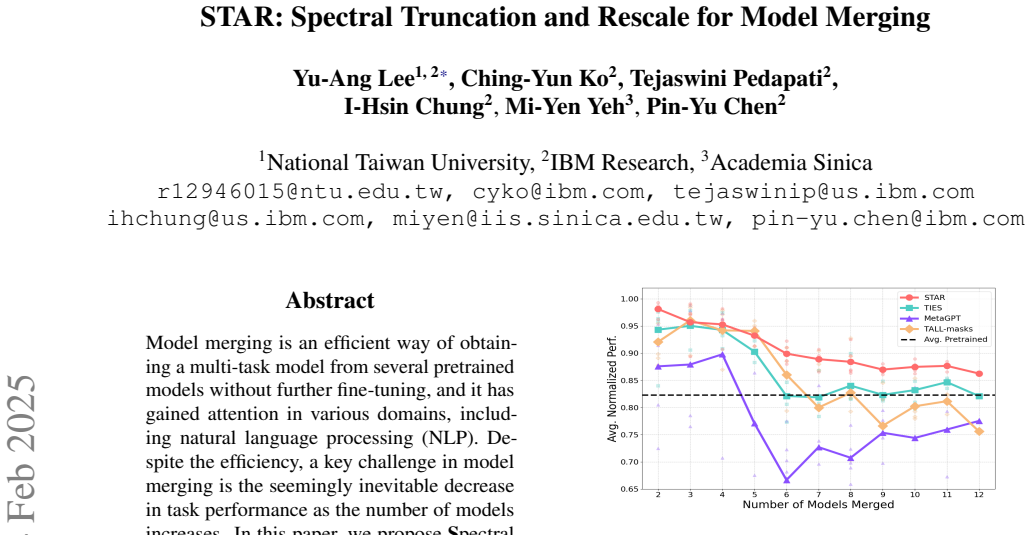
Pith's one-line read STAR claims data-free merging of up to 20 fine-tuned models by truncating small singular components of task vectors and rescaling to restore nuclear norm, outperforming baselines by 4.2% on 12-model Flan-T5 merges.
desk verdict Clean, data-free merging trick with fair baselines, but the appendix bound only covers truncation without the rescale step, and the empirical support is thinner than the prose suggests. read the letter →
The pith
A machine-rendered reading of the paper's core claim, the machinery that carries it, and where it could break.
The reading
What carries the argument
The machinery is per-layer singular value decomposition of task vectors. Each task vector is $\theta_{\mathrm{ft}} - \theta_{\mathrm{pre}}$; STAR reshapes its entries back into weight matrices, decomposes each matrix as $\sum_i \sigma_i u_i v_i^\top$, and keeps only the components needed so that the kept singular values contain at least $\eta\%$ of the total nuclear norm (default $\eta = 40$). It then multiplies each kept $\sigma_k$ by $\|\sigma\|_1 / \|\sigma_{1:r}\|_1$, reconstructs the cleaned matrix, and averages the cleaned task vectors across tasks. The rescale step is what makes truncation safe: without it the task vector shrinks and the merged model drifts back toward the pretrained model; with it the matrix keeps its original size in the nuclear norm while shedding the small components. This combination gives STAR an automatic, layer-specific rank choice and a data-free pipeline.
What would settle it
Take a fine-tuned model, keep only the small singular components of its task vector (discard the top directions), merge that residual into the pretrained model, and measure task accuracy: if accuracy stays high, task knowledge is not concentrated in the large singular directions and STAR's premise is wrong. A cheaper check is to compare STAR with a variant that truncates the same number of singular components chosen at random; if random truncation performs equally well, the benefit is not specifically spectral.
Extended reading notes
Core claim
The paper's central claim is that the ceiling on how many models can be merged is set less by the number of tasks than by how much conflicting, low-signal content each task vector carries. STAR's hypothesis is that task-specific knowledge lives in the top singular directions of each layer's weight update, while the small singular directions are mostly noise or redundant fine details, so removing them before averaging reduces cross-task interference without sacrificing task performance. The method makes this precise with a bound: for a point on task A's data manifold, the interference contributed by task B's matrix satisfies $\|Bx\| \le r_B \beta \sqrt{r_A}$, and truncating $B$ to a lower rank shrinks that upper bound. After truncation, STAR rescales the kept singular values by a common factor so the matrix's nuclear norm matches the original, preventing the cleaned task vector from shrinking relative to the pretrained model. On this basis the paper claims that STAR outperforms TIES, TALL-masks, and MetaGPT in one-shot use, degrades more gracefully as the model count grows to 12 and 20, and needs no tuning of its threshold across combinations.
Load-bearing premise
The load-bearing premise is that each task's useful knowledge sits in the large singular directions of its weight update, so discarding the small singular components removes noise rather than skill.
Editorial extensions
If this is right
- Merging 20 LoRA-tuned adapters into one static Mistral-7B model keeps averaged normalized performance above the pretrained baseline, so multi-task assembly no longer has to stop at a handful of models.
- Because the same $\eta = 40$ works across Flan-T5-base, Flan-T5-large, and Mistral-7B-Instruct, deployment can use the default threshold instead of a per-task hyperparameter search.
- The optimal threshold decreases as more models are merged, implying that stronger truncation is exactly what is needed when conflicts are most severe.
- The method operates on task vectors before the averaging step, so it can be composed with other merging rules that also start from task vectors.
Reading between the lines
- If the low-rank prior is right, the singular-value spectrum of a task vector becomes a cheap, data-free predictor of how safely that model can be merged; steep spectra should merge cleanly, flat spectra should not.
- The same spectral truncation and nuclear-norm rescale recipe is architecture-agnostic, so it could plausibly transfer to vision or multimodal adapters, or to fusion rules other than simple averaging; the paper tests only NLP models and averaging.
- A stress test the paper does not run: fine-tune a model so that a rare but essential capability is encoded only in small singular components, then check whether STAR removes precisely that capability. If it does, the method's advantage would disappear exactly on long-tail skills.
Editorial analysis
A structured set of objections, weighed in public.
Referee Report
Summary. The paper proposes STAR (Spectral Truncation and Rescale), a data-free model merging method that applies per-weight-matrix singular value decomposition (SVD) to task vectors, truncates small singular-value components to reduce rank, rescales retained singular values to restore the matrix nuclear norm, and finally averages the processed task vectors. The authors claim that STAR outperforms TIES, TALL-masks, and MetaGPT as the number of merged models grows, with a 4.2% improvement over baselines when merging 12 models on Flan-T5, robustness to the single hyperparameter η, and the ability to merge up to 20 models on Mistral-7B. The manuscript includes a theoretical bound on cross-task interference (App. A.1), ablations of the rescaling step, hyperparameter sensitivity experiments, and comparisons with DARE as a plug-in.
Significance. If the empirical claims hold, STAR would be a practically valuable contribution to data-free model merging: it requires no inference on training data, has a single hyperparameter with demonstrated robustness, and is clearly specified with public code. The strongest aspect is the consistent empirical trend across three model families (Flan-T5-base, Flan-T5-large, Mistral-7B-Instruct) showing that STAR's performance decay is slower than that of prior methods as the number of merged models increases. The paper also provides a formal, albeit incomplete, motivation for spectral truncation. The significance is tempered by the limited number of sampled task combinations and by the gap between the theoretical bound and the actual STAR algorithm, both of which need to be addressed for the claims to be fully credible.
major comments (3)
- [App. A.1 and Sec. 3.2] The conflict-reduction bound ∥Bx∥ ≤ r_B β√r_A is derived for a truncated B without rescaling, but Algorithm 1 always rescales retained singular values by c = ∥σ∥_1/∥σ_{1:r}∥_1 > 1 (Sec. 3.2). After rescaling, the upper bound becomes r · c · max_{i≤r}|σ_B^i α_j| · √r_A, which is not necessarily smaller than the original r_B β√r_A; the reduction holds only under a spectral condition that is neither stated nor verified in the paper. Since this bound is the paper's stated theoretical rationale for why STAR mitigates merging conflicts, the motivation is incomplete and should be corrected to a bound for the full STAR transform or explicitly reframed as a heuristic.
- [Sec. 4.2 and Fig. 4] The central empirical claims, including the abstract's 4.2% improvement and the ability to merge up to 20 models, rest on averaged results over only 5 sampled task combinations for Flan-T5 and 3 for Mistral-7B, with no error bars or confidence intervals on the averaged curves. For a claim about robustness across model sizes and numbers of models, this is a thin statistical basis; the authors should report variance and ideally use more random task combinations to substantiate the comparisons.
- [Sec. 1 and Fig. 4] The introduction states that STAR can merge up to 20 models while achieving positive performance gains compared to the pretrained model, but the pretrained-model baseline is never plotted in Fig. 4 or Fig. 1, nor are the exact values reported. Without this baseline, the reader cannot verify whether the merged model remains above the pretrained model, which is the paper's own criterion for the purpose of model merging (Sec. 4.1). Please add the pretrained baseline to the figures or state the numerical values.
minor comments (5)
- [Abstract and Sec. 5] There are typos in the abstract and conclusion: 'hyperparamater' should be 'hyperparameter' and 'principaled' should be 'principled'.
- [Sec. 3.1] The low-rank prior ('small singular values often correlate with noise or fine details') is stated as fact; since it is the key assumption underlying the method, it should be presented more cautiously as a working assumption and discussed in the limitations.
- [Alg. 1 and Sec. 3.3] Algorithm 1 calls the subroutine 'rank_keep(σ, η, p)' but the variable p is never defined; the rank-determination rule in Sec. 3.3 involves only σ and η, so the pseudocode should be corrected.
- [Sec. 4.1 and Sec. A.6] The main text says the total number of task vectors for Flan-T5-base/large is 13, but Sec. A.6 indicates Flan-T5-base has 12 (7 from FusionBench plus 5 fine-tuned) and Flan-T5-large has 13 (7 plus 6); this inconsistency should be corrected.
- [Sec. 3.2 and Table 2] In the DARE comparison (Table 2), DARE's drop rate p is selected as the best-performing value over a grid (p*), while STAR uses a fixed η=40; this asymmetry should be disclosed in the main text or in the table caption to avoid overstating STAR's advantage.
Circularity Check
No significant circularity: STAR's ranking, truncation, and rescaling are defined independently of the evaluated outputs, and no self-citation chain is load-bearing.
full rationale
STAR is a data-free manipulation of task vectors: SVD, adaptive rank selection by cumulative singular-value energy threshold eta, nuclear-norm-preserving rescaling, and averaging. The rank criterion r=argmin_k(... >= eta%) and rescale sigma'_k=||sigma||_1/||sigma_{1:r}||_1 * sigma_k are definitional algorithm steps, not quantities fitted to the benchmark tasks; eta=40 is fixed a priori and the sensitivity analysis spans eta in {10,...,70}. The conflict-reduction argument in Sec. A.1 is an independent inequality about truncation, and while it is not extended to the rescaled transform (so the rescaling step's theoretical motivation is under-supported), that is a rigor gap, not a circular reduction. The paper's positive-gains and 4.2% claims are measured against external benchmarks (GLUE, PIQA, etc.) and baselines, not derived from the values being predicted. There are no load-bearing self-citations: references to task arithmetic, TIES, MetaGPT, DARE, and FusionBench are external prior work, and the authors' own fine-tuned models are data, not premises. The stated limitation (PEFT-only evaluation) is an honest scope restriction. No circular step can be exhibited.
Assumptions & free parameters
free parameters (1)
- rank retention ratio eta =
40
assumptions (6)
- domain assumption Task vectors delta = theta_ft - theta_pre encode the task-specific update (Ilharco et al., 2022).
- domain assumption Small singular values of task-vector weight matrices correspond to noise or fine details and can be removed without hurting task performance.
- domain assumption Nuclear norm is a proper measure of matrix size for the merging context; restoring it compensates for truncation.
- domain assumption Simple averaging of truncated-and-rescaled task vectors is a valid merging operation.
- domain assumption The Cauchy-Schwarz based bound in Sec A.1 is a meaningful proxy for actual merging conflict.
- standard math SVD exists for all weight matrices considered.
Cite this review
Pith. "Pith review of STAR: Spectral Truncation and Rescale for Model Merging." pith.science (2026). https://pith.science/paper/EXPRVP4P
@misc{pith2026250210339,
  author       = {Pith},
  title        = {Pith review of: STAR: Spectral Truncation and Rescale for Model Merging},
  year         = {2026},
  howpublished = {\url{https://pith.science/paper/EXPRVP4P}},
  note         = {Machine review of arXiv:2502.10339}
}
abstract
Model merging is an efficient way of obtaining a multi-task model from several pretrained models without further fine-tuning, and it has gained attention in various domains, including natural language processing (NLP). Despite the efficiency, a key challenge in model merging is the seemingly inevitable decrease in task performance as the number of models increases. In this paper, we propose $\mathbf{S}$pectral $\mathbf{T}$runcation $\mathbf{A}$nd $\mathbf{R}$escale (STAR) that aims at mitigating ``merging conflicts'' by truncating small components in the respective spectral spaces, which is followed by an automatic parameter rescaling scheme to retain the nuclear norm of the original matrix. STAR requires no additional inference on original training data and is robust to hyperparamater choice. We demonstrate the effectiveness of STAR through extensive model merging cases on diverse NLP tasks. Specifically, STAR works robustly across varying model sizes, and can outperform baselines by 4.2$\%$ when merging 12 models on Flan-T5. Our code is publicly available at https://github.com/IBM/STAR.
Figures


Figures from the paper (4 more)


Reference graph
Works this paper leans on
-
[1]
write newline
" write newline "" before.all 'output.state := FUNCTION fin.entry add.period write newline FUNCTION new.block output.state before.all = 'skip after.block 'output.state := if FUNCTION new.sentence output.state after.block = 'skip output.state before.all = 'skip after.sentence 'output.state := if if FUNCTION not #0 #1 if FUNCTION and 'skip pop #0 if FUNCTIO...
-
[2]
online" 'onlinestring :=
ENTRY address archivePrefix author booktitle chapter edition editor eid eprint eprinttype howpublished institution journal key month note number organization pages publisher school series title type volume year doi pubmed url lastchecked label extra.label sort.label short.list INTEGERS output.state before.all mid.sentence after.sentence after.block STRING...
-
[3]
write newline
" write newline "" before.all 'output.state := FUNCTION n.dashify 't := "" t empty not t #1 #1 substring "-" = t #1 #2 substring "--" = not "--" * t #2 global.max substring 't := t #1 #1 substring "-" = "-" * t #2 global.max substring 't := while if t #1 #1 substring * t #2 global.max substring 't := if while FUNCTION word.in bbl.in capitalize " " * FUNCT...
-
[4]
Yonatan Bisk, Rowan Zellers, Ronan Le Bras, Jianfeng Gao, and Yejin Choi. 2020. Piqa: Reasoning about physical commonsense in natural language. In Thirty-Fourth AAAI Conference on Artificial Intelligence
2020
-
[5]
Rickard Br \"u el-Gabrielsson, Jiacheng Zhu, Onkar Bhardwaj, Leshem Choshen, Kristjan Greenewald, Mikhail Yurochkin, and Justin Solomon. 2024. Compress then serve: Serving thousands of lora adapters with little overhead. arXiv preprint arXiv:2407.00066
arXiv 2024
-
[6]
Jian-Feng Cai, Emmanuel J Cand \`e s, and Zuowei Shen. 2010. A singular value thresholding algorithm for matrix completion. SIAM Journal on optimization, 20(4):1956--1982
work page 2010
-
[7]
Emmanuel Candes and Benjamin Recht. 2012. Exact matrix completion via convex optimization. Communications of the ACM, 55(6):111--119
work page 2012
-
[8]
Emmanuel J Candes and Yaniv Plan. 2010. Matrix completion with noise. Proceedings of the IEEE, 98(6):925--936
work page 2010
Show all 35 references
-
[9]
Daniel Cer, Mona Diab, Eneko Agirre, Inigo Lopez-Gazpio, and Lucia Specia. 2017. Semeval-2017 task 1: Semantic textual similarity-multilingual and cross-lingual focused evaluation. arXiv preprint arXiv:1708.00055
2017 arXiv
-
[10]
Hyung Won Chung, Le Hou, Shayne Longpre, Barret Zoph, Yi Tay, William Fedus, Yunxuan Li, Xuezhi Wang, Mostafa Dehghani, Siddhartha Brahma, et al. 2024. Scaling instruction-finetuned language models. Journal of Machine Learning Research, 25(70):1--53
2024
-
[11]
Christopher Clark, Kenton Lee, Ming-Wei Chang, Tom Kwiatkowski, Michael Collins, and Kristina Toutanova. 2019. Boolq: Exploring the surprising difficulty of natural yes/no questions. In NAACL
2019
-
[12]
Kostadin Dabov, Alessandro Foi, Vladimir Katkovnik, and Karen Egiazarian. 2007. Image denoising by sparse 3-d transform-domain collaborative filtering. IEEE Transactions on image processing, 16(8):2080--2095
2007
-
[13]
Nico Daheim, Thomas M \"o llenhoff, Edoardo Maria Ponti, Iryna Gurevych, and Mohammad Emtiyaz Khan. 2023. Model merging by uncertainty-based gradient matching. arXiv preprint arXiv:2310.12808
2023 arXiv
-
[14]
MohammadReza Davari and Eugene Belilovsky. 2023. Model breadcrumbs: Scaling multi-task model merging with sparse masks. arXiv preprint arXiv:2312.06795
2023 arXiv
-
[15]
Fidel A Guerrero Pena, Heitor R Medeiros, Thomas Dubail, Masih Aminbeidokhti, Eric Granger, and Marco Pedersoli. 2022. Re-basin via implicit sinkhorn differentiation. in 2023 ieee. In CVF Conference on Computer Vision and Pattern Recognition (CVPR), pages 20237--20246
2022
-
[16]
Edward J Hu, Yelong Shen, Phillip Wallis, Zeyuan Allen-Zhu, Yuanzhi Li, Shean Wang, Lu Wang, and Weizhu Chen. 2021. Lora: Low-rank adaptation of large language models. arXiv preprint arXiv:2106.09685
2021 arXiv
-
[17]
Chenyu Huang, Peng Ye, Tao Chen, Tong He, Xiangyu Yue, and Wanli Ouyang. 2024. Emr-merging: Tuning-free high-performance model merging. arXiv preprint arXiv:2405.17461
2024 arXiv
-
[18]
Gabriel Ilharco, Marco Tulio Ribeiro, Mitchell Wortsman, Suchin Gururangan, Ludwig Schmidt, Hannaneh Hajishirzi, and Ali Farhadi. 2022. Editing models with task arithmetic. arXiv preprint arXiv:2212.04089
2022 arXiv
-
[19]
Moritz Imfeld, Jacopo Graldi, Marco Giordano, Thomas Hofmann, Sotiris Anagnostidis, and Sidak Pal Singh. 2023. Transformer fusion with optimal transport. arXiv preprint arXiv:2310.05719
2023 arXiv
-
[20]
Albert Q Jiang, Alexandre Sablayrolles, Arthur Mensch, Chris Bamford, Devendra Singh Chaplot, Diego de las Casas, Florian Bressand, Gianna Lengyel, Guillaume Lample, Lucile Saulnier, et al. 2023. Mistral 7b. arXiv preprint arXiv:2310.06825
2023 arXiv
-
[21]
Tushar Khot, Peter Clark, Michal Guerquin, Peter Jansen, and Ashish Sabharwal. 2020. Qasc: A dataset for question answering via sentence composition. arXiv:1910.11473v2
2020 arXiv
-
[22]
Maas, Raymond E
Andrew L. Maas, Raymond E. Daly, Peter T. Pham, Dan Huang, Andrew Y. Ng, and Christopher Potts. 2011. http://www.aclweb.org/anthology/P11-1015 Learning word vectors for sentiment analysis . In Proceedings of the 49th Annual Meeting of the Association for Computational Linguist...
2011
-
[23]
P. Malo, A. Sinha, P. Korhonen, J. Wallenius, and P. Takala. 2014. Good debt or bad debt: Detecting semantic orientations in economic texts. Journal of the Association for Information Science and Technology, 65
2014
-
[24]
Michael S Matena and Colin A Raffel. 2022. Merging models with fisher-weighted averaging. Advances in Neural Information Processing Systems, 35:17703--17716
2022
-
[25]
Guillermo Ortiz-Jimenez, Alessandro Favero, and Pascal Frossard. 2024. Task arithmetic in the tangent space: Improved editing of pre-trained models. Advances in Neural Information Processing Systems, 36
2024
-
[26]
Derek Tam, Mohit Bansal, and Colin Raffel. 2024. Merging by matching models in task parameter subspaces. Transactions on Machine Learning Research
2024
-
[27]
Anke Tang, Li Shen, Yong Luo, Han Hu, Bo Do, and Dacheng Tao. 2024. Fusionbench: A comprehensive benchmark of deep model fusion. arXiv preprint arXiv:2406.03280
2024
-
[28]
Ke Wang, Nikolaos Dimitriadis, Guillermo Ortiz-Jimenez, Fran c ois Fleuret, and Pascal Frossard. 2024. https://openreview.net/forum?id=DWT9uiGjxT Localizing task information for improved model merging and compression . In Forty-first International Conference on Machine Learning
2024
-
[29]
Prateek Yadav, Derek Tam, Leshem Choshen, Colin A Raffel, and Mohit Bansal. 2024. Ties-merging: Resolving interference when merging models. Advances in Neural Information Processing Systems, 36
2024
-
[30]
Enneng Yang, Li Shen, Guibing Guo, Xingwei Wang, Xiaochun Cao, Jie Zhang, and Dacheng Tao. 2024. Model merging in llms, mllms, and beyond: Methods, theories, applications and opportunities. arXiv preprint arXiv:2408.07666
2024 arXiv
-
[31]
Enneng Yang, Zhenyi Wang, Li Shen, Shiwei Liu, Guibing Guo, Xingwei Wang, and Dacheng Tao. 2023. Adamerging: Adaptive model merging for multi-task learning. arXiv preprint arXiv:2310.02575
2023 arXiv
-
[32]
Le Yu, Bowen Yu, Haiyang Yu, Fei Huang, and Yongbin Li. 2024. Language models are super mario: Absorbing abilities from homologous models as a free lunch. In Forty-first International Conference on Machine Learning
2024
-
[33]
Rowan Zellers, Ari Holtzman, Yonatan Bisk, Ali Farhadi, and Yejin Choi. 2019. Hellaswag: Can a machine really finish your sentence? In Proceedings of the 57th Annual Meeting of the Association for Computational Linguistics
2019
-
[34]
Xiang Zhang, Junbo Zhao, and Yann LeCun. 2015. Character-level convolutional networks for text classification. Advances in neural information processing systems, 28
2015
-
[35]
Yuyan Zhou, Liang Song, Bingning Wang, and Weipeng Chen. 2024. Metagpt: Merging large language models using model exclusive task arithmetic. arXiv preprint arXiv:2406.11385
2024 arXiv
Reviewed August 7, 2026 · model on record in the stance chip above.
Discussion (0). Continue with ORCID to comment.