REVIEW 2 major objections 4 minor 69 references
Algebraic Classical and Quantum Field Theory on Causal Sets
T0 review · 2 major / 4 minor · reviewed 2026-08-14 · deepseek-v4-flash
Pith's one-line read This paper constructs interacting scalar quantum field theories on any fixed finite causal set, for arbitrary smooth interactions, by quantizing a classical theory built from discretised wave operators and retarded/advanced Green functions.
desk verdict A largely checkable pAQFT framework for interacting fields on causal sets, with a real but openly acknowledged gap between the off-shell algebra and the discretized dynamics. read the letter →
The pith
A machine-rendered reading of the paper's core claim, the machinery that carries it, and where it could break.
The reading
What carries the argument
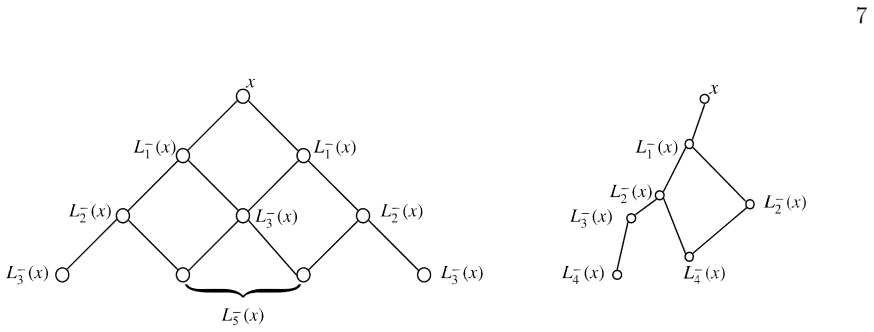
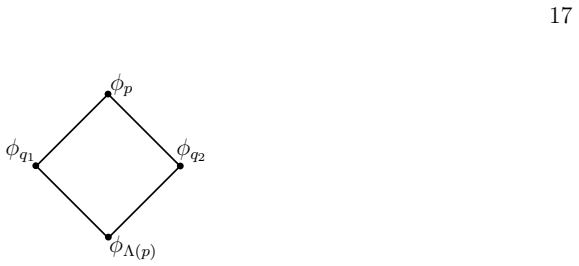
The machinery is finite-dimensional linear algebra carried by the causal order. The retarded Green operator $E_+ = P^{-1}K$ is lower triangular because $P$ is retarded, so its transpose $E_-$ is advanced; everything else is built from their difference $E$. The paper's new discretised wave operator is defined through a preferred past structure: a choice $\Lambda(p)$ of a rank-2 point in the past of $p$, giving $P_\Lambda\varphi_p = \varphi_p - 2\,\mathrm{mean}_{\Lambda(p)\prec q\prec p}\varphi_q + \varphi_{\Lambda(p)}$ for points outside the two-layer past infinity, and $\varphi_p$ on the boundary. On a regular diamond lattice in two-dimensional flat spacetime this has continuum limit $\frac{1}{2}\square$ and retarded Green function $\frac{1}{2}(1+C)$, where $C$ is the causal chain matrix, and the paper proves this by direct matrix identities. The quantum deformation is carried by the star product $F \star G = m \circ \exp(\frac{1}{2}i\hbar\, \mathcal{D}_E)(F\otimes G)$, the normally ordered product with covariance $W$, the time-ordered product with covariance $\Delta_F$, and the retarded quantum map that turns the free algebra into the interacting one.
What would settle it
On a regular diamond lattice approximating two-dimensional flat spacetime, take the preferred-past operator $P_\Lambda$ and a compactly supported smooth source $f$, compute $E_{+,\Lambda}f$ with the paper's scaling, and compare pointwise with the continuum retarded solution; if the difference does not vanish as the lattice spacing tends to zero, the proposed Green function fails its continuum-limit claim. A second test: on a small random causal set, find a source $f$ for which $E P f \neq 0$; because the equation-of-motion ideal is generated by functionals of the form $\Phi_{Pf}$, such an $f$ shows directly that the quotient by the kernel of $E$ is not the same as imposing the wave equation.
Extended reading notes
Core claim
The central claim is that a single finite causal set $C$ of $N$ points can carry a full interacting quantum field theory. The field is a real function on $C$; the configuration space is $\mathbb{R}^N$. Choosing a lower-triangular discretised wave operator $P$ and a source-averaging operator $K$ gives a retarded Green matrix $E_+ = P^{-1}K$, with advanced Green matrix $E_- = E_+^T$. Their antisymmetric difference $E = E_- - E_+$ defines the classical bracket $F_i E_{ij} G_j$ and, after deformation quantization, the quantum commutation relations. Since $E P$ is not zero on a causal set, the paper does not impose the equations of motion directly; instead it quotients the algebra by functionals whose functional derivatives are annihilated by $E$, noting that this is the causal-set replacement for going on shell and is only approximate. On this base it defines a two-point function $W = \frac{1}{2}(iE + \sqrt{-E^2})$, a propagator $\Delta_F = \frac{1}{2}(E_+ + E_-) + H$, the time-ordered product $F \cdot_T G = m \circ \exp(\hbar/2\, \mathcal{D}_{\Delta_F})(F\otimes G)$, the formal S-matrix $S(\lambda V) = \exp(i\lambda V/\hbar)_T$, and the retarded quantum map $R_{\lambda V}(F) = S(\lambda V)^{-1} \star_H\bigl(S(\lambda V) \cdot_T F\bigr)$. The interacting algebra $A_{\mathrm{int}}(C)$ is then obtained by deforming the free product; $n$-point functions of interacting fields are explicit formal power series in $\hbar$ and $\lambda$. This is the construction the paper claims as the first of its breadth in quantum field theory on causal sets.
Load-bearing premise
The load-bearing premise is that quotienting the algebra by functionals whose derivative is annihilated by the antisymmetric Green matrix $E$ is an adequate way to impose the field equation, even though $E$ does not invert the wave operator on a causal set; if that replacement misrepresents the dynamics, the free and interacting quantum theories built on it inherit the error.
Editorial extensions
If this is right
- Every fixed finite causal set now carries a definite family of interacting scalar field theories, one for each smooth interaction functional, with explicit algebraic definitions and no renormalization step.
- Correlation functions of interacting fields are computable as formal power series, and the paper's graphical expansions give explicit Feynman-like diagram rules on finite causal sets.
- On a regular diamond lattice the preferred-past wave operator and its Green function reproduce the continuum retarded Green function as the spacing goes to zero, so the free theory has a concrete continuum-limit check.
- The distinguished state is pure, and because the configuration space is finite, all sufficiently regular representations of the algebra are unitarily equivalent; changing the auxiliary inner product produces alternative states, including precursors of Hadamard states in the continuum.
- The relative Cauchy evolution provides a way to measure how observables respond when the background causal set is altered, a step toward connecting discrete geometry to the dynamics of observables.
Reading between the lines
- The paper leaves open whether the quotient by the kernel of $E$ becomes a faithful on-shell condition for dense sprinklings; an editor's test is to compute the spectrum of $E$ on growing causal sets and check that the kernel collapses to the image of the wave operator in the continuum limit.
- Averaging the preferred-past operator over all admissible choices of $\Lambda$ would remove the choice of preferred past; this could yield a dimension-agnostic discrete wave operator, a program the paper names but does not carry out.
- Because the propagator $\Delta_F$ depends on the chosen covariance $H$, the scheme actually defines a family of interacting theories; selecting $H$ so that the continuum limit is Hadamard, as the paper suggests for the free state, is a reasonable criterion for choosing among them.
- A numerical check on small sprinklings — computing interacting $n$-point functions for a $\varphi^4$-type local interaction and comparing with continuum perturbation theory on a lattice — would show whether the formal construction has the expected physical limit.
Signed reviews
Editorial analysis
A structured set of objections, weighed in public.
Referee Report
Summary. The paper adapts the framework of perturbative algebraic quantum field theory (pAQFT) to scalar fields on finite causal sets. It introduces a preferred past structure, a new discretized d'Alembertian P_Λ, retarded Green functions, a Peierls bracket, and a classical free algebra, then quantizes via deformation quantization, constructs Weyl algebras, discusses the Sorkin-Johnston state, and defines interacting algebras through time-ordered products, S-matrices, and quantum Møller operators. The abstract claims that this yields the first construction of interacting quantum field theory models for arbitrary smooth interactions on causal sets.
Significance. If the central claims are substantiated, the paper would be a genuinely useful bridge between causal set theory and pAQFT, providing explicit algebraic tools for interacting scalar fields on discrete causal structures. The paper contains several concrete strengths: a new discretized d'Alembertian with a clear Taylor-expansion continuum limit on the 2D diamond lattice, an exact computation of its Green function, a careful proof of positivity of the evaluation state, a self-contained construction of the Weyl algebra and SJ state, and the import of graph-expansion formulas for interacting star products from [37]. However, the physical interpretation of the free and interacting algebras is currently incomplete, because the on-shell reduction is replaced by a quotient by the kernel of the Peierls bracket matrix, which does not impose the discretized equations of motion. The significance of the claimed 'first construction of interacting QFT models on causal sets' therefore depends on closing or clearly qualifying this gap.
major comments (2)
- [Sec. III.D, Eq. (90); Abstract; Sec. IV.D]
- [Secs. III.B-III.C, Eqs. (34)-(36) and (72)-(83)]
minor comments (4)
- [Sec. III.D, Eq. (90)]
- [Sec. III.B.2, Definition III.4; Sec. V]
- [Lemma III.5, Eq. (55)]
- [Sec. IV.D.2, Eq. (154)]
Circularity Check
No circularity: every central construction is explicit and benchmarked externally; the only self-citation ([37]) is an independent algebraic theorem and is not load-bearing.
full rationale
The paper's derivation chain is self-contained. PΛ is introduced as an explicit ansatz (Eq. (40)) and its continuum limit is verified by Taylor expansion (Eqs. (48)-(49)) against 1/2□ on the diamond lattice; E+Λ = 1/2(1+C) is derived algebraically in Lemma III.5 and its continuum limit is compared with the known retarded Green function of M2 (Eqs. (56)-(59)), so the discrete Green function is checked against an external benchmark rather than fitted. The Peierls bracket (72) is derived from the retarded/advanced response computation (Eqs. (80)-(83)) rather than assumed. The on-shell quotient (90) is explicitly a quotient by the kernel of E, not by the discretized equations of motion; the paper itself flags EP≠0 and cites Sorkin [16] for the conclusion that equations of motion hold only approximately (Sec. III.D). That is a physical limitation of the model, not a circular reduction: the algebra and bracket are defined directly and the limitation is acknowledged. The SJ state is constructed from E using the external uniqueness theorem of [16] (Eq. (113)), and the interacting S-matrix and quantum Møller operator are defined explicitly in Eqs. (150)-(152). The only self-citation, [37] (Hawkins-Rejzner), supplies graph expansions and classical-limit identities; it is an independent algebraic result whose assumptions do not include the present causal-set construction, and the central definitions do not rely on it. Accordingly there is no step in which an output is equivalent by construction to an input.
Assumptions & free parameters
free parameters (3)
- H (symmetric part of W) =
arbitrary, subject to W1-W3
- k (edge layers) =
2 for P_Λ, 3 for P_S
- preferred past rule =
maximal layer rule for the diamond lattice; unspecified for general sprinklings
assumptions (6)
- standard math Causal set axioms (transitivity, acyclicity, local finiteness), finite-dimensional linear algebra, formal power series, GNS construction, Schur product theorem
- domain assumption P is retarded lower triangular with nonvanishing diagonal so that P is invertible and P^{-1} is retarded
- domain assumption Preferred past structure exists: every point outside C_2^- has at least one point of rank 2 in its past
- domain assumption The causal set is finite for the quantum constructions
- ad hoc to paper The physical on-shell algebra is the quotient by kernel of E, not by the equations of motion
- ad hoc to paper Edge prescription: set (Pφ)_p = φ_p for p in C_k^- and set K diagonal entries to 1 there
invented entities (1)
-
Preferred past structure Λ
Cite this review
Pith. "Pith review of Algebraic Classical and Quantum Field Theory on Causal Sets." pith.science (2026). https://pith.science/paper/EYUGPCAO
@misc{pith2026190801973,
  author       = {Pith},
  title        = {Pith review of: Algebraic Classical and Quantum Field Theory on Causal Sets},
  year         = {2026},
  howpublished = {\url{https://pith.science/paper/EYUGPCAO}},
  note         = {Machine review of arXiv:1908.01973}
}
read the original abstract
The framework of perturbative algebraic quantum field theory (pAQFT) is used to construct QFT models on causal sets. We discuss various discretised wave operators, including a new proposal based on the idea of a `preferred past', which we also introduce, and show how they may be used to construct classical free and interacting field theory models on a fixed causal set; additionally, we describe how the sensitivity of observables to changes in the background causal set may be encapsulated in a relative Cauchy evolution. These structures are used as the basis of a deformation quantization, using the methods of pAQFT. The SJ state is defined and discussed as a particular quantum state on the free quantum theory. Finally, using the framework of pAQFT, we construct interacting models for arbitrary interactions that are smooth functions of the field configurations. This is the first construction of such a wide class of models achieved in QFT on causal sets.
Figures
Reference graph
Works this paper leans on
-
[37]
M. Cortês and L. Smolin, The universe as a process of unique events, Physical Review D90, 084007 (2014)
work page 2014
-
[1]
Discretized retarded wave equations As in continuum QFT, we will construct the interacting theory as a perturbation of a free field equation. The starting-point is therefore a suitable discretization of the continuum field equation □φ =f (32) to a causal set. Several possible causal set d’Alembertians or ‘box operators’ have been discussed previously [1, 18...
-
[2]
It is based on a ‘preferred past structure’ defined as follows
Causal sets with a preferred past structure As an alternative to the principle of neighbourly democracy, we propose a new type of discretized d’Alembertian for causal sets, which will be investigated in more detail elsewhere. It is based on a ‘preferred past structure’ defined as follows. Definition III.4.Given a causal set C, a preferred (2-step) past stru...
-
[3]
The continuum metric and d’Alembertian areds2 = dudv and □ = 4∂u∂v
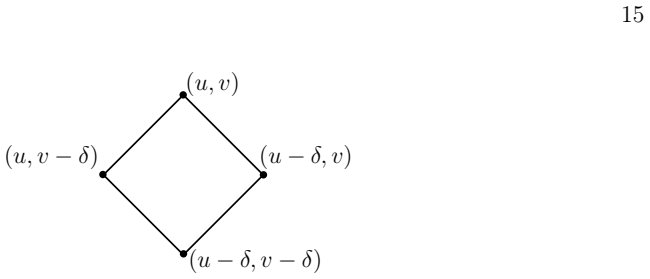
: m,n∈ Z } embedded in M2, using (u,v )-coordinates related to the standard inertial Minkowski coordinates byu = t−x, v = t +x. The continuum metric and d’Alembertian areds2 = dudv and □ = 4∂u∂v. Each lattice cell therefore has spacetime volume𝓁2 (explaining the factor of √ 2 above), so 𝓁 is a natural length scale associated with the lattice and indeed on...
-
[4]
The starting observations are thatΩ precisely coincides with the link matrixL, and thatW = 1 2 1
Retarded Green function forPΛ on the regular diamond lattice The retarded Green function may be computed exactly forPΛ on the regular diamond lattice in M2 for various choices of operatorK, which may help to illustrate the additional freedom that it represents. The starting observations are thatΩ precisely coincides with the link matrixL, and thatW = 1 2 ...
-
[5]
Edge effects at past infinity and the Cauchy problem In causal sets with a past boundary, i.e., points with no predecessors in the causal order, the form (33) of the wave equation given above should be reconsidered near to that boundary. In fact we have already anticipated this in our definition ofPΛ, which treats points inC− 2 differently to those in the bul...
-
[6]
We do this using the method of Peierls [15]
Tentative definition The next step is to define a Poisson structure on the space of observables on a fixed causal set. We do this using the method of Peierls [15]. Using the commutator function (36) (in analogy to [15]), we define the following bracket on C∞(E(C), C) {F,G} = N∑ i=1 N∑ j=1 δF δφi EijδG δφj , (72) where we used the Euclidean inner product to ra...
-
[7]
Justification of the formula for the bracket We now discuss a sense in which (72) corresponds to a discrete version of the Peierls bracket [15], by showing that it represents the difference between suitably defined retarded and advanced responses of the field equation to linear perturbations, supposing that the unperturbed equation has ak-layer Cauchy problem...
Show all 69 references
-
[8]
We work perturbatively, so the space of observables is now extended to include formal power series in the coupling constantλ, i.e
Interacting and linearized interacting equations of motion Let V ∈ C∞(E(C), C), where|C| = N and let λ be the coupling constant. We work perturbatively, so the space of observables is now extended to include formal power series in the coupling constantλ, i.e. it becomesF(C)[[λ...
-
[9]
Starting from the free Green functionE+, we construct the interacting one using the Neumann series: E+ λV =E+ + ∞∑ n=1 λnE+( V (2)E+)n
Interacting Poisson bracket The prescription for the Poisson bracket of the interacting theory with the interaction λV is given by {G,H}λV .=G,iEλV (φ)ijH,j, (96) where EλV (φ) = (E+ λV (φ))T−E+ λV (φ), andE+ λV (φ) is the retarded Green function for the interacting linearized...
-
[10]
a lin- earized wave equation (66) and its retarded Green functionE+
Exponential products Deformation quantization of the classical theory starts with the free theory, i.e. a lin- earized wave equation (66) and its retarded Green functionE+. From this we obtain E and the Peierls bracket. Let us for the moment restrict ourselves to the subspace ...
-
[11]
Onepossibilityistoconsideranalyticfunctions (e.g
Formal power series Going beyond the polynomial observables requires some caution, since the power series definingthestarproductmightnotconverge. Onepossibilityistoconsideranalyticfunctions (e.g. exponentials, as discussed in the next section) or to extend the framework to allo...
-
[12]
We use the framework of perturbative AQFT [11, 14, 51], where the interacting fields are constructed with the use of quantum Møller operators
Motivating the approach We finish this section with the construction of the interacting theory for a given inter- action V ∈ F(C). We use the framework of perturbative AQFT [11, 14, 51], where the interacting fields are constructed with the use of quantum Møller operators. The m...
-
[13]
Feynman-like
S-matrix and interacting fields We start with the algebra A(C), constructed in section IVA2, but we introduce a new formal parameter λ, which plays the role of the coupling constant. In this section Aℏ,λ(C)≡ (F(C)[[ℏ,λ ]],⋆ ). We fix a Hadamard functionW = i 2E +H and denote Aℏ,...
2016
-
[14]
R. D. Sorkin, Does locality fail at intermediate length scales?, inApproaches to Quantum Grav- ity: Toward a New Understanding of Space, Time and Matter, edited by D. Oriti (Cambridge University Press, 2009) pp. 26–43
2009
-
[15]
R. D. Sorkin, Causal sets: Discrete gravity, in Lectures on Quantum Gravity, edited by A. Gomberoff and D. Marolf (Springer US, Boston, MA, 2005) pp. 305–327
2005
-
[16]
Henson, The causal set approach to quantum gravity, inApproaches to Quantum Gravity: Toward a New Understanding of Space, Time and Matter, edited by D
J. Henson, The causal set approach to quantum gravity, inApproaches to Quantum Gravity: Toward a New Understanding of Space, Time and Matter, edited by D. Oriti (Cambridge University Press, 2009) pp. 393–413. 40
2009
-
[17]
Haag and D
R. Haag and D. Kastler, An algebraic approach to quantum field theory, Journal of Mathe- matical Physics 5, 848 (1964)
1964
-
[18]
Haag,Local quantum physics(Springer-Verlag, Berlin, 1993)
R. Haag,Local quantum physics(Springer-Verlag, Berlin, 1993)
1993
-
[19]
C. J. Fewster and K. Rejzner, Algebraic Quantum Field Theory - an introduction, arXiv:1904.04051 [hep-th] (2019), arXiv:1904.04051
2019 arXiv
-
[20]
Brunetti, K
R. Brunetti, K. Fredenhagen, and R. Verch, The generally covariant locality principle—A new paradigm for local quantum field theory, Commun. Math. Phys.237, 31 (2003)
2003
-
[21]
Hollands and R
S. Hollands and R. M. Wald, Local Wick polynomials and time ordered products of quantum fields in curved spacetime, Commun. Math. Phys.223, 289 (2001)
2001
-
[22]
C. J. Fewster and R. Verch, Algebraic quantum field theory in curved spacetimes, inAdvances in Algebraic Quantum Field Theory, edited by R. Brunetti, C. Dappiaggi, K. Fredenhagen, and J. Yngvason (Springer, 2015) pp. 125–189
2015
-
[23]
Brunetti and K
R. Brunetti and K. Fredenhagen, Microlocal analysis and interacting quantum field theories, Commun. Math. Phys.208, 623 (2000)
2000
-
[24]
Brunetti, M
R. Brunetti, M. Dütsch, and K. Fredenhagen, Perturbative algebraic quantum field theory and the renormalization groups, Adv. Theor. Math. Phys.13, 1541 (2009)
2009
-
[25]
Dütsch and K
M. Dütsch and K. Fredenhagen, The Master Ward identity and generalized Schwinger-Dyson equation in classical field theory, Communications in Mathematical Physics243, 275 (2003)
2003
-
[26]
Dütsch and K
M. Dütsch and K. Fredenhagen, Algebraic quantum field theory, perturbation theory, and the loop expansion, Commun. Math. Phys.219, 5 (2001)
2001
-
[27]
Rejzner, Perturbative Algebraic Quantum Field Theory
K. Rejzner, Perturbative Algebraic Quantum Field Theory. An introduction for Mathemati- cians, Mathematical Physics Studies (Springer, 2016)
2016
-
[28]
R. E. Peierls, The commutation laws of relativistic field theory, Proceedings of the Royal Society of London. Series A. Mathematical and Physical Sciences214, 143 (1952)
1952
-
[29]
R. D. Sorkin, From Green function to quantum field, International Journal of Geometric Meth- ods in Modern Physics14, 1740007 (2017)
2017
-
[30]
D. M. Benincasa and F. Dowker, Scalar curvature of a causal set, Physical Review Letters 104, 181301 (2010)
2010
-
[31]
Dowker and L
F. Dowker and L. Glaser, Causal set d’Alembertians for various dimensions, Classical and Quantum Gravity 30, 195016 (2013)
2013
-
[32]
Glaser, A closed form expression for the causal set d’alembertian, Classical and Quantum Gravity 31, 095007 (2014)
L. Glaser, A closed form expression for the causal set d’alembertian, Classical and Quantum Gravity 31, 095007 (2014)
2014
-
[33]
Belenchia, D
A. Belenchia, D. M. T. Benincasa, and S. Liberati, Nonlocal scalar quantum field theory from causal sets, Journal of High Energy Physics2015, 36 (2015)
2015
-
[34]
B. Z. Foster and T. Jacobson, Quantum field theory on a growing lattice, Journal of High Energy Physics 2004, 024 (2004)
2004
-
[35]
R. M. Wald,Quantum field theory in curved spacetime and black hole thermodynamics(Uni- versity of Chicago Press, 1994)
1994
-
[36]
Cortês and L
M. Cortês and L. Smolin, Quantum energetic causal sets, Physical Review D90, 044035 (2014)
2014
-
[38]
Brunetti, K
R. Brunetti, K. Fredenhagen, and K. Rejzner, Quantum gravity from the point of view of locally covariant quantum field theory, Communications in Mathematical Physics345, 741 (2016)
2016
-
[39]
D. P. Rideout and R. D. Sorkin, Classical sequential growth dynamics for causal sets, Physical Review D 61, 024002 (1999). 41
1999
-
[40]
Afshordi, S
N. Afshordi, S. Aslanbeigi, and R. D. Sorkin, A distinguished vacuum state for a quantum field in a curved spacetime: formalism, features, and cosmology, Journal of High Energy Physics 2012, 1 (2012)
2012
-
[41]
Johnston,Quantum fields on causal sets, Thesis (2010), [arXiv:1010.5514]
S. Johnston,Quantum fields on causal sets, Thesis (2010), [arXiv:1010.5514]
2010 arXiv
-
[42]
C. J. Fewster and R. Verch, On a recent construction of ‘vacuum-like’ quantum field states in curved spacetime, Classical and Quantum Gravity29, 205017 (2012)
2012
-
[43]
Wingham,Generalised Sorkin-Johnston and Brum-Fredenhagen States for Quantum Fields on Curved Spacetimes, Thesis (2019), phD at the University of York
F. Wingham,Generalised Sorkin-Johnston and Brum-Fredenhagen States for Quantum Fields on Curved Spacetimes, Thesis (2019), phD at the University of York
2019
-
[44]
Brum and K
M. Brum and K. Fredenhagen, ‘Vacuum-like’ Hadamard states for quantum fields on curved spacetimes, Classical and Quantum Gravity31, 025024 (2014)
2014
-
[45]
C. J. Fewster and B. Lang, Pure quasifree states of the Dirac field from the fermionic projector, Classical and Quantum Gravity32, 095001 (2015)
2015
-
[46]
R. D. Sorkin, Spacetime and causal sets, inRelativity and gravitation: classical and quantum (Cocoyoc, 1990), edited by J. C. D’Olivo, E. Nahmad-Achar, M. Rosenbaum, M. P. Ryan, L. F. Urrutia, and F. Zertuche (World Sci. Publ., River Edge, NJ, 1991) pp. 150–173
1990
-
[47]
R. D. Sorkin, Scalar field theory on a causal set in histories form, inJournal of Physics: Conference Series, Vol. 306 (IOP Publishing, 2011) p. 012017
2011
-
[48]
S. A. Major, D. Rideout, and S. Surya, Spatial hypersurfaces in causal set cosmology, Classical and Quantum Gravity23, 4743 (2006)
2006
-
[49]
Aslanbeigi, M
S. Aslanbeigi, M. Saravani, and R. D. Sorkin, Generalized causal set d’Alembertians, Journal of High Energy Physics2014, 24 (2014), arXiv:1403.1622 [hep-th]
2014 arXiv
-
[50]
Hawkins and K
E. Hawkins and K. Rejzner, The Star Product in Interacting Quantum Field Theory, (2016), [arXiv:math-ph/1612.09157]
2016 arXiv
-
[51]
Nomaan Ahmed, F
S. Nomaan Ahmed, F. Dowker, and S. Surya, Scalar field Green functions on causal sets, Classical Quantum Gravity34, 124002, 19 (2017), arXiv:1701.07212
2017 arXiv
-
[52]
C. Bär, N. Ginoux, and F. Pfäffle,Wave Equations on Lorentzian Manifolds and Quantization (European Mathematical Society, 2007) pp. 1–199
2007
-
[53]
Jakobs,Eichbrücken in der klassischen Feldtheorie, Diploma thesis (2009), diploma Thesis, Hamburg University
S. Jakobs,Eichbrücken in der klassischen Feldtheorie, Diploma thesis (2009), diploma Thesis, Hamburg University
2009
-
[54]
Dütsch and K
M. Dütsch and K. Fredenhagen, Perturbative algebraic field theory, and deformation quanti- zation, Mathematical Physics in Mathematics and Physics: Quantum and Operator Algebraic Aspects 30, 1 (2001)
2001
-
[55]
H. J. Groenewold, On the principles of elementary quantum mechanics, Physica12, 405 (1946)
1946
-
[56]
Van Hove, Sur certaines représentations unitaires d’un groupe infini de transformations, acad
L. Van Hove, Sur certaines représentations unitaires d’un groupe infini de transformations, acad. roy, Belg. Cl. Sci. Mém. Collect80, 29 (1951)
1951
-
[57]
C. J. Fewster and R. Verch, Dynamical locality and covariance: What makes a physical theory the same in all spacetimes?, Annales Henri Poincaré13, 1613 (2012)
2012
-
[58]
C. J. Fewster, The art of the state, International Journal of Modern Physics D27, 1843007 (2018)
2018
-
[59]
Dappiaggi, V
C. Dappiaggi, V. Moretti, and N. Pinamonti, Distinguished quantum states in a class of cosmo- logical spacetimes and their Hadamard property, Journal of Mathematical Physics50, 062304 (2009)
2009
-
[60]
Gérard and M
C. Gérard and M. Wrochna, Hadamard property of the in and out states for Klein-Gordon fields on asymptotically static spacetimes,Annales Henri Poincaré, 18, 2715 (2017)
2017
-
[61]
Dereziński and D
J. Dereziński and D. Siemssen, An evolution equation approach to the Klein-Gordon operator on curved spacetime, Pure and Applied Analysis1, 215 (2019). 42
2019
-
[62]
Johnston, Feynman propagator for a free scalar field on a causal set, Physical Review letters 103, 180401 (2009)
S. Johnston, Feynman propagator for a free scalar field on a causal set, Physical Review letters 103, 180401 (2009)
2009
-
[63]
C. J. Fewster and R. Verch, The necessity of the Hadamard condition, Classical and Quantum Gravity 30, 235027 (2013)
2013
-
[64]
Fredenhagen and K
K. Fredenhagen and K. Rejzner, Perturbative construction of models of algebraic quantum field theory, [arXiv:math-ph/1503.07814] (2015)
2015 arXiv
-
[65]
Dereziński and C
J. Dereziński and C. Gérard,Mathematics of quantization and quantum fields(Cambridge University Press, 2013)
2013
-
[66]
Moretti, Spectral Theory and Quantum Mechanics: With an Introduction to the Algebraic Formulation (Springer Science and Business Media, 2013)
V. Moretti, Spectral Theory and Quantum Mechanics: With an Introduction to the Algebraic Formulation (Springer Science and Business Media, 2013)
2013
-
[67]
Bordemann and S
M. Bordemann and S. Waldmann, Formal GNS construction and states in deformation quan- tization, Communications in Mathematical Physics195, 549 (1998)
1998
-
[68]
Dütsch and K
M. Dütsch and K. Fredenhagen, A local (perturbative) construction of observables in gauge theories: the example of QED, Comm. Math. Phys.203, 71 (1999)
1999
-
[69]
Epstein and V
H. Epstein and V. Glaser, The role of locality in perturbation theory, AHP19, 211 (1973)
1973
Reviewed August 14, 2026 · model on record in the stance chip above.
Discussion (0). Continue with ORCID to comment.