JGRA: Jacobian Geometry Robustness Assessment in NISQ Noise-Aware Quantum Neural Networks
Pith reviewed 2026-06-27 16:03 UTC · model grok-4.3
The pith
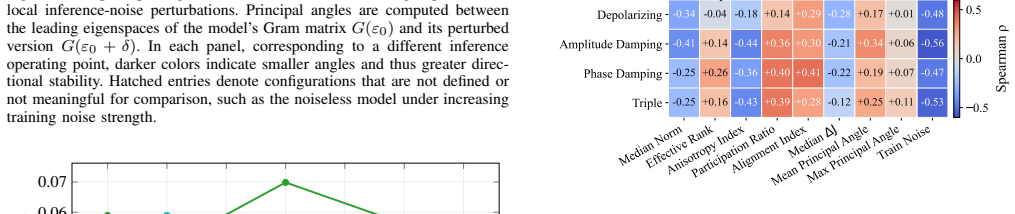
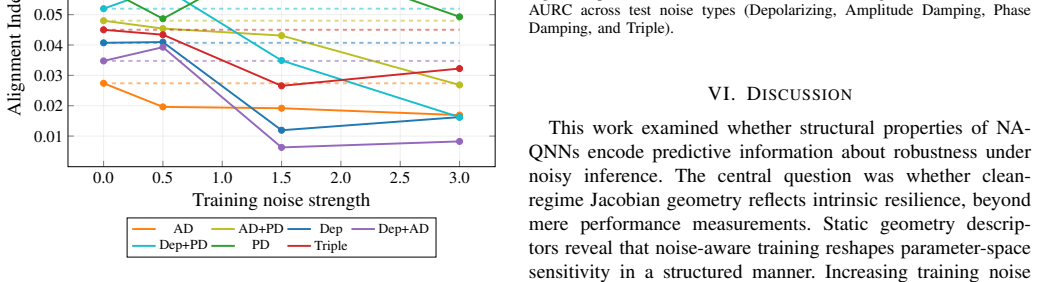
Jacobian geometry descriptors from clean quantum neural networks predict their robustness to unseen NISQ noise.
A machine-rendered reading of the paper's core claim, the machinery that carries it, and where it could break.
Core claim
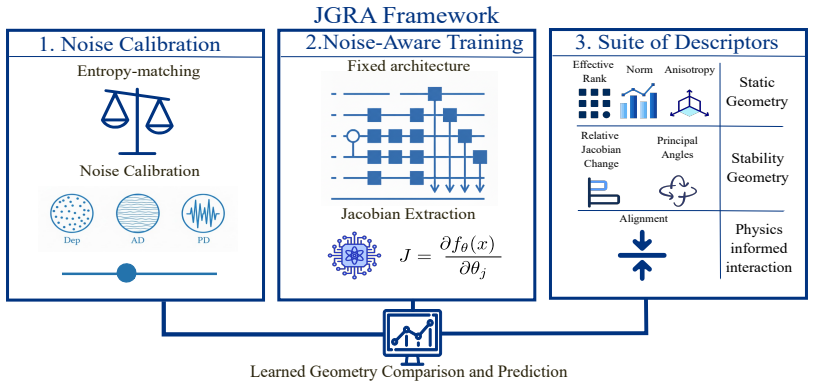
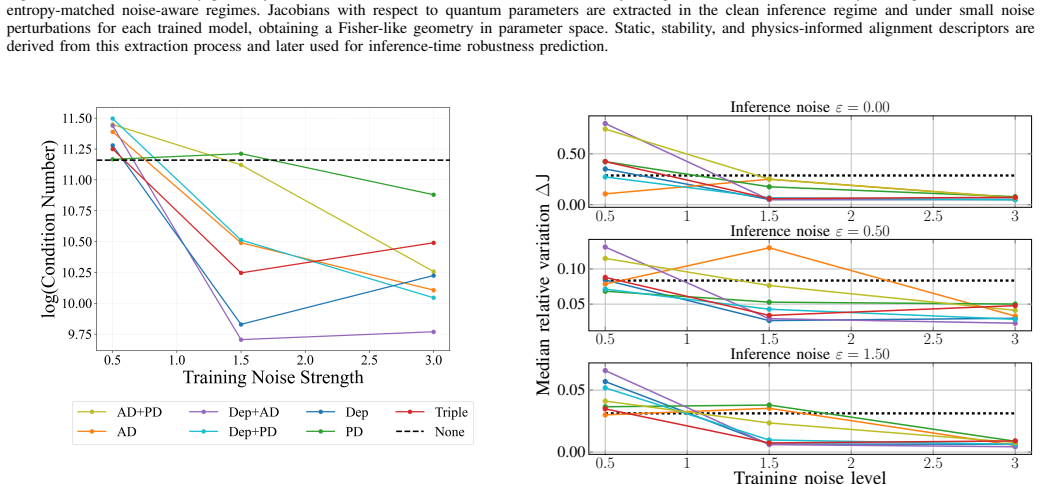
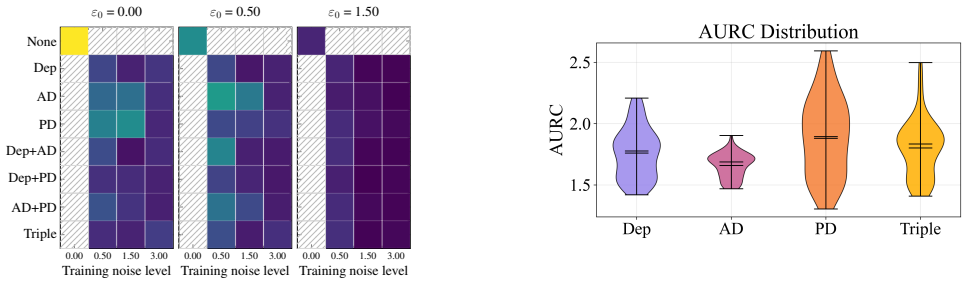
The JGRA framework produces geometric descriptors via noise-conditioned Jacobian extraction that encode predictive information about the robustness of noise-aware QNNs under unseen noise, by linking clean-regime structure to noisy inference behaviour through entropy-matched calibration and noise-aware training.
What carries the argument
The noise-conditioned Jacobian and resulting geometric descriptors, which quantify model sensitivity to parameter perturbations induced by noise and link clean structure to noisy outcomes.
If this is right
- The descriptors enable prediction of robustness to new noise without requiring exhaustive testing under every noise instance.
- Clean-regime Jacobian analysis combined with calibration provides a quantitative link to noisy performance.
- Noise-aware training integrated with geometric extraction yields descriptors usable for resilience assessment.
- The method supports design choices in QNNs that improve tolerance based on clean-regime geometry.
Where Pith is reading between the lines
- The descriptors could guide selection of QNN parameters or architectures to enhance inherent noise tolerance.
- The framework might apply to other quantum models to evaluate noise effects using similar geometric analysis.
- Predictive power could be tested for scaling with circuit depth or qubit count in larger systems.
Load-bearing premise
Entropy-matched noise calibration and noise-conditioned Jacobian extraction can capture the link between clean-regime structure and noisy inference behaviour in QNNs.
What would settle it
Empirical tests in which the geometric descriptors show no statistical correlation with measured robustness metrics when QNNs encounter previously unseen noise models.
Figures
read the original abstract
The NISQ era places stringent constraints on quantum computation, where noise and decoherence fundamentally limit performance. In classical deep learning, model robustness and resilience to perturbations are well studied: deep neural networks (DNNs) maintain high performance despite pruning, noise injection, and structural perturbations due to inherent redundancy in their representations. A central challenge in quantum machine learning is to transfer this notion of robustness to quantum neural networks (QNNs) under realistic NISQ noise. While classical deep learning exhibits robustness through structural redundancy, analogous principles for QNNs remain underdeveloped. We propose JGRA: a framework for assessing robustness in noise-aware QNNs via Jacobian geometry, capturing model sensitivity to parameter perturbations induced by noise. Our method includes entropy-matched noise calibration, noise-aware training, and noise-conditioned Jacobian extraction, yielding geometric descriptors that link clean-regime structure to noisy inference behaviour. We also empirically demonstrate that these descriptors encode predictive information about robustness under unseen noise.
Editorial analysis
A structured set of objections, weighed in public.
Referee Report
Summary. The paper proposes the JGRA framework for assessing robustness in noise-aware quantum neural networks (QNNs) under NISQ noise. It combines entropy-matched noise calibration, noise-aware training, and noise-conditioned Jacobian extraction to produce geometric descriptors that purportedly link clean-regime structure to noisy inference behavior. The central empirical claim is that these descriptors encode predictive information about robustness under unseen noise.
Significance. If the empirical demonstration holds with proper controls for noise-family generalization, the approach could provide a practical tool for predicting QNN robustness without exhaustive noisy simulations, addressing a key limitation in NISQ-era quantum machine learning.
major comments (2)
- [Abstract] Abstract: the load-bearing claim that Jacobian geometric descriptors 'encode predictive information about robustness under unseen noise' requires explicit evidence that test noise instances are drawn from a distribution distinct from the entropy-matched calibration family; without this, the reported correlation may reflect noise-specific sensitivity rather than intrinsic clean-regime geometry.
- [Abstract] Abstract (methodology description): the framework assumes entropy-matched calibration plus noise-conditioned Jacobian extraction isolates structure-robustness links, but no details are given on how the Jacobian is conditioned or whether the resulting descriptors remain predictive when the noise model (e.g., depolarizing vs. amplitude damping) changes between calibration and test.
minor comments (1)
- [Abstract] Abstract: the phrase 'we also empirically demonstrate' appears without any mention of datasets, QNN architectures, noise models, metrics, or cross-validation procedure, making it impossible to assess the strength of the reported predictive result.
Simulated Author's Rebuttal
We thank the referee for the constructive feedback on the JGRA framework. The comments highlight important clarifications needed regarding noise distribution distinctions and methodological details on Jacobian conditioning. We address each point below and will incorporate revisions to strengthen the manuscript.
read point-by-point responses
-
Referee: [Abstract] Abstract: the load-bearing claim that Jacobian geometric descriptors 'encode predictive information about robustness under unseen noise' requires explicit evidence that test noise instances are drawn from a distribution distinct from the entropy-matched calibration family; without this, the reported correlation may reflect noise-specific sensitivity rather than intrinsic clean-regime geometry.
Authors: We agree that explicit evidence of distribution shift is necessary to support the claim of predictive information about robustness under unseen noise. The current experiments use entropy-matched calibration on a noise family with parameter variations held out for testing, but these remain within-family. To address this, we will revise the abstract and add a dedicated subsection in the experiments detailing the exact noise parameter distributions for calibration versus test sets, including statistical tests confirming the distinction. We will also include cross-validation results showing descriptor-robustness correlations under these conditions. revision: yes
-
Referee: [Abstract] Abstract (methodology description): the framework assumes entropy-matched calibration plus noise-conditioned Jacobian extraction isolates structure-robustness links, but no details are given on how the Jacobian is conditioned or whether the resulting descriptors remain predictive when the noise model (e.g., depolarizing vs. amplitude damping) changes between calibration and test.
Authors: The referee correctly identifies a gap in the methodology description. The manuscript provides high-level steps for noise-conditioned Jacobian extraction but lacks explicit conditioning formulas and cross-model generalization tests. We will revise the methods section to include the precise mathematical definition of noise conditioning on the Jacobian (via the noise-aware loss gradient) and add new experiments evaluating descriptor predictiveness when calibration uses depolarizing noise and testing uses amplitude damping (and vice versa). The abstract will be updated to note these controls. revision: yes
Circularity Check
No circularity: framework description contains no equations or self-referential derivations
full rationale
The provided abstract and context contain no equations, parameter-fitting procedures, or cited uniqueness theorems. The central claim is an empirical demonstration that Jacobian descriptors encode predictive information about robustness under unseen noise, but this is presented as a result of the described procedure (entropy-matched calibration + noise-aware training + Jacobian extraction) without any reduction shown to be tautological by construction. No self-citation load-bearing steps, fitted-input predictions, or ansatz smuggling are identifiable from the given text. The derivation chain cannot be walked because no chain is supplied; the paper is therefore scored as self-contained with no circularity.
Axiom & Free-Parameter Ledger
Reference graph
Works this paper leans on
-
[1]
Quantum computing in the nisq era and beyond.Quantum2, 79 (2018)
J. Preskill, “Quantum computing in the NISQ era and beyond,” Quantum, vol. 2, p. 79, Aug. 2018. [Online]. Available: http://dx.doi.org/10.22331/q-2018-08-06-79
work page internal anchor Pith review doi:10.22331/q-2018-08-06-79 2018
-
[2]
Noisy intermediate-scale quantum algorithms,
K. Bharti, A. Cervera-Lierta, T. H. Kyaw, T. Haug, S. Alperin- Lea, A. Anand, M. Degroote, H. Heimonen, J. S. Kottmann, T. Menke, W.-K. Mok, S. Sim, L.-C. Kwek, and A. Aspuru- Guzik, “Noisy intermediate-scale quantum algorithms,”Reviews of Modern Physics, vol. 94, no. 1, Feb. 2022. [Online]. Available: http://dx.doi.org/10.1103/RevModPhys.94.015004
-
[3]
Nature Communications , author =
J. R. McClean, S. Boixo, V . N. Smelyanskiy, R. Babbush, and H. Neven, “Barren plateaus in quantum neural network training landscapes,”Nature Communications, vol. 9, no. 1, Nov. 2018. [Online]. Available: http://dx.doi.org/10.1038/s41467-018-07090-4
-
[4]
and Cincio, Lukasz and McClean, Jarrod R
M. Larocca, S. Thanasilp, S. Wang, K. Sharma, J. Biamonte, P. J. Coles, L. Cincio, J. R. McClean, Z. Holmes, and M. Cerezo, “Barren plateaus in variational quantum computing,”Nature Reviews Physics, vol. 7, no. 4, p. 174–189, Mar. 2025. [Online]. Available: http://dx.doi.org/10.1038/s42254-025-00813-9
-
[5]
Nature communications , volume=
S. Wang, E. Fontana, M. Cerezo, K. Sharma, A. Sone, L. Cincio, and P. J. Coles, “Noise-induced barren plateaus in variational quantum algorithms,”Nature Communications, vol. 12, no. 1, Nov. 2021. [Online]. Available: http://dx.doi.org/10.1038/s41467-021-27045-6
-
[6]
Noise tailoring for scalable quantum computation via randomized compiling,
J. J. Wallman and J. Emerson, “Noise tailoring for scalable quantum computation via randomized compiling,”Phys. Rev. A, vol. 94, p. 052325, Nov 2016. [Online]. Available: https://link.aps.org/doi/10.1103/PhysRevA.94.052325
-
[7]
J. Stokes, J. Izaac, N. Killoran, and G. Carleo, “Quantum natural gradient,”Quantum, vol. 4, p. 269, May 2020. [Online]. Available: http://dx.doi.org/10.22331/q-2020-05-25-269
-
[8]
Fisher Information in Noisy Intermediate-Scale Quantum Applications
J. J. Meyer, “Fisher information in noisy intermediate-scale quantum applications,”Quantum, vol. 5, p. 539, Sep. 2021. [Online]. Available: http://dx.doi.org/10.22331/q-2021-09-09-539
-
[9]
Representation learning via quantum neural tangent kernels,
J. Liu, F. Tacchino, J. R. Glick, L. Jiang, and A. Mezzacapo, “Representation learning via quantum neural tangent kernels,” PRX Quantum, vol. 3, no. 3, Aug. 2022. [Online]. Available: http://dx.doi.org/10.1103/PRXQuantum.3.030323
-
[10]
G. Gour and M. M. Wilde, “Entropy of a quantum channel,”Physical Review Research, vol. 3, no. 2, May 2021. [Online]. Available: http://dx.doi.org/10.1103/PhysRevResearch.3.023096
-
[11]
A. Uhlmann, “The “transition probability” in the state space of a∗-algebra,”Reports on Mathematical Physics, vol. 9, no. 2, pp. 273–279, 1976. [Online]. Available: https://www.sciencedirect.com/science/article/pii/0034487776900604
arXiv 1976
-
[12]
M. M. Wilde,Quantum Information Theory. Cambridge University Press, 2013
2013
-
[13]
Pennylane: Automatic differentiation of hybrid quantum-classical computations,
V . Bergholmet al., “Pennylane: Automatic differentiation of hybrid quantum-classical computations,” 2022. [Online]. Available: https://arxiv.org/abs/1811.04968
Pith/arXiv arXiv 2022
discussion (0)
Sign in with ORCID, Apple, or X to comment. Anyone can read and Pith papers without signing in.