REVIEW 4 major objections 5 minor 29 references
Resonance production in small collision systems is set by the competition between regeneration and rescattering, not by resonance lifetime alone.
Reviewed by Pith at T0; open to challenge. T0 means a machine referee read the full paper against a public rubric. the ladder, T0–T4 →
T0 review · deepseek-v4-flash
2026-08-02 00:14 UTC pith:F3T73X2V
load-bearing objection Useful EPOS4 scan with a clear message; the baryon underprediction and the tau_had extraction deserve referee scrutiny before the regeneration-dominance claim is accepted. the 4 major comments →
Investigation of hadronic effects on resonance productions in small collision systems using the EPOS4 model
The pith
A machine-rendered reading of the paper's core claim, the machinery that carries it, and where it could break.
Core claim
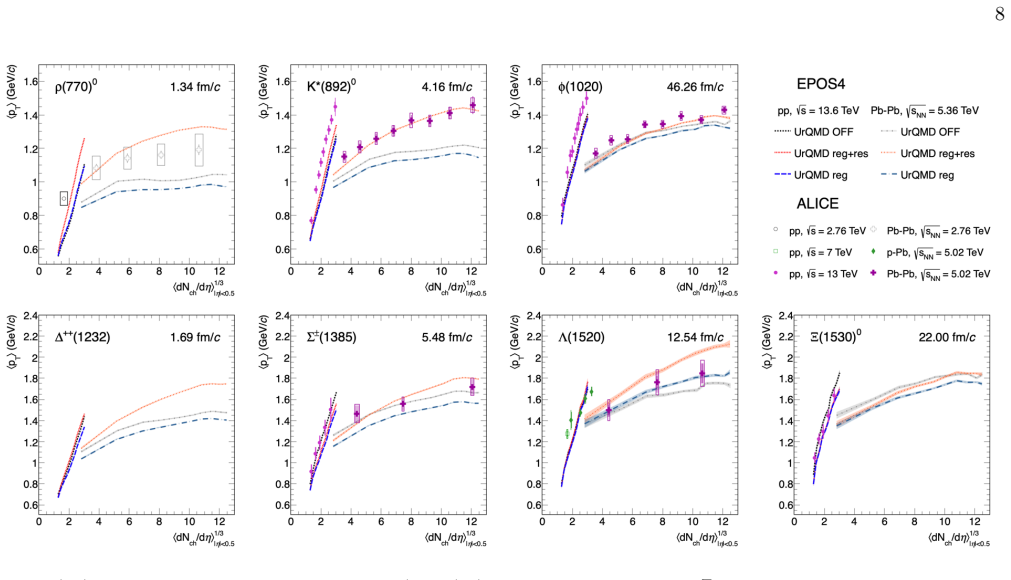
The central claim is that the final observable yield of a resonance is governed by the competition between regeneration and rescattering in the hadronic phase, not by the resonance lifetime alone. In the EPOS4+UrQMD framework, the configuration that keeps all resonances after the cascade (UrQMD reg) almost always yields more resonances than the calculation with the hadronic cascade switched off (UrQMD OFF), showing that regeneration adds particles. When daughter-particle rescattering is required to be absent (UrQMD reg+res), the yields drop for short-lived mesons such as rho(770) and K*(892), reproducing the suppression trend seen in data. But for baryonic resonances such as Delta(1232) and
What carries the argument
The three-configuration comparison within one model: UrQMD OFF (no hadronic cascade), UrQMD reg (all resonances after the cascade), and UrQMD reg+res (only resonances whose decay daughters did not rescatter, approximating the observable signal). The gap between reg and OFF quantifies regeneration; the gap between reg and reg+res quantifies rescattering loss. This decomposition is the tool that lets the authors separate the two competing effects and show that their balance, not lifetime alone, controls the final resonance yield.
Load-bearing premise
The load-bearing premise is that the UrQMD hadronic cascade, and its specific classification of regenerated versus rescattered daughters, faithfully reproduces what a real detector would reconstruct; if UrQMD's hadronic cross sections, especially among baryons, are inaccurate, the claimed dominance of regeneration for Delta(1232) and Sigma(1385) would be a model artifact rather than physics.
What would settle it
A measurement of the Sigma(1385)/Lambda or Delta(1232)/p yield ratio in high-multiplicity pp or p-O collisions that decreases monotonically with multiplicity, with no sign of a low-pT excess relative to the low-multiplicity baseline, would contradict the regeneration-dominance claim. Alternatively, a modified version of UrQMD with baryon cross sections tuned differently would show the regeneration excess disappearing, indicating it is an artifact of the model's cross sections.
If this is right
- In proton-proton collisions, hadronic interactions can visibly modify resonance yields, not only in heavy-ion collisions; the effect is small but present for several species.
- Short-lived mesons like rho(770) and K*(892) are net suppressed, consistent with existing measurements of their resonance-to-ground-state ratios.
- Baryonic resonances like Delta(1232) and Sigma(1385) can be net enhanced by regeneration, so experimental ratios above the low-multiplicity baseline would be a direct signature of this mechanism.
- Estimates of the hadronic-phase lifetime from resonance-to-ground-state ratios are biased unless regeneration is explicitly modeled; the extracted tau_had should be treated as an effective model-dependent quantity.
- The O-O and p-O systems fill the gap between pp and Pb-Pb: resonance yields and yield ratios evolve smoothly with multiplicity, while mean pT retains sensitivity to collision geometry and initial-state dynamics.
- The competition between regeneration and rescattering implies that the widely used no-regeneration exponential formula for lifetime extraction is inadequate for resonances with sizable regeneration contributions.
Where Pith is reading between the lines
- A clean experimental test of the regeneration-dominance claim would be a pT-differential measurement of the Delta(1232)/p or Sigma(1385)/Lambda ratio in high-multiplicity pp collisions; if regeneration is real, the low-pT excess over the low-multiplicity baseline should grow with multiplicity.
- The paper's model-internal classification of "reconstructible" resonances by a single daughter-scattering tag may be a coarse proxy for what real detectors reconstruct; a more refined tag based on the actual momentum kick or track density could change the quantitative balance even if the qualitative competition remains.
- The apparent saturation of the extracted hadronic-phase lifetime near ~1 fm/c in pp and p-O at high multiplicity is a specific, unexpected prediction that could be compared with independent estimates from femtoscopy or from other event generators.
- The species-dependence of regeneration suggests that resonance measurements with different quark contents and baryon numbers could be used as a spectroscopy of hadronic-phase dynamics, not just as a universal suppression scale.
Editorial analysis
A structured set of objections, weighed in public.
Referee Report
Summary. The paper presents a systematic EPOS4+UrQMD study of hadronic final-state effects on resonance production in pp, p–O, O–O, and Pb–Pb collisions. Three model configurations are compared: UrQMD OFF (no hadronic cascade), UrQMD reg (total resonance yield after the cascade, including regeneration), and UrQMD reg+res (reconstructible resonances, excluding those whose decay daughters rescatter). The authors report species-dependent differences in pT-integrated yields, resonance-to-ground-state ratios, and mean pT, concluding that the final resonance yield is governed by the competition between regeneration and rescattering rather than by resonance lifetime alone, and that regeneration significantly enhances several baryonic resonances even in small systems. The paper also extracts an effective hadronic-phase lifetime by inverting an exponential rescattering formula. The central qualitative claim—that regeneration and rescattering compete species-dependently—follows from the internal model comparisons, but several validation and interpretation issues require attention.
Significance. If the UrQMD-based decomposition is trustworthy, this is a valuable model study: it isolates regeneration from rescattering in a single framework, spans a wide range of resonance lifetimes and species, and extends from pp to Pb–Pb via p–O and O–O, a timely system-size scan. The paper is commendably explicit that the extracted hadronic-phase lifetime is an effective, model-dependent quantity. The main value is as a benchmark for interpreting LHC resonance measurements, especially the message that resonance suppression is not the only hadronic-phase effect. However, the evidence for baryonic regeneration dominance rests on a baseline (UrQMD OFF) that the paper itself says underpredicts measured baryon yields, and no uncertainties are provided for the model bands. These issues are fixable but affect the strength of the central claim.
major comments (4)
- [Sec. III A, Figs. 1–2] The claim that Delta(1232)++ and Sigma(1385)± yields are governed by regeneration relies on the observation that UrQMD reg+res exceeds UrQMD OFF. The text states that for some baryonic resonances the model 'tends to underestimate the measured yields' with the reg+res configuration. Since OFF lies below reg+res, the primary-production baseline is too low; the regeneration contribution relative to primary production can thus be inflated, and the apparent regeneration dominance may partly compensate for missing primary production. Please provide a quantitative model-data comparison for the OFF and reg+res configurations separately, and discuss how the baryon underprediction affects the decomposition. Without this, the species-dependent 'regeneration dominance' is not yet established.
- [Sec. III E, Eq. (1)] The hadronic-phase lifetime is extracted by inverting an exponential relation that explicitly neglects regeneration, while the paper's own main conclusion is that regeneration is significant for several species. Using UrQMD reg as '[h*/h]_chemical' and UrQMD reg+res as '[h*/h]_kinetic' means the ratio difference includes regeneration effects, so the resulting tau_had is an effective re-parameterization of the model ratio rather than a physical lifetime. The statement that shorter-lived resonances yield shorter tau_had is partly encoded in the exponential ansatz. I recommend either repositioning this section as a model-internal comparator without quantitative comparison to ALICE, or developing an estimator that accounts for regeneration.
- [Throughout, Figs. 1–11] No statistical uncertainties, event statistics, or systematic band definitions are given for the model results. The differences among UrQMD OFF, reg, and reg+res are small in the pp region, and without uncertainties it is impossible to judge whether the claimed pp effects are statistically significant or whether the ordering of configurations is robust. Please add at least statistical uncertainties to the model bands, and state the number of events and the definition of the bands.
- [Sec. II B] The reg+res configuration is defined by excluding resonances whose decay daughters undergo rescattering, and the paper states that this provides the 'closest model representation of the experimentally observable resonance signal.' This is a strong claim. No validation is shown that this tagging reproduces a full reconstruction (invariant-mass analysis with detector acceptance and efficiency). At minimum, a comparison with a direct reconstruction within the model would substantiate the claim and strengthen the comparison to experimental data.
minor comments (5)
- [General] The manuscript does not mention availability of code or data. For reproducibility, please add a statement about the EPOS4 version and configuration, and whether analysis scripts are available.
- [Figure captions, Figs. 1, 3, 5, 8–11] The captions refer to 'available experimental measurements at different collision energies' without specifying the energies or references in the caption. Please list the relevant collision systems and energies in each caption or in a table.
- [Eq. (1)] The notation [h*/h] is clear in context, but it would help to define h* and h explicitly as resonance and ground-state hadron. Also clarify the relation between the model configurations and the chemical/kinetic ratios before Eq. (1).
- [Sec. III B, phi discussion] The statement that the systematic reduction of phi(1020) when UrQMD is enabled 'suggests additional mechanisms, such as nuclear absorption' is speculative and not developed in the paper. Either substantiate with a quantitative estimate or remove it to avoid mixing mechanisms.
- [Sec. III E, Fig. 11] The claim that resonances with similar intrinsic lifetimes yield comparable tau_had values is not quantified. A correlation plot of tau_had versus resonance lifetime would make the ordering visible and easier to assess.
Circularity Check
No meaningful circularity: the central claim is a model-internal empirical comparison, and the only derived quantity (tau_had) is explicitly labeled an effective re-parameterization.
full rationale
The paper's main derivation chain is a controlled model comparison, not a fit-then-predict loop. The three configurations (UrQMD OFF, reg, reg+res) are defined operationally, and the central claim that regeneration and rescattering compete is an empirical reading of the simulated ordering across species, pT, and system size. No parameter is fitted to data and then 'predicted'; the comparisons to ALICE data are external checks, and the paper openly states a limitation: 'For some baryonic resonances, however, the model tends to underestimate the measured yields' (Sec. III A), which weakens but does not circularize the regeneration-dominance evidence. The tau_had extraction in Sec. III E uses Eq. (1) to convert reg/reg+res ratio differences into an effective lifetime; the paper explicitly says 'the extracted tau_had should be regarded as a model-dependent effective quantity defined from the difference between the regeneration-included and reconstructible resonance yields' and admits that regeneration also changes the ratio. This is a transparent re-parameterization of the same model output rather than a hidden input/prediction swap. Self-citations (e.g., Ref. [20], a same-group PYTHIA8 study) are contextual and not load-bearing; the analysis method is cited to Ref. [17] by a different group. No uniqueness theorem or ansatz is smuggled through a self-citation. The baryon underprediction is a model-data discrepancy (a correctness risk), not a circular step.
Axiom & Free-Parameter Ledger
axioms (4)
- domain assumption EPOS4+UrQMD provides a quantitatively reliable description of hadronization and hadronic final-state interactions.
- domain assumption UrQMD reg corresponds to chemical freeze-out yields and UrQMD reg+res to kinetic freeze-out/reconstructible yields.
- domain assumption Eq. (1): [h*/h]_kinetic = [h*/h]_chemical exp(-tau_had/tau_h*) with regeneration neglected.
- domain assumption Daughter rescattering removes a resonance from the reconstructible sample.
read the original abstract
Recent experimental results in high-multiplicity proton-proton (pp) collisions have suggested the possible emergence of collective behavior and medium-like effects previously considered characteristic of heavy-ion collisions. Resonance production provides a sensitive probe of such effects, as resonance yields and transverse-momentum distributions can be modified by hadronic interactions occurring between chemical and kinetic freeze-out. In this study, these effects are investigated using the EPOS4 event generator, in which hadronic final-state interactions are modeled through the UrQMD transport approach. By comparing calculations performed with and without UrQMD, the impact of hadronic interactions on resonance production is evaluated. In addition, the UrQMD contributions are separated into regeneration and rescattering, enabling a detailed investigation of both resonance production enhancement and the loss of reconstructible resonance signals. The analysis is performed for various mesonic and baryonic resonances with different lifetimes in pp collisions at LHC energies and is extended to p-O, O-O, and Pb-Pb collisions to study the system-size dependence of hadronic-phase effects. The results show that resonance production is governed by the competition between regeneration and rescattering, whose relative importance depends strongly on the resonance species, transverse momentum, and collision system. While rescattering suppresses reconstructible short-lived resonance signals, regeneration can significantly enhance the yields of several resonance species, particularly baryonic resonances. These findings demonstrate that hadronic interactions can play an important role even in small collision systems and highlight the need to measure resonances with different lifetimes and quantum numbers to constrain the dynamics and lifetime of the hadronic phase across collision systems.
Figures




Reference graph
Works this paper leans on
-
[1]
K. Adcoxet al.(PHENIX), “Formation of dense par- tonic matter in relativistic nucleus-nucleus collisions at RHIC: Experimental evaluation by the PHENIX collab- oration,” Nucl. Phys. A757, 184–283 (2005), arXiv:nucl- ex/0410003
arXiv 2005
-
[2]
John Adamset al.(STAR), “Experimental and theoret- ical challenges in the search for the quark gluon plasma: The STAR Collaboration’s critical assessment of the evi- dence from RHIC collisions,” Nucl. Phys. A757, 102–183 (2005), arXiv:nucl-ex/0501009
Pith/arXiv arXiv 2005
-
[3]
The PHOBOS perspec- tive on discoveries at RHIC,
B. B. Backet al.(PHOBOS), “The PHOBOS perspec- tive on discoveries at RHIC,” Nucl. Phys. A757, 28–101 (2005), arXiv:nucl-ex/0410022
Pith/arXiv arXiv 2005
-
[4]
Quark gluon plasma and color glass condensate at RHIC? The Perspective from the BRAHMS experiment,
I. Arseneet al.(BRAHMS), “Quark gluon plasma and color glass condensate at RHIC? The Perspective from the BRAHMS experiment,” Nucl. Phys. A757, 1–27 (2005), arXiv:nucl-ex/0410020
Pith/arXiv arXiv 2005
-
[5]
The ALICE experi- ment: a journey through QCD,
Shreyasi Acharyaet al.(ALICE), “The ALICE experi- ment: a journey through QCD,” Eur. Phys. J. C84, 813 (2024), arXiv:2211.04384 [nucl-ex]
Pith/arXiv arXiv 2024
-
[6]
Sensitiv- ity of the final resonance spectra on the hydrodynamical freeze out,
J. Steinheimer, J. Aichelin, and M. Bleicher, “Sensitiv- ity of the final resonance spectra on the hydrodynamical freeze out,” EPJ Web Conf.36, 00002 (2012)
2012
-
[7]
Hadron resonance production and final state hadronic interactions with UrQMD at LHC,
J. Steinheimer and M. Bleicher, “Hadron resonance production and final state hadronic interactions with UrQMD at LHC,” EPJ Web Conf.97, 00026 (2015)
2015
-
[8]
Influence of the hadronic phase on observables in ultra- relativistic heavy ion collisions,
J. Steinheimer, J. Aichelin, M. Bleicher, and H. St¨ ocker, “Influence of the hadronic phase on observables in ultra- relativistic heavy ion collisions,” Phys. Rev. C95, 064902 (2017), arXiv:1703.06638 [nucl-th]
Pith/arXiv arXiv 2017
-
[9]
Shreyasi Acharyaet al.(ALICE), “System-size depen- dence of the hadronic rescattering effect at energies avail- able at the CERN Large Hadron Collider,” Phys. Rev. C 109, 014911 (2024), arXiv:2308.16115 [nucl-ex]
Pith/arXiv arXiv 2024
-
[10]
Shreyasi Acharyaet al.(ALICE), “Evidence of rescatter- ing effect in Pb–Pb collisions at the LHC through pro- duction of K∗(892)0 andϕ(1020) mesons,” Phys. Lett. B 802, 135225 (2020), arXiv:1910.14419 [nucl-ex]
Pith/arXiv arXiv 2020
-
[11]
Review of particle physics,
S. Navaset al.(Particle Data Group), “Review of particle physics,” Phys. Rev. D110, 030001 (2024)
2024
-
[12]
Multiplicity depen- dence of K ∗(892)0 andϕ(1020) production in pp colli- sions at √s= 13 TeV,
Shreyasi Acharyaet al.(ALICE), “Multiplicity depen- dence of K ∗(892)0 andϕ(1020) production in pp colli- sions at √s= 13 TeV,” Phys. Lett. B807, 135501 (2020), arXiv:1910.14397 [nucl-ex]
Pith/arXiv arXiv 2020
-
[13]
Production of K ∗(892)0 andϕ(1020) in p–Pb collisions at √sNN = 5.02 TeV,
Jaroslav Adamet al.(ALICE), “Production of K ∗(892)0 andϕ(1020) in p–Pb collisions at √sNN = 5.02 TeV,” Eur. Phys. J. C76, 245 (2016), arXiv:1601.07868 [nucl- ex]
Pith/arXiv arXiv 2016
-
[14]
Multiplicity- dependent production of Σ(1385) and Ξ(1530) 0 in pp collisions at √s= 13 TeV,
Shreyasi Acharyaet al.(ALICE), “Multiplicity- dependent production of Σ(1385) and Ξ(1530) 0 in pp collisions at √s= 13 TeV,” JHEP05, 317 (2024), arXiv:2308.16116 [nucl-ex]
Pith/arXiv arXiv 2024
-
[15]
Multiplic- ity dependence of f 0(980) production in pp collisions at √s= 13 TeV,
Ibrahim Jaser Abualrobet al.(ALICE), “Multiplic- ity dependence of f 0(980) production in pp collisions at √s= 13 TeV,” Eur. Phys. J. C86, 76 (2026), arXiv:2507.19347 [nucl-ex]
arXiv 2026
-
[16]
Production of the ρ(770)0 meson in pp and Pb-Pb collisions at√sNN = 2.76 TeV,
Shreyasi Acharyaet al.(ALICE), “Production of the ρ(770)0 meson in pp and Pb-Pb collisions at√sNN = 2.76 TeV,” Phys. Rev. C99, 064901 (2019), arXiv:1805.04365 [nucl-ex]
Pith/arXiv arXiv 2019
-
[17]
A. G. Knospe, C. Markert, K. Werner, J. Steinheimer, and M. Bleicher, “Hadronic resonance production and interaction in partonic and hadronic matter in the EPOS3 model with and without the hadronic after- burner UrQMD,” Phys. Rev. C93, 014911 (2016), arXiv:1509.07895 [nucl-th]
Pith/arXiv arXiv 2016
-
[18]
Vikash Sumberia, Dukhishyam Mallick, Sanjeev Singh Sambyal, and Nasir Mehdi Malik, “Examining hadronic resonance dynamics at energies available at the CERN Large Hadron Collider: Insights from EPOS4,” Phys. Rev. C113, 015202 (2026), arXiv:2412.05178 [hep-ph]
Pith/arXiv arXiv 2026
-
[19]
Klaus Werner, “Revealing a deep connection between fac- torization and saturation: New insight into modeling high-energy proton-proton and nucleus-nucleus scatter- ing in the EPOS4 framework,” Phys. Rev. C108, 064903 (2023), arXiv:2301.12517 [hep-ph]
Pith/arXiv arXiv 2023
-
[20]
Exploring hadronic rescattering effects on resonance productions in pp and p–Pb collisions with PYTHIA8,
Su-Jeong Ji, Gyeongbin Park, Bong-Hwi Lim, and Sanghoon Lim, “Exploring hadronic rescattering effects on resonance productions in pp and p–Pb collisions with PYTHIA8,” Nuclear Physics A1074, 123455 (2026)
2026
-
[21]
Evidence for parton energy loss in oxygen−oxygen collisions at√sNN =5.36TeV,
Dana Ali Hassan Abdallahet al.(ALICE), “Evidence for parton energy loss in oxygen−oxygen collisions at√sNN =5.36TeV,” (2026), arXiv:2606.19967 [nucl-ex]
Pith/arXiv arXiv 2026
-
[22]
Aram Hayrapetyanet al.(CMS), “Observation of Sup- pressed Charged-Particle Production in Ultrarelativis- tic Oxygen-Oxygen Collisions,” Phys. Rev. Lett.136, 162301 (2026), arXiv:2510.09864 [nucl-ex]
Pith/arXiv arXiv 2026
-
[23]
K. Werner, B. Guiot, Iu. Karpenko, and T. Pierog, “Analysing radial flow features in p–Pb and p–p colli- sions at several TeV by studying identified particle pro- duction in EPOS3,” Phys. Rev. C89, 064903 (2014), arXiv:1312.1233 [nucl-th]
Pith/arXiv arXiv 2014
-
[24]
Core-corona separation in ultra- relativistic heavy ion collisions,
Klaus Werner, “Core-corona separation in ultra- relativistic heavy ion collisions,” Phys. Rev. Lett.98, 152301 (2007), arXiv:0704.1270 [nucl-th]
Pith/arXiv arXiv 2007
-
[25]
Relativistic hadron hadron colli- sions in the ultrarelativistic quantum molecular dynam- ics model,
M. Bleicheret al., “Relativistic hadron hadron colli- sions in the ultrarelativistic quantum molecular dynam- ics model,” J. Phys. G25, 1859–1896 (1999), arXiv:hep- ph/9909407
arXiv 1999
-
[26]
Microscopic models for ultrarelativistic heavy ion collisions,
S. A. Basset al., “Microscopic models for ultrarelativistic heavy ion collisions,” Prog. Part. Nucl. Phys.41, 255–369 (1998), arXiv:nucl-th/9803035
Pith/arXiv arXiv 1998
-
[27]
Theϕmeson in nuclear matter from theory and experimental data,
Philipp Gubler, Elena Bratkovskaya, Masaya Ichikawa, and Taesoo Song, “Theϕmeson in nuclear matter from theory and experimental data,” EPJ Web Conf.291, 04003 (2024)
2024
-
[28]
Determination of theϕ-meson production process and its absorption cross section via directed flow,
Jan Steinheimer, Tom Reichert, and Marcus Bleicher, “Determination of theϕ-meson production process and its absorption cross section via directed flow,” Phys. Lett. B869, 139870 (2025), arXiv:2507.19289 [hep-ph]
arXiv 2025
-
[29]
Strong absorp- tion of hadrons with hidden and open strangeness in nuclear matter,
J. Adamczewski-Muschet al.(HADES), “Strong absorp- tion of hadrons with hidden and open strangeness in nuclear matter,” Phys. Rev. Lett.123, 022002 (2019), arXiv:1812.03728 [nucl-ex]
Pith/arXiv arXiv 2019
discussion (0)
Sign in with ORCID, Apple, or X to comment. Anyone can read and Pith papers without signing in.