REVIEW 3 major objections 5 minor 1 cited by
Kubernetes hardening can be driven entirely by runtime logs: LLM prompt chains turn audit, network, and provenance data into least-privilege Roles, NetworkPolicies, and Deployments, reaching a perfect F1 on Role creation.
Reviewed by Pith at T0; open to challenge. T0 means a machine referee read the full paper against a public rubric. the ladder, T0–T4 →
KubeGuard generates and refines Kubernetes Roles, NetworkPolicies, and Deployments from aggregated audit, network, and provenance logs using prompt-chained LLMs, achieving F1 up to 0.96 with GPT-4o.
T0 review reviewed 2026-08-05 challenge →
load-bearing objection KubeGuard is a well-executed LLM+multi-log pipeline for Kubernetes least-privilege manifests; the evaluation is encouraging on its own terms, but the baseline's dependence on the same logs leaves a real completeness gap. the 3 major comments →
KubeGuard: LLM-Assisted Kubernetes Hardening via Configuration Files and Runtime Logs Analysis
The pith
A machine-rendered reading of the paper's core claim, the machinery that carries it, and where it could break.
The reading
Core claim
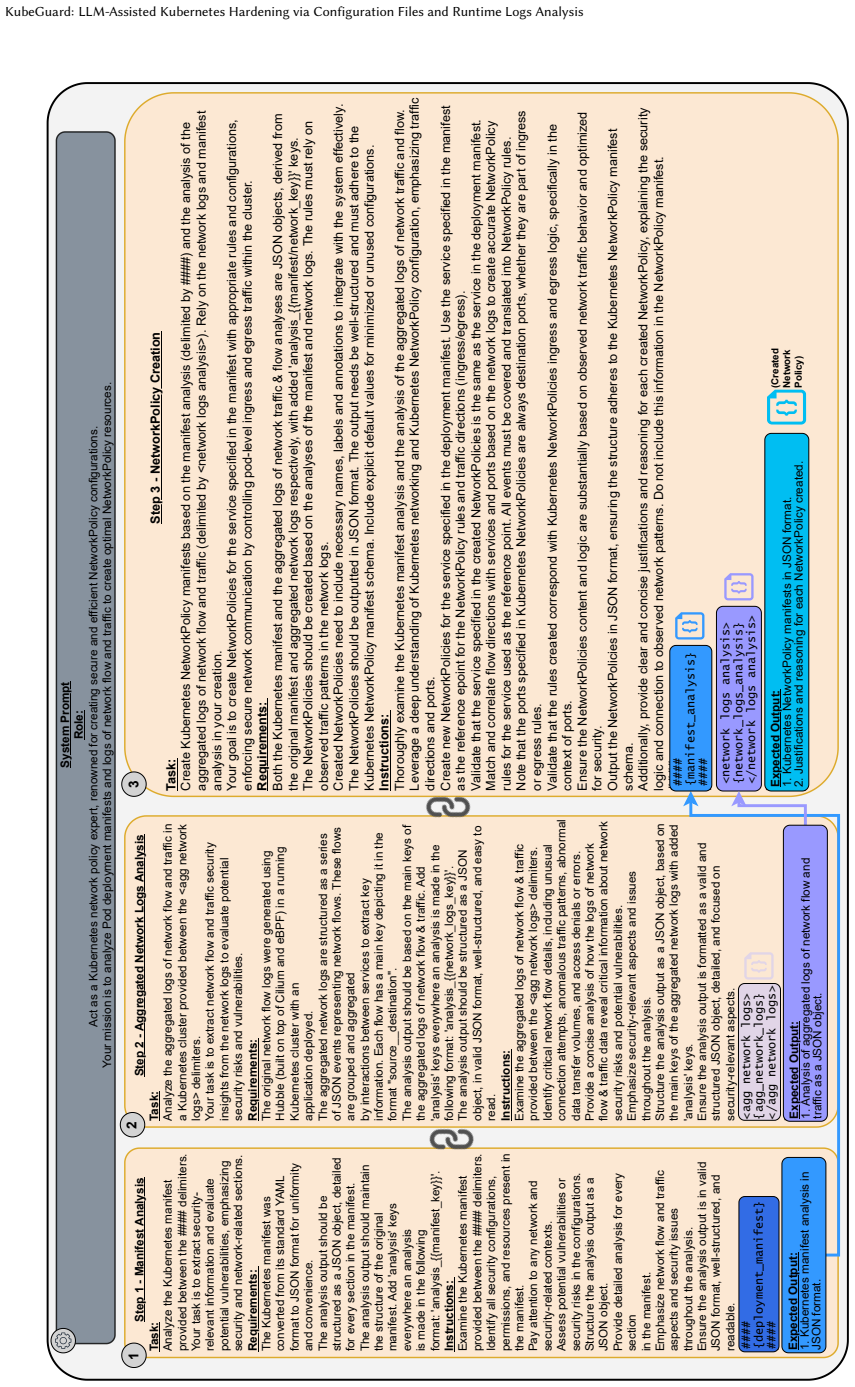
The paper's central claim: multi-source runtime logs, compressed into key-value summaries, carry enough information for an LLM to derive Kubernetes manifests that grant only the permissions, connections, and settings an application actually uses. KubeGuard implements this as Resource Creation (generate Roles or NetworkPolicies from scratch) and Resource Refinement (strip unused verbs, redundant ports, and over-broad rules from existing manifests). The discovery is that prompt chaining — decompose each task into analyze, match, recommend, revise — is what makes this reliable, and that the log-to-manifest matching step is load-bearing: removing it drops refinement F1 across all resources (Netw
What carries the argument
Two mechanisms carry the argument. (1) K-V aggregation: raw audit logs, Hubble network flows, and SPADE provenance records are flattened into key-to-set-of-values maps grouped by microservice, compressing model input tokens by up to 99.96% while preserving the behavioral facts a manifest must encode. (2) Prompt chaining: each task is a fixed sequence of structured prompts — analyze logs, analyze manifest, match logs to manifest, recommend revisions, revise — where each prompt's output becomes the next prompt's input; the matching step is what ties declared permissions to observed activity. Together they turn the least-privilege principle into a concrete, log-derived editing operation on YAML
Load-bearing premise
The framework assumes the logs collected during the observation window include every legitimate operation the application will ever need; any permission or connection absent from those logs is pruned as excessive, even if a rare scheduled job or failover path requires it.
What would settle it
Run KubeGuard on a workload with a documented rare-but-legal operation (e.g., a nightly batch job or a failover endpoint) that is excluded from the traffic fed into the logs; if the hardened Role or NetworkPolicy drops the permission or connection that operation needs and the workload breaks, the completeness assumption fails. A cheaper check: compare KubeGuard's refined manifests against the full documented API surface of a mature application and count pruned permissions that are later exercised in production.
If this is right
- Operators can replace static, rule-based hardening tools with adaptive, behavior-aware configuration: every generated or refined manifest is grounded in the cluster's own audit, network, and provenance records.
- Kubernetes hardening becomes measurable: a refined manifest's residual attack surface is quantified by the permissions and rules left after matching against observed behavior, scored with precision, recall, and F1 against a log-derived baseline.
- Privacy-constrained organizations can run the full workflow offline with an 8-billion-parameter local model (Llama-3.1-8B), accepting a moderate accuracy drop (e.g., Role refinement F1 0.808) in exchange for keeping cluster data on-premises.
- Iterative refinement offers a cheap accuracy boost for weaker models: recursing the NetworkPolicy refinement chain lifts Llama-3.1-8B recall from 0.385 to 0.593 over three iterations, at the cost of oscillation and diminishing returns in later rounds.
- The framework is model-agnostic and resource-agnostic, so the same creation-and-refinement pattern extends to additional Kubernetes resource types beyond Roles, NetworkPolicies, and Deployments.
Where Pith is reading between the lines
- The completeness assumption cuts both ways: KubeGuard prunes what the logs do not show, so any legitimate operation absent from the observation window — nightly batch jobs, failover paths, manual debugging access — will be dropped unless an operator reviews the output; the paper's convergence result (audit logs stabilize after ~1.75 days) suggests collecting at least that long before trusting a Ro
- If KubeGuard is right that aggregated observability is the right input signal, the same aggregation-plus-chaining recipe should transfer to other policy surfaces beyond Kubernetes, such as cloud IAM or service-mesh authorization, where declared configuration can be checked against observed calls.
- A testable extension would be to pair KubeGuard's log-derived baseline with an explicit operator-supplied keep-list of rare-but-legitimate operations, turning the completeness assumption from an unstated gap into a controllable input.
- The near-perfect Role-creation score may reflect how cleanly audit logs encode RBAC actions (each API request names verb, resource, and subject), whereas NetworkPolicy and Deployment refinement must reason from noisier flow and provenance data — so future work should expect harder ceilings for network- and container-level hardening.
Editorial analysis
A structured set of objections, weighed in public.
Referee Report
Summary. KubeGuard is a log-driven Kubernetes hardening framework that aggregates audit logs, Hubble network flows, and SPADE provenance data into key-value summaries and feeds them, together with existing manifests, through modular LLM/SLM prompt chains. It supports two tasks: creating least-privilege Roles and NetworkPolicies from observed behavior, and refining existing Roles, NetworkPolicies, and Deployments. The paper evaluates KubeGuard on two microservice applications, using GPT-4o and several open-source models, and reports precision/recall/F1 against baseline manifests 'derived from real application logs' (Sec. 4.2), with additional ablations, sensitivity analyses, and comparisons to audit2rbac and KUBETEUS. The strongest reported results are perfect F1 for Role Creation and high F1 for the refinement tasks with GPT-4o.
Significance. If the evaluation supported the completeness of the generated policies, KubeGuard would be a valuable practical contribution: it combines multiple runtime data sources, uses a modular prompt-chain design, and demonstrates that local SLMs provide a usable privacy-preserving alternative. The paper includes a substantial set of experiments: prompt-strategy selection, model comparisons, iterative refinement, sensitivity to log duration and prompt order, ablation of matching steps and data sources, and two external baseline comparisons. These are real strengths and go beyond what is typical in this line of work. The main weakness is that the evaluation measures extraction fidelity from the input logs rather than the correctness of the hardening recommendation with respect to the application's true operational requirements. Because the ground truth is derived from the same logs KubeGuard consumes, false negatives are defined only relative to what is present in those logs. This limits the strength of the central claim that KubeGuard preserves functionality while reducing attack surface.
major comments (3)
- [Sec. 5.8.2] The ground-truth baselines are 'derived from real application logs' (Sec. 4.2), and a false negative is defined as a required element 'despite being evidenced in the logs' (Sec. 4.3.1). This makes the evaluation circular with respect to log completeness: if a legitimate Role verb, network flow, or Deployment setting never appears in the collected audit/Hubble/provenance data, it is also absent from the baseline and is never counted as a miss. The reported F1 scores therefore show how well KubeGuard recovers the evidence contained in the logs, not whether the resulting least-privilege manifest is complete for the application. This is a load-bearing gap for the paper's 'maintaining application functionality' claim. I ask the authors to provide a concrete test of completeness, for example by (a) constructing ground-truth policies from application semantics or documentation that include oper
- [Sec. 5.8.2] The convergence analysis uses Cosine, Overlap, and Dice similarity between successive cumulative aggregated-log segments (Fig. 8). This establishes that the token sets stabilize over time, but it does not establish that the stabilized set is complete relative to the application's true permission/network requirements. A stable set can still omit a rare but legitimate scheduled job, a failover path, or an administrative action. The paper's own limitation section (Sec. 6) correctly notes that 'capturing sufficient log data requires representative traffic,' and the convergence argument does not close that gap. I suggest adding an evaluation that varies the length of the log-collection window and measures the effect on the generated policy's recall against a ground truth that includes operations outside the observed window, or, at minimum, an analysis of which rare tokens are absent from the
- [Table 3, Role Creation row] The perfect F1 of 1.00 for Role Creation is suspicious given the baseline construction. If the baseline Roles are a rule-based extraction of verbs/resources from the AALs, and KubeGuard's prompt chain is designed to translate AALs into Roles, then perfect agreement may reflect deterministic information transfer rather than the model learning to generalize to unseen permission requirements. The same concern applies to the high refinement scores, which may be inflated because the baseline contains only elements already present in the logs. Please clarify how the baselines were constructed (human review, rule-based extraction, or a combination), and report at least one metric that is defined against an independent source of required permissions/connections, not against the logs themselves.
minor comments (5)
- [Sec. 5.8.2] The text refers to 'similarity metrics (Sec. 5.9.1)', but the Cosine, Overlap, and Dice metrics are defined in Sec. 4.3.2. The cross-reference should be corrected.
- [Sec. 5.3, Table 4] The text says Qwen2.5-7B's precision was 0.722, while Table 4 reports 0.772±0.122. One of these is a typo; please correct it.
- [Sec. 5.5, Fig. 7] Figure 7 shows iterative refinement results without the standard-deviation bars that accompany the other tables. Since the earlier tables report ± values, adding the same confidence information to the figure would help the reader judge the stability of the oscillation claim.
- [Sec. 5.2 and Sec. 5.10] The paper repeatedly mentions 'postprocessing' as a mitigation for recall drops and underspecified rules, but never describes what postprocessing is or whether the reported numbers include it. Please clarify, since this is a free parameter in the evaluation. The axiom ledger in the review identifies postprocessing as a free parameter; the manuscript should state exactly how and when it was applied.
- [Sec. 3.2.2, NetworkPolicy Refinement step 4] The chain has both step 4 and step '4.A' (validation of log-to-policy matches), but the text does not explain what the validation consists of or how it differs from the matching step. A brief description or a pointer to Figure 13/14 would make the workflow easier to follow.
Circularity Check
Evaluation baselines are derived from the same runtime logs KubeGuard consumes, so reported F1 measures agreement with the input rather than external correctness; log completeness is assumed but untested.
specific steps
-
self definitional
[Section 4.2 (Task-Specific Evaluation) and Section 4.3.1 (Task Effectiveness metrics)]
"KubeGuard's tasks were evaluated through log-based assessments by comparing their output manifests with least-privilege baseline policies, derived from real application logs. ... False Negative (FN): A required permission or rule that is missing from the hardened output, either because it was not created or not refined by the framework, despite being evidenced in the logs."
The 'least-privilege baseline policies' are derived from the same aggregated audit, network, and provenance logs that KubeGuard consumes as input (Sec. 3.1). A false negative is defined only as a missing element 'despite being evidenced in the logs.' Therefore, any legitimate permission, network flow, or deployment configuration that is absent from the collected logs is also absent from the baseline and is never counted as a miss. The F1 scores (e.g., 1.00 Role Creation) thus measure how well the LLM reproduces a log-derived target, not whether the output is complete or correct relative to the application's true requirements. The paper acknowledges in Sec. 6 that 'capturing sufficient log data requires representative traffic,' and Sec. 5.8.2's convergence analysis only shows token-set simi
full rationale
KubeGuard's derivation chain is a log-to-manifest translation pipeline: aggregated logs (AALs/ANLs/APLs) are fed into prompt chains that produce or refine manifests. The method itself is not circular; it is an LLM-based transformation of log evidence. The circularity lies in the evaluation: the ground-truth 'least-privilege baseline policies' are built from the same logs that constitute the system's input, and the metric definitions (TP/FP/FN/TN) are all anchored to 'observed behavior' in those logs. This design validates that KubeGuard can reconstruct the log-derived baseline, but it cannot detect omissions of legitimate operations that never appear in the collected logs, such as rare scheduled jobs or failover paths. The paper explicitly acknowledges the representative-traffic limitation in Sec. 6, which is honest but does not remove the self-referential nature of the reported F1 scores. Convergence analysis in Sec. 5.8.2 shows only that aggregated token sets stabilize over time, not that the stabilized set equals the true set of required permissions/connections. There is no load-bearing self-citation: the related work cites GenKubeSec [58] by overlapping authors, but that citation is contextual and not used to justify KubeGuard's design or evaluation. External comparisons to audit2rbac and KUBETEUS are also measured against the same log-derived baselines, so they inherit the same limitation. Overall, the framework has substantial independent content (multi-source log integration, prompt-chain design, model comparisons), but the central quantitative claim of least-privilege correctness is partially circular because the evaluation target is derived from the system's own input.
Axiom & Free-Parameter Ledger
free parameters (5)
- Prompt chain order =
Logs-to-Manifest
- Matching step presence =
Included
- Data explanations =
Per-task toggle
- Iterative refinement rounds =
5 iterations
- Postprocessing =
Unspecified but recommended
axioms (4)
- domain assumption Metadata-level audit logs capture all API actions relevant for RBAC inference
- domain assumption K-V aggregation preserves all security-relevant information from raw logs
- domain assumption The log-derived least-privilege baselines are the correct ground truth
- domain assumption Load-generator traffic is representative of real production usage
Cite this review
Pith. "Pith review of KubeGuard: LLM-Assisted Kubernetes Hardening via Configuration Files and Runtime Logs Analysis." pith.science (2026). https://pith.science/paper/F6DZLDOJ
@misc{pith2026250904191,
  author       = {Pith},
  title        = {Pith review of: KubeGuard: LLM-Assisted Kubernetes Hardening via Configuration Files and Runtime Logs Analysis},
  year         = {2026},
  howpublished = {\url{https://pith.science/paper/F6DZLDOJ}},
  note         = {Machine review of arXiv:2509.04191}
}
read the original abstract
The widespread adoption of Kubernetes (K8s) for orchestrating cloud-native applications has introduced significant security challenges, such as misconfigured resources and overly permissive configurations. Failing to address these issues can result in unauthorized access, privilege escalation, and lateral movement within clusters. Most existing K8s security solutions focus on detecting misconfigurations, typically through static analysis or anomaly detection. In contrast, this paper presents KubeGuard, a novel runtime log-driven recommender framework aimed at mitigating risks by addressing overly permissive configurations. KubeGuard is designed to harden K8s environments through two complementary tasks: Resource Creation and Resource Refinement. It leverages large language models (LLMs) to analyze manifests and runtime logs reflecting actual system behavior, using modular prompt-chaining workflows. This approach enables KubeGuard to create least-privilege configurations for new resources and refine existing manifests to reduce the attack surface. KubeGuard's output manifests are presented as recommendations that users (e.g., developers and operators) can review and adopt to enhance cluster security. Our evaluation demonstrates that KubeGuard effectively generates and refines K8s manifests for Roles, NetworkPolicies, and Deployments, leveraging both proprietary and open-source LLMs. The high precision, recall, and F1-scores affirm KubeGuard's practicality as a framework that translates runtime observability into actionable, least-privilege configuration guidance.
Figures



Forward citations
Cited by 1 Pith paper
-
Does Runtime Topology Context Improve LLM-Generated Kubernetes Security Patches?
Providing LLMs with live cluster topology and service-account context raised correct Kubernetes security patches from 11.1% to 78.0% on topology-dependent findings, with no change on a topology-independent control.
Reference graph
Works this paper leans on
-
[1]
Mashal Abbas, Shahpar Khan, Abdul Monum, Fareed Zaffar, Rashid Tahir, David Eyers, Hassaan Irshad, Ashish Gehani, Vinod Yegneswaran, and Thomas Pasquier. 2022. PACED: provenance-based automated container escape detec- tion. In 2022 IEEE International Conference on Cloud Engineering (IC2E) . IEEE, 261–272
2022
-
[2]
Josh Achiam, Steven Adler, Sandhini Agarwal, Lama Ahmad, Ilge Akkaya, Flo- rencia Leoni Aleman, Diogo Almeida, Janko Altenschmidt, Sam Altman, Shya- mal Anadkat, et al. 2023. Gpt-4 technical report. arXiv preprint arXiv:2303.08774 (2023)
Pith/arXiv arXiv 2023
-
[3]
Muntaha Alawneh and Imad M Abbadi. 2022. Expanding DevSecOps prac- tices and clarifying the concepts within kubernetes ecosystem. In 2022 Ninth International Conference on Software Defined Systems (SDS) . IEEE, 1–7
2022
-
[4]
Sponsored by Red Hat Ansible. 2025. Ansible Community Documentation - Ansible offers open-source automation that is simple, flexible, and powerful. KubeGuard: LLM-Assisted Kubernetes Hardening via Configuration Files and Runtime Logs Analysis https://docs.ansible.com/
2025
-
[5]
Anthropic. 2024. Chain Prompts. https://docs.anthropic.com/en/docs/build- with-claude/prompt-engineering/chain-prompts Accessed: 2025-04-14
2024
-
[6]
Anthropic. 2024. Claude 3. https://www.anthropic.com/news/claude-3-family
2024
-
[7]
AppArmor. [n. d.]. AppArmor: Linux kernel security module. https://apparmor. net/
-
[8]
Aqua Security. 2024. kube-hunter: an Open Source Tool for Discovering Security Issues in Kubernetes Clusters. https://github.com/aquasecurity/kube-hunter
2024
-
[9]
Ashish Gehani (ashish gehani). [n. d.]. SPADE. https://github.com/ashish- gehani/SPADE
-
[10]
hassaanirshad ashish gehani. [n. d.]. SPADE: Configuring namespace report- ing. https://github.com/ashish-gehani/SPADE/wiki/Collecting-system-wide- provenance-on-Linux-with-Audit#configuring-namespace-reporting
-
[11]
hassaanirshad ashish-gehani (Ashish Gehani). 2024. SPADE Audit Provenance: Data Model and Schema. https://github.com/ashish-gehani/SPADE/wiki/Audit- provenance
2024
-
[12]
Azure-Samples. 2024. AKS Store Demo. https://github.com/Azure-Samples/aks- store-demo
2024
-
[13]
Daniele Bringhenti, Riccardo Sisto, and Fulvio Valenza. 2023. Security automa- tion for multi-cluster orchestration in Kubernetes. In2023 IEEE 9th International Conference on Network Softwarization (NetSoft) . IEEE, 480–485
2023
-
[14]
Clinton Cao, Agathe Blaise, Sicco Verwer, and Filippo Rebecchi. 2022. Learning state machines to monitor and detect anomalies on a kubernetes cluster. In Proceedings of the 17th International Conference on A vailability, Reliability and Security. 1–9
2022
-
[15]
Carmine Cesarano and Roberto Natella. 2025. KubeFence: Security Hardening of the Kubernetes Attack Surface. arXiv:2504.11126 [cs.CR] https://arxiv.org/ abs/2504.11126
work page internal anchor Pith review Pith/arXiv arXiv 2025
-
[16]
Checmarx. 2021. KICS: keeping infrastructure as code secure is an open source solution for static code analysis of Infrastructure as Code. https://kics.io/index. html
2021
-
[17]
Xutong Chen, Hassaan Irshad, Yan Chen, Ashish Gehani, and Vinod Yeg- neswaran. 2021. CLARION: Sound and clear provenance tracking for microser- vice deployments. In 30th USENIX Security Symposium (USENIX Security 21) . 3989–4006
2021
-
[18]
Cilium. 2024. Hubble. https://github.com/cilium/hubble
2024
-
[19]
Cilium. 2025. Inspecting the Cluster’s Network Traffic with Hubble Relay. https://docs.cilium.io/en/stable/observability/hubble/hubble-cli/ #inspecting-the-cluster-s-network-traffic-with-hubble-relay
2025
-
[20]
Henry Clausen, Robert Flood, and David Aspinall. 2019. Traffic generation using containerization for machine learning. In Proceedings of the 2019 Workshop on DYnamic and Novel Advances in Machine Learning and Intelligent Cyber Security . 1–12
2019
-
[21]
Prisma Cloud. 2019. Checkov: Policy-as-code for everyone. https://www. checkov.io/
2019
-
[22]
DeepSeek-AI. 2024. DeepSeek-V3 Technical Report. arXiv:2412.19437 [cs.CL] https://arxiv.org/abs/2412.19437
Pith/arXiv arXiv 2024
-
[23]
Alaeddine Diaf, Abdelaziz Amara Korba, Nour Elislem Karabadji, and Yacine Ghamri-Doudane. 2024. BARTPredict: Empowering IoT Security with LLM- Driven Cyber Threat Prediction. In GLOBECOM 2024-2024 IEEE Global Commu- nications Conference. IEEE, 1239–1244
2024
-
[24]
Boubacar Diarra, Karine Guillouard, Meryem Ouzzif, Philippe Merle, and Jean- Bernard Stefani. 2024. In-depth analysis of Kubernetes manifest verification tools for robust CNF deployment. In 2024 27th Conference on Innovation in Clouds, Internet and Networks (ICIN) . IEEE, 17–24
2024
-
[25]
Ashish Gehani and Dawood Tariq. 2012. SPADE: Support for provenance audit- ing in distributed environments. In ACM/IFIP/USENIX International Conference on Distributed Systems Platforms and Open Distributed Processing . Springer, 101–120
2012
-
[26]
Aaron Grattafiori, Abhimanyu Dubey, Abhinav Jauhri, Abhinav Pandey, Ab- hishek Kadian, Ahmad Al-Dahle, Aiesha Letman, Akhil Mathur, Alan Schel- ten, Alex Vaughan, et al . 2024. The llama 3 herd of models. arXiv preprint arXiv:2407.21783 (2024)
Pith/arXiv arXiv 2024
-
[27]
Daya Guo, Qihao Zhu, Dejian Yang, Zhenda Xie, Kai Dong, Wentao Zhang, Guanting Chen, Xiao Bi, Y. Wu, Y. K. Li, Fuli Luo, Yingfei Xiong, and Wen- feng Liang. 2024. DeepSeek-Coder: When the Large Language Model Meets Programming – The Rise of Code Intelligence. arXiv:2401.14196 [cs.SE] https://arxiv.org/abs/2401.14196
Pith/arXiv arXiv 2024
-
[28]
Mubin Ul Haque, M Mehdi Kholoosi, and M Ali Babar. 2022. Kgsecconfig: a knowledge graph based approach for secured container orchestrator configura- tion. In 2022 IEEE International Conference on Software Analysis, Evolution and Reengineering (SANER). IEEE, 420–431
2022
-
[29]
Wajih Ul Hassan, Lemay Aguse, Nuraini Aguse, Adam Bates, and Thomas Moyer
-
[30]
Jonatan Heyman, Carl Byström, Joakim Hamrén, Hugo Heyman, and contribu- tors. 2025. Locust: An open source load testing tool. https://locust.io/
2025
-
[31]
Ben Hirschberg. 2022. Kubescape: A Kubernetes Open-Source Plat- form Providing a Multi-Cloud Kubernetes Single Pane of Glass. https://www.armosec.io/blog/kubescape-the-first-tool-for-runningnsa- and-cisa-kubernetes-hardening-tests/
2022
-
[32]
Lei Huang, Weijiang Yu, Weitao Ma, Weihong Zhong, Zhangyin Feng, Haotian Wang, Qianglong Chen, Weihua Peng, Xiaocheng Feng, Bing Qin, et al. 2025. A survey on hallucination in large language models: Principles, taxonomy, challenges, and open questions. ACM Transactions on Information Systems 43, 2 (2025), 1–55
2025
-
[33]
Sandeep Kampa. 2024. Navigating the Landscape of Kubernetes Security Threats and Challenges. Journal of Knowledge Learning and Science Technology ISSN: 2959-6386 (online) 3, 4 (2024), 274–281
2024
-
[34]
Ahmad Faraz Khan, Azal Ahmad Khan, Anas Mohamed, Haider Ali, Suchithra Moolinti, Sabaat Haroon, Usman Tahir, Mattia Fazzini, Ali R Butt, and Ali Anwar. 2025. LADs: Leveraging LLMs for AI-Driven DevOps. arXiv preprint arXiv:2502.20825 (2025)
Pith/arXiv arXiv 2025
-
[35]
Hareem Kibriya, Wazir Zada Khan, Ayesha Siddiqa, and Muhammad Khurram Khan. 2024. Privacy issues in large language models: a survey. Computers and Electrical Engineering 120 (2024), 109698
2024
-
[36]
Bom Kim, Hyeonjun Park, and Seungsoo Lee. 2025. KUBETEUS: An Intelli- gent Network Policy Generation Framework for Containers. Cybersecurity Convergence Laboratory (CCLAB) at Incheon National University (2025)
2025
-
[37]
Hirokuni Kitahara, Kugamoorthy Gajananan, and Yuji Watanabe. 2020. Highly- scalable container integrity monitoring for large-scale kubernetes cluster. In 2020 IEEE International Conference on Big Data (Big Data) . IEEE, 449–454
2020
-
[38]
Danila Koryugin. 2023. Analysing and alerting on application logs within Kuber- netes infrastructure. B.S. thesis. University of Twente
2023
-
[39]
Nane Kratzke and André Drews. 2024. Don’t Train, Just Prompt: Towards a Prompt Engineering Approach for a More Generative Container Orchestration Management.. In CLOSER. 248–256
2024
-
[40]
Kubernetes. 2024. Auditing. https://kubernetes.io/docs/tasks/debug/debug- cluster/audit/
2024
-
[41]
Kubernetes. 2024. Describing a Kubernetes Object. https://kubernetes.io/docs/ concepts/overview/working-with-objects/#describing-a-kubernetes-object
2024
-
[42]
Kubernetes. 2024. Kubernetes - Operator Pattern. https://kubernetes.io/docs/ concepts/extend-kubernetes/operator/
2024
-
[43]
Kubernetes. 2024. Kubernetes Documentation / Concepts / Overview. https: //kubernetes.io/docs/concepts/overview/
2024
-
[44]
Kubernetes. 2024. Kubernetes Documentation / Concepts / Security / Service Accounts. https://kubernetes.io/docs/concepts/security/service-accounts/
2024
-
[45]
Kubernetes. 2024. Kubernetes Documentation / Concepts Configuration / ConfigMaps. https://kubernetes.io/docs/concepts/configuration/configmap/
2024
-
[46]
Kubernetes. 2024. Network Policies - Kubernetes. https://kubernetes.io/docs/ concepts/services-networking/network-policies/
2024
-
[47]
Kubernetes. 2025. Auditing – Audit policy (minimal audit policy file to log all requests at the Metadata level). https://kubernetes.io/docs/tasks/debug/debug- cluster/audit/
2025
-
[48]
Kubernetes. 2025. Kubernetes Deployment. https://kubernetes.io/docs/ concepts/workloads/controllers/deployment/
2025
-
[49]
Kubernetes. 2025. Kubernetes Documentation / Concepts / Storage / Persistent Volumes. https://kubernetes.io/docs/concepts/storage/persistent-volumes/
2025
-
[50]
Kubernetes. 2025. Kubernetes Documentation / Reference / API Access Control / Using RBAC Authorization - Kubernetes Role. https://kubernetes.io/docs/ reference/access-authn-authz/rbac/
2025
-
[51]
Patrick Lewis, Ethan Perez, Aleksandra Piktus, Fabio Petroni, Vladimir Karpukhin, Naman Goyal, Heinrich Küttler, Mike Lewis, Wen-tau Yih, Tim Rock- täschel, et al. 2020. Retrieval-augmented generation for knowledge-intensive nlp tasks. Advances in neural information processing systems 33 (2020), 9459– 9474
2020
-
[52]
Haoran Li, Jun Sun, and Xiong Ke. 2024. AI-driven optimization system for large-scale Kubernetes clusters: Enhancing cloud infrastructure availability, security, and disaster recovery. Journal of Artificial Intelligence General science (JAIGS) ISSN: 3006-4023 2, 1 (2024), 281–306
2024
-
[53]
Xing Li, Yan Chen, Zhiqiang Lin, Xiao Wang, and Jim Hao Chen. 2021. Automatic policy generation for{Inter-Service} access control of microservices. In 30th USENIX Security Symposium (USENIX Security 21) . 3971–3988
2021
-
[54]
Z Li, S Dutta, and M Naik. 2024. LLM-Assisted Static Analysis for Detecting Security Vulnerabilities. arXiv 2024. arXiv preprint arXiv:2405.17238 (2024)
Pith/arXiv arXiv 2024
-
[55]
Jordan Liggitt. 2023. audit2rbac: Autogenerate RBAC policies based on Kuber- netes audit logs. https://github.com/liggitt/audit2rbac
2023
-
[56]
Aman Madaan, Niket Tandon, Prakhar Gupta, Skyler Hallinan, Luyu Gao, Sarah Wiegreffe, Uri Alon, Nouha Dziri, Shrimai Prabhumoye, Yiming Yang, et al
-
[57]
Vijay B Mahajan and Sunil B Mane. 2022. Detection, analysis and counter- measures for container based misconfiguration using docker and kubernetes. In 2022 International Conference on Computing, Communication, Security and Intelligent Systems (IC3SIS). IEEE, 1–6. Omri Sgan Cohen, Ehud Malul, Yair Meidan, Dudu Mimran, Yuval Elovici, Asaf Shabtai
2022
-
[58]
Ehud Malul, Yair Meidan, Dudu Mimran, Yuval Elovici, and Asaf Shabtai. 2024. GenKubeSec: LLM-Based Kubernetes Misconfiguration Detection, Localization, Reasoning, and Remediation. arXiv preprint arXiv:2405.19954 (2024)
Pith/arXiv arXiv 2024
-
[59]
Meta AI. 2024. Llama-3.1-70B-Instruct. https://huggingface.co/meta-llama/ Llama-3.1-70B-Instruct
work page 2024
-
[60]
Michael Kerrisk. 2025. namespaces(7) — Linux manual page . man7.org. https: //man7.org/linux/man-pages/man7/namespaces.7.html
work page 2025
-
[61]
mistralai. 2024. ministral. https://mistral.ai/news/ministraux
work page 2024
-
[62]
MongoDB. 2025. MongoDB: The World’s Leading Modern Database. https: //www.mongodb.com/
work page 2025
-
[63]
Luc Moreau, Ben Clifford, Juliana Freire, Joe Futrelle, Yolanda Gil, Paul Groth, Natalia Kwasnikowska, Simon Miles, Paolo Missier, Jim Myers, et al. 2011. The open provenance model core specification (v1. 1). Future generation computer systems 27, 6 (2011), 743–756
work page 2011
-
[64]
Ioannis Morfonios. 2023. Kubernetes cybersecurity . Master’s thesis. Π𝛼𝜈𝜀𝜋𝜄𝜎𝜏 ´𝜂𝜇𝜄 o Π𝜀𝜄𝜌𝛼𝜄 ´𝜔𝜍
work page 2023
-
[65]
ANIRUDH MUSTYALA. 2022. Comprehensive Monitoring and Logging in Kubernetes: Best Practices and Tools. EPH-International Journal of Science And Engineering 8, 4 (2022), 05–14
work page 2022
-
[66]
Andrzej Mycek and Maryna Łukaczyk. 2024. SECURITY OF CONTAINER- IZATION PLATFORMS: THREAT MODELLING, VULNERABILITY ANALYSIS, AND RISK MITIGATION. ECMS - The European Council for Modelling and Simulation (2024)
work page 2024
-
[67]
NP-Guard. [n. d.]. NP-Guard: Shift-left Automation for Generating and Main- taining Kubernetes Network Policies. https://np-guard.github.io/
-
[68]
NVIDIA. 2024. rtx6000. https://www.nvidia.com/en-us/design-visualization/ rtx-6000/
work page 2024
-
[69]
OpenAI. 2024. GPT-4o System Card. https://openai.com/index/gpt-4o-system- card/
work page 2024
-
[70]
Sundar Pichai and Demis Hassabis. 2023. Introducing Gemini: our largest and most capable AI model. Google. Retrieved December 8 (2023), 2023
work page 2023
-
[71]
Google Cloud Platform. 2025. Load Generator for microservices-demo (Online Boutique). https://github.com/GoogleCloudPlatform/microservices-demo/tree/ main/src/loadgenerator. Part of the microservices-demo repository
work page 2025
-
[72]
Google Cloud Platform. 2025. Online Boutique: Microservices Demo Applica- tion. https://github.com/GoogleCloudPlatform/microservices-demo
work page 2025
-
[73]
Mike Prechtl, Robin Lichtenthäler, and Guido Wirtz. 2020. Investigating possi- bilites for protecting and hardening installable faas platforms. In Symposium and Summer School on Service-oriented Computing . Springer, 107–126
work page 2020
-
[74]
Cilium Project. 2025. Special Identities — Cilium Documentation. https://docs. cilium.io/en/latest/gettingstarted/terminology/#special-identities
work page 2025
-
[75]
RabbitMQ. 2025. RabbitMQ: One broker to queue them all. https://www. rabbitmq.com/
work page 2025
-
[76]
Akond Rahman, Shazibul Islam Shamim, Dibyendu Brinto Bose, and Rahul Pandita. 2023. Security misconfigurations in open source kubernetes manifests: An empirical study. ACM Transactions on Software Engineering and Methodology 32, 4 (2023), 1–36
work page 2023
-
[77]
Monika Rangta. 2022. Tools for Security Auditing and Hardening in Microservices Architecture. Master’s thesis. Aalto University
work page 2022
-
[78]
Zhengping Ruan. 2021. Network security prediction method based on ku- bernetes. In Journal of Physics: Conference Series , Vol. 2010. IOP Publishing, 012109
work page 2021
-
[79]
Eoghan Russell and Kapal Dev. 2024. Centralized Defense: Logging and Mitiga- tion of Kubernetes Misconfigurations with Open Source Tools. arXiv preprint arXiv:2408.03714 (2024)
work page internal anchor Pith review Pith/arXiv arXiv 2024
-
[80]
Areeg Samir and Håvard Dagenborg. 2023. Adaptive Controller to Identify Mis- configurations and Optimize the Performance of Kubernetes Clusters and IoT Edge Devices. In European Conference on Service-Oriented and Cloud Computing . Springer, 170–187
work page 2023
This paper was first reviewed by deepseek-v4-flash on August 5, 2026.
discussion (0)
Sign in with ORCID, Apple, or X to comment. Anyone can read and Pith papers without signing in.